

Introduction
Democratic backslidingFootnote 1 has attracted intensive scholarly attention in the past several decades.Footnote 2 We now know that the subversion of democracy by chief executives represents the predominant mode of backsliding (Bermeo Reference Bermeo2016; Svolik Reference Svolik2020). A central puzzle about this phenomenon is that these executives obtain massive support. Accordingly, we must ask, in the words of Milan Svolik (Reference Svolik2020, 5), “Why do voters who routinely profess pro-democratic values simultaneously support incumbents intent on subverting democracy?” Donald Trump of the United States, Viktor Orban of Hungary, Narendra Modi of India, Jair Bolsonaro of Brazil, and Recep Erdoğan of Turkey are some manifestations of this puzzle.
Philippine's President Rodrigo Duterte joins the list of incumbents who assaulted democracy yet remain popular. Upon being elected in 2016, Duterte mounted attacks on democratic norms and institutions and killed thousands of suspected drug users without due process (Rafael Reference Rafael2021). Despite local and international criticism, he remained very popular among Filipino voters, maintaining between about 60 percent and 90 percent approval according to most surveys. Scholars have provided a handful of ways to make sense of this, attributing his popularity to his personality (Arguelles Reference Arguelles2019; Jennings Reference Jennings2019; Kenny and Holmes Reference Kenny and Holmes2020), his moral appeal (Kusaka Reference Kusaka2017a; Warburg and Jensen Reference Warburg and Jensen2020a), his populist style (Curato Reference Curato2016; Dulay, Hicken, and Holmes Reference Dulay, Hicken and Holmes2022), his policies (Kenny and Holmes Reference Kenny and Holmes2020), and historical conjunctures (Arugay and Slater Reference Arugay and Slater2019; Garrido Reference Garrido2022; Teehankee Reference Teehankee and Curato2017; Thompson Reference Thompson2018). These analyses provide significant insights into the ascent of Duterte and the broader dynamics of Philippine politics.
As a complementary contribution to the existing scholarship, we offer an alternative perspective that delves into Duterte's popularity by examining the phenomenon of preference falsification—specifically, the act of adjusting one's behavior to appear socially acceptable. We have focused on social desirability bias (SDB), a particular form of preference falsification. Nearly conceptually synonymous with preference falsification, SDB is a term commonly used in the survey research literature. It refers to the behavior of giving an untruthful but socially acceptable or desirable answer. Although the suspicion that Duterte's popularity rating may be inflated due to SDB has been discussed by some analysts (David Reference David2020; Elemia Reference Elemia2020; Santos Reference Santos2020; Teodoro Reference Teodoro2020), we are unaware of any study that has empirically tested it.
To fill this gap, we employed the list experiment method, a survey method devised to explore socially sensitive questions. We conducted face-to-face and online surveys simultaneously from late February to early March 2021, which was a period of national lockdown and high unemployment rates induced by the COVID-19 pandemic. Our main finding was that Duterte's strikingly high approval rating was significantly inflated around that time, with more than one in three respondents who answered they support Duterte in both survey modes pretending to support the president. Specifically, we found that the magnitude of SDB was 39.5 percentage points for face-to-face survey and 28.3 percentage points for online survey. Further, three types of respondents were more likely to pretend to support the president: the socioeconomically vulnerable, Mindanaoans, and those who perceived or believed that the president was popular among their neighbors.
Our results may appear counter-intuitive to some, due to the high magnitude of SDB we observed. It is important to underscore our commitment to transparency through the pre-registration of our research design and including a battery of sensitivity analyses, as detailed in the Online Appendix. Furthermore, it is crucial to note that our investigation pertains to a specific timeframe (February–March 2021), and therefore caution should be exercised when generalizing our findings to other periods of Duterte's presidency. Keeping these considerations in mind, we maintain that our results are reliable to the best of our knowledge.
This study contributes to multiple strands of scholarship. First, regarding the comparative study of democratic backsliding, our study suggests an alternative explanation for the puzzle of popular backsliding incumbents. Recent studies have argued that political polarization (Graham and Svolik Reference Graham and Svolik2020; Svolik Reference Svolik2020) and a majoritarian preference among voters (Grossman et al. Reference Grossman, Kronick, Levendusky and Meredith2021) are the major ways to understand this puzzle. While further investigation is required to examine the applicability of theories within the Philippine context, our study introduces an additional factor for consideration: the presence of voters who engage in preference falsification regarding their opinions on regime support, who we call “pretenders.” Traditionally, preference falsification was a major concern in repressive authoritarian regimes (e.g., Kuran Reference Kuran1995; Wedeen Reference Wedeen1999). Our study demonstrates that it is also a concern in the context of democratic backsliding. The existence of pretenders is non-trivial because a backsliding incumbent's source of legitimacy is popular support. Accordingly, an inflated approval undermines public opinion to function as a check on the executive. This can send the incumbent an unwarranted signal that they can continue attacking democracy. As such, pretenders play a consequential role in backsliding democracies. Furthermore, our study expands the political context suitable for studying sensitivity bias to countries experiencing democratic backsliding, in addition to the authoritarian contexts suggested by Blair, Coppock and Moor (Reference Blair, Coppock and Moor2020).
Second, this study provides insights into the democratic backsliding of the Philippines during the Duterte era. Our findings empirically confirm the suspicion held by some observers that his popularity was inflated, especially toward the latter part of his presidency (David Reference David2020; Elemia Reference Elemia2020; Santos Reference Santos2020; Teodoro Reference Teodoro2020). Adding the element of preference falsification tempers our understanding of the Duterte administration. We discuss this point in this article's conclusion.
Third and related to the second point, this study engages with the studies investigating Duterte's popularity. As discussed earlier, numerous arguments have been put forth to comprehend why he is so popular, with a notable commonality that most such studies accepted his popularity as a given, or unquestioned the reliability of opinion poll results. Conversely, this study challenges the premise that he is genuinely popular. Our findings encourage scholars critically assess such underlying assumptions in analyzing the executive approval in the case of Duterte and possibly beyond.
Fourth, this study adds to the nascent but rapidly expanding body of studies that utilize survey methods to study politics in developing countries (Lupu and Michelitch Reference Lupu and Michelitch2018). Our article joins the studies that use list experiments to understand the existence of SDB in opinion surveys about political leaders in developing countries. To the best of our knowledge, our paper is the first to implement a list experiment among Filipino respondents to study socio-politically motivated SDB.
The puzzle of popular backsliding incumbents
Duterte's popularity as an unresolved puzzle
A puzzling aspect of recent incumbent-led backsliding is that these executives obtain significant support despite attacking democratic norms and institutions. Svolik (Reference Svolik2020, 5) notes that it is often confusing that voters would elect such leaders and, “even more perplexingly, many undemocratic incumbents, including the examples of Chavez, Putin, and Erdoğan, enjoy significant and genuine popular support.” Luo and Przeworski (Reference Luo and Przeworski2019, 3) and Przeworski (Reference Przeworski2019, 187) raise similar concerns.
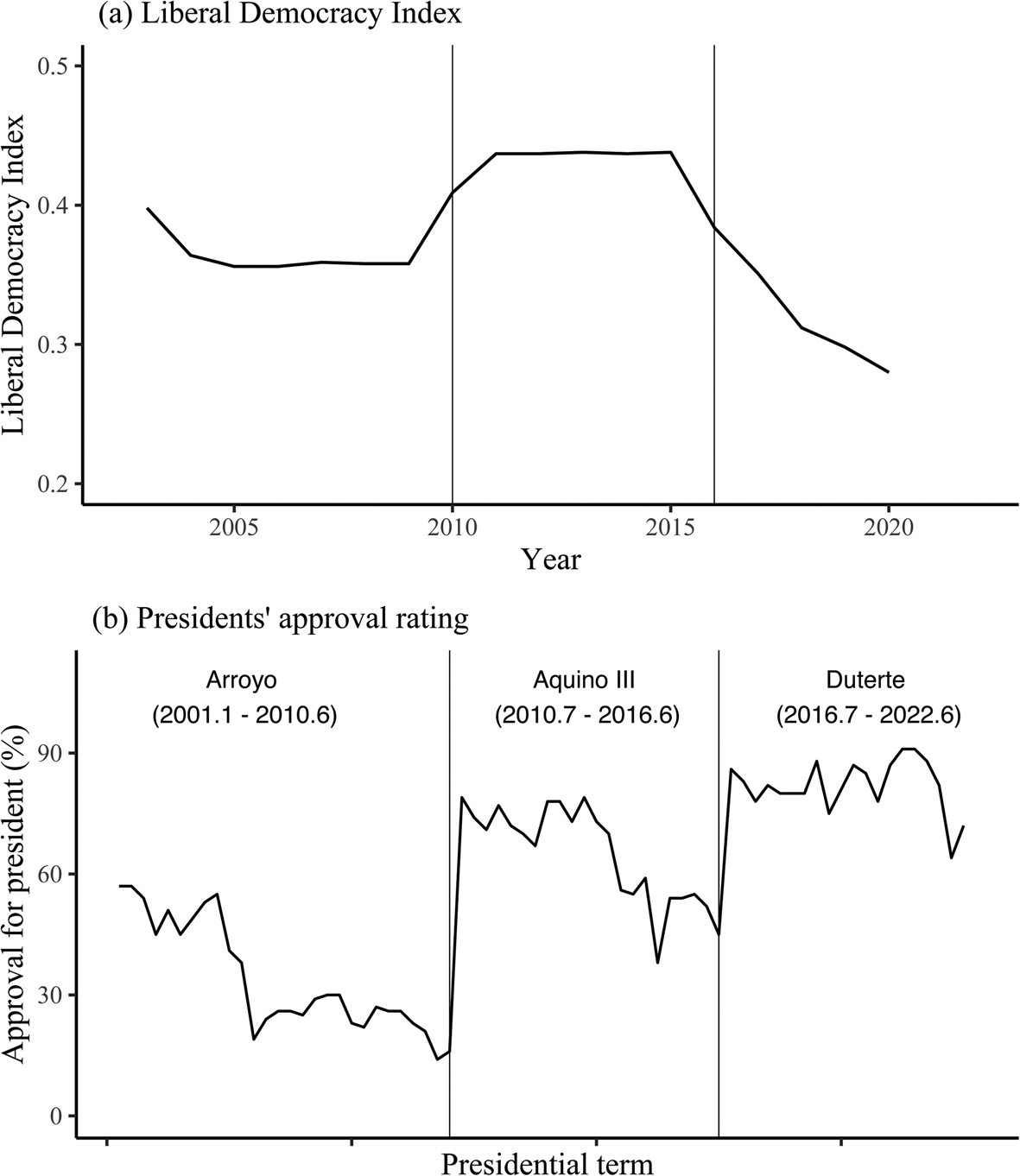
President Duterte is one case of a popular backsliding incumbent. Figure 1 compares the Liberal Democracy Index (LDI) of the V-Dem Project—a composite indicator of how a country achieves ideals of liberal democracy (Coppedge et al. Reference Coppedge, Gerring, Knutsen, Lindberg, Teorell, Altman, Bernhard, Cornell, Fish and Gastaldi2021)—and the survey-based presidential approval rating provided by the local polling company Pulse Asia. As Figure 1(a) shows, on the one hand, democracy backslid under Duterte's presidency. Upon being elected in 2016, he attacked democratic institutions, including the legislature, courts, civil society groups, and the media. In the context of his “war on illegal drugs” campaign, thousands of people accused of selling drugs were killed without due legal process (Johnson and Fernquest Reference Johnson and Fernquest2018). On the other hand, Figure 1(b) shows that he remained very popular. Duterte's approval rating remained between 60 percent and 90 percent throughout his term. Moreover, unlike his predecessors Arroyo and Aquino III, whose popularity sharply declined during their final years, he maintained a high approval rating until the end of his term.
Duterte's Popularity amid Democratic Backsliding.
Source: 1(a) from Coppedge et al. Reference Coppedge, Gerring, Knutsen, Lindberg, Teorell, Altman, Bernhard, Cornell, Fish and Gastaldi2021; 1(b) from Pulse Asia.

Duterte's high approval rating has been a subject of inquiry since the beginning of his term. Some analysts attributed his popularity to personality traits: he is charismatic (Kenny and Holmes Reference Kenny and Holmes2020), easily identifies with the masses (Arguelles Reference Arguelles2019; Jennings Reference Jennings2019), and resonates with the morality of the poor (Kusaka Reference Kusaka2017a, Reference Kusaka2017b; Warburg and Jensen Reference Warburg and Jensen2020a). Others emphasized the “us versus them” rhetoric of Duterte's populist leadership style, characterizing his version as “penal populism” (Curato Reference Curato2016; Kenny and Holmes Reference Kenny and Holmes2020) and “ethno-populism” (Dulay, Hicken, and Holmes Reference Dulay, Hicken and Holmes2022). From a policy perspective, his signature policy, the war on illegal drugs, appealed to Filipinos who were tired of chronic drug-related problems (Kenny and Holmes Reference Kenny and Holmes2020). Others placed his emergence as a political leader in history terms, claiming that voters were disillusioned with the liberal democracy initiated by his predecessors and considered Duterte's emphasis on disciplined rule an attractive alternative (Curato Reference Curato2017; Garrido Reference Garrido2022; Teehankee Reference Teehankee and Curato2017; Thompson Reference Thompson2018) and part of cyclical careening between populism and elite democracy (Arugay and Slater Reference Arugay and Slater2019).
Duterte's popularity was further scrutinized when Pulse Asia released the results of its regular executive approval survey in October 2020. The survey was conducted in September 2020, when the country was in the midst of a sharp surge in COVID-19 patients, very strict lockdown measures, and high unemployment rates. Despite these factors, Duterte obtained his highest recorded approval rating, 91 per cent (Calonzo Reference Calonzo2020).Footnote 3
That result prompted some to offer another interpretation of his popularity: Survey respondents were pretending to support Duterte out of social concern. For example, sociologist Randy David (Reference David2020) wrote in his newspaper column that most Filipinos “would readily give ‘safe’ answers [rather] than say something that could expose them to unwanted drug raids or to being denied ‘ayuda’ (government handouts).” Political analyst Richard Heydarian said at a press conference, “What's the incentive for people to be completely honest about whether they like or dislike a person? The climate of fear cannot be taken out as a factor” (Elemia Reference Elemia2020). Veteran journalists Luis Theodoro (Teodoro Reference Teodoro2020) and Vergel Santos (Santos Reference Santos2020) wrote similar analyses.
Preference falsification is the social science term for the point made by David and Heydarian. This concept refers to the act of not publicly revealing one's private (truthful) preferences due to feelings of fear or shame. Timur Kuran, who pioneered the study of preference falsification in political contexts, notes that this is a specific form of lying aimed at manipulating others' perceptions of the speaker's motivations or dispositions (Kuran Reference Kuran1995, 4–5).Footnote 4
SDB is another term pertaining to our research context. While preference falsification can happen in any human interaction, SDB is usually restricted to the answers respondents give in surveys. This study uses the two terms as conceptual equivalents but distinguishes them according to context.Footnote 5
Against these backdrops, we address political preference falsification among Filipino survey respondents. Was Duterte's approval rating inflated due to SDB? If so, to what extent and under what conditions were respondents more vulnerable to such bias?
Hypotheses
Our central hypothesis is that Duterte's approval rating was significantly inflated by over-reporting due to SDB. The hypothesis empirically examines the concern addressed by some Philippine analysts (David Reference David2020; Elemia Reference Elemia2020; Santos Reference Santos2020; Teodoro Reference Teodoro2020).
H1 Duterte's approval rating was inflated due to the presence of SDB in some respondents.
Our second hypothesis examines whether the survey mode makes a difference in inducing SDB. This hypothesis also examines some suggestions of Filipino analysts. For example, after explaining how sensitive Filipino social interactions can be, Molo (Reference Molo2020) posed the following hypothetical:
[C]an you imagine a situation where a stranger arrives in your house and asks you, “How much do you approve of Duterte?”
Reflecting on this implies that the face-to-face survey method employed by Pulse Asia can intimidate some respondents. Furthermore, the survey method literature shows that when sensitive questions are asked, face-to-face respondents are more susceptible to SDB (due to the presence of an interviewer) than those who answer online surveys (Duffy et al. Reference Duffy, Smith, Terhanian and Bremer2005; Heerwegh Reference Heerwegh2009; Richman et al. Reference Richman, Kiesler, Weisband and Drasgow1999). We expect that a similar mode effect exists in the Philippine context.
H2: The face-to-face interview method produces a higher degree of SDB than the online survey method.
The rest of our hypotheses examine conditions that might affect susceptibility to SDB. We focus on two types of conditions: “the climate of fear” as described by Philippine analysts, and social conformity pressure. Journalist Louis Theodoro explained the first condition: “The transformation of the country's political context from one that, prior to 2016, was relatively threat-free to the climate of fear that now defines it is most certainly a factor as well in the way the populace responds to surveys and public opinion polls” (Teodoro Reference Teodoro2020). We examine the fear factor in Hypotheses 3, 4, and 5.
Hypothesis 3 operationalizes the fear argument by mentioning “extrajudicial killing” (EJK), that is, the killing of suspected illegal drug dealers and addicts without due legal process.Footnote 6 Although the estimated number of EJK victims under the Duterte administration varies,Footnote 7 EJKs began frequently making headlines soon after his inauguration. In a survey conducted by the local polling company Social Weather Stations in mid-2017, about 70 percent of respondents said they were concerned that they or somebody they knew would be a victim of EJK (ABS-CBN 2019). For these reasons, we expect respondents who personally knew EJK victims to feel more fear about giving unsafe answers and propose the following:
H3: Respondents who personally know an EJK victim are more likely to falsify their preferences and express approval of Duterte.
Our second operationalization of the fear thesis focuses on “red-tagging”: being labeled a communist or a member of a left-leaning political group. As one Philippines-based journalist noted, “[R]ed-tagging has become a dangerous tool amid the widespread culture of impunity under Duterte. While most, if not all, of these accusations are baseless, those targeted fear for their lives” (Gavilan Reference Gavilan2021). Expecting those who personally knew victims of red-tagging to be more fearful and more likely to be influenced by SDB, we proposed the following.
H4: Respondents who personally know a victim of “red-tagging” are more likely to falsify their preferences and express approval of Duterte.
Analysts also mention “the regime's keyboard army of trolls” as a reason for the fear (Teodoro Reference Teodoro2020). Online political trolls intentionally leave offensive messages online. Since Duterte's term, social media sites such as Facebook have been filled with repugnant messages against those who criticize Duterte (Cabanes and Cornelio Reference Cabanes, Cornelio and Nicole2017). Frequent internet users see more of such content, making them more likely to develop fear. This led to our third operationalization of the fear factor:
H5: Respondents who spend more time using online social media (such as Facebook and Twitter Footnote 8) are more likely to falsify their preferences and express approval of Duterte.
Our sixth hypothesis examines the effects of what the social psychology literature calls “social conformity pressure” (e.g., Asch Reference Asch and Guetzkow1951).Footnote 9 This notion refers to the act of changing one's originally correct answer to something incorrect but endorsed by the majority of people they encounter. Although social conformity pressure is similar to the notion of SDB, it differs in that it occurs in settings where people face direct pressure from the group they belong to. The source of social conformity pressure can be a vague notion of the people or the society. Using respondents' perceptions of Duterte's popularity in their neighborhood as a proxy for social conformity pressure, we hypothesized the following:
H6: Respondents who believe President Duterte is highly popular in their neighborhood are more likely to falsify their preference and express approval of Duterte.
Our hypothesis concerning social conformity pressure resembles what Canare et al. (Reference Canare, Mendoza, Yap, Jaminola and Mendoza2021) labeled “herd behavior.” Economists and sociologists use this term to refer to the phenomenon of people following a crowd. Canare et al.'s (Reference Canare, Mendoza, Yap, Jaminola and Mendoza2021) survey research, conducted among Metro Manila residents, found that respondents who believed the president was popular among people they knew were more likely to support him than those who did not. Although H6 is identical to their herd behavior hypothesis, we did not follow their theoretical framing because herd behavior may or may not involve preference falsification. Because our study focuses explicitly on preference falsification, we have used the more precise term social conformity pressure.
Data and methods
List experiment surveys
We conducted pre-registered list experiments to measure the proportion of Duterte's approval rating unaffected by SDB.Footnote 10 We commissioned Pulse Asia to include the list experiment and related questions in its periodic nationwide face-to-face survey, fielded from February 22 to March 3, 2021. The population was Filipino adults. Multi-stage random sampling with uniform quotas for gender × region (four strata: National Capital Region [NCR], Luzon excluding NCR, Visayas, and Mindanao) was applied. There were 1,200 respondents. We simultaneously conducted an online survey with the same experiment and questions as the face-to-face survey. Respondents were recruited from Lucid Marketplace from February 26 to March 3. Given difficulties reaching older respondents in the Filipino online setting, we set the target of our online survey as citizens who were aged 44 or younger. Thus, we only use the data from respondents to the face-to-face survey who are in this age bracket when we compare the results of the two surveys. We set quotas for gender, age (three strata: 18–24, 25–34, and 35–44), and region to ensure that the sample's marginal distribution was as close as possible to that of the national population. We concurrently conducted an additional online survey containing a placebo list experiment and performed a novel sensitivity analysis to address the problem of non-strategic misreporting often associated with the list experiment method (Kuhn and Vivyan Reference Kuhn and Vivyan2022; Riambau and Ostwald Reference Riambau and Ostwald2021). We describe the design of the placebo experiment and provide the results of the sensitivity analysis in Section ‘Sensitivity analysis for non-strategic misreporting’.
We randomly assigned respondents to treatment and control groups in all surveys. We conducted blocked randomization based on gender and region in the face-to-face survey and based on gender, age, education (completed high school or below, vocational or some college, and completed college or higher), and region in the online survey.Footnote 11 Our experiment adopted the following core question:
Of the politicians on this list, how many do you approve of in terms of performance of duties?
• MANUEL QUEZON
• FERDINAND MARCOS
• CORAZON “CORY” AQUINO
• (RODRIGO “DIGONG” DUTERTE)
The item “RODRIGO ‘DIGONG’ DUTERTE” was shown only to the treatment group. The order of the items was randomized in the online survey. Respondents chose one of the numbers from 0 to 3 (for the control group) or 0 to 4 (for the treatment group). Following Frye et al.'s (Reference Frye, Gehlbach, Marquardt and Reuter2017) design, we put Duterte alongside previous presidents of the Philippines.Footnote 12
To test Hypothesis 1, we included a direct question about respondents' approval of Duterte. Because the presidential approval question in Pulse Asia's regular survey employs a five-point scale and is not comparable with our list question, we added an original question to the surveys: “Do you approve or disapprove of President Duterte's performance of his duties?” The options were “Approve,” “Disapprove,” and “Don't know” (DK). Following the advice of Blair and Imai (Reference Blair and Imai2012), the direct question was asked after the list question. We considered the “direct questioning (DQ)-based” approval rating as the percentage of “Approve,” with DK treated as a missing value.Footnote 13 Additionally, because the face-to-face survey contained Pulse Asia's question about support for Duterte based on a five-point scale, we added this question to the online survey for reference purposes.Footnote 14
After the list question, we asked the following four questions to test Hypotheses 3–6. We first asked respondents whether they personally knew a victim of an EJK. Second, we asked whether they personally knew anyone labeled a communist or a member of a communist group (i.e., red-tagged). The options for these two questions were “Yes” and “None.” Third, we asked respondents how many minutes they spent using their social networking services, such as Facebook and Twitter, on a typical weekday. Options were 0–60, 61–90, 91–120, and over 121 (minutes). We re-categorized respondents using a threshold of 60. The fourth question asked each respondent whether they perceive people in their barangay (neighborhood or the smallest administrative unit) to be satisfied with Duterte's performance of his duties. This question was measured using a four-point Likert scale with a “don't know” option. We divided respondents into two groups, excluding those who answered “don't know.”
Inferences
We obtain an unbiased estimate of the percentage of individuals who would select a sensitive item (in our case, “RODRIGO ‘DIGONG’ DUTERTE”) if it were displayed in the list by computing the difference in outcome means between the treatment and control groups. We conducted linear regressions in which the dependent variable is each respondent's answer to the list experiment question, and the independent variable is an indicator for being assigned to the treatment group. The coefficient represents the estimate of Duterte's approval rate not affected by SDB.Footnote 15 Because we conducted blocked randomization in the online surveys, the intercept varied by block when we analyzed the online survey data (Imbens and Rubin Reference Imbens and Rubin2015, chap. 9). We estimated the parameters of this model by ordinary least squares with HC2 robust standard errors.
To test Hypothesis 1, we estimated the magnitude of SDB in both the face-to-face and online surveys. Because we measured Duterte's approval ratings from estimates based on DQ and the list experiment, subtracting the latter value from the former yields an unbiased estimate of the magnitude of SDB. Following standard practice (e.g., Blair, Coppock, and Moor Reference Blair, Coppock and Moor2020), we estimated the variance of this estimate by summing the variances of the DQ- and list-experiment-based estimates. Additionally, we tested the null hypothesis using the z-test.
Hypotheses 2–6 concern the difference in the magnitudes of SDB between different types of surveys or survey subgroups. We obtained an unbiased estimate of this quantity by subtracting the point estimate of the magnitude of SDB in one group from that in the other group (i.e., taking the difference-in-differences in means). Assuming the independence of the estimated magnitude of SDB across surveys and subgroups, the variances of these estimates were computed by summing the variances of the magnitudes of SDB in each group; the statistical tests were based on the standard normal distribution. Although we set a statistical significance threshold of 0.05, we also report exact p-values.
Results
Social desirability bias and survey mode effects
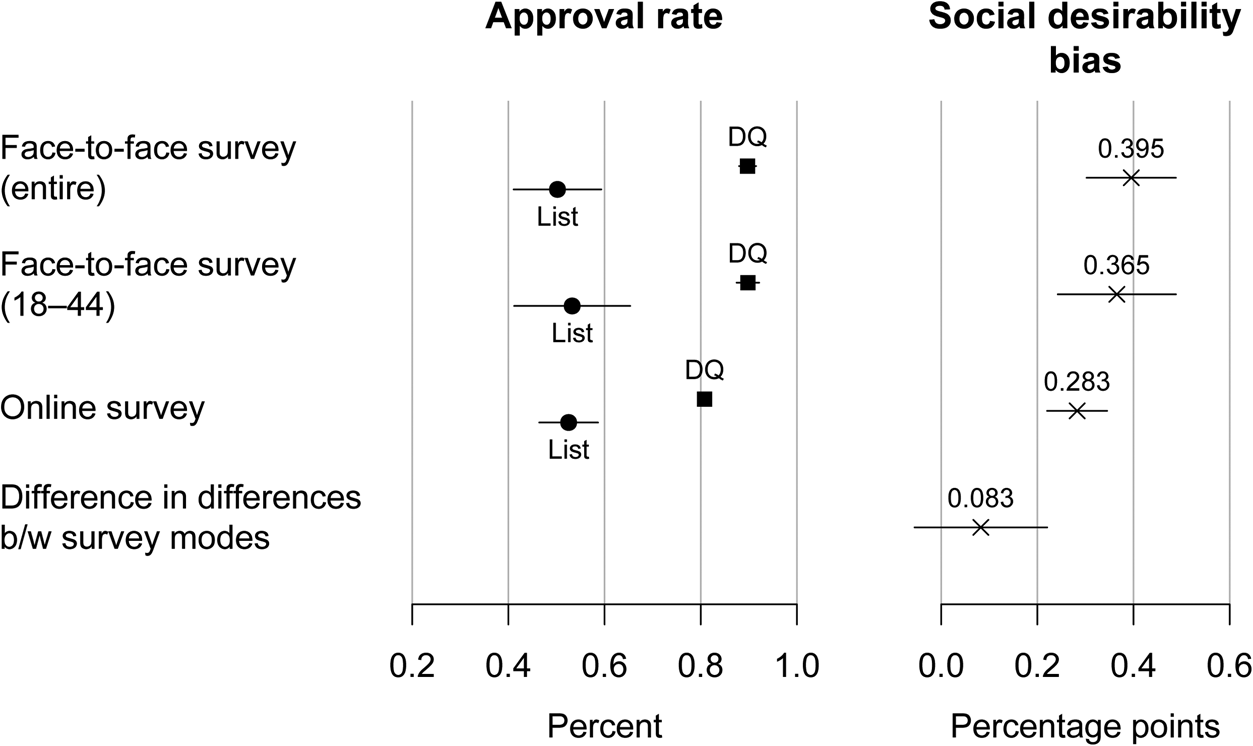
Figure 2 demonstrates the estimation results of Duterte's approval ratings using both direct and list-type questions, indicating the differences observed between survey modes. The figure also displays the difference in SDB magnitudes between face-to-face and online surveys (in the bottom line). Cross marks and dots represent point estimates. Horizontal segments represent the 95 percent confidence intervals (CIs).
Estimates of Duterte's approval ratings, SDB, and differences in SDB between survey modes.
Note: Cross marks and dots represent point estimates. Horizontal segments represent the 95% CIs.

When we asked respondents directly whether they approved of Duterte's performance of his duties, his approval rate was 0.897 [0.880, 0.915] in the face-to-face survey and 0.808 [0.795, 0.821] in the online survey (95 percent CIs appear in brackets; this applies consistently hereafter). These high approval ratings are consistent with previously reported surveys and also coincide with the aggregate results of the Pulse Asia-style direct question in our surveys.Footnote 16 In contrast, list-experiment-based estimates of Duterte's approval rate were 0.502 [0.411, 0.593] for the face-to-face survey and 0.525 [0.464, 0.586] for the online survey. The differences in the DQ-based and list-experiment-based estimates were 0.391 [0.291, 0.491] for the face-to-face survey and 0.283 [0.220, 0.345] for the online survey. These values are significantly distinguishable from zero (p-value was almost zero for both survey modes). The difference can be interpreted as being due to SBD's existence, providing strong support for Hypothesis 1.
To test Hypothesis 2, we compared SDB magnitude between survey modes. We restricted the sample of the face-to-face survey to those who were 44 years old or younger to reconcile the distribution of respondent age across surveys. Figure 2 shows that this restriction did not substantially change the estimates of approval ratings or SDB in the face-to-face survey, with the bottom row showing the estimated difference in the magnitude of SDB to be 0.078 [−0.070, 0.226]. As predicted, SDB was greater in the online survey than the face-to-face survey. However, because this difference is not statistically significant (p = 0.301), we cannot confirm Hypothesis 2.
We note that the difference in SDB magnitude between survey modes can be attributed to the difference in DQ-based approval ratings and that the list-experiment-based approval rates for Duterte are stable across surveys. These results indicate that it is likely that our list experiment detected the true level of Duterte's popularity.
Heterogeneity in susceptibility to social desirability bias
Figure 3 shows the results of testing Hypotheses 3–6. Cross marks indicate the point estimate of SDB magnitude for each subgroup based on the comparison between the direct questions and the list experiment questions (note that the horizontal axis of Figure 3 differs from that of Figure 2). Dots indicate the point estimate of the difference in the magnitude of SDB between subgroups. Labels show the number of respondents in each subgroup.
Subgroup comparison of the magnitudes of SDB for Hypotheses 3–6.
Note: Dots represent point estimates. Horizontal segments represent the 95% CIs.

In neither survey was personally knowing EJK or red-tagging victims significantly related to SDB magnitude. Because the number of such respondents was very small in the face-to-face survey, we must say that the tests for the face-to-face survey were underpowered. Nonetheless, we can confirm that knowing EJK or red-tagging victims was hardly related to SDB magnitude in the online survey.
The results of both surveys demonstrate that the size of SDB did not significantly vary according to the time respondents spent on social media. Therefore, we can conclude that Hypothesis 5 does not hold.
In contrast, we found strong support for Hypothesis 6. The results indicate that individuals who believed that people in their barangay were dissatisfied with Duterte's performance would not alter their responses based on whether the question format was direct or list; they were completely unaffected by social desirability. Participants who perceived their neighbors as supporters of Duterte's performance were more likely to report that they approved of Duterte when directly asked than when the list question format was used. Such tendencies of social conformity pressure were observed in both surveys. The estimated difference in SDB size was 0.475 [0.193, 0.756] in the face-to-face survey and 0.397 [0.246, 0.549] in the online survey, a difference significantly distinguishable from zero (p < 0.001 in both surveys).
Exploratory subgroup analyses
In addition to testing SDB heterogeneity, we investigated how the degree of SDB differed according to certain demographic variables. We focused on gender, educational attainment, region of residence, and socioeconomic class.Footnote 17 Note that, as Figure 2 shows, we mentioned that the difference in SDB caused by respondent age was negligible, with the SDB in the face-to-face sample of respondents aged 18–44 close to the entire sample's SDB.
We split respondents into two groups based on education level: those with some college education or higher and those with less than some college education. Respondents' socioeconomic class was measured by the question on the type of housing, which is regularly used in Pulse Asia and other face-to-face polls in the Philippines. Following convention, we treated the respondents classified A, B, or C as the upper class and those in the D or E categories as the lower class. This information was only available for the face-to-face survey results.
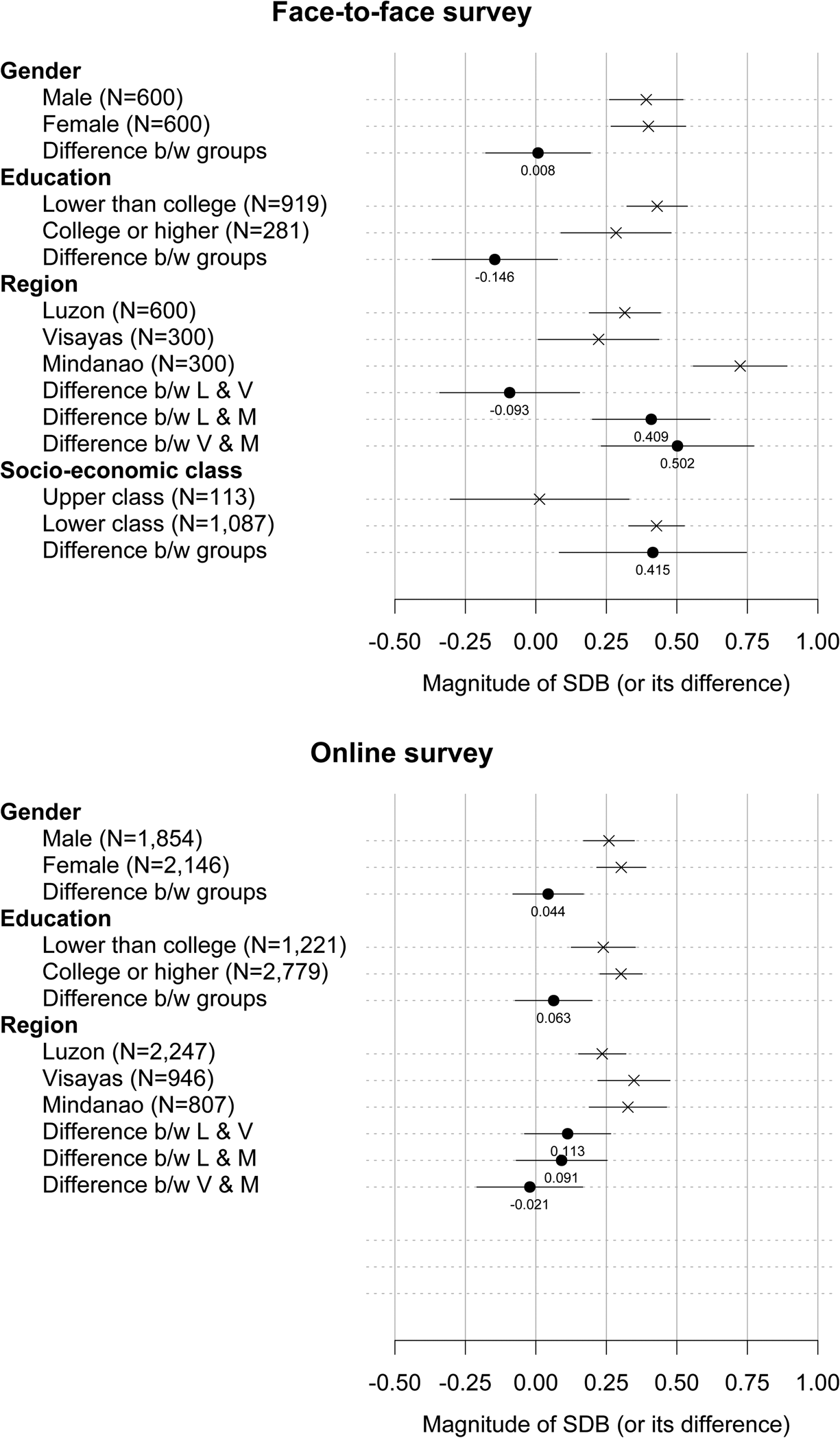
We report the results in Figure 4. As with Figure 3, cross marks show the SDB point estimate, and dots show the point estimate of the difference in SDB between subgroups. The horizontal segments represent 95 percent CIs. Neither gender nor education level produced a significant SDB difference in either the face-to-face or the online survey.
Exploratory subgroup comparison of SDB magnitude according to demographic variables.
Note: We did not compare socioeconomic class in the online survey because the respondent class was not measured in the online survey. The “college or higher” group includes respondents with some college education. Dots represent point estimates, and horizontal segments represent 95% CIs.

However, the face-to-face survey results suggest a large difference across three major regions. While the degree of SDB was modest among respondents in Luzon and Visayas (about 27 and 24 percentage points, respectively), the magnitude reached 72.5 percentage points for Mindanaoans. As we report in the Online Appendix, the DQ-based approval estimate was greater in Mindanao (0.952 [0.928, 0.977]) than in other regions (0.883 [0.856, 0.909] in Luzon and 0.869 [0.829, 0.909] in Visayas); this is consistent with the conventional narrative that Mindanao represents Duterte's supporter base. However, the list-based estimate, which is assumed to reflect truthful answers, was remarkably low in Mindanao (0.228 [0.063, 0.392]) compared with other regions (0.567 [0.444, 0.691] in Luzon and 0.646 [0.436, 0.856] in Visayas).Footnote 18
In the online mode, we did not find regional differences that resembled our face-to-face survey. This absence of regional differences in the online survey is due to the list-based estimate for Mindanao being at the same level as other regions (0.612 [0.475, 0.748]; see Online Appendix C), unlike in the face-to-face survey. The difference in Mindanao's SDB between surveys may be due to socioeconomic differences between online and face-to-face respondents. As the tables provided in Online Appendix C show, in Mindanao, the upper-class segment is smaller, and internet use is less extensive than in other regions. Due to these regional traits and the upper class being heavier internet users, it is likely that Mindanao's online survey respondents included a larger proportion of affluent Filipinos than other regions. As detailed in this paper's discussion section, upper-class respondents demonstrated low SDB. The approval rating among upper-class respondents remained very high (about 80 percent) when measured by the list question. We suspect that the online list-based estimate had an upward bias for Mindanao compared to the face-to-face results.
Figure 4 reveals that poverty is a major source of preference falsification. A sizable amount of SDB—about 40 percentage points—was attributed to lower-class respondents (the DQ-based approval estimate was 0.897 [0.879, 0.916], and the list-based estimate was 0.470 [0.373, 0.566]). Among upper-class respondents, SDB was nearly zero (The DQ-based and list-based estimates were 0.896 [0.838, 0.954] and 0.883 [0.572, 1.195]).
Sensitivity analysis for non-strategic misreporting
Despite the scholarly belief that list experiments address the problem of strategic misreporting, some researchers have recently raised concerns that list experiments are vulnerable to non-strategic misreporting (Agerberg and Tannenberg Reference Agerberg and Tannenberg2021; Ahlquist Reference Ahlquist2018; Kuhn and Vivyan Reference Kuhn and Vivyan2022; Riambau and Ostwald Reference Riambau and Ostwald2021). To borrow Riambau and Ostwald's (Reference Riambau and Ostwald2021) explanation, while “[s]trategic errors arise when respondents lie to conceal their position on the sensitive issue” (172), “[n]on-strategic error includes such things as coding errors and poor quality responses that arise when respondents do not understand or rush through the list experiment” (173). If non-strategic misreporting exists, the estimated prevalence of affirmative response to a sensitive item using the difference-in-means estimator should be biased.
To address this issue, as indicated in our preregistration, we conducted an online survey including a placebo list experiment at the same time as the main survey and used the data obtained from this placebo survey for a sensitivity analysis.Footnote 19 One thousand respondents aged 44 or younger were recruited via Lucid Marketplace from February 26 to March 3, 2021. The recruitment procedure for this survey, including the quota settings and the method for omitting inattentive respondents, was identical to the main online survey, and we prevented respondents from giving answers to both surveys. We can thus consider the characteristics of respondents to be almost identical for the two surveys.
Except for demographic questions and a matrix-type item battery containing a directed question to detect satisficing participants, the placebo survey featured only a list experiment question. Respondents were block-randomized, as in the case of the main survey. The lists were the same as those used for the main survey, except that the list for the treatment group included the item “PAUL NUEVA” instead of “RODRIGO ‘DIGONG’ DUTERTE.” Although “Paul Nueva” is a completely plausible name in the Philippines, to the best of our knowledge, no politician has this name. As such, we can assume that most attentive respondents would not have considered “PAUL NUEVA” a politician they approved of; that is, “PAUL NUEVA” is assumed to have functioned as a placebo item. Under this assumption, we can check how sensitive our estimate of Duterte's approval rate and the SDB to the proportion of non-strategic misreporters with simple computation.Footnote 20
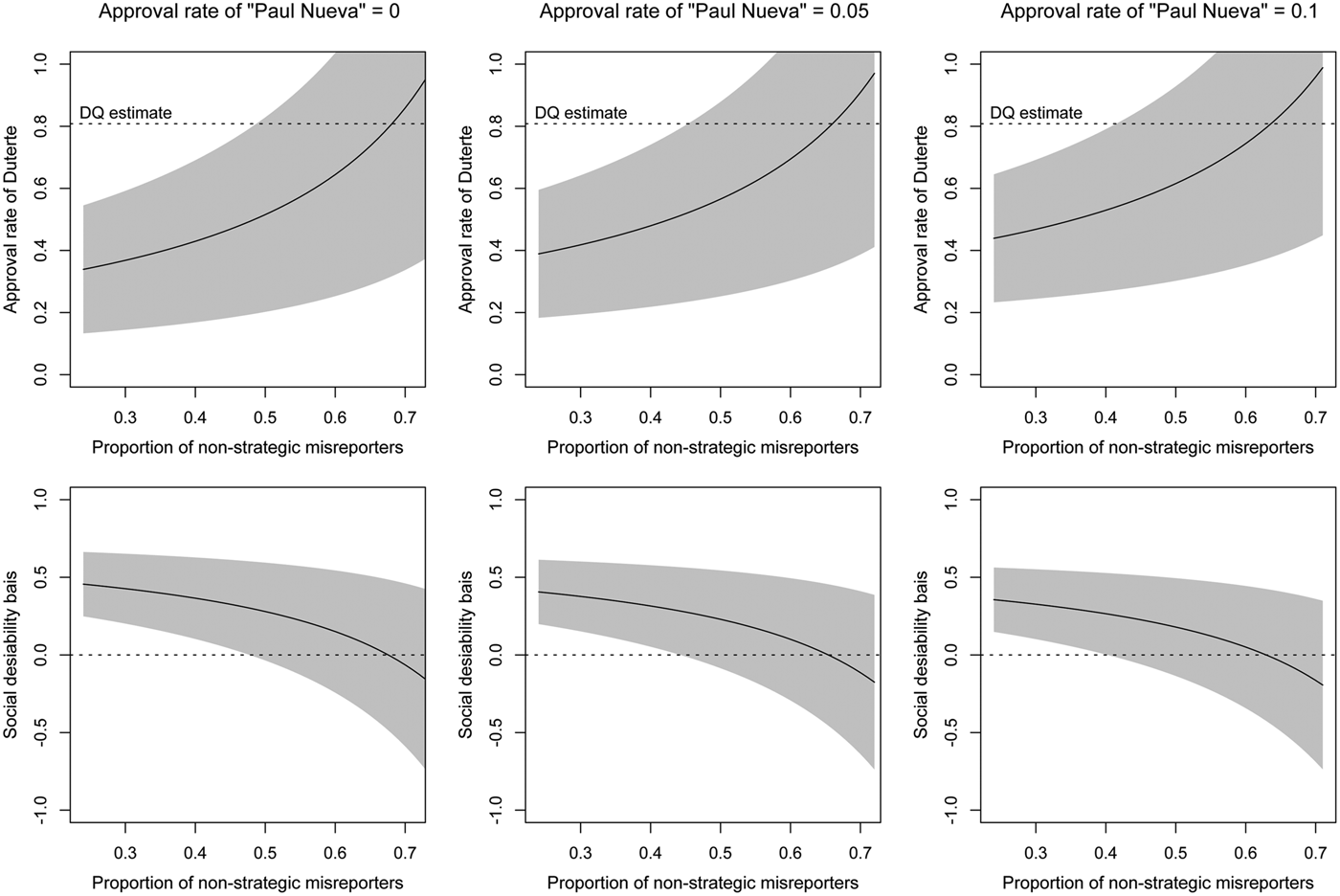
In this study, we found that the difference-in-means estimate for our placebo survey was 0.242, with a standard error of 0.060. Given the above assumption, if there were no non-strategic misreporters, this value should have been zero. Accordingly, it is certain that there were non-strategic misreporters. Furthermore, under an additional reasonable assumption, we can estimate that the proportion of non-strategic misreporters was no less than 24.2 percent (see Online Appendix B.4.3. for details). Using this value as the lower bound, we conducted a sensitivity analysis using a simulation. In that simulation, the proportion of non-strategic misreporters and the approval rate of “Paul Nueva.”Footnote 21 Figure 5 presents the results of our sensitivity analysis. The top row shows how our estimate of Duterte's approval rate (the vertical axis) changes depending on the assumed proportion of non-strategic misreporters (the horizontal axis). The bottom row shows the corresponding results for the SDB estimate. The first, second, and third columns show the results for the cases where the approval rate of “Paul Nueva” was set to 0, 0.05, and 0.1. The solid lines represent point estimates, the shaded areas represent the 95 percent CIs, and the dotted lines in the top row panels indicate the DQ-based estimates of Duterte's approval rate in the main online survey.
Results of the sensitivity analysis for non-strategic misreporting using a placebo list experiment.
Note: The solid lines represent point estimates, the shaded areas represent 95% CIs, and the dotted lines in the top row panels represent the DQ-based estimates of Duterte's approval rate in the main online survey.

According to the top left panel, given that the approval rate of “Paul Nueva” is zero, only when the proportion of non-strategic misreporters is as high as 0.65 does the point estimate of Duterte's approval rate reach its DQ-based estimate. Even when we focus on the upper limit of the 95 percent CI, the corresponding proportion does not exceed 0.49. Consequently, unless we suppose that more than half the respondents were non-strategic misreporters, we can be confident of SDB in respondents' expression of their approval of Duterte.Footnote 22
The bottom left panel shows that the SDB estimate is 0.436 [0.261, 0.610], 0.404 [0.214, 0.593], 0.336 [0.116, 0.557], and 0.242 [−0.023, 0.507] when we assume the proportion of non-strategic misreporters was 24 percent, 30 percent, 40 percent, and 50 percent. If we consider implausible the scenario in which more than half of the respondents were non-strategic misreporters, we can conclude that the SDB was 24 percentage points or higher. The second and third panels demonstrate that the setting of the approval rate of “Paul Nueva” did not substantially change the conclusion.
Discussion
Several caveats must be made before discussing our findings. First, our results only capture voter attitudes around February and March 2021, four years and eight months into the Duterte presidency. This period coincided with a national lockdown and a high unemployment rate induced by the COVID-19 pandemic. Our survey also took place before the vaccination roll-out started.Footnote 23 This makes it possible to suggest that a significant portion of the Filipino population shared a prevailing sentiment of frustration and anxiety at the time of our survey. Accordingly, our results may not be relevant to other periods of Duterte's rule. For example, his popularity might have been authentic during the election campaign and earlier in his term. In an ethnographic analysis of the 2016 presidential campaign, Curato (Reference Curato2016) suggested that Duterte offered “hope” to the poor. However, as noted by Teodoro (Reference Teodoro2020), the country's relatively “threat-free” environment before 2016 was overwhelmed by a “climate of fear” due to the mass killings of drug suspects and severe punishments imposed on violators of COVID lockdown measures. It is crucial to note that our results should not be interpreted as suggesting a consistent inflation of Duterte's approval rating throughout his entire tenure due to SDB.
Second, Duterte was a relatively popular president even when SDB-induced answers are discounted, with the proportion of respondents who indicated genuine support at approximately 50 percent. Our findings should not be perceived as refuting the widely accepted notion that Duterte enjoyed significant popularity. Instead, this study can be regarded as an additional investigation that introduces a qualifying element, thereby tempering the certainty or extent of such understanding when most of the existing studies neglect to account for SDB in their interpretation of survey results.Footnote 24
Third, Pulse Asia executive director Ana Tabunda, in an interview in June 2021, remarked that the non-response rate (those who refused to answer surveys) had not increased since the beginning of the Duterte administration, offering this as an indication of the absence of SDB (Rappler 2021). Regarding this point, Shen and Truex (Reference Shen and Truex2021, 1675, en.3) reported that surveys conducted in authoritarian regimes demonstrate only a slightly lower non-response rate than those in democracies, although it is usually thought that respondents in authoritarian regimes tend to exhibit higher levels of preference falsification. Furthermore, in a study of about 50 autocracies, Guriev and Treisman (Reference Guriev and Treisman2020) found that the level of state repression did not significantly affect the refusal rate among respondents. Although these findings may not squarely apply to this study's context, they nevertheless suggest that the rate of interview refusal may not relate to SDB concerning the regime support question, indicating that it remains possible to expect the presence of SDB even when the interview acceptance rate remains the same (as in the Duterte era).
With these caveats in mind, our study primarily confirms the suspicion that Duterte's popularity was inflated due to SDB. Roughly one in three respondents pretended to support the president in the face-to-face survey. Some may think that this is too high to be possible. Here, one can refer to studies concerning Russia's President Putin's popularity. In studies that employed the face-to-face list experiment, scholars have observed degrees of SDB concerning Putin's support ranging between 10 percentage points (Frye et al. Reference Frye, Gehlbach, Marquardt and Reuter2017) and 44 percentage points (Kalinin Reference Kalinin2015), depending on the time of the survey. Furthermore, in a preliminary study, Iglesias and Cheng (Reference Iglesias and Cheng2022) conducted a face-to-face list experiment with residents of Metro Manila and its neighboring provinces in late 2021. They found that the magnitude of SDB concerning support for Duterte was about 40 percentage points. These studies suggest that our results fall within the conceivable range.
Some may also think that our online survey's magnitude of SDB is too high at 28.3 percentage points. Preference falsification is generally associated with hesitation to reveal one's true preference in front of another person. In that case, one could argue that we should not observe a high degree of SDB online, where anonymity is high. Indeed, this was the logic behind our second hypothesis (face-to-face surveys invoke significantly higher SDB than online surveys), which was not supported empirically. It is conceivable that some respondents thought that responding online might not have guaranteed anonymity. Several studies conducted in other countries reported a considerable degree of SDB in online list experiments. On the support for the Chinese government, Li, Shi and Zhu (Reference Li, Shi and Zhu2018), Robinson and Tannenberg (Reference Robinson and Tannenberg2019), Nicholson and Huang (Reference Nicholson and Huang2022) reported approximately 28, 25, and 13 percentage points of SDB, respectively. On Russia's invasion of Ukraine, Chapkovski and Schaub (Reference Chapkovski and Schaub2022) reports 10 percentage points of overreporting on the support for Putin's decisions. These results suggest that some respondents do not regard online surveys as totally anonymous.
Furthermore, for both face-to-face and online surveys, we conducted a battery of tests to examine the validity of our assumptions and the robustness of our results, including placebo tests. These are reported in Section ‘Sensitivity analysis for non-strategic misreporting’ and Online Appendix. We found no issues regarding face-to-face survey. Although we detected a problem caused by non-strategic misreporters in online surveys, our sensitivity analysis showed that our overall conclusion holds under a reasonable assumption on the percentage of non-strategic misreporters. In sum, the available evidence suggests that our detection of SDB cannot be dismissed because it is too high.
It is critical to consider what drove respondents to pretend to support Duterte. One possible mechanism that emerges from our analyses is social conformity pressure. Testing our hypothesis (H6) concerning whether one's perception of Duterte's neighborhood popularity induces SDB produced strong and significant findings: In the face-to-face survey, the magnitude of SDB was 47.5 percentage points, while that of the online survey was 39.7 percentage points. Given this result, we posit that social pressure from “moral politics” (Kusaka Reference Kusaka2017b) may have been an important mechanism behind conformity pressure.Footnote 25 Based on his ethnographic research in Metro Manila's urban slums, Kusaka (Reference Kusaka2017b) argued that the 1986 People Power was a catalyst event for the emergence of moral politics, which divided politics between “good versus evil” rather than between elites and the masses or the rich and poor. Subsequently, being on the side of the “good” became an important guiding principle for many Filipinos.
Furthermore, Kusaka (Reference Kusaka2017b, Reference Kusaka2020) highlights that Duterte, as both a popular presidential candidate and president, fostered a prevailing moral discourse where supporters of his anti-drug campaign and strict COVID lockdown policies were regarded as “good,” while those who opposed them were labeled “evil” or “pasaway” (naughty or trouble-maker in Filipino). This interpretation was corroborated by Warburg and Jensen (Reference Warburg and Jensen2020a, Reference Warburg and Jensen2020b) through their long-term ethnographic research in Metro Manila's slum area. The amplification of Duterte's discourse by internet trolls further served to silence his critics (Ong and Tapsell Reference Ong and Tapsell2022). Under such circumstances, individuals likely experienced social pressure to conform to the state-imposed morality, which advocated for the killing of drug users and severe punishment for those who defied COVID-related restrictions. Notably, both Kusaka (Reference Kusaka2020) and Warburg and Jensen (Reference Warburg and Jensen2020a) observed the presence of discreet dissenters against Duterte's imposed morality. Considering these observations, we suspect that some survey respondents may have yielded to the influence of this dominant, state-imposed morality, feigning support for Duterte.
While this may come as a surprise to many, we found that SDB among Mindanaoans was extremely high. As reported in Section ‘Exploratory subgroup analyses’, our face-to-face study revealed that an overwhelming proportion of Mindanaoans (72.5 percentage points) pretended to support Duterte in our face-to-face survey. In Luzon and Visayas, SDB was below half (31.5 and 22.2 percentage points, respectively).
It is worth considering what might explain this regional variation. Again, the logic of morality-induced conformity pressure might be at play. Mindanaoans have been exposed to the moral discourse of Duterte for the longest because he served as mayor or vice mayor of Davao city for over 30 years before he emerged as a national-level politician. This makes it possible that the pressure to conform to Duterte-imposed morality was more strongly felt among Mindanaoans than Filipinos residing in other regions. The findings presented in Online Appendix C show that a significant proportion of Mindanaoans (91 percent) expressed the belief that individuals within their local community exhibited either a high or moderate level of satisfaction with Duterte. The corresponding figures for respondents from Luzon and Visayas are 82 percent and 80 percent. Although this discrepancy of 10 percent may not fully account for the regional disparity observed in SDB, we propose that variations in the intensity of social conformity pressure could potentially contribute to the differences.
Given the limited availability of data for comprehensive analysis, we are constrained to providing a speculative interpretation of our finding that individuals from lower socioeconomic backgrounds exhibit higher susceptibility to SDB than their wealthier counterparts. Specifically, the prevalence of SDB among respondents from lower-class strata was observed to be 42.8 percentage points, in contrast to a mere one percentage point among those from upper-class strata. However, unlike the previously discussed case of regional disparity, there was minimal divergence observed between different socioeconomic classes regarding respondents' perceptions of Duterte's popularity, as Online Appendix C shows.Footnote 26 This suggests that it is difficult to use higher social conformity pressure to explain high SDB among the poor (as operationalized by H6). Another plausible explanation—suggested by David (Reference David2020)—could be the fear of losing access to government pandemic subsidies, commonly referred to as “Ayuda.” Considering the paucity of empirical investigations around this possibility, it is imperative for forthcoming studies to undertake an in-depth exploration of the mechanisms that establish a link between poverty and SDB.
On the question of “climate of fear” or respondents' SDB due to the fear of being a victim of Duterte's war on illegal drugs or red-tagging, our hypotheses (H3, H4, and H5) were not supported. This result can be interpreted in several ways. First, the fear thesis was not relevant in reality despite the speculation of some analysts (Gavilan Reference Gavilan2021; Teodoro Reference Teodoro2020). Second, it is possible that the fear factor was relevant, but our operationalization was not valid. For example, asking whether participants personally knew victims of EJK (H3) or red-tagging (H4) may have provoked self-censorship.Footnote 27
It is now worth considering how our empirical findings relate to existing studies concerning Duterte's popularity. One proposition that is testable using this study's dataset is the claim made by Dulay, Hicken and Holmes (Reference Dulay, Hicken and Holmes2022) that Duterte's popularity was driven by ethnic affiliation: Filipino voters with non-Tagalog ethnicity tended to demonstrate greater support for Duterte. This argument holds even if the data used were contaminated by the SDB, provided the SDB did not correlate with respondent ethnicity. We used our data to examine whether the magnitude of SDB varied depending on respondent ethnicity and found that the difference was not statistically significant. Online Appendix C.4.3 reports that result. This analysis consequently substantiates that our findings corroborate and are compatible with the central argument presented by Dulay, Hicken and Holmes (Reference Dulay, Hicken and Holmes2022).
Conclusion
This article has empirically confirmed the suspicion of some Filipino analysts: Duterte's strikingly high popularity in the polls was highly inflated as of March 2021, the time of our survey. Our analyses also found that the poor, the Mindanaoans, and those who believed Duterte was popular in their neighborhoods were more likely to pretend to support him. Given that previous studies predominantly portray Duterte as a genuinely popular president, there may be concerns regarding the plausibility of our results. It is important to emphasize our commitment to transparency, as evidenced by pre-registering our research design and a battery of sensitivity analyses found in the Online Appendix. We also note that our study is constrained to capture a “snapshot” of voter attitudes at a given time and cannot easily be extrapolated to other time periods. Keeping these considerations in mind, we offer the following implications.
Our results elucidate the possible presence of another type of voter in backsliding democracies. Recent studies have shown that there are three types of voters who support illiberal incumbents: “autocrats” who dislike democracy, “militants” who support their party despite the party violating norms, and “majoritarians” who support the incumbents on the basis of being elected even when they violate norms (Grossman et al. Reference Grossman, Kronick, Levendusky and Meredith2021). Our study introduces a fourth type: “pretenders.” These are voters who pretend to support the backsliding incumbent, especially in opinion polls. Our study suggests that such voters are of particular concern in developing countries, where most voters are socioeconomically vulnerable.Footnote 28 Thus, our findings imply that explanations for popular backsliding incumbents may differ between developing and developed countries.
Concerning democratic backsliding in the Philippines, our findings provide several new insights. The dominant narrative about Duterte features multiple aspects. First, voters were fascinated by the emergence of an illiberal leader, Duterte. They elected him and supported his illiberal policy (the war on drugs). Next, the implementation of his signature policy was accompanied by attacks on democratic norms and institutions, yet voters overwhelmingly supported him. However, our study's results reveal that he was not as overwhelmingly popular as the polls suggested, at least toward the end of his term. His popularity was significantly inflated because many respondents pretended to support him. What would have happened if there had been no pretenders? In this counterfactual scenario, declining support might have sent Duterte an effective signal to refrain from further eroding democracy.Footnote 29 Thus, were survey results less inflated, poll results might have served as more effective checks on the executive, better pushing back against the executive aggrandizement.
This study also challenges the stereotype of Filipino voters. Existing studies tend to portray them as uncritical and naive, calling them “dutertards” (retarded Duterte supporters) or “bobotantes” (stupid voters). Our findings indicate such interpretations to be potentially superficial. In reality, many voters may be sophisticated strategists who play it “safe.” This might mean that Filipino voters are not “deluded”;Footnote 30 voters may be deluding the interviewers and observers. However, as we noted already, their individually optimal choice may have undesirable social and collective consequences: If a larger segment of respondents had answered that they sincerely did not support Duterte, the survey results might have functioned as a force against democratic backsliding.
What can our study tell us about post-Duterte politics? If Duterte's popularity was substantially inflated due to SDB, how can we make sense of the popularity of his successors, namely, President Ferdinand Marcos Jr. and Vice President Sara Duterte (Rodrigo Duterte's daughter)? Both won the 2022 election by broadly claiming to maintain Duterte's policies (Dulay et al. Reference Dulay, Hicken, Holmes and Menon2022). On this point, we maintain that it would be premature and inappropriate to extrapolate our findings to directly explain the electoral victories of Marcos Jr. and Sara Duterte for several reasons. First, voting outcomes involve not only individual psychology—our study's context—but also mobilization schemes encompassing patronage and vote buying (Aspinall et al. Reference Aspinall, Weiss, Hicken and Hutchcroft2022). These broader factors significantly contribute to shaping electoral results. Second, as cautioned in the foregoing Discussion section, our study provides only a snapshot of respondent behavior in February/March 2021, and different dynamics may emerge during other time periods. Consequently, our study's main implication concerns not providing insights into post-Duterte politics but rather shedding light on the complexities associated with survey methodology and the interpretation of survey results.
Finally, we conclude this article by advocating for more studies addressing SDB in opinion surveys conducted in the Philippines and other backsliding democracies. An obvious first step is to conduct more surveys that employ indirect questioning techniques, such as the list experiments employed here. Furthermore, other methods, such as implicit association tests (Huang, Intawan, and Nicholson Reference Huang, Intawan and Nicholson2022) and the conjoint experiments (Horiuchi, Markovich, and Yamamoto Reference Horiuchi, Markovich and Yamamoto2022), may be useful. Second, scholars can triangulate various research approaches as suggested by Rosenfeld (Reference Rosenfeld2022). Examples include using combinations of indirect questioning, focus-group interviews, ethnographic studies, and direct questions from multiple survey sources. Considering what likely transpired in Duterte's Philippines, the inflated popularity of authoritarian leaders can justify their attacks on democracy. Properly estimating a nation's true “pulse” is critical to preventing democracy's slow death.
Supplementary material
The supplementary material for this article can be found at https://doi.org/10.1017/jea.2023.18. Replication materials are available at the Harvard Dataverse (https://doi.org/10.7910/DVN/RQWIZL).
Acknowledgements
For their helpful comments we thank the journal editor, two anonymous reviewers, Cleo Anne Calimbahin, Dean Dulay, Allen Hicken, Sol Iglesias, Marisa Kellam, Wataru Kusaka, Nico Ravanilla, Julio C. Teehankee, Mark Thompson, Marites Vitug and participants at the Philippine Political Studies Association annual meeting and at the Waseda University Contemporary Political Economy Institute's experimental political science study group meeting. We extend our special thanks to Ronald Holmes for his invaluable contributions during the design stage of this project.
Sources of support
This work was supported by the Japan Society for the Promotion of Science KAKENHI Grant Number 19H00584, the Sakuradakai Foundation grant, and Keio University's academic research promotion fund.
Competing interests
The authors declare none.
Yuko Kasuya is a professor of Comparative Politics at Keio University. Her research interests include regime transition, comparative political institutions, electoral systems, party politics, and East and Southeast Asian politics.
Hirofumi Miwa is a professor of Political Science at Gakushuin University. His research interests lie in the areas of political behavior, including voter ideology and partisanship, and Japanese politics.