Numerous scholars (Hoskyns, Reference HOSKYNS1992; Oehrle, Reference OEHRLE1993; Elliot, Reference ELLIOTT1995; Joseph, Reference JOSEPH1999; Röscher, Reference RÖSCHER2002) agree that an important link exists between Music Education (MusEd) and the overall education of young learners. According to Hwenha (Reference HWENHA2014:7), young learners who are exposed to MusEd are more likely to become purposeful, successful and ‘economically productive individuals as adults.’ Hannaway (Reference HANNAWAY2016:25) summarises that education opportunities enhance learners’ growth and development of adequate skills, as they are being prepared for future responsibilities in becoming adult citizens in a democratic society. Taken into account that MusEd is so important in child development, the question arises, whether student teachers in MusEd are prepared effectively. This concern is not new in South Africa and has received widespread attention amongst South African researchers (Van Niekerk, Reference VAN NIEKERK1987; Le Roux, Reference LE ROUX1992; Cochran-Smith, Reference COCHRAN-SMITH2004). Röscher (Reference RÖSCHER2002:1-1) emphasised that ’it is of the utmost importance that this subject be taught well and according to acceptable standards.’
The rationale for the study pointed out the lack of effective MusEd teaching and learning frameworks. This ascribes the status quo to ineffective training of music teachers (Van Eeden, Reference VAN EEDEN1995:1). From an American perspective, Boardman (Reference BOARDMAN1992:21) concurs with Van Eeden by stating ‘We can only hope to see any improvement in the schooling of our youth to the extent that we restructure teacher preparation curricula to meet the challenges of the next century.’
Consequently, the inclusion of MusEd in the South African national curriculum emphasises a compulsory part of the Foundation Phase (FP) programme in primary schools. In South African primary schools, the FP refers to the first 3 years of formal training in a primary school consisting of Grade 0–3 learners, where multicultural learners in classrooms are a given and therefore teacher preparation curricula need to be adapted to make provision for demands for transformation, decolonisation and Africanisation (Butler-Adam, 2016)
According to Du Preez, Simmonds and Verhoef, (Reference DU PREEZ, SIMMONDS and VERHOEF2016:1), transformation is essentially about ‘change, evolution, remodelling, modification and restructuring of some sort.’ The transformation processes from the previous Apartheid regime, evident as a legacy of a colonial education system, changes to ‘decolonise the country and the intellectual landscape of the [specific] country’ (Oelofsen, Reference OELOFSEN2015:131). This is reiterated by Sium, Desai and Ritskes (Reference SIUM, DESAI and RITSKES2012:1) as ‘oppositional to colonial ways of thinking and acting.’ This led to a renewed focus on Africa, as the Africanisation of ‘indigenous knowledge and an African community competing in a global society’ (Louw, Reference LOUW2010:42). This process is about ‘affirming the African culture and its identity in a world community’, where it involves ‘incorporating, adapting and integrating…African identity and culture’ (Makgoba, Reference MAKGOBA1997:199).
The political, social and economic transformation processes of Higher Education in the South African context include ‘political democratisation, economic reconstruction and development, and redistributive social policies aimed at equity’ (South Africa, Department of Education, 1996:29). The transformation processes, therefore, imply changes in the political, social and economic landscape of Higher Education Institutions (HEIs) where the redress of previously disadvantaged students is being adhered to.
In my experience as a Higher Education MusEd lecturer at the University of Pretoria for 10 years, I have come to the realisation that South African MusEd lecturers in HEIs have to prepare student teachers in MusEd amidst various challenges, the most being to provide student teachers with meaningful multicultural programme content within given time constraints (Russel-Bowie, Reference RUSSELL-BOWIE2009; Vermeulen & Van Aswegen, Reference VERMEULEN and VAN ASWEGEN2010). Preparation involves helping student teachers to construct their own understandings of a multicultural MusEd and then relate this to young learners whom they have to teach. Student teachers are therefore being prepared to make a musical impact on children of the future. Russel-Bowie (Reference RUSSELL-BOWIE2009:23) supports this view that the current education student teachers are ‘tomorrow’s teachers’, and their attitudes, beliefs and experiences of MusEd will ‘impact on their attitudes and practice when they are teaching in schools.’
Teacher preparation curricula in the FP for MusEd require theoretical academic knowledge (musical concepts) integrated with practical skills (musical activities) and didactical skills (philosophical and pedagogical viewpoints). Pedagogical knowledge needs to be applied in practical on-site situations to prepare student teachers suitable for the multicultural MusEd classroom. To summarise the various aspects of an effective teacher training framework, Russel-Bowie (Reference RUSSELL-BOWIE2009:33) concludes that student teachers should ‘graduate with adequate confidence and effective knowledge to make a difference in the lives of the children in their future classes, make a positive impact on the priority and practice in their schools in relation to MusEd and teach their children about the world of sound and music.’ The emphasis therefore in the MusEd class on holistic ‘child-centred’ approaches, multicultural relevant teaching materials available to all and community engagement projects (micro-lessons) are domains of development that the student teachers are exposed to (Loots, Reference LOOTS2015; Mailwane, Reference MAILWANE2016; Hannaway, Reference HANNAWAY2016).
Contrary to this outlook, the literature identifies negative influences that are evident in MusEd in the FP, such as frequent changes in South African policies and curricula (Wolhuter, Reference WOLHUTER2006), higher education and school practice breaches (Jorgensen, Reference JORGENSEN2005), shortage of FP teachers (Hannaway, Reference HANNAWAY2016), insufficient awareness of the value of MusEd for young children (Abril & Gault, Reference ABRIL and GAULT2007), scarcity of MusEd programmes (Nompula, Reference NOMPULA2011), balancing theoretical musical knowledge with practical applications (Jorgensen, Reference JORGENSEN2005), ‘generalists’ student teachers with limited musical knowledge (Russell-Bowie, Reference RUSSELL-BOWIE2009), teachers lacking confidence and the absence of teaching opportunities (Joseph, Reference JOSEPH1999).
The Force Field Model
These challenges led to the decision to use The Force Field Model (FFM) by Samuel (Reference SAMUEL2008) as a lens to identify the various push and pull factors evident in the four forces that influence MusEd lecturers’ perspectives and experiences in their professional practice at South African HEIs. These forces cannot be understood simplistically, but in depth with varying tempos, as several intricacies between forces in the MusEd lecturers’ lifeworlds are considered.
The FFM consists of first the contextual, external forces of the macrosocial, political and historical forces in South Africa; second, the institutional, internal forces consist of the micro-contextual forces in each HEI; third, the biographical, internal forces are the authentic, unique and personal forces; and fourth, the programmatic, internal forces or conceptions of curriculum forces, all have a determining influence on perspectives regarding MusEd (Samuel & Van Wyk, Reference SAMUEL and VAN WYK2008:140). The four forces are not static and have influences on one another where overlapping intersections are evident. These various ‘push and pull’ factors shape the stances and experiences of MusEd lecturers’ in their quest to prepare student teachers to present effective music lessons in the classroom.
The external and internal forces that influence and determine the continually changing educational and tertiary landscapes are signposted by South Africa’s diverse social, political, cultural and economic facets during particular periods in the country’s history (Mudzielwana & Maphosa, Reference MUDZIELWANA and MAPHOSA2013:176). For the purpose of this study, contextual forces refer to the historical and political effects on Higher Education teaching and learning processes. Several key individuals and political developments play dominant and decisive roles in those processes that ultimately determine the status of Higher Education in South Africa (Weiss, et al., Reference WEISS, KNAPP, HOLLWEG and BURRILL2015). Such effects cannot be easily avoided – as Samuel (Reference SAMUEL2008:13) states we are all ‘products and processors of our history.’
Colonialism in South Africa began when a fleet of the Dutch East India Company, under the stewardship of Jan van Riebeeck, arrived from the Netherlands at the Cape of Good Hope in 1652. The bulk of the country’s teachers originated from Europe in the following centuries. During the 20th century, White children were generally instructed in music according to the Classical European music system (Cochran-Smith, Reference COCHRAN-SMITH2004:295). According to Malan (Reference MALAN2015:12,13), most coloured schools had access to a MusEd curriculum during the apartheid era, but no Black schools.
Indigenous African cultures and music had existed before the arrival of colonial administrations in South Africa. However, as Mngoma (Reference MNGOMA1990:122) mentions, Western culture managed to influence the cultural preferences of African learners. Nompula (Reference NOMPULA2011:371) adds that many African learners were under the impression that only the European music system existed and was deprived of opportunities to learn more about their own traditional musical styles. According to Herbst et al. (Reference HERBST2005:264), the pre-1994 curriculum promoted Western heritage, lifestyles, behaviours and belief systems to the detriment of many indigenous cultural practices – the use of Western instrumentation to adapt rural songs illustrates this situation.
The post-apartheid period after 1994, marked the start of a major restructuring of the Higher Education landscape in South Africa (Louw, Reference LOUW2010). The newly elected African National Congress (ANC) overhauled the education and teacher training systems in accordance with their political ideology (WOLHUTER, Reference WOLHUTER2006:124). Since 1994, sustained efforts were made to accommodate the different races, cultures and ethnic groups, as well as religious and social frameworks, in teacher education. Mudzielwana and Maphosa (Reference MUDZIELWANA and MAPHOSA2013:175) mention that the emphasis is now on ‘equity, equality and redress of past imbalances’ in the current tertiary landscape.
Contextual forces are, therefore, observed as the ‘distinctiveness of the macro-environment of educational transformation’ (Samuel, Reference SAMUEL2008:13). Teaching and learning processes in the South African education landscape are determined by decisions of a number of key players that are largely dominated by political developments (Weiss, et al., Reference WEISS, KNAPP, HOLLWEG and BURRILL2015), which have a determining impact on the status of higher education in South Africa.
The linking of external and internal forces in the ‘magnetic field’ of the Higher Education landscape – where lecturers and student teachers engage with these forces – constitutes a bigger picture of the sociocultural context embedded in the South African education system. The continual changes of external forces that influence internal forces are applied to the roles and identities of Higher Education lecturers teaching MusEd. These lecturers have to contend with driving and constraining forces in their working arena. As Samuel and Van Wyk (Reference SAMUEL and VAN WYK2008:140) mention, macro-contextual forces of policy influence lecturers’ identities and their practices in unique teaching locations.
The unique features of an institutional setting or an institution’s ‘expectations, values and goals’ (Samuel, Reference SAMUEL2008:13), determines each institution’s forces. The underlying vision, mission and theoretical underpinning of each institution influence self-concepts, various roles and identities of members in a specific institutional community (Samuel, Reference SAMUEL2008:13). In HEIs, common activities such as ‘societal expectations, regulatory frameworks, cooperative and competitive linkages’ are embedded in the macrostructure of each institution (Teichler, Reference TEICHLER2004:3). Lecturer identities, teaching sites and practicum develop according to internal institutional forces in HEIs. The merging of teaching colleges with universities, for instance, negatively affected the teaching and learning environments, and specifically the humanities departments. The Department of Humanities Education at the University of Pretoria, which houses MusEd, converted the practicum section of the teacher education programme.
The biographical forces refer to the course or events in a person’s life as each individual is unique with varied experiences and choices in life (Oxford Dictionary, 1974:82). Individuals’ internal and external forces constitute ‘their lived experiences’ (Samuel & Van Wyk, Reference SAMUEL and VAN WYK2008:140) as biographical or personal forces. These forces are unique to each lecturer, as every lecturer’s gender, age, ethnicity, level of tertiary education, level of MusEd training as well as language problems contribute to the learning and teaching environment. According to Amin and Ramrathan (Reference AMIN and RAMRATHAN2009:70), biographical forces ‘shape teaching competence and ability, impacting on the experiential/psycho-emotional dimension of learning to teach.’
Applying these forces to HEIs lecturers or teacher educators, they are described as ‘those who motivate students, convey concepts, and help students overcome learning difficulties’ (Kreber, Reference KREBER2002; Mitchell et al., Reference MITCHELL2004). According to Ben-Peretz et al., (Reference BEN-PERETZ, KLEEMAN, REICHENBERG and SHIMONI2010:13), the educators participate in ‘numerous and diverse, but very challenging, day-to-day responsibilities by lecturing in a specific field of expertise; making the learning process accessible to student teachers; encouraging reflective processes in the trainees; and being involved in research and in developing research skills in their students.’
The programmatic forces determine the programmatic content of each HEI programme. Three focus areas are needed according to Bitzer (Reference BITZER2009:16), namely knowledge as a foundational component, practical skills which will enable the student to apply the knowledge and reflectivity where students should use metacognition in thinking about and understanding the content. Although HEIs’ do not prescribe specific curriculum content, practical skills or the methodology thereof, the South African education curriculum or Continuous Assessment Policy Statement (CAPS) are to be adhered to in Faculties of Education. When considering what is taught in the HEIs curriculum, Letsekha (Reference LETSEKHA2013:9) as cited in Le Grange (Reference LE GRANGE2004) states that ‘curriculum refers to what knowledge is included or excluded in university teaching and learning programmes.’ Prescribed education curricula, such as the CAPS document affect what and how MusEd lecturers teach. The MusEd lecturer must furthermore keep the demographics of the students in mind as they need to provide student teachers with musical abilities from which they can relate skills and knowledge to construct their own understanding of MusEd for the classroom. Furthermore ‘institutional restructuring’ must also be considered as it has ‘a strong and direct impact on the nature of initial teacher education programmes in Music Education’ (Kruss, Reference KRUSS2008:155). Ultimately, MusEd lecturers determine their own direction, quality teaching and learning and methodology of programmes. Bresler (Reference BRESLER1991:8) confirms this by stating that lecturers’ perceptions, views and beliefs about MusEd and how it influences children’s developments, shape their practice. Consequently, the proposed programme content and suggested direction of the teaching and learning forces are determined by each individual lecturer.
Research methodology
To enquire about different outlooks from the HEIs MusEd participants, the research methodology comprised of the research questions, design and methods used in this investigation. The research questions encompassed of:
-
♪ How and why are criteria and key elements constituted to determine an effective teacher training framework for MusEd in the FP?
-
♪ How do the influences of challenges (pushing factors) and opportunities (pulling factors) determine an effective teacher training framework for MusEd?
The research design comprised the interpretive paradigm, qualitative approach and multiple case studies. Eight different South African HEI systems were contacted, teaching and learning situations were scrutinised and relationships with various colleagues were formed to gain insight into individual situations, phenomena or communities (Blaikie, Reference BLAIKIE2000). However, only six MusEd lecturers at four universities responded positively to the research invitations. Data were collected about the research participants’ experiences pertaining to the problem under study. The six research participants completed a biographical questionnaire, participated in qualitative semi-structured interviews with open-ended questions and shared programme content documents. Face-to-face interviews and telephonic interviews were conducted with each HEI lecturer either at their workplace or at a place convenient for them.
The required ethics permission was obtained from the Dean of the Faculty of Education before the commencement of my research. I adhered to the following ethical principles as prescribed by the University of Pretoria (2013) at all times during the research.
-
♪ Voluntary participation, implying that the participants have the right to withdraw from the research at any time;
-
♪ Informed consent, meaning that research participants must at all times be fully informed about the research process and purpose, and must give consent to their participation in the research;
-
♪ Safety in participation, dictating that no participants or research subjects should ever be placed in positions of potential risk or harm of any kind;
-
♪ Privacy, meaning that the confidentiality and anonymity of participants should be protected at all times; and
-
♪ Trust, implying that participants will never be subjected to any acts of deception or betrayal in the research processes or its published outcomes.
In this instance, all the participants had prior knowledge and experience of ethical research guidelines at tertiary institutions. Each participant signed a letter of consent before any interview processes started. I assigned pseudonyms (codes) to each research participant to ensure their anonymity and that their contributions would remain confidential in all subsequent research procedures.
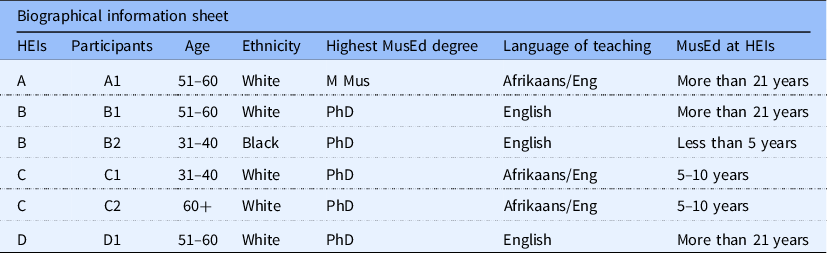
Six research participants (A1; B1&B2; C1&C2 and D1) from four HEIs (A; B; C; D) varied in the age from 30 to 60 years; mostly White race, 5/6 have PhD degrees; teach mostly in English and have adequate HEI teaching and learning experience (refer to Table 1) Apart from the MusEd lecturers as research participants, Prof. Michael Samuel, from the University of KwaZulu Natal (UKZN), was contacted for an expert interview with regard to the theoretical framework and another HEI lecturer for an expert interview on curriculum construction. Documents analysed included MusEd study guides, study manuals, textbooks, handouts and production planning course books. Research data gaps were identified after the accumulation of the explorative interviews and document analyses which led to follow-up interviews with three selected research participants. This was done to collect more specific data, aimed to determine the strengths, weaknesses, opportunities and challenges in the MusEd arena.
Data analysis
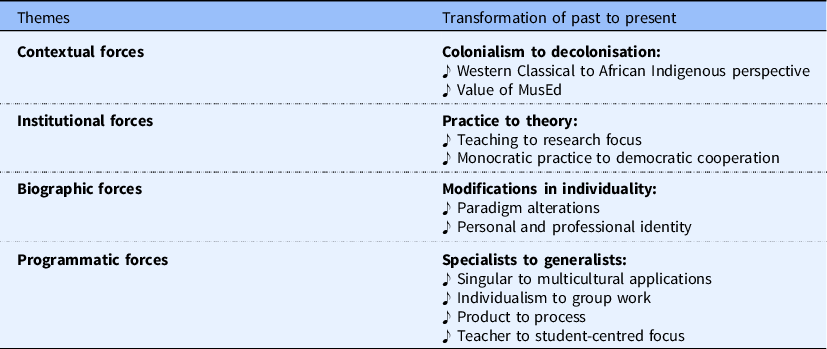
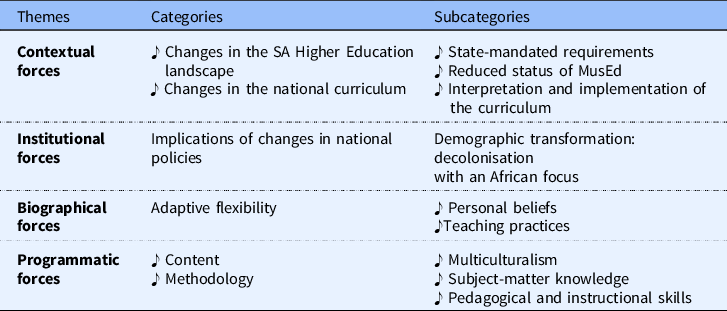
Deductive data analysis is usually followed where researchers are aware, before the interviews and document analysis, of possible participants’ responses and personal viewpoints (Burnard et al., Reference BURNARD, GILL, STEWART, TREASURE and CHADWICK2008:429). This study relied on the deductive analytical procedure, where the push and pull factors of the varying forces regarding MusEd lecturers’ personal preferences, teaching experiences and work worlds were influenced. The data collection process was a prolonged process where the data had to be read and reread, reviewed, made sense thereof and organised to verify received data and fill in identified gaps in information. The research data were then organised according to the four forces of the FFM as themes (refer to Table 2) where categories and subcategories emerged (refer to Table 3).
Biographical information about participants

Key findings per theme

Themes, categories and subcategories

Theme 1: Contextual forces
The historical and political forces of the apartheid and the post-apartheid systems in South Africa prompted changes to the wider sociocultural context that is embedded in the national education system. The pre-democracy era adhered to a policy of segregation (apartheid). At the time, the different races in South Africa experienced fragmentation and disconnectedness because of various education systems designed for different communities. After 1994, the post-apartheid government initiated a complete overhaul, shifting priorities towards an inclusive incorporation of all the races in one national education system. The redress of inequality developed the most in the Higher Education system where a growth in African students became evident. Transformational endeavours of the ANC government determine national policies and education programmes. Key players in the South African government determined state-mandated requirements about transformation in Higher Education settings. Changes in government policies and practices about education filtered through to HEIs and then to secondary and primary schools.
Having established how these state-mandated requirements influenced participants’ experiences in their professional realms, the changes being enforced in the current climate can be reasonably summarised by a participant’s comment describing it as a ‘level of prescription towards a territorial state.’ HEI MusEd lecturers feel they ‘are becoming technicians of state.’ These comments imply that teacher educators become responders to state policies and prescriptions, consumers of directives and mere reproducers of what they are able to incorporate – with limited means. Resultantly, the changes in governmental policies prompted the reduction in MusEd’s status as an academic subject and a severe decline in the numbers of specialist MusEd lecturers. The most problematic change in the national curriculum, as perceived by the participants, is that MusEd’s status as a specialist academic subject was reduced to becoming a component of Creative Arts, which is categorised under the Life Skills field of education. Consequently, this new arrangement created a situation where MusEd lecturers felt obliged to form their own interpretations of the prescribed curriculum, and to design their own implementation of the curriculum. One participant stated that she does not follow the CAPS curriculum as she sincerely believes that no specialist music educators were involved in compiling the ‘new’ curriculum. Although this possibility is worth acknowledging, another participant felt that ‘sometimes you just follow what the policy says and you’re just being creative.’ The drive to include transformation principles in classroom practices encourages the adoption of a multicultural approach in implementing the national curriculum content, as well as the incorporation of theoretical subject knowledge into practical activities as part of the design of effective MusEd practices.
Theme 2: Institutional forces
The contextual forces from government policies and the national curriculum are the same for each HEI institution, but decisions in terms of how those prescriptions are implemented depend on the executive management of each HEI. The managements’ varying perspectives and circumstances determined the way in which national policies were interpreted, implemented and manifested at each institution. Institutional forces at each South African HEI are determined by their respective visions, missions, values and goals. Although the Department of Higher Education (DHET) formulates the national policies and practices, the Higher Education landscape is decentralised, meaning that every HEI integrates national policy prescriptions in its own way. In alignment with national policies, the shift towards the decolonisation of education is reflected in demographic shifts at HEIs. More Black lecturers are being permanently appointed and more Black students register at HEIs. Regrettably, many Black student teachers still lack a sense of belonging to the tertiary environment and HEIs should, therefore, prioritise the fostering of inclusive campus environments where all cultures are acknowledged and valued.
Changes in national policies, therefore, affect each institutional community in a certain and unique way. Every HEI also varied with regard to demographic outlays in classes, student population sizes and programme preparations. Notable frustrations and obstacles to effective training were recorded such as allocations of limited time schedules, classes with overly large attendance numbers and shifts away from specialist training towards a generalist approach in MusEd programme structures. These problematic situations result in the ineffectiveness of student teachers’ preparation in the present-day MusEd environment. Consequently, the inclusion of different cultural styles of music can be highly beneficial to MusEd. One participant aptly mentioned, ‘Where possible we enlarge the exposure of our students to various music specifically.’ HEI MusEd lecturers, therefore, have a non-racial tool to expose student teachers to a variety of cultural practices, and hence inspire students to adopt innovative and creative transformation processes in their future careers as FP teachers.
Theme 3: Biographic forces
Biographical forces are the authentic, unique and personal forces as applied by each individual MusEd lecturer. Lecturers need adaptability to successfully incorporate various transformational policies and prescriptions in their programmes. A healthy attitude towards these challenges provides the flexibility needed to find creative and innovative solutions.
Music is a universal language and although visionary solutions are possible, not all HEI lecturers embrace MusEd as a multicultural tool for social cohesion, but most research participants are White citizens and in the latter stages of their careers. They feel comfortable to harness the Western Classical approach in their teaching and learning practices in accordance with their biographic background and their ‘sense of self.’ Participants stated that they relied on their Western cultural backgrounds while planning their lectures and activities to ‘stay on the safe side’, where they ‘resonate or are comfortable with’ the ‘kind of biographical heritage they draw on.’ Their accumulated personal experiences within the previous education system established stoic outlooks and paradigms on academic content and practical activities.
A general resistance to change with regard to national policies became apparent amongst participants; most of whom expressed feelings of anxiety and frustration about the possibility of being replaced at work as a result of the transformational agenda. However, those declarations of frustrations and insecurities emphasise the need for MusEd lecturers to reflect critically and to regard other possibilities beyond standard approaches and curricula prescriptions, and to realise that they can implement creative solutions to any teaching and learning dilemma if they embrace the transformational changes to the education landscape. One participant declared that she does not know how to change her practices.
It can, therefore, be reasonably argued that lecturers need critical reflections and self-assessments to develop integrative creative approaches and practice procedures – not only in terms of biographical perceptions of ‘self’ but also in terms of the needs of the current student-teacher generation. The Western Classical way of teaching and learning does not resonate with present-day students – one participant aptly stated that ‘die student van vandag wil nie meer so werk nie’ (today’s students do not wish to work according to this way anymore). Another participant suggested that the HEI lecturers should work towards a more ‘learner-sensitive education.’ MusEd lecturers, consequently, can define or determine their own competencies by engaging with the needs of the students, thereby adapting their personal teaching philosophies and approaches towards the subject.
Theme 4: Programmatic forces
Although most participants had conveyed positivity towards MusEd at HEIs, they also expressed their frustrations regarding to have to contend with the assertion that ‘students have no content knowledge’ and that they find the ‘theoretical component difficult.’ In emphasising the problem with the limited time allocated to MusEd instruction, one participant noted that when students ‘come to university we give them fourteen academic weeks, then we send them back.’ Authorities assume that the HEI MusEd lecturers will ‘fix the situation, but they [do] not.’ The limited time allocated to MusEd in HEIs’ timetables is not sufficient for lecturers to efficiently guide the student teachers to master the basic principles and prescriptions of the national curriculum for MusEd.
Another problematic situation is caused by the manner in which the MusEd modules are situated within BEd courses. The student teachers are admitted to the MusEd short course in their first or second year of study. However, the theoretical concepts and practical skills are not revisited during the rest of their degree courses. This situation causes retention problems for student teachers, as they do not get any further opportunities to enhance their practical skills, resulting in a general ‘under-preparedness of the students’ for school practice. In this way, students only acquire superficial or basic knowledge about MusEd concepts and practical skills, without satisfactorily mastering the necessary skills.
On a positive note, the research participants agreed that ‘music is universal, and can be integrated into various curricula.’ Student teachers need programmes that include multicultural philosophies and subject-matter knowledge to accumulate significant fundamental knowledge of MusEd elements. Concurrently, student teachers also need to absorb and grasp cultural knowledge to be able to integrate it with their practical activities. The empirical data obtained for this research confirms that the current methodology – or the practical execution – of teaching MusEd in the FP is insufficient. The curriculum prescriptions create the situation where student teachers mostly become generalists and ‘have hardly any practical music’ experiences. The present situation paints the picture where student teachers are ill-equipped to become MusEd teachers and as one participant observed, ‘they think they are prepared, but they are totally underprepared.’
The requirement for lecturers to change from established modes of teaching and learning to new MusEd structures in terms of pedagogical and instructional skills is indisputable. One participant stated that ‘it’s crucial, even if they’re not going to teach it because it has an impact on their identity as generalists’ teachers. It impacts teacher-identity, […] professional identity and their personal identity.’ The development of self-confidence, as a component of personal and professional identity, specifically for MusEd classes is imperative as this determines the success of presenting music in practice.
In summary, and in terms of MusEd lecturers’ management of the state-mandated prescriptions in the Higher Education environment, lecturers have to be adaptable and flexible in their approaches towards multicultural elements, decolonisation and Africanisation, subject-matter knowledge and methodological instructions in their personal beliefs and professional capacities. One participant suggested that MusEd programme leaders ought to engage with wider communities (outreaches), another suggested a new educational policy based on African musical philosophies while a third participant recommended the integration of MusEd activities with language development. Although the intensity of the challenges varied amongst HEIs, the originality, creativity and innovative solutions applied by some lecturers revealed a versatility that may be useful in creating an effective teacher training framework for student teachers in FP MusEd.
Findings
The participants provided the research data that allowed me to investigate how push and pull factors from the contextual, institutional, biographical and programmatic forces influenced and determined planning, execution and outcomes of MusEd teaching and learning situations. Within these four themes, the most vital aspect was the transformational processes imposed on the lecturers’ professional domains – processes that were designed to address apartheid’s legacy of inequalities. The respective systematic, structural and ideological differences in viewpoints between the former and current governments prompted several changes to the education system as a whole.
The simple parable of ‘Who Moved My Cheese?’ (Johnson, Reference JOHNSON2004) aptly illustrates the phenomenon of change. The characters in the story are confronted with change when a block of cheese was moved away from its original place. Each character had to learn how to manage this change in order to minimise the resultant stress. This enlightened tale reveals profound insights about functional responses to changes and how the responses could initiate more success in the workplace. This story serves as an applicable analogy in a demonstration of the respective MusEd lecturers’ perceptions and reactions to the enforced changes in the Higher Education arena.
Colonialism to decolonisation
The transformation from the former colonial education system to a decolonisation of the education landscape revealed changes in terms of national policies, strategies, curriculum instructions, state funding for HEIs, mergers between teacher colleges and HEIs, broad demographic alterations to student and staff populations, language policies and the harnessing of technological advances. The national education policies shifted the focus towards the decolonisation of the curriculum and a renewed emphasis on Africanisation. Transformations in the social sector heightened the importance of redressing past imbalances in the educational sector. Evident changes in the national curriculum strengthened social values more than academic content. The focus on social cohesion and inclusion resulted in a lack of university funding for teaching and learning practices. The status of Higher Education diminished as financial resources dried up and teaching colleges merged with HEIs. Consequently, the status of MusEd in the national curriculum was reduced.
The focus on inclusivity led to changes in the demographic profiles of staff and students. Some HEIs changed their language policies to institute English as the primary medium for instruction (replacing Afrikaans) in recognition of language diversity. While the inclusion of all races resulted in larger student numbers and shortened MusEd timeslots, one participant noted that ‘music is universal, can integrate into various curriculums.’
Although music can be incorporated as an educational tool in various curricula, the differences between Western Classical music genres and Indigenous African perspectives need to be explained. In Western Classical music training, students are taught to identify individual microelements of a musical composition. In the African musical sphere, in the Swahili culture, the ‘Ubuntu’ holistic principle simultaneously surface along with the macro integration of all artistic forms or expressions. One participant summarised it as such: ‘The Western approach is you break it down into components. You understand the components and then you try to build the whole. Africans do the whole, they start singing the song, harmonising and dancing, holistically immediately…try to go African the whole time as they experience everything, they experience holistically.’ This perception of integration of various disciplines relates to the view of MusEd representing the basket that carries a range of other school subjects.
Practice to theory
Institutional policies determine the language of instruction, length of modules, lecture allocations, student classes and financial resources for the MusEd classes. Although all the research participants expressed their frustrations about the nature of the adjustments imposed on them, they still understood the need to incorporate institutional policies in their working environments, as illustrated by a participant’s remark: ‘We need to meet the requirements of the Department of Higher Education.’ After the change of Governments in 1994 the teaching colleges merged with the HEIs, the DHET changed the teaching focus from practical student preparation to the accumulation of theoretical academic knowledge. One participant described this change as emphasising the ‘cognitive cerebral dimensions of understanding the theoretical, structural system issues.’ Resultantly, the HEIs’ focus shifted towards academic research in MusEd, which in turn caused a loss of quality teaching programmes. The focus on the building of larger postgraduate research departments created new difficulties in MusEd, such as finding adequate ways to prepare generalist student teachers for that purpose. This changed situation amplified the workload and stress levels that the research participants experienced in their working domains.
During the apartheid era, the HEI lecturers’ working methods comprised individualistic and autocratic styles of labour. With the new era of transformational changes and the building of social cohesion in a democratic system, the HEI lecturers began to focus on the process of working together. This also started a process to establish national and international networks to increase peer teaching and learning.
Modifications in individuality
According to Samuel, theoretical framework specialist-participant, stated that the complexities of our lives are borne from our ‘interconnectedness with the social, political and ideological environment that we are living in.’ The biographical adjustments as experienced by the participating MusEd lecturers resulted in paradigm shifts. On the basis of these interviews, these participants’ Western paradigms had to change and embrace aspects of decolonisation and Africanisation. They had to alter their traditional methods of teaching and embrace the realm of diverse races, cultures and customs. This prompted a continuing development of personal and professional identities and an evolution in MusEd lecturers’ professional practices.
Specialists to generalists
The main objective of multicultural education is to accept and affirm cultural diversity in teaching and learning circumstances. The transformation of the programmatic forces in Higher Education curricula led to a heterogeneous student population where specialist training changed to generalist training. The policy of compulsory attendance of MusEd courses created a situation of classrooms becoming filled with students lacking a specialist Westernised curriculum, background knowledge and practical experiences in music, which resulted in the problematic phenomenon of generalist and superficial knowledge accumulation. While most students hence received general MusEd training, one participant felt obliged to expand her programme and ‘help them to see the value of music and to grow a love for music activities.’
The individualistic approach towards training specialist MusEd teachers was replaced by an emphasis on group tasks and assignments. The new culture formed by students working together led to social and cultural expansion and development where the situation could stimulate ‘a curriculum of practice’ where the students ‘grow through musicking [with] more practical activities.’ This created a change from individualistic working towards a ‘perfect’ end product, but rather to ‘musicking’ together where the focus is on the participation of the multicultural developmental process of teaching and learning.
This methodology involved the integration of theoretical knowledge with multicultural practical activities initiated a shift in focus from teacher-centred approaches towards child-centred and student-centred approaches, resulting in learner-sensitive education. This implies that the role of the MusEd lecturers changed from an autocratic educator to a facilitator in teaching and learning practice. A modified role as facilitator in the MusEd classroom stimulated creative solutions, such as the incorporation of electronic technology, videotaped lesson presentations, concert performances and YouTube video demonstrations.
Yesterday, Today and Tomorrow Model
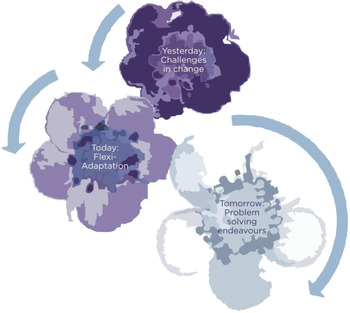
Upon reflection on the research conclusions and changes brought by different time aspects (past, present and future), I noticed the ‘Yesterday, Today and Tomorrow’ bush in the garden. While I contemplated the changing colours of the different flowers coming from the same root, a creative idea formed in my mind. According to the University of Florida (2017), the ‘Yesterday, Today and Tomorrow’ garden shrub produces colour-changing flowers, originating with purple flowers that change to lavender and then fade to white over the period of 1–2 days. In applying this principle to a MusEd teachers’ training framework, the ‘Yesterday, Today and Tomorrow’ model is flexible in time as the changing processes involve interlinks between the different moving phases. The former National Party government focused on Eurocentric education, the current ANC government focuses on the Africanisation of education and I propose that the future for education is a globalised approach where various cultural influences are incorporated into the MusEd curriculum. Figure 1 is a graphical representation of the ‘Yesterday, Today and Tomorrow Model’ in MusEd.
The Yesterday, Today and Tomorrow Model in Music Education.

MusEd is embedded in a specific context that includes the social, political and economic domains of a country where the approach followed in a specific programme is mirrored by the context of its society. The first circle represents ‘Yesterday’, when the White community governed the country via the apartheid regime. As the White population generally comprised descendants of Western societies, the MusEd teaching strategy was based on the Western Classical approach.
The view that present-day transformational challenges could change a person’s point of view relates to Lewin’s ‘Theory of change’ – his three phases of ‘unfreeze, change and refreeze’ describe the changing levels in performances. A change in perspective with regard to MusEd viewpoints, approaches and methodology occur when the push and pull factors associated with the forces are identified and incorporated in MusEd teaching and learning practices. Thus, the second circle in the figure represents ‘Today’, where transformation principles gradually realign a MusEd lecturer’s focus towards decolonisation and Africanisation. This circle represents the fact that HEIs MusEd lecturers have to adapt and be flexible in terms of personal beliefs and teaching practices, while having to incorporate principles of Africanisation and multiculturalism in MusEd. One proposed solution is to teach the same MusEd programme content from an African perspective instead of a Western Classical paradigm. This means that HEI lecturers should teach student teachers from diverse cultural backgrounds and present MusEd elements and activities belonging to a variety of cultures in classrooms. Consequently, MusEd lecturers should continuously endeavour to find creative solutions to problems in implementing new directives in their MusEd teaching and learning environments.
The third circle in the figure represents problem-solving endeavours in MusEd relating to the implementation of a globally multicultural MusEd where ‘new’ genres will emerge. The reality is that South African lecture halls contain a multitude of students representing not only Western and African cultures but other varieties as well, such as Eastern cultures. The proposed progression, therefore, not only involves the identification and implementation of comparisons and differences between Western Classical and African music philosophies and genres, but also involves an enhanced integration of Western Classical, African and Eastern cultural principles. One example is the pentatonic tonal system that is shared by African Indigenous music and some Japanese musical forms. Therefore, the suggested principle of globalisation in MusEd that would reveal emerging musical genres belonging to various cultures would also refine multiculturalism in Higher Education. The third circle hence represents ”Tomorrow’, where the recurring process of the integration of multiculturalism in a global MusEd society would establish a truly cosmopolitan form of education.
Therefore, the most important findings of an effective teacher training framework are:
-
♪ Acceptance of the pros and cons of past educational policies;
-
♪ Flexibility in adapting to current policies and incorporating new directives;
-
♪ Creation of a problem-solving environment for the establishment of a global MusEd agenda – this fresh approach of embracing multicultural characteristics in different music genres will lead to innovative teaching and learning practices.
An important principle for an effective teacher training framework is to acknowledge the value of MusEd in the development of young learners’ lives. The second principle is to incorporate the Africanisation process of a changed national curriculum, as this will restore and redress past imbalances. The focus on the inclusion of social values and social cohesion in a multicultural classroom will enhance the benefits of the wellness of the totality of student teachers and young learners. The third principle is to incorporate a change of outlook in teaching and learning opportunities where it has to change from a teacher-centred to student-centred approach. This will inevitably lead towards a learner-sensitive education. Consequently, this attitude towards embracing multicultural characteristics in different music genres will lead to innovative teaching and learning practices which leads to optimal social cohesion between multicultural communities. A cosmopolitan approach towards exposing student teachers to multicultural genres of music is therefore proposed.
This study fills a gap in the existing literature about the influence of the four forces on MusEd lecturers’ professional practices. The study has revealed that the teaching and learning situations are outcomes of a process set in motion by external contextual and internal institutional, biographical and programmatic forces. Having utilised a literature review, theoretical framework, research questions, data analysis and interpretation, it became clear that creative solutions to the complex and multifaceted challenges are needed.