Do electoral institutions and ethnopolitical cleavages shape the structure (the fragmentation or concentration) of party systems separately or jointly? If they shape the structure of party systems jointly, how can this joint effect be theoretically specified and empirically tested? If ethnopolitical groups and associated ethnopolitical cleavages are not primordially fixed but constructed in the course of social, economic, and political interactions, as the accumulated findings of over three decades of comparative research on ethnopolitics attest, how can constructed ethnopolitical groups be specified and associated ethnopolitical cleavages measured? Do measures of ethnopolitical cleavages premised on constructivist logic and processes offer better explanations of variations in the structure of party systems, independently and in combination with electoral institutions, than measures based on primordialist logic? What are the implications of how electoral institutions and ethnopolitical cleavages shape party systems for the stability of Africa's unconsolidated democracies in which political parties are weak and multiethnic coalitions fluid?
To answer these questions systematically, we utilize two new data sets on African countries—one on elections and electoral institutions and the other on ethnopolitical groups and cleavages. While empirically focused on Africa, our analysis and data sets are designed to address three substantive theoretical issues in comparative scholarship that are reflected in the preceding list of questions. The first issue concerns the competing emphases on electoral institutions and social cleavages as mutually exclusive determinants of the structure of party systems and recent attempts to bridge this theoretical divide. Arguing for their joint impact, we employ the notion of embedded institution to clarify how electoral institutions and ethnopolitical cleavages structure the strategic coordination of voters and candidates over votes and seats, and we systematically test for their independent, additive, and interactive effects on the fragmentation or concentration of party systems as measured by the number of electoral and legislative parties. The second issue concerns the accumulated findings in comparative scholarship that ethnic groups, identities, and cleavages are not primordially fixed, but are constructed in the course of social, economic, and political interactions, and the analytical implications of this constructivist approach for specifying ethnopolitical groups, measuring the cleavages among them, and incorporating these measures in explaining variations in the structure of party systems. We reject primordialism and draw on the insights of the constructivist approach to specify ethnopolitical groups (constructed and politicized ethnic groups, as discussed below) and measure the cleavages among and within them. Our data analysis shows that these specifications and measures provide improved accounts of variations in the number of electoral and legislative parties. The third issue concerns the prospects for stability of unconsolidated emerging democracies. We proceed by clarifying the first two issues, followed by a description of our research design and the presentation of data analysis. In the conclusion, we speculate on how our analysis helps to clarify the third issue.
INSTITUTIONS, CLEAVAGES, AND PARTY SYSTEMS
An important debate in the comparative literature on parties and party systems involves the competing emphasis on electoral institutions (Duverger 1962) and social cleavages (Lipset and Rokkan 1967) as mutually exclusive determinants of the structure of party systems. But scholars also recognize that social cleavages condition institutional effects. Thus, plurality formulas that typically produce two-party systems also tend to foster multiparty systems if voters are regionally concentrated and vote as a block, as, for example, in India and Canada (Rae 1971). And proportional formulas predictably tend to increase the number of parties but only in ethnically heterogeneous societies and not in ethnically homogeneous ones (Ordeshook and Shvetsova 1994). These emendations suggest the possibility of a joint impact of electoral institutions and social cleavages on the structure of party system. In particular, they underscore the importance of two dimensions of ethnopolitical cleavages in mediating the direct effects of electoral institutions: ethnopolitical fragmentation and ethnopolitical concentration. We present quantitative measures of both dimensions and test their independent as well as additive and interactive effects with each other and with electoral institutions on the number of electoral and legislative parties in Africa's emerging democracies.
Embedded Institutions
Systematically sorting out the independent and joint effects of institutions and cleavages on party systems requires a theoretical specification of these relationships that denies a priori privilege to either institutions or cleavages. The notion of “embedded institutions” provides this specification. It conceptualizes electoral institutions as embedded in wider social contexts, raising the possibility that similar institutions may not produce similar outcomes in different contexts and leaving the validation or rejection of that possibility to empirical investigation (Grofman et al. 1999).
The notion of embedded institution highlights how electoral institutions and ethnopolitical cleavages shape party systems. Electoral institutions and ethnopolitical cleavages shape party systems as sources of information that structure the mutual expectations of voters and candidates about winning and losing, thus facilitating their strategic coordination over votes and seats. However, the information that the two variables contain and convey may not necessarily be consistent; indeed, they may be at odds with each other. This may explain why electoral institutions do not always produce their expected results in many new democracies (Moser 2001; Mozaffar 1997). That expected institutional outcomes do not obtain, however, is often interpreted as an indication of the failure of electoral institutions to perform in expected ways. An alternative, but related, explanation is that contextual variables provide more relevant information for voters and candidates that modifies the impact of electoral institutions. It is a useful research strategy, therefore, to sort out this relationship of structured tension between electoral institutions and ethnopolitical cleavages by specifying and examining their independent, additive, and interactive effects on the structure of party systems.
Strategic Coordination
The strategic coordination role of electoral institutions is now well established (see, e.g., Cox 1997; Lijphart 1994; Sartori 1994; Taagepera and Shugart 1989). Cox's (1997) definitive work clarifies the central logic: (a) candidates wish to get elected and voters wish to gain the benefits of voting for winners, and (b) candidates' and voters' expectations of winning and losing tend to be mutually reinforcing. Electoral institutions structure these two micro-level processes, which, in turn, affect the number of electoral and legislative parties. The role of electoral institutions in strategic coordination is premised on political actors' knowledge and understanding of the information embodied in these institutions. In emerging democracies, however, electoral institutions are new and their incentives and outcomes not well known or understood by political actors, who compensate for the resulting information deficit by relying on alternative sources of information and coordination. In Africa, ethnopolitical groups and cleavages are these alternative sources.
Ethnopolitical groups facilitate strategic coordination because the identities that define them are strategic resources that are contingently (not reflexively) activated to define group interests and that help to reduce the cost of collective political action in response to the institutional incentives that structure the competition for power and resources. In Africa, colonial institutions established the initial institutional incentives for constructing and politicizing ethnic groups and identities, while varied postcolonial regimes reinforced the incentives for sustaining and occasionally redefining these groups and identities, as discussed in the next section (Laitin 1986; Rothchild 1997).
How ethnopolitical cleavages facilitate strategic coordination among voters and candidates to shape the structure of party systems depends largely on patterns of ethnopolitical fragmentation and concentration. Analysts generally posit an isomorphic relationship between ethnopolitical cleavages and party systems on the assumption that each ethnopolitical group involved in a cleavage is totally separate from others and is also sufficiently large and internally cohesive to support a party by itself. Thus, ceteris paribus, large numbers of cleavages (high ethnopolitical fragmentation) increase and small numbers of cleavages (low ethnopolitical fragmentation) reduce the number of parties. However, the nature of constructed ethnopolitical groups in Africa and the resulting cleavages that we describe below reveal a complex group morphology that seriously militates against such a reflexive relationship between ethnopolitical cleavages and party system structure. Specifically, African ethnopolitical demography features politically salient differences within as well as among groups. The resulting high ethnopolitical fragmentation, ceteris paribus, either produces such a high degree of vote dispersion among large numbers of small parties that most are unlikely to secure enough votes to win seats or produces small numbers of large multiethnic parties by encouraging them to campaign for votes across both intergroup and intragroup cleavages. Either way, high ethnopolitical fragmentation is likely to reduce the number of parties.
African ethnopolitical groups, however, also exhibit the highest levels of geographic concentration in the world (Gurr 1993). Such concentrations, especially when they exist “in above-plurality proportions in particular constituencies and geographical pockets” (Sartori 1994, 40), help to counteract the reductive effect of ethnopolitical fragmentation on the number of parties. Geographic concentration by itself, however, is unlikely to overcome the reductive effect of high fragmentation due to the presence of large numbers of small ethnopolitical groups. Countries with low fragmentation, moreover, feature a small number of large ethnopolitical groups that are also likely to have dispersed populations and, therefore, do not need concentrated voters to sustain a small number of parties. These variations in the configurations of ethnopolitical cleavages suggest the likelihood of an interactive effect of ethnopolitical fragmentation and concentration on the structure of party systems.
The magnitude of this effect will depend on the district magnitude, that is, the number of seats in each electoral district. District magnitude shapes party systems by setting a minimum threshold of votes required to win one seat (or, conversely, the maximum number of votes a party can secure without winning a seat) and thus influencing the proportionality between votes and seats. Ceteris paribus, small districts set high thresholds that increase vote-seat disproportionality and reduce the number of parties, while large districts set low thresholds that reduce vote-seat disproportionality and increase the number of parties.
Presidential elections also play a crucial role in shaping the structure of party systems (Cox 1997, 187–90, 203–21; Jones 1995; Shugart and Carey 1992). This has special resonance in Africa, where all new democracies, except Lesotho and South Africa, have adopted presidential systems. Presidential elections in Africa are important for three reasons. First, with the presidency as the top prize in the political game, presidential elections attract a large number of candidates, few of whom have any realistic chance of winning. Characteristic problems of postauthoritarian democracies—limited experience with competitive elections, information deficit about the extent of electoral support, plus personal ambition—prevent opposition candidates from coordinating on a single candidate to oppose incumbents armed with the standard advantages of incumbency. Second, an important strategic reason for the entry of large numbers of contenders in presidential elections is that African presidents possess substantial resources for patronage. Presidential contenders with weak winning potential often expect to demonstrate sufficient electoral support to bargain entry into postelection coalitions and secure state resources for their constituencies in return for political support of the winners. Third, for leading presidential candidates the electoral base and bargaining resources possessed by weaker candidates are also strategically important because of the salience of ethnopolitical groups for electoral support. Just as it constrains legislative candidates, the combination of ethnopolitical fragmentation and concentration may also constrain leading presidential candidates from securing outright electoral majorities. And since the weaker candidates often control small but cohesive blocks of votes, leading presidential contenders have strong incentives to form minimum-winning coalitions with them to ensure an electoral victory and a governing majority.
The extent to which strong and weak presidential contenders are able to negotiate minimum-winning coalitions will depend, among other things, on the proximity of presidential and legislative elections and the number of presidential candidates (Cox 1997, 209–13). Greater proximity of presidential and legislative elections tends to reduce the number of parties due to the coattail effects of winning presidential candidates. Large numbers of presidential candidates have the opposite effect due to the influence of ethnopolitical cleavages.
In addressing these substantive theoretical concerns, our analysis builds on the only two studies, of which we are aware, that also test for the independent, additive, and interactive effects of electoral institutions and ethnic heterogeneity on the number of electoral (Cox 1997, esp. 203–21) and legislative (Ordeshook and Shvetsova 1994) parties.1
Powell (1982) also focused on the joint effects of electoral institutions and social heterogeneity but examined only their additive effects on the number of legislative parties.
But our analysis also extends their theoretical insights in two specific ways. First, the two studies measure ethnic heterogeneity by a fractionalization index that is based on primordialist specification of
ethnic groups and, therefore, can neither distinguish politically relevant ethnic groups from irrelevant ones nor capture politically salient intragroup differences. We focus only on
ethnopolitical groups, that is, on politically relevant ethnic groups specified by the logic of constructivism. Our measures of ethnopolitical cleavages, therefore, capture multiple levels of politically salient cleavages consistent with the complex morphology of ethnopolitical groups in African countries. Second, the two studies focus only on ethnic fragmentation, while we focus on ethnopolitical concentration
as well as ethnopolitical fragmentation.
SPECIFYING CONSTRUCTED ETHNOPOLITICAL GROUPS AND CLEAVAGES2
The logic of constructivism turns on the notion that individuals have multiple ethnic identities that are constructed in the course of social, economic, and political interactions. This malleability of ethnic identities derives (a) from the multiplicity of objective ethnic markers (language, religion, race, caste, “tribe,” territory, etc.) that may be invoked to define and distinguish ethnic groups, (b) from the relative complexity of these markers that may foster intragroup divisions combined with intergroup differences (e.g., sectarian divisions in a religion, “tribal” differences among same language speakers, or subjects of the same kingdom), and (c) from temporal changes in the relevance of these composite markers and their components in defining and distinguishing ethnic groups as well as in the politicization of resulting intergroup and intragroup cleavages (Chandra 2001, 7–8; Laitin and Posner 2001, 13–16).
Intrinsic to the logic of constructivism are three specific processes that motivate our criteria for specifying the ethnopolitical groups and the cleavages among them that we include in our analysis: construction, politicization, and particization. We do not explicate the construction of ethnic groups and cleavages, but we do highlight its salient features because it is a necessary precondition for the politicization of ethnic groups, that is, the construction of ethnic groups into ethnopolitical groups. Like other social cleavages, however, not all ethnic cleavages become politicized, and even fewer become “particized, that is, made into important lines of partisan division” (Cox 1997, 26, original emphasis). We describe below how this crucial distinction between particization and other forms of politicization of ethnic cleavages helps to solve the problem of endogeneity that is ostensibly inherent in measuring ethnopolitical cleavages for explaining variations in the number of electoral and legislative parties.
An ethnic group is constructed when individuals in culturally plural societies self-consciously choose one or more objective ethnic markers to distinguish in-groups from out-groups. In Africa, as elsewhere, the individuals' choice of ethnic markers and the consequent size of the constructed ethnic groups are constrained by the variety, complexity, and prior use of such markers, the associated cost of forming new groups and sustaining group solidarity, and the institutional framework of governance defined by the state. Increased variety and complexity of ethnic markers expand opportunities for ethnic group construction but also constrain unfettered construction of especially large and cohesive ethnic groups because of (a) the high start-up cost of group formation associated with the incorporation of competing groups and interests defined by varied ethnic makers to construct larger and more encompassing ethnic groups and (b) the high cost of sustaining group solidarity in the face of the varied markers serving as competing sources of group definition within the larger constructed agglomerations. These structural and strategic factors thus limit the size and the cohesion of ethnic groups that can be constructed and mobilized for collective political action.
In Africa, colonial rule and postcolonial regimes reinforced these constraints by structuring the variety and complexity of ethnic markers and politicizing some of them. Colonial rulers' reliance on local agents to cope with the dilemma of maintaining control at low cost encouraged these agents to differentiate their groups from those not so privileged by colonial authority either by recombining and redefining existing objective markers of ethnicity or by accentuating previously minor group differences (Vail 1989). Colonial rulers' creation of administrative units to secure additional economies in the cost of governance incorporated culturally disparate groups within single administrative units or separated culturally similar groups into separate units. Occasionally, administrative encapsulation enabled the combination and redefinition of different ethnic markers for the construction of larger, territorially concentrated and, hence, also cohesive ethnopolitical groups. In other instances, colonial rulers privileged one ethnic marker (e.g., ancestral village) to foster spatially distributed, hence fragmented, groups over another (e.g., religion) that could foster larger and more encompassing groups (Laitin 1986). In these different ways, colonial rule emphasized the relevance of a wide range of diffuse and heterogeneous criteria of group formation, thereby increasing instead of decreasing the variety and complexity of objective ethnic markers that constrained the construction and politicization of large and cohesive ethnic groups in Africa's culturally plural societies.
At independence, therefore, African countries inherited a distinctive ethnic morphology with three defining features that are reflected in the structure of constructed ethnopolitical groups and that have shaped the pattern of their political interactions: (1) marked differences in group size, such that virtually no major ethnopolitical group comprises an outright majority in a country, although some comprise a large plurality; (2) considerable variety and complexity in ethnic markers, such that, even as they produce politically salient interethnic differences, they also produce politically salient intragroup heterogeneity but limited cultural differences among large agglomerations of such groups; and (3) the territorial concentration of some ethnic groups that facilitates their construction as large and cohesive units for collective political action. These three features have combined with the accommodation by postcolonial regimes of instrumental (“pork-barrel”) ethnopolitical demands to foster communal contention as the typical pattern of political interactions in which ethnopolitical groups serve as cost-effective strategic resource for organizing political competition for power and resources. Communal contention, however, underscores the high start-up cost of new group formation and the high maintenance cost of group solidarity, thus discouraging political entrepreneurs from exaggerating cultural differences among groups and encouraging them instead to maintain strong group identities, including some coexisting subgroup identities, that are strategically sustained by their ability to access the state and secure valued goods and services for their followers (Mozaffar and Scarritt 1999, 239–42).
The constructivist processes highlighted above motivate five criteria for specifying ethnopolitical groups and cleavages. The first, which derives from the distinction among the construction, politicization, and particization of ethnic groups and helps to avoid the endogeneity problem noted above, involves specifying only those groups that have demonstrated their actual political relevance or high potential political relevance based on past relevance, apart from or prior to particization. We thus employ the decision rule that the incidence of at least one of the following several forms of long-standing politicization other than particization is a necessary and sufficient indicator of the construction of ethnopolitical groups: (a) organized group mobilization unrelated to party formation (primarily in ethnic associations or cliques of leaders within the same party, the bureaucracy, or the military); (b) articulation of grievances by leaders claiming to speak for a group rather than a party; (c) participation in collective action or (violent or nonviolent) conflict with other groups or the state and being subjected to state violence; (d) encapsulation within or domination of an officially designated administrative unit; (e) occupying a disproportionate number of high positions in the bureaucracy or the military; and (f) controlling disproportionate socioeconomic resources.
The second criterion involves specifying all ethnopolitical groups, even at the risk of being overly inclusive. Thus our decision rule deliberately defines forms of nonparty politicization broadly. Furthermore, we draw on the extensive secondary Africanist literature in history, anthropology, sociology, and political science to assess the demonstrated and potential political relevance of a wide range of ethnic groups to arrive at the list of ethnopolitical groups included in our data set.3
We acknowledge that in the case of ambiguity in the secondary literature, we relied on our best judgments based on our knowledge and expertise to assess demonstrated political relevance of specified groups.
The third criterion involves specifying ethnopolitical groups at three levels of inclusiveness in order to capture all cleavages that may affect variations in party system structure, including national dichotomous cleavages between top-level groups (which are found in twelve countries), as well as a variety of more complex multiethnic ones usually involving both middle-level groups (within or independent of top level groups) and lower-level groups within them. The fourth criterion involves specifying the geographic concentration of ethnopolitical groups and subgroups. As noted above, territorial concentration facilitates ethnopolitical group construction by furnishing a critical mass of individuals with similar interests based on common location, thus reducing the start-up cost of group formation and the maintenance cost of group solidarity. The final criterion concerns specifying the time frame for the cleavages that we analyze. Thus, to be included in our data set, ethnic groups at all levels of inclusiveness must have been politicized at least 10 years prior to the first election analyzed in each country, which helps to avoid the problem of endogeneity, and the most recent evidence of their politicization must be no more than 20 years prior to this election, which helps to establish their continued, and potential for future, politicization.
4 We made an exception to the 10-year rule for inclusion in the case of politicization of groups through violence because this is so clearly independent of particization. For example, ethnic associations that were instrumental in politicizing the Yorubas and the lbos in Nigeria were founded in the 1920s and 1930s and have continued to be active within the last 20 years, while the politicization of the Ogoni and other “oil minorities” in that country occurred only a little more than 10 years prior to the 1999 election and involved considerable violence. This criterion means that politicized groups remain constant for all of the elections analyzed in this article, although their particization may change between elections. The analysis of future elections may require that changes in politicization be taken into account.
Based on these five criteria, we specified 242 ethnopolitical groups and subgroups at three levels of inclusiveness in 34 countries that held multiparty elections between 1980 and 2000. These countries and elections are the focus of our analysis, and the 242 groups are the basis of our two measures of ethnopolitical cleavages, fragmentation and concentration. Ethnic groups that did not meet one or more of the necessary and sufficient conditions for politicization specified above, or are subgroups of our lower-level groups, are excluded from the analysis (Scarritt and Mozaffar 1999, 88–91).
MEASURES, METHODS, AND MODELS
Variable Operationalizations
Party Systems.
The structure of the party system measured by the number of electoral and the number of legislative parties is the dependent variable in our analysis. We employ the widely used indices developed by Laakso and Taagepera (1989) to operationalize both measures: Effective Number of Electoral Parties and Effective Number of Legislative Parties.
Electoral Institutions.
District Magnitude is now widely acknowledged as the decisive institutional variable in shaping the structure of party systems. Because countries with proportional representation formulas for converting votes into seats have multiple districts of varying size, we follow Lijphart (1994) and utilize average district magnitude as the summary measure for district magnitude. Also, because of the potential curvilinear relationship between district magnitude and the number of parties (Ordeshook and Shvetsova 1994, 106–7), we utilize the natural log of district magnitude.5
Proximity of Presidential and Legislative Elections is also an important institutional variable that shapes the structure of party systems. We utilize Cox's (1997, 209–13) formula to operationalize this variable. Cox extends the insights of the comparative literature on the reductive effects of presidential elections on the number of parties (Shugart and Carey 1992) with a more refined interval measure of the degree of proximity between presidential and legislative elections instead of the standard nominal measure of the two elections as concurrent or separate. Proximity is a matter of degree and ranges from maximal proximity (concurrent elections) to zero proximity when legislative elections are held at the presidential midterm. Between these extremes, as proximity increases presidential elections tend to reduce the number electoral and legislative parties. The magnitude of this effect depends on the degree of fractionalization of presidential elections as measured by the effective number of presidential candidates (Cox 1997, 211–13). We, therefore, also examine the interaction of the proximity of presidential and legislative elections with the effective number of presidential candidates, Proximity of Presidential and Legislative Elections × Effective Number of Presidential Candidates.
Constructed Ethnopolitical Cleavages: Fragmentation and Concentration.
We use two indices to operationalize the two dimensions of constructed ethnopolitical cleavages, fragmentation and concentration. The Ethnopolitical Group Fragmentation index is based on the share of the politicized population that belongs to each ethnopolitical group or subgroup. Most countries have different fragmentation scores derived from these population shares, depending on which of the three levels of inclusiveness is used to calculate the index. For some countries, these differences will range from very low to very high fragmentation. A strict application of constructivist logic might require calculating fragmentation at the level having greatest relevance at the time of a given election, but that would be almost impossible to do and would increase the danger of endogeneity by conflating politicization and particization. Therefore, we use the index of total fragmentation in our analysis. This index combines all three levels of inclusiveness by including all undivided top and middle-level groups and all lowest-level groups. In other words, total fragmentation includes all groups that are potentially politically relevant at the national level, while excluding groups that have not been politicized. We thus relate the greatest possible nationally relevant ethnopolitical fragmentation as identified in our data set to variations in the structure of the party system, which makes theoretical sense since parties can appeal to groups at any of the three levels of inclusiveness.
The Ethnopolitical Group Concentration index is based on concentration codes adapted from the Minorities at Risk (Phase III) data set: 0 = widely dispersed, 1 = primarily urban or minority in one region, 2 = majority in one region, dispersed in others, and 3 = concentrated in one region (Gurr 1993). The index for each group is calculated by multiplying its concentration code by its share of the ethnopolitically relevant population in the country, with the results for all groups summed to obtain the ethnopolitical group concentration score for the country. Because we wish to examine whether fragmentation and concentration have independent or joint effects on the number of parties, we include an interaction term reflecting their product in the analysis, Ethnopolitical Group Fragmentation × Ethnopolitical Group Concentration.
Comparison with Other Measures of Ethnic and Ethnopolitical Cleavages
One of our important claims in this article is that our measures of ethnopolitical cleavages offer better accounts of the number of electoral and legislative parties than measures that are not based on our measurement criteria. To test this claim, we examine the effects of two such measures. One is the widely used Ethnolinguistic Fractionalization (ELF) Index. Based principally on data from the Atlas Narodov Mira (1964), it assumes that ethnic groups are primordially fixed, measures ethnic rather than ethnopolitical cleavages, specifies only one level of cleavage, and does not measure concentration. Our test shows that it has no significant effect on the structure of party systems in Africa's emerging democracies.
The second measure we test is the politically relevant ethnic groups (PREG) index developed by Posner (2000) in response to the flawed application of the ELF index by economists to explain the negative impact of ethnic heterogeneity on economic growth in Africa. Posner started from the Atlas Narodov Mira (1964) data to develop a baseline population count (labeled Count C) that includes all ethnic groups listed in the Atlas. Then he used secondary sources on political competition to eliminate groups that are not relevant to economic policymaking and, in some countries, to disaggregate ethnic groups that are politically divided or to combine ethnic groups that act together politically. This method produced a second population count (Count B) that specifies ethnopolitical groups at a higher level of aggregation but with less inclusiveness than in Count C. The groups in Count B were further reduced in number or aggregated to develop a new population count (Count A). The PREG index derived from groups specified in Count B comes closest to approximating the fragmentation index that we have developed in the sense of including the most ethnopolitical groups; hence we expected it to be more closely related to the number of electoral and legislative parties than the previously discussed ELF measure. Our test shows, however, that its relationship with these outcomes is weakened by it failure to include all ethnopolitical cleavages or geographic concentration.
Case Selection
Our analysis is based on data from 62 elections to the lower chamber of national legislatures in 34 African countries that underwent democratic transitions in the context of the third wave of democratization. In focusing on elections as the unit of analysis, we follow Rae (1971) but acknowledge Lijphart's (1994, 7) criticism of Rae that “elections under the same rules are not really independent cases but merely repeated operations of the same electoral system.” We also examine 15 countries that have held only one election in conjunction with countries that have held multiple elections, which unduly treats the electoral systems in both groups as temporally stable. The temporal stability of electoral system is a key assumption underlying the hypothesized relationship between electoral institutions and party systems, but there is no “wholly satisfactory methodology … to learn the ‘true’ (stable) number of parties in a regime that encompasses … two or three elections” (Ordeshook and Shvetsova 1994, 102). Therefore, while cognizant of these problems in case selection, we adopt a pragmatic approach of including the maximum number of cases in our analysis.
Model Specification
We utilize OLS regression to test eight specifications, four each for Effective Number of Electoral Parties and Effective Number of Legislative Parties. Model 1 is an institutional specification that includes variables measuring legislative electoral institutions (District Magnitude) and two aspects of presidential elections, the Proximity of Presidential and Legislative Elections and the interaction between the Proximity of Presidential and Legislative Elections and the Effective Number of Presidential Candidates. Model 2 is a sociological specification that tests for the independent effects of Ethnopolitical Group Fragmentation and Ethnopolitical Group Concentration as well as their interactive effects (Ethnopolitical Group Fragmentation X Ethnopolitical Group Concentration). Model 3 is an additive specification in which all six variables in the previous two models are entered in the equation. Model 4 is an additive/interactive specification and hence a fully specified model. It includes five variables in Model 3 but replaces the interaction of the two measures of ethnopolitical cleavages in that model with an interaction term reflecting the product of district magnitude and the two measures of ethnopolitical cleavages (District Magnitudes X Ethnopolitical Group Fragmentation X Ethnopolitical Group Concentration).6
RESULTS
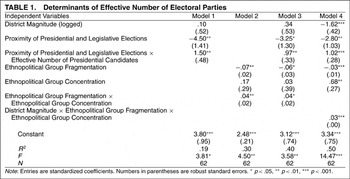
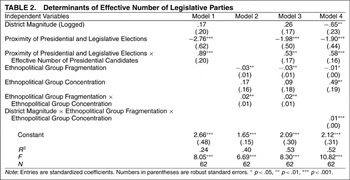
Tables 1 and 2 display the results of each set of four specifications for the Effective Number of Electoral Parties and the Effective Number of Legislative Parties, respectively. For both dependent variables, all four models are statistically significant and all independent variables correctly signed and statistically significant. The purely institutional specification (Model 1) explains 19% of the variance in the number of electoral parties and 24% of the variance in the number of legislative parties. The purely sociological model (Model 2), which tests for the independent and interactive effects of ethnopolitical fragmentation and concentration, explains 30% of the variance in the number of electoral parties (an increase of 11% over the institutional model) and 40% of the variance in the number of legislative parties (an increase of 16% over the institutional model). In Model 3, the additive effects of electoral institutions and ethnopolitical cleavages account for 40% of the variance in the electoral party system, increasing the explanatory power of the additive model by 21% over the institutional model, and 53% of the variance in the legislative party system, increasing the explanatory power of the additive model by 29% over the institutional model. The fully specified model (Model 4) explains 50% of the variance in the electoral party system and 52% of the variance in the legislative party system.
Overall, these results confirm the importance of ethnopolitical cleavages in structuring the strategic coordination among voters and candidates and in mediating the effects of electoral institutions on the structure of party systems in Africa's emerging democracies. Examination of the effects of individual clusters of variables provides additional confirmation. Models 2 and 3 confirm the importance of ethnopolitical cleavages in shaping the structure of party systems, both independently and interactively. Ethnopolitical fragmentation independently reduces the number of electoral and legislative parties in both models.7
We ran a separate equation without the interaction term to confirm the independent effects of ethnopolitical fragmentation. We do not report the results to save space.
This reductive effect, which stems from the distinctive morphology of African ethnopolitical groups that we noted above and that our data set captures, suggests that increased number of group cleavages encourages candidates to forge intergroup alliances to improve on their electoral gains. Such alliances, while improving the prospect of group cooperation, also tend to reduce the number of electoral and legislative parties. Ethnopolitical concentration, however, counteracts this reductive effect of fragmentation. For example, when group concentration is high, at 2.56, group fragmentation tends to
increase the effective number of electoral parties by .04 and the effective number of legislative parties by .03. Correspondingly, when group concentration is low at .63, group fragmentation tends to
reduce the effective number of electoral parties by −.04 and the effective number of legislative seats by −.02.
8 We derived these conditional effects of fragmentation on the number of electoral and legislative parties by calculating the value of one standard deviation of the concentration index above and below the mean value of the index and entering these values into an equation to obtain the additive and multiplicative coefficients.
This counteracting influence of ethnopolitical concentration on ethnopolitical fragmentation remains even with the addition of institutional variables in Model 3.
These important results can be explained by the role of group concentration in reducing the transaction costs of forging and sustaining group solidarity. Scholars of social movements (Tarrow 1994) have found, for instance, that unmediated communication of ideas, strategies, and resources is crucial for reducing the collective action costs of group cohesion. The effectiveness of such communication derives from the face-to-face interaction in small groups that typically constitute the larger social movements as loosely linked “congeries of social networks” (Tarrow 1994, 22). African ethnopolitical groups are not social movements, but their morphologies are conceptually similar. As described above, the combinations of cleavages among and within groups that typically characterize African ethnopolitical groups diminish the effectiveness of strategic face-to-face interaction in forging groups that are sufficiently large and cohesive to sustain political parties of their own. Group concentration, however, helps to overcome this constraint. The physical proximity engendered by group concentration facilitates the strategic face-to-face interaction of small groups, which helps to solidify the otherwise loose links among the subgroups. The associated affinity of place, moreover, helps to define the common interests of the emergent, spatially anchored larger group in electoral competition with similarly constructed groups. This process is the key to the interactive effect of ethnopolitical group fragmentation and concentration on increasing the number of electoral and legislative parties in Africa's emerging democracies. And this effect obtains with or without the effect of electoral institutions.
The variables related to presidential elections consistently demonstrate the substantial effect of the Proximity of Presidential and Legislative Elections in reducing the number of electoral and legislative parties, reproducing in Africa the almost-universal tendency of presidential regimes to constrict the structure of party systems. But, just as consistently, the interaction of proximity and the Effective Number of Presidential Candidates counters this effect, indicating, for the reasons detailed above, the importance of ethnopolitical cleavages in shaping strategic entry as well as voter behavior in presidential elections (Cox 1997, 211).
District magnitude, widely acknowledged as the decisive institutional variable in shaping the structure of party systems, has no independent effect (Models 1 and 3). This unexpected result may reflect the workings of weakly institutionalized electoral systems, but it also indicates the effect of context. The two, of course, are not mutually exclusive. District magnitude is a hard constraint to which political actors must strategically adjust. In emerging democracies, however, political actors' limited knowledge and understanding of institutional incentives and the salience of ethnopolitical cleavages as alternative incentive structures vitiate the expected strategic consequences of district magnitude, but without totally removing its mechanical effects. In other words, candidates and voters in emerging democracies rely on familiar cues of ethnopolitical affiliations for cost-effective coordination of electoral strategies, but district magnitude may still mechanically exert a moderating influence. This is why we test for the joint effects of institutional and contextual variables (Models 3 and 4). This test shows that district magnitude does have a significant effect, but only in interactive combination with ethnopolitical cleavages. In the additive Model 3, for instance, district magnitude has no independent effect on the number of electoral and legislative parties. But in the fully specified Model 4, which includes an interaction term measuring the product of district magnitude and the two ethnopolitical cleavage measures, district magnitude substantially reduces the number of electoral and legislative parties.9
We used the Aikaike information criterion (AIC) and the Bayes criterion to determine the superiority of the three-way interaction among district magnitude, ethnopolitical fragmentation and ethnopolitical concentration over the two-way interaction between district magnitude and each of the two ethnopolitical cleavage measures.
Large district magnitudes tend to reduce the number of parties if ethnopolitical fragmentation is high and ethnopolitical concentration is low, as exemplified by South Africa, but they tend to increase the number of parties if both fragmentation and concentration are high, as exemplified by Benin. In South Africa, ethnopolitical groups are highly fragmented (fragmentation index = 7.89) due to substantial cleavages among the nine groups that comprise the majority African population as well as among the English-speakers and the Afrikaners that comprise the White population. They are also spatially dispersed (concentration index = 1.6).10
The Asians and the Coloreds, the other two ethnopolitical groups in South Africa, are not internally divided. For comparative reference, the mean, median, and range of the fragmentation indices for the 34 countries in our data set are 4.38, 3.92, and 1.0–9.91, respectively. The corresponding values for the concentration indices are 1.60, 1.84, and 0.0–3.0, respectively.
However, the continued strategic importance of race as a cost-effective basis of electoral mobilization diminishes the political significance of intragroup cleavages among African voters, while White voters typically tend to divide their votes among several smaller parties. As a result, the average effective numbers of electoral and legislative parties in South Africa over two elections are 2.2 and 2.2, respectively, even though the average district magnitude is 40 seats and the allocation rule is the highly proportional Largest-Remainder Droop formula.
In Benin, ethnopolitical groups are only slightly less fragmented than in South Africa (fragmentation index = 7.30), but they are also more geographically concentrated, principally in the administrative provinces that form the electoral districts (concentration index = 3.0). Combined with an average district magnitude of 11 seats and with the highly proportional Largest-Remainder Hare formula as the allocation rule, this concentration has fostered correspondingly fragmented party systems, with the average effective numbers of electoral and legislative parties at 13.0 and 7.0, respectively.
Finally, even moderate levels of geographical concentration of ethnopolitical groups tends to offset the expected constraining effects of ethnopolitical fragmentation and small district magnitudes on the number of parties, as exemplified by Kenya and Malawi. In both countries, seats are allocated by plurality formula in single member districts. But in Kenya, which has a fragmentation index of 9.5 and a concentration index of 2.3, the effective numbers of electoral and legislative parties are 4.3 and 3.0, respectively. In Malawi, which has a fragmentation index of 5.8 and a concentration index of 2.8, the effective numbers of electoral and legislative parties are 2.8 and 2.8, respectively.
The influence of district magnitude on the structure of party systems in Africa's emerging democracies thus reflects a complex pattern of interaction with ethnopolitical cleavages. Large district magnitudes tend to reinforce the reductive effect of highly fragmented and spatially dispersed ethnopolitical groups on the number of parties. Large district magnitudes tend to reinforce the expansive effect of spatially concentrated but otherwise fragmented ethnopolitical groups on the number of parties. And small district magnitudes tend to reduce the number of parties when ethnopolitical groups are fragmented but tend to increase them when ethnopolitical groups are spatially concentrated.
Comparing the Effects of ELF and PREG Indices
To test if the two alternative measures of ethnic heterogeneity, the ELF and PREG indices, improve on our measures of ethnopolitical cleavages in explaining variations in the number of electoral and legislative parties in Africa's emerging democracies, we substituted them for our measures in the fully specified Model 4, excluding ethnopolitical concentration because the two indices do not measure it. The results, not reported here to save space, show that the two indices have no significant effect, independently or interactively with district magnitude. The proximity of presidential and legislative elections and its interaction with the effective number of presidential candidates wholly account for the variance in the number of electoral and legislative parties.
The nonsignificance of the ELF index is not surprising. The index measures ethnic heterogeneity by indicators of social cleavages, such as language, but not every objective indicator of social cleavage possesses intrinsic political salience. Indeed, most conventional ethnographic indicators, including, especially, language and religion, have not acquired the political salience in contemporary Africa that they have elsewhere (Mozaffar and Scarritt 1999). The PREG index, which is otherwise premised on constructivist logic, was nonsignificant for two possible reasons. First, the PREG index was designed to explain the potential impact of ethnic heterogeneity on the lack of economic growth in Africa, and not on electoral outcomes. Thus the levels of ethnopolitical cleavage captured by its Counts A or B may not necessarily be the most relevant ones in electoral politics. Second, it does not measure ethnopolitical concentration, which in our analysis consistently counteracts the impact of fragmentation.
CONCLUSION AND IMPLICATIONS
Our results demonstrate that, in Africa's emerging democracies, both electoral institutions and ethnopolitical cleavages shape the structure of party systems, but not reflexively. They do so contingently and strategically. Our results thus point up the need to replace the misconstrued institutions-or-cleavages debate in the comparative literature on party systems with a more analytically sound theoretical specification that privileges neither institutions nor cleavages but allows for systematically sorting out their independent and joint effects. Our results also demonstrate that ethnopolitical cleavage measures based on constructivist specification of ethnopolitical groups improve on explanations that utilize measures of ethnic heterogeneity based on primordialist specification. Our results thus underscore the importance of systematic incorporation of constructivist insights in comparative research agendas.
Finally, our results demonstrate the significance of both ethnopolitical fragmentation and ethnopolitical concentration, the latter heretofore unexamined in comparative scholarship, in influencing the number of electoral and legislative parties in Africa's emerging democracies. In particular, they clarify the complex ways in which the two cleavage dimensions independently and interactively with each other and with electoral institutions shape the structure of party systems. By influencing the effective number of presidential candidates, ethnopolitical cleavages moderate the reductive effects of the proximity of presidential and legislative elections on the number of parties, encouraging the formation of electoral alliances between major presidential contenders seeking electoral victory and minor ones controlling critical blocs of votes that can secure it. By counteracting the reductive effects of ethnopolitical fragmentation, moreover, ethnopolitical concentration helps to increase the number of electoral and legislative parties, expanding opportunities for electoral competition and political representation. But district magnitude limits excessive party system fragmentation due to this expansive effect. It reinforces the reductive effect of ethnopolitical fragmentation, enabling geographically concentrated voters voting as a bloc to increase the number of electoral and legislative parties. But it interacts with both cleavage dimensions to offset excessive party system fragmentation.
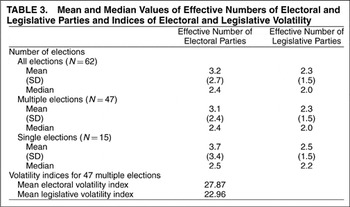
These complex relationships between electoral institutions and ethnopolitical cleavages have fostered in Africa's emerging democracies electoral and legislative party systems that are characterized by relatively low levels of fragmentation. For example, the data in Table 3 show that for all 62 elections in 34 countries that we analyze, the mean values of the effective numbers of electoral and legislative parties are 3.2 (SD = 2.7) and 2.3 (SD = 1.5) parties, respectively; the corresponding median values are 2.4 and 2.0 parties, respectively. For 47 multiple elections in 19 countries, the mean values for effective numbers of electoral and legislative parties are 3.1 (SD = 2.4) and 2.3 (SD = 1.5) parties, respectively; the corresponding median values are 2.4 and 2.0 respectively. And for 15 single elections in 15 countries, the average effective numbers of electoral parties and legislative parties are 3.7 (SD = 3.4) and 2.5 (SD = 1.5) parties, respectively; the corresponding median values are 2.5 and 2.2, respectively. This remarkable convergence of Africa's emerging democracies around some semblance of party system stability obtains even in the face of high levels of underlying electoral and legislative volatility. For example, the data in Table 3 also show that for the 47 multiple elections (ranging from 2 to 5 elections), the mean electoral volatility index (based on votes) is 27.87 and the mean legislative volatility index (based on seats) is 22.96.11
We use Pedersen's (1983) volatility index, which is calculated by adding the net percentage change in the votes (or seats) won by each party from one election to the next and dividing the sum by two.
These indices are comparatively lower than those reported for new democracies in post-World War II western Europe and in southern Europe in the 1970s but are roughly comparable to those reported for the new democracies in Latin America in the 1980s and in the former communist states in eastern Europe in the 1990s. In all these new democracies, moreover, high electoral volatility coincides with high party system fragmentation (
Bielasiak 2002). That high electoral volatility coincides with low party system fragmentation in Africa's emerging democracies is thus a paradox. Our analysis suggests three reasons for this paradox.
First, because of the manifest programmatic and organizational weakness of African political parties, candidates rely principally on ethnopolitical group support to win. But, because of intergroup and intragroup cleavages, few African ethnopolitical groups possess sufficient numerical strength and internal cohesion to propel a candidate to victory on their own. Candidates, therefore, forge ethnopolitical coalitions to secure victory in each election. However, because of the very morphology that encourages them in the first place, these election-specific coalitions tend to shift from election to election, increasing electoral volatility. Second, because characteristic problems of limited information about new electoral institutions and the extent of electoral support in postauthoritarian democracies vitiate the constraints of strategic barriers to entry in electoral competition (Cox 1997, 151–72), excessively large numbers of candidates and parties, most lacking even minimum levels of electoral support, compete in democratic elections in Africa's emerging democracies. This typically results in a highly skewed vote distribution, with a small number of candidates and parties winning by substantial majorities, in high levels of electoral volatility, in the emergence of a small number of electoral and legislative parties, and hence in relatively concentrated party systems. Finally, these two reasons suggest a curvilinear relationship between ethnopolitical fragmentation and the structure of party systems in Africa's emerging democracies. Low fragmentation correlates in a straightforward way with a small number of parties and low party system fragmentation. High fragmentation encourages the formation of intergroup coalitions that also help to reduce the number of parties and party system fragmentation. But moderate levels of fragmentation, combined with the countervailing effect of concentration, increase the number of parties and party system fragmentation, with district magnitude exerting an additional moderating influence to diminish the prospect of excessive increases in both. The complex interaction of electoral institutions and ethnopolitical cleavages thus structures the conversion of electoral volatility into concentrated party systems in Africa's emerging and unconsolidated democracies.
What are the implications of our analysis for the stability of these democracies? We conclude with three speculative answers. First, both the dominant multiethnic pattern of ethnopolitical cleavages captured by our data set and the resulting structures of electoral and legislative party systems revealed by our data analysis are generally conducive for democratic consolidation. The multiethnic pattern of ethnopolitical cleavages exerts pressure toward the formation of multiethnic electoral coalitions that, in turn, engender party systems without excessive fragmentation. Such party systems facilitate the formation of multiethnic governing coalitions. Second, to the extent that elections remain the principal legitimate source of forming and changing governments, increasing information on the effects of electoral institutions and the extent of electoral support engenders a learning process for both voters and candidates that is likely to improve the prospect of strategic coordination among competing ethnopolitical groups over a small number of winning candidates.12
This will also help to lower the current high rate of electoral volatility and the associated cost of forming multiethnic coalitions in each election.
Finally, our analysis suggests that no intrinsic antipathy exists between ethnopolitical diversity and democratic stability in Africa or, for that matter, elsewhere. Claims of such antipathy typically posit a reflexive relationship between ethnicity and democracy that is grossly misconstrued, rests on the fundamentally flawed primordialist conception of ethnicity, and reflects an odious one-dimensional view of ethnic identities. Our data and analysis show, instead, that clarifying the relationship between ethnicity and democracy requires (a) conceiving ethnicity as a strategic resource that is contingently politicized and (b) paying close attention to variations in the configuration of resulting ethnopolitical cleavages. Democratic stability is typically threatened when ethnopolitical cleavages reflect the configuration of deeply divided societies in which two internally cohesive, sharply polarized, and spatially mixed groups are implacably arrayed against each other, as exemplified most brutally in contemporary Africa by Rwanda and Burundi.13
But Comoros and Djibouti, with similar ethnopolitical configurations, have not experienced similar brutality or violence.
Our data and analysis reveal, however, that ethnopolitical cleavages in the other 38 African countries manifest a predominantly multiethnic configuration engendered by the combination of salient intergroup and intragroup cleavages.
14 Multiethnicity, in fact, is the dominant configuration even in the eight countries in which ethnopolitical cleavages were either previously, or can potentially be, transformed into deeply divided configurations: Benin, Equatorial Guinea, Guinea-Bissau, Mauritania, Nigeria, Sudan, Tanzania, and Uganda. For a conceptual distinction between, and measurement of, multiethnic and deeply divided societies, see Mozaffar (2001).
Within the dominant multiethnic configurations of African countries, therefore, variations in the incidence and interaction of ethnopolitical fragmentation and concentration, and in the interaction of these two cleavage dimensions with electoral institutions, offer partial but crucial insights into, as well as reasons for cautious optimism about, the relationship between ethnopolitical diversity and the prospective stability of Africa's emerging democracies.






Comments
No Comments have been published for this article.