In 1770, Roux Brothers, a prominent merchant house from Marseille, had thirty-seven main correspondents in Carcassonne, one of the main wool cloth-making towns in France, 300 kilometers from Marseille. Like all prominent merchant houses, Roux carefully sorted the letters that it received: these thirty-seven correspondents were deemed important enough to be singled out by Roux employees from the “miscellaneous correspondents” file for Carcassonne. The oldest correspondent, the firm Astoin, had sent its first letter to Roux in 1728, but most of the other first letters date back to the 1760s. Only nineteen of the thirty-seven still exchanged letters with Roux after 1780. In the 1770s, twenty-one new Carcassonne correspondent files were created, six of which were inactive by 1780. On the other side of the Atlantic, in Saint-Pierre, one of the French ports in the Caribbean, Roux conducted different activities but with a similar turnover among its correspondents. In 1770 the firm had eleven correspondents (Marc Diant was the longest-term correspondent, dating to 1736), only four of which still exchanged letters with the firm by 1780; in the 1770s, new files were opened and closed for four other houses. When a successor firm with a partly different company name (e.g., one of the associates had retired and been replaced) continued writing to Roux without interruption, we did not consider it as a new correspondent.
This overview certainly testifies to the brief lives of many general partnerships: the legal status of the overwhelming majority of merchant firms at the time, including Roux’s correspondents.Footnote 1 Correspondents came and went because partnerships were created and dissolved as partners died, moved away, or retired. However, this is not the only reason why Roux had so many correspondents yet received few letters from most of them. First letters were not always answered; they did not always prompt a transaction, let alone a long-standing relationship.
Letters from merchant houses have always been central to the study of their business. In addition to providing a particularly interesting source for historians, they form the very medium of most of this business. The letters conveyed information on products, markets, and political context, as well as on the reputation of other houses; they were often the only available source, and generally the fastest way to send or receive this type of information.Footnote 2 Many letters also included orders, thereby creating proof of contracts and property rights that would be admitted by some, if not all courts.Footnote 3 Correspondents were indeed trading partners, or potential trading partners. We do not consider here the letters exchanged between partners belonging to the same firm, or between the head of a firm and one of its factors (an employee of the firm who managed a branch in a different location). This study focuses on separate firms that wrote to Roux in order to trade with them, that is, to act as a commission merchant, or to buy, ship, or sell goods on their own account, or to engage in a financial transaction, or to ask Roux to do so. Some of those firms were already in business with a correspondent of Roux’s, while others sent “cold-call” letters, as we would say today, not even mentioning a common acquaintance. What all those firms had in common was that they had never written to Roux before, and they all offered commercial or financial services: those are the two criteria that defined the letters studied here.
On the basis of the existence and content of merchant correspondences, historians have defined the notion of “merchant networks”: stable arrangements of firms (mostly partnerships) that often traded with each other, thereby mitigating the issues of information and trust that were particularly prevalent in long-distance trade. Following this literature, we use the word network to denote the correspondents of a merchant house and use merchant networks to describe the many overlapping sets of correspondents that existed at that time. This substantive definition differs from the technical one used in social network analysis, where a network is a set of ties and non-ties of any type.Footnote 4 Although many researchers still take for granted the idea that, in the early modern period, such networks were overwhelmingly based on family ties or shared religion or ethnicity, various studies have revisited this claim over the last two decades. Truly global trade would have been inaccessible for houses that limited themselves to such “ascribed ties.” Information on commercial opportunities circulated thanks to bridges (non-ascribed ties) between communities. Sources also show that even between nearby locations, trust in correspondents was mostly process-based, meaning it relied on repeated and often reciprocal exchanges over time rather than on preexisting ascribed ties. Repeated exchanges functioned as tests to reassess a correspondent’s trustworthiness and to create a bond, a routine, or even emotional connections that made a change of partners more costly.Footnote 5 In his study of account books, Pierre Gervais confirmed that these books were used to monitor closely (credit) relationships, much more so, in his view, than to maximize profit. The daily work of a merchant very much consisted in nurturing non-ascribed ties or in ending early enough those that would endanger the credit of his house.Footnote 6
Nevertheless, researchers have dedicated little empirical attention to the first stage of this networking activity, namely the first exchanges of letters that resulted—or not—in the establishment of a new correspondence and in a series of commercial or financial transactions. “In acknowledging the advantages of network analysis, business historians have been more concerned with understanding the way networks operate than with analyzing the factors that lead to the creation of new links.”Footnote 7 The importance of this stage was well known at the time. In 1773 Barthélémy Fornier, a merchant in Nîmes, wrote to his brothers who ran a firm in Cadix in which he was a limited partner: “The trust and assiduousness of correspondents depend on the beginning of the correspondence, and the way one follows it—more than on the best information and recommendations, which are only useful to write the first letter.”Footnote 8
Fornier thus stressed two points. A first letter, or rather an efficient first letter, could not exist without information and recommendations—according to him, a cold-call letter would never succeed. Historians often concur on this point. Even if merchant networks were not limited to those belonging to one same family or diaspora, meeting in person before becoming correspondents was useful. If that was impossible, recommendations by a mutual acquaintance could at least offer a foundation for trust. As Silvia Marzagalli put it, “Eighteenth-century transatlantic trade relations were built on personal ties because there was no alternative,” because information on potential sellers, their quality of merchandise, services, and prices was not publicly available.Footnote 9 Fornier indeed saw recommendations as one of two things that were useful in a first letter. His second point, however, was that it was more important to “follow the correspondence” in the right manner—in this letter and in those that followed. What was this right manner? Fornier’s elliptic sentence seems to allude as much to the proper execution of the first transaction as to the actual writing of the letters. Historians of merchants, while emphasizing the importance of recommendations, also hint at the importance of the command of correct merchant style, which had equivalents in all languages and allowed the intelligible communication of reciprocal commitments.Footnote 10
Could this command allow merchants to entirely dispense with recommendations? Or could good products and prices altogether trump the effect of good writing? This is an important question, because the ability to write a correct first letter arguably became more and more accessible in the eighteenth and nineteenth centuries. In the late eighteenth century, almanacs published the names and specialties of merchants in each town, making it easier to learn whom to write to, beyond acquaintances of acquaintances.Footnote 11 Handbooks for merchants had long focused on the technicalities of change, accounting, and law, but they gave little advice on writing per se—merchant style had emerged from centuries of practice and merchants learned it on the job. Nevertheless, from 1800 onward, merchant handbooks and general correspondence handbooks began to give models of letters explicitly aimed at establishing business relationships.Footnote 12 Could anyone try to become a correspondent, and succeed if they were honest and offered the right goods? In other words, did merchant networks become more open and more impersonal, if not in their daily workings—given that a network of correspondents is not an anonymous market—then at the point of entry? This would, of course, confirm theories of modernization.Footnote 13
There are many reasons to doubt that this modernization was linear. On the one hand, Silvia Marzagalli has explored the context of wars and revolutions around the 1800s, which increased uncertainty and forced merchants to explore new routes. She concluded, “Although the general trend in risk management was toward reinforcement of institutional arrangements and the establishment of more impersonal relations among businessmen, merchants reverted to older practices.”Footnote 14 Here, Marzagalli supports the opposition between an old and a new regime of commerce, but surmises that an old regime reappears in uncertain times. On the other hand, historians and sociologists have shown that personal and impersonal relationships were often used together, rather than as substitutes of one another, in merchant practices from the 1800s to the 2000s, thus shedding doubt on the general narrative of modernization.Footnote 15
Our research addresses such questions on the resources mobilized by merchants to establish new correspondence relationships by using the archives of two merchant houses established in eighteenth-century France. More precisely, we studied first letters found in the archives of Roux Brothers (230 correspondents, writing from 1728 to 1840, but mostly before 1820). For comparative purposes, we also studied those of Greffulhe Montz & Cie (94 correspondents, writing from 1789 to 1795, but mostly from 1789 to 1792). This was when the firm was one of the leaders of Parisian banking, which had not yet been too heavily disrupted by the revolution. Our definition of a “first letter” is one that did not follow a previous letter between two houses and included offers of services, however elusive. Note that many of these first letters were sent in thanks to some kind of preexisting relationship.Footnote 16
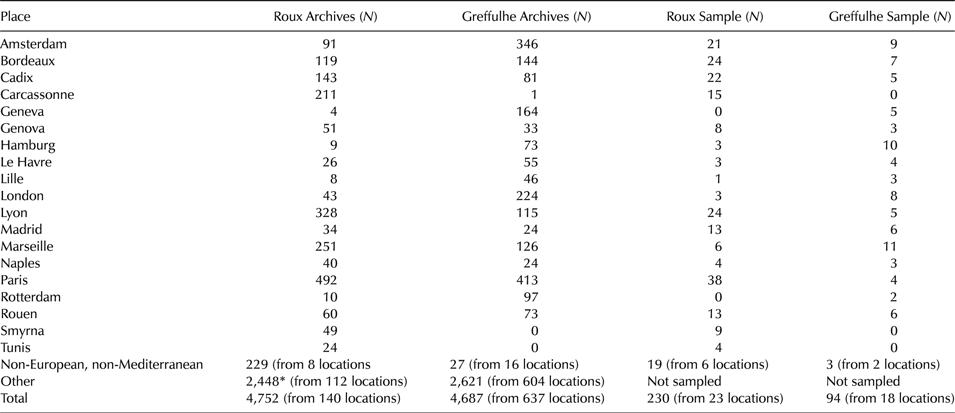
Roux Brothers was, like almost all European firms at the time, a general partnership with few direct employees. It existed under several company names from 1728 to 1841; as successors of Bruny & Cie, they immediately reached the top of the merchant elite in Marseille, which they never left. They traded with the Levant, where Roux established a limited partnership in the 1760s, exported French wool cloth and American goods and imported cotton and spices. Roux also did business directly with the French sugar islands in the Caribbean and through Cadiz with the Spanish Empire, with imports of sugar, coffee, silver, and tinctures, and with exports of French silk and wool cloth. Roux traded in the western Mediterranean, mostly but not only with Barcelona, Genoa, and Tunis to trade wine, corn and oil. To buy some of the goods sold there, and for financial operations, Roux had correspondents in many other countries in Europe—with a distinct bias toward Southern Europe—and the Mediterranean (Table 1). The Roux Archives contain letters written by approximately 4,750 correspondents from 140 different cities and towns; more than 1,300 were sorted by the firm into distinct files while other letters were bundled as “miscellaneous correspondents.”
Geographical distribution of correspondents in the Roux and Greffulhe archives and our samples

Note: Authors’ calculations based on Roux and Greffulhe Archives. For both Roux and Greffulhe, some correspondents were not merchants but wealthy individuals who used a firm’s financial services. They are included in total numbers of correspondents, but were excluded from our sample according to our definition of “first letters.”
* For Roux, the number of correspondents in Other locations is an estimate based on the total number of separate files for those locations and the share of “miscellaneous correspondents” (those without a separate file) for the locations that we sampled.
Greffulhe Montz & Cie, formed in 1789, also took over from a well-established firm, Parisian bankers Girardot Haller & Cie—Louis Greffulhe had previously worked in finance in Amsterdam. It remained an investment bank, which at that time meant that it carried out payments and collections, accepted bills of exchange and overdrafts for authorized clients, and supplied the commercial papers required by its clients. It had almost 5,000 distinct correspondents for the period 1789 to 1795, in just under 640 small towns and large cities throughout Europe and sometimes oversea, most of them in France, the Netherlands, Switzerland, and various German states. Its clients were not only businesses but also wealthy individuals who used Greffulhe to recover annuities (that correspondence is not considered here). Greffulhe Montz & Cie was one of the pillars of European Protestant banking, but its network of correspondents does not seem to have been restricted by religion.
Both firms were clearly part of the mercantile elite. In comparison with other merchants and merchant bankers, they were present in quite diverse markets, although continental Europe and the Mediterranean remained their primary focus, with Roux trading in manufactured goods as well as commodities, whereas Greffulhe leaned toward banking for the nobility (not just merchants) and traded less in manufactured goods.Footnote 17 The two houses do not appear to have made elitist choices that would have limited their businesses to a select few correspondents whom they considered as peers, let alone required exclusivity from their correspondents, contrary to British merchant banking houses of the early nineteenth century, such as Barings or Rothschild. Instead, they accepted the cost of monitoring large networks, which brought more opportunities and spread risk.Footnote 18 Even so, they did not engage in repeated exchanges with just any house.
The object of our study is the ways in which other merchants, bankers, and producers, small or large, in France and elsewhere, wrote to such central players to offer their services in their diverse capacities (e.g., to sell cloth, or bills of exchange, or the freight of a ship), and perhaps become steady correspondents. It would, of course, be interesting to extend this study to elite houses in other countries, as well as to less prominent firms. Our systematic methodology would be easy to replicate on any merchant archives arranged by correspondent. Interpretations on the foundations of trust and the practices of merchant correspondence are almost never backed by numbers: whereas ships and cargoes are often counted by historians, recommendations and the vocabulary of trust, for all their argued ubiquity, are not.Footnote 19 We, therefore, complemented the close reading of correspondences with the creation of a database documenting more than 100 distinct features of each letter, from the date and location of writing to the closing formulas, including, for instance, mentions of prices, phrases including words such as “trust” and “friend,” and the quality of spelling. The database documents style as well as content.
The first section of this article offers our methodology and gives precision to our sampling strategy and our working definition of “first letters.” The following sections present the three main types of first letters sent by Roux’s and Greffulhe’s correspondents. Surprisingly, letters using a previous personal acquaintance or an explicit recommendation to try to establish a correspondence were a minority, but others were not completely cold-call letters either. In a majority of letters, business proposals were neither supported by such interpersonal ties nor phrased in the exact way handbooks would have had it. Quite frequently, the establishment of a correspondence in fact relied on sending a seemingly casual letter referring to a specific commercial operation. In order to send such a letter, one certainly needed to have relational resources in the merchant world, but these resources were not used in the way generally envisioned by historical studies. Finally, a minority of letters, closer to the models provided in handbooks, tried to draw on the power of words, and the products or services that their authors offered, without mentioning any third party. For each of these types of letters, we present our definition, with examples, and investigate whether these types were associated with specific correspondents in terms of location or specialty, and whether their frequency changed over time as modernization theories would have it, moving from the first to the third type, closer and closer to the idea of a cold-call letter. In the last section of the article, we show that relational and rhetorical resources do not appear to have mattered much for the establishment by Roux of new correspondence ties; more precisely, they mattered less than this prominent merchant house’s general expansion strategy. This study of first letters sheds new light on the processes that made it possible for rather small firms to trade very diverse goods over long distances.
Methodology: Defining “First Letters”
We chose to study the archives of Roux and Greffulhe not only because we wanted to consider one prominent merchant house and one prominent bank in two different cities but also because these archives seem reasonably complete for the periods studied here—that is, a short time range for Greffulhe—and are arranged by correspondent. There is one exception in the Roux Archives: it bundles some letters by single correspondent but also bundles together some “miscellaneous correspondents” files. We read and analyzed the first five letters from each correspondent, but the quantitative results presented here are based only on the first letter from each correspondent. The archives do not include Roux’s or Greffulhe’s responses, although the existence of an answer and its date are often mentioned on the back of the letters. We also counted the total number of letters from each correspondent preserved in the archives and used this information as an indicator of their success in establishing a correspondence.
Because we wanted to study the letters in depth, we sampled the correspondents. We decided to concentrate on some cities and towns so as to preserve geographical diversity while also zooming in on certain places. This would not have been possible using a random sample of the entire archives, which would have been a rather impractical solution anyway. We chose to focus on about twenty locations. Our choice was partly arbitrary in that it would have been interesting to also include, for example, Leghorn, Lisbon, or Nantes. Our aim was to cover most banking hubs, all remote locations, and a diverse enough sample of other French and European locations. We sampled letters from:
• Six European banking hubs: Amsterdam, Genoa, Hamburg, London, Madrid, and Paris.
• Important Atlantic and Mediterranean merchant ports: Bordeaux, Cadiz, Le Havre, Marseille, Naples, Rotterdam, Rouen, Smyrna, and Tunis.
• The manufacturing or merchant continental locations that appeared most often in the archives: Carcassonne, Geneva, Lille, and Lyon. We had also listed Liverpool and Mulhouse but found no first letter (in our definition) originating from there.
• All the non-Western European, non-Mediterranean correspondents, which were mostly in Russia for Greffulhe and in the Caribbean for Roux.
For each location in each archive, we took pictures of the letters from all correspondents when there were not too many, and of a random sample when there were more than twenty-five. In total, we have photos of 1,896 first letters. We wanted to compare the writing of first letters in different locations; hence our initial sampling strategy. We deliberately overrepresented the locations in which Greffulhe or Roux had few correspondents (such as Lille or Naples) and underrepresented those in which they had many (such as Paris for both firms, Amsterdam for Greffulhe, and Marseilles for Roux). We refer to this initial sample as our “complete” sample in the article. The present article, however, treats Greffulhe’s and Roux’s entire passive correspondences as aggregates in which we tried to uncover patterns, such as changes over time in the use of recommendation letters. This required a geographically representative sample. We did not want to overemphasize, for example, evolutions that would have happened mostly in Lille or Naples. Therefore, the article is, for the most part, based on a subsample of 971 first letters with the same geographical distribution between the locations we took into account as the whole archive group. It can be considered a reasonably good sample of Roux’s and Greffulhe’s complete networks of correspondents. In order to create this subsample, we randomly selected a smaller number of letters for the locations that had been overrepresented at the photo-taking stage (such as Lille and Naples). The main results of this article are also found in the complete geographically nonrepresentative sample.
When we began to categorize our material, we encountered an unexpected problem: two-thirds of the “first letters” that we had initially photographed—meaning the letters situated at the beginning of an archival bundle—turned out, when we read them, not to be first letters at all. We did not discard any such letter because it showed that the correspondents already knew each other. This was one of the points that we wanted to investigate: Did people begin to write because they had met each other in person? Still, we were faced with “first letters” that either explicitly referred to previous letters or were written in such a way that they were obviously part of an ongoing correspondence. This is probably explained by the history of these archives, which we were not able to reconstruct in a satisfactory manner.Footnote 20 Therefore, we decided to consider only as “first letters” those that included offers, however implicit, to establish or continue a commercial relationship. If, for example, a firm abruptly asked Greffulhe to recover a sum but wrote nothing more, we hypothesized that they had already written to each other. However, for some reason, those letters were missing or classified elsewhere in the Greffulhe Archives. If, however, the same abrupt letter ended with the firm offering services to Greffulhe, we considered it as a genuine first letter. We did this both when the offer was explicit (e.g., “We take this opportunity to offer, Sirs, our services here, with insurance that your orders will be followed without reservation”)Footnote 21 and when it was vague (e.g., “We hope that you will continue to trust us”). We knew from the close reading of many letters that this type of vague yet standard clause was used even when the sender had never interacted with the addressee. Our sample of 324 first letters is therefore, in fact, a sample of first letters making offers of services, however elusive, which is appropriate for our research questions. As the percentage of such first letters varied between locations, the geographical distribution of our final sample does not exactly match that of the complete archives (see Table 1). For example, Greffulhe had many correspondents in Paris but received few offers of services in the period that we studied here; they were mostly ongoing correspondences. The same is true for Roux in Marseille.
Explicitly Using Personal Acquaintances
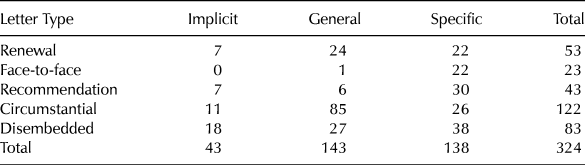
In light of the secondary literature, we expected to find recommendation letters to be the most frequent epistolary type in our dataset, perhaps mixed with instances in which the two partners had already been introduced during a face-to-face meeting; for example, at a fair or when a house’s associate was traveling. In fact, we find explicit mentions of direct or indirect preexisting relationships only in a minority of cases. The explicit relational foundations of first letters are shown in Table 2. Our categories of letters include renewal, face-to-face, recommendation, circumstantial, and disembedded. At one end are the renewal letters, which is when the sender and receiver appeared to know each other the best; these occurred when one firm was a correspondent of a previous incarnation of the other firm: we consider the first letter between the two houses in their current incarnation, and it not only includes an offer of services but also builds on a relationship with predecessors. At the other end are disembedded letters, which is when we have no indication of a previous acquaintanceship and no form of recommendation or other mention of a mutual acquaintance.
Relational foundations of first letters

Note: Authors’ calculations based on Roux and Greffulhe Archives. Definitions of the categories are discussed in the text.
We now discuss the contents, styles, and uses of each of our five types of first letters, following this scale from more to less familiar correspondents. In intermediary positions on this apparent continuum, we delineated three categories. “Face-to-face” first letters are cases when we are sure that no letter was sent before, yet partners or employees of the two firms had already met in person: there was already a relationship, but it was not epistolary. “Recommendation” first letters are cases when a third party is explicitly mentioned either as having encouraged the sending firm to write to Roux or Greffulhe or as a potential informant on the qualities of the sending firm. “Circumstantial” first letters also generally mention a third party, but without such an explicit recommendation process. Those are letters that directly initiated a transaction with Roux or Greffulhe (and generally with a third party), without any prior correspondence.
Most of this typology could be derived from the historical literature on merchant networks, for example the aforementioned books by Silvia Marzagalli and Francesca Trivellato.Footnote 22 We, however, offer a new, more systematic approach, which allows us to investigate patterns of use of each type of first letter (according to periods, geographical locations, etc.) and to assess which of these letters had more chances to initiate a lasting correspondence. The results of this systematic investigation of the actual contents and uses of first letters prompted us to emphasize the differences between circumstantial first letters and those using recommendation letters—two categories that are generally confused in the literature—and to qualify the simple hierarchy of embeddedness that we just presented.
Networks and the Brief Lives of Partnerships
First, the brief lives and frequent reconstructions of partnerships have an important impact on first letters. A “new” firm writing to Roux or Greffulhe would sometimes be the successor of one of their correspondents. We tried to avoid including such cases by ignoring “new” correspondents who, according to finding aids, clearly appeared as direct successors of previous correspondents. However, we still found fifty-three “first letters” in our sample that were intended to revive a preexisting relationship. Twenty of these, which had escaped our initial scrutiny, were letters sent by firms that had taken over from past correspondents; the others were first letters sent to a new incarnation of Roux (which had four different names during the period considered) or, mostly, to the new firm Greffulhe Montz & Cie at the time when it replaced Girardot Haller & Cie in 1789.Footnote 23 We disregard these “renewal” letters in the remainder of the article, because our sampling scheme originally excluded them; therefore, they are not representative. Their contents, however, proved quite interesting: these renewal letters did not “repeat” the sender’s service offers, as was routinely done when writing to established correspondents, but instead made the same type of offers as non-correspondents. In fact, they do not differ in style or content from printed circular letters sent by successors of houses that had not been Roux’s or Greffulhe’s correspondents. Such letters gave brief details of the old and new partnerships before they expressed generic offers. The details were mostly the names of the associates who could serve as implicit recommenders, and often a statement that business would continue without any changes.
This use of circular and renewal letters shows how merchant correspondence, among other purposes, helped mitigate the transience of partnerships.Footnote 24 Any change had to be notified, and services had to be offered in the same way as they were for a new correspondent. Lists of correspondents were transmitted, so that the network did not have to be regularly rebuilt from scratch. This would have made it easier for the successors of a correspondent to reach out to Greffulhe or Roux. For example, one of the first letters sent to Roux by a Lyonese merchant opens with this overly polite introduction—and follows up, quite atypically so, by making a specific offer rather than a generic one:
Having married the daughter of the late Mr. Antoine Diaque Lain, I saw in the books his widow gave me that he had the honor of making considerable business with you, which is why, Messrs., I have the honor of writing to you to pray you to let me know in return if it would be possible to sell advantageously in your city a few quintals of quina that I have in Cadix.Footnote 25
This commercial offer is much more specific than it would be in a printed circular letter sent to a non-correspondent; the author took advantage of preexisting trade relations with his father-in-law’s firm to not only write to Roux but also directly make a specific proposal. This tactic worked—at least for some time, because the quina deal eventually proved disastrous. In the meantime, the Lyonese merchant sent five more letters to Roux, becoming a correspondent—albeit a short-lived one—of the firm. However, this advantage brought by previously established relationships does not seem to have been a general occurrence. There is no significant difference in our two samples between renewal letters, at least those we have sampled, and other first letters in terms of these being followed by a second letter.Footnote 26 Successors of former correspondents were subjected to the same tests as those who did not have this advantage. Networks did not collapse when partners changed, yet merchants did not put blind faith in implicit recommendations by old correspondents.Footnote 27
From Travels to Letters
There is a second case of the sender’s house having already interacted with the addressee, even when only considering first letters. These are instances in which both houses kept the same company name, but representatives met face-to-face before the letter was sent. In our sample, we found only 23 such cases (7 percent in the Greffulhe Archives, not considering renewals, and 9 percent in the Roux Archives). The meeting had taken place between partners and their families in half of the cases; in the other half, a traveling salesman representing the addresser visited the addressee’s house.Footnote 28 The first letter, in such cases, only confirmed offers that had first been made verbally, in the context of a trip explicitly aimed at extending the firm’s commercial network. Traveling salesmen mostly appeared after 1780 in our data (in nine out of eleven cases), confirming that their use had only begun to spread in pioneering sectors such as the wine and silk trades.Footnote 29 Previous face-to-face meetings, through partners or traveling salesmen, are mentioned in 6 percent of first letters in the Roux Archives before 1789, but in 19 percent afterward; whereas this is generally deemed the oldest form of contact, it actually appears to have become more and more important. This is likely part of an evolution observed in the early nineteenth century, not toward less personal relationships as classical modernization theories would have it but instead toward more direct and explicit prospecting, as we show below. First letters following face-to-face meetings did not elicit significantly more (or fewer) second letters than others.
Recommendations: Relations or Rhetoric?
The third and, according to the secondary literature, most important type of use of previous acquaintances is recommendation or, more precisely, the explicit mention of mutual acquaintances (other than predecessors) who could vouch for the sender. Merchant handbooks, which increasingly singled out letters offering services as a distinct template in the early nineteenth century, did indeed place a lot of emphasis on recommendation.Footnote 30 We found forty-five such cases, including 15 percent in the Greffulhe Archives and 17 percent in the Roux Archives, not considering renewals; two letters that mention recommendations also involved face-to-face meetings, hence the small discrepancy with Table 2. It seems that, contrary to Barthélémy Fornier, such mentions of recommendations were not strictly required in a first letter. Moreover, the lack of a recommendation does not appear to have been particularly detrimental for Roux or Greffulhe; again, second letters did not follow significantly more often when there was a recommendation; if anything, they followed a bit less often than average, as was the case when the first letter referred to a face-to-face encounter.
Like templates in handbooks, some letters included the phrase “sous les auspices de [nom]” (under the auspices of [name]) in their first sentence (the phrase occurs thirteen times in our corpus, including eleven times in the first sentence; and twenty-five times, including twenty-two times in the first sentence, in our complete sample). The words “recommend” or “recommendation” were, on the contrary, seldom used. The standard phase of under the auspices indicated that a third house had mentioned Roux’s or Greffulhe’s name, address, and/or reputation to the sender, thus enabling him to write his first letter. Some merchants gave more details on this process:
• “I have had the honor of writing to my cousin Negrel, inviting him to kindly help me in seeking your protection.”
• “Mr. Charles Seirla invited us to approach you in the event of any trading opportunities.”
• “On account of the gracious offers made to me by Messrs. Diant Brothers, merchants in this island, with whom I am tightly linked.”
• “On account of the assurance given by Messrs. Ginestet & Joyaux, that you would kindly accept to insure me.”
• “Under the auspices of Messrs. Garavaque & Cusson and on account of the assurance they gave me of your diligent regard for the interests you manage.”Footnote 31
This more-or-less standard incipit often included the stock phrases, “Nous prenons la liberté de vous écrire” (We take the liberty to write to you) or “nous n’avons pas l’honneur d’être connu de vous” (We do not have the honor to be known by you). We found one or the other in thirteen letters, seven of which also included the phrase under the auspices, a statistically strong association despite the small numbers (in the complete sample, we found twenty-four cases of “taking the liberty” or “not having the honor,” eleven of which also mentioned “under the auspices”). Specialist merchants used these indications of deference more often (five out of nine cases) than others (seven out of twenty-nine cases). Recommendation letters with a standard incipit were also particularly likely to refer to the third house as “friends,” the standard way to describe commercial partners, rather than just giving its name or adding details.Footnote 32
Other recommendation letters described a slightly different process in a less formulaic way. This second type was absent among specialist merchants, but present in one-third of other first letters including recommendations. The sending firm stated—typically not in the first sentence, which generally did not include the phrase under the auspices—that a third firm could be asked for information about it:
• “Please have faith in this and in whatever Messrs. François & Augustin Guys will tell you about us.”
• “For any first information, you may reach out to Messrs. Le Couteulx & co. of Paris, Rouen, and Cadix, our common close relatives.”Footnote 33
As with mentions of previous face-to-face meetings, allusions to recommendations seem to appear increasingly over time among first letters sent to Roux (in 9 percent of letters sent before 1750, and 19 percent afterward). This difference, however, is not statistically significant. This practice did not patently spread; neither did the more standard phrase of under the auspices spread or abate (its first occurrence in our sample is found in Madrid in 1733).Footnote 34 Both rhetorical versions of recommendation were spread evenly over time in first letters, and were followed by the same share of second letters. Beyond differences in phrasing, the two types of recommendations clearly referred to the same social process: the sender mentioned the name of a third firm partly in order to show that he knew well-reputed merchants—he was somehow part of the club—and partly so that Roux or Greffulhe could check his own reputation with this third firm.
The historical literature often mixes the two processes, as it is difficult to ascertain how exactly recommendations were used by the addressees. Only two of our first letters with explicit mentions of recommendations actually enclosed a letter by a third firm recommending the sender. Most of those letters were lost, but the main text mentions that they were enclosed. In our complete sample, which includes eighty-eight recommendations, we found only seven mentions of enclosed letters.Footnote 35 Did Roux and Greffulhe specifically seek to assess the sender’s reputation by asking the persons mentioned in the letter whether they actually knew him and what they thought about him? Was a recommendation thus a process involving three distinct persons or firms, and three successive interactions, in writing or face-to-face? Or was the third party merely invoked in the letter, without directly taking part in the process? A letter sent to Greffulhe points at the fact that these interactions did not always occur: the sender, J. Jones, reminded Greffulhe that it had previously promised to recommend Jones’s London branch to correspondents of Greffulhe’s in Marseille but had not yet done so. Moreover, Jones asked that he be told exactly to whom Greffulhe intended to recommend his London branch to ensure that he could take advantage of these recommendations.Footnote 36
We could imagine that, reading the formulaic recommendations listed above, Roux would act under the assumption that they told the truth, perhaps only to sanction the sender harsher if it later transpired that the Diant Brothers, for example, did not in fact trust him. When the recommendation involved people with whom Roux routinely exchanged letters, such as Garavaque & Cusson, it was easy to casually take the opportunity to check about the sender with them. When the recommender was a mere acquaintance of the addressee, however, it is likely that nothing was verified. In our sample, the senders who mention a recommendation to Greffulhe clearly specified that Greffulhe knew this house or person only in two out of nine cases; for Roux, this specification appears in just under half of the cases, and our database allowed us to verify that the names cited were indeed those of correspondents of Roux’s. This left us with many cases in which the recommendation would probably have had less weight. Interestingly, in our sample all but one letter that mentioned actual correspondents of Roux as recommenders was sent before 1789; this is a significant difference between periods, despite the small numbers. However, not mentioning a correspondent but instead another third party did not statistically influence the continuation of the correspondence. It is very clear from the correspondence of merchants and bankers that they often wrote to their regular correspondents to inquire about the reputation of prospective partners, as is logical, in the absence of credit records or other public sources of information. It is, however, quite possible that they would have written to the correspondent whom they trusted the most in each location, rather than to the person cited by the prospective partner.Footnote 37
It is therefore likely that the often formulaic clauses of recommendation, especially after the 1780s, did not signal a reliance on interpersonal ties as much as a respect for epistolary conventions. Our research calls for a more precise study of recommendations, which would not necessarily be interpreted as symptoms of the interconnectedness of the merchant world; that is, the fact that it was relatively closed to outsiders and relied on shared social norms that placed a heavy emphasis on actual interpersonal interaction. Some types of recommendation rather look like the expression of shared conventions: what mattered was being able to mention names in the proper way, regardless of the exact underlying relationship.
Finally, whereas recommendations are often considered in the literature as a central resource among insiders and firms with established networks, our data paints a different picture. Among those who wrote to Roux, recommendations were in fact used slightly more frequently by relative outsiders; that is, those who could not be recognized as genuine négociants (generalist merchant-bankers). We found them in 26 percent of letters sent by specialized merchants (those who explicitly stated that they traded in just one or two different products), manufacturers, transporters, and so on, whereas just 15 percent of non-specialized merchant-bankers mentioned recommendations; it should be noted this difference is not significant in our small sample. There is a significant difference, however, between locations. Letters from extra-European ports, that is from the Caribbean (mostly Saint-Pierre de la Martinique; two of the recommendations quoted above originated there), Smyrna, and Tunis, included more recommendations than other letters (30 percent to 15 percent, respectively). Recommendations seem to have been used chiefly by those located at the farthest geographical or social distance, in order to reach in. However, this strategy did not prove particularly successful. Specialized merchants, however recommended, only sent a second letter in one out of three cases; the proportion was two out of three for merchants writing from more remote places, but similarly, recommendations did not improve this number. None of this holds in the case of Greffulhe in the early 1790s: this house did not receive any letters ostensibly emanating from specialized merchants, and it only received three non-European letters (without recommendations). Outsiders do not seem to have even tried to establish ties with the bank, perhaps due to the uncertain political context. Face-to-face and recommendation letters in Greffulhe’s correspondence were followed significantly less often by second letters than other types of letters.
In aggregate, our results point to a less central use of recommendation letters than generally presented in the literature. This does not imply, however, that merchants did not use preexisting connections to extend their networks. They were definitely not impersonal sellers of standardized products, yet the exact way in which they networked deserves a careful analysis.
When Writing Is Already Doing Business
However, many first letters that did not include an explicit recommendation did contain names of firms. Renewal and recommendation letters were not the only ones that used third parties as foundations, especially to establish the good reputation of the sending firm. Names also appeared in situations that were extremely prevalent in our sources, yet that have seldom been discussed in the literature: first letters that testified to an already ongoing transaction involving the sender and the receiver, generally along with a third firm. These are what we call circumstantial first letters. Two of the most prolix correspondences of Greffulhe and Roux, for example, began in this way.
First Letters Beginning in media res
In the first of 128 letters sent to Roux, Jacques Gough & Cie in Cadix abruptly began by stating that they had received, through Captain Charles Paillera, a bill of lading for two boxes of silk sent by Roux, as instructed by Gough’s “friend” Bertrand Forsans from Bayonne (the silk, in fact, had arrived before the letter from Bayonne announcing it). The letter went on to discuss insurance details for the boxes, and included a bill of lading for Mexican piastres (silver) sent to Marseille by coach pour compte et risque (for account and risk) of Gough’s brother Edouard, in Paris. This could look like a letter taken from the middle of a correspondence were it not for the last sentence: “We hope that these beginnings will offer us the opportunity to be of use to you here.” Although general, this is in fact a typical offer of services in such a first circumstantial letter.Footnote 38 Jacques Gough & Cie seemed particularly eager to trade with Roux: it sent two more letters within two months, mentioning other merchandise. Roux answered each of them, however belatedly, and this was the beginning of a long correspondence.
Similarly, in the first of 87 letters written to Greffulhe between 1791 and 1795, the Bordeaux firm of Guillaume Coppinger Father & Son seemed to begin in media res, remitting a bill of exchange for 828 livres, 13 sols, and 6 deniers, drawn on Greffulhe for the Marseille firm of Bouillon, Katter & Cie (the ultimate payer), as instructed by their “friends” at Vandenyver Brothers & Cie (the ultimate beneficiary of the transferred sum). The letter went on with general complaints about the “unfortunate” political situation in Saint-Domingue that had led to an increase in the prices of colonial goods, and quoted currency exchange rates in Amsterdam, London, and Hamburg with a short comment, before concluding: “We offer you our services.”Footnote 39 Greffulhe and Coppinger soon undertook to speculate on currency arbitrage together.
As with these two letters, 57 percent of our first letters, including renewals, contained precise orders referring to ongoing transactions. In 84 percent of such cases in the Greffulhe Archives and 30 percent in the Roux Archives, the transactions were financial: the sender informed the receiver that a bill of exchange had been drawn on him, or the house sent a remittance to be recovered by Greffulhe or Roux. The other letters had to do with rent, armament, insurance, or mostly consignment sales of merchandise in which the sending firm informed Roux or Greffulhe that it had either consigned or received the goods.
For the most part, these were not transactions that had been first discussed orally and then formalized in writing; this would fall under our face-to-face category. Only a handful of cases mentioned such a process. Similarly, a minority of letters that mentioned ongoing transactions also referred to predecessors or included explicit recommendations such as the ones discussed above. Half of the letters that mentioned ongoing transactions in the Greffulhe Archives and three-quarters in the Roux Archives included no explicit mention of a face-to-face meeting or recommendation. It is clear, nonetheless, not only from their placement in the archives but also from their wording—which included offers of services—that those were indeed first letters to Greffulhe or Roux.
Despite the advice in the handbooks, it was possible to dispense with almost all formalities and begin business straightaway in a first letter. This was the case in about 45 percent of first letters received by both Roux and Greffulhe, excluding renewals: circumstantial first letters were the most frequent type (see Table 2). They were not specific to one type of location or another but were from everywhere. The historical literature has not yet paid specific attention to circumstantial first letters because they are devoid of the obvious rhetorical markers that would have scholars take note, because they recognize either a recommendation or a prospective first letter inspired by a handbook. The offers of services in circumstantial letters are generally more subdued, as if added as an afterthought, and the general style of circumstantial letters is less remarkable. It is only because we systematically tried to assess the relational foundations of each first letter that we discovered this less visible but fundamental institution of early modern long-distance trade.
The Circumstantial First Letter: An Institution of Long-Distance Trade
Circumstantial first letters neither mentioned a previous direct acquaintance between the sender and Roux or Greffulhe nor an explicit recommendation by a third party, even though they relied on relational resources. In fact, what this category shows, even better than recommendations, is how third parties introduced merchant houses and thus created opportunities for expanding their networks. Being cited in such a letter involved practical and legal responsibilities. The third party was generally mentioned in the first sentence. It had prompted the transaction that was to take place between the sender and Roux or Greffulhe. In the first case mentioned above, it was Forsans who had ordered Roux to send silk, which Gough had only received. In the second case described above, Bouillon had allowed Coppinger to draw a bill of exchange on Greffulhe, which Coppinger then used to pay Vandenyver. The sender thus acted mostly as an agent for the third house.
These are two examples that explain how business could happen without any proper introductions or explicit recommendations. In fact, this business ultimately occurred between a third house and Roux or Greffulhe. The third house would be held responsible so that neither Roux nor Greffulhe would pay any capital in advance and thus would avoid any risks. Roux or Greffulhe did not need to specifically trust the sender to proceed with the transaction—they only needed to trust the third party; and if they proceeded, they would be able to check immediately that the sender had not lied about the involvement of the third party. When we were able to specify the actual transaction that took place, we found that in more than 80 percent of cases, Roux or Greffulhe acted as agents (as consignees in sales of goods or factors in financial transactions) and hence were not directly at risk. In the other cases, the new firm had been brought in by an established and frequent correspondent of Roux’s and/or the transaction involved a very small amount of money as a test. In 40 percent of the thirty-one cases in which Roux was only a consignee, there was no second letter following the circumstantial first letter; this indicates that the test had somehow failed but no party was harmed. Conversely, there was a second letter in more than 80 percent of the twelve cases in which Roux sold or bought for its own account.Footnote 40 It is likely that the firm had only taken this risk because it trusted the third party much more than other potential partners, thanks to repeated interactions. This also benefited the sender of the first letter.Footnote 41
In circumstantial first letters, the actual initiator of the transaction, and therefore of the correspondence, was Roux, Greffulhe, or one of their “friends” (the third party) rather than the firm that had sent the first letter. It is not surprising that these first letters deviate in their writing from the models in handbooks. Such models provided advice for a merchant initiating an entirely new relationship on his own initiative (using recommendation whenever possible, or else writing a cold-call letter). Circumstantial letters, conversely, were very similar to letters written to an established correspondent after having received a cargo or having remitted a bill of exchange, except that they ended with an offer of services. Interestingly, they made very little use of the established repertoire of merchant language, which was otherwise quite prevalent in our sample of first letters. By this, we mean the words “trust,” “friend” or “friendship,” “interest(s),” “zeal,” and “punctuality” describing the qualities of the sender or of the anticipated commercial relationship; they often occurred together in the same letters (their presence is significantly correlated for each couple of words). Circumstantial first letters included these particular words significantly less often than our other categories of first letters because they relied on different, less rhetorical foundations. Even if they thus differed from models of letters offering services—that is lettres d’entrée en relation (letters aimed at establishing a relationship) in handbooks, they marked the beginning of many correspondences.
Such letters provided the sender with the opportunity to transform this circumstantial role into a more direct, personal, long-term relationship with Roux or Greffulhe; hence, the offers of services that appeared after the detail of the transaction. It is not incidental that these offers were quite general and even elliptical. The offers were made almost as an afterthought and did not appear as the main object of the letter. These were not ostensibly prospective letters. Their aim was to transform a circumstantial exchange into a potential for a more intensive, long-term correspondence. Circumstances would then decide on the fate of the relationship.
If the offer was accepted, a triad was closed, to use social network analysts’ phrasing. The third house had introduced one of its correspondents in an instrumental role to Roux or Greffulhe; if this low-stakes interaction proved successful and the correspondent’s offers were considered interesting, the correspondent could become part of Roux’s or Greffulhe’s network. Of course, not all circumstantial interactions gave birth to long-term relationships. Only 48 percent of such first letters in the Roux Archives and 58 percent in the Greffulhe Archives were followed by a second letter, indicating at least some form of continuation, even if it was merely an exchange of information. The entire reason to use circumstantial letters was so that the receiving house could decide on the basis of experience and of their own perceived needs to expand their network in this direction—or not. It is interesting that in the case of Greffulhe (between 1789 and 1795), circumstantial letters were much more likely than other types of first letters to produce a continuation in the correspondence. Second letters followed in just 29 percent of other types of letters, which is a significant difference. This could indicate that circumstantial letters were a favored way to establish a relationship with a banking house and/or that they were more effective than recommendation letters at a time of political turmoil in Europe. Moreover, circumstantial introductions were used everywhere, although significantly less often by specialized merchants than by others. For example, circumstantial letters comprise only one-quarter of the letters sent by specialized merchants in Roux’s correspondence; only two specialized merchants wrote to Greffulhe, and neither used a circumstantial letter. It is likely that specialized merchants lacked membership in other merchant-banking networks that would have helped close triadic relationships to become part of either Greffulhe’s or Roux’s network.
Circumstantial introductions denote that merchant networks were an institution in the sense that certain practices were taken for granted among those who were part of such networks: these practices were difficult for outsiders to decipher. It may be hard to believe that these first letters were not preceded by any prior face-to-face meeting because senders wrote as if they knew the addressee well. They not only skipped formal recommendations but they also glossed over the details of any future transactions. For example, if Roux or Greffulhe needed to recover a bill of exchange, the sender did not include that should the drawee refuse, the letter would have to be protested; such a routine procedure was known by both parties because they were merchants. Transactions could begin without preparatory letters because such conventions were shared and because the third party was known and reasonably trusted by both the sender and the receiver, which guaranteed that the sender and the receiver could consider each other as peer merchant-bankers. This paints a picture of merchant networks that is quite different from accounts that focus on families and diasporas, and provides a better understanding of how such networks could grow. As long as there was some overlap between two networks of correspondents, that is, if House A was a correspondent of both Houses B and C, then House B could write to House C as a circumstantial partner in a transaction between Houses A and C, make direct offers to House C, be tested, and perhaps (although not necessarily) become one of House C’s correspondents. This is probably what Fornier had in mind when he mentioned “the beginning of the correspondence, and the way one follows it” as even more important than information and recommendations: tests, offers, and further tests were keys to becoming a correspondent, even though some, because of circumstances and their specialty, were less likely than others to succeed.
What can be observed in the eighteenth and early nineteenth centuries is arguably the most institutionalized version of these merchant networks: “the international Republic of the bill of exchange,” as Arnaud Bartolomei put it.Footnote 42 Within this international Republic, the personal character of relationships has often been emphasized, because credit was associated with names such as those of general or limited partners, the signatories of bills of exchange, and so on. However, names, as well as long-standing business relationships that allowed firms to eschew external growth, should not be equated with ascribed ties or face-to-face relationships. The expansion of networks of long-standing relationships relied on opportunities to experiment with occasional partners; and conventions and laws allowed such experiments to take place, quite often, without formal recommendations, let alone face-to-face meetings or a shared religion or ethnicity. The main criterion was to be recognized as a peer: a fellow merchant-banker.
This institution was not static. It had been built over centuries, and what appears to the beginning of its demise can be observed. The wording of correspondences, even among the banking elite, was quite different and less casual in the sixteenth century.Footnote 43 In our sample of first letters sent to Roux over nearly one century, circumstantial introductions underwent sharp changes. Mentions of recommendations tended to become more prevalent but less specific toward the end of the eighteenth century. Conversely, the share of circumstantial introductions decreased decade by decade, with a marked drop around 1780. In our corpus, they are present in 60 percent of first letters sent before 1780 and in 20 percent of those sent in 1780 or afterward, which is a significant difference. Along with mostly rhetorical recommendations, a new type of letter, ostensibly disembedded and often more explicitly prospective, tended to replace circumstantial introductions. Long-distance trade apparently could no longer rely on the established conventions of the mid-eighteenth century.
From Relations to Rhetoric? How to Write a Disembedded First Letter
We have explained that several different types of relationships were mentioned in first letters, sometimes with the explicit purpose of establishing a sender’s credit. We found mentions of predecessors, partners, or employees of the sending firm who had met the addressee, potential recommenders, and partners through previous transactions. However, 83 first letters in our sample did not mention any of the above. These letters make up 30 percent of the first letters received by our two houses, excluding renewals (see Table 2).
Disembedded First Letters in Handbooks and in Practice
In the Roux Archives, disembedded first letters tended to replace circumstantial introductions starting in the 1770s and from the 1780s onward: disembedded first letters made up 18 percent of first letters before 1780 but 47 percent after this year, and closer to 60 percent after 1810. These were letters in which the sender—who was not previously known by the addressee, or ostensibly recommended by anybody, or already involved in a transaction with the addressee and a third party—could rely only on rhetoric, the appeal of information, and offers of service. In fact, one-quarter of these disembedded letters were meant to initiate a transaction; as with circumstantial introductions, the sender mentioned specific merchandise or a specific bill of exchange that was to be acted on. We placed such letters in this disembedded category because no relationship was mentioned. Such letters did not fail (or succeed) any more than other letters at opening correspondences, either before 1780 when they were relatively uncommon or after. Even in the relatively closed merchant world that we have described, there apparently had always been a place for such disembedded, or unmediated, expansions of networks. In our sample, among the 87 letters received by Roux before 1780 that were followed by second letters, 15 exemplified this possibility. Four of these had been sent from non-European ports and three by specialist merchants. Not all senders in such positions tried to use recommendations; some dared to send completely disembedded letters and succeeded. This was the case of Pascal, a manufacturer of woolen cloth in Carcassonne, in an atypically early disembedded letter sent in 1731. Using the unusual pronoun “I” rather than “we,” he abruptly began by stating that he had woven and dyed pieces of drap Londres (woolen cloth, London style) that were “most perfect in quality and color,” and added that, if Roux should have any “friends” who would like to buy them above market price, they should send their orders to Pascal. He went on to state clearly that he “was inclined to correspond” with Roux and that this offer of drap Londres was intended as a small opportunity, a test, with which Roux certainly would “not be unhappy.”Footnote 44
There was a (modest) spread of recommendations in our sample several decades after the wording had been partly standardized. Nineteenth-century handbooks testify to this standardization, but they did not cause it, as our sample clearly shows. Most merchants probably still learned epistolary conventions on the job rather than in handbooks. What about disembedded first letters? We studied approximately twenty merchant and correspondence handbooks published in France between 1692 and 1870.Footnote 45 Most handbooks over this period clearly stated that bold approaches such as Pascal’s—making too explicit offers without using recommendations—were bound to fail. It is only starting in 1870 that we found templates that gave details of merchandise and prices, and eschewed general assertions of trustworthiness and offers of friendship, while keeping the vocabulary of care and dedication. Were the disembedded first letters in our corpus pioneers of this style? The answer is likely no, but what is even more striking is the rhetorical diversity of disembedded first letters. In the period we studied, there was no standardization. The spread of disembedded first letters included an astonishing diversity of contents.
The Art of Offering Services
One interesting way to map this diversity is to focus on offers of services (Table 3). We used the presence of such offers to define “first letters,” yet the wording of the offers was quite disparate. Some were very implicit. For example, one included, “We hope that the funds we have gathered and the knowledge we have acquired will enable us to satisfy the persons who will make us the honor of trusting us”; another used, “They will inspire in you all the feelings of trust that they deserve, by sharing interests with them, as we pray you to do.”Footnote 46 We are only able to recognize such phrases as offers of services because of our experience with merchant correspondences. We found this type of implicit offer in 13 percent of first letters. The percentage is the same in the Roux and Greffulhe samples, as well as with renewal letters (renewal letters with implicit offers are generally printed circular letters). Other merchants clearly stated, “We offer you our services,” as Coppinger wrote to Greffulhe, but gave no additional information about what such services could be. From the remainder of the letter, the addressee would only know the location where the firm was active, one type of transaction it could perform, whether the letter was part of this transaction, and possibly names of firms connected to this transaction. The general offer, therefore, was a first step, as we found in circumstantial first letters from Gough and Coppinger. If Roux or Greffulhe were interested, they would write back about a possible test transaction or to ask for more information about the firm generally, and additional correspondence might ensue. We found such general offers in 44 percent of our sample (the percentage was the same in the two archives). In 43 percent of offers, there was more specificity, such as that from Pascal describing a specific type of cloth and the operations of his manufacture.
Relational foundations and types of offers of services in first letters

Note: Authors’ calculations based on Roux and Greffulhe Archives. Roux (N = 230); Greffulhe (N = 94). Definitions of the types of offers are discussed in the text.
We found in Roux’s correspondence that disembedded first letters were more common after 1780. So were specific offers, which were present in 37 percent of first letters before 1780 and 53 percent afterward. This change, however, mostly occurred in letters that were different from Pascal’s. This growth was partly caused by the increasing number of first letters that followed face-to-face contact, especially by traveling salesmen; nearly all such letters understandably referred to specific offers (see Table 3). Recommendation letters were also significantly associated with specific offers (two-thirds of letters sent to Roux, and seven out of the eight sent to Greffulhe, including explicit recommendations, made specific offers). Be they detailed, vague, or standard, recommendation letters were, therefore, not considered sufficient to replace details about the recommended house and what it had to offer. The offers in recommendation letters were more specific than in other types of letter. For example, Verne, a Caribbean merchant who invoked the recommendation of his cousin Negrel, also wrote that the “all powerful” Roux firm was in a position to “make his fortune,” gave details on local demand for silk stockings and ribbons, and stated that he was prepared to sell such merchandise for Roux (be it on his or Roux’s account) and he would send sugar or coffee in return, to which he specified current prices.Footnote 47 This is one example that shows the relational character of recommendation in and of itself carried little weight. Disembedded first letters could be considered to represent a modern, impersonal type of exchange that avoided personal ties in favor of one-off transactions based solely on quality and price. One would expect such letters to contain the most specific offers, but that was not the case in our sample.
Table 3 shows eighteenth-century merchant networks were working institutions. Our data demonstrates the strength of these institutions before 1780 and their demise after this year. General offers were indeed clearly associated in the Greffulhe and the Roux Archives with circumstantial introductions. In the context of a specific transaction set in motion by a third party, the sender wrote to Roux or Greffulhe to casually make a general offer, such as those made by Gough or Coppinger. Half of the 126 first letters, excluding renewals, received by Roux before 1780 were of one type: circumstantial introductions that included general offers. This template was equally represented in all locations and with specialized merchants, as well as with others. After 1780, however, the combinations of relational and rhetorical resources found in our sample are extremely diverse. In the Greffulhe Archives from 1789 to 1795, we found 26 percent of circumstantial introductions with general offers, 18 percent of disembedded letters with general offers, 13 percent of recommendations with specific offers, and 13 percent of circumstantial introductions with specific offers, among other types of letters. In the Roux Archives from 1780 to 1840, the types of letters were equally diverse: 22 percent were disembedded letters with specific offers (the supposedly modern template later promoted by merchant handbooks), 14 percent were circumstantial introductions with general offers (the traditional template), 14 percent were disembedded letters with implicit offers; and 13 percent were recommendation letters with specific offers, among other types of letters.
In the late eighteenth and early nineteenth centuries, no clear template appears to have replaced the institution of the circumstantial introduction with a general offer or the alternative of the explicit recommendation with a specific offer. Merchants and bankers experimented with several rhetorical possibilities that relied less directly on specific names and relations. Accordingly, handbooks provided an extensive list of items that were to be mentioned in first letters; a category that was increasingly singled out as a lettre d’entrée en relation (letter aimed at establishing a relationship). Such letters were expected to mention the specialty of the house, its customs (such as their preferred mode of payment or credit terms), the amount of its capital, the specific skills of its partners, the advantages of being geographically close to a given production, as well as names of renowned merchants with whom the house already had ties and who were known by the addressee.Footnote 48 In our sample, experimentation seems to have been preferred over such an accumulation of information. Senders rarely offered details about all of these topics; instead, they tended to address at least one of them. In addition, they stuck to the classic vocabulary of “trust” and “friendship,” as exemplified in implicit offers. The use of those two stock words, as well as “interest(s),” “zeal,” and “punctuality” significantly increased in our sample after 1780, when first letters tended to include more of these five words than before that year. This is partly due to the decreased use of circumstantial introductions; other types of first letters used more rhetorical resources, but were otherwise very diverse.
Who Becomes a Correspondent? Firm Strategy Trumps Relationships and Rhetoric
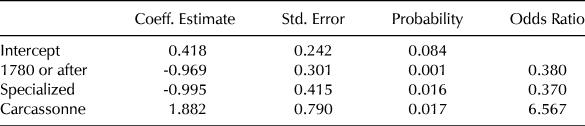
Studying first letters provides a better understanding of the way in which eighteenth-century merchants-bankers expanded their networks, how they relied on a rather restrained repertoire of relational and rhetorical resources, and how this repertoire evolved at the end of the century. Throughout this article, we have emphasized that no type of relational foundation appeared to work better than others—if what is meant by “work” is that a letter prompted additional letters between the sender and Roux or Greffulhe. A multivariate regression was used to model what led in about half of the Roux cases to the continuation of correspondence versus half of first letters being the only letters sent. This model confirms and refines this conclusion in the case of Roux (Table 4). There was not a sufficient number of first letters, excluding renewals, in our sample to use the same technique for Greffulhe.
Logit binomial regression: Becoming a correspondent of Roux

Note: Authors’ calculations based on Roux and Greffulhe Archives. N = 209 (excluding renewal letters). Dependent variable: letters to Roux (sender sent at least two letters, N =110; sender sent one letter, N = 99). Independent variables: first letter sent (before 1780, N = 126; 1780 or after, N = 83); author mentioned specialization (other than banking, N = 35; mentioned no specialization or only banking, N = 174); sender’s location (Carcassonne, N = 14; elsewhere, N = 195). Nonsignificant independent variables (tested in other models, not shown here): type of resource (face-to-face, N = 20; recommendation letters, N = 35; circumstantial letters, N = 93; disembedded letters, N = 61); offers (implicit, N = 27; general, N = 91; specific, N = 91); alternative specifications of sender’s location (major banking location, N = 83; other frequent locations, N = 104; marginal locations, N = 22; in Europe, N = 182; outside of Europe, N = 27); use of words (ami[s], amitié/friend[s], friendship, N = 91; confiance/trust, N = 68; intérêt[s]/interest(s), N = 48; zèle, zélé/zeal, zealous, N = 43; ponctualité/exactitude/punctuality, N = 18); total number of these words used (mean = 0.83).
The most striking result is that no specific relational foundation and no wording of the offer of services significantly influenced one’s chance of becoming a Roux correspondent. The only factors that appeared to matter were the time period, the sender’s specialization, and if writing from Carcassonne (versus from anywhere else). Roux appears to have become more selective after 1779. The probability of a first letter to be followed by a second one dropped significantly after this year (the coefficient is negative, and the probability measuring the risk that this effect might in fact be random is inferior to 5 percent). We found a similar effect with a threshold set in 1770, 1790, and 1800, but not in 1760. The year 1780 offered the most significant contrast; our substantive claim is that change happened during the three last decades of the eighteenth century. More precisely, the “odds ratio” indicates that all other things being equal (e.g., location from where the letter was sent, identity of the sender), the odds for a letter sent in 1780 or afterward to be followed by a second letter were, on average, 2.6 times lower than for a letter sent before this year. In addition, across all periods, specialist firms (e.g., merchants who mentioned a specialty in one or two types of goods, manufacturers, transporters) were also 2.7 times less likely to become correspondents than non-specialized merchants or merchant-bankers. Finally, again with all things being equal, a letter sent from Carcassonne was more than six times more likely to be followed by a second letter than a letter sent from elsewhere; this means that a specialized merchant or manufacturer from Carcassonne had twice as many chances than even a merchant-banker from elsewhere of becoming a correspondent.
These results suggest that the ultimate decisive factor was Roux’s general strategy, and not the efforts made by less central firms to become its correspondents. Generally, Roux was clearly not looking to have a regular correspondence with many specialist merchants, and no type of relational or rhetorical resources could change this.Footnote 49 Roux’s powerful position allowed it to turn down specialists’ offers of services without even having to write to them to that effect.
In most locations, Roux had one main correspondent plus a few others, and all were merchant-bankers rather than specialists. Sébastien Lupo called this pattern “network relations.”Footnote 50 This was especially the case in Martinique and also generally in non-European ports. In these instances, we found that recommendation was mentioned by merchants more often than elsewhere as they probably knew of this strategy and hoped to gradually work their way into Roux’s network, which was slowly but constantly evolving. In other locations, circumstantial letters were used for the same purpose. Roux, however, made an exception for Carcassonne, where the firm chose “market relations,” in Lupo’s terms. Roux would buy woolen cloth there at the cheapest price, and did not hesitate to change partners if competition could offer a better deal. Our results are consistent with this strategy (even for the last decades that we study, which Lupo did not consider). In Carcassonne, Roux’s power translated into its ability to constantly add new trade partners to its portfolio. This differs from its preference for a closed circle of frequent partners in other locations. Its ability to enact these different strategies in different places can be considered as evidence of its power.
After 1780, be it in Carcassonne or elsewhere, Roux appeared less willing to extend its network or change correspondents, even to include new merchant-bankers. This might have been related to a change in management. Pierre-Honoré Roux, one of the founding brothers, remained in charge of the firm until his death in 1774. This effect is difficult to disentangle from that of the political turmoil of the late eighteenth and early nineteenth centuries. Mediterranean trade was more isolated from the Atlantic during the Napoleonic Empire, and commerce generally became more uncertain. Roux thus grew more selective in accepting new correspondents, be it on the basis of a recommendation, a test, a face-to-face meeting, or a cold-call letter. Contrary to other firms,Footnote 51 it did not shift to ascribed ties but changed its general strategy regarding new commercial partners.
Finally, other variables—including the phrasing of offers, the inclusion of standard keywords of merchant correspondences (e.g., “trust” and “friend”), and the type of relational resources used—were not significant in this regression; that is, all things being equal, they had no impact on the success of offers of services. This is perhaps the most important result that we found. It should be noted that we tried to use interaction terms, in case some relational foundations or phrasings of offers would have had an effect, but only in the first or second period. We found no significant effect. There were epistolary conventions that had to be followed, but they were not a necessary or sufficient condition to become a correspondent. An outsider could not succeed by simply using the right wording. Even if he were able to learn it from actual correspondences rather than from handbooks, which were late in registering the norm, it would not have increased his chances of success. Moreover, the use of recommendation, face-to-face meetings, or circumstantial introductions by third parties did not have any impact. Of course names and personal ties were everywhere in merchant correspondences, as often stated in the literature; but depending on the most established firms’ strategies, less-connected merchants could be chosen over better-connected ones, provided that they wrote at the right time, from the right location, and about the right product. This might not have been true, however, of all central merchant houses at that time. More systematic research is needed to assess whether Roux’s strategy was specific in this respect.Footnote 52
Conclusions
Our study of first letters sent to major merchant and banking houses has allowed us to better define the institution of merchant networks, which made it possible for long-distance trade to expand during the early modern period. This study also demonstrates that these practices were shaken up in the late eighteenth century and slowly reconfigured over several decades through diverse experiments, before perhaps settling into a new order after the period studied here. Whereas changes in the way Roux responded to first letters were perhaps caused by the specific context of the revolutionary and imperial wars, which disrupted merchant networks from the 1790s to 1810s, those changes appear relatively distinct from evolutions in the writing and relational foundations of first letters themselves. Some of the latter evolutions had begun much earlier, and handbooks testify to the fact that they continued in later years. Nevertheless, these evolutions do not easily fit within a linear narrative of modernization.
First, if we consider our categories of first letters as a continuum from those written by successors of well-known partners to those sent by unknown people without any recommendation (through face-to-face meetings, explicit mentions of recommendations, and circumstantial introductions), we find that none of these relational resources helped more than others, all other things being equal, to become a correspondent. These findings challenge the widely shared assumption that business was more interpersonal in the past than it is today and they call for a better definition of this allegedly “interpersonal” quality.
Second, our contribution qualifies the range from the more personal to the more impersonal. We found, for example, that some recommendations were more routinely applied than others, which should probably be considered as rhetorical rather than relational devices. Conversely, the most clearly relational mechanism was circumstantial introduction; that is, the closure of triads in a context of overlapping networks of correspondents. This mechanism relied on testing new partners. Third parties allowed for such tests to occur, but it was the repetition of dyadic relations that ultimately mattered. Circumstantial introduction has often been overlooked due to historians’ interest in travel and face-to-face meetings, on the one hand, and in formal recommendations, on the other hand—not to mention family or ethnic ties. Conversely, we found circumstantial introduction to be a central institution in eighteenth-century merchant banking, one that allowed networks to grow without becoming anonymous markets. It is important to realize that this neither relied on ascribed ties nor involved explicitly prospective letters. Part of the art of correspondence was to not appear eager to expand one’s network while leaving that possibility open. Merchants spent a lot of time cultivating their networks, not only by carefully monitoring their ties with frequent partners, which involved a lot of credit and thus risk,Footnote 53 but also by establishing dormant ties with potential partners by using circumstantial introduction. What changed in the late eighteenth century was that prospection became more active and used wider relational and rhetorical repertoires.
One of the aims of our research was to devise a strategy that could be replicated in other merchant archives, provided they are arranged by correspondent, so that our results could be generalized or qualified. The letters written from outside of France made up half of our sample, 42 percent came from the French metropole, and 8 percent came from the empire. Seven percent were in foreign languages. All of these followed the same rhetorical and relational strategies: the language of merchants was transnational and easily translated, as least in the wide sphere of locations connected with European trade.Footnote 54 Our typologies of relational resources and offers, and more generally the categories of our database, could therefore easily be used for non-French and even non-European archives, as well as for those of less prominent houses.