Introduction
In the recent revised generic classification of the Pannariaceae, Ekman et al. (Reference Ekman, Wedin, Lindblom and Jørgensen2014) provisionally accepted the genus Psoromidium, but noted that further studies were necessary. Since then we have managed to acquire fresh material, making it possible to investigate the position of the type species using molecular studies, which has not yet been done in any other such studies (e.g. Spribille & Muggia Reference Stirton2013). Morphological and anatomical characters alone are not distinct enough to secure a clear perspective on the taxonomy of this genus and other Psoroma-like taxa that lack a thalline apothecial margin. Several names have been proposed and the treatments of these taxa have varied considerably through the years. For example, Müller (Reference Müller1894) treated them in Phyllopsora, a view also held by Zahlbruckner (Reference Zahlbruckner1905) who placed them in the Phyllopsoraceae and subsequently in the Lecideaceae (Zahlbruckner Reference Zoller, Scheidegger and Sperisen1926). Dodge (Reference Dodge1971) redescribed the type species of Psoromidium as Coccocarpia fineranii (Arvidsson Reference Arvidsson1983). More recently, Galloway & James (Reference Galloway and James1985) treated Psoromidium, a genus originally described with only one species by Stirton (Reference Zahlbruckner1877), in detail, accepting two species: P. aleuroides (Stirt.) D. J. Galloway & P. James and P. versicolor (Hook. f. & Taylor) D. J. Galloway & P. James, the former being the type species. Jørgensen (Reference Jørgensen2004), however, regarded these as belonging in two different genera and transferred the latter to the new genus Degeliella. Psoromidium versicolor had originally been included in the genus Psoromaria Nyl. ex Hue under its synonym P. subdescendens (Nyl.) Hue, the species which Clements & Shear (Reference Clements and Shear1931) chose as the lectotype of that genus.
In this paper we intend, as far as possible, to resolve these taxonomic and nomenclatural problems.
Material and Methods
Fresh material of Psoromidium aleuroides was kindly submitted to us by G. Kantvilas, collected from Tasmania [Mt. Young, 7 June 2008, G. Kantvilas 219/08 (HO)].
Herbarium material relating to the mentioned species was studied by standard microscopic and TLC methods (Jørgensen Reference Jørgensen1978). The chemically and microscopically studied material is found in the following herbaria: BG, BM, G, H, HO, S, UPS, and listed in Ekman et al. (Reference Ekman, Wedin, Lindblom and Jørgensen2014).
Total DNA was extracted using DNeasy Plant Mini Kit (Qiagen). The mrSSU region of the mtDNA was amplified using the primers mrSSU1 and mrSSU3R (Zoller et al. Reference Zoller, Scheidegger and Sperisen1999). The PCR reactions were performed with 1× GeneAmp® 10× PCR Buffer II (Applied Biosystems), 2·5 µM MgCl2 (Applied Biosystems), 20 µM dNTPs (Promega), 0·7 µM of each primer, 1·5 U AmpliTaq® DNA Polymerase (Applied Biosystems), 5·0 µl of genomic DNA extract and distilled water to a total volume of 50 µl. Thermal cycling parameters were: initial denaturation for 4 min at 94 °C, followed by 40 cycle reactions (denaturation at 94 °C for 1 min, annealing with a 56–50 °C touchdown procedure decreasing 1° per cycle for 30 s each, polymerization at 72 °C in 1 min 45 s), and a final elongation for 10 min at 72 °C.
PCR product was cleaned according to the manufacturer’s instructions using Exo-Sap-IT (GE Healthcare). Direct sequencing of PCR product was done in both directions. Sequencing reactions were carried out using BigDye Terminator Cycle Sequencing kit (Applied biosystems), and run on an ABI Prism 3700 DNA analyzer (Applied Biosystems) at the DNA Sequencing Laboratory at the University of Bergen, Norway.
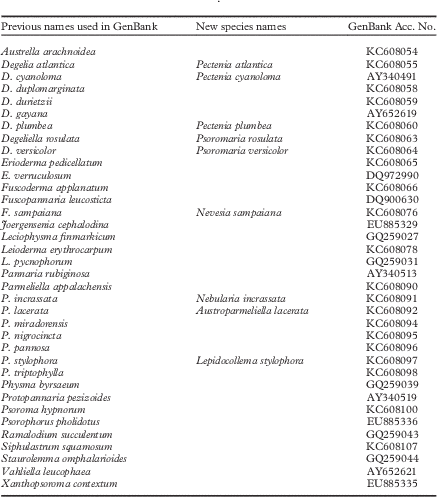
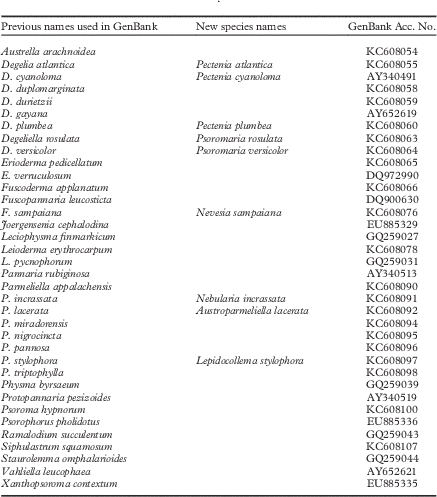
The mrSSU sequence of Psoromidium aleuroides was edited, assembled and aligned using Geneious® version 8.0.4 (http://www.geneious.com, Kearse et al. Reference Kearse, Moir, Wilson, Stones-Havas, Cheung, Sturrock, Buxton, Cooper, Markowitz and Duran2012), together with 36 mrSSU sequences downloaded from GenBank (Table 1), based on the study of Ekman et al. (Reference Ekman, Wedin, Lindblom and Jørgensen2014). One sequence from each species of Clade 1 in Ekman et al. (Reference Ekman, Wedin, Lindblom and Jørgensen2014) was included, and sequences of the type species were included from Clade 2. As in Ekman et al. (Reference Ekman, Wedin, Lindblom and Jørgensen2014), Vahliella leucophaea was chosen as outgroup. Ambiguously aligned sites were removed from the alignment manually.
List of sequences downloaded from GenBank for use in this study. The new species names are based on Ekman et al. (Reference Ekman, Wedin, Lindblom and Jørgensen2014) and this study.
MrModeltest 2.3 (Nylander Reference Nylander2004) was used to find the most appropriate substitution model for the Bayesian phylogenetic analysis that was performed with MrBayes v3.2.1 (Ronquist et al. Reference Ronquist, Teslenko, van der Mark, Ayres, Darling, Hohna, Larget, Liu, Suchard and Huelsenbeck2012). The analysis was performed with the GTR+I+G model. Two parallel MCMC runs were performed, each with four parallel chains, three heated and one ‘cold’, with the temperature set to 0·10 °C. The analysis was run until the average standard deviation of split frequencies was below 0·01, as a measure of convergence, resulting in 1 100 000 generations, and sampling every 200th generation. Relative burn-in was set to 25%. The resulting majority-rule consensus tree with posterior probabilities was made using FigTree v1.4 (Rambaut Reference Rambaut2006).
Results
The mrSSU sequence of Psoromidium aleuroides is deposited in GenBank with accession number KP279291. The resulting alignment contained 37 sequences and 700 bps, whereas 410 were constant.
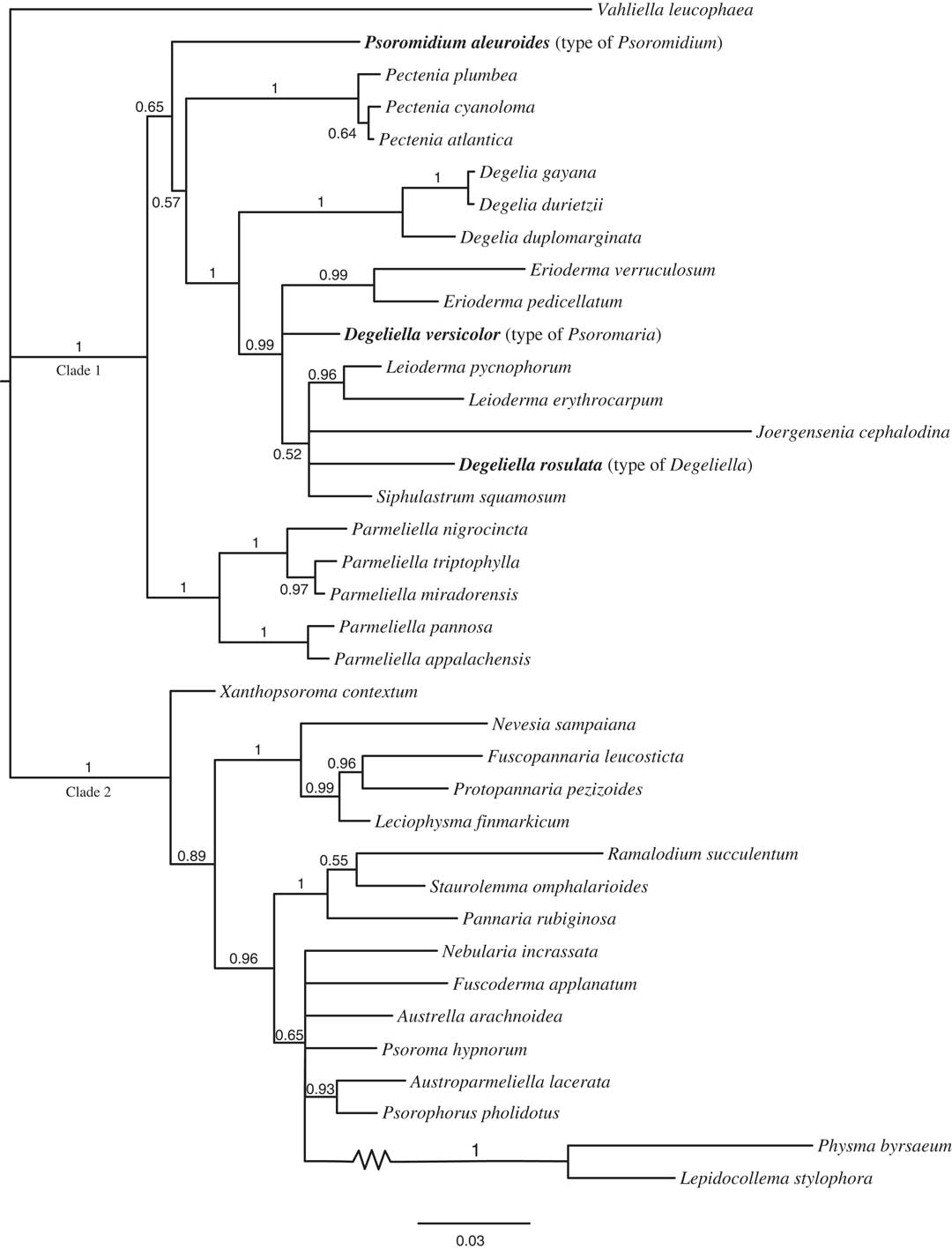
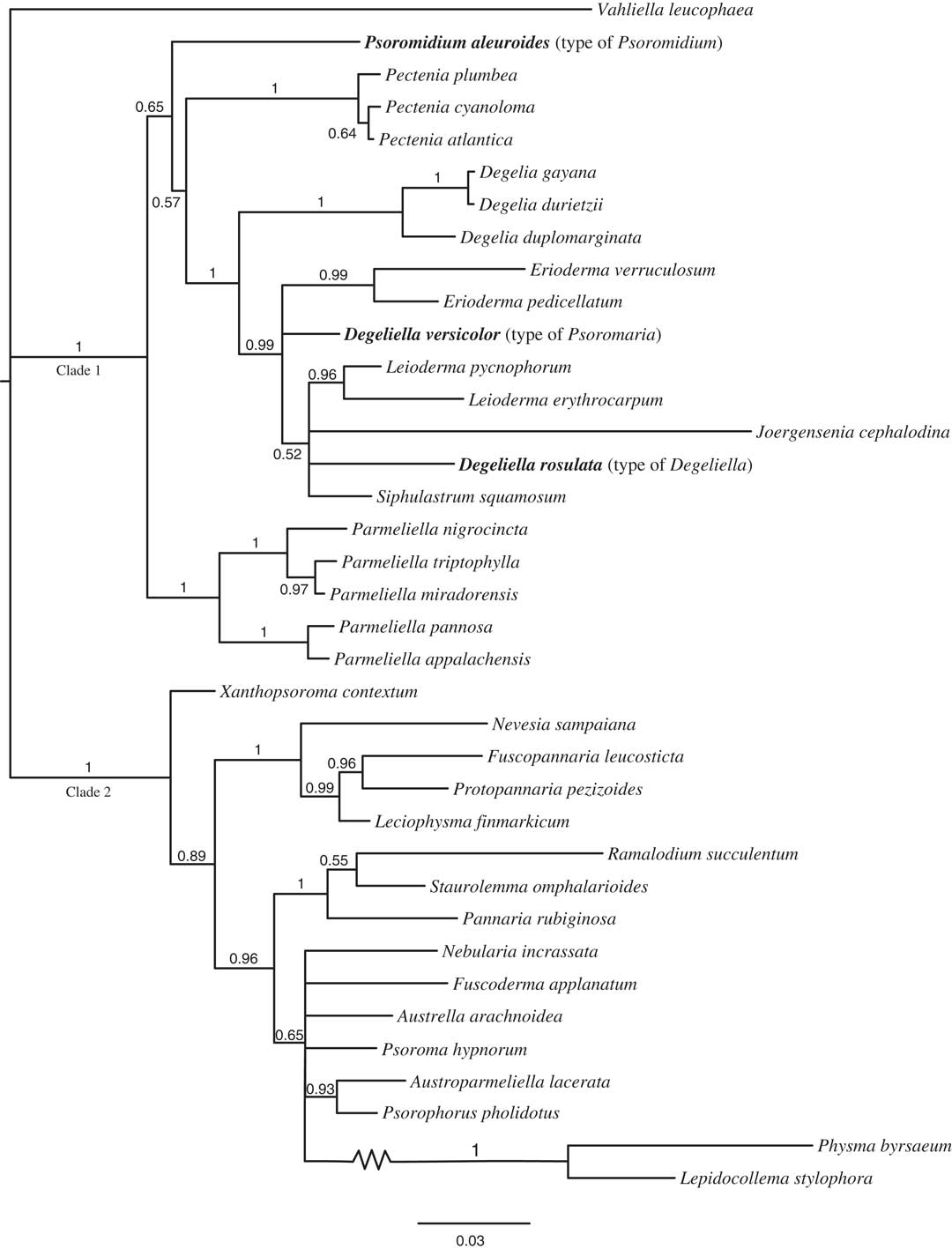
The resulting majority-rule consensus tree from Bayesian inference (Fig.1) with strong support includes P. aleuroides in Clade 1 using the numeration from Ekman et al. (Reference Ekman, Wedin, Lindblom and Jørgensen2014).This tree shows that Psoromidium is a separate genus when regarded as unispecific, but the support for this branch is low, suggesting that the internal position of Psoromidium within Clade 1 is uncertain. The other species that sometimes has been included in this genus, Degeliella versicolor (Psoromaria versicolor), appears in a complex, unresolved group containing Degeliella rosulata, the type of the genus Degeliella.
Majority-rule consensus tree from the Bayesian MCMC analysis, with all compatible groups and branch lengths. Branches values are posterior probabilities. Psoromidium aleuroides, Degeliella versicolor and Degeliella rosulata are given in bold, and Vahliella leucophaea is outgroup. The annotation of Clades 1 and 2 is taken from Ekman et al. (Reference Ekman, Wedin, Lindblom and Jørgensen2014).
Discussion and Conclusions
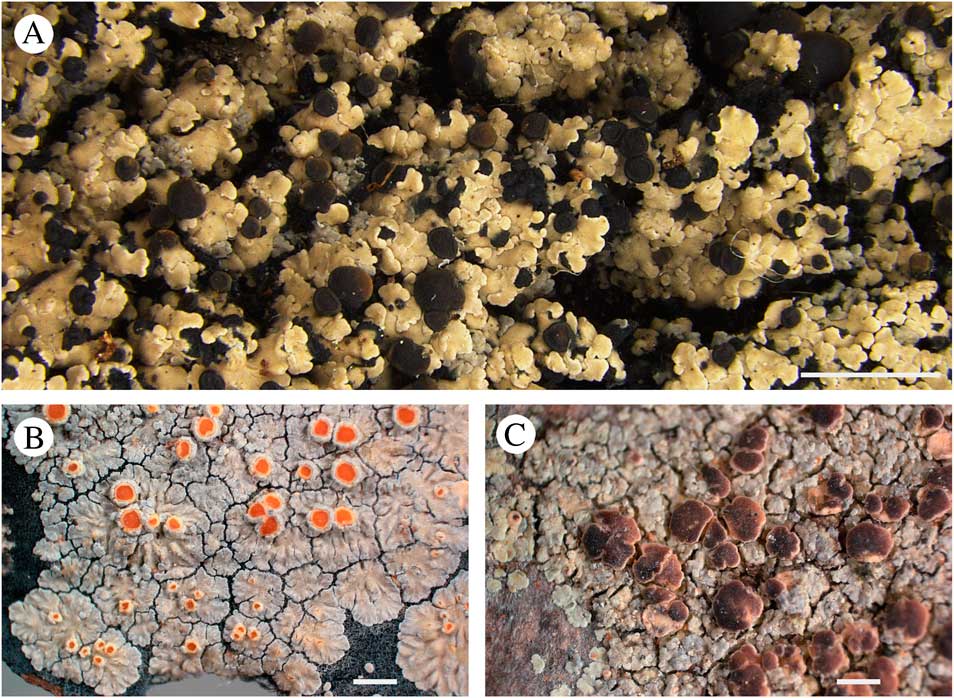
The status and circumscription of Psoromidium has been discussed in detail by Galloway & James (Reference Galloway and James1985) and needs no further comment, except that we restricted it to the type species (Psoromidium aleuroides). A full description of the type species (Fig. 2A) can be found in Galloway & James (op. cit.).
A, Psoromidium aleuroides from Tasmania: a distinctly squamulose species. Photograph: Katrine Kongshavn. B, Psoromaria rosulata; C, Psoromaria versicolor from the type specimens. These species have closely adpressed, subcrustose rosettes. Photographs: Jan Berge. Scales=5mm. In colour online.
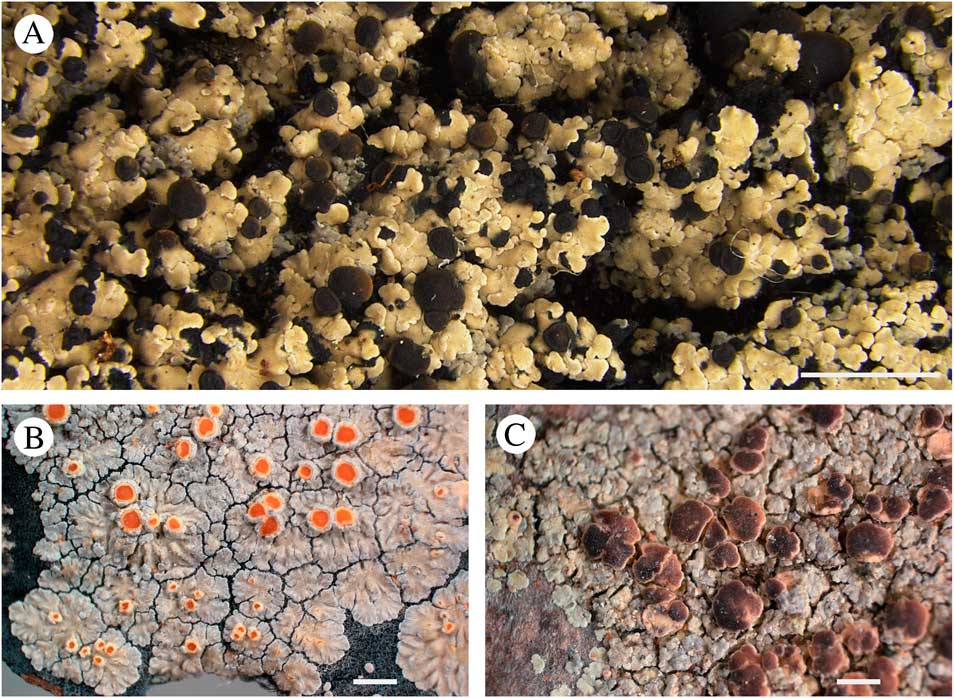
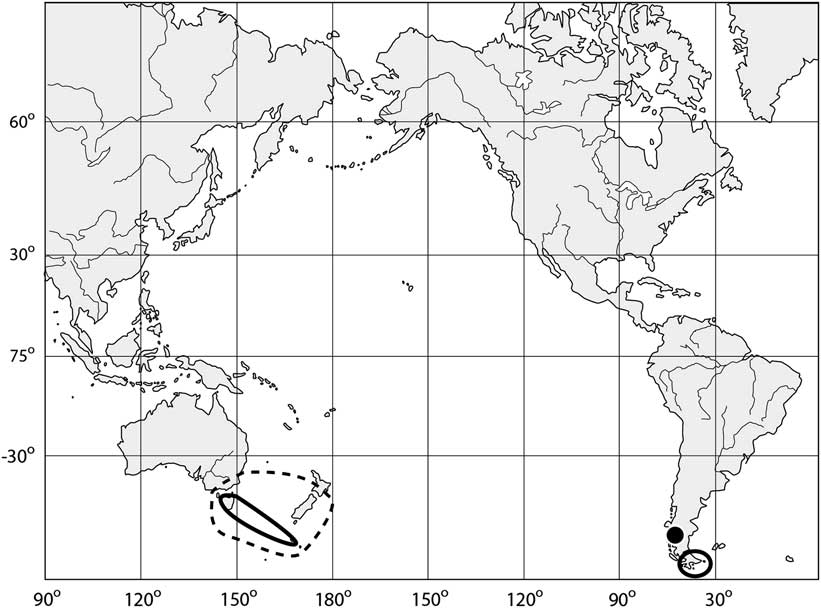
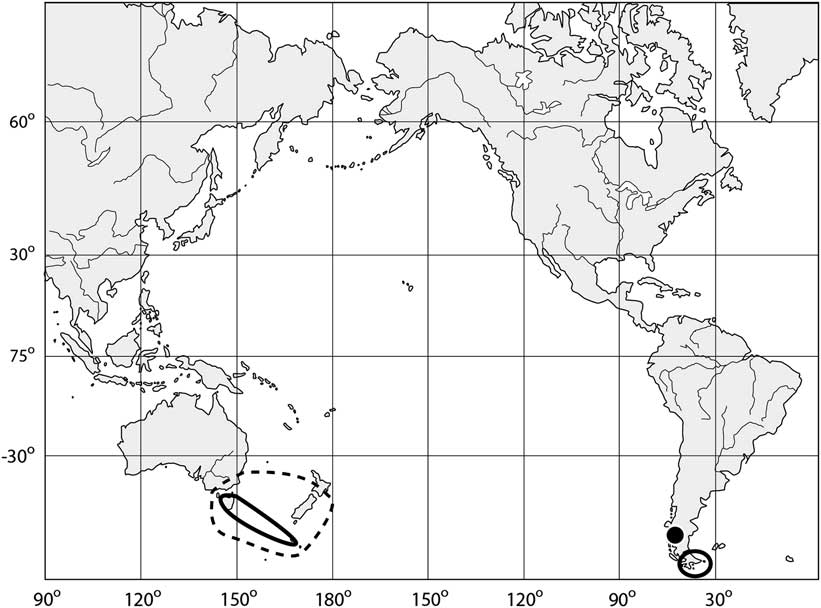
Psoromidium is easily separated from Psoromaria on the basis of the amyloid hymenial reaction and the asci with an amyloid apical ring-structure. Psoromidium aleuroides is also a more distinctly squamulose species (Fig. 2A), whereas the species of Psoromaria (including Degeliella) are closely adpressed, subcrustose rosettes (Fig. 2B & C). Psoromidium is a species centred around the region of the Tasman Sea, whereas Psoromaria has a wider, more subantarctic distribution (Fig. 3), perhaps suggesting a different evolutionary history. The situation concerning Degeliella is less clear and quite complex, and is discussed below.
Distribution of the genera Psoromidium (broken line) and Psoromaria (continuous line and dot).
Though there is no molecular evidence for the acceptance of Psoromaria, we are, however, sure that the generic name Psoromaria needs to be reintroduced for nomenclatural reasons, for Psoromaria versicolor (Fig. 2B, described in detail by Galloway & James Reference Galloway and James1985), and P. rosulata. When Jørgensen (Reference Jørgensen2004) described the genus Degeliella with the blue-green D. rosulata (Fig. 2C) as the type species, he also included Psoromaria versicolor within it, unaware that Clements & Shear (Reference Clements and Shear1931) had selected this species under its synonym P. subdescendens (Nyl.) Hue as the lectotype of that genus. It follows that Degeliella is a superfluous, illegitimate name for Psoromaria, a genus which Nylander (Reference Nylander1888) only suggested by pointing out that two species in Psoroma differed so much from the others that they perhaps were better placed in a genus of their own, and for which he proposed the name Psoromaria. The first formally correct description and acceptance of the genus was published by Hue (Reference Hue1891). It was lectotypified by Clements & Shear (Reference Clements and Shear1931) by Psoromaria subdescendens, but when Galloway & James (Reference Galloway and James1985) revised Psoromidium (to which they referred this species) they found an older name (Hooker & Taylor Reference Hooker and Taylor1844) for it, Lecanora versicolor Hook. f. & Taylor, which they transferred to Psoromidium. However, they had overlooked that this older name was illegitimate since it is a younger homonym of the completely different Lecanora versicolor (Pers.) Ach. (Acharius Reference Acharius1814). Müller (Reference Müller1888) nevertheless took up this epithet in a new position, basing it on Hooker’s material, when describing Psoroma versicolor, which is a legitimate name; Nylander’s name Psoroma subdescendens had just been published a few months previously, and this would therefore be the correct one to apply to the species. Müller’s name, however, has been conserved over Nylander’s after a proposal by Fryday & Coppins (Reference Fryday and Coppins2009), so its correct name is as follows:
Psoromaria versicolor (Müll. Arg.) P. M. Jørg. & H. L. Andersen comb. nov.
MycoBank No.: MB812691
Psoroma versicolor Müll. Arg., Flora 71: 534 (1888).
According to the facts above Degeliella rosulata needs the following nomenclatural adjustment:
Psoromaria rosulata (P. M. Jørg. & D. J. Galloway) P. M. Jørg. & H. L. Andersen comb nov.
MycoBank No.: MB812693
Degelia rosulata P. M. Jørg. & D. J. Galloway, Flora of Australia 54: 314 (1992).
However, there are still taxonomic problems in this group. The inclusion of Degeliella rosulata in Psoromaria is unresolved based on the molecular phylogeny. Nevertheless, the two species share the same characters of a non-amyloid hymenium and asci that lack amyloid apical structures. These features separate both species from Siphulastrum Müll. Arg., which has a hemiamyloid hymenium and apical ascal ring-structure, as well as containing argopsin (Pd+orange) in the thallus, while that of Psoromidium is totally negative. We believe that the matter is best solved by adding more taxa and more genes to the molecular analysis.
We are most grateful to Gintaras Kantvilas, Hobart, for providing fresh material of P. aleuroides, as well as to the curators of the cited herbaria for sending material on loan. We are also indebted to the following staff members in Bergen for technical assistance of various kinds: Beate Helle, Katrine Kongshavn and Louise Lindblom. We thank three anonymous referees whose comments helped us improve this paper.