Introduction
Chronic rhinosinusitis with nasal polyps (CRSwNP) is a prevalent chronic condition characterised by symptoms such as nasal congestion, postnasal drip, hyposmia and facial pain.Reference Kato, Peters, Stevens, Schleimer, Tan and Kern1 Beyond the physical discomfort it causes, CRSwNP significantly impairs patients’ quality of life and often gives rise to psychological challenges, particularly among those scheduled for functional endoscopic sinus surgery (FESS).Reference Zhang, Xu, Liang, Liao, Ren and Chang2 Similar to how environmental and systemic factors can exacerbate mental health struggles, the chronic, recurrent nature of CRSwNP—coupled with uncertainties about surgical outcomes—frequently leads to psychological issues like anxiety and depression in affected patients.Reference Khan, Gajula, Goehring, Takashima, Dhanda and Syed3 These negative emotions are not merely subjective distress; they have been shown to influence surgical outcomes and the post-operative recovery process, making the management of preoperative mental health a critical aspect of comprehensive patient care.Reference Cheah, Tan, Yeo, Lim, Tan and Teoh4–Reference Ospina, Liu, Crump, Sutherland and Janjua7
Cognitive behavioural therapy (CBT) is an evidence-based psychological intervention that targets the modification of maladaptive thought patterns and behaviours to improve mental well-being.Reference McMain, Newman, Segal and DeRubeis8 Its efficacy has been well-demonstrated across a range of chronic conditions, from addressing workplace-related stress (a context where individualistic pressures and systemic demands often contribute to psychological distress, as noted by Smith et al.Reference Smith, Smith, McLuckie, Szeto, Choate and Birks9) to managing chronic pain and mental health comorbidities in medical populations.Reference Sanabria-Mazo, Colomer-Carbonell, Fernández-Vázquez, Noboa-Rocamora, Cardona-Ros and McCracken10 Despite this broad applicability, the use of CBT in the context of CRSwNP remains underexplored.Reference Craske and Stein11–Reference Furukawa, Sakata, Yamamoto, Nakajima, Kikuchi and Inoue13 Most existing research on CRSwNP focuses on physiological interventions, such as surgical techniques or pharmacological treatments, with limited attention to the psychological dimensions of the disease.Reference Vogt, Sahota, Bidder, Livingston, Bellas and Gane14 This gap is notable, as the interplay between mental health and chronic physical illness is well-documented—psychological distress can amplify physical symptom perception, while effective psychological intervention may enhance patients’ ability to cope with their condition and engage in treatment.Reference Hennemann, Killikelly, Hyland, Maercker and Witthöft15
Furthermore, CRSwNP represents a distinct phenotype of chronic rhinosinusitis, with unique pathophysiological features and patient-reported outcomes.Reference Esmaeilzadeh, Shahhosseini, Gholami, Nabavizadeh, Alyasin and Mortazavi16 The lack of tailored psychological interventions for this specific group means that a key component of holistic care is missing. Just as Smith et al.Reference Smith, Smith, McLuckie, Szeto, Choate and Birks9 emphasised the need to address mental health within the unique systemic and cultural context of academia, addressing CRSwNP-related mental health requires interventions that account for the specific challenges of this disease—including symptom recurrence, surgical anxiety and the impact of nasal symptoms on daily functioning (sleep disruption, social withdrawal).
Against this backdrop, the present study aims to investigate the effectiveness of a CBT for improving the preoperative mental health of patients with CRSwNP. By integrating CBT principles with the needs of CRSwNP patients, this study seeks to fill the existing research gap, provide evidence for the value of psychological intervention in this population and contribute to the development of comprehensive, patient-centred care strategies for CRSwNP.
Methods
Study design and setting
This was a single-centred, parallel-group randomised controlled trial. Sample size calculation was performed using G*Power 3.1 software, with the Self-rating Anxiety Scale (SAS) score as the primary outcome. Based on a previously reported effect size (d = 0.8) of CBT on anxiety in patients with chronic diseases, a significance level (α) of 0.05 and a power (β) of 0.8, 70 patients per group were required. Accounting for a 10 per cent attrition rate, the final sample size was set at 72 patients per group (total N = 144).
Inclusion criteria
Inclusion criteria are age 18–70 years, confirmed diagnosis of CRSwNP (EPOS 2020)Reference Fokkens, Lund, Hopkins, Hellings, Kern and Reitsma17 and planned FESS and patients who voluntarily participated in the study and signed an informed consent form.
Exclusion criteria
Exclusion criteria are history of previous nasal surgery, patients suffering from severe mental illness or cognitive disorders, patients with other serious physical diseases or complications and patients who have recently received other psychological interventions.
Randomisation
Group randomisation was conducted using an online tool (http://www.randomizer.org) with blocks of four to ensure baseline balance between groups. Patients and CBT providers were unblinded to group allocation (blinding of providers was infeasible for psychological interventions), but outcome assessors were blinded to group assignment (single-blind design) to minimise assessment bias. The study flow and patient enrolment are shown in Figure 1.
Research flow diagram.

Intervention
Intervention group: Received six structured CBT sessions (1 session/week × 6 weeks, 60 min/session; detailed in Supplementary Table 1). CBT was delivered by two professionally trained psychotherapists (holding national Level-2 psychological counsellor certification and ≥100 hours of CBT-specific training). All sessions adhered to a standardised operation manual, and providers completed a session record form after each intervention to document patient engagement, mastery of core skills and adjustments made. A senior psychotherapist provided weekly supervision to ensure intervention consistency and quality. Notably, no fees were charged to patients for the CBT program, which was fully funded by the research team. Based on institutional cost accounting, the total unit implementation cost for the entire six-week CBT program was assessed to be £200–£260 per patient, covering therapist labour hours, supervision fees, standardised training materials and session documentation costs.
Control group: Received routine preoperative education, including medication guidance (e.g., preoperative anti-infective agents, nasal corticosteroids: dosage, administration and precautions) and surgical procedure explanation (e.g., duration, anaesthesia type intra-operative steps). Education was delivered as a single 30-minute one-on-one session by clinical nurses.
Evaluation indicators
Primary indicator: Mental health status was assessed before and six weeks after FESS using SAS and Self-rating Depression Scale (SDS) (contains 20 entries respectively). Anxiety level assessment: 50–59 was classified as mild anxiety, 60–69 as moderate anxiety and ≥70 as severe anxiety. Depression level assessment: 53–62 was categorised as mild depression, 63–72 was categorised as moderate depression and ≥73 was categorised as severe depression.Reference Ospina, Liu, Crump, Sutherland and Janjua7
Secondary indicator: The Sino-Nasal Outcome Test (SNOT-22) was used to assess the impact of chronic sinusitis symptoms on quality of life in patients before and six weeks after surgery.
Follow-up
The follow-up period was one year post-FESS, using a combined model of “offline centralised re-examination + telephone follow-up”: offline centralised re-examination was conducted 1 month after surgery (completing SAS, SDS, SNOT-22 scale assessments and face-to-face interview) and brief telephone follow-up was conducted 3, 6 and 12 months after surgery (confirming symptom stability and skill use).
Statistical analysis
Statistical analyses were performed using SPSS 27.0. Continuous variables are presented as mean plus or minus standard deviation (mean ± SD) and compared using independent samples t-tests. Categorical variables are presented as frequencies (percentages) and compared using χ2 tests. Repeated-measures analysis of variance (ANOVA) was used to compare score changes across five time points (pre-CBT and 1, 3, 6 and 12 months post-FESS) between groups, with Bonferroni post-hoc tests. Subgroup analyses were planned to explore heterogeneity in CBT efficacy by age (18–45 years, 46–60 years and 61–70 years) and disease duration (<3 years, 3–6 years and >6 years). A two-tailed p less than 0.05 was considered statistically significant.
Results
Patient characteristics
Baseline patient characteristics are presented in Supplementary Table 2. A total of 144 patients participated in the study and completed follow-up. The two groups were comparable at baseline with no significant differences in key characteristics (all p > 0.05). Specifically, the intervention group had a mean age of 55.35 plus or minus 11.99 years and mean disease duration of 5.51 plus or minus 3.01 years, while the control group had 53.86 plus or minus 10.58 years and 5.74 plus or minus 3.10 years (p = 0.43 and p = 0.66, respectively). The incidence of anxiety (38.89 per cent vs. 40.28 per cent) and depression (29.17 per cent vs. 30.56 per cent) was similar between groups (both p > 0.05). Baseline scores of SAS (49.07 ± 5.20 vs. 48.92 ± 4.76; p = 0.85), SDS (50.39 ± 4.57 vs. 50.28 ± 5.54; p = 0.90) and SNOT-22 (25.60 ± 3.07 vs. 25.50 ± 3.57; p = 0.86) also showed no statistical differences (Supplementary Table 3).
Anxiety (SAS score)
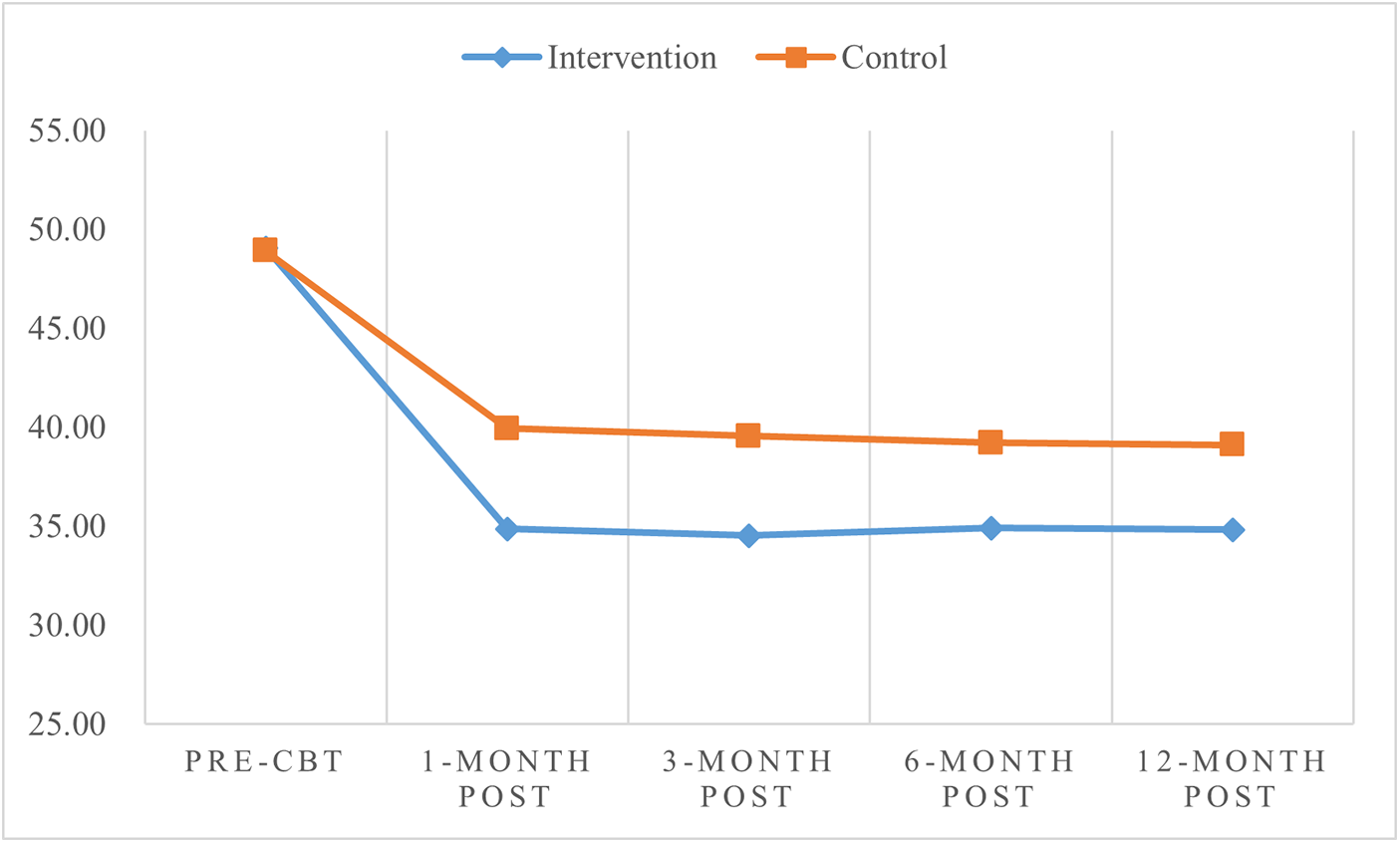
There was no significant difference in SAS scores between groups pre-CBT (p = 0.85), but the intervention group showed a more pronounced and sustained reduction post-FESS (Supplementary Table 3; Figure 2). At 1-month post-FESS, the intervention group’s SAS score dropped to 34.85 plus or minus 3.56, which was significantly lower than the control group’s 39.93 plus or minus 3.83 (p < 0.001). This advantage persisted through 3-month (34.52 ± 3.51 vs. 39.56 ± 3.79; p < 0.001), 6-month (34.90 ± 3.53 vs. 39.20 ± 3.76; p < 0.001) and 12-month follow-ups (34.82 ± 3.52 vs. 39.10 ± 3.75; p < 0.001). Notably, the intervention group’s scores remained stable from 3 to 12 months (p > 0.05), except for the 61- to 70-year-old subgroup, where SAS scores increased from 35.28 plus or minus 3.59 (3-month) to 38.95 plus or minus 3.98 (6-month) and 39.22 plus or minus 4.05 (12-month) (all p < 0.05).
Changes in Self-rating Anxiety Scale (SAS) scores between the intervention and control groups from pre–cognitive behavioural therapy (CBT) to 12 months post–functional endoscopic sinus surgery (FESS).

Depression (SDS score)
The trend of SDS scores was consistent with SAS (Supplementary Table 3, Figure 3). Pre-CBT scores were comparable between groups (p = 0.90), but the intervention group achieved significantly lower scores at all post-FESS time points: 1 month (39.94 ± 4.26 vs. 43.93 ± 4.45; p < 0.001), 3 months (39.35 ± 4.18 vs. 43.42 ± 4.39, p < 0.001), 6 months (39.72 ± 4.20 vs. 43.05 ± 4.36; p < 0.001) and 12 months (39.65 ± 4.19 vs. 42.95 ± 4.33; p < 0.001). The intervention group’s SDS scores remained stable after 3 months (p > 0.05), while the 61- to 70-year-old intervention subgroup showed a significant increase: 40.35 plus or minus 4.23 (3 months)→45.32 plus or minus 4.68 (6 months)→45.87 plus or minus 4.75 (12 months) (all p < 0.05).
Changes in Self-rating Depression Scale (SDS) scores between the intervention and control groups from pre–cognitive behavioural therapy (CBT) to 12 months post–functional endoscopic sinus surgery (FESS).

Sinus symptoms (SNOT-22 score)
SNOT-22 scores followed a similar pattern (Supplementary Table 3; Figure 4). No pre-CBT difference was observed (p = 0.86), but the intervention group had significantly lower scores post-FESS: 1 month (14.67 ± 2.65 vs. 17.96 ± 3.87; p < 0.001), 3 months (14.32 ± 2.58 vs. 17.53 ± 3.81; p < 0.001), 6 months (14.68 ± 2.60 vs. 17.20 ± 3.78; p < 0.001) and 12 months (14.61 ± 2.59 vs. 17.10 ± 3.76; p < 0.001). The intervention group’s scores were stable from 3 to 12 months (p > 0.05), except for the 61- to 70-year-old intervention subgroup, where scores rose from 14.89 plus or minus 2.67 (3 months) to 19.42 plus or minus 3.25 (6 months) and 19.86 plus or minus 3.32 (12 months) (all p < 0.05).
Changes in 22-item Sino-Nasal Outcome Test (SNOT-22) scores between the intervention and control groups from pre–cognitive behavioural therapy (CBT) to 12 months post–functional endoscopic sinus surgery (FESS).

Subgroup analysis
To explore whether the efficacy of CBT varies among CRSwNP patients with different characteristics, we conducted subgroup analyses based on age (18–45 years, 46–60 years and 61–70 years) and disease duration (<3 years, 3–6 years and >6 years). All subgroups had comparable baseline characteristics (all p > 0.05). CBT efficacy was consistent across most age and disease duration subgroups (interaction p > 0.05), with only the 61- to 70-year-old intervention subgroup showing heterogeneous results (Supplementary Table 4).
Age subgroups: For the 18- to 45-year-old and the 46- to 60-year-old subgroups, the intervention group maintained significantly lower SAS/SDS/SNOT-22 scores at 12 months post-FESS (all p < 0.001) with stable trends from 3 to 12 months (p > 0.05). The 61- to 70-year-old intervention subgroup, however, showed increased scores from 3 to 12 months (all p < 0.05), though still lower than the control subgroup at 12 months (p < 0.001).
Disease duration subgroups: For less than 3 years, 3–6 years and greater than 6 years, the intervention group had significantly lower scores at 12 months post-FESS (all p < 0.001) with no significant changes from 3 to 12 months (p > 0.05). No heterogeneity was observed across these subgroups (interaction p > 0.05).
Discussion
This randomised controlled trial investigated the impact of CBT on the mental health of patients with CRSwNP scheduled for FESS. The results indicated that CBT significantly alleviated anxiety and depression and improved chronic sinusitis symptoms, with beneficial effects sustained up to one year post-operatively—providing robust evidence of its medium-term clinical value. Notably, this durability was consistent across most age and disease duration subgroups, except for the 61- to 70-year-old intervention subgroup, where symptom scores (SAS, SDS and SNOT-22) increased from 3 months post-FESS onward, though remaining lower than the control subgroup at 12 months. These findings extend prior research by confirming CBT’s long-term utility in CRSwNP care while highlighting important subgroup heterogeneity.
Our findings align with prior CBT research in chronic disease populations. The systematic review by Sanabria-Mazo et al.Reference Sanabria-Mazo, Colomer-Carbonell, Fernández-Vázquez, Noboa-Rocamora, Cardona-Ros and McCracken10 of CBT for chronic pain with psychological distress reported a similar effect size for anxiety/depression reduction, while Ibrahim et al.Reference Ibrahim, Elkhidir, Mohammed, Abdalla, Mohamed and Hemmeda18 demonstrated CBT’s benefits for mental health in coronary artery bypass graft patients—consistent with the cognitive restructuring and behavioural activation mechanisms observed here.
In the CRSwNP field, Vogt et al.Reference Vogt, Sahota, Bidder, Livingston, Bellas and Gane14 reported that omalizumab improved residual anxiety (but not depression) in CRSwNP patients with asthma, whereas CBT in our study improved both anxiety and depression—highlighting the broader emotional regulatory advantages of psychological interventions. The meta-analysis by Fan et al.Reference Fan, Han, Gong, Wu, Fu and Zhu19 reported anxiety and depression prevalences of 29.7 per cent and 24.7 per cent in CRSwNP patients, closely matching our baseline rates and underscoring the clinical relevance of our findings. Importantly, our subgroup analysis adds novel insights: while CBT is broadly effective across age (18–45, 46–60 years) and disease duration subgroups, older patients (61–70 years) may require tailored adaptations (e.g., longer sessions, booster doses) to maintain long-term benefits, potentially due to age-related physiological changes, reduced social support or greater comorbidity burden.
Multifaceted Mechanisms Underlying CBT Efficacy
Psychological level: cognitive restructuring breaks the negative emotional cycle
Cognitive restructuring—a core CBT component—helps patients identify and challenge irrational beliefs about surgery and disease. For example, patients often hold catastrophic thoughts (e.g., “Surgery will definitely fail,” “Post-operative symptoms will worsen”), which are replaced with rational cognitions (e.g., “The medical team is experienced; recovery is gradual”) via evidence-checking exercises and case discussions. This process aligns with the “cognition-emotion-behaviour” chain model proposed by Smith et al.,Reference Smith, Moutoussis and Bilek20 where modified thought patterns directly influence emotional responses and behavioural choices. For older patients (61–70 years), this mechanism may be less durable without ongoing reinforcement, as age-related cognitive flexibility changes or unaddressed social isolation could reactivate negative thought patterns over time—suggesting the need for targeted booster sessions in this subgroup.Reference Yang, Zhong, Han, Pu, He and Huang21
Behavioural level: active coping enhances self-efficacy
Behavioural activation shifts patients from “passive disease endurance” to “active disease management” via personalised preoperative health checklists and postoperative progressive activity plans. Pre-operative training (e.g., diaphragmatic breathing, progressive muscle relaxation) and post-operative pain-coping skills (e.g., guided imagery) not only alleviate symptoms directly but also enhance patients’ sense of control over their disease. Rodolico et al.Reference Rodolico, Cutrufelli, Maccarone, Avincola, Concerto and Cunsolo22 noted that improved self-efficacy is a key mediator of mental health gains in chronic disease patients—evidenced here by reduced activity avoidance and restored social function. The sustained stability of scores in younger and middle-aged subgroups (18–60 years) further confirms that behavioural activation fosters enduring self-management capabilities,Reference Lin, Cheng, Hou, Lin, Chen and Tsai23 whereas older patients may require more intensive skill reinforcement to maintain these behaviours.
Psychophysiological interaction: emotional improvement alleviates symptom perception
The significant reduction in SNOT-22 scores reflects CBT’s psychophysiological effects. Anxiety and depression activate the hypothalamic-pituitary-adrenal axis, increasing nasal mucosal vasoconstriction and inflammatory cytokine release—exacerbating congestion and pain.Reference Khan, Gajula, Goehring, Takashima, Dhanda and Syed3 By reducing emotional stress, CBT indirectly mitigates nasal mucosal inflammation and improves symptom perception thresholds. Additionally, CBT’s disease education and self-management training enhance adherence to nasal irrigation and medication,Reference Everhart, Saavedra, Ford, Gibson, Reid and Muther24 further relieving sinus symptoms. Our findings support this mechanism’s longevity: sustained emotional improvement likely maintains reduced inflammatory burden, preventing symptom recurrence in most patients.Reference Yamaoka, Ishii and Terasawa25 For the 61- to 70-year-old subgroup, age-related declines in immune function or medication adherence may weaken this psychophysiological link, contributing to late-phase score increases.
Cost-Effectiveness Considerations
The implementation costs of this program, including therapist labour, supervision, standardised materials and documentation, should be considered. In this study, the six-week CBT program was provided to patients at no cost, funded by the research team. Although the upfront costs are substantially higher than those of routine preoperative education, the sustained efficacy over one year strongly suggests favourable cost-effectiveness. Prior literature has established that untreated anxiety and depression in CRSwNP patients are associated with a 30–40 per cent increase in post-operative healthcare utilisation, including unscheduled follow-up visits, additional medications for symptom exacerbation and extended recovery-related resource use.Reference Pandrangi, Mace, Detwiller, Smith and Geltzeiler26 In contrast, our data demonstrate that CBT-induced symptom stability (maintained across 12 months post-FESS) reduces such avoidable healthcare consumption, thereby offsetting the initial programme cost over time. This aligns with the core principle of value-based care, where short-term investment in targeted psychological intervention yields long-term savings by mitigating preventable clinical burden.
Limitations
This study has several limitations that should be acknowledged. First, while the one-year follow-up period offers valuable intermediate efficacy evidence, longer-term assessment over two to three years remains necessary to verify the sustained cost-effectiveness and enduring therapeutic effects of CBT.Reference Witt, Lüdtke and Willich27, Reference Stankiewicz, Tami, Truitt, Atkins, Winegar and Cink28 Mental health issues and chronic sinusitis symptoms are inherently recurrent in clinical practice,Reference Davis, Yueh, Walker, Katon, Koepsell and Weymuller5, Reference Fan, Han, Gong, Wu, Fu and Zhu19 and extended follow-up would better capture the long-term trajectory of symptom control, particularly for vulnerable subgroups such as older patients (61–70 years) who showed late-phase score increases. Second, the study focused exclusively on CRSwNP patients, without evaluating other chronic rhinosinusitis (CRS) phenotypes (e.g., CRS without nasal polyps). Different CRS phenotypes exhibit distinct pathophysiological mechanisms and patient-reported outcomes, meaning CBT’s efficacy may vary across subgroups.Reference Toppila-Salmi, Reitsma, Hox, Gane, Eguiluz-Gracia and Shamji29 Future research should expand to a more diverse CRS population to generalise the intervention’s applicability. Third, despite the use of randomisation to balance baseline characteristics, unmeasured confounding factors may still have influenced results. These include patients’ socioeconomic status, family support networks and genetic predispositions to mental health disordersReference Norris, Olino, Gosch, Compton, Piacentini and Ginsburg30, Reference Kodal, Fjermestad, Bjelland, Gjestad, Öst and Bjaastad31—factors known to modulate both psychological outcomes and surgical recovery. These variables were not systematically collected, which limits the ability to adjust for their potential effects. Fourth, while the six-week CBT protocol was effective, it may not be the most accessible or scalable model for routine clinical practice. Future research should explore optimised delivery formats, such as abbreviated four-week protocols (retaining core cognitive restructuring and behavioural activation components) or digital tools (e.g., mobile applications, Web-based modules), to reduce implementation costs and improve accessibility.
What is already known:
• Chronic rhinosinusitis with nasal polyps (CRSwNP) patients awaiting Functional endoscopic sinus surgery (FESS) often face anxiety and depression, which affect surgical and recovery outcomes. CRSwNP management mainly focuses on physical treatments (surgery, medication), with psychological support often overlooked.
• Cognitive behavioural therapy (CBT) is effective for mental health issues in chronic diseases, but tailored preoperative CBT for CRSwNP patients is understudied, with limited long-term data.
What this paper adds:
• Six weeks of structured CBT significantly reduces anxiety, depression and sinus symptoms in CRSwNP patients, with benefits lasting one year post-FESS (all P<0.001 vs. routine preoperative education).
• CBT works for most age (18–60 years) and disease duration subgroups; the 61- to 70-year-old subgroup shows late-phase score increases but still fares better than controls, needing tailored adjustments.
Key clinical implications:
• This study fills the gap in psychological care for CRSwNP patients, providing evidence to integrate structured CBT into preoperative plans. The one-year sustained effect and subgroup findings inform personalised care, advancing patient-centred multimodal management of CRSwNP.
Conclusion
This study confirms six weeks of structured CBT improves anxiety, depression and sinus symptoms in CRSwNP patients awaiting FESS, with benefits sustained for one year. Broadly applicable across subgroups, older patients (61–70 years) may need tailored adjustments. However, additional high-quality research is needed to validate CBT’s long-term efficacy, expand its application scope and optimise its delivery.
Supplementary material
The supplementary material for this article can be found at https://doi.org/10.1017/S0022215126104381.
Acknowledgements
None.
Competing interests
The authors declare no conflicts of interest.
Funding
None.
Ethics statement
Ethical approval was obtained from the Institutional Ethics Committee (Approval No.: 2025-SR-293), and all patients provided written informed consent.
Data availability statement
The datasets generated and analysed during the current study are available from the corresponding author on reasonable request.
Author contributions
All authors contributed to the study conception and design, with specific contributions from Qi Wang, Ran Shi, Yujie Yan and Ping Liu. Study design and implementation and manuscript drafting were performed by Qi Wang and Ran Shi. Scale collection and statistical analysis were performed by Yujie Yan. Study design and supervision were provided by Ping Liu. All authors commented on previous versions of the manuscript and read and approved the final manuscript.