Introduction
Food is not only a source of nutrients for fish, but can also be a route of infection with parasites. In the latter case, a shift in the diet of small versus large fish results in a change of parasite fauna composition. In small Baltic cod the dominant parasites are acanthocephalans, particularly Echinorhynchus gadi, which occurs in the digestive tract (Pilecka-Rapacz & Sobecka, Reference Pilecka-Rapacz and Sobecka2004). Larger cod may serve as intermediate or paratenic hosts for anisakid nematodes, as well as being the final host for the rhabditid nematode Hysterothylacium sp., which resides mainly in the digestive tract of fish. The parasite fauna of cod from the Baltic Sea is well known and has been studied by many authors (Myjak et al., Reference Myjak, Szostakowska, Wojciechowski, Pietkiewicz and Rokicki1994; Buchmann, Reference Buchmann1995; Mellergaard & Lang, Reference Mellergaard and Lang1999; Perdiguero-Alonso et al., Reference Perdiguero-Alonso, Montero, Raga and Kostadinova2008; Haarder et al., Reference Haarder, Kania, Galatius and Buchmann2014; Mehrdana et al., Reference Mehrdana, Bahlool, Skov, Marana, Sindberg, Mundeling, Overgaard, Korbut, Strøm, Kania and Buchmann2014; Nadolna & Podolska, Reference Nadolna and Podolska2014; Zuo et al., Reference Zuo, Huwer, Bahlool, Al-Jubury, Christensen, Korbut, Kania and Buchmann2016), but the life cycles of the parasites of Baltic cod have only been described in general.
Invertebrates have been noted previously as intermediate hosts in the life cycles of both nematode (Klimpel et al., Reference Klimpel, Palm, Ruckert and Piatkowski2004) and acanthocephalan (Olson & Pratt, Reference Olson and Pratt1971) parasites. There is no in situ evidence that invertebrates are transmitters of parasites in the Baltic Sea ecosystem. The aim of this study was to determine the source of Baltic cod infections with parasites found in situ in invertebrates present in cod stomachs.
Materials and methods
Sampling of fish
The research material consisted of the stomachs of 98 individual Baltic cod, collected during two commercial cruises in the southern Baltic Sea Polish Exclusive Economic Zone (depth 30 and 41 m) in February and May 2015. Samples were frozen at −20°C until stomach content was analysed for dietary composition.
Species identification
All invertebrates found in each cod stomach were collected, and taxonomic identification of each prey item was performed to the lowest possible level, depending on the degree of its decomposition. All individual invertebrates were analysed for the presence of parasites. The majority of invertebrates were already partly digested, therefore parasites could be observed without additional treatment. For invertebrates such as Saduria entomon with a thick, non-transparent carapace, digestion in artificial stomach juice was carried out prior to parasitological analysis.
Preliminary taxonomic identification of parasites to the genus level was performed on the basis of anatomo-morphological features (Fagerholm, Reference Fagerholm1982; Berland, 1991). The microscopic identification was then verified using molecular methods described by Zhu et al. (Reference Zhu, Gasser, Podolska and Chilton1998). Polymerase chain reaction (PCR) products were sequenced directly using standard procedures and amplification primers. The sequences obtained have been deposited in GenBank under accession numbers KY018600 and KY018601.
Results and discussion
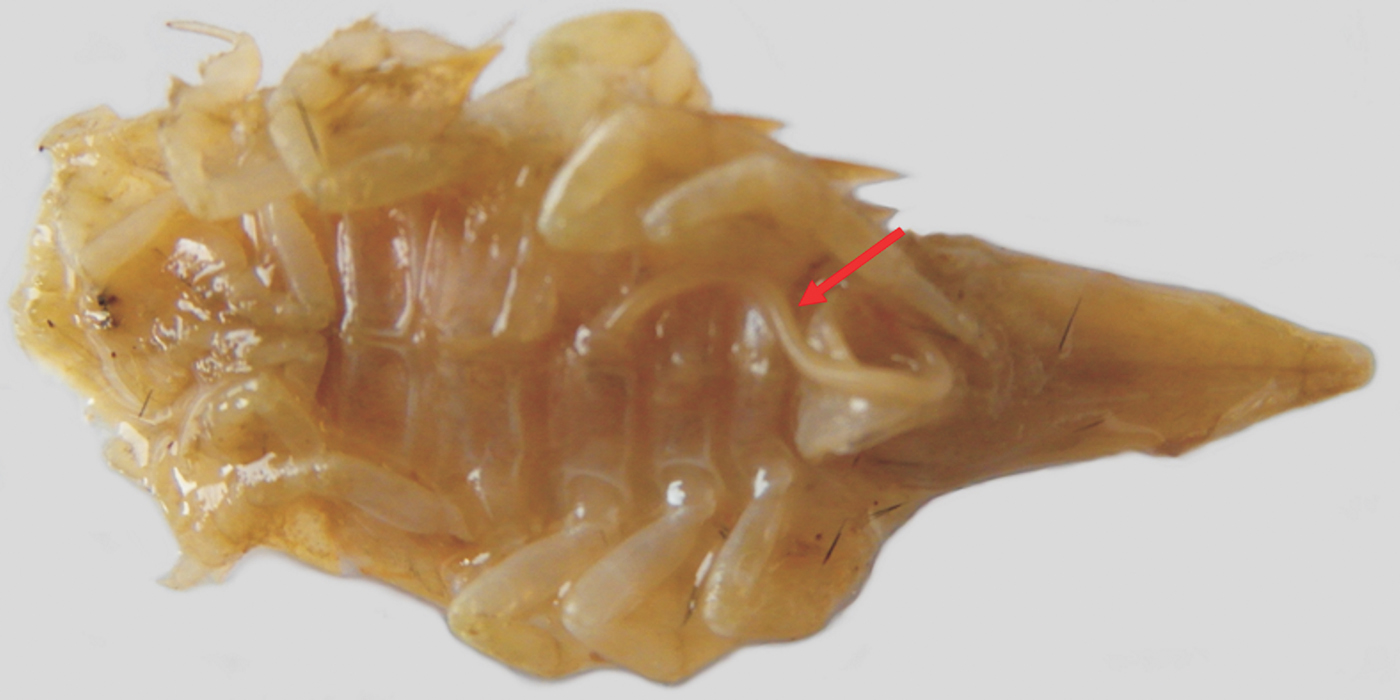
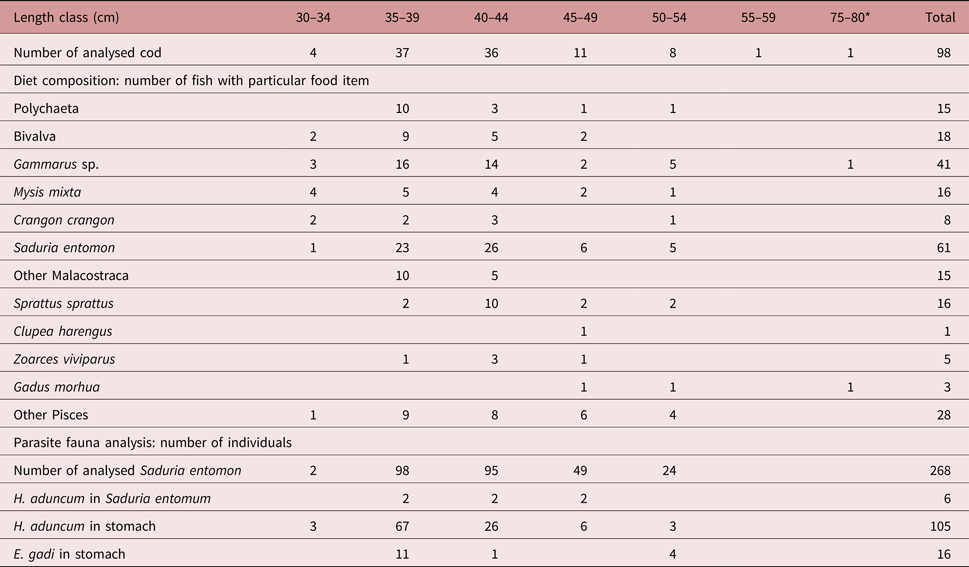
The results of stomach content analysis are shown in table 1. Macroscopic analysis revealed the presence of one nematode parasite in the body cavity of each of two individuals of S. entomon (fig. 1), identified as one adult male and one stage 4 larva (L4) of Hysterothylacium sp. The remaining S. entomon were digested using artificial stomach juice to allow easier detection of parasites, which were subsequently found in a further four individuals of S. entomon, but it was impossible to identify their developmental stage due to the level of decomposition of the parasite. Digestion of other food items did not reveal the presence of parasites. Molecular analysis confirmed that all these nematodes were of the species Hysterothylacium aduncum. The rDNA sequences of both individuals were identical and the lengths of read fragments were 910 nt.
Hysterothylacium aduncum in the body cavity of Saduria entomon.

Composition of cod diet and parasite fauna according to the length class of fish.

*There were no fish in length classes 60–74 cm.
Individuals of H. aduncum were also found in the lumen of the stomach of 27 fish (prevalence 25%; intensity of infection 1–31) close to the remains of invertebrates. The acanthocephalan E. gadi was found in the stomachs of eight cod (prevalence 8.16%; intensity of infection 1–8), whose stomachs contained prey species Gammarus sp., S. entomon or Mysis mixta. The numbers of parasites found in stomachs, according to the length class of fish, are presented in table 1.
The routes of Baltic cod's parasitic infection are described only in general terms and the role of particular organisms in the life cycles of these parasites is not fully understood. This is probably at least partially because research on the parasitic infection of invertebrates in the sea environment is complicated, laborious and expensive.
Food as a source of the parasitic infection of fish has been described for freshwater fish (Valtonen & Julkunen, Reference Valtonen and Julkunen1995). In cod, the composition of the diet varies with the size of fish and the type of foraging area (Pachur & Horbowy, Reference Pachur and Horbowy2013). Cod is a migratory species (Sualamo & Neuman, Reference Sualamo and Neuman2002), therefore the stomach contents do not necessarily correspond to the food species available where fish are caught. Parasitic infection may have occurred during earlier feeding episodes. In our analysis, the parasites H. aduncum and E. gadi were found in the stomachs of cod in the vicinity of predominant food species. Echinorhynchus gadi has been found next to the remains of S. entomon, Gammarus sp. and sprat Sprattus sprattus, while H. aduncum has been found near Gammarus sp., S. entomon and M. mixta. If the parasites are present near the remains of the digested prey, this suggests that these particular food organisms might be the source of infection.
In our studies, H. aduncum (Rudolphi 1802) was found to be the dominant parasite in the cod stomach. In general, H. aduncum matures in fish, but the first intermediate hosts are crustaceans such as copepods, amphipods, decapods and isopods (Køie, Reference Køie1993). Various fish species serve as paratenic or final hosts, acquiring H. aduncum through the food chain (Køie, Reference Køie1993; Balbuena et al., Reference Balbuena, Karlsbakk, Saksvik, Kvenseth and Nylund1998); however, gadoids are considered to be the main final hosts for Hysterothylacium sp. (Berland, Reference Berland1961).
During our analysis of well-preserved H. aduncum found in S. entomon, both adult (n = 1) and L4 larval stages (n = 1) were identified. The presence of the adult form of H. aduncum in the crustacean suggests that invertebrates (as well as fish) might function as final hosts, as described by Luque et al. (Reference Luque, Bannock, Lagrue and Poulin2007). On the other hand, the adult parasite was found in an undigested S. entomon individual inside a cod stomach. It is possible, therefore, that transformation from L4 larva to the adult stage took place inside the S. entomon, but after the death of the invertebrate in the cod. The initial digestion of the invertebrate by the stomach juices might drive the transformation of the parasite to the next developmental stage. However, the presence of an L4 larva and adult nematode in the isopod might be connected with post-mortem migration of the parasites to the crustacean in the fish stomach (Marcogliese, Reference Marcogliese1996). Iglesias et al. (Reference Iglesias, Valero, Galvez, Benitez and Adroher2002) described the conditions for optimal development and survival of these nematodes. They proved that if the medium was supplemented with pepsin, all the larvae reached the adult stage. Similar conditions were described by Adroher et al. (Reference Adroher, Malagon, Valero and Benitez2004).
To the best of our knowledge, no parasite species has been reported previously in S. entomon. More specifically, this is the first report of H. aduncum in situ in S. entomon found in the stomach of cod sampled from the Baltic Sea. Genetic identification confirmed the results of anatomo-morphological analysis. Cod is an opportunist when feeding and, as S. entomon is a major part of its diet, this invertebrate might be an important intermediate host in the life cycle of H. aduncum and thus a significant source of cod infection.
Acknowledgements
We thank Dr H-P. Fagerholm from the Institute of Parasitology in Åbo Academy, Finland, for consultation on the identification of parasite developmental stages. The research material was collected as part of the National Programme for Collection of Fisheries Data (EU DCF).
Financial support
This study was financed by the National Science Centre (Poland): grant number 2015/19/N/NZ9/00173.
Conflict of interest
None.