‘[W]hen preferences [of voters] are unstable or emergent, the representative has incentives to search… for the characteristics of the voter…’
Jane MansbridgeFootnote 1
‘Uncertainty regarding the preferences of constituents distresses many congressmen…’
Charles ClappFootnote 2
Albert Gore, Sr. (D-Tennessee) had a long and celebrated career in the US Congress. Prior to the 1960s, Gore was a popular senator who seemed to understand the needs and preferences of his electorate. When Gore was initially elected to the Senate, almost all of his constituents who were eligible to vote were white due to the disenfranchisement of African-Americans in his state. However, Gore's grasp of his constituents’ preferences changed in the 1960s, as his constituency saw a substantial increase in new voters. During the 88th Congress (1963–64), in Gore's second term in the US Senate, Tennessee saw its biggest increase in black registration in the twentieth century (over 20 percentage points). Gore explained that these ‘social and political trends’ in the US South, most notably – though not limited to – black enfranchisement, were causing instability in his state. Noting the massive increases in black voter registration leading up to his re-election in 1964, Gore admitted that he was no longer as knowledgeable about his constituents’ views as he had been and that he ‘recognized the uncertainty involved’ in positions he took on a host of issues.Footnote 3 What happens to the roll-call behaviour of legislators like Gore who face massive shifts in their electorates, which cause legislator uncertainty about constituent preferences?
Does uncertainty about constituent preferences explain ideological inconsistency by legislators? While many commentators and scholars view inconsistent legislative behaviour as erratic or unpredictable, we offer a theory for this type of legislative behaviour that is based on the uncertainty legislators have about their constituents. Our article starts where other scholars end their enquiries into the determinants of legislative behaviour. Many theories examine the convergence (or divergence) of parties or politicians in an ideological direction,Footnote 4 but little research systematically examines why politicians or parties’ general ideological positions fail to predict specific voting decisions on some issues. In other words, why do equally liberal (or conservative) legislators nonetheless vote on different sides when the prediction is that they should be in agreement? We argue that legislators engage in ideological hedging when faced with high levels of uncertainty about constituent preferences, and that this hedging behaviour leads to ideologically inconsistent voting on roll calls.
We theorize that legislators have incentives to present inconsistent voting records when these legislators are uncertain about constituent preferences. We test our theory by examining the US Senate, which has never been studied through the lens of legislator uncertainty.Footnote 5 We find that uncertainty leads to higher ideological inconsistency among US senators, even after controlling for ideological extremism. Specifically in the US South during 1961–2004, senators with large constituency changes due to black enfranchisement and subsequent mobilization are most likely to vote in an inconsistent fashion.Footnote 6 More generally, in all fifty US states over the same time period, senators facing the largest change in constituency populations (such as the Southern Democrats) are found to be most ideologically inconsistent in their roll-call records. While we test our theory by examining the US Senate, the theory can be applied and extended to other legislators, elected officials or to any agents who may be uncertain over the preferences of their principals.
This study departs significantly from the extant literature on behaviour within legislative institutions. First, much scholarly attention is paid to the factors that lead legislators to change their voting records in one ideological direction, or to the correlates of legislative roll-call voting more generally. By examining ideological inconsistency, our model takes a conceptual turn away from extant models, and provides a novel theoretical framework that explains ideological hedging (or inconsistency – we use these terms interchangeably). Inconsistent legislators have generally been dismissed as outliers or ‘inept’ politicians who do not fit the model of a typical legislator.Footnote 7 Instead, we offer an explanation for behaviour that has previously been considered idiosyncratic. Secondly, we measure the inconsistency in a legislator's voting record by the percentage of votes incorrectly predicted by a legislator's revealed preference, which is not typically the subject of empirical study. As Brady and Rohde note, ‘very little use [is] made of the errors or incorrect predictions [in the DW-NOMINATE model].’Footnote 8 Thirdly, there is scant empirical work on the effect of incumbent uncertainty of constituency preferences on position-taking, or on the effect of legislators’ personal characteristics on roll-call voting.Footnote 9
Fourthly, while some work examines changes in the voting behaviour of the southern electorate,Footnote 10 few studies examine voting patterns at the elite level during the same time period.Footnote 11 Fifthly, while most empirical work on congressional representation focuses on the US House, the US Senate offers an opportunity to study representation in a different institutional setting. Indeed, most studies examining the effect of population change and the effect of black enfranchisement have focused on the US House, where redistricting can sometimes lead to more uncertainty. We examine the US Senate because state lines cannot be manipulated by elites, allowing for a cleaner measure of uncertainty based purely on exogenous population and demographic changes.
Legislator uncertainty and ideological inconsistency
We define legislator uncertainty as a legislator lacking full knowledge of the views or preferences of his or her constituents on policy. For many reasons, uncertainty about constituent preferences will vary across legislators, as some may have a general idea that their constituents are liberal or conservative, but may not know precisely how liberal or conservative.Footnote 12 In contrast, others may have very little knowledge regarding constituent preferences on specific issues.
We define ideological inconsistency as legislative voting records that are not easily predicted by the legislator's ideal point on one or two key ideological dimensions that shape legislative and electoral politics.Footnote 13 An inconsistent legislator is one who, relative to other legislators, votes in a less predictable fashion given the location of his or her ideal point. In contrast, consistent legislators’ ideal points regularly predict their roll calls. More colloquially, on any given roll-call vote, inconsistent legislators are those conservative (liberal) legislators who support the liberal (conservative) option even when their equally conservative (liberal) colleagues do not. For instance, during the early 2000s, midwestern senators Russ Feingold (D-Wisconsin) and Paul Wellstone (D-Minnesota) were two of the most liberal senators in the US Senate. Yet Feingold was much more unpredictable and inconsistent than Wellstone during the latter's tenure in the Senate, occasionally voting in ways not predicted by his liberal ideological location. On the basis of DW-NOMINATE estimates, Feingold's ideal point did not predict his vote choices as frequently as Wellstone's did. Our article models this variation in ideological inconsistency above and beyond extremism/moderation.
Such behaviour begs the following question: why would a rational legislator present an ideologically inconsistent record that, at first blush, may appear to be odd at best and irrational at worst? Fenno states that a lack of consistency ‘feeds the media's appetite for inconsistency, generates dissonance …, and in general opens possibilities for political attack or self-destruction’.Footnote 14 Kingdon points to several reasons why it may be beneficial for legislators to show consistency in their voting patterns.Footnote 15 In contrast, we argue that legislator uncertainty about constituent preferences can explain ideological inconsistency in roll-call voting: politicians uncertain about the locations of their constituents will ‘hedge their bets’ by spreading out their votes more widely across the ideological spectrum within the area in which the politicians are uncertain about constituent preferences. Inconsistency may thus be a rational, strategic attempt to respond to uncertainty in a way that has not been recognized by other scholars.
A Theory of Ideological hedging
To motivate our theory of ideological hedging by legislators under uncertainty, we first discuss extant theoretical work about candidate uncertainty of the median voter. In a typical two-candidate Downsian model, a candidate should take a position at the median of the electorate. This equilibrium prediction rests on several assumptions, including the assumption that a candidate possesses accurate information on the location of the median voter. Once these assumptions are relaxed, however, the resultant equilibrium prediction changes. For instance, the candidate who is uncertain about the location of the median voter will, under some conditions (such as having a mix of pure electoral and personal policy preference motivations), take a position in equilibrium that is different from that of the median voter.Footnote 16 However, convergence or divergence equilibria are not always found. When a candidate has strong personal preferences and has high uncertainty about the constituent median, an ‘equilibrium does not exist … even in the unidimensional case.’Footnote 17 This disequilibrium suggests the possibility that a candidate shifts back and forth within some (relatively narrow) space. We assume that legislators are motivated by both personal preferences and re-election,Footnote 18 though we focus on the re-election inducements of preferences.
During an election campaign, incumbent legislative candidates (and their opponents) who are uncertain about the location of the median (or more broadly uncertain about the location of other constituents such as the primary constituency, key subconstituency groups and the like) may take a position somewhere between their best guess of the median and the location of their own personal policy preferences, or may shift back and forth in response to the other candidate's previous move.Footnote 19 These expectations from prior work assume two candidates (or parties) competing in an electoral space. But what happens when a legislator is required to take positions on roll-call votes in a context that does not involve a two-candidate election campaign? Moving from the campaign setting to the legislative arena, legislators may face uncertainty over both the median constituent and the identity of future candidates (in both primary and general election settings).
Uncertain Legislators Hedge Their Bets
In our theory, we are interested in the positions taken by a legislator during an entire term, which includes the period before the emergence of an election opponent. The expected behaviour of a legislator, even in periods when an election opponent has yet to emerge, will be predicated at least partially on the legislator's goal of achieving re-election. While we assume that a legislator is motivated by a mix of both re-election and personal preferences, each legislator will have re-election as a primary goal. While other inducements also matter, a legislator's ideal points can be induced by his or her constituents when re-election is driving the legislator's choices. A legislator votes yea on a roll call when its policy position is closer to his or her ideal point than the status quo is; and s/he votes nay when her or his ideal point is closer to the status quo than to the new proposed policy (whether or not the legislator is uncertain about constituency preferences).
When a legislator who cares about re-election is certain about the preferences of his or her constituents, the predicted behaviour is clear: the legislator should take consistent positions near the district's median voter. But the more interesting question is: what happens when a legislator is uncertain about constituent preferences? Under uncertainty, a legislator's knowledge of his or her constituency-induced preferences can shift within a short time period as s/he learns about the preferences of the constituents, which can result in position shifts on roll calls.
In order to be re-elected under conditions of uncertainty, legislators may have an incentive to try out a number of positions in the area within the issue or ideological space where they think constituent preferences may lie. Legislators will experiment by taking a variety of roll-call positions because they can learn through constituent feedback not only where their constituents stand but also the median voter's preference. These legislators can reduce uncertainty by presenting ideologically inconsistent positions. Also, they may have an incentive to keep their overall ideological record somewhat inconsistent or ambiguous as they anticipate future elections and challengers that have yet to emerge.
In addition, uncertain legislators may have an incentive to cast roll calls in an ideologically inconsistent manner even when factors beyond constituency preferences induce legislator ideal points. In this scenario, legislators may simply vote based on their own personal preferences under conditions of high uncertainty, and receive feedback from constituents based on the legislators’ revealed personal preferences. Since legislators’ personal preferences are typically more extreme than those of constituents,Footnote 20 once re-election-seeking legislators learn their constituent preferences, it is likely that legislators will adjust their roll-call voting records. This will produce ideological inconsistency in roll-call voting records.
Observing feedback from voters via communications with constituents during the representational process, legislators will adapt and adjust in the expected direction of the median within the area of uncertainty.Footnote 21 We argue that legislators take positions – even before an opponent has emerged – with constituent preferences and electoral goals in mind. Under conditions of uncertainty, legislators will search for the location of the constituent median by voting on roll calls in ways that will not map clearly onto one point on the ideological spectrum. This uncertainty is likely to vary across legislators and even within a particular legislator's career. One factor that can cause uncertainty for legislators is the addition of new voters. When this happens, a legislator is likely to have some prior expectation as to the preferences of the new voters, but will not be certain about their exact location. As a result, the legislator will search and move in the direction where the legislator thinks the new median may be located.
Legislators and Learning
As legislators search within the ideological space, trying to find the median voter under uncertainty, they receive feedback from constituents. The microfoundations of the feedback process are as follows. Prior to an election, legislators can learn about the positions of their constituents by assessing constituent reactions to a variety of roll calls. This learning process can occur during contact with constituents: town meetings, tele-town halls, phone calls from constituents, polls and talking with constituents during recess periods. By casting some roll calls that are in different locations in the ideological space, legislators are able to offer something for everybody. This allows legislators to explain their positions to constituents, and assess reactions to each. If legislators get more negative feedback for voting conservatively, they learn that the constituency median is likely to be liberal. This process of learning about constituent preferences will cause legislators to take a number of different positions at first, leading to a prediction of ideological inconsistency. Negative feedback from the constituency median on a roll-call vote will suggest that the legislator has either not moved far enough towards the true median – or has moved too far away past the true median. Incumbents who are uncertain about constituent preferences (unlike challengers) can mitigate negative constituent feedback on some roll calls by promoting distributive policy goods brought to the constituency. Specifically, uncertain legislators can explain away unpopular votes by claiming to have extracted distributive policy goods from party leaders in exchange for what is later learned by the legislator to be an unpopular roll call.
Legislators learn about constituent preferences through this feedback received from constituents, which reduces legislator uncertainty. Rarely do legislative offices get flooded with constituent telephone calls praising a position taken by a legislator. Instead, legislators are most likely to hear from their constituents when the legislator has taken an unpopular position. Since negative feedback is more likely than positive feedback, a legislator may want to cast ideologically inconsistent roll calls that allow for that legislator to respond to negative feedback from constituents on one roll call by pointing to a different roll call where constituents are more likely to agree. If a large bloc of new voters is added to the constituency – either through enfranchisement or through voter registration and mobilization – legislators will face increased uncertainty, which may make it optimal for them not to immediately establish a reputation in one location of the ideological space. Legislators can change their revealed preferences when faced with large changes in their constituencies, and this will result in a voting record that looks inconsistent.
This theoretical logic of candidates searching within a policy space can be applied to incumbent legislators’ representational decisions when challengers finally emerge as well. For instance, Sulkin shows that legislators update their beliefs about the preferences of their constituents by taking cues from their opponent's legislative platform, and Evans finds that legislators rely on their ‘perceptions about current and potential constituent viewpoints’ when a constituent position is not known to the legislator.Footnote 22 Studying vote switching by legislators, Espino and Canon argue that ‘members’ positions are not carved in stone’.Footnote 23 Since voters may worry that their legislator is an ideologueFootnote 24 and given legislator uncertainty about constituent preferences, the legislator has an incentive to vote in an ideologically inconsistent fashion as inconsistency, under conditions of uncertainty, yields higher expected utility for the legislator. Legislators may be aware that their constituencies are changing, but highly unsure of the location of the median voter. In this scenario, legislators may try a variety of positions and gauge reactions from constituents.
This trying out of a variety of positions should not, however, occur blindly or randomly. While legislators are uncertain about their constituents’ preferences, legislators may have a reasonable expectation as to the range in which the constituents’ preferences lie in an issue or ideological dimension. For instance, an increase in African-American voters in the electorate due to enfranchisement or mobilization might lead legislators to assume that the new median has shifted to the left.Footnote 25 However, while legislators know that the median has moved to an area on the left, they are unsure of its exact location. Thus, even when legislators have an inkling of the general direction of the median though they do not know its precise location, they will take a variety of positions in the area where they think the median lies, and in so doing assess the responses received from voters.
Alternative Theories
In contrast, extant theories of elite positioning under conditions of uncertainty sometimes argue or assume that two candidates facing uncertainty have an incentive to take one consistent and convergent position. Hinich and Munger claim that ‘if two candidates have access to the same information, then their ‘best guesses’ about the location of the median voter will be the same’ and that a vote-maximizing candidate's best response under conditions of uncertainty is to take the same position as his/her challenger.Footnote 26 But these extant theories of candidate positioning assume that there is a campaign opponent and that positions are taken during the course of a campaign. Hinich and Munger argue that voters prefer a consistent and ideologically distant candidate to an inconsistent yet ideologically close one, since voters reward consistency and certainty in their legislator.Footnote 27 The reason for this is that the expected utility voters derive from electing a candidate is a function not only of the distance between ideal points, but also the variance of legislator position-taking. To put it differently, Hinich and Munger argue that voters prefer legislators who clearly communicate a precise ideological position; according to Hinich and Munger, voters are willing to trade some ideological closeness for certainty.
Our theory departs from Hinich and Munger and the earlier work that they summarize in several ways.Footnote 28 First, we are not necessarily interested in candidate position-taking but rather in legislator position-taking, irrespective of a campaign. Elected legislators, though, are forced to take positions on roll-call votes. Legislators do not have the luxury of engaging in empty position-taking or credit-claiming (often an assumption of candidate-centred models) because roll-call voting requires that a position be taken at the time the roll call comes up for a vote.Footnote 29 Furthermore, legislators facing re-election are unable to abstain frequently because of electoral pressures, and thus they must take roll-call positions.Footnote 30
Secondly, our prediction that legislators will take inconsistent positions is obviously at odds with models that predict consistent voting records. We argue that when faced with uncertainty, legislators are unwilling to commit to a clear position until they learn more about the preferences of their constituents. In this case, electoral benefits are realized by a legislator being ambiguous or inconsistent, rather than consistent.Footnote 31 When incumbent legislators commit to a consistent position, they establish a reputation that may be difficult to shed if they need to do so due either to the emergence of a challenger or updated beliefs about the location of the median. Owing to the high uncertainty, a consistent legislator may take a position very far from the median voter; and a challenger can emerge that easily dominates that position (especially if the challenger emerges during a time of low uncertainty). The ability to adjust future roll-call voting is easier for a legislator who has not committed to one ideological position in past roll calls.Footnote 32
Work from outside this tradition examines party or candidate adaptation in taking positions. Similar to Kollman, Miller and Page, we argue that candidates may try out positions to assess feedback from voters; however, we do not assume that the incumbent's ‘platform remains fixed.’Footnote 33 Incumbents are able to assess feedback by taking positions on a variety of roll calls. Since an incumbent legislator is able to use explanation when interacting with constituents,Footnote 34 a position taken by a legislator that turns out to be unpopular when the legislator hears from constituents is easily discarded by the legislator when taking a position in future roll calls. An incumbent legislator has the luxury of being able to explain away unpopular roll calls by claiming that distributive goods for the district were received for the unpopular roll call or that other important concessions from the party leadership were extracted for an unpopular vote (a challenger is unable to explain away unpopular positions in this way). The legislator can subsequently point the constituents to popular positions taken on other roll calls. Since the representational process involves explanation, legislators have quite a bit of leeway to take positions across the ideological space and to promote those roll-call positions that turn out to be favoured by the constituency as the legislators become more certain about the preferences of constituents.
Summary of Our Theoretical Argument
In sum, we predict that ideological inconsistency on roll calls will occur when legislators are uncertain about the preferences of their constituency median. This inconsistency occurs for two reasons. First, legislators who search for the median and assess feedback during their terms in office will vote inconsistently as they experiment with a number of positions. Secondly, legislators may opt for a strategy of ambiguity or inconsistency when faced with uncertainty. Given that legislators are unlikely to learn the position of the median voter quickly under conditions of high uncertainty, they may be better off taking a variety of ideological positions, which maximizes their vote shares. Earlier theories have noted the importance of ambiguity for candidates as an optimal strategy, but none have connected the ability of incumbent legislators to be ambiguous to their roll-call voting records.Footnote 35
Uncertainty and Inconsistency Due to Constituent Change
We apply our theory to legislators facing constituency changes. Perhaps the most obvious cause of exogenous legislator uncertainty will be constituency changes related to the addition (or subtraction) of new voters. However, given our theory of legislator uncertainty, the addition of new voters is not a sufficient condition for legislative ideological inconsistency. Adding new voters (as long as the new voters do not comprise a majority of the constituents) will not always lead to extensive uncertainty about the location of the median. Rather, the level of preference heterogeneity among the ‘old’ constituents conditions the extent to which the addition of new voters affects legislator uncertainty.
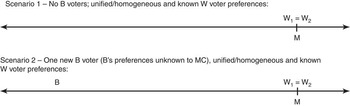
Consider the stylized one-dimensional constituencies in Figures 1 and 2. In Scenario 1 of Figure 1, we assume there are two voters, W1 and W2, with unified or homogeneous preferences whose ideal points are observed by the legislator. In this scenario, the legislator will consistently vote at the position of W1 = W2. Now, consider the addition of a new voter, B, to that constituency (Scenario 2 in Figure 1). The legislator knows an additional voter has been added to the constituency, but does not observe that voter's ideal point. Since W1 and W2 share the same position (which is observed by the legislator), the addition of B does not shift the location of the median voter: no matter what the location of B's ideal point along the dimension, the position where W1 = W2 will still be the median and the legislator will know this with certainty. Thus, in Scenario 2 of Figure 1, the legislator will still consistently take positions favoured by the known median voter, even after the addition of a new voter with unknown preferences. When constituent preferences are homogeneous, then, the addition of a numerical minority of new voters with unknown preferences will cause very little legislator uncertainty about the median voter's location.
New voters added to an existing constituency with homogeneous/unified preferences

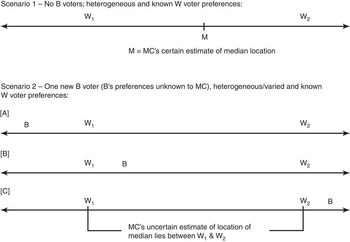
New voters added to an existing constituency with heterogeneous/varied preferences

In contrast, Scenario 1 of Figure 2 shows a similarly stylized constituency with two voters, W1 and W2. Unlike Figure 1, this constituency is heterogeneous in its preferences, though as in Figure 1, the legislator observes the location of each Wi voter. If we assume a model with probabilistic voting and quadratic utility losses, then, because the legislator has complete knowledge about constituents’ preferences, the optimal position would be a consistent position on roll calls near M, the median location of the constituency (located at the midpoint between W1 and W2).
In Scenarios 2(a), 2(b) and 2(c) in Figure 2, a new voter, B, has been added to the constituency. The legislator knows this voter has been added, but does not know the location of the new voter in the constituency. Each scenario yields a different location for the new median. In Scenario 2(a), the new voter B has an ideal point to the left of the existing voters W1 and W2, and therefore the new median (unobserved by the legislator) is W1. In Scenario 2(b), the new median voter is B, but again this is unobserved by the legislator. In Scenario 2(c), W2 is the new median, though again the legislator does not know this.Footnote 36 Since the legislator does not know the location of B, but observes the location of W1 and W2, the legislator knows the location of the median voter is somewhere between W1 and W2, probably closer to W1 than W2 in this particular instance. As the space between W1 and W2 increases, the legislator will have less certainty about the exact location of the new median. The level of uncertainty about the location of the new median is therefore contingent upon the amount of variation or heterogeneity of known constituency preferences (the Wi voters). The implications of our theory of ideological search under Scenario 2 in Figure 2 would be that the legislator would engage in ideological hedging. The legislator would cast some votes that might be preferred by W1, some other votes that would be preferred by W2, and observe feedback in order to gauge the preferences of the new constituency median. The larger the distance between the known W voters when new B voters are added, the less incentive a legislator will have to commit to one position within the ideological space. Instead, a legislator's best response will be to present an inconsistent set of roll calls. Having set up our theoretical framework, we now turn to our hypotheses.
Hypotheses
The enfranchisement of new voters – in this case African Americans in the US South – induces uncertainty. For example, in 1964, African Americans were only about 5 per cent of the registered electorate in Mississippi. In 1966, African Americans were 27 per cent of the registered electorate, a two-year increase of over 400 per cent in black electoral strength. While many increases in black voter enfranchisement and mobilization occurred with the adoption of the Voting Rights Act in 1965, the 1960s and 1970s are not the only periods in which the United States saw large increases in black voter registration that resulted from earlier enfranchisement. In the 1980s, spurred in part by Jesse Jackson's presidential bid, black voter registration levels increased dramatically, introducing uncertainty for legislators during another time period as well.
Large population change in a state may also lead to uncertainty about constituent preferences, which may cause legislator inconsistency as there is ‘a relation between a diverse, recently transplanted population and a mutable politics.’Footnote 37 Therefore, in our models, we examine this more general change in state population that is not necessarily a function of the enfranchisement of new voters (and can thus be applied to other settings).
In the light of our theoretical framework, we must identify determinants of constituent heterogeneity. When considering the enfranchisement and mobilization of African-Americans in the US South, the heterogeneity and instability of Democratic political coalitions are much greater than those of the Republicans – and Democratic legislators are more uncertain about both primary and general electorate medians than are Republican legislators, as African-Americans are much more likely to vote in Democratic party primaries. On the one hand, Democratic senators were faced with the uncertainty associated with balancing a coalition of African-American voters, conservative white voters and more moderate-to-liberal white voters. On the other hand, Republicans were less concerned with the need to balance a diverse coalition, since their support came almost entirely from conservative white voters. Thus, our first hypothesis regarding the effect of constituency change is as follows:
HYPOTHESIS 1: Changes in black electoral strength will have a greater impact on the inconsistency of voting records of Democratic senators than on the voting records of other senators.
Heterogeneity within the general electorate can also be measured by the level of political competition within the constituency. Legislators from states that are not politically competitive, where the same candidates and same parties win regularly, should not feel as much pressure to change their voting records in response to changes in the constituency—since their re-election is all but secured in these politically homogeneous constituencies. Thus, a second hypothesis regarding uncertainty due to constituency change is:
HYPOTHESIS 2: (a) Changes in black electoral strength and (b) population change will have a greater impact on the inconsistency of voting records of senators from politically competitive states than from less competitive states.
An alternative hypothesis: heterogeneity only. As an alternative to our theoretical argument and its resultant hypotheses, one may suggest that the effect of an influx of new voters on ideological inconsistency is simply due to increased heterogeneity rather than uncertainty about constituency preferences. How do we know that increased ideological inconsistency is due to uncertainty and not only to a legislator responding to a more heterogeneous constituency?
As we note above, under our theory of uncertainty and ideological inconsistency, constituency heterogeneity by itself is not sufficient for ideological inconsistency. If voter preferences are heterogeneous, but known to the legislator, then the legislator will simply vote consistently near the median. Also, the theory suggests that an increase in new voters by itself is not sufficient to lead to ideological inconsistency. Therefore, the idea that constituency heterogeneity only affects ideological inconsistency versus the claim that constituency heterogeneity combined with legislator uncertainty yields ideological inconsistency are testable competing hypotheses. If our theory's implications are correct, variables interacting (a) constituency change; and (b) constituency heterogeneity will be statistically significant. However, if the alternative hypothesis that constituency heterogeneity alone predicts inconsistency, then the relationship between constituency change and heterogeneity, on the one hand, and inconsistency, on the other, will be an unconditional one.
Data and results
We examine roll-call inconsistency in the US Senate from 1961 to 2004. This time period allows us to compare electorates with large changes in enfranchisement levels and mobilization to electorates that faced very little constituency change; it also allows us to examine more contemporary time periods in which there was significant population growth in many states. In one empirical model, we limit the analysis to the US South because data for black electoral strength are only available in southern states. In a second model, we analyse the effect of all independent variables other than those pertaining to black electoral strength using data from the universe of senators from all fifty states during 1961–2004. The dependent variable of interest in our subsequent analyses is legislative ideological inconsistency. We measure legislative inconsistency as the percentage of misclassified votes in Poole and Rosenthal's two-dimensional DW-NOMINATE model of legislative voting. This measure or similar measures of misclassification have been used by others to measure roll-call unpredictability or inconsistency.Footnote 38 As Poole and Rosenthal note, two dimensions correctly predict approximately 80 per cent of all roll-call votes cast in the US Senate during the twentieth century (McElroy and Benoit find this in the context of the European Parliament as well).Footnote 39 The first dimension is a traditional left–right dimension, while the second dimension is a racial/civil rights or social issues dimension. However, despite the accuracy of aggregate predictions, not all individual senators are well classified by the two-dimensional model of spatial voting. Those with numerous classification errors are deemed more inconsistent than their low-error colleagues, as the locations of their ideal point estimates do a poorer job of predicting individual votes.Footnote 40
This inconsistency measure assesses how frequently a legislator's ideal point (revealed from roll calls taken in a given congress) incorrectly predicts individual vote decisions. Senators who vote with conservatives (liberals) on roll calls when they fall on the right (left) side of the estimated cutting line are considered consistent. Those who vote with liberals (conservatives) on some roll calls when their revealed preferences suggest that they should vote with conservatives (liberals) are considered inconsistent. In sum, senators with more misclassified roll calls voted differently than had been anticipated based on their revealed ideological positions (and the location of the bill's cutting line).Footnote 41 We use each senator's percentage of misclassified roll calls in each congress to measure inconsistency.
Who Were the Most Inconsistent Senators?
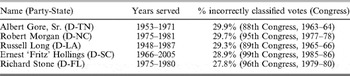
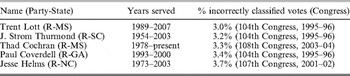
Table 1 lists the five southern senators with the highest percentage of misclassified votes in a single congress during the 1961–2004 period. This list includes iconic senators who have been identified by biographers and historians as ideologically inconsistent, and most served during periods of large increases in the black electorates of their states. Albert Gore, Sr. (D-Tennessee) had the most inconsistent voting record in a congress during this time period. This finding echoes the characterization of Gore as an ‘iconoclast’ who sometimes presented a ‘confusing [ideological] message’ to his constituents by taking both racially liberal and racially conservative positions during the same time period.Footnote 42 The DW-NOMINATE model of two-dimensional spatial voting incorrectly classified 29.9 per cent of Gore's votes during the 88th Congress (1963–64). The other four most inconsistent senators (in a single congress) during 1961–2004 include Robert Morgan (D-North Carolina), Russell Long (D-Louisiana), ‘Fritz’ Hollings (D-South Carolina) and Richard Stone (D-Florida). Interestingly, Long showed the most inconsistency during the 89th Congress (1965–66), a time period of massive increases in black registration levels throughout the South. In Louisiana during this short two-year period, African-American registration rates increased from about a third of the black population to almost 50 per cent.Footnote 43 Long's inconsistent and somewhat erratic behaviour was not lost on his colleagues, and it was reported that he lost his position of Majority Whip to Ted Kennedy in large part due to his unpredictable behaviour.Footnote 44 At the other end, Table 2 displays the five southern senators with the most consistent voting records during the period examined: Trent Lott (R-Mississippi), Strom Thurmond (R-South Carolina), Thad Cochran (R-Mississippi), Paul Coverdell (R-Georgia), and Jesse Helms (R-North Carolina). This list includes senators well known for their ideological consistency.
Senators with the highest rates of ideological inconsistency, 1961–2004Footnote *

* Note: The senators named in Table 1 are the five most inconsistent senators in the period.
Senators with the lowest rates of ideological inconsistency, 1961–2004Footnote *

* Note: The senators named in Table 2 are the five most consistent senators in the period.
Specifying the Empirical Models
We specify empirical models where each senator–congress dyad during the period 1961–2004 is the unit of analysis. In the first set of models, we examine only senators from southern states, given our interest in changes in black electoral strength. Data on changes in black electoral strength are not available nationally for this entire time period, but are available for the southern states from 1960 onwards.Footnote 45 We also estimate a model using national data on all senator–congress dyads during 1961–2004. As noted above, the dependent variable is the percentage of inconsistent roll calls, which differs across each congress for each senator. On average, 13.5 per cent of a southern senator's votes were inconsistent between 1961 and 2004, with a range of 3.0–29.9. In terms of the actual number of votes, the average southern senator had about eighty inconsistent votes per congress.Footnote 46
Constituency uncertainty: independent variables of interest
To test our hypotheses regarding the conditional effect of uncertainty, we include three interaction variables and four associated lower-order terms. The Absolute change in state population variable is the absolute value of the change (in percentage points) in the state-wide population during each congress for each senator, from the second year of the preceding congress to the second year of the current congress (for example, for the 87th Congress, 1961–62, this is the change in the state population between 1960 and 1962). Higher values mean that the state is growing (or shrinking) rapidly.Footnote 47 Absolute change in black electoral strength in a two-year period is measured as the absolute change in the ratio of black registered voters to the total number of registered voters.Footnote 48 We multiply this variable by 100, so a one-unit change means a one percentage-point change in black electoral strength. As with state population, this change is measured from the second year of the preceding congress to the second year of the current congress.Footnote 49 Democratic senator is a dummy variable coded 1 for Democratic senators and 0 otherwise. We also include a variable capturing the level of state political heterogeneity. We use David's, Hood, Kidd and Morris's, and Lamis's measure of Political competitiveness, which is computed as follows: 1 minus the absolute difference in the state-wide electoral strength of Republicans and Democrats in the previous election year.Footnote 50 States where both parties are evenly matched have a value approaching 1, while uncompetitive states have a value that approaches 0.
We include three interactions to examine whether the effect of constituency change is contingent upon the level of heterogeneity: Absolute change in state population × Political competitiveness, Absolute change in black electoral strength × Democrat, and Absolute change in black electoral strength × Political competitiveness. These three interactions are crucial for capturing the mediating effect of heterogeneity on the relationship between changes in the electorate and legislative inconsistency. If our uncertainty-based theory's predictions are correct, these interaction variables will probably yield significant results. But if higher inconsistency is associated only with heterogeneity and not uncertainty, then these interaction variables may not be significant, though each constitutive term may be significant.
Other independent variables
We also include a number of variables that could affect classification errors. Some of these variables attempt to explain propensities for roll-call inconsistency at the level of individual senators, while other variables control for methodological aspects of the DW-NOMINATE algorithm that could affect the percentage of classification errors. Amateur senator is a dummy variable coded 1 for senators with no prior experience before their election to the Senate. As described by Shafer and Johnston, the Cosmopolitan senator dummy is coded 1 for senators identified as non-local ‘cosmopolitans’ and coded 0 for ‘local’ senators.Footnote 51 These two dummy variables should be positively correlated with inconsistency for several reasons. First, it is reasonable to assume that amateurs and non-local legislators are more uncertain about the preferences of their constituents. Alternatively, it could be the case that these are different ‘types’ of legislators, perhaps with less structured preferences (especially in the case of amateurs). In either case, we should expect a positive correlation with inconsistency.
Absolute value of DW-NOMINATE 1st dimension and Absolute value of DW-NOMINATE 2nd dimension are included to capture those senators who are at the extremes of each ideological dimension. As Poole and Rosenthal note, ‘Legislators far from the cutting line [and thus legislators who are extremists] will have either very high or very low probabilities of voting Yea’, and thus they are likely to have very few classification errors.Footnote 52 By including these variables, we are controlling for extremism/moderation. Also, DW-NOMINATE ideal point estimates are constrained to move linearly over time, and therefore senators serving in a large number of congresses might have more errors (since their score in any given congress is a function of their behaviour across a long career, rather than simply their behaviour during that congress alone). Therefore, we include a variable for the Maximum congresses served over Senate career. It is important to note that this measure is not the same as seniority in a given congress, as it is a constant value that indicates the total number of congresses for which the senator has a different DW-NOMINATE estimate. We also include the Number of votes cast by senator as a small number of votes may result in a high error rate, though it may also cause consistency (if, for instance, the senator is choosing to abstain on difficult votes). Seniority of senator is measured as the number of congresses a senator has served at the end of the congress examined (i.e., one for a freshman senator). Senior senators may have better knowledge of their constituents and may vote more consistently, though they may also have lost touch with constituents, which may cause inconsistency.
Congress/time (82nd, 83rd, etc.) is included to control for a trend in the dependent variable.Footnote 53 We also include an Indicator for first congress of six-year term and an Indicator for second congress of six-year term (each coded 1) to control for the cycle embedded into a six-year Senate term. The Previous general election margin of victory and the Previous primary margin of victory, both over the second-place finisher, are likely to affect roll-call inconsistency. Large margins of victory may suggest that senators have leeway and are able to vote consistently (perhaps based on their own personal preferences). Alternatively, large margins of victory may cause increased inconsistency if these large margins indicate senators taking a multiplicity of positions across the policy space. Retiring senator is a dummy variable coded 1 for senators who retired at the end of the congress; these senators are free to vote their personal preferences, and this may lead to more or less inconsistency depending upon the legislator's personal preferences and shirking tendencies. We also include a dummy variable for Defeated in primary, coded 1 if the senator lost a primary during the congress. Senators defeated in a primary will vote on many roll calls following their defeats, and with the electoral connection severed, these senators’ voting patterns might differ from those of other senators (and like retiring senators, the direction could be positive or negative). Ran for president is a dummy variable that equals 1 during the congress in which a senator ran for that office (for example, the 100th Congress for Al Gore, Jr). Those senators running for president may vote more inconsistently if they attempt to appeal to both state and national constituencies, though they may also be more consistent as they tailor positions to more extreme presidential primary voters.
We also include the State population (measured in millions) as Lee and Oppenheimer show that state size affects representation.Footnote 54 Senators from small states may have a greater understanding of their smaller constituencies, resulting in lower inconsistency. Alternatively, Richman shows that large constituencies are correlated strongly with one-dimensional voting, which results in roll-call consistency.Footnote 55 Finally, a dummy variable is included for Third-party senators, and this variable should be positive as senators not affiliated with the two major parties are likely to engage in roll-call voting behaviour that does not map onto the dimensional structure of voting in Congress.Footnote 56 These control variables are important so that we can isolate the effects of the variables associated with our hypotheses. While not central to our argument, even the results of these control variables are novel as no one has examined any individual-level predictors of ideological inconsistency.
Results
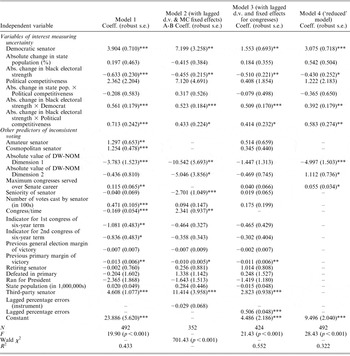
We estimate four separate models, all of which yield similar results with respect to our main variables of interest. The first model is estimated using the variables mentioned in the previous section. We also estimate models in which we include the lagged dependent variable and fixed effects for each individual senator (Model 2), as well as the lagged dependent variable and fixed effects for each congress (Model 3). By estimating a within-career model, in Model 2 we are able to isolate constituency effects by removing all legislator-specific characteristics with fixed effects (such as being prone to vote on a consistent third dimension, or having preferences that are less structured). Note that in Model 2, we estimate the regression parameters using the Arellano–Bond estimator for panel data with unit effects and a lagged dependent variable.Footnote 57 In Model 3 by including fixed effects for congresses, we are controlling for potential agenda-specific effects that may lead to more inconsistency in some congresses and less inconsistency in other congresses (since the fixed effects will capture congress-specific agenda effects). These alternative specifications put to rest any concerns that either agenda effects or member-specific characteristics are driving the results. Finally, in Model 4, we estimate a ‘reduced’ model that includes only the variables of interest with respect to our hypotheses, as well as variables that control for the way in which the NOMINATE algorithm affects classification errors. We estimate this parsimonious model so as to alleviate any concern regarding overspecification of our other regression models. In the rest of this section, we mostly discuss Model 1, but refer the reader to Table 3 for the results of the four models (also see the online appendix). Each model is estimated by means of ordinary least squares (OLS) with robust standard errors.
Legislative Inconsistency Among Southern Senators, 1961–2004Footnote †

*** Significant at the 0.01 level; ** significant at the 0.05 level; * significant at the 0.10 level. All significance tests are 2-tailed except for the following variables where 1-tailed tests are used (see text for details): Amateur (+); Cosmopolitan (+); Absolute DW-NOM dim. 1 (−); Absolute DW-NOM dim. 2 (−); Number of congresses (+); Third-party senator (+); Lagged % errors (+).
† Notes: Dependent variable: Percentage of inconsistent roll calls by legislator. As noted in fn. 40, these results also hold when the dependent variable is measured as misclassifications in a 3-dimensional or 4-dimensional model.
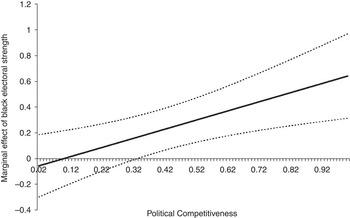
First, consistent with Hypothesis 1, we find that the coefficient for the interaction of black electoral strength with Democrat is positive and significant. This indicates that changes in black electoral strength are met with more inconsistency by Democratic senators compared to their Republican counterparts. In accordance with Hypothesis 2, the effect of changes in black electoral strength on roll-call inconsistency is also larger in competitive states than in uncompetitive states, given the value of the Absolute change in black electoral strength × Political competitiveness variable. To see the interplay of black electoral strength and political competition in how they affect inconsistency, Figure 3 shows the marginal effect of a change of one unit in black electoral strength on roll-call inconsistency for a Democratic senator at various values of political competitiveness.Footnote 58
Marginal effects of changes in black electoral strength on legislator ideological inconsistency, at various values of political competitiveness (with 95% confidence interval)

The marginal effect of changes in black electoral strength increases as a state becomes more competitive. On the one hand, in the least competitive states, the marginal effect of changes in black electoral strength is not statistically distinguishable from zero. In the most competitive states, on the other hand, changes in black enfranchisement have a positive and significant effect on legislator inconsistency. A change of 2.4 percentage points in black electoral strength (equal to the difference between the 25th and 75th percentiles over the entire time period, 1961–2004), for example, brings an increase of about 1.5 in the percentage of misclassified votes, or about nine additional votes for a typical congress. Of course, during periods of dramatic changes in black enfranchisement and mobilization, two-year changes in black electoral strength were much more pronounced. For instance, from 1964 to 1966, the black electoral strength in Mississippi increased by 22 percentage points (recall that this measure is the absolute two-year change in the ratio of black registered voters to total registered voters multiplied by 100). Thus, if we set the change in black electoral strength at the 90th percentile (for example, equal to about the change in black electoral strength in Alabama between 1964 and 1966), our model shows that senators representing the most politically competitive states will be much less consistent, casting about 3.7 percentage points more misclassified votes than in states that do not change (about twenty-two additional misclassified votes for a typical congress). The line depicted in Figure 3 is for Democratic senators; the marginal effect for Republican senators at all realistic levels of competitiveness is not statistically different from zero (that is, we cannot reject the null hypothesis that the slope for Republican senators is a flat line).
Taken together with the previous results (pertaining to the partisan affiliation of senators), these results support the claim that changes in black electoral strength affect Democrats more than Republicans, and that this effect on inconsistency is larger when the state is competitive.Footnote 59 Democratic senators facing large increases in black registration levels were voting inconsistently as a reaction to the massive change in their constituencies. The results imply that uncertainty tied with heterogeneity leads to higher inconsistency. Contrary to our expectations, we did not find any effect of overall state population change on roll-call inconsistency in the South, even in competitive states. This result may be due to data limitations: the changes in population over two years were not large enough to cause much uncertainty in most states, though the changes in black electoral strength were.
Other variables were significant and in the expected direction. All else being equal, amateur senators and cosmopolitan senators are more inconsistent than other senators. It is difficult to say whether this relationship is due to uncertainty or amateurs (and to a lesser extent cosmopolitans) being different ‘types’ of legislators. However, at least in the case of amateurs, we can probably rule out uncertainty since the coefficient of an interaction between amateur and seniority is positive (results not shown but available upon request), which indicates that amateurs do not become more consistent over time; rather, they become even more inconsistent. This suggests that amateurs may differ from non-amateurs and as they win re-election, they do more of what they think is optimal behaviour (i.e., they show more inconsistency).
The absolute value of the 1st dimension NOMINATE scores is a significant predictor, since extremists are, by definition, far away from the cutting line on most votes. Senators are also more inconsistent in the last two years of their term (the omitted category). The coefficients for the first four years of a term are always negatively signed, which is consistent with the finding that senators moderate strategically as election nears.Footnote 60 With this moderation comes an increased inconsistency. The negative and significant coefficient for primary margin suggests that senators who win by small margins make more errors. The effect of primary margin, coupled with a lack of a similar effect of general election margin, is consistent with the notion that much of the competition in the US South took place in primaries during much of this time period. Senators for whom re-election is a pressing concern (i.e., marginal members and those up for re-election) tend to respond with ideological hedging, perhaps to appeal to a wider array of voters.
In Model 2, we estimated a model with the lagged dependent variable and unit-specific fixed effects. In such a model, the lagged dependent variable is correlated with the error term, which introduces bias and inconsistency in the parameter estimates. To remedy this, we used a procedure outlined by Arellano and Bond, which consists of taking the first differences of each variable and substituting an instrument for the first-differenced lagged dependent variable.Footnote 61 In this case, the instrument consists of the dependent variable lagged by two periods as well as a lag of the various independent variables. This new instrument is assumed to be uncorrelated with the error term, which is confirmed empirically by a Sargan test of exogeneity (χ 2, 339 d.f. = 294.64, p > 0.96). Also, while we cannot reject the null of no autocorrelation of order 1, we can reject the null of no autocorrelation of order 2 (z = 0.15, p > 0.88). This means that the inclusion of the first-differenced instrument is the appropriate procedure to follow, whereas an instrument differenced by two periods is unnecessary (given the absence of autocorrelation of order 2). The results from Model 2, the within-career model, are largely consistent with those from Model 1. Also, we now find that senators with the most seniority exhibit less inconsistency, supporting the idea that long-serving senators may have more knowledge about their constituents’ preferences. Finally, in a separate analysis (not shown but available upon request), we find that among cosmopolitan senators, the negative effect of seniority is even larger, which suggests that cosmopolitan senators become more ideologically consistent over time as they become more acclimated with their constituency.
Model 3 now introduces fixed effects for congresses, which allow for different congress-specific agendas to be controlled for by the fixed coefficient. Again, much of our results remain unchanged. Finally, Model 4 is a ‘reduced’ model which only includes the main variables of interest as well as the variables that directly affect the estimation of NOMINATE scores. Again, all of our results remain unchanged. Thus, we are confident that the results we discussed with respect to Model 1 are not due to (a) legislator-specific attributes, (b) congress-specific attributes, or (c) overspecification of the model.Footnote 62
National Model, 1961–2004
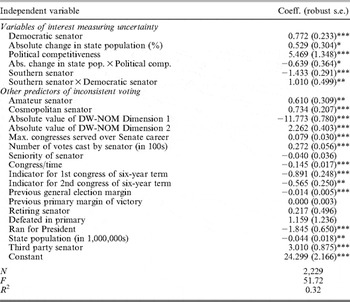
We also estimated a model on all individuals who served in the US Senate from 1961 to 2004 (using a specification paralleling Model 1 in Table 3). Since the variable measuring black electoral strength is not available for all states during that period, we include instead a southern dummy variable and an interaction between that variable and the Democratic senator dummy variable. If the enfranchisement and subsequent mobilization of black southerners is causing Democratic senators to take more inconsistent positions in Congress, then that interaction should be positive and significant. Table 4 shows the results from this estimation.
Legislative Inconsistency, National Sample, All US Senators, 1961–2004

*** Signif. at the 0.01 level; ** 0.05 level; * 0.10 level. All significance tests are 2-tailed except for those noted earlier.
Note: Dependent variable: Percentage of inconsistent roll calls by legislator.
First, the coefficient for Southern senator × Democrat is positive and significant. This result indicates that the partisan differences between Republican and Democratic senators are much larger in the South, which is consistent with the results from our model estimated on southern senators only. Secondly, unlike the southern model, the absolute change in population has an effect on inconsistency, and that effect is larger in competitive states (both the Absolute change in state population variable and the Absolute change in state population × Political competitiveness variables are statistically significant and in the expected directions). This result provides support for Hypothesis 2 at the national level: rapid population shifts in politically heterogeneous constituencies lead to inconsistent voting by legislators. Legislator uncertainty is increased when a state faces rapid population growth, and this rapid population growth – especially in politically competitive states – is met with more ideological inconsistency from the legislator.
As before, the coefficients for amateur and cosmopolitan are positive and significant, which indicates that nationally those senators are more inconsistent than their experienced and local counterparts, respectively. Other predictors also yield statistically significant results. For instance, third-party senators, senators running for president, and senators with close margins of victory in the previous general election have more classification errors.
The results from our various models paint a clear picture: legislators react to significant changes to their environment when those changes create uncertainty. As a consequence, senators affected by large shifts in their electorates will present voting records that are more inconsistent than other legislators. These results – both in the US South and in all fifty US states – suggest that what appears to be unpredictable and inconsistent behaviour is actually predictable and can be explained theoretically.
Discussion: Can Ideological Inconsistency Be an Indicator for Mavericks?
This analysis shows that ideological inconsistency can be modelled systematically as a response to a changing constituency environment. While the theoretical implications of our analyses suggest that our current understanding of legislative position-taking was incomplete, our analysis also offers an empirical improvement over existing legislative studies. Indeed, by examining the consistency of voting records (as opposed to the location of roll-call votes on an ideological spectrum), our analysis is one of the first to model an observable component of legislative voting that is often discarded as ‘unpredictable’ or ‘in the error term’. In that sense, we improve on the extant literature on both theoretical and measurement grounds.
The use of classification errors offers many possibilities, one of which we explored in this article. Another possible use for this measure pertains to the identification (and correlates) of ‘maverick’ legislators. Mavericks are known as marching to the beat of their own drum, and they are often a thorn in the side of their party leaders. However, being able to define a maverick in a general way, and being able to identify actual maverick legislators are two different things. Since unpredictability and inconsistency are often associated with the behaviour of mavericks, can ideological inconsistency as we operationalize it offer a way to identify maverick legislators?
To investigate this intriguing possibility, we computed an average measure of ‘maverickness’ for the 809 individuals who served in the US Senate between 1915 and 2004. We computed this score by conducting a very simple regression of each senator/congress dyad's inconsistency score (as defined above) on the absolute value of the first and second dimensions of DW-NOMINATE, as well as a dummy variable for each congress (to pick up congress-specific effects). Then we computed a ‘maverickness’ measure equal to the difference between the predicted inconsistency and actual inconsistency (i.e.  ).Footnote 63 Higher values mean that, controlling for individual congresses, the senator exhibited more inconsistency than that predicted by his or her ideological extremism. Then we averaged this score over each senator's career, which gave us a unique ‘maverickness’ measure for each individual senator. A look at the senators with the highest values on this measure seems to validate our use of misclassified votes as a measure for inconsistency, but also suggests that this measure could be used to identify mavericks in future research. Among those who served at least one full term, the top fifteen senators include several individuals known as mavericks with a long history of inconsistent behaviour: Coleman Blease (Number 1), William Langer (Number 2), William Henry King (Number 4), William Proxmire (Number 5), Ernest Gruening (Number 7), Russ Feingold (Number 8), Wayne Morse (Number 10), Frank Lausche (Number 12) and Paul Douglas (Number 15). Many of these politicians feature prominently in various discussions of mavericks,Footnote 64 and we examine some of these cases in more detail.
As governor of South Carolina, Coleman Blease (Number 1 on our list) was described as a politician who ‘followed no consistent policy at all’,Footnote 65 and as a senator he was described by Time magazine as ‘blatant and erratic’.Footnote 66 ‘Wild Bill’ Langer from North Dakota (Number 2 on our list), who was once removed from office as governor for ethics violations, has been described as a maverick by more than one observer.Footnote 67 In the wake of the CIA-organized invasion of Guatemala in 1954, for example, Langer cast the lone dissenting vote against a Senate resolution reaffirming the US position against communist interference in the Western Hemisphere.Footnote 68 William Proxmire (D-Wisconsin) is a well-known maverick who strenuously opposed, among other things, the Vietnam War and wasteful spending, and he is ranked Number 5 on our list. He was called an outsider who did not fit the usual ‘Senate type’.Footnote 69 Ernest Gruening (D-Alaska) was, along with Wayne Morse, one of only two senators to oppose the Gulf of Tonkin Resolution. He was known for being a ‘wild card’, who did not shy away from bucking the Senate leadership.Footnote 70 Russ Feingold (D-Wisconsin) is not only a well-recognized maverick, but he has also been compared favourably to other mavericks who score high on our measure: Gruening, Morse and Al Gore Sr.Footnote 71 Number 10 on the list, Senator Wayne Morse from Oregon is in many ways the prototypical maverick whose behaviour deviated from the norm.Footnote 72 In 1953, Morse conducted what was at the time the longest filibuster in Senate history, holding the floor for more than twenty-two hours.Footnote 73 He is one of the few members of Congress to have been, in turn, a Republican, an independent and a Democrat, all in the span of less than three years. Morse has been called ‘a maverick in the classic mould … always unwilling to accept the demands of party discipline and … never tired of insisting that he should not be subject to the mandates of his constituents’.Footnote 74 Lady Bird Johnson considered Frank Lausche (D-Ohio and Number 12 on our list) an ‘authentic maverick’,Footnote 75 which is consistent with how Lausche was viewed throughout his career.Footnote 76 Finally, Senator Paul Douglas (D-Illinois and Number 15 on our list) was described as a quixotic ‘isolated crusader’.Footnote 77 He was featured on the cover of Time magazine and was described as a maverick who, among other things, voluntarily enlisted during the Second World War at the venerable age of 50.Footnote 78
While this discussion is exploratory, it nonetheless suggests that the measure we study in this article may be put to use by legislative scholars interested in modelling atypical, unpredictable or even maverick behaviour. On measurement grounds, then, it appears that the measure of ideological inconsistency we use may address questions that have up to now been eluding political scientists.Footnote 79
Conclusion
We have offered a theory of ideological hedging by legislators when uncertainty about constituent preferences is high. The theory suggests that large increases in new registrants are likely to have an impact on legislator uncertainty about constituents, but this uncertainty is contingent upon the heterogeneity of the existing distribution of voters. This is the first attempt, to our knowledge, to explain systematically erratic or inconsistent behaviour among elected officials. The erratic behaviour characterized by inconsistent voting patterns can thus be interpreted as a rational response to changes in the electoral environment. The issue preferences of black voters are better established today given the increasing public knowledge of black opinion (and public opinion in general). However, during the 1960s especially, a time of flux in the US South, the preferences of African Americans were not necessarily known to incumbent senators. While most newly enfranchised voters may have been located somewhere on the left of the second dimension, the southern Democratic party had been openly hostile to African-American interests before the large increases in black registration. Further, non-civil rights issue preferences of black voters were not well known by senators during the 1960s: political polling did not focus on African Americans’ views and senators did not have an understanding of the issue preferences of a group disenfranchised for decades.
Empirically, we identified key factors due to constituency change and heterogeneity that affect legislators’ uncertainty about their constituencies. In the US South, we have shown that legislator inconsistency was a direct function of the changes in black electoral strength, and that this effect was largest in competitive states as well as for Democratic senators. In the examination of US senators from all fifty states, we have shown that inconsistency was more frequent among southern Democrats and among all senators representing competitive states with large shifts in their state populations. A theory of legislative voting that interprets misclassified votes as simply ‘noise’ is unsatisfactory; our theoretical framework accounts for behaviour that until now has been dismissed as ‘part of the error term’.
While we have shown that senators vary their consistency in Congress, future work should examine the consequences of such behaviour. There are presumably electoral constraints that do not allow incumbents to move freely across the ideological spectrum. Charges of inconsistency may have reputational ramifications that legislators wish to avoid. Party leaders have an incentive to present a unified, consistent front to voters, as the value of the party label is contingent on the informational cues that it provides. However, ideological inconsistency may yield electoral benefits. If legislators are hedging their ideological bets and are trying to please all the people some of the time, then higher roll-call inconsistency may yield higher margins of victory. This ideological hedging may be a senator's attempt at representational pluralism, appealing to multiple subconstituencies. Future work should model these institutional and electoral constraints and effects. Also, as Evans suggests, the underlying process between legislator uncertainty and specific voting decisions on salient roll calls should be considered.Footnote 80
We believe that this line of inquiry can be extended to examine other periods of large changes in the electorate, such as (1) the enfranchisement and mobilization of women; (2) the years immediately following the Civil War in which southern blacks were enfranchised and subsequently disenfranchised; or (3) even short-run increases in new voter registration (for example, during the 2008 presidential primary). With respect to the enfranchisement of women, it would especially be interesting to examine whether legislators were more inconsistent immediately following their states’ decisions to enfranchise this new voting bloc (as many did so prior to passage of the nineteenth amendment). Future work should also examine if these relationships hold on specific roll-call votes or issues of import only.
Similarly, this analysis suggests that a large influx of new voters may lead to highly inconsistent voting in a legislature – and by implication, institutional instability. On the one hand, this institutional instability suggests, in a normatively dismal way, that massive enfranchisement of new voters in democracies with heterogeneous preferences may lead to high roll-call inconsistency. This result may offer insights as to why new democracies in Latin America, for instance, have been relatively unstable compared to the early period of US democracy where there were few new voters and constituency preferences were homogeneous due to massive disenfranchisement. As Huntington noted regarding Latin America, ‘increases in voting and increases in political instability have gone hand in hand.’Footnote 81 On the other hand, it also suggests that large increases in enfranchisement do not result in long-term instability once newly enfranchised voters’ preferences become known to elected representatives. The research can also be extended to other actors operating in a principal–agent framework. In our theory, the uncertain agent is the legislator and the principal is the legislator's electorate. Other agents, such as bureaucrats, may be uncertain about their principal's preferences, and thus may make inconsistent implementation decisions.
And finally, a number of scholars have attempted to explain the rise of polarization among elites in present-day politics compared to that in recent decades.Footnote 82 This rise in polarization may be attributed to the fact that with no significant group of new voters being enfranchised (other than disfranchised felons),Footnote 83 legislators are able to vote in a consistent manner in Congress, which is an important component of polarization.Footnote 84 Perhaps the much-heralded era of lower party polarization (roughly 1920s–1970s) can be attributed to increases in uncertainty for some legislators due to large changes in the electorate (due first to female enfranchisement and later with African-American enfranchisement). If this is the case, then the debate on polarization needs to focus more of its attention on changes within the electorate as an explanation for this oft-decried phenomenon.