Introduction
The ‘thrifty phenotype’ hypothesis proposes that adult type 2 diabetes and related metabolic traits are a result of the fetus having to be thrifty in managing its nutrition during intrauterine life. Reference Hales and Barker1 The initial report in an English study showed that prevalence of type 2 diabetes was higher in those with lower birthweight. Reference Hales, Barker and Clark2 This association has been replicated in other populations. Reference Whincup, Kaye and Owen3 While the exposures in the original thrifty phenotype referred to low birthweight alone, this has since been extended to include relative abnormalities in body proportions, body composition, and development of organs and physiological-endocrine systems. Reference Fall4 India has a high prevalence of type 2 diabetes as well as intra-uterine undernutrition; this situation helped expand the thrifty phenotype concept. The Pune Maternal Nutrition Study showed that the short and thin (low ponderal index) Indian newborn weighing only 2.7 kg had more subcutaneous and visceral fat compared to a 3.5 kg English baby, along with higher concentrations of insulin and leptin and lower concentrations of adiponectin in cord blood. Reference Yajnik, Fall and Coyaji5–Reference Modi, Thomas, Uthaya, Umranikar, Bell and Yajnik7 Since these differences were already seen at birth, the well-known Indian ‘thin-fat’ phenotype could be at least partially ascribed to the influence of intrauterine undernutrition on body composition of the developing fetus (nutritional programming). This is possibly achieved through epigenetic mechanisms regulating fetal growth and development. Reference Yajnik8 ‘Thin-fat’ phenotype persists through childhood, adolescence and adult age, and is associated with an increased risk of diabetes. Reference Yajnik and Yudkin9–Reference van Steijn, Karamali and Kanhai12 Such a phenotype (albeit milder) is also described in South-East Asian populations Reference Deurenberg-Yap, Schmidt, van Staveren and Deurenberg13 but rarely investigated in other populations.
Twins are born with lower birthweight as compared to singletons and therefore lend themselves to DOHaD research. Comparison of adult disease risk in birthweight-discordant twins, especially monozygotic (MZ), is valuable as it allows the dissection of genetic and intra-uterine epigenetic influences. The smaller of the twins (irrespective of zygosity) have a higher risk of developing type 2 diabetes. Reference Poulsen, Vaag, Kyvik, Møller Jensen and Beck-Nielsen14 Comparison between twins and singletons also provides an opportunity to study the effects of relative intra-uterine undernutrition. Most of the studies have concentrated on lower birthweight alone, and adiposity has been under-explored in twins as compared to singletons. These studies have been done in relatively well-nourished Western populations. It has been discussed that the biology of small size is different in twins from that in singletons and the difficulties in interpretation of association of birth size with later cardiometabolic risk in twins have been highlighted. Reference Phillips, Davies and Robinson15 Studying twins in low socioeconomic populations could be more informative, as twinning would compound the effects of maternal undernutrition in pregnancy with the ‘distributive’ biology of twin growth (30% of monozygotic and all dizygotic twins are dichorionic Reference Hall16 ). Thus, twin studies have the potential to reveal outcomes which could otherwise be missed. In Africa, there is a high natural twining rate, including in Guinea-Bissau, a low-income country. Reference Smits and Monden17,Reference Bjerregaard-Andersen, Lund and Jepsen18 A twin registry was set up by the Bandim Health Project (BHP, www.bandim.org) in the capital city of Bissau. Reference Bjerregaard-Andersen, Gomes and Hennild19 Follow-up of twins in this registry showed that young twins had higher plasma glucose concentrations both in fasting and in the post-glucose state compared to age-matched singletons. Reference Hennild, Bjerregaard-Andersen and Joaquim20,Reference Bjerregaard-Andersen, Hansen and da Silva21 This study measured skinfolds in addition to the routine anthropometry and provided an opportunity to compare adiposity of twins with that of singletons. We hypothesized that twins in Guinea-Bissau would be thinner but fatter compared to singletons.
Methods
Cohort description
This is a secondary analysis of previously collected (2009–2012) data from one of Africa’s first twin registries set up by the Bandim Health Project (BHP) in Guinea-Bissau. Reference Bjerregaard-Andersen, Gomes and Hennild19 The BHP is a health and demographic surveillance site (HDSS), conducting epidemiological and health related research in the capital Bissau over the past 40 years. The results of the two main metabolic twin studies have previously been reported. Reference Hennild, Bjerregaard-Andersen and Joaquim20,Reference Bjerregaard-Andersen, Hansen and da Silva21 Briefly, twins (n = 209) and singleton controls (n = 182), identified randomly from the HDSS register between 7–34 years of age were investigated for risk of diabetes and metabolic syndrome with a weight-adjusted oral glucose tolerance test (OGTT) (1.75 g glucose/kg body weight, maximum 75 g). The majority of measurements were done by a HemoCue Glucose 201+ apparatus (HemoCue, Ängelholm, Sweden), which uses capillary blood and then automatically converts the results to plasma values. In 7% of the twins and 21% of the singletons an AccuChek Active apparatus (Roche Diagnostics, Indiana, USA) was used, due to shortage of HemoCue cuvettes. Other biochemical measurements included total and HDL cholesterol, and triglycerides by standard enzymatic methods. Anthropometric measurements were performed by trained personnel. They included: height, weight, mid-upper arm circumference (MUAC), waist and hip circumferences using standard techniques. Skinfolds (triceps, biceps, subscapular and suprailiac) were measured using a Harpenden Skinfold Caliper (Baty International, West Sussex, United Kingdom).
Deliveries happened at home or in local institutions. Birthweight was available only in a limited number (n = 102) who were delivered in a hospital or health institution. Other anthropometric measurements (skinfolds, length and circumferences) were not available at birth.
Statistical analysis
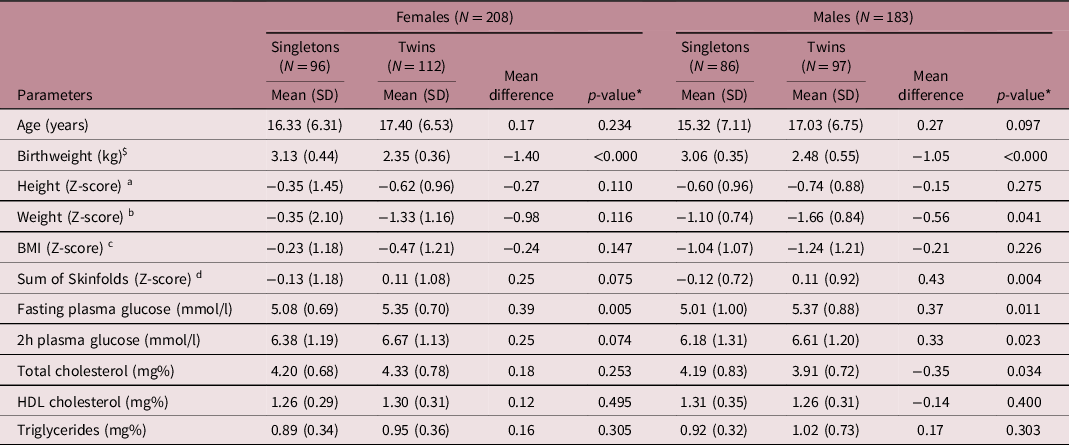
The primary analysis was to compare anthropometric measurements of height, thinness-obesity (BMI) and adiposity (skinfolds) between twins and singletons (Table 1). At the time of measurements, the age range was quite wide (7–34 years), therefore our preliminary analysis compared body size and composition based on sex specific WHO Z scores which provide data from birth to 19-years. The Nineteen-year value was used as reference to calculate Z-scores for older subjects.
Comparison of singletons and twins

$ Birthweight available on 102 participants (Females: S (24), T (26), Males: S (22), T (30)).
a Z scores based on WHO height-for-age criteria.
b Z scores based on WHO weight-for-age criteria.
c Z scores based on WHO BMI-for-age criteria.
d Standardized Z scores calculated internally using regression method.
* p-value calculated using t-test.
We performed linear mixed effect model using the mean of anthropometric measurement as outcome. Exposures tested in the model included twin status (twin vs singleton), sex (males vs females), age in years, and interaction between age and sex as fixed effects. Further, two indicator variables indicating whether age is more than 8 years and 16 years respectively and their interaction was also included as fixed effects, to adjust for the additional effect of age at these growth points. These age indicators were selected based on biological growth transitions: 8 years for pre-pubertal and 16 years for late pubertal. Random intercepts for monozygotic (MZ) and dizygotic (DZ) twins were included to account for correlations between the twins.
Let, S identify twins (1 for all twins, even those twins that do not have their sibling, 0 for birth singletons) and F identify families. Further, assume M identifies MZ twin pairs and D identifies DZ twin pairs. Let Y denote the outcome (height, BMI and skinfolds). For any given outcome, we allow MZ twin pairs to have some covariance different from DZ twin pairs, which can be achieved by assuming a random interecept model for each level of M and D. Let, m be the random intercept associated with M and d be the random intercept associated with D, the model for the i th subject is given by,
 $${Y_i} = \beta {S_i} + {m_i} + {d_i} + {e_i}$$
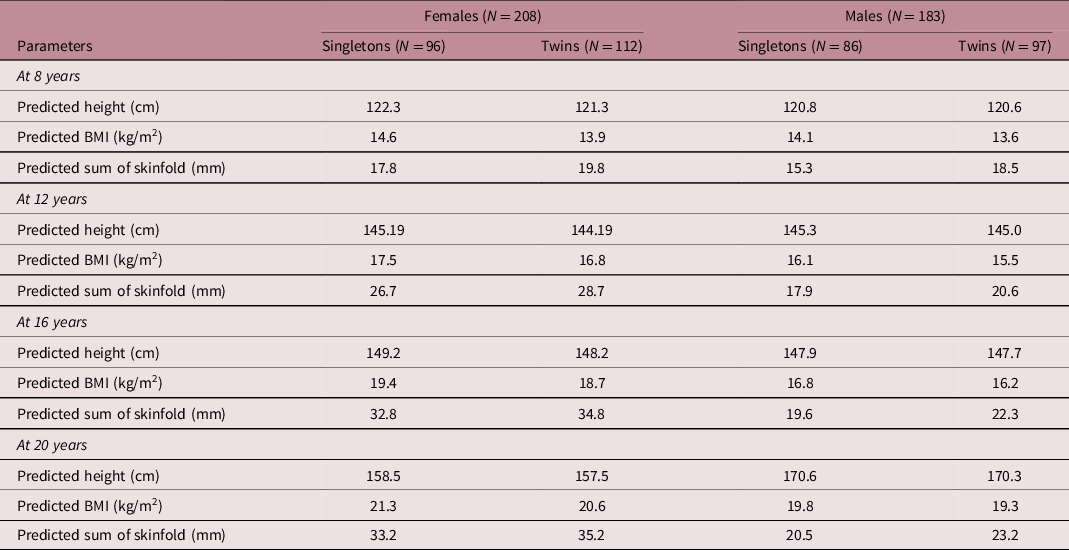
where e is the error term independent of d and m. We assume the random effects to follow a Gaussian distribution with 0 mean and positive variance independent of each other. The main parameter of interest is β (the twins effect). We used R package lme4 Reference Rabe-Hesketh, Skrondal and Gjessing22 to fit the random effect models. Further details of fitting the model are provided in supplementary material (Appendix S1). This model was used to predict the values given in the Table 2.
We investigated the association of twin status (twin vs singleton) with fasting and 2-hour glucose concentrations by comparing the two groups by t-test (Table 1). We further investigated if differences in age, sex, BMI and skinfolds between two groups influenced the difference (ANCOVA).
For ease of interpretation, results in tables and figures are presented using native variables. For formal statistical analysis, we used log-transformed variables. All statistical analysis was performed using R software (version 4.1). 23
Results
The analysis comprised 209 twins (81 pairs and 47 individuals where only one of the twins was available) and 182 singletons (Table 1). Of the twins, 11 were MZ and 56 DZ twin pairs, and 14 pairs with no established zygosity. Birthweight was available on 102 participants (56 twins and 46 singletons) who were born in health institutions, these participants were younger compared to those on whom birthweight was not available (12.8 ± 4.8 years vs 18.8 ± 6.4 years, p < 0.001) (Supplementary table S2). Twins had lower birthweight compared to singletons (2.42 ± 0.4 vs 3.10 ± 0.5 kg, p < 0.001).
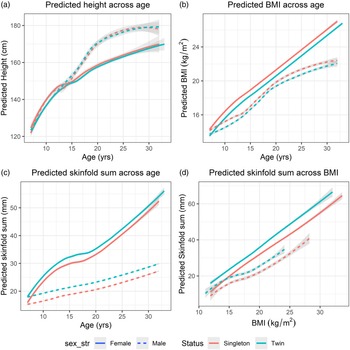
At the time of study, both male and female twins were shorter, lighter, had lower BMI but higher skinfolds (adiposity) compared to singletons (Table 1). To understand the anthropometric trajectory, we used the LME models to predict the outcomes at ages 8 years, 12 years, 16 years and 20 years (Table 2). These ages broadly represent pre-pubertal, early and late pubertal, and young adulthood and are shown for depicting average cohort representative. There was the expected increase in height, BMI and skinfolds with increasing age. Females were shorter, had higher BMI and skinfolds compared to males. The Fig. 1 a–c compare the anthropometry by age in twins and singletons and show that twins were shorter, had a lower BMI and higher sum of skinfolds across the whole age range compared to singletons. Twins also had higher skinfolds for each BMI compared to the singletons (Fig. 1 d).
Comparison of anthropometry and body composition between singletons and twins. Solid line: females, dotted line: males, orange: singleton, green: twin.

Predicted values (linear mixed effect model) between singletons and twins at different ages

As previously reported, fasting and 2-hour plasma glucose concentrations during OGTT were higher in the twins compared to the singletons, adjusting for the age and sex difference. The difference in fasting and 2-hour plasma glucose between twins and singletons remained significant after adjusting for BMI and skinfolds. However, adjusting for birthweight reduced the size of the difference, suggesting that birthweight difference in the two groups might contribute to this association, though the number in this model was much lower (Supplementary table S1). There was no difference between twins and singletons in total and HDL cholesterol and triglyceride concentrations (Table 1).
Discussion
We explored the presence of a ‘thin-fat’ body composition in twins as compared to singletons using data from the Guinea-Bissau twin registry. We found that twins were thinner and more adipose than their singleton counterparts, across the age range studied. Importantly, the thin-fat twins had higher plasma glucose concentrations compared to the singletons, implying increased future diabetes risk. This was at least partially attributable to lower birthweight of twins. These findings in a novel situation (twins in a low socio-economic African country) support the role of the intra-uterine undernutrition in influencing body composition and NCD risk, first described in Indians.
‘Thinness’ refers to lower BMI and lean mass, and ‘adiposity’ to higher body fat measurements (skinfold thicknesses). This combination was considered a typically Indian (ethnic) characteristic. However, it has since been described in other South-East Asian populations from Singapore. Reference Deurenberg-Yap, Schmidt, van Staveren and Deurenberg13 The phenotype could have a genetic basis but no specific genetic markers have been described as yet. It is thought to be predominantly related to multigenerational maternal-fetal undernutrition of both macro- and micronutrients which would have epigenetic influence on gene expression during crucial periods of intrauterine development. Reference Yajnik24,Reference Yajnik and Yajnik25 Multigenerational undernutrition in Indians and South-East Asians is highlighted by the fact that between 1830 and 1980, these populations did not gain in height while Europeans gained ∼15 cm. 26 The ‘thin-fat’ phenotype adds a body compositional dimension to the ‘thrifty’ phenotype described by Hales and Barker based on the association of lower birthweight with higher risk of diabetes. The relative adiposity is also reflected in biochemical (hyperglycemia) and endocrine (high leptin and insulin, and low adiponectin concentrations) abnormalities in the cord blood, further expanding the scope of the phenotype. Reference Yajnik, Lubree and Rege6 Maternal obesity and diabetes have been shown to exaggerate the phenotype in migrant Indian populations. Reference Anand, Gupta and Schulze27
The increased risk of diabetes in the ‘thin-fat’ individuals appears multifactorial. Adiposity would influence risk factors for diabetes from early age including insulin resistance. Reference Joglekar, Fall and Deshpande28,Reference Bavdekar, Yajnik and Fall29 Lower muscle mass would also contribute to insulin resistance through its role in glucose disposal. Reference Abdul-Ghani and DeFronzo30 Post-mortem studies of Indians have shown smaller organs (pancreas, liver, kidneys, etc) compared to those in Europeans, highlighting a lower ‘capacity’ in relation to higher metabolic ‘load’. Reference Wells, Pomeroy, Walimbe, Popkin and Yajnik31 Such factors may explain failure of pancreatic beta cell insulin secretion at a young age and low BMI not only in Indians, Reference Staimez, Weber and Ranjani32,Reference Yajnik, Bandopadhyay and Bhalerao33 but also in the twins compared to singletons in Guinea-Bissau.
The limited data on body composition of twins in the literature is mainly from the well-nourished European populations. In one study, twins had higher abdominal obesity (waist-hip ratio), insulin resistance (HOMA and Insulin Sensitivity Index) and increased prevalence of type 2 diabetes in adult life as compared to singletons. Reference Poulsen, Grunnet and Pilgaard34 Another study which measured adiposity (DXA) in young and elderly MZ twins and a small number of singleton controls reported no significant difference between twins and singletons. Reference Malis, Rasmussen and Poulsen35 The increased risk of diabetes was also not observed in a large twin registry. Reference Petersen, Nielsen, Beck-Nielsen and Christensen36 Thus, the strength and consistency of evidence linking lower birthweight in twins with the risk of diabetes and adiposity remains less conclusive than that in singletons from the developed countries.
Guinea-Bissau is a low-income country (Human Development Index: 0.480, Rank: 175/189) with political instability and high prevalence of undernutrition. 37,38 At the same time, African populations have a more muscular body composition compared to Europeans. Reference Wagner and Heyward39,Reference Silva, Shen and Heo40 Demonstration of a relatively adipose phenotype in twins compared to singletons provides support for intrauterine programming of adverse body composition by nutritional compromise. Our data showed that the twins had the expected lower birthweight (∼700 g lower) than in singletons and were shorter, thinner (lower BMI) but fatter (higher skinfolds) at follow-up. Thus, they were ‘thin-fat’ compared to singletons and had higher glycaemia. Lower birthweight explained some of the variance of higher glycaemia compared to singletons, the possible reasons for which are discussed. Animal model of multigenerational maternal undernutrition has described similar findings. Reference Hardikar, Satoor and Karandikar41 Sonographic measurements have usually stressed that growth in twins falters in the third trimester of gestation which is ascribed to fetal undernutrition but recent studies have demonstrated earlier growth faltering, especially in the abdominal circumference but with preservation of head circumference. Reference Muhlhausler, Hancock, Bloomfield and Harding42,Reference Hiersch, Okby and Freeman43 Growth failure in early gestation suggests that factors in addition to under-nutrition may contribute, for example hormonal and epigenetic. Reference Muhlhausler, Hancock, Bloomfield and Harding42 Animal experiments involving fetal reduction also seem to support factors in addition to nutritional deprivation. Reference Muhlhausler, Hancock, Bloomfield and Harding42 A post-mortem study in aborted human fetuses showed that adipose tissue is demonstrable from late first trimester, their precursors divide, differentiate and mature upto 22–23 weeks of gestation, and subsequently grow only in size (hypertrophy). Reference Poissonnet, Burdi and Bookstein44 It would be interesting to decide if the adiposity of twins is hyperplastic or hypertrophic or both. The developmental fate of the cells is mostly decided at gastrulation but currently there are no non-invasive tests to investigate these molecular-cellular mechanisms in human pregnancies.
Strengths of our study are a unique and rarely studied West-African low socio-economic population with high rates of twinning. Data are available on a sizeable number of twins and singletons which facilitates the comparison. Measures of skinfolds were available in addition to the usually measured weight and height. The study has limitations, being an exploratory secondary analysis. A small number of MZ twin pairs and lack of zygosity information on 14 pairs prevented us from using the classic approach of defining ‘heritability’ in twin studies. While it is tempting to attribute the phenotype to intra-uterine undernutrition, we are limited in our argument because birthweight was available only in a fourth, and little information was available on factors such as socio-economic condition, shortened gestation and higher rates of perinatal infections and other maternal morbidities (e.g., HIV, tuberculosis, malaria) that may have contributed. In this population, twins have a 1.7-fold higher prematurity rate, compared to singletons. Reference Bjerregaard-Andersen, Lund and Jepsen18 Relative resource deprivation would be perpetuated even after birth for twins, such as sharing of lactation as well as economic burdens on the family hampering nutrition. We were not able to directly measure or control for many of these factors in this retrospective analysis. Thus, our report may be considered only hypothesis generating, and would hopefully prompt future prospective studies which will allow careful matching to test the relative contributions of all these factors to the fetal phenotype and future disease risk.
In summary, we found that twins in Guinea Bissau are thinner but fatter compared to singletons, in addition to having higher glucose concentrations. Our results should invite larger twin registries to investigate fetal programming of body composition and metabolism in this unique biological model.
Supplementary materials
For supplementary material for this article, please visit https://doi.org/10.1017/S2040174422000150
Acknowledgements
The authors would like to thank all the participants in Guinea-Bissau, as well as the local field assistants and laboratory technicians from the Bandim Health Project, particularly Moises Soares Gomes, Leontina Indeque and Lita Indeque. The authors would also like to thank Lone Hansen, laboratory technician at the Department of Endocrinology, Odense University Hospital, Denmark, for assisting with the OGTT training and supply, as well as the biochemical analyses on collected samples. We would like to thank prof. Peter Aaby, Prof. Christine Stabell Benn and Prof. Henning Beck-Nielsen for support during the project, and Dr Sanat Phatak for critical reading and useful comments on the manuscript. Finally, the authors would like to acknowledge the late diabetes specialist Dr Luis Carlos Joaquím, (who sadly died in 2012), for his assistance.
Financial support
The principal investigator (MBA) received a combined grant from Forsknings-og Innovations Styrelsen, the University of Southern Denmark, and Odense University Hospital. Den Danske Forsknings Fond, Odense University Hospital, Fonden for Lægevidenskabens Fremme and Aase and Ejnar Danielsen’s Foundation supported the data collection. CSY was a visiting professor to the University of Southern Denmark and Danish Diabetes Academy during this work, supported by Novo Nordisk Fonden. The funding sources had no role in the study design, data collection, data analysis or in writing of this manuscript.
Conflicts of interest
The authors declare no conflicts of interest.
Ethical standards
The investigations were approved by the Ethical Committee in Guinea-Bissau. Consultative approval was obtained from the Central Ethical Committee in Denmark. Written consent (either signature or fingerprint) was obtained in all cases. For individuals <15 years consent was obtained from the mother or another caretaker.