Introduction
In Spring 2010, DSM-5 criteria for the diagnostic category of alcohol use disorder (AUD) were proposed. This category describes 11 criteria that attempt to overcome some of the limitations of DSM-IV differentiation between alcohol abuse and alcohol dependence. As a consequence, the proposed DSM-5 criteria include both categorical and dimensional approaches to AUDs (Hasin et al. Reference Hasin, Liu, Alderson and Grant2006; Helzer et al. Reference Helzer, van den Brink and Guth2006, Reference Helzer, Bucholz and Gossop2007; Muthén, Reference Muthén2006), which are not mutually exclusive, as in the previous DSM-IV criteria for alcohol abuse and dependence. Craving (one criterion of alcohol dependence in ICD-10 but not in DSM-IV) was included in the set of DSM-5 criteria but the criterion ‘legal problems’ was removed from the new criteria set. Thus, 10 of the 11 criteria in DSM-IV and DSM-5 are overlapping, with ‘legal problems’ dropped and ‘craving’ added.
Previous studies, mainly large population and family studies from the USA and Australia, investigated the dimensionality of DSM-IV alcohol and abuse criteria either separately or together in various samples (Langenbucher et al. Reference Langenbucher, Labouvie, Martin, Sanjuan, Bavly, Kirisci and Chung2004; Kahler & Strong, Reference Kahler and Strong2006; Martin et al. Reference Martin, Chung, Kirisci and Langenbucher2006; Proudfoot et al. Reference Proudfoot, Baillie and Teesson2006; Saha et al. Reference Saha, Chou and Grant2006; Gelhorn et al. Reference Gelhorn, Hartman, Sakai, Stallings, Young, Rhee, Corley, Hewitt, Hopfer and Crowley2008; Hasin & Beseler, Reference Hasin and Beseler2009). Approaches used to investigate the AUD continuum include the Rasch model or item response theory (IRT) analyses. The majority of these analyses applied to DSM-5 show that the criteria for abuse and dependence are combined in an underlying spectrum of severity (Langenbucher et al. Reference Langenbucher, Labouvie, Martin, Sanjuan, Bavly, Kirisci and Chung2004; Kahler & Strong, Reference Kahler and Strong2006; Martin et al. Reference Martin, Chung, Kirisci and Langenbucher2006; Saha et al. Reference Saha, Chou and Grant2006). Two studies investigated diagnostic thresholds, one in a combined set of DSM-IV alcohol dependence and abuse criteria (Shmulewitz et al. Reference Shmulewitz, Keyes, Beseler, Aharonovich, Aivadyan, Spivak and Hasin2010) and the other using the DSM-5 proposed set of criteria (Borges et al. Reference Borges, Cherpitel, Ye, Bond, Cremonte, Moskalewicz and Swiatkiewicz2011). The first study reported that a threshold of at least three criteria produces the best agreement with previous DSM-IV diagnoses, and the second study noted that an endorsement of at least two criteria can be used as the threshold to define individuals with an AUD. In the final version, the following classification of severity of DSM-5 AUD was proposed: 2–3 criteria would indicate a diagnosis of ‘light’, 4–5 ‘moderate’ and ⩾6 ‘severe’ AUD (APA, 2013).
Significant differences in several external validators distinguishing subjects with a ‘light’ DSM-5 AUD from those in the moderate to severe group were reported by Hagman & Cohn (Reference Hagman and Cohn2011). In their study, multivariate analyses indicated that those who met DSM-5 criteria for an AUD were more severe on alcohol consumption variables and related correlates compared to those who did not meet DSM-5 criteria, whereas those in the ‘moderate’ and ‘severe’ groups had mean rates of alcohol consumption, drinking restraint and alcohol problems that were equivalent to those classified respectively as abuse and dependence under the DSM-IV guidelines.
However, although finding a diagnostic threshold is difficult in a dimensional disorder and is always arbitrary, the magnitude of severity may also vary across samples. As individuals may be diagnosed positively using DSM-5 AUD criteria at a higher rate compared to DSM-IV alcohol dependence or alcohol abuse, the degree of severity (light versus moderate) may then indicate whether an affected individual is advised to undergo more or less intensive treatment. Furthermore, the current proposals on light or moderate severity may capture and differentiate the milder end of DSM-5 AUDs rather than more severely affected individuals who endorse five criteria or more (Hagman & Cohn, Reference Hagman and Cohn2011).
Identification of criteria that are more likely to be relevant for mild forms of AUD compared to those with a higher probability in more severe forms can add to knowledge of the progress of AUD from subclinical to severe stages. Thus, research on stages of severity may be helpful in clinical practice from diagnosis to therapy to relapse prevention.
The aim of this study was to confirm the unidimensionality of the AUD construct in an international sample of drinking individuals. First, we aimed to determine the factor structure of the AUD criteria. Second, the inner structure of potential AUD factor(s) was addressed by differentiating a latent AUD dimension according to the severity and the discrimination potential of the AUD criteria. Based on the ranking of symptoms on a potential AUD factor, we aimed to include characteristic symptoms for each stage of severity in addition to a simple symptom count to determine the intensity of the AUD. Third, external validitors were used to differentiate grades of severity of the DSM-5 AUD. These external validators include several measures of age at onset, lifetime AUD and mental co-morbidity.
Method
This analysis used the World Health Organization (WHO)/International Society on Biomedical Research on Alcoholism (ISBRA) Study on State and Trait Markers of Alcohol Use and Dependence dataset (e.g. Conigrave et al. Reference Conigrave, Degenhardt, Whitfield, Saunders, Helander and Tabakoff2002). Subjects included in the analyses were aged ⩾18 years and were recruited in five countries: Australia (Sydney), Brazil (São Paulo), Canada (Montreal), Finland (Helsinki) and Japan (Sapporo). A range of recruitment settings was used but primarily included the community and alcohol dependence treatment services. In-patients from general hospitals were not enrolled. Recruitment was stratified by age, gender and alcohol consumption categories (including non-consumers, current consumers, and persons currently receiving treatment for AUD) in each center (Helander & Tabakoff, Reference Helander and Tabakoff1997; Menninger et al. Reference Menninger, Baron, Conigrave, Whitfield, Saunders, Helander, Ericksson, Grant, Hoffman and Tabakoff2000; Conigrave et al. Reference Conigrave, Degenhardt, Whitfield, Saunders, Helander and Tabakoff2002). In Australia and Finland, only men were recruited. Only currently consuming subjects were included in the analysis. Patients residing in alcohol dependence treatment units were interviewed within 72 h of admission. Subjects were excluded if they had a current major physical or mental disorder (e.g. any physical condition requiring other emergency hospital treatment; any mental condition requiring in-patient treatment), if they reported intravenous drug abuse or were being treated for dependence on a substance other than alcohol. Except for the non-consuming group, patients were excluded if they had not consumed alcohol in the past month.
Assessments
The verbal assessment instrument for the WHO/ISBRA Study on State and Trait Markers of Alcohol Use and Dependence was developed in concert with the Alcohol Use Disorder and Associated Disabilities Interview Schedule (AUDADIS; Grant et al. Reference Grant, Harford, Dawson, Chou and Pickering1995; Glanz et al. Reference Glanz, Grant, Monteiro and Tabakoff2002). This gathers a range of data including sociodemographic details, frequency and quantity of beverage-specific alcohol consumption during the past 30 days, lifetime and past-year symptoms of AUDs, including average and maximum drinking amount, and presence of an AUD diagnosis (Menninger et al. Reference Menninger, Baron, Conigrave, Whitfield, Saunders, Helander, Ericksson, Grant, Hoffman and Tabakoff2000). The schedule was translated into Finnish, Japanese, French and Portuguese for the purpose of this study, and accuracy of translation was checked by back-translation.
External validators
Several characteristics obtained by the structured interview were used as external validators. These variables include reports of lifetime DSM-IV alcohol dependence and abuse, age at drinking onset, family history of AUD in first-degree relatives and lifetime DSM-IV major depression. Individuals who display symptoms of alcohol dependence or abuse are likely to exhibit some form of impairment across several areas of functioning. Age at drinking onset and a positive family history of alcohol dependence were used as external validators in previous research (Hasin et al. Reference Hasin, Liu, Alderson and Grant2006; Grove et al. Reference Grove, McBride and Slade2010), and we further included a lifetime history of depression as an additional validating criterion. Depression is one of the most common mental co-morbidities in alcohol-dependent individuals. Rates of major depression in alcohol dependence from epidemiological surveys such as the Epidemiological Catchment Area (ECA) study (Regier et al. Reference Regier, Farmer, Rae, Locke, Keith, Judd and Goodwin1990) and the National Comorbidity Survey (NCS; Kessler et al. Reference Kessler, Crum, Warner, Nelson, Schulenberg and Anthony1997) were found to be 11.6% and 26.4% respectively.
Statistics
A five-step methodological procedure was used in the current study. First, to clarify the sample characteristics and the distribution of the proposed AUD criteria across centers, χ 2 tests (Fisher's exact tests for cross tables with zero cell counts respectively) and one-way ANOVAs were computed.
In a second step, an analysis was conducted on the set of proposed DSM-5 AUD criteria loaded on a single factor. Exploratory factor analyses were computed to clarify the underlying factor structure. Model fit analysis was computed using AMOS 17 (Arbuckle, Reference Arbuckle2008). Evaluation of the specified model included the following indicators of goodness of fit (Schermelleh-Engel et al. Reference Schermelleh-Engel, Moosbrugger and Müller2003): as indicators of local model fit (variance of a criterion that is explained by the factor; should be > 0.40) and factor reliability (internal consistency of the criteria of a factor; should be > 0.60). Global fit was calculated using the Normed Fit Index (NFI, should be > 0.9) and the root mean square error of approximation (RMSEA; < 0.05 for good fit and < 0.08 for modest fit).
The third methodological step was to study the latent AUD construct to gather information about the inner structure of this dimension. The aim of this approach was to suggest a new classification of patients’ AUD severity with respect to IRT characteristics of the individually fulfilled criteria. For this purpose we divided our sample into two groups of approximately equal size. The first group was used for IRT modeling and to construct the new classification and the second was used for validation of this classification. The subjects were randomly assigned to one of two groups resulting in a first group of 711, representing 86 subjects from Helsinki, 227 from Montreal, 212 from São Paolo, 82 from Sapporo and 104 from Sydney. The two groups did not differ with regard to gender (χ 2 1 = 0.348, p = 0.555), age (t 1422 = 0.385, p = 0.700), race (χ 2 3 = 1.127, p = 0.771) and marital status (χ 2 6 = 5.292, p = 0.507).
IRT models were calculated for the different centers of the WHO/ISBRA sample and also for the complete first sample of the total population using BILOG-MG 3.0 for Windows (Zimosky et al. Reference Zimosky, Muraki, Mislevy and Bock2007). The marginal maximum likelihood IRT approach of equating coefficients was used resulting in two main parameters: the threshold and the discrimination parameter. The first refers to the severity of a criterion, with high severity being those criteria endorsed less frequently by respondents. The second parameter shows the ability of a criterion to discriminate between respondents with low or high levels of disorder continuum (slope). Item characteristic curves (ICCs) were used as graphical aids and plots of both parameters. These curves can show if the criteria endorsement reflects similar levels of severity of latent variables in different samples.
With reference to the position of a given AUD criterion within the ascending severity range of all AUD lifetime criteria, we assumed that the three items with the lowest thresholds reflected ‘mild’ AUD. The four criteria with medium thresholds were assumed to reflect ‘moderate’ AUD and the four criteria with the highest thresholds were assumed to reflect ‘severe’ AUD. In a fourth step we grouped the patients into four categories: subclinical, mild, moderate and severe AUD. Grouping was achieved using the following a priori classification: patients who fulfilled less than two criteria were categorized as ‘subclinical’. Patients with more than one criterion but less than five criteria and not more than one criterion with a high threshold and not more than two criteria with a medium threshold were assigned to the ‘mild’ AUD group. Patients were grouped as having a ‘moderate AUD’ when they fulfilled at least three criteria with a medium threshold but not more than two criteria with a high threshold or having more than four but less than eight criteria in total. Finally, patients with more than two criteria with a high threshold or more than seven criteria in total were categorized as having a ‘severe AUD’.
In the fifth step, these groups were compared regarding external validators as lifetime DSM-IV alcohol dependence, lifetime DSM-IV alcohol abuse, age at drinking onset, family history of AUD and lifetime DSM-IV major depression using χ 2 and ANOVA statistics.
Results
Sample
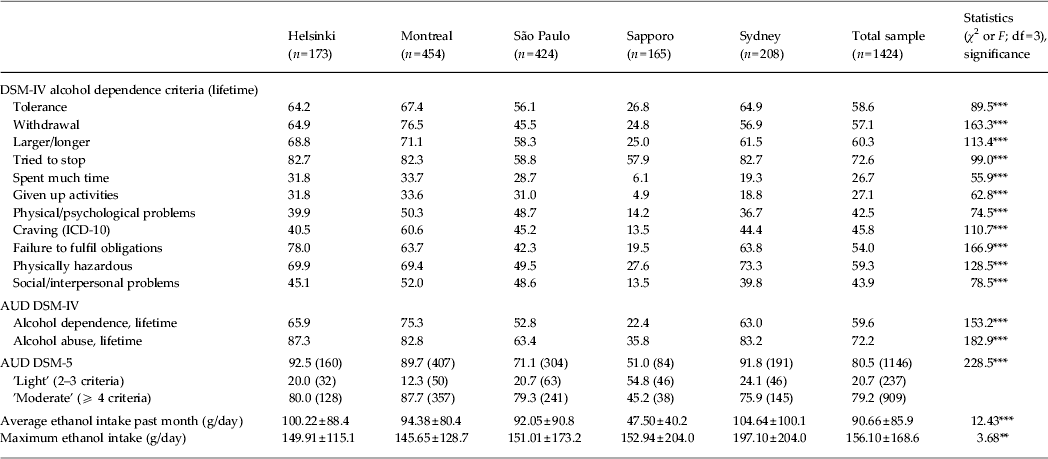
A total of 1424 currently consuming subjects (453 women) from five centers in Europe, North and South America, Japan and Australia were included into the analyses. Gender differed significantly across centers. Whereas more than half of the subjects in São Paulo were female, no females were enrolled in Sydney and Helsinki. Participants were recruited mostly from the general community; however, recruitment settings differed across centers. As shown in Table 1, rates of all 11 single lifetime DSM-5 criteria were significantly different between sites. The DSM-5 criteria endorsed most often for the total sample included alcohol consumption desire or failed attempts to stop (72.6%), larger and longer consumption than intended (60.3%), substance use in hazardous situations (59.3%) and tolerance (58.6%), whereas the lowest rates were found for the criteria much time spent on alcohol use (26.7%) and given up important activities (27.1%).
Alcohol consumption and DSM-IV/5 alcohol use disorder (AUD) characteristics of drinking individuals across centers

df, Degrees of freedom.
Values given as percentage (number) or mean ± standard deviation.
** p < 0.01, *** p < 0.001.
Of the total consuming sample, 848 (59.6%) met lifetime DSM-IV alcohol dependence criteria and 1028 (72.2%) of the consumers had a lifetime DSM-IV alcohol abuse diagnosis. Of the individuals with a lifetime diagnosis of DSM-IV alcohol dependence, 781 (92.1%) also had a lifetime DSM-IV diagnosis of alcohol abuse. Vice versa, 76.0% of individuals with DSM-IV alcohol abuse also met criteria for DSM-IV alcohol dependence. In comparison, 1146 individuals of the total sample (80.4%) met at least two criteria of a DSM-5 AUD.
Descriptive statistics also reveal that the majority of the drinking sample who pass the diagnostic threshold fall into the moderate/severe spectrum of the AUD (more than three criteria, 79.3%), without further differentiation.
Factor analyses
Exploratory factor analyses produced one single factor with an eigenvalue > 1. This factor (eigenvalue = 5.374) explained 49% of the variance in the total sample and all items significantly loaded onto it. A potential second factor (eigenvalue = 0.962) would only explain additional 8.7% of the variance. Factor loadings ranged from 0.588 to 0.813 with highest loading for social/interpersonal problems and physical/psychological problems. Lowest factor loadings were found for the criteria ‘physically hazardous’ and ‘tried to stop’. A confirmatory factor analysis revealed a good factor reliability (0.890), a good global model fit (NFI = 0.923) and a satisfactory RMSEA (0.083) for the one-factor solution. Local model fit was good (indicator reliability > 0.4) for all criteria, except ‘tolerance’ (0.31), ‘tried to stop’ (0.29) and ‘physically hazardous’ (0.26).
IRT
IRT results for the split samples of each study site and the merged sample are presented in Table 2 and Fig. 1. In the split total sample, the largest discrimination scores were found for the criteria ‘substance use despite social or interpersonal problems’ and ‘given up activities’.
Item characteristic curves (ICCs) for DSM-5 alcohol use disorder (AUD) criteria in the World Health Organization (WHO)/International Society on Biomedical Research on Alcoholism (ISBRA) sample, all sites.

Item response theory (IRT) analysis of alcohol use disorder (AUD) by ISBRA sites (split sample)

ISBRA, International Society on Biomedical Research on Alcoholism.
a Slope: discrimination of item characteristic curve (ICC).
b Threshold: severity of ICC.
Criteria with highest slopes and thresholds in bold. Criteria with lowest slopes and thresholds in italics.
The largest discrimination score for at least one of these criteria was also detected in the subsamples from Helsinki, Montreal, São Paolo and Sydney. In Sapporo, ‘substance use despite physical or psychological problems’ and ‘failure to fulfill obligations’ had the highest discrimination scores. Lowest discrimination scores in the total sample were found for ‘tolerance’ and ‘withdrawal’. ‘Tolerance’ was among the criteria with the lowest discrimination scores in all subsamples whereas ‘withdrawal’ was among the weakest discriminating criteria in Helsinki and Sydney. In Montreal, São Paolo and Sapporo, ‘physically hazardous’ had lower discrimination scores.
The largest severity scores in the total sample and also in every subsample were found for ‘spent much time’ and ‘given up activities’.
In the merged sample, the lowest severity of AUD was indicated by the criteria ‘tried to stop’ (also in Helsinki, Montreal and Sapporo) and ‘larger/longer’ (also in São Paolo and Sapporo). Other criteria with low severity scores were ‘failure to fulfill obligations’ (Helsinki and Sydney), ‘physically hazardous’ (Sydney), ‘withdrawal’ (Montreal) and ‘tolerance’ (São Paolo) (see also Fig. 1). From these figures it becomes clear that the different AUD criteria are arranged along the continuum according to a more or less similar order across all five study sites.
As the current proposal for AUD severity results in a somewhat uneven distribution of affected individuals, we propose an alternative subgrouping of these subjects regarding DSM-5 AUD severity. According to the severity scores in the total sample, we assumed the following criteria to reflect mild AUD: ‘tried to stop’, ‘larger/longer’ and ‘physically hazardous’. The following four criteria were assumed to reflect moderate AUD: ‘tolerance’, ‘withdrawal’, ‘failure to fulfill obligations’ and ‘craving’. The following four criteria with the highest severity scores were assumed to reflect severe AUD: ‘drinking despite social or interpersonal problems’, ‘drinking despite psychological or physical problems’, ‘given up activities’ and ‘spent much time’ (see Table 3)
AUD severity classification proposal

AUD, Alcohol use disorder; IRT, item response theory.
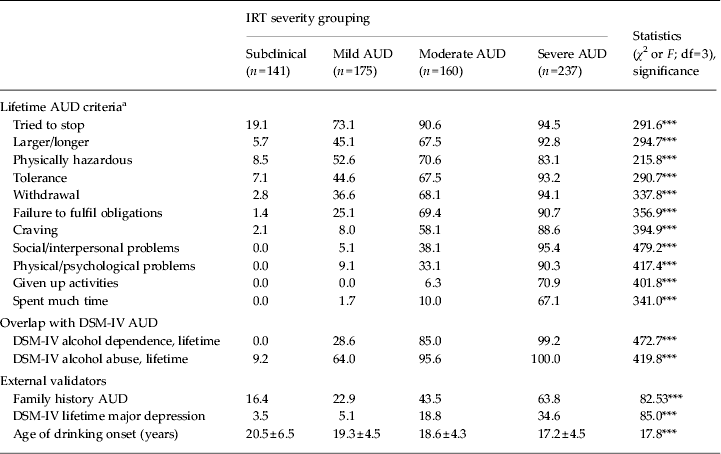
For subsequent validation of this a priori classification we used both the first (n = 711) and the second parts of the split sample (n = 713). The results are presented in Table 3. For the total sample 278 persons (19.5%) were classified as ‘subclinical’ or ‘no diagnosis’, 323 patients (22.7%) having mild AUD, 316 patients (22.2%) with moderate AUD and 507 patients (35.6%) with severe AUD. Both subgroups (IRT and validation subsample) did not differ in the frequency of the AUD severity groups (χ 2 3 = 4.51, p = 0.211).
In the validation subsample AUD severity, groups differed significantly regarding DSM-IV alcohol dependence and alcohol abuse diagnoses and the external validators (see Table 4).
Groups of proposed AUD severity, criteria and external validators (validation subsample, n = 713)

AUD, Alcohol use disorder; IRT, item response theory; df, degrees of freedom.
a Sorting order: ascending severity score from IRT.
*** p < 0.001.
Values given as percentage or mean ± standard deviation.
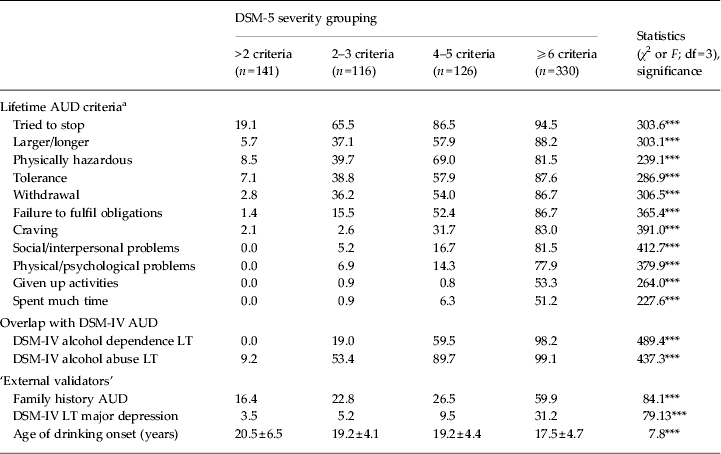
Comparing the group differences with the DSM-5 severity grouping proposal (Table 5), both grouping mechanisms resulted in similar differences regarding criteria frequency, overlap with DSM-IV AUD and external validators. However, the IRT grouping created severity groups that were more evenly distributed across individuals whereas the original DSM-5 grouping categorized 46.3% of all subjects into ‘severe AUD’ (more than five criteria fulfilled).
Overlap with DSM-IV AUD and external validators according to DSM-5 severity grouping (validation subsample, n = 713)

AUD, Alcohol use disorder; LT, lifetime; df, degrees of freedom.
a Sorting order: ascending severity score from item response theory (IRT).
Values given as percentage or mean ± standard deviation.
*** p < 0.001.
Following this over-representation of DSM-5 ‘severe AUD’, differentiation of patients according to criteria with high severity scores (drinking despite social or interpersonal problems, drinking despite psychological or physical problems, given up activities, and spent much time) was slightly better using the IRT grouping. In particular, differentiation between the mild and moderate AUD groups was better using the IRT grouping (according to statistically higher group differences).
Using the originally DSM-5 stages of severity (0–1 = subclinical, 2–3 = moderate and ⩾4 criteria = severe AUD), 16.6% of the sample fall into the moderate grouping, 63.8% into the severe and 19.5% into the subclinical.
Furthermore, comparing rates of subjects into no diagnosis, light, moderate and severe stages of AUD, our proposal and the most recent DSM-5 distribution (light, moderate, severe) differed significantly across all stages (χ 2 9 = 2773.01, p < 0.001).
Discussion
The first aim of our analysis of the international drinking sample was to confirm the dimensional and factorial structure of DSM-5 AUD criteria. In line with the majority of previous studies, our results support a one-dimensional structure of DSM-5 AUD without clear natural boundaries. Previous research in two epidemiological samples, the National Longitudinal Alcohol Epidemiologic Survey (NLAES) and the National Epidemiologic Survey of Alcohol and Related Conditions (NESARC; Hasin et al. Reference Hasin, Liu, Alderson and Grant2006), and other studies (Martin et al. Reference Martin, Chung, Kirisci and Langenbucher2006; Proudfoot et al. Reference Proudfoot, Baillie and Teesson2006) also support a one-factor solution whereas other investigations support a two-factor model (Muthén et al. Reference Muthén, Grant and Hasin1993; Muthén, Reference Muthén1995; Harford & Muthén, Reference Harford and Muthén2001; Grant et al. Reference Grant, Harford, Muthén, Yi, Hasin and Stinson2007). A more recent study, which recruited an international sample of 5195 injured and non-injured patients attending seven emergency departments from four countries, reported a single dimensional trait when DSM-IV alcohol dependence and abuse criteria were considered together (Borges et al. Reference Borges, Ye, Bond, Cherpitel, Cremonte, Moskalewicz, Swiatkiewicz and Rubio-Stipec2010). A subsequent analysis of the same sample (Borges et al. Reference Borges, Cherpitel, Ye, Bond, Cremonte, Moskalewicz and Swiatkiewicz2011) likewise reported strong support for one dimension of a DSM-5 AUD. Although similar results regarding dimensionality have been obtained, the samples analyzed were fairly heterogeneous, including adolescents (Martin et al. Reference Martin, Chung, Kirisci and Langenbucher2006; Gelhorn et al. Reference Gelhorn, Hartman, Sakai, Stallings, Young, Rhee, Corley, Hewitt, Hopfer and Crowley2008) and representative drinking samples from Australia (Proudfoot et al. Reference Proudfoot, Baillie and Teesson2006) and the USA (Saha et al. Reference Saha, Chou and Grant2006, Reference Saha, Stinson and Grant2007). If the results converge even in very different samples, the validity of the finding may be high.
In line with the analysis of DSM-5 criteria by Borges et al. (Reference Borges, Cherpitel, Ye, Bond, Cremonte, Moskalewicz and Swiatkiewicz2011), the new item ‘craving’ was detected in a medium position regarding the severity of a latent AUD dimension. In accordance with this finding are results from the Australian National Survey of Mental Health and Well-Being sample (Mewton et al. Reference Mewton, Slade, McBride, Grove and Teesson2011). The authors conducted factor and IRT analysis of the DSM-5 criteria, and their findings confirm the high correlation between the craving criterion and an underlying AUD trait and located craving in the moderate to high severity spectrum of the continuum. Another study on the NLAES sample also found the craving criterion unidimensional with other AUD criteria but at the more severe end of the AUD dimension (Keyes et al. Reference Keyes, Krueger, Grant and Hasin2011).
Thus, in line with some (Cherpitel et al. Reference Cherpitel, Borges, Ye, Bond, Cremonte, Moskalewicz and Swiatkiewicz2010; Shmulewitz et al. Reference Shmulewitz, Keyes, Beseler, Aharonovich, Aivadyan, Spivak and Hasin2010; Borges et al. Reference Borges, Cherpitel, Ye, Bond, Cremonte, Moskalewicz and Swiatkiewicz2011; Casey et al. Reference Casey, Adamson, Shevlin and McKinney2012) but not all (Hagman & Cohn, Reference Hagman and Cohn2011; Keyes et al. Reference Keyes, Krueger, Grant and Hasin2011; Mewton et al. Reference Mewton, Slade, McBride, Grove and Teesson2011) previous studies, the results of the IRT analysis in the current sample reveal that the craving criteria is located in the moderate region of corresponding difficulty ranges compared with the other DSM-5 criteria.
Although our results support a one-factor solution of AUD in terms of model parsimony, underlying secondary factors have to be acknowledged. Previous studies indicated that there may be at least two underlying factors extractable from the DSM-5 AUD criteria that result in a slightly increased global model fit (Cherpitel et al. Reference Cherpitel, Borges, Ye, Bond, Cremonte, Moskalewicz and Swiatkiewicz2010). These two subfactors possibly represent at least the two extremes of continuum: one for fairly mild expressions of AUD and one for more severe forms (Hagman & Cohn, Reference Hagman and Cohn2011). Consistently, DSM-5 proposes two stages of severity for individuals who endorse two or more criteria: two to three criteria are considered ‘mild’ and more than three criteria ‘moderate’ AUD (e.g. Borges et al. Reference Borges, Cherpitel, Ye, Bond, Cremonte, Moskalewicz and Swiatkiewicz2011). Using these stages in our sample, however, resulted in an uneven distribution of affected individuals. As shown in Table 3, of all subjects who endorsed at least two DSM-5 criteria, only slightly more than 20% of subjects fall into the mild group whereas the remaining 80% of individuals are at least moderately affected. Therefore, the proposed stages of severity may better classify individuals with no or mild AUD (Hagman & Cohn, Reference Hagman and Cohn2011), but not individuals with more severe disorder. Using the more recently proposed DSM-5 classification of severity (light, moderate, severe), almost half of the subjects still fall into the ‘severe’ stage. This rate of severely affected individuals decreases significantly to about one-third when our proposal is used. Therefore, the proposal not only has the advantage of integrating more information for stages of severity than a simple symptom count but also leads to a more even distribution of affected individuals across severity stages.
Consequently, and based on the results of the IRT analyses, we propose an alternative subgrouping of individuals according to DSM-5 AUD severity. The different severity stages of AUD are defined using the dimensions of number of DSM-5 criteria endorsed and two or three criteria that characterize each subgroup (mild: tried to stop, physically hazardous, larger/longer; moderate: tolerance, withdrawal, failure to fulfill obligations, craving, severe: drinking despite social or interpersonal problems, drinking despite psychological or physical problems, given up activities, spent much time). As several individuals endorse criteria not only of their specific subgroup but also those of others, criteria from higher severity stages are also acknowledged. In the ‘mild’ group, subjects may also fulfill one ‘severe’ and one ‘moderate’ criteria; in the ‘moderate’ group, they may also fulfill a maximum of two ‘severe’ criteria. Although there is no advantage to the originally DSM-5 suggested stages of severity using external validators, which perform very well in both classifications, 99% of drinking individuals in our sample could be classified in one of the suggested severity subgroups. Across both classifications, more severe stages had a significant increase (percentage of positive family history or major depression) or decrease (age of drinking onset) across the proposed severity groups. These and other external validating variables have been used by previous studies (Hasin et al. Reference Hasin, Liu, Alderson and Grant2006; Grove et al. Reference Grove, McBride and Slade2010) to differentiate between diagnostic thresholds and original, and also the proposed, stages of severity, which, in our impression, performed fairly well in our sample. Thus, the suggested severity groups are not superior to the original DSM-5 proposal.
Even if the recruited subjects are from a drinking population that included all intensities of alcohol use, this sample is not typical for treatment-seeking subjects with an AUD. These subjects usually have at least moderate severity of AUD, in particular those who are admitted for in-patient treatment in central Europe. For these individuals, better differentiation for moderate to severe stages of their AUD may be useful.
Clearly, subgrouping individuals who fulfill two or more DSM-5 AUD criteria regarding their severity along a latent AUD trait is challenging. However, well-evaluated stages of AUD severity may be helpful for the clinician to decide on treatment setting and intensity. For instance, an individual with a more severe disorder may require more frequent in-patient rather than out-patient treatment and more frequent aftercare than a person with mild disease intensity. Because of the paucity of studies on the relationship between AUD severity and treatment intensity, further research is warranted.
This study has attempted to shed more light on the latent AUD construct. The proposed new classification system to differentiate between subjects suffering from mild, moderate or severe AUD certainly adds complexity to the existing systems based on symptom count. The proposed new categorizing system has similar power to differentiate between patients with different stages of AUD severity as the DSM-5. However, beyond simple categorization, which provides valuable information for clinicians, it adds theoretical knowledge to the latent dimension of AUD. Clarification of the inner structure of AUD helps in the understanding of the progress of AUD from subclinical to severe stages. Whereas efforts to stop alcohol consumption and larger amounts of time spent consuming alcohol without social/interpersonal problems (or psychological or physical impairments) indicate an early subclinical stage, the transition to mild AUD occurs with increasing social, psychological and physical problems. These problems increase in moderate AUD.
Furthermore, this classification may also be helpful in clinical practice. From diagnosis to psycho-education, therapy and rehabilitation to relapse prevention, it defines the topics clinicians have to address with their patients. At hospital admission, knowledge of the inner structure of the latent AUD dimension can make diagnoses more valid, especially with a disorder that can be hampered by socially desired answers from patients in diagnostic interviews. For instance, psycho-education can be enriched by showing the worsening of disorder not only by single symptom increase but also by anticipating the forthcoming steps of individual development of the disorder. Therapy can focus on attempts to stop consumption by behavioral analyses of relapse triggers in mild cases. In moderate cases, cognitive strategies of craving control should be involved; severe AUD therapy should additionally address social/interpersonal problems.
Thus, for simple scoring purposes, the proposed system may be too complex for daily practice. However, in understanding the disorder and adapting diagnostics and therapy to an individual suffering from AUD, the added complexity can provide valuable information for therapists.
There are several limitations in our study. First, the sample does not consist of an epidemiologically representative population with treatment-seeking subjects from in- or out-patient addiction treatment facilities. In two recruiting sites, only males were enrolled in the study. Furthermore, the results for the more complex suggestion for stages of severity were evaluated only in the WHO/ISBRA sample. The suggested system certainly needs replication, for example in samples not recruited in treatment settings. These factors limit the generalizability of the results. However, the sample covers consumption patterns from patients with and without an AUD from different continents and different parts of the world. Furthermore, several other characteristics of AUDs that may be of diagnostic importance were not included in the analyses, for instance hazardous drinking at the low end and alcohol-related complications such as delirium tremens or alcohol withdrawal-induced seizures on the severe end of a unidimensional factor for a DSM-5 AUD continuum.
Appendix. WHO/ISBRA Investigators
K. M. Conigrave, M. Dongier, H. Edenberg, C. J. P. Eriksson, M. L. O. S. Formigoni, B. F. Grant, A. Helander, P. L. Hoffman, K. Kiianmaa, T. Koyama, L. Legault, T.-K. Li, M. Monteiro, T. Methuen, T. Saito, M. Salaspuro, J. B. Saunders, B. Tabakoff, S. Tufik, J. B. Whitfield and F. M. Wurst.
Declaration of Interest
None.