


In the first volume of his entertaining memoirs, Edward B. Marks recalled the early days of Joseph W. Stern, the music publishing company he had helped found: “We bought so much stuff from colored writers in those days that sometimes we wondered whether we were running a publishing house or a vaudeville theater.” He noted that “there was small welcome for the colored boys in the older, more dignified publishing houses” but explained that “to me, at least, their songs rang a little truer than the rest.”Footnote 1 He concluded that “our young publishing firm witnessed and fostered the first mass invasion of the amusement world by colored America.”Footnote 2
Marks’s dismissal of “older, more dignified” publishers is perhaps a little unjust—M. Witmark & Sons, for example, had acquired the catalogue of Black composer Gussie L. Davis (1863–1899) in 1892Footnote 3 —but recent scholars have tended to concur with his conclusion. Rick Benjamin, for example, asserts that “during the late 1890s and on into the first decade of the twentieth century, Stern was America’s number-one publisher of black music.”Footnote 4 However, such assessments have been informal and impressionistic. The purpose of the present article is to test this conclusion by detailed analysis of the copyrights registered by Joseph W. Stern & Co. from 1894 through 1904 and, in the process, to uncover some of the initiatives and agencies exercised by the very Black musicians that Stern claimed to “foster.”
The methodology is simple: digitization of the registration books compiled by the copyright office has made possible automated searching. A search for “Stern” in each published volume yields all the titles published by Joseph W. Stern & Co. in that year, together with the composer’s name and, sometimes, additional information. The titles are entered into a series of spreadsheets and assigned categories. From these (and from other sources like sheet-music covers, advertisements, and newspaper reports) conclusions can be drawn about Stern’s publishing strategies and the ways in which Black songwriters contributed to and exploited them.Footnote 5
Beginnings
The firm “Jos. W. Stern & Co.” came into being because Edward B. Marks and Joseph W. Stern sat down “in the parlor of a hotel in Mamaroneck” and wrote “The Little Lost Child.” Marks (1865–1945) was five years older than Stern (1870–1934) and had been dabbling with song lyrics since 1892. Late in 1893 he landed his first hit, “December and May,” with music written by William Loraine.Footnote 6 With the confidence (and possibly the remuneration) this created, he and Stern decided to go into business, naming the firm after Stern to preserve Marks’s day job.Footnote 7
The new song was copyrighted the week of January 15, 1894. Marks and Stern were both salesmen, and they promoted their work relentlessly. On March 27, a performance of this “new descriptive song” by Minnie Schult (1867–1900) “caught the fancy of the house at once” at Brooklyn’s Huber and Gebhardt’s Casino.Footnote 8 By early April, the firm could boast of a dozen endorsements by performers and producers.Footnote 9 In mid-May, Stern & Co. took out a second copyright, now dedicating the song to Minnie.Footnote 10 Sometime after that, both Della Fox (1870–1913) and Lottie Gilson (1862–1912)—true headliners—took up the song.Footnote 11 By July 1895, eighteen months after its composition, “The Little Lost Child” was reported to have earned its writers $15,000.Footnote 12
With their burgeoning earnings, Marks and Stern expanded. By the end of 1894, they had copyrighted eleven titles by seven composers and republished two titles with new copyrights.Footnote 13 (Their imprint also appears on at least four more titles for which no Stern copyright exists.) With only two possible exceptions, their stable of contributors was drawn from their friends and New York associates. Marks and Stern themselves wrote another song for Schult: “His Last Thoughts Were of You.” Two titles were contributed by William H. Fox (1858–1929), who had written the music for two of Marks’s lyrics in 1892.Footnote 14 Two more were written by George Rosey (1859–1936), also a prior collaborator with Marks. “Rosey” was born George M. Rosenberg and emigrated from Germany in the mid-1880s; Marks took credit for inventing his “euphonious” pseudonym, and “Rosey” continued publishing with the firm for at least a decade.Footnote 15 One title was written by Henry Stern (1874–1966), Joseph’s brother, who quickly assumed the pseudonym “S. R. Henry” to thwart accusations of nepotism.Footnote 16 Another was by Leo Feist (1869–1930), whom either Marks or Stern might have known from their traveling-salesman days—Marks sold notions, Stern sold neckties, and Feist sold corsets—and who would go on to found one of the great Tin Pan Alley publishing houses.Footnote 17 Two other writers were more distantly connected: Mork M. Doob (1876–1935), a young songwriter from Cincinnati, possibly also a salesman, who abandoned the field in 1897 after Stern had issued a small handful of titles; and Dion de Romandy (1862–1899), a Hungarian orchestra leader based in Los Angeles.Footnote 18 Finally, there was one title by Will Taylor, who has so far resisted identification. This initial stable of composers is predictably homogeneous: young men from New York, nearly all at the start of their careers, the majority already linked to Marks or Stern either professionally or personally, and all White and of European ancestry. The songs themselves were, if anything, slightly out-of-date; “The Little Lost Child,” for example, belonged to a sentimental “descriptive” genre that was beginning to fade. However, in future years, Stern and especially Marks displayed a remarkably good awareness of new and emerging trends.
The same demographic prevailed in 1895, though the quantity just about tripled: thirty new titles and seven republications or arrangements. The core continued: Marks and Stern wrote three new songs, and Rosey wrote six (a seventh apparently was not registered). Max S. Witt (1871–1914)—like Rosey, a German immigrant and skilled pianist—joined the firm, where he would remain until his death, and supplied two titles, and Will H. Fox and Mork M. Doob each contributed one new song. But the new firm also began to enlist established professionals. John A. Stromberg (1858–1902) had been the musical director for touring shows for almost a decade before Stern published his “My Best Girl’s a Corker,” which became a major success and the first of a dozen of Stromberg’s contributions over the next three years.Footnote 19 Charles Graham (1863–1899) had been writing songs for various publishers since at least 1888, with an enduring hit (“Two Little Girls in Blue”) in 1893. Marks managed to persuade him to write three songs for Stern & Co. in 1895.Footnote 20 Ed Rogers (1866–1928) had been performing since the early 1880s but only began his extensive career as a songwriter in 1893. Stern published “Sweet Dora McCree” in 1895, with other Rogers compositions coming their way until 1902. There was also the curious Arthur Trevelyan (1875–1961), “a little Englishman noted as a nobby dresser,” who spent several years in the States peddling songs before returning to England to peddle cigars.Footnote 21 He probably arrived in 1893, placing a dozen songs with almost a dozen publishers before he locked onto Stern & Co., giving them four titles toward the end of 1895. A handful of other writers—some well-known, some not—contributed the remainder of the year’s output. But one of these is of historical interest: an arrangement by August Reinhard (1831–1912) of Carl Maria Von Weber’s Adagio and Rondo, the company’s first imprint by a non-American composer. These would increase substantially in years to come.
The company grew less dramatically in 1896, with 43 copyrights registered. Three were republications or arrangements, so there were 40 new titles issued, a modest 33 percent increase over the preceding year. However, three titles were by Englishmen. Marks (or Stern) had negotiated with Frank Dean (1857–1922), the English songwriter and publisher, for the first of what would become many agreements whereby Stern registered the American copyright for songs originally issued elsewhere.Footnote 22 These would substantially expand the geographic and cultural range of Stern publications in the first decade of the twentieth century. But in 1896, the most significant expansion was precipitated by that “nobby dresser,” Arthur Trevelyan. Trevelyan wrote both words and lyrics, sometimes together but often with a collaborator. For his final 1895 publication, “You Know the Kind of Thing I Mean,” he was the composer and Edward Marks was the lyricist. A month later, in January 1896, Gussie L. Davis wrote the words for Trevelyan’s “Down in Poverty Row.”
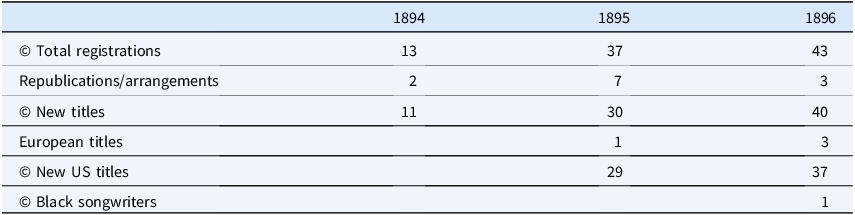
Davis was the first Black songwriter published by the young firm, and “Poverty Row” remained a hit for at least a decade, with its numerous performances, recordings, and parodies uncounted. Perhaps this was why Marks, years later, described Davis as “the third mainstay of the young firm,” despite the fact that Davis published only three titles with Stern before the turn of the century.Footnote 23 The other two “mainstays” were Monroe H. Rosenfeld (1853/4–1918)Footnote 24 and James Thornton (1861–1940); Thornton supplied “On the Benches in the Park,” another big hit of 1896, and Marks and Stern themselves wrote a third, “Mother Was a Lady.”Footnote 25 The firm’s stable of composers continued to produce: three titles from Rosey, three from Witt, and four from Stromberg. A noteworthy addition was the New England team of Stanley Carter (1870–1946) and Harry Braisted (1871–1947), who contributed yet another hit, “You’re Not the Only Pebble on the Beach.”Footnote 26 A collection of songwriters similar to those in 1896 completed the year’s output. For a summary of the firm’s activities between 1894 and 1896, see Table 1.
Jos. W. Stern & Co. copyrights, 1894–1896

Table 1. Long description
The table presents data on Jos. W.Stern & Co. copyrights for the years 1894, 1895, and 1896. It has 6 rows and 4 columns. The columns are labeled with the years 1894, 1895, and 1896. The rows are labeled with different categories: Total registrations, Republications/arrangements, New titles, European titles, New US titles, and Black songwriters. Row 1: Total registrations, 1894: 13, 1895: 37, 1896: 43. Row 2: Republications/arrangements, 1894: 2, 1895: 7, 1896: 3. Row 3: New titles, 1894: 11, 1895: 30, 1896: 40. Row 4: European titles, 1894: 1, 1895: 1, 1896: 3. Row 5: New US titles, 1894: 29, 1895: 37. Row 6: Black songwriters, 1896: 1.
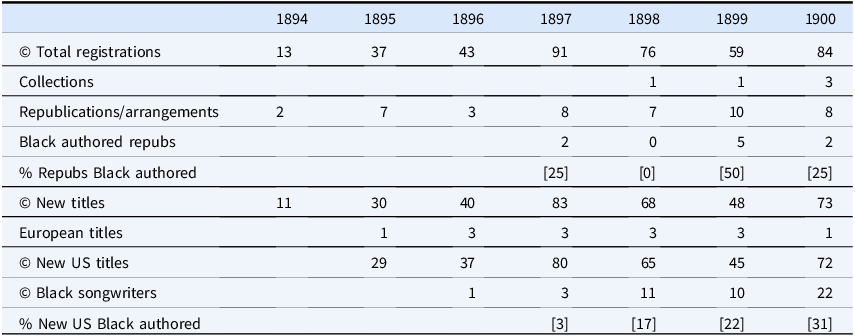
Jos. W. Stern & Co. copyrights, 1894–1900

Table 2. Long description
A table showing Jos. W.Stern & Co. copyrights data from 1894 to 1900. The table has 13 rows and 8 columns. Row 1: 1894, 1895, 1896, 1897, 1898, 1899, 1900. Row 2: Total registrations, 13, 37, 43, 91, 76, 59, 84. Row 3: Collections, 1, 1, 3. Row 4: Republications/arrangements, 2, 7, 3, 8, 7, 10, 8. Row 5: Black authored repubs, 2, 0, 5, 2. Row 6: % Repubs Black authored, [25], [0], [50], [25]. Row 7: New titles, 11, 30, 40, 83, 68, 48, 73. Row 8: European titles, 1, 3, 3, 3, 3, 1. Row 9: New US titles, 29, 37, 80, 65, 45, 72. Row 10: Black songwriters, 1, 3, 11, 10, 22. Row 11: % New US Black authored, [3], [17], [22], [31].
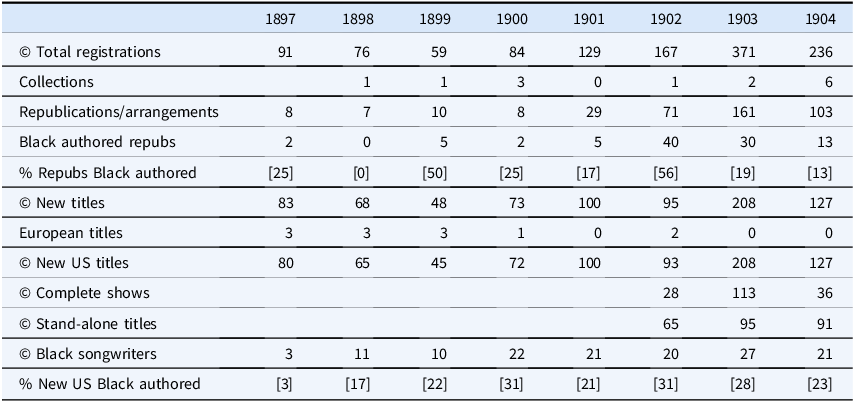
Jos. W. Stern & Co. copyrights, 1897–1904

Table 3. Long description
The table presents data on Jos. W.Stern & Co. copyrights from 1897 to 1904. It includes eight columns for each year and multiple rows for different categories. Row 1: Total registrations: 1897, 91; 1898, 76; 1899, 59; 1900, 84; 1901, 129; 1902, 167; 1903, 371; 1904, 236. Row 2: Collections: 1897, 1; 1898, 1; 1899, 3; 1900, 0; 1901, 1; 1902, 2; 1903, 2; 1904, 6. Row 3: Republications/arrangements: 1897, 8; 1898, 7; 1899, 10; 1900, 8; 1901, 29; 1902, 71; 1903, 161; 1904, 103. Row 4: Black authored repubs: 1897, 2; 1898, 0; 1899, 5; 1900, 2; 1901, 5; 1902, 40; 1903, 30; 1904, 13. Row 5: % Repubs Black authored: 1897, 25 percent; 1898, 0 percent; 1899, 50 percent; 1900, 25 percent; 1901, 17 percent; 1902, 56 percent; 1903, 19 percent; 1904, 13 percent. Row 6: New titles: 1897, 83; 1898, 68; 1899, 48; 1900, 73; 1901, 100; 1902, 95; 1903, 208; 1904, 127. Row 7: European titles: 1897, 3; 1898, 3; 1899, 3; 1900, 1; 1901, 0; 1902, 2; 1903, 0; 1904, 0. Row 8: New US titles: 1897, 80; 1898, 65; 1899, 45; 1900, 72; 1901, 100; 1902, 93; 1903, 208; 1904, 127. Row 9: Complete shows: 1897, 28; 1903, 113; 1904, 36. Row 10: Stand-alone titles: 1902, 65; 1903, 95; 1904, 91. Row 11: Black songwriters: 1897, 3; 1898, 11; 1899, 10; 1900, 22; 1901, 21; 1902, 20; 1903, 27; 1904, 21. Row 12: % New US Black authored: 1897, 3 percent; 1898, 17 percent; 1899, 22 percent; 1900, 31 percent; 1901, 21 percent; 1902, 31 percent; 1903, 28 percent; 1904, 23 percent.
Development
At the end of its first three years, then, Jos. W. Stern & Co. had issued a half-dozen songs that were producing a substantial income. Using the classic business model for “popular” music publishers, it reinvested its profits. In 1897, it registered 91 titles, more than double the preceding year. Deducting duplicates and republications, 83 new titles were registered. Three of these were from England, courtesy of Frank Dean, so there were 80 new titles by Americans, again double the preceding year.Footnote 27 The firm’s mainstays (Witt, Thornton, Carter, and Rosenfeld) weighed in with about a third of the total, and the firm landed two songs by the young George M. Cohan (1878–1942) and four by the colorful and mysterious Ilda Orme.Footnote 28
The firm continued to expand its range both stylistically and demographically. Louis Tocaben (1864–1953) contributed six pieces for mandolin, the first in a genre that Stern & Co. would exploit in years to come. Tocaben was a commercial artist by profession, but he was tireless in arranging and promoting music for mandolins and guitars in various combinations. He published widely and with a variety of firms, and he contributed a substantial number of arrangements to the Stern catalog up through 1906.Footnote 29 More importantly, however, Gussie L. Davis returned to author two titles, now writing both music and lyrics, and another Black composer, Irving Jones, wrote “Take Your Clothes and Go,” a smash hit that Stern issued in three different arrangements.Footnote 30 All three were made by William H. Tyers (1870–1924), a Black, gifted, classically educated pianist and arranger who would play an important role in the Stern organization until about 1914.Footnote 31 However, in 1897, Tyers was officially a staff arranger for a competing publisher, F. A. Mills, for whom he had already written several very popular piano pieces. Thus, his work for Stern was, in effect, moonlighting.Footnote 32 Overall, Stern’s commitment to Black songwriters and musicians was growing: they contributed nearly three percent of new titles and, because of Jones’s big hit, a quarter of the firm’s republications.
Stern & Co. registered fewer publications in 1898, for reasons that aren’t evident. Of 76 total titles, 7 were republications or arrangements, and one was a collection of previously published material, the first of many that Stern would issue over the next twenty years. Three were by the Englishman Felix McGlennon (1856–1943), so there were only 65 titles by American composers, a substantial drop from the 80 American titles issued in 1897. Davis and Thornton were absent, but Monroe H. Rosenfeld (the third “mainstay”) wrote nine of these, and house composers Rosey and Witt wrote another nine. Other familiar names, such as John Stromberg and Sidney Carter, wrote eight titles, and there were the usual scattered contributions by Tin Pan Alley regulars. An emerging figure, Harry Von Tilzer (1872–1946), wrote four songs, though his most successful songs were issued by Stern’s competitors.Footnote 33 Regardless, of the 65 publications, 11 were by Black songwriters, including four titles from Bert Williams (1874–1922) and George Walker (1873–1911), arguably the most prominent Black performers of the 1890s.Footnote 34 Irving Jones wrote one song, and two titles were arranged by William H. Tyers, but the other music was contributed by persons new to the firm: the vaudeville team of Deas and Wilson,Footnote 35 Jeff De Mont (1869–1915)Footnote 36 and Hen Wise (1872–1917),Footnote 37 Tom Logan (1861–1908),Footnote 38 Sidney Perrin (1873–1931),Footnote 39 and Nathan Bivins (1862–1961).Footnote 40 It might be that this diverse contingent was recruited by Tyers, by Williams and Walker, or even by Gussie Davis, but it might also be that Ed Marks and Joe Stern made a deliberate attempt not only to increase the quantity of titles by Black composers but also the breadth of composers published. In any case, the proportion of Black-authored titles saw a fivefold increase, from 3 percent in 1897 to 17 percent in 1898.
In 1899, both trends continued: Stern registered fewer copyrights (only 59), but the proportion contributed by Black authors continued to increase.Footnote 41 The firm issued a single collection, assembled by the tireless Rosey, and there were three contributions by European authors, all reprints of German titles, a strategy that other publishers had long pursued. It may be that these republications signaled an intention to compete with so-called “standard” publishers like Oliver Ditson; in any case, the strategy was pursued only sporadically in future years. The portfolio of conventional popular songs was enhanced by six contributions from Dave Reed, Jr. (1872–1946), but the excitement was short-lived, as Reed shifted to a different publisher the following year.Footnote 42 Overall, then, there were 55 registrations of American compositions, of which 10 were republications or arrangements.
The relative value of Stern’s growing Black portfolio can be inferred from the ten songs previously published; five (a remarkable fifty percent) had been authored by Black songwriters. Moreover, all five republications were arrangements by William H. Tyers, who had left F. A. Mills early in the year. In April, the Washington Bee announced that “Mr. Wm. H. Tyers, the famous colored pianist and composer of New York City, is now connected with the big firm of James [sic] W. Stern & Co., music publishers of that city. Mr. Tyers is the best known Afro-American composer now before the American public…. Several new pieces by this fine young composer are now in press.”Footnote 43 Indeed, Tyers wrote four new titles for Stern, in addition to providing the arrangements and, no doubt, general assistance in refining and promoting new publications. In all, Black authors wrote ten new compositions; Tyers wrote four, and Irving Jones and Williams and Walker each wrote one; and the remaining four came from four leading Black entertainers, perhaps brought to Stern through Tyers: Jesse A. Shipp (1864–1934), “Jolly” John Larkins (1877–1936), Percy Y. Clarke (1876–1902), and—pointing to the future—Bob Cole (1868–1911). Since there were 45 registrations of new titles by American composers, the Black contribution represents 22 percent of the whole. More importantly, Stern had become a major asset to the rising generation of Black creative artists. Jesse A. Shipp was equally important as a playwright, performer, and producer; for just one slice of his exceptional career, see Thomas Bauman’s book on the Pekin theater.Footnote 44 “Jolly” John Larkins (born John Larkin Smith) was associated with important Black companies and shows before moving into films in 1930.Footnote 45 Percy Y. Clarke’s promising career as a trained pianist, composer, and arranger was cut short by his premature death. Bob Cole was a pre-eminent figure in early Black musical shows and a valued collaborator with James Weldon Johnson and other figures who later constituted the Harlem Renaissance.Footnote 46
By the turn of the century, Stern & Co. was fully established as a major player in the emerging Tin Pan Alley. In the new year, the firm consolidated its position with increases in both its overall registrations and the proportion written by Black Americans. Stern recorded 84 copyrights in 1900 (a 43 percent increase over 1899), but three were for collections and eight were arrangements, two of which (25 percent) were Tyers’s arrangements of Williams and Walker songs. One new title was by an Englishman, Paul Rubens (1875–1917), so there were 72 new titles registered by American composers. Among these are many familiar names—Max Witt, George Rosey, and even a single title by Marks and Stern themselves—but a remarkable eleven titles were written by the prolific J. Fred Helf (1871–1915) and Will A. Heelan (1874–1920), who would only stay with Stern for two years.
At the beginning of the century, Stern & Co. had become the publisher of choice, it seems, for the leading Black composers of the day. Of the new titles, 22 (a remarkable 31 percent) were written by Black songwriters. Tyers was credited with two new titles in addition to his arrangements, and the remaining Black compositions were by people at the top of the profession but newcomers to Stern: two titles were written by Will Accooe (1874–1904), four by Will Marion Cook (1869–1944), seven by Ernest Hogan (1865–1909), and seven by J. Rosamond Johnson (1873–1954). Accooe was known primarily as a music director for shows that included the first production by Bob Cole.Footnote 47 Will Marion Cook’s extensive career in musical theatre is well covered in Marva Griffin Carter’s biography. Ernest Hogan wrote the notorious “All Coons Look Alike to Me,” but his career as a performer and songwriter transcended that one song.Footnote 48 J. Rosamond Johnson was the younger brother of James Weldon Johnson; together they wrote “Lift Every Voice and Sing,” now commonly described as the “Black national anthem.” Stern copyrighted this landmark work on October 19, 1900.Footnote 49 For a summary of the firm’s activities between 1894 and 1900, see Table 2.
Culmination
The next four years marked the culmination of Stern’s initial investment in Black songwriters. In 1901, the firm again increased its output, this time by over fifty percent, to 129 registrations. However, the number of new titles increased only to 100 (a 39 percent rise), because Stern & Co. substantially increased its publication of arrangements by almost fourfold, from 8 to 29. In the process, the firm began to build a team of arrangers, about whom far too little is known: Louis Tocaben, arranging for mandolin and guitar; Emil Boettger (1841–1906), for instrumental ensembles; George Lechler (1864–1926), for zither; Charles de Janon (1834–1911), for guitar;Footnote 50 and Reuben Brooks (1861–1906) and Harry Denton (1867–1959), for banjo. It also expanded the range of its offerings. In addition to rescoring titles for different instruments, it began to build medleys by combining two of its titles in a single arrangement for instrumental ensemble, signaled in copyright listings by the word intro. Thus, for example, J. Rosamond Johnson’s “My Castle on the Nile” appears in an orchestral arrangement “intro. The leader of the ball two-step … arr. by E. Boettger.” (“The Leader of the Ball” was a song written by Thomas Lemonier and Cecil Mack and published about three months before Johnson’s song appeared.) Stern issued seven of these medleys in 1901, all probably intended for performances in theaters or band concerts; of the seven, three involved titles by Black composers, and for all three the primary title was paired with another of Black authorship. Of the 29 arrangements, 17 percent (five) were of titles authored by Black songwriters, a respectable number; more interesting, perhaps, was that Tyers evidently left the firm (though he would return in 1903), and that Theodore H. Northrup may have joined it. Northrup was credited as the arranger for Louie Dacre’s song, “The Coon Dolly.”
Of the 100 new titles, 21 were by Black songwriters. Some authors continued from previous years (Accooe, one title; Hogan, one title; Williams and Walker, two titles), and some were new to Stern: a single title each from Tim Brymn (1873–1946) and Shepard N. Edmonds (1876–1957), and four titles from Thomas Lemonier (1869–1945) and Cecil Mack (Richard Cecil McPherson, 1873–1944). Again, the four new songwriters were among the best of a rising generation; all four would be central members of the community that founded the first Black music publishing houses a few years later.Footnote 51 Brymn became a celebrated bandmaster as well as a composer whose career spanned over forty years.Footnote 52 Edmonds was a successful minstrel performer who moved, less successfully, into music publishing.Footnote 53 Lemonier and Mack were originally a composer and lyricist, respectively, but their extended careers led both into criticism and the industry.Footnote 54 The other eleven songs (over half the total) were by Bob Cole and the Johnson brothers, variously credited. At least two of the Cole-Johnson songs were interpolated into a major (and very White) show, The Little Duchess (the first of many shows thus enhanced); over the next few years, Black composers would increasingly supply individual titles to mainstream Broadway offerings.Footnote 55 Overall, then, Black songwriters contributed 21 percent of Stern’s new titles in 1901. This is a lower percentage than in the previous year, but that is probably more attributable to the firm’s ongoing recruitment of White composers than to its neglect of Black ones.Footnote 56 Still, it intimates changes that would be realized in the watershed year of 1904.
The following year was a high mark in Stern’s relationship with Black songwriters. In 1902, the firm registered 167 copyrights. Again, this was a substantial increase (30 percent), but again it was due entirely to republications: one collection and 71 arrangements (double the number in 1901; 43 percent of the total registrations). After deducting these, there were actually 95 new titles registered, slightly fewer than in the previous year. The arrangements had somewhat different properties, however. First, apart from a single arrangement made by J. Rosamond Johnson, Black arrangers are entirely absent. Second, 40 of the 71 arrangements (an astonishing 56 percent) were of Black-authored compositions. Third, the most heavily exploited titles were by Bob Cole: eleven arrangements of “The Maiden with the Dreamy Eyes” and nine of “Under the Bamboo Tree.” And fourth, the racial segregation that seemed implicit in the medleys of the year before is gone. For example, in one arrangement, Cole’s “The Maiden with the Dreamy Eyes” was paired with Max Witt’s “The Palace of Pleasure and Pride”; in another, Bob Cole’s “Oh, Didn’t He Ramble” was paired with Witt’s “My Clinging Ivy.”Footnote 57
Of the 95 new titles, two were imported from the New Zealander Frederick Wynne-Jones (1869–1938). Hence, there were 93 titles registered that were authored by Americans. However, Stern & Co. undertook a new initiative in 1902: it contracted with the producers of two major Broadway shows to publish all the music from their productions. This it did with a uniform cover page that listed the songs from the show and, sometimes, the instrumental music or ensemble numbers.Footnote 58 Thus, the firm registered eight titles from Sally in Our Alley (music by Ludwig Englander, book and lyrics by George Hobart) and twenty titles from The Mocking Bird (music by A. Baldwin Sloane, book and lyrics by Sydney Rosenfeld). These 28 registrations must be treated as a separate category, since everything from design to marketing was handled entirely differently from the “stand-alone” titles that Stern had published previously. Deducting these, there remain 65 stand-alone registrations for 1902. Of these, 20 titles (31 percent) were written by Black composers, distributed almost exactly as in the previous year: nine titles from Brymn, Edmonds, Hogan, Williams, and Walker; and eleven (again, over half) from Bob Cole and the Johnson brothers, variously credited.
That Jos. W. Stern & Co. was committed to Black creatives is also attested indirectly by two artifacts from 1902. The first was an unregistered collection issued that year, the “Mark Stern Ragtime Folio No. 1.” This publication, created by simply omitting the covers to music published in the past three years and then concatenating the interior pages, contained 21 compositions. Twelve (57 percent) were by Black composers, and a similar proportion characterized the “Folio No. 2,” probably issued two years later.Footnote 59 The second is an advertisement that Stern placed in Billboard, which boasted of “7 Pianists—Always in Attendance at N. Y. Office to Teach Songs,” listing their names below: Max S. Witt, Louis G. Munix, Sam Peyser, J. E. Andino, Rosamond Johnson, Bob Cole, and Shepp Edmunds [sic]. Three of the seven were Black, so evidently the firm hired Johnson, Cole, and Edmonds as regular members of its staff, not simply as occasional contributors of songs.Footnote 60
But if 1902 was a peak year, in 1903 things began to turn sour. It’s not evident from the numbers; Stern registered a whopping 371 titles, the largest annual output it ever recorded and 222 percent more than in 1901. Two were collections, so there were 369 registrations for single works. The proportions—and the people—mirrored closely the previous year, with one important difference. Republications and arrangements accounted for 161 registrations (44 percent of the total), almost exactly as in 1902; but only 30 of the arrangements (19 percent) were authored by Black musicians, and these were overwhelmingly dominated by Rosamond Johnson (17 titles) and Bob Cole (8 titles).
A substantial portion of the increase—in both new titles and republications—can be ascribed to Stern’s increasing investment in Broadway shows. The firm contracted for eight shows, which together accounted for 113 new titles registered and the bulk of the arrangements. Deducting these, only 95 stand-alone titles remain, 46 percent more than in 1902, but not even close to the increase in total titles. The number of new titles contributed by Black authors also dropped, proportionally, to 27 registrations, 28 percent of the stand-alone total. Perhaps more significantly, 20 of these were written by Bob Cole and the Johnson Brothers, and only one title by a new set of composers—Chris Smith (1879–1949) and Elmer Bowman (1870–1916)—was added.Footnote 61 (Hogan wrote four songs and Edmonds two.)
Marks and Stern’s motivations have yet to be uncovered, but it seems clear that the firm decided to reinvent itself, at least partly. A publication list that had been dominated by rags and up-tempo novelties, suited for minstrelsy and burlesque and written in large part by Black composers, had shifted dramatically toward middle-class tastes and aesthetics, bringing “high class” show tunes, dances, and ensemble numbers to the fore. At the same time—and surely not unrelated—the honeymoon with Black musicians appears to have ended. Since 1899 the proportion of Black contributions by the Johnsons and Cole had steadily increased, and the diverse collection of musicians that characterized the firm in 1898 and 1899 had drifted away. By the end of 1903, only Rosamond Johnson and his collaborators remained faithful.
The parting was not always amicable. In January 1903, The Freeman printed a communication from J. Harry Jackson, writing from New York City:
Shepard N. Edmonds, the well-known author “I’m Going to Live Anyhow Until I Die,” “Kissing Trust,” “Deed I Do,” and many other popular song hits, has brought suit against J. W. Stern & Co., music publishers, to recover damages for their failure to pay royalties for several of his compositions, which he alleges they have on several occasions refused to do. Several months ago when “coon” songs were in the height of popularity, the big music publishers almost ran over themselves in an effort to secure the most successful Negro writers for their particular firm. The authors, when signing contracts, agreed to write for only one firm during the time of contract, to receive a certain price for each song submitted and accepted by the publishers and in some instances were to receive a percentage on the sale of their compositions, the publishers to use every effort to get them before the public. Now it is alleged that the publishers are “holding back” several good songs of the Negro authors and publishing others, thereby causing complaint from the colored brother. The outcome of this suit is being watched with interest by the Negro authors of New York, there being two or more connected with every large publishing house in the city.Footnote 62
Nothing more was said about the lawsuit, and one assumes that a settlement was reached, since three months later Edmonds was boosting a new song, “Dat’s Just What ‘Expotentisious’ Means,” copyrighted by Stern on June 2.Footnote 63 But the dust-up illuminates the business model then in use and may perhaps explain the gradual dispersal of Black songwriters from Stern & Co. The dispersal was no doubt hastened because, by 1903, Black composers were receiving increasing interest from other, newly established firms. A notable instance was Harry Von Tilzer, who had learned the business from Stern and from Maurice Shapiro (1872–1911). In 1902 he formed his own company, and a year later he stole a march from Stern when he acquired the rights to what was arguably the first Black Broadway musical, In Dahomey.Footnote 64
In any case, matters slipped fully from Stern’s control in 1904, when Black songwriters seized the publication initiative by founding their own company, the Attucks Music Publishing Company. The manager of the company was Shepard N. Edmonds, but the hidden force was probably Alex Rogers (1876–1930), who wrote the first five titles published by the new firm. Jesse A. Shipp, William A. Tyers, and Thomas Lemonier also contributed to the first year’s output, and Williams and Walker, as performers, were frequently present on the covers.Footnote 65
Stern was by no means in trouble; deducting the six copyrights for collections, the firm registered 230 titles for single works in 1904, the second highest number in its history. Republications and arrangements accounted for 103 of these—44 percent, exactly the proportion in 1903—but only 13 (13 percent) were of titles authored by Black songwriters. All of those were by Cole or Johnson, so the divestment of its diverse stable of Black musicians may have been at least partly Stern’s own decision. Of the 127 new titles, 36 were from Broadway shows, and of the 91 stand-alone titles, 21 (23 percent) were by Black composers. However, 18 of these were by Cole and Johnson, who were also honored by a collection, the Cole & Johnson Vocal Folio. Chris Smith contributed two titles, and Tim Brymn contributed one, but Stern’s association with Black songwriters other than Cole and Johnson had effectively ended. The firm would not compete for dominance again until 1910, when Black-owned publishers began to decline; but from then until World War I, for quite different reasons and with quite different people, Stern & Co. would again be a major distributor of music authored by Black Americans. For a summary of the firm’s activities between 1897 and 1904, see Table 3.
Conclusion
Edward Marks wanted to believe—or, at least, to claim—that Jos. W. Stern & Co. had “fostered the first mass invasion of the amusement world by colored America.” The data supports a substantially modified version of that assertion: Stern & Co. undoubtedly played a significant role in publishing and disseminating music by Black Americans between 1898 and 1903, but the “invasion” was accomplished by the musicians themselves. First, the surge in publications came after Black performers had established their own companies, genres, and circuits. Thus, the “invasion” was in the first instance performative, rather than compositional. Second, Black musicians like William H. Tyers and Jesse A. Shipp carved out careers that, though entangled with Stern, were in no sense dependent on that relationship. Third, Stern’s association with the most celebrated figures—Williams and Walker, the Johnson brothers, Bob Cole—certainly benefited the firm as well as the songwriters. Marks might well have written that “colored America fostered the first successes of Jos. W. Stern & Co.”
Finally, anecdotal information suggests that Stern was by no means the first and certainly not alone. Edward Marks noted that in 1895, as the firm was getting started, its two major competitors were Howley, Haviland & Co. and Spaulding and Gray.Footnote 66 To these might be added F. A. Mills, with whom W. H. Tyers had first been affiliated. In 1897, the back cover of “Forest and Stream,” produced by Tyers and published by Mills, promoted ten titles; two were by Tyers and one was by Rosamond Johnson, so thirty percent were written by Black Americans. It would take Stern three years to get to that proportion. From 1893 to 1896, Gussie L. Davis published over twenty titles with Spaulding and Gray; he became Stern’s third “mainstay” two years later by selling the young firm a paltry three songs. Howley and Haviland issued a magazine, Ev’ry Month, and the January 1899 issue was entirely devoted to Black composers, with compositions by Cole and Johnson, Bert Williams, Ernest Hogan, and Gussie L. Davis.
Jos. W. Stern & Co. outlasted all three competitors, after which it was transformed into the Edward B. Marks Music Company, whose catalog still exists under the framework of Carlin America. The victors write the histories; Edward Marks was a charming and personable advocate for Stern for half a century and the author of two volumes of memoirs; thus, Stern’s preeminence is largely self-declared. But the data suggests that the predominant narrative needs a far more nuanced reading if the relations between Black composers and White publishers at the turn of the century are to be understood. Comparative data needs to be assembled for Mills, Spauding and Gray, and Howley, Haviland & Co. Trade journals and, especially, Black newspapers must be scrutinized for supporting information and critical assessment, and far more detailed biographies of the musicians and publishers need to be limned. The task is well worth doing. The rise of Black songwriters in the twenty years that surround 1900 was foundational to the development of Black culture and pride—foundational, in fact, to the history of American music in the twentieth century.
William Brooks taught for forty-one years at the University of Illinois (Urbana-Champaign) and the University of York (England) before his retirement in 2021. He has written about Charles Ives, John Cage, and popular music, and he is the curator of two online sheet music repositories of World War I titles from the Driscoll Collection (Newberry Library) and the Myers Sheet Music Collection (University of Illinois).

 Open access

