Introduction
The circumpolar north is associated with survival and adaptation to a harsh environment, characterised by ice-deserts, permafrost, low- and slow growing vegetation and other inhospitable aspects of life.
At first glance, the livelihood and mode of dwelling that industrial labour migrants in the Russian north have seems to be built around the notion of fighting against, rather than living with the environment: the life of northern incomers is characterised by big cities, massive physical engagement with the environment, conquering and subduing nature, resulting in maximal footprint on the land, which is in some cases considered a desired outcome of human interaction with the land that creates attachment to place (Stammler Reference Stammler2011). But recent research has also shown that this does not exclude sincere love and attachment to place among such industrial workers and their descendants (Bolotova and Stammler Reference Bolotova and Stammler2010; Bolotova Reference Bolotova2012).
It is the indigenous inhabitants of these areas that have the longest experience in this environment. With their hunting, gathering, and mobile herding livelihood, they developed a sophisticated way of engaging with this environment, with the idea of leaving a minimal footprint on the land. Their relationship with the land in the north is reciprocal, characterised by giving and taking (Anderson Reference Anderson2000). Any material, tangible traces of human indigenous dwelling on the northern expanses can be very quickly ‘taken back’ by other non-human agents in the environment, once humans decide to abandon a site, even though it is possible to detect human presence in the area for millenia (Haakanson Reference Haakanson2000; Gusev Reference Gusev and Fedorova2010). In other words, this indigenous livelihood is embedded into an organic holistic environment, where all the natural components, including the supernatural and human components, are related to each other.
Having studied such local land-based livelihoods on the one hand, and industrialisation on the other, the last thing that we were expecting in the early phase of an urban anthropological research project in the Russian north was settlements of summer cottages where people go to grow food and build houses to spend their free time. In doing so, owners of such places called dachas voluntarily agree to refrain from ‘escaping’ from the north to more temperate regions for holidays, which they usually do for most of their free time. Instead, they work on their dacha. Even in Russian social science research, this phenomenon has gained attention rather recently (Nakhshina and Razumova Reference Nakhshina, Razumova, Bashmakova and Ristolainen2009), because it is mostly an outcome of perestroika and its aftermath. In this article, we share some of the insights from seeing, thinking about, and living on dachas in the north, as well as from talking to their owners and administrators. Data for this article were gathered from three regions: the mining cities of Kirovsk and Apatity in Murmansk Oblast in the Russian far northwest, the gas extraction cities of Novyi Urengoi, Pangody and Nadym in Yamal, west Siberia, and the city of Yakutsk, the capital of the Sakha Republic. While all these places share a harsh northern climate, their large dacha movement differs substantially. Kirovsk and Apatity have a population of approximately 110000 together, and the dacha settlements are located along the shore of lake Imandra as well as along the highway between both cities (figures on numbers of dachas were not available). The absence of permafrost and a long agricultural tradition of the population influenced the orientation of many dachas there towards subsistence garden production. In west Siberia's gas cities, dachas on the permafrost are more oriented towards recreation. Figures were available for Novyi Urengoi, where a population of 115000 has registered approximately 10000 dacha plots, which exclude garage settlements also used for recreational purposes (Vladimir Nuykin, Novyi Urengoi city administration, personal communication, 19 May 2013). In Yakutsk, there are 210000 people with access to a dacha, out of a population of 318000, according to the municipality, for 2013. Yakutsk has the longest dacha tradition among our field sites. Another particularity is the ethnic character of the dacha culture among Sakha on the one hand and Russians or other Russian speaking incomers on the other.
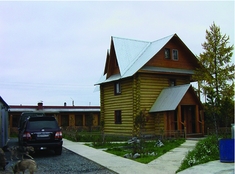
In west Siberia as well as in the Murmansk region, such summer activities by incomers to the region started to become popular after perestroika. In Russia's gas capital Novyi Urengoi, one of the authors could not believe his eyes seeing people working on a potato plot with imported soil from the south, poured onto the permafrost. Next to the plot was a beautifully built wooden house with individual layout (Fig. 1). Looking around this place, there were 10s if not 100s of such little plots and houses, and every one looked different from the others: what a contrast from the industrial city built in concrete, what a visual, material, aesthetic and functional diversity!
Dacha in Novyi Urengoi, West Siberia.

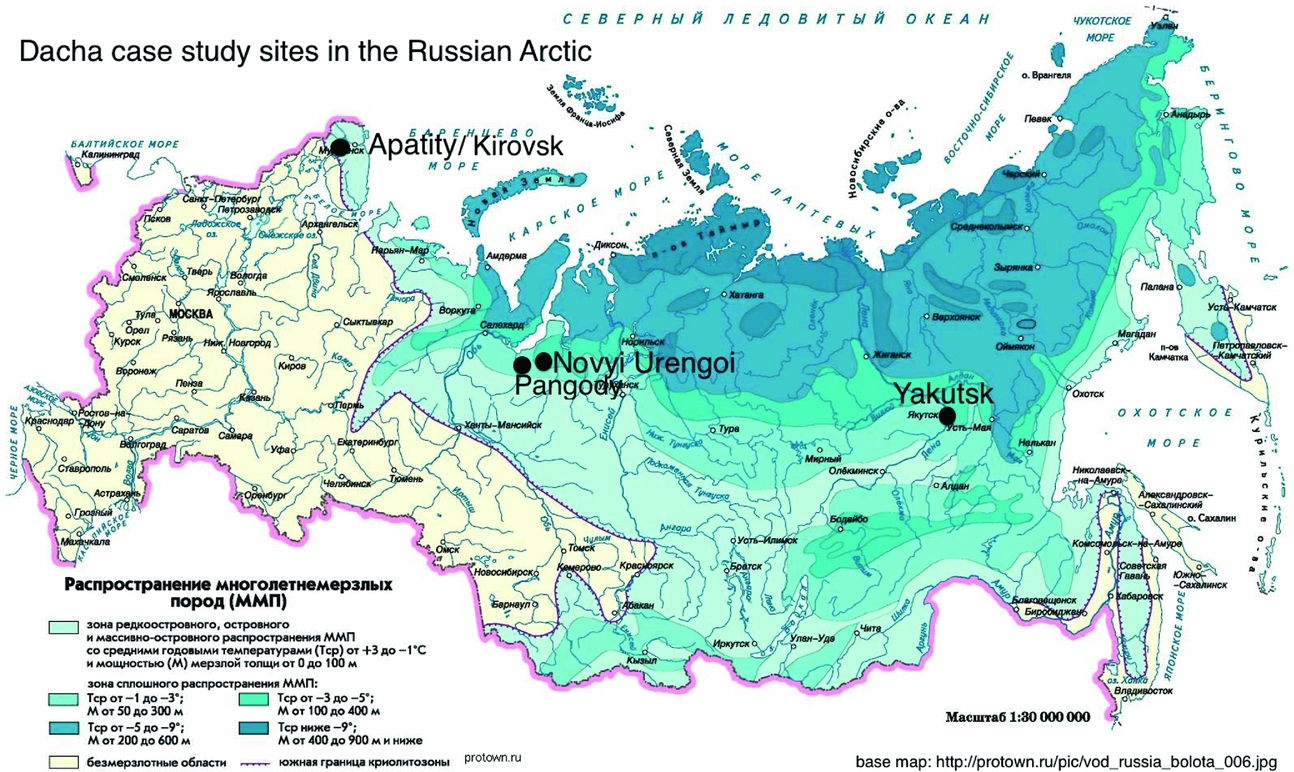
These data were gathered as a side-effort within the afore-mentioned research projects during 2008–2012, and by living in cities in the three case study regions (see Fig. 2). We explore in this article the various roots of the dacha movement in the Russian Arctic, and pay special attention to the ways in which dacha gives room for enacting human relations with the environment in urban northern society in Russia. These relations also reveal dacha-dwellers’ place-specific aspects of identity, in particular when it comes to notions of attachment to place. The latter aspect is worth analysing, as much of the anthropological literature gives the impression that mainly indigenous inhabitants can have such attachment. We provide evidence for the different ways in which non-indigenous northerners enact their relations to place.
Case study sites for Arctic dachas, on the background of a permafrost map.

Dacha – building and dwelling in the north
Dachas in Russia are widespread today although statistics are scattered and hard to standardise. In 2009 out of a population of 142 million, 27 million were dacha owners, horticulturalists and gardeners registered with the Russian Horticulturalists’ Union [soyuz sadovodov Rossii] (ILO 2009: 21). Considering that such dacha owners spend much of their summers on their dacha, this way of life can be considered to some extent a seasonal mobility of large parts of the population not unlike transhumance of livestock owners. We can see this link particularly well among dacha owners in Yakutsk, whose move to their summer houses grew out of the pastoralist past of urbanised Sakha as cattle and horse breeders (Crate Reference Crate2006; Takakura Reference Takakura2002). Different from more recent industrial northern cities, dachas therefore have a longer standing tradition in Yakutsk, to the extent that more than 70% of the urban population there has a dacha, meaning around 210,000 people. This is remarkable as in Yakutia the permafrost area reaches very far south and the temperature change between summer and winter of up to 90° C is more extreme than in any other Russian city.
The word dacha for the Russian summer housing comes from a plot of land that is given (davat’, darit’) by the state. From the time of Peter I onwards, dachas were dwellings with gardens for summer recreation close to a city.
This tradition of the Russian nobility was re-defined by the Soviet state in the 1920s. Dacha settlements were for the Soviet communist party elite (for example obkomovskie dachi in Yakutsk), or summer settlements for intellectuals that became a prestigious attribute of status. A dacha was a place of recreation, leisure and retreat, not least also retreat from the tight control of Soviet power, as Vainshtein emphasises in her writings on the famous intelligentsia dachas at the Nikolina Gora in Moscow (Zhiritskaia Reference Zhiritskaia2008).
When the Soviets started to let cities grow fast from the 1950s onwards, dacha construction became possible also for the broader society including the working class, most of whom had rural roots and where thus used to living close to the land. Some cities in the north, such as Yakutsk or Arkhangelsk saw dacha settlements grow at the same time as happened all over the country. These cities have a century-old local population with deep roots to the land.
The less usual and more recent phenomenon that this article analyses is dacha settlements in Russian Arctic monoindustrial cities. Cities, built between 1930 and 1980, were mostly planned as ‘sleep towns’ or even as temporary settlements for industrial workers. Millions were brought (or induced to move) as a workforce for extracting gigantic mineral resources discovered by soviet geologists (Bolotova Reference Bolotova, Bammé, Getzinger and Wieser2005). After some years of work, people were supposed to return where they came from, to home. This is what they thought and what the Soviet state intended for them (Bolotova and Stammler Reference Bolotova and Stammler2010; Stammler and Khlinovskaya Reference Stammler, Khlinovskaya Rockhill, Sapper, Weichsel and Humrich2011). After the Soviet Union collapsed, it turned out that for many the option of leaving became unreasonable, and temporariness became permanent (Stammler Reference Stammler, Stammler and Eilmsteiner–Saxinger2010; Khlinovskaya-Rockhill Reference Khlinovskaya-Rockhill2010). Due to their short history, we can trace through people's biographies how dacha construction as expression of attachment to the north is gaining importance in people's life.
Both during and after the Soviet Union, decision makers are most interested in economic development and rationality, which figure prominently in both soviet development-planning for northern industrial cities (Bolotova Reference Bolotova2012) as well as in post-soviet northern development scenarios focusing on fly-in/fly-out industrialisation (Eilmsteiner-Saxinger Reference Eilmsteiner-Saxinger2013). In both cases people were human resources, and care had to be taken for them to the extent that they would do their best for work, rather than for their needs as persons.
The transient workers in monoindustrial Arctic cities were supposed to do something completely different in the north than the indigenous population would ever imagine: extracting resources from under the land's surface. For some reindeer herders even sticking a little knife into the ground injured the land, which has spiritual dimensions.
The difference is that while indigenous inhabitants of the north exist there because of their adaptive capacity with their environment, incomers seem to be there in spite of the harsh environment. Their approach to the north is one of maximal footprint on the land, rather than the minimal footprint idea of the indigenous people (Stammler Reference Stammler2011). We get the impression that the more incomers to the north change the landscape, the prouder they are about their achievements, be it the construction of huge cities, factories, infrastructure.
Such processes of changing the landscape are also evident in the dacha settlements at the fringes of northern monoindustrial towns. A ‘maximal footprint’ approach seems to originate from a very agricultural relation of people to the land. Through human intervention, be it through construction or through cultivating a field, the land becomes valuable, acquires meaning, whereas before human intervention the north is portrayed as being empty or void of meaning for many incomers (Bolotova Reference Bolotova, Bammé, Getzinger and Wieser2005; Bolotova and Stammler Reference Bolotova and Stammler2010). Sense of belonging among the northern population with southern origins often evolves through the creation of a place of one's own from an empty space. During fieldwork we heard people guiding us through industrial cities with pride comments such as ‘look, 30 years ago there was nothing but “naked tundra” here, and now we established a vibrant town’ (Yuri Petrovich Kuznetsov, personal communication, 12 February 2010).
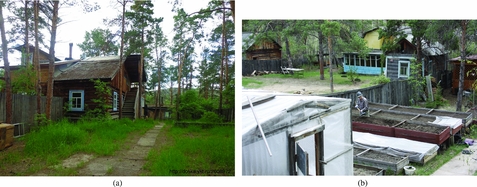
The example of Yakutsk shall be used to illustrate the differences in which dacha express people's relations to the land: whereas most of the urban Sakha (ethnic Yakut) use summer homes for living outside and recovering from the dusty dry hot urban concrete environment, for incomers with roots in the south dacha becomes the arena for intensive transformation through physical work (intensivnoe osvoenie). Sometimes you can tell from two neighbouring dachas those two different social and cultural worlds. In one of them there is a maximum of open space and micro-landscape for recreation. In the other one, you will find plantations for vegetables with narrow paths between the plant-rows (Figs. 3a, 3b). Such a dacha figures in the Nakhshina and Razumova (Reference Nakhshina, Razumova, Bashmakova and Ristolainen2009) article as ideal for cultivation.
A typical Sakha and typical Russian dacha.

At first glance it would be easy to argue that local and indigenous people follow in Ingold's (Reference Ingold2000: chapter 10) terms a dwelling perspective with minimal physical intrusion to natural shapes in the landscape, whereas industrial incomers from the south have a building perspective where a more physical footprint is considered better. However, dacha practices confirm what Bolotova (Reference Bolotova2012: 649) has argued, namely the combination of dwelling and building perspective among urban northerners with roots elsewhere: many of them consider their dacha plot as an arena of osvoenie, of mastering, of adding meaning and value. The practice of adding such value is through building, be it one's dacha home, one's sauna, greenhouses, or plantation. It is material engagement in the environment that changes its outer appearance and makes it human-made. On the other hand, the practice of constructing and changing the shape of a dacha-plot (uchastok) is very much a way of dwelling for the inhabitants. In real life among those incomer-northerners the building and dwelling perspectives are not as opposed as they might seem when reading Ingold (Reference Ingold2000: chapter 10). By working on their houses, on their plantations, by digging the ground for potatoes and other acts of giving their environment added human value, these incomer-inhabitants exercise practices of dwelling in the environment.
Individual and collective agency in dacha practices
A main organising element of socialist city-space (sotsgorod) is a clear division between work and leisure, industry and ‘nature’. The latter acquires within the socialist city-landscape a function as barrier for industrial pollution (Bolotova Reference Bolotova2012: 646, 660). However, in many cases the cities and industrial areas have expanded, and in many places dachas are at the outskirts of town and very close to such industrial zones, be it airports, mineral processing plants, construction material depots or pipeline pumping stations. So while ‘nature’ in the sotsgorod is supposed to function as a unpopulated pollution sink and green belt to protect the city houses from industry, the expansion of dacha places means that now these pollution sinks and green belts are populated. This shows that dachas are part of the city environment and occupy zones that were for various reasons considered unfit for human year round inhabitation.
While many incomers are attached and proud of the city they built and live in (Bolotova and Stammler Reference Bolotova and Stammler2010; Yakutsk Vechernyi [Evening Yakutsk] 15 March 2013: 9.), the urban environment there did not afford them the freedom to enact their own ideas of turning a non-place (barren land) into a place of their own. Whatever physical construction they did in the cities during the Soviet osvoenie, was always part of a bigger project by order of the state or an industrial company, even though many inhabitants identified with such a corporate identity.
With perestroika and the increase of individualism in Russia, it became possible, to some extent even necessary, to not only work in northern industrial cities, but also live and individually engage with the land in the north. Building dachas, creating one's own place and growing food there is one possible way of doing so. This is why many dacha settlements evolved at the outskirts of monoindustrial towns from the grassroots, sometimes even to the surprise of the city authorities.
Although still part of the city-environment and under city-territorial administration, dachas are not subject to the same standardised functional planning of buildings in the industrial city. An important attribute of these places is that they allow people to enact their own individual creative freedom (Bolotova Reference Bolotova2012: 664). This place-creation follows closely Ingold's building perspective (Reference Ingold2000: chapter 10) the idea that man changes the appearance of nature, through building a house, ‘cultivating’ the land around it. In dacha constructions one can see how the Soviet building perspective of mastering nature as a collective on the one hand and individual agricultural building perspective of creating one's own place on the other, meet at the outskirts of industrial zones. However, individual agency is closely regulated even on dacha spaces, which are much part of the city, as we shall show below.
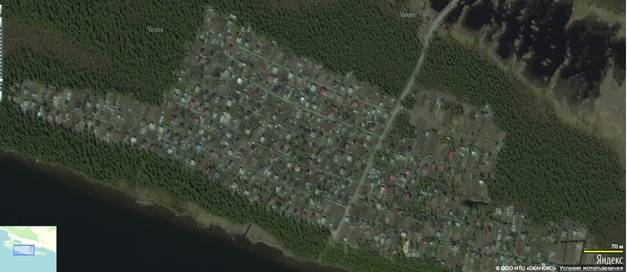
Alongside the deeply individual process of creating one's individual place, dacha creation is also a fundamentally social process in Russia. Evidence for this may be found in the very social logic of land allocation by city administrations for dachas: a larger territory for dacha settlements is earmarked as a whole, and then separated into individual plots of the same size, typically 6–10 ‘sotok’ (600–1000 m2). This means that the dacha neighbours live in very close vicinity to each other, the houses usually not more than 30 m apart, and the plots bordering one another with no barren land between them (Fig. 4). The city authorities transfer the administration of the plots to cooperatives of plot holders (dachnyi kooperatif), associations that are responsible for the order, common infrastructure, utilities and their fees, peace, conflict resolution and all other issues on the dacha area that are common for all plot holders.
Tik-Guba, Apatity.

In late Soviet times the trade unions were responsible for the allocation of land plots for dachas. Good locations were given to privileged groups. The trade union committees acted as extension arms of the Soviet administration, which meant that the steering groups of dacha cooperatives resembled in personnel those of committees within industrial enterprises. Correspondingly, the names of many of the early cooperatives revealed what kind of people were its members, such as ‘stroitel’ (meaning members of a construction enterprise), ‘gazovik’ (Novyi Urengoi: members of gas extraction company), ‘avtomobilist’ (Apatity: members of transport company), ‘vodokanal’ (Kirovsk: members of wastewater company). With the development of a real estate market and land having become a commodity, the membership in dacha cooperatives has become more diverse, and the names would not tell much about the background of their members, such as ‘Letnye Yurty’ (Novyi Urengoi), or ‘Severnoe Sianie (Kirovsk, northern lights).
While during Stalin's times members had to leave the dacha cooperative when they left their job, later they could hold on to their dacha regardless of their employment, and forms of social life in these cooperatives are not as predefined as they were before. In some cases, such as in Novyi Urengoi, cooperatives self-organised even before the city authorities officially earmarked the exact area for the dacha settlement. It seems that this way of organising dacha space corresponds to the deeply social idea of a group of Russian people relating to the land. Living close by your neighbour is not thought to be a problem, unless you are enemies. In fact, since dacha people actually spend a lot of time outdoors, often there is more communication with their dacha garden neighbours than with their neighbours in their apartment blocks in the cities. We want to emphasise this deeply social aspect of dacha livelihood, as this aspect is so far underrepresented in the otherwise so richly argued publication on northern dachas by Nakshina and Razumova (Reference Nakhshina, Razumova, Bashmakova and Ristolainen2009).
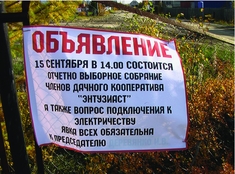
As the photo shows, some cooperatives have a rather strict leadership style (Fig. 5), maybe inspired by Soviet trade union committee and Komsomol (youth organisation) practices, while others are more loose in style.
Strict leadership style in a dacha cooperative in Novyi Urengoi. The text reads: Announcement: 15 September at 14:00 is the reporting and electing meeting of the members of the ‘enthusiast’ dacha cooperative. Also the question of connecting to the electricity grid [will be discussed]. Presence of all is mandatory, report to the chairman.

While dacha people may ‘escape’ from the city to enact their individual creativity the landscape, they run from one standardised collective (the industrial city, the work environment) to another collective, where they practice social control by having to make compromises in their freedom for the benefit of their (dacha) collective. The difference may be that in the industrial city, decisions about the creation of place are not made by the residents themselves, whereas in dacha settlements the members have more decision making power over how their assigned plot can look. Rather than seeing dachas as mostly an expression of people's individuality and the individual adaptation of southern migrants (Nakhshina and Razumova Reference Nakhshina, Razumova, Bashmakova and Ristolainen2009), we take their argument further by finding a combined expression between the individual and the social dimension in the Russian northern dacha places, which also combine the idea of the city with elements of ‘nature’. It is this collectivity that is the main difference of the dacha from the idea of, for example, the Finnish summer cottage (Fig. 6).
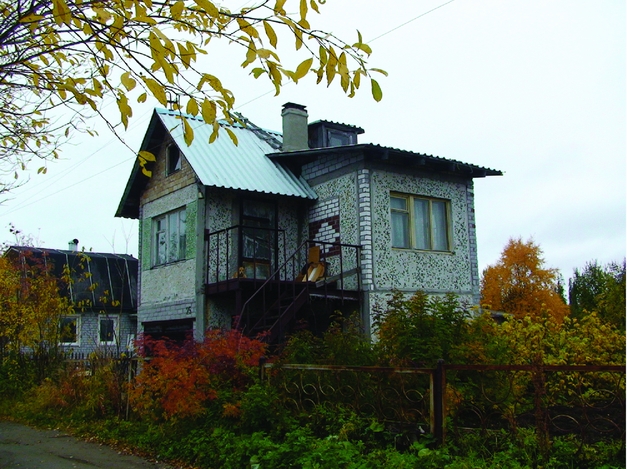
Dacha built of concrete blocks in Tik-Guba, Apatity.

Cityscape and ‘wild nature’ in people's summer home narratives
Although Bolotova (Reference Bolotova2012: 662) also considers industrial people's activities further away from the city, she conceives both the activities in remote forests and suburban dachas as practices in nature outside the city. Indeed, Arctic industrial city dwellers often define ‘nature’ as space outside town, not regulated by the standardised Soviet city planning. In light of the tight organisation of dacha collectives we would slightly rectify this statement, as dacha is so much part of the city-environment and human-made, engineered surroundings.
As such this is very different from people's cabins in the forest. This is why Bolotova distinguishes different ‘natures’ paraphrasing Macnaghten and Urry (Reference Macnaghten and Urry1998). For example, 81 year old Valentin Ivanov in Nadym (west Siberia) has a very different approach to the environment from the dacha people. He talked with pride about his remote cabin in the forest that is far away from any other man-made structure, where he fishes and picks the gifts of nature with his wife. ‘I take the gun with me only because of the bear. He is the master of the taiga, but for scaring away this is needed.’ (Valentin Ivanov, personal communication, 1 April 2008). An important characteristic of this place for him is its distance, very much unlike a dacha locality with all the close neighbour relations. He would not call his forest cabin 100 km away from Nadym a dacha. Ivanov intimately knows that forest place and his narratives of being there convey a mix of adventure and meditation.
The difference between these two recreational places, city-scape and ‘wild’ nature becomes evident when comparing Ivanov's narrative to that of the dacha-dweller who perceived the forest surrounding his dacha as an extension of his living room where he walks wearing his slippers. In an extended forest-living room you would neither have the idea of respecting other masters, such as the bear, nor take a gun along for your own safety. On the other hand, Ivanov's idea is also different from an indigenous perception in which the taiga would be home, and people would move in the environment for hunting and herding rather than recreational fishing and picking. We suggest a clear distinction between dacha places of industrial workers close to their cities and remote forest destinations of the fewer experts, fishers and pickers, and leisure time hunters. In other words: forest cabins are no dachas, because they lack the cooperative social component. Other than in dacha places, with forest cabins we can also hardly find a ‘building perspective’. Ivanov was clear about leaving as little footprint as possible with his cabin in the otherwise unchanged environment.
Forms and orientation of dachas in the Russian north
This section illustrates the diverse practices that have always been part of dacha life in different combinations. Nakshina and Razumova (Reference Nakhshina, Razumova, Bashmakova and Ristolainen2009) introduce as motivations for establishing dachas in the Murmansk region economic and recreational reasons. In many cases dachas are places for recreation, as well as garden plots for subsistence. Another important component is seasonal mobility of the population (see above). In the most recent cases in Russia an additional component of permanent habitation changes significantly the meaning of dacha, which then loses its character as a refuge from industrial city life, the notion of peace of mind and recovery.
The garden plot subsistence dacha
The classical form of dacha in Soviet Russia that was imported to the north is first and foremost a garden plot, in which the individual or family is free to cultivate and grow as much as their own skills and the climate allow. Moreover, they enjoy the freedom to build a house on that plot that can be anything from an extended shed for gardening tools to a full-fledged summer house that could possibly even developed for year-round inhabitation (see end of article). Just as in the industrial city, and very different from indigenous northerners’ life, in the northern dachas everything is imported from the south, from construction materials, tools, equipment and greenhouse materials to seeds and sometimes even soil. By using this imported material, these people create their own imported microcosm on the northern permafrost, as they may have it in their own imagination that is influenced by their past experience from their places of origin. Many dacha people become very ambitious in creating these mirror images of the south in what they first perceive as a harsh northern frontier (see Nakhshina and Razumova Reference Nakhshina, Razumova, Bashmakova and Ristolainen2009: Figs. 3–5).
Murmansk Oblast is a northern region with a very strong dacha movement in which the garden plot dacha is a dominant category. In spite of its northern latitude, the region has a relatively mild climate and no permafrost, which makes growing plants less problematic. Moreover, the Murmansk region has been, with its post-Soviet outmigration and industrial decline, in an economically more difficult situation in comparison to west Siberia (Nuykina Reference Nuykina2011) or Yakutia. This made growing one's own food an economic necessity for many, given the low salaries and pensions in the region. There is numerical evidence for this from Heleniak's (Reference Heleniak2010) comparative research, which shows the far northwest and the far northeast as regions with most economic decline, outmigration and negative demographic tendencies. For people in Murmansk region, this development made it not only possible but in some cases necessary to work on the land in order to get fresh vegetables and fruits. It is this aspect that is prominent in Nakshina's and Razumova's (Reference Nakhshina, Razumova, Bashmakova and Ristolainen2009) explanation for the evolution of what they call ‘dacha culture’. The garden plot dachas in Murmansk Oblast are more elaborate than in Yamal-Nenets Okrug, where most people are more affluent and growing conditions on the permafrost are harsher. The early history of immigration into the Murmansk north shows that many incomers came from a rural agricultural background (Bolotova and Stammler Reference Bolotova and Stammler2010). Not only were they not used to an urban life (Nakshina and Razumova Reference Nakhshina, Razumova, Bashmakova and Ristolainen2009: 418) amidst grey concrete blocks, they were also familiar with working the land. According to Salimova (Reference Salimova2011: 8), in the early 1930s 91% of the forced relocatees to Kirovsk were peasants. Their expertise was used to establish a sovkhoz, a Soviet state farm on the shore of Lake Imandra, to feed the industrial workers of Kirovsk. That sovkhoz ‘industria’ is considered the cradle of Apatity village, which later in the 1960s would become a mineral resource extraction town which soon outgrew Kirovsk.
However, this organised Soviet agricultural activity to feed industry workers of monoindustrial cities in the north is very different from dacha subsistence plots, which were not foreseen in the development plans for industrial cities (Bolotova Reference Bolotova2012).
The main economic rationale for the evolution of dachas in the Arctic was the idea of additional food supply in times of defitsit, lack of supply. Towards the end of the Soviet period, more and more food items were in defitsit. Moreover, dacha people emphasised the notion of freshness beyond economic considerations. Fresh vegetables from one's own garden were the only possibility to get access to fresh plant-based food, as imported food from the south would not be fresh by the time it arrived in the shops. In this respect the importance of one's dacha plot is much more than economical, as freshness is not something that money can buy. Fresh local food is also known to be a source of place-based identification of people, as Weiss (Reference Weiss2011) has shown well beyond the Arctic in rural USA. In the Russian north, local fresh dacha food is a source of great pride.
As the example quoted above from Yakutsk illustrates, the notion of dacha used as a place to intensively work (intensivnoe osvoenie) and open up the land can be interpreted as non-indigenous incomers enacting their relations to the environment, as Nakhshina and Razumova (Reference Nakhshina, Razumova, Bashmakova and Ristolainen2009) and Bolotova (Reference Bolotova2012) show. In addition to that, since these dacha owners are all Soviet industrial migrants to the Arctic or their descendants, there is an obvious parallel in the approach to dacha osvoenie with the official Soviet idea of osvoenie that meant the conquest of nature, adding meaning and usefulness to otherwise empty and senseless space.
It was not until the 1980s and perestroika, that northern industrial settlers started seeing dachas as places attaching them to their northern places of residence, rather than to their southern places of origin. The possibility to establish one's own place outside of the city was like a return back to the earth for people with roots in the arable south, after a long break living in concrete housing blocks. It was the return to a situation in which owners could enact their agricultural engagement with the land that had been identity-forming for many of their ancestors.
The comparably soft climate and absence of permafrost soils definitely makes cultivation easier than in Siberia, as well as construction. Engaging with the northern land on an individual basis through building dachas and growing food there became a realistic alternative to leaving the north to some dacha in the south every year.
On the other hand, the example of Yakutsk shows that garden-plot dachas are also possible and popular on permafrost. While dachas have a long history in Yakutsk for the intelligentsia and the party elites (see above), it was in the 1960s and 1970s that Yakutsk became an administrative centre for diamond and gold mining. Incoming workers established dachas as garden plots. With the short but hot and humid summer, cultivating fruits and vegetables became widespread. Water melons, honey melons, and other non-northern plants successfully grown on those dachas are a source of particular pride. Yakutsk suffered from economic decline too, albeit less than the Murmansk region. Shortage and lack of money to buy food even when it was for sale made people in both places focus more on growing their food on their dachas. This is also because of the widespread collapse of Russian agriculture that made the north entirely dependent on imported food or subsistence production. As a result, pastures and agricultural land was abandoned. In Yakutsk some of that land is now occupied by dacha plots (Budaev Reference Budaev2013).
In both Murmansk and Yakutsk one might think that the importance of garden plot dachas would decrease as people become more affluent and the supply system for imported food is stable. However, while several informants have mentioned that their children and grandchildren are no longer motivated to help on the dacha plot, the reputation of local food has become much stronger, reflecting a worldwide trend well summarised by Holt and Amilien (Reference Holt and Amilien2007). This is why even north of the Arctic Circle there is a continued demand for people working the land above the permafrost and apparently many of those who do not have their own dacha plots are happy to pay a higher price for food produced by local farms.
Recreational dachas
In northwest Siberia's gas cities, the idea of dacha places and individual’naya zastroika, territories covered by individual construction, was still somewhat alien and unsuitable for the harsh climate when our fieldwork started among the city dwellers in 2007. The idea of dachas was inspired by the Soviet idea of garden subsistence plots in central Russia. Recreational dachas even pre-dated the Soviet Union and were then taken on by intelligentsia and party elites in the north early on, for example in Yakutsk. Arctic industrial cities, however, were seen as places to work, not to live, which is why there was no dacha construction planned there.
After the Soviet Union and the post-perestroika crisis, some people have become rather affluent and can afford to keep a dacha just for a change from city-life. The physical need to grow one's own food decreased and fresh food became available even in markets in the north. Now more people keep a dacha exclusively for spending their free time without growing anything on the plot. Such dachas are appreciated as a change from the standardised apartment block to one's self-built, or self-planned house. Most such dachas will have a sauna (Fig. 1). From short interviews and living on dacha places and individual houses in Novyi Urengoy, Nadym and Pangody, it seems that people would not sacrifice their yearly summer holiday somewhere ‘on the land’ (na zemle) in the south just because they would care for their dacha plants on the permafrost. In people's narratives there the idea of living in the here and now has become much more prominent: ‘We don't want to eat out of cans and sit on cardboard boxes anymore, just to save our life for the future. We want to live here now in the north as well as maybe on the land (na zemle) later.’ (Galina Konechnaia, personal communication, 27 March 2008). Recreational dachas in industrial cities can therefore be understood as a sign of incomers having arrived at an understanding of the north as their place of life to which they feel attached. However, as Khlinovskaya Rockhill (Reference Khlinovskaya-Rockhill2010) and Stammler (Reference Stammler, Stammler and Eilmsteiner–Saxinger2010) showed, this does not mean that people necessarily plan to live their entire life there. In the emerging dacha movement of Arctic industrial cities, a dacha is therefore also seen as an investment that can bring good returns in case the owners decide to sell it and return to their places of origin.
Novyi Urengoy shall serve as an example of this movement. The city was planned as a monoindustrial gas town, initially consisting of temporary living containers (bochki) and wooden barracks in the late 1970s, and later of Soviet style concrete blocks for Gazprom workers and their support industry. Individual houses and dachas were not part of the city plan, not even after the Soviet Union, as Novyi Urengoy's then chief architect Alla Lyaskovskaya confirmed. The first dachas were built towards the end of the 1990s after planned apartment blocks were not constructed. Then people lobbied for permission to build individual houses in the growing city in order to have somewhere to live. But all they could get was land allocated for recreational purposes.
Yuri Plotnikov was among the pioneers of the recreational dacha movement there, the first one who built a dacha house with all amenities such as water, electricity, heating. He proudly states: ‘When I came up with the idea to build myself a house outside of town, people in the city administration looked down at me and said I was crazy. But then all sorts of people wanted to do the same’ (Yuri Plotnikov, personal communication 23 September 2007). When Plotnikov sold his dacha because of his move to Moscow in 2009, he got 10 times the US dollars price that he had invested in the early 2000s. By then dacha and individual housing had become a big movement. More and more space was appropriated for dachas between the urban living zone and industrial zones of Novyi Urengoi. The purpose of these dachas was mainly recreational.
You have to give people the possibility of spending their leisure time actively. My husband is totally into that on our dacha. He is a real master and loves doing everything himself. [. . .] Look, in the city we have here everything in monochrome (Alla Lyaskovskaya, personal communication 28 September 2007)
The first [the dachas] were only containers, where people would go for barbeque. Then the first flower beds appeared, then some greenhouses, and people built themselves saunas. And then later also suburban cottages, and some even real concrete houses. Now not only those with the big money build, but also in ‘economy class’ – everybody according to his wallet (Vladimir Nuykin, personal communication, 19 May 2013).
These processes led Novyi Urengoi with a population of 115,000 to have approximately 10,000 dacha plots, of which as of 2013, 40 % have proper houses on them, while another 20% are just allocated but still untouched, and the remainder is used as plots without buildings.
However, this number does not seem to include another form of recreational territory in the monoindustrial city, namely garage cooperatives. These are organised similarly to dacha cooperatives, and the male recreational activities on both are similar: people meet there for barbecue. The garages are many men's pride with elaborate workshops where they meet and repair all kinds of equipment, such as cars, engines, boats, snowmobiles and the like. Others specialise in their garages on building and constructing, for example furniture, and a few even use their garage as arts and handicrafts ateliers. One such case is Viktor Seliverstov from Novyi Urengoy. The former Gazprom driller from Tatarstan came in 1978 to the north, at the very start of west Siberian gas development. He had found a lot of mammoth tusks during his travels on the gas fields, and started carving figures out of them. He took that so seriously that he got deeply involved in northern indigenous symbolism, cosmology and handicraft and developed skills to the extent that his mammoth creations are nowadays in high demand by Gazprom leadership, who give them as presents to VIP guests. Seliverstov did all this in his garage, where he regularly assembles the creative intelligentsia for intellectual and philosophical discussions.
Seliverstov exemplifies how people combine creativity with recreation in their life in monoindustrial cities. be it through construction of a dacha house or carving artworks in their garage workshops.
It seems likely that the number of dachas and recreational garage cooperatives must be well above 10,000 in a place like Novyi Urengoy. This is the recreational aspect, be it in a garage or a dacha, that prevails in places such as Novyi Urengoi, Nadym and Pangody more than for example in Murmansk and Yakutsk. On the west Siberian permafrost, not only is the average material affluence of people higher; but the conditions for growing plants are also harsher. However, during fieldwork some people were also planting potatoes on their dacha plots in Novyi Urengoi, on soil that was shipped 1000s of kilometres ‘s zemlei’ to the north, because no potato would grow on the sandy ground on the permafrost in that area.
In more cases, however, the whole dimension of a dacha as partial subsistence supply is missing in northwest Siberia. There, the intimate physical engagement of people with the land is mostly through picking mushrooms and berries. Some may embark on hunting or fishing trips from their garages or dachas. In this respect a dacha without a garden plot, the gathering of male friends in somebody's garage at the outskirts of town or in forest cabins all have a similar recreational aspect.
Gender, mobility and place in dacha orientations
One might argue that this recreational aspect of dacha life is highly gender-specific; typical ways of men spending their time off work are sitting together outdoors, drinking beer or stronger alcoholic beverages, telling stories about one's fishing and hunting adventures, going together to sauna, frying meat and sausages, and collective relaxing of the hectic work and city life [otvesti dushu]. We would argue that this is a stereotype with the famous kernel of truth. Surely joint drinking and sauna are more associated with men than women in public opinion, but much of the fieldwork indicates that women are also often vitally included in the recreational aspects of dacha as a way of life, as well as men are part of dacha as a subsistence activity. After all, it is mostly men in the north who are involved in ordering and bringing the soil from the south that is needed to grow potatoes and other plants on the permafrost. That soil has to be unloaded from trucks, distributed on the dacha plot, prepared for the growing season, the potatoes have to be regularly dug over, and many other activities.
The main difference between a dacha with garden plot and one for leisure time is the extent to which the former ‘binds’ their owners physically to the place in the growing season. People who are serious about cultivating something on their dacha cannot really afford to leave for extended holidays, as their compatriots with pure leisure-time dachas may do. The garden requires care during three seasons of the year at least: spring, summer and autumn. Absences of several months that are typical for northern labour migrants become much more difficult to organise with such a dacha-commitment in the north. This means that such people will spend less time in the south at their places of origin. As a result of their practical engagement with the northern land and their gradual ‘alienation’ from a distant south, their attachment to the north increases. This may seem a rather abstract conclusion, and we agree with Khlinovskaya Rockhill (Reference Khlinovskaya-Rockhill2010) that real life is not organised into those dichotomies that we create in our minds. Northerners do not forget their belonging to their places of origin either, nor do only those without northern dachas visit the south. But indeed several informants in our project emphasised that mostly those with a strong relation to the northern place bother to have a garden plot dacha. The evolving of dacha places is therefore both a sign of increased belonging to the north among inhabitants, as well as of uninterrupted presence there. Dacha places as garden plots are therefore more difficult to combine with the transient livelihoods that were thought to be typical for industrial workers, who would spend all their summers ‘at home’ in the south, or work on a fly in/fly out working plan. Recreational dachas are therefore better suited for a way of life that involves multiple geographic localities throughout the year.
In this respect large parts of the Russian population are migratory, between their urban life in autumn, winter and spring, and their dacha life in summer. The dacha as home for the entire summer enables people to move back to the earth regularly. This move which is a way for the urban population to preserve their rural roots, since urbanisation is a rather recent tendency in Russia. While in the 1930s there were hardly any significant cities in the Russian north, 80 years later more than 80% of the population lives in cities in most of the northern regions, namely 92% in Murmansk Oblast and 83% in the Yamal-Nenets Autonomous Okrug. In Russia altogether, 74% of the population lived in cities in 2010 (Russia Population Census 2010). This is the background on which the dacha movement caught up in Russia.
From dacha to year-round suburban villages
The notion of the dacha as summer home adds a dimension of mobility and seasonality to life in the northern industrial city. Many incomers have dachas at their places of origin. The popularity of dacha settlements in Murmansk Oblast and west Siberia as well as Yakutsk with its longer dacha history testifies this, where many people stay for their entire summer on their dacha. The dacha as summer home is particularly important in the north among all those who do not have expressed attachments to other places outside of the region. Paradoxically, most of the northerners who keep connections to the places of origin in the south do so through spending the summer holidays there in the south, although it would seem to make much more sense to leave the north for the winter. Thus, we have seen so far that dacha places by definition are seasonally limited to the warmer times of the year. The whole point of having a dacha in the north was to have an alternative place to move to when people want to be closer to the earth and have more creative freedom in place-making than they could ever have in an Arctic socialist city with strict efficiency planning and zoning.
In our three case sites of Kirovsk-Apatity (Murmansk Region), Novyi Urengoy (Yamal) and Yakutsk (Sakha Yakutia) we can see, however, how this clear cut understanding of dacha versus city life is gradually being blurred.
The dacha as a place for summer recreation gradually gets redefined as a place for year-round inhabitation, enacting one's freedom in individual houses closer to the land, rather than apartment blocks. In expanding cities like Novyi Urengoi, Surgut and Yakutsk, dacha settlements where people used to spend time only in summer, gradually turn into suburban areas with individual houses for the affluent for year-round permanent inhabitation.
Maybe the time has come to depart from the idea of housing only in apartment blocks in our city. People want to live on their own now. It's good the administration is considering to give plots out on the field for individual construction now (Ivan Avramenko, personal communication, 17 June 2013).
There is a technological, demographic-economic and social aspect of such developments: firstly, new construction technologies, autonomous heating, septic tanks and heat insulation have made it possible for house owners to establish permanent year-round housing on their dacha places. Secondly, the high immigration into expanding Arctic cities because of extractive industries has led to rising real estate prices on a now free market in these towns where previously all housing was owned by the state or the single industrial company in town. These institutions stopped building new apartment blocks, and house construction became a commodity. In this situation building a permanent house also for winter (zimnii variant) on a dacha plot becomes a possibility for people to solve their housing problem or improve their housing conditions. This is a widespread tendency in regions such as Sergelyakh in Yakutsk, Chernorechenski in Surgut or Severyanin in Novyi Urengoy, with prices easily reaching between 1000 and 3000 EUR/m2. Thirdly, individual freedom has become more important in northern cities. People are not ready to sacrifice and postpone their pursuit of a comfortable life to a future in the south. The experience of perestroika has shown them that they can never be sure if that will ever come. This social change underlies the tendency of dachas becoming permanent homes; people want to live in the North in their houses here and now, and not only during the short summer.
I did not succeed to look around, and I’m 50 years already. I came here with 25. So what, would I live my life in some next life? Maybe not! That's why I think dachas – this is concretely the way forward in Novyi Urengoi. One has to live today in good conditions and allow people in this way to realise some of their wishes for recreation. We have now the means to create this (Alla Lyaskovskaya, personal communication, 28 September 2008).
This is interesting as she had the post of lead city-planning architect in Novyi Urengoy in the early 2000s and thus witnessed herself the change of the approach to life in the Arctic city. As much as she advocated on a professional level centralised housing-planning, as much she was privately beautifully describing how important it is for her and her neighbours to be close to the land on their dachas.
This apparent contradiction comes from the substantial difference it makes for the organisation of city space when individual year-round housing is encouraged and when it is not. In both Novyi Urengoi and Yakutsk this is exemplified by the presence or absence of a formal address. A formal address starts with a transfer of the legal category of the land from a ‘recreational zone’, which is what dacha cooperative territories are legally, into a part of the ‘housing zone’ of the city. A city official from Novyi Urengoy explains that the status of the land will not change even though more individuals build their houses according to the zimnyi variant for year round use. The reason is that this would entail ‘certain obligations’ by the municipality. These are for example access to municipal electricity, rubbish collection, street maintenance, public transport, postal and internet services, schools, healthcare police stations and all other aspects of municipal services. While in Yakutsk entire neighbourhoods of dachas are being transformed into regular suburbs with all services, In some municipalities such as Novyi Urengoi there is resistance to these obligations:
You can't turn this city into this settlement pattern about which we talk – go back to the land. In principle, how can one live and extract gas, when I have to think where I find firewood for heating my autonomous device? Let the dear gentleman reply to this question.[. . .] You have to create a structure which would supply the citizens. Otherwise, how will he do it? Feed wood to an oven? We don't have forest here [in the tundra] (Alla Lyaskovskaya, personal communication, 28 September 2007)
This means that such individual permanent houses will not have official postcodes nor streetnames and numbers ‘although within the dacha cooperatives for people's comfort and orientation they give names for the driveways’ (Vladimir Nuykin, personal communication,19 May 2013).
Much but not all individual year round housing in northern industrial cities is constructed on dacha territories. This transforms the character of dacha places gradually into a more urban atmosphere. These tendencies from the regions not only in the Arctic but all over Russia have now made their way up to the Federal Russian political discussion: the government and parliament are in favour of adopting a law allowing people officially to register on their dacha places as permanent residents. It remains unclear as of 2014 if such new permanent residents then have to pay regular housing tax for their dacha-houses and plots, as these developments are new and this tax would be under regional or municipal control. Premier Medvedev admitted that this would legalise an already established de facto year round inhabitation on dacha plots by many people (RIA Novosti (Moscow) 5 August 2013).
This process is seen by some long-time dacha inhabitants as the disappearance of dachas (dachi izcheznut). On the other hand, one can say that the spirit of dacha places expands to a year-round quality of life, with the recreational aspects, the individual freedom in place creation, and the being close to the land included. So the urban built environment gradually acquires more rural traits. One significant consequence of this development is that seasonality and the rhythm of moving between city and dacha places on the outskirts gets lost as the borders between the two become blurred. This is exactly the opposite of what happens in many villages in the Russian Arctic, and also the Finnish North, which turn gradually from permanent villages into summer settlements as services and social infrastructure close down. Nakhshina (Reference Nakhshina, Anderson, Wishart and Vaté2013) describes this process in her ethnography of encounters between seasonal and permanent dwellers of Kuzomen’, a village in Murmansk region.
We argue here that both these tendencies are interconnected: the more people leave villages to live in cities, the more permanent houses will be built in those cities on previously unbuilt territory. Analysing a recent article on the future planning of Yakutsk, it became very clear how the city will become more rural-looking within its urban zone, as it will be surrounded by a number of suburbs with individual houses that will form with the city centre together the ‘Mini-Moscow’, as the authors call it (Yakutsk Vechernyi [Evening Yakutsk] 15 March 2013: 301 9.). A team of Yakutsk-based regional researchers envisages that by 2032 the city population will live just outside the centre ‘in well-equipped low-rise houses on their own plots with not less than 1000m2, garages for 2 cars and the necessary high quality social infrastructure in the vicinity [. . .] and a journey to work of not more than 30 minutes’ (Yakutsk Vechernyi [Evening Yakutsk] 15 March 2013: 301 9.). According to that plan, the territories for such future suburbs will be those currently allocated for dacha plots.
This shows that the move from the seasonality of dacha places to the permanence of suburban settlements in the Russian Arctic is a bottom-up movement that has arisen from the individual practices of dacha-creators described in Nakhshina and Razumova's (Reference Nakhshina, Razumova, Bashmakova and Ristolainen2009) article. This movement has now arrived in the halls of power of municipal administrations that have to deal with such new realities and the increased municipal obligations related to them. The former Novyi Urengoy chief architect described this dilemma:
Originally, historically the individual house exemplifies the Russian person. What was bad in this [Soviet] period? In our life here in these modern cities there was no such concept of one's own house, but it is now back, coming back at this very time. But it would be wrong now, in the setting of Novyi Urengoi, to allow the development of individual construction. It would be a mistake, because the city was originally not designed for that. Yes, the question of individual construction was put to me as the chief architect very seriously. They simply put pressure on me. [Allowing] it is a compromise (Alla Lyaskovskaya, personal communication) 28 September 2007)
Based on statements like this, we argue that the northern population had realised that they cannot hope for some all-caring state to increase their living standard in Arctic cities. Instead they took their own initiative and created faits accomplis. Officials could not ignore this movement towards the land anymore and had to take individual year-round house planning based on dacha places into consideration.
Life beyond industrial work in the north
What unites all types of dachas and the permanent houses on dacha plots and garage cooperatives is that these places are created by people wanting to spend their private life and their free time in the north. This is an extension of the original idea of northern industrial city-development, in which people were induced to move exclusively for working. Our informants express clearly this tendency towards more of a ‘life’ dimension of their northern existence. Gone are the early days of northern industrial city development, in which many said they did not bother to furnish their apartments properly, have proper dishes, eat out of cans, and saved everything for the future. This Soviet approach of being temporarily in the Arctic, described by Khlinovskaya Rockhill (Reference Khlinovskaya-Rockhill2010) turns Yurchak's famous book title ‘Everything was forever, until it was no more’ (2005), upside down into ‘Everything was temporary, until it became forever’. The discovery of the north by incomers and their descendants not only as a place of work but a place of life necessarily changes the intensity of residents’ relations to their built, natural and social environment. The evolution of dachas and of individual permanent housing is a logical consequence of this development.
We have shown that the typical dacha with a garden plot and a summer house has a clearly seasonal character, and with few exceptions people do not spend much time there in winter. However, as their presence in the north becomes less seasonal and their involvement with the northern land more intensive, signs of permanent living on dacha places increase. In such cases the former dacha transforms to a hybrid of summer place close to the natural environment and permanent housing close to the city.
It is in this microcosm of their own plots where northerners with southern origin can enact their intensive individual engagement with the land using their creative and productive potential in free decision making. We agree with Nakhshina and Razumova (Reference Nakhshina, Razumova, Bashmakova and Ristolainen2009) that dachas reflect the individual freedom and creativity of the plot owners. This freedom is crucial as a counterbalance to their work in the north that has always been a part of a larger development project for a country-wide community. It is, alongside the physical engagement with the land, a crucial factor characterising the particular human-environment relation that dacha people have. Dacha owners create on their plots material expressions of their own individual character and biography. In the life histories recorded during fieldwork in 2007–2010 we see how lifelines connect southern places of origin and northern places that have become home. They become intertwined in the dacha places that combine a more southern agricultural logic with garden plots, plants, vegetables, and a northern approach to nature in which berry picking, hunting, and fishing as recreational and subsistence activity are very important.
We can interpret on the dacha plots these intertwined lines through the construction materials used, an aspect also covered in the publication by Nakhshina and Razumova (Reference Nakhshina, Razumova, Bashmakova and Ristolainen2009). Somebody who works, for example, in a concrete factory, or has friends who do so, is more likely to use various leftovers or otherwise acquired items, of that kind of production on their dachas, although usually dachas would be built of wood in a countryside village style (Fig. 6). Some dacha plots are very elaborate, in perfect order, decorated with love for every detail, whereas others focus more on the functionality, take the growing of food very seriously, as they or their relatives may have done in their places of origin in the south. Or they may just use the dacha plot for planting flowers, and as a base to gather, hunt and fish in the northern landscape surrounding the dachas, in cases where industrial expansion has left space for such practices. This individual freedom of creating a place of one's own preference is something that people cannot enjoy in their city. There they live in apartment blocks planned and built by somebody else following a collective ideology with the goal of efficient organisation of work and life.
This combination of one's southern mirror image of home and components stemming from one's northern life and work lets the dacha appear almost as a physical necessity: how else could people express this other dimension of homeness and placehood that goes beyond living for the sake of working in an industrial city until reaching the age of retirement? Therefore, dacha can become, but not always is, a sign of increased attachment of one's northern place of life, which was not originally thought for long-term inhabitation by incomers. But different from the indigenous hunter or gatherer, the attachment here is not to the natural environment with minimal footprint, but to one's self-created place that combines elements of one's southern origin, the northern place of work, and the local climate. In most cases the relationship of people to their dacha places is reciprocal. It complements the idea of the ‘giving environment’ that we know from hunter-gatherer societies (Bird-David Reference Bird-David1990), in which a sentient environment offers its resources to the hunter who shows respect and his knowledge of the places through appropriate behaviour (Anderson Reference Anderson2000).
Among northern industrial city inhabitants, the self-created dacha place rewards its master's hard work with giving back the fruits of the land, even though maybe on soil especially imported from the south and put in a layer on top of the permafrost. The environment is thus self-created. In this respect we cannot necessarily speak of settlers getting closer to natives as is suggested for Chukotka in the work of Thompson (Reference Thompson2008).
Conclusion
This article has described the development of dachas in Arctic Russian industrial cities. We took the anthropological study of Arctic dacha places a step further from a single region case study as was done previously (Nakshina and Razumova Reference Nakhshina, Razumova, Bashmakova and Ristolainen2009; Nakshina Reference Nakhshina, Anderson, Wishart and Vaté2013; Bolotova Reference Bolotova2012) to a comparative approach. We acknowledge the diversity and uniqueness of our three field sites and therefore state ahead of our general conclusions that those must not be taken as generalisations and final words, but rather as invitation for further research in this little studied field.
The analysis of dacha situations in Arctic cities in three regions (Apatity-Kirovsk, Novyi Urengoy, Yakutsk) leads us to reach the following four main points: firstly, the Arctic city dacha movement can be seen in path-dependence to the Soviet working class dachas, whereas the pre-Soviet summer recreational house idea re-surfaces gradually after the immediate post-Soviet period. Secondly, in the Arctic dacha movement the expression of individual creativity and intensive social organisation in collectives do not exclude each other. Thirdly, we suggest that Arctic dacha settlements and practices are excellent cases for studying processes of human agency and place creation, which grant us deeper insights in the determinants of people's relation to the land. Fourthly, this human agency on the land helps us to understand how urban communities in Arctic Russia change their spatial practices gradually from state-induced inhabitation of compressed dense high-rise concrete landscapes to village-resembling agglomerations of smaller houses close to the land. As a consequence, the seasonality of dacha practices gradually gives way to a reintroduction of people's quality of life closer to what they call ‘nature’ on a permanent year-round basis.
What do these four main concluding points tell us? Industrial northerners change the approach to their cities: people who invest today in a dacha stop seeing themselves as just working in the north, but gradually also start living there, be it temporarily or permanent. This shows how the Arctic has become a place to lead a normal life for immigrants and their descendants, with characteristics of a normal urban population elsewhere, albeit with some specifics related to seasons, climate and permafrost.
The increase in development of Arctic dachas as garden plots arose largely out of economic necessities in perestroika but at the same time was a perfect match with a deeply Russian approach to the land, namely through physical agricultural engagement that is focused on refinement of nature, on leaving the human footprint, and on adding value. The increasing popularity of recreational dachas, we argued here, alongside the blurring of borders to permanent individual housing areas in Arctic cities is a sign of the end of the post-Soviet period. We see here the advent of broader trends of mainstream everyday life in the Arctic, with relative affluence and life-trajectories that are not characterised by a love for the extreme (climate, conditions, exceptional social fabrics), but for the normal.
We have further analysed the dacha as a visual arena for the interplay between economic and social needs of northerners in the Russian Arctic. More than just enabling additional food production in difficult times, the dacha is a playground for balancing the freedom of individual creation of place with the deeply social desire to share experiences with neighbours. Dachas are like books wherein we can read and experience the character, professional biography, material wellbeing, individual life story, social status and belonging and preferred practices of their owners. The Arctic dacha cooperative in Russia is a model of self-governance that incorporates the Soviet legacy of the kollektif while also considering individual creative freedom in place creation. Dacha places are also a mirror image of the changed balance between the individual and the collective since the perestroika period in Arctic Russia: late Soviet time dachas were open and visible, while from the late 1990s onwards high fences became the symbols of dachas even in the Arctic, where people usually emphasise that collectivity and mutual assistance are life-important.
We suggest seeing these developments as a sign of the Russian Arctic becoming a less extreme and more normal place. Rather than a frontier to open up as portrayed in so many popular discourses on Arctic resources, the north has become home for the non-indigenous population that was induced by the state to move there. While the ‘nativeness of settlers’ (Thompson Reference Thompson2008) or their intensive adaptation to the northern nature (Nakshina and Razumova Reference Nakhshina, Razumova, Bashmakova and Ristolainen2009) have been emphasised before, our material suggests that incomer dacha-people's worldview and relation to the land in those industrial areas of the Russian north is based largely on their southern roots and an agricultural logic. Dichotomies are always controversial but we dare to put them forward to inspire more refined analysis in this direction. We argue that industrial city-dwellers and dacha owners’ footprint on the land contributes to pride and identity-building, whereas among most indigenous inhabitants people's embeddedness in the surrounding environment with minimal footprint prevails. This means that the future of the Russian north is one of at least two different modes of dwelling and perceiving the environment, both of which involve very intimate relations between people and the land.
Acknowledgements
We thank all our friends and collaborators in Apatity/Kirovsk, Novyi Urengoy, Nadym, Pangody and Yakutsk for their openness and hospitality. Funding is gratefully acknowledged from the research projects BOREAS MOVE-INNOCOM, funded by the Finnish Academy under the BOREAS ESF EUROCORES scheme, decision number 118702 and from the subsequent Finnish Academy project ORHELIA decision number 251111. Moreover, the project ‘The peoples of the north-east of the Russian Federation: choosing a new adaptive strategy under conditions of globalisation / A social-anthropological approach’. Yakutsk (North Eastern Federal) University Russia) contributed funding for this research.