Introduction
Patients with chronic kidney disease exhibit immune dysfunction marked by immunodepression, making them particularly susceptible to infections. Notably, they face a mortality risk twice as high following respiratory infections and are highly vulnerable to severe cases of COVID-19.Reference Su, Iwagami and Qin1,Reference Geetha, Kronbichler and Rutter2 During the SARS-CoV-2 pandemic, patients undergoing dialysis emerged as one of the highest-risk groups, experiencing higher susceptibility to severe outcomes.Reference Geetha, Kronbichler and Rutter2
Dialysis units are original places in healthcare facilities that are usually set up in a large multiple occupancy rooms, in order to be able to take care of several patients simultaneously. However, gathering immunocompromised patients within the same room creates a risk of exposure to respiratory virus cross-transmission through the airborne route in case one or several of these patients are infectious.Reference Tofighi, Asgary and Merchant3
Even though personal protective equipment, especially during epidemic peaks, are a crucial element of Infection Prevention and Control (IPC) in healthcare facilities, maintenance of the Heating, Ventilation and Air-Conditioning (HVAC) system is critical and complementary. Ventilation can play a strategic role as an appropriate system helps eliminate airborne agents responsible for some infectious diseases and reduces the spread of contaminants if maintenance and cleaning are regularly performed.Reference Moscato, Capolongo, Settimo and Gola4 Conversely, poor maintenance of ventilation systems can cause microbial growth through bacterial and mold spores collected in air filters. Thus, room air affected by inadequate upkeep could become a vector of respiratory healthcare-associated transmission.Reference Simmons, Price, Noble, Crow and Ahearn5
Computational fluid dynamics (CFD) simulations are used to better understand respiratory cross-transmission.Reference Mathai, Das, Bailey and Breuer6,Reference Crawford, Vanoli and Decorde7 These modelizations can provide insightful observations and recommendations to healthcare workers (HCWs), and in particular, IPC professionals, to better understand transmission risks in indoor environments, where the role played by ventilation systems is crucial. Thus, based on patient parameters (coughing, sneezing, mask wearing) and technical features (ventilation inlet and outlet airflow rates and room volume), which give a number of Air Changes per Hour (ACH), simulations can be performed to enable the visualization of particle trajectories. These highly interactive visualizations can help raise awareness around respiratory virus cross-transmission risks among HCWs.
Past research has demonstrated that the air within single-occupancy rooms accommodating patients with respiratory infections can pose a potential risk of healthcare-associated transmission. However, data concerning areas outside patient rooms remain relatively scarce, with no apparent available data specifically addressing multiple occupancy rooms such as dialysis units. In response, our investigation was centered on the detection of respiratory viruses within the air of the dialysis unit, coupled with an evaluation of the ventilation system’s performance. This evaluation was facilitated through the application of CFD simulations, shedding light on the system’s dynamic role in mitigating airborne transmission risks.
Methods
Area sampling
The investigation was carried out in a large 260 square meter multiple occupancy room hosting 11 dialysis beds within the Hemodialysis unit; to better understand aeraulic dynamics, we theoretically segmented the space into seven distinct zones, presented in Figure 1. Zones 1 to 5 and rooms 4 and 5 host patients, while rooms 1, 2, 3, 6, 7, and 8 are dedicated to healthcare professionals, serving as nurse stations or supply rooms.
Dialysis map with patient’s spot, air entrance/exit valves, and air samplers (A, B, C).

Aerosol sampling
Three AerosolSense™ samplers (ThermoFisher Scientific) were positioned within the dialysis unit, each situated 120 cm above the floor on dedicated surfaces. These samplers were distributed throughout the multiple occupancy rooms, labeled as A, B, and C (Figure 1). Sampler A was placed near the unique window, which was opened systematically for 10 minutes, at the end of each dialysis session when no patients were present in the ward. On the other hand, samplers B and C were positioned between the inlet and outlet air vents to capture a maximum number of organisms passing through the airflow. The collected aerosols were directed into sample cartridges installed within each respective sampler. Each sampler had an outflow rate of 200 L/min. Air collection was carried out during four hours for each morning and afternoon dialysis sessions, as well as 12 hours overnight (between afternoon and morning sessions). This resulted in a total sampled volume of 48 m3 and 144 m3 over 4-hour and 12-hour periods, respectively.
Nasopharyngeal and oral sampling
Nasopharyngeal swabs or salivary fluid samples were collected,Reference Kernéis, Elie and Fourgeaud8 at the beginning of each dialysis session for the detection of respiratory viruses as part of routine surveillance of SARS-CoV-2 infection.
Sampling periods
We performed three sampling periods. The first period occurred between January 24th and February 4th, 2022. The second and third periods occurred respectively from October 10th to October 14th, 2022, and from November 21st to November 25th, 2022. Thus, the number of sampled days was six for the first period, and five each for the second and third periods.
We performed clinical sampling sessions when patients were present in the unit (morning and afternoon) as well as night sampling sessions without any patients present. Between each sampling period, bio-cleaning was performed following French hygiene authorities’ recommendations.9
In addition, we counted an average of 20, 21.2, and 20.4 patients overtaking a dialysis cure per day respectively during the first, second, and third periods. Healthcare professionals were composed of one physician and eight nurses and medical assistants.
Ventilation system
A ventilation system guarantees air renewal via multiple vents designed to facilitate the inflow and outflow of air for both supply and exhaust purposes. The theoretical capacity of the air-handling unit is 3530 m3 per hour for the provision of fresh air, which is distributed through eight supply vents. Additionally, the system is configured to extract 3910 m3 per hour through ten exhaust vents. All air flows were measured with all doors closed, except those between the multiple occupancy room and isolation rooms 4 and 5.
Maintenance
The technical team performed the maintenance of the ventilation system (motor and pipes) of the dialysis unit on November 7th, 2022.
CFD simulations
The CFD simulations of the hemodialysis unit were performed using a Lattice-Boltzmann Method (LBM) approach with the software PowerFLOW©. This approach enables a very detailed modeling of the internal layout of the room, including the ventilation vents. LBM simulations are well adapted to mixed flow conditions (natural and forced convection) with heat transfer in large environments that include small details to resolve. Airborne particles are modeled and emitted following a periodic breathing cycle. The emission rate was set at 100 particles/L.Reference Bake, Larsson, Ljungkvist, Ljungström and Olin10 The particles’ size is based on a Gaussian distribution centered around 3 µm. Their density is set to the same one as water (1000 kg/m3). Particle tracking is modeled with a Lagrangian approach including splash breakup and re-entrainment.Reference Crawford, Vanoli and Decorde7
Virus detection in air and clinical samples
Air samples were collected in cartridges containing two filter sponges, which were then extracted in phosphate-buffered saline and tested for respiratory viruses. All air samples were processed on the day of collection. The detection of respiratory virus genomes in the air was performed using a multiplex PCR technique using the BioFire® Respiratory Panel 2.1 plus (bioMérieux).Reference Ouafi, Dubos and Engelmann11
To estimate and compare virus levels detected in the air, we obtained Cycle threshold (Ct) values from the Xpert® Xpress SARS-CoV-2 test (Cepheid) for SARS-CoV-2 and from the BioFire® Respiratory Panel 2.1 plus for other viruses.
Clinical samples were tested for SARS-CoV-2 only during the first period, using the Cobas® SARS-CoV-2 Test (Roche) and/or the Xpert® Xpress SARS-CoV-2 Assay (Cepheid), as it was the main circulating virus at that time. During the second and third periods, clinical samples were tested for all respiratory viruses using a set of real-time PCR assays (Applied Biosystems™ TrueMark™ Respiratory III Plus Combo Kit, Thermo Fisher Scientific).
Statistics
A non-parametric Mann-Whitney test was employed to compare the two independent small-sized samples of Ct values from PCR assays targeting nucleic acids of respiratory viruses with a significance level of p < 0.05.
Results
Virological data
Throughout this investigative endeavor, a comprehensive tally of 144 air samples were collected (Table 1). Among these samples, 16 out of 51 (31.4%), three out of 45 (6.7%), and four out of 45 (8.9%) yielded positive results during the respective first, second, and third testing periods.
Air sampling results

First study period
Patients were scheduled during distinct sessions to avoid direct contact between patients infected with SARS-CoV-2 and those who were not. Thus, we distinguished between COVID-negative sessions, with patients presumed not infected, and COVID-positive sessions, with patients presumed infected during the last 21 days. Through six COVID-negative sessions, six COVID-positive sessions, and six overnight periods, 51 air samples were collected. Virus detection by using multiplex PCR yielded positivity rates of 7% (1/15), 28% (5/18), and 56% (10/18) for systems A, B, and C, respectively. The rate of air virus positivity was 35.2% (6/17) and 52.9% (9/17) during COVID-negative and COVID-positive sessions, respectively, and 12% (2/17) at night (Table 1).
A total number of 32 patients were admitted in the dialysis unit, of which 30 individuals benefited from routine nasopharyngeal or salivary sampling for the diagnosis of SARS-CoV-2 infection (65 samples). Eleven out of 65 samples (17%) positive for SARS-CoV-2 were in COVID-positive sessions and one patient was detected positive during a COVID-19 negative session and was then moved to COVID-positive sessions. During the first period, SARS-CoV-2 positive patients had a mean Ct of 26.35 (range 17.33–35.82).
Second study period
The viral detection rates in the air for the second period were 7% (1/15), null (0/15), and 13% (2/15) for systems A, B, and C, respectively (Table 1), reflecting the gradient of positivity found during the first investigation period. In parallel, 67 patient samples were tested, with an overall positivity rate of 2% (1/67), reflecting low respiratory virus circulation among dialysis patients in this period. The only positive sample was for human Rhinovirus.
Third study period and impact of technical maintenance
The detection rates for the last period were respectively 13% (2/15), 13% (2/15), and null (0/15) for systems A, B, and C, respectively, as illustrated in Table 1. In parallel, 92 patient samples were routinely tested, with a positivity rate of 14% (13/92), highlighting an increase in the circulation of respiratory viruses among patients. The viruses detected were SARS-CoV-2, Human Metapneumovirus, Human Rhinovirus, Human Enterovirus, Adenovirus, and Influenza B.
The ratio of viral positivity in the air to patient positivity was 1.84 (31.4/17) and 3.35 (6.7/2) during the first and the second periods respectively. It then dropped to 0.64 in third period (8.9/14) after maintenance, highlighting a likely reduction in virus spread in the air. In addition, during the last two timeframes, the average Filmarray PCR Ct values from air samples increased significantly (P = 0.02) from 24.7 (range: 23.5–27) to 27.1 (range: 27.1–27.1) indicating lower levels of virus nucleic acids in positive samples after the ventilation system maintenance.
Finally, when focusing on the night sessions, when no patient was present in dialysis unit, the positivity rates for the three sampling periods were 11% (2/18), 13% (2/15), and zero respectively (Table 1).
Airflow rate measurements
First and second study period
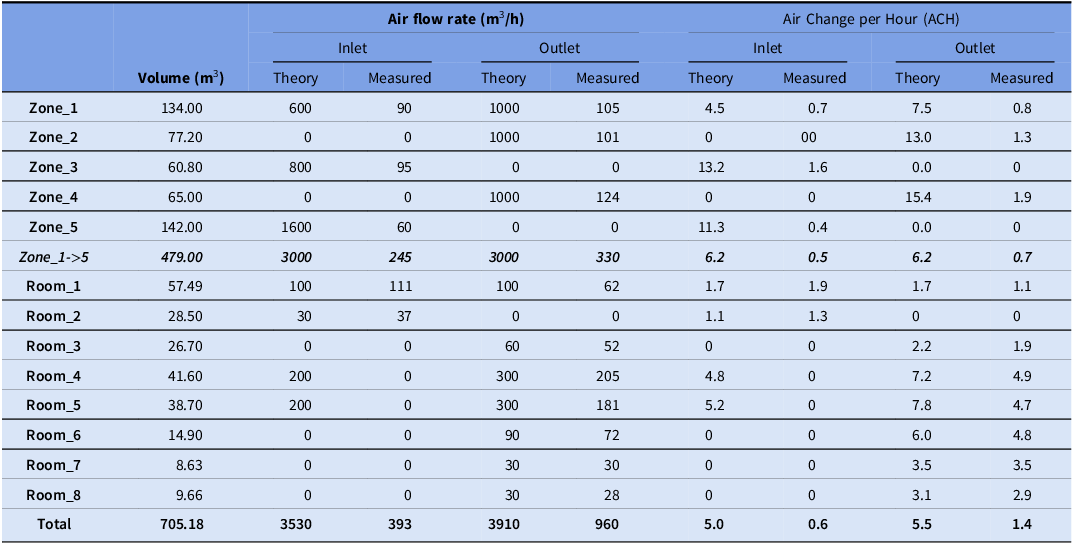
Airflow rate measurements conducted to assess the clean air supply in the designated facility revealed significantly lower values than the projected theoretical estimations based on the building’s HVAC schematics. Specifically, the measured supply and exhaust rates were 393 m3/h and 960 m3/h, respectively, representing nearly ninefold and fourfold reductions compared to the anticipated values.
Third study period and impact of technical maintenance
Following technical maintenance procedures and during the third phase of the investigation, the clean air supply flow rate measured improved, aligning closely with the projected values (3530 m3/h).
Aeraulic and computational data
First and second study period
The measured and theoretical airflow rates are presented in Table 2. As a result, measured and theoretical air change per hour (ACH) values for the whole multi-occupancy room were determined to be 0.6 and 5, respectively. Additionally, zonal ACH was calculated in each of the zones defined above based on their respective volume and airflow rates. This enabled us to observe disparities between the average value for the whole room and the local values present in each zone. Indeed, zones 2 and 4 are not directly supplied by clean air from the HVAC system. Furthermore, zones 1, 3, and 5 have very disparate clean air supply levels, 0.7, 1.6 and 0.4 respectively, due to the heterogeneous position, number, and flow rate of the inlet ventilation vents. As a result, this multiple occupancy room cannot be considered a homogeneously ventilated space.
Airflow rate and corresponding ACH in each zone of the dialysis unit in theory and after measurements

A first CFD simulation was performed, using the measured ventilation parameters as boundary conditions, representing the settings of the first and second sampling periods. As can be seen on the air velocity slice parallel to the ceiling (Figure 2), very little air is injected into the room through the ventilation inlets and the air is globally almost motionless within the ward (cf blue color corresponding to low velocities, below 0.2 m/s).
Airflow velocity (m/s) from the simulated dialysis unit when taking as boundary conditions the measured ventilation parameters.

Furthermore, when looking at another slice perpendicular to a patient, we can clearly see the natural convection induced by the heat produced by the patient’s body and assess that it is the main driver of the airflow. We can indeed recognize a vertical flow ascending above the patient at a speed of 0.2 m/s, due to buoyancy effect (Figure 4). The heterogeneous distribution of ventilation inlets and outlets throughout the ward’s ceiling, combined with the architecture of the room, creates a global air flow pattern from zone 5 to zone 2 (Figure 1), aligning with the positive pressure gradient. Airborne particles emitted by a simulated infectious patient will consequently follow this flow pattern, dispersing throughout the room accordingly. This ventilation configuration will also lead to prolonged particle suspension times due to a low extraction rate.
Airflow velocity (m/s) from the simulated dialysis unit when taking as boundary conditions the theoretical ventilation parameters.

Airflow velocity (m/s) in vertical plan, from the simulated dialysis unit when taking as boundary conditions the measured ventilation parameters.

Third study period and impact of technical maintenance
After maintenance was performed on the dialysis unit’s HVAC system, a second CFD simulation was launched with these new boundary conditions. The analysis of the simulation results highlights increased air movements near the ceiling throughout the whole unit due to the nominal ventilation (Figure 3).
The previously dominant natural convection effect from the patient is not dominant anymore and both local and global air renewals are improved following the maintenance procedures (Figure 5).
Airflow velocity (m/s) in vertical plan, from the simulated dialysis unit when taking as boundary conditions the theoretical ventilation parameters.

Discussion
This study delves into the presence of respiratory viruses within the air of a spacious, open-design dialysis unit, shedding light on their temporal and spatial distribution patterns. The molecular surveillance of viruses in the air enabled to identify likely defaults in air renewal. Our study spotlighted the heterogeneous spatial distribution of the virus within the same setting. Notably, during identical sampling periods, the positivity rates of air samplers displayed a considerable range, spanning from 6% to 56%, depending on their location. We did not expect such spatial differences in the same space of care as well as the identification of virus during nocturnal sampling sessions, a time when patients are absent.
This observation coincided with another unexpected finding; a nearly ninefold variance between the measured and theoretical airflow, prompting a rigorous reassessment of the ventilation system’s efficacy. This discrepancy raised concerns and led to a thorough system inspection. Consequently, the maintenance investigation uncovered pipe malfunctions, which were subsequently rectified. Following the repairs, we observed the disappearance of the heterogeneous viral spatial distribution and the absence of virus detection during nighttime hours, along with a significant decrease of virus air positivity after normalization with virus patient positivity.
Identification of respiratory virus cross-transmission among hemodialysis patients is known, especially when infection prevention practices are suboptimal.Reference Marvil, Babiker and Preston12 Hence, it appears crucial to implement suitable infection control protocols in hospital environments, encompassing activities such as contact tracing, evaluating exposure risks, and employing effective symptom-based testing strategies, all aimed at thwarting SARS-CoV-2 outbreaks,Reference Schwierzeck, König and Kühn13 as well as of other pathogens, which transmit through the air. The presence of SARS-CoV-2 in air samples of hospitalized patient rooms is well-known and has been successfully identified.Reference Chia, Coleman and Sean14,Reference Lednicky, Lauzard and Fan15 One specific study even extended its investigation to encompass not only the patient’s room but also surrounding areas like hallways, nursing stations, and corridors.Reference Lan Ma and Babiker16 Furthermore, it is worth mentioning that additional viruses, such as the Monkeypox virus, have been detected in the air within consultation rooms housing infected patients.Reference Mellon, Rubenstein and Antoine17 However, it’s noteworthy that, to date, no prior studies have ventured into examining respiratory viruses within expansive open environments, such as dialysis units.
While direct evidence linking ventilation to respiratory infectious disease transmission risk remains limited, studies underscore the correlation between inadequate ventilation and increased disease transmission rates.Reference Atkinson, Chartier, Pessoa-Silva, Jensen, Yuguo Li and Wing-Hong18 Although other investigations have explored potential disease transmission pathways, only a handful have specifically delved into the direct influence of ventilation on disease transmission dynamics. Thus, insufficient air change rates per hour and inadequate upkeep of ventilation systems have also been linked to respiratory diseases infection such as tuberculosis outbreaks and was also reported for other respiratory diseases.Reference Escombe, Ticona, Chávez-Pérez, Espinoza and Moore19–Reference Lungo, Fennelly, Keen, Zhai, Jones and Miller21 We could here consider that HVAC maintenance and increased air renewal improves protection against transmission of respiratory diseases through the air.
Previously, computational fluid dynamics (CFD) simulations have been instrumental in assessing the dispersion patterns of infectious aerosols within indoor ventilated environments. These simulations have greatly enhanced our understanding, particularly regarding the dynamics and patterns of aerosol propagation over time.Reference Crawford, Vanoli and Decorde7,Reference Mao and Celik22 CFD complements observational knowledge by providing a visualization of particle flow and the potential circulation between patients. Consequently, CFD emerges as a pivotal initial step in the development of a comprehensive strategy aimed at mitigating contamination risks within hospital settings. The model offers remarkable adaptability, allowing tailored configurations to suit diverse room layouts. This versatility renders it applicable across a wide spectrum of healthcare environments.Reference Crawford, Vanoli and Decorde7 In addition, CFD can be merged with augmented reality technology in order to be used as a pedagogical tool to help HCW to better understand the challenges of respiratory cross-transmission in large multiple occupancy rooms.Reference Mellon, Crawford, Vanoli and Donval23
Finally, our investigation revealed that the virus’s positivity rate mirrored the epidemiological trends of the year, peaking in winter (29.6%) and receding in early fall (6.7%). While the predominant identification was the SARS-CoV-2 virus, we also detected other respiratory viruses including rhinovirus, adenovirus, human metapneumovirus, influenza B and enterovirus. These findings corroborate Moriyama M et al. results.Reference Moriyama, Walter, Hugentobler and Iwasaki24
This study is subject to several inherent limitations. Firstly, our investigation spanned three distinct periods from January to November 2022, each marked by varying epidemiological data. Consequently, this divergence in data might have influenced our findings to some extent. Nevertheless, despite a context of a higher incidence of viral infection in patients during the period after the ventilation system maintenance, the ratio of virus detection in the air to virus detection in patients decreased fivefold. Secondly, we faced challenges in coordinating with the maintenance team for a timely intervention coinciding with the initial air and viral assessments. Third, it is worth noting that we did not record air CO2 concentrations, which could have been a valuable parameter to complement our assessment of ACH. Lastly, we did not collect samples from healthcare workers who cared for the patients and shared the multi-occupancy room with them.
Moreover, our investigation stands as an innovative endeavor, uniquely integrating CFD simulations, virus detection in the air, and aeraulic data to create vivid visual representations. These representations contribute significantly to a more profound understanding and comprehensive evaluation of the systemic challenges at play. Our study systematically documented the pivotal impact of maintenance operations on the ventilation system, yielding notable outcomes, with a significant improvement of virus clearance from the air. Additionally, our findings emphasize that considering the global ACH for a vast, multiple occupancy room might not be the most effective approach. Instead, it is prudent to assess ACH on a zone-by-zone basis within such spaces. This could be helpful in order to reach World Health Organization ACH goals for healthcare facilities as published in 2021.25
Finally, our findings highlight with virological data how ventilation maintenance is key in prevention and infection control in healthcare facilities.
Supplementary material
To view supplementary material for this article, please visit https://doi.org/10.1017/ice.2024.217
Acknowledgments
Authors would like to thank the entire Nephrology team; Prof. Carmen Lefaucheur, Dr. Imade Abboud, and Fatiha Seigaher.
Financial support
No funding for that study.
Competing interests
Authors declare no conflicts of interest.