


Introduction
Functional neurological symptom disorder (FNSD; also known as conversion disorder) is characterized by symptoms normally associated with neurological disorders, but with no identified structural cause.
Neuroimaging and neurophysiological studies of patients with various functional neurological symptoms suggest that neural networks and neurophysiological mechanisms may mediate these symptoms (see Voon et al., Reference Voon, Cavanna, Coburn, Sampson, Reeve and LaFrance2016, for a review). However, no cause or mechanism for FNSD has been firmly established, and treatment studies have generally shown modest positive benefits at best (see Carson et al., Reference Carson, Brown, David, Duncan, Edwards, Goldstein, Grunewald, Howlett, Kanaan, Mellers, Nicholson, Reuber, Shrag, Stone and Voon2012, for an overview). Relevant to this study, there has been some degree of treatment success with in-patient physical rehabilitation, incorporating some simple behavioural modification principles, e.g. Jordbru et al. (Reference Jordbru, Smedstad, Klungsoyr and Martinsen2014).
Psychological models of functional neurological symptoms broadly focus on the idea of the activation of some type of ‘top-down’ processing being important, such as the Integrative Cognitive Model posited by Richard Brown and colleagues (e.g. Brown and Reuber, Reference Brown and Reuber2016). This model suggests that some type of ‘rogue representation’/‘seizure scaffold’ is automatically activated, in the context of a ‘high level inhibitory processing dysfunction’. Similar to this is the account of functional symptoms described by Edwards et al. (Reference Edwards, Adams, Brown, Pareés and Friston2012), which suggests that these symptoms autonomously arise from inferences based on prior beliefs and experience.
These accounts are consistent with our observation that almost every single person with functional symptoms has some reason to doubt the integrity of their neurological system, e.g. having received a neurological diagnosis unrelated to their symptoms, or having been concussed shortly before symptom onset.
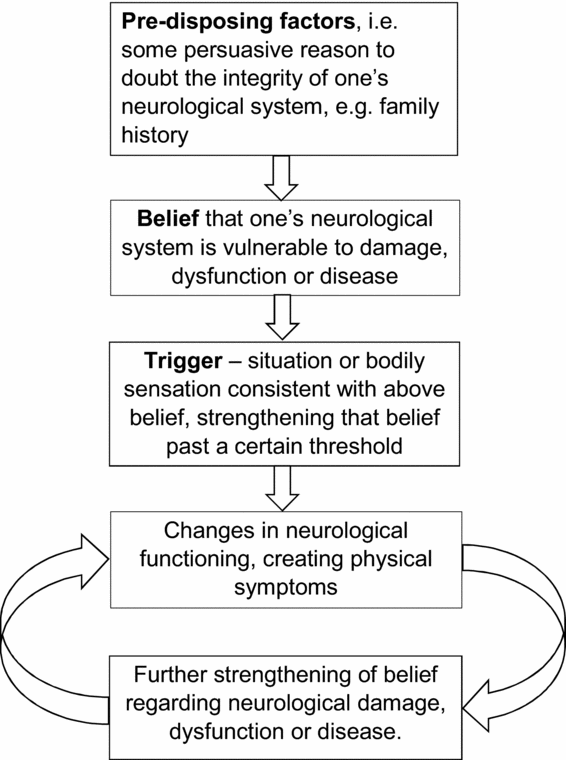
If there are representations or beliefs that lead to functional symptoms, one could assume that they are similar to the idea ‘I am neurologically damaged’. The idea that such top-down representations can trigger physical symptoms would be consistent with the idea of a nocebo response, defined by Colloca and Miller (Reference Colloca and Miller2011) as ‘the expectancy-induced changes in the patient's brain-body unit’. If present, such symptoms are almost certain to strengthen the belief in one's neurological impairment, which would then create a maintenance (i.e. ‘vicious’) cycle.
Clear demonstrations of the role of negative expectation or belief in functional neurological symptoms are sparse. However, there are numerous reports in the literature of rapid and/or dramatic placebo response (i.e. symptom reduction) in individuals with functional neurological symptoms, further suggesting an important role of expectations/beliefs in this population.
The aim of this study was to test the following hypothesis: if FNSD is the result of something akin to a nocebo effect/response, a treatment protocol consistent with this theory should be effective.
Method
This study has a retrospective consecutive case series design, with no control group. It is essentially a summary of the results of a consistently applied treatment protocol in a neuro-rehabilitation setting, supported by the rehabilitation unit's routinely used outcome measures. Whilst not specifically measured, it is estimated that the in-patient participants were treated with the customary intensity of intensity (approximately 2‒4 hours of therapy a day, for 5 days a week, with nursing support available 24 hours a day).
For 17 months, every patient admitted with functional neurological symptoms (i.e. after a full neurological assessment found no structural cause for the symptoms) was included in the case series. There were no exclusions. Twelve participants (six males, six females; age range 19‒63 years; mean 41.2 years) met this criterion, with one participant presenting twice. Eleven participants were admitted as in-patients, and one was seen as an out-patient (3 hours total input).
In terms of clinical presentation, the sample had a variety of functional symptoms. To briefly describe the sample's predominant (i.e. most disabling) symptom, seven presented with weakness/reduced mobility, three with tremor, and two with non-epileptic seizures. Two of the sample had mixed symptomatology.
The following list outlines some of the participants’ circumstances that could be categorized as ‘reasons to doubt the integrity of their neurological system’:
• A confirmed neurological diagnosis (that did not explain the symptoms), including epilepsy, neurofibromatosis, an excised brain tumour as an infant, and multiple mild traumatic brain injuries.
• Significant spinal surgery in the past.
• Initial diagnosis of multiple sclerosis, with a second neurological opinion (diagnosis of functional symptoms) many months later.
• Taken to hospital in dramatic circumstances (e.g. in a helicopter), with paramedical and medical staff initially suspecting serious structural neurological impairment.
• Intellectual disability or borderline intellectual disability.
The participants were treated using the following protocol:
• Medical staff explained key evidence regarding the improbability or impossibility of structural changes to the neurological system.
• A clinical psychologist gathered information about their medical history, the onset and course of symptoms, the participant's understanding of the medical evidence, their personal belief about the causes of their symptoms, and their understanding of the terms ‘subconscious’ and ‘placebo effect’. This was useful in helping judge how much, and what degree of psychoeducation would be necessary in order to proceed. There was little or no conversation about emotional factors.
• A formulation was then transparently and collaboratively developed with the participant that incorporated relevant history within a ‘nocebo model’ (see Fig. 1). In essence, this served to explain the discrepancy between the medical findings and the participant's subjective experience. It was hoped that this would engender in the participant an alternative belief about their symptoms, to challenge the one currently held (often something approximate to ‘the doctors have missed something’, or ‘this is being caused by stress’).
• The participant was consequently encouraged to examine this different perspective on their symptoms. This might commonly involve creating a new personal narrative about how events transpired around the onset of symptoms, but this time assuming that the new ‘nocebo model’ formulation was more accurate. Whilst every individual was different, the general aim was to challenge participants’ beliefs that they were damaged, or in danger. Instead, a narrative/metaphor such as e.g. ‘some simple misfiring of their intact neurological system’, or ‘no more dangerous than a stutter’ was provided as psychoeducation. A hardware/software metaphor was often used to this end.
• The participant was then given opportunities to experience themselves as functioning better. This invariably involved physiotherapy sessions, e.g. focusing on getting their affected limbs moving again. This was often done by varying what the participant attended to (e.g. trying to get them to walk without attending to their body movement, using distraction such as music, rhythm or attentionally absorbing video games), and using video recording/feedback to show them any improvement in limb movement. Video feedback appeared essential, especially given the observation that improved mobility appeared to accompany a lack of conscious attention paid to one's movements – the participant cannot notice their improvement in real time, as when attention was directed towards particular parts of the body, symptoms usually worsened. A treadmill was often used with those with weakness/movement difficulties, due to the frequent observation that this led to a more reliable production of improved limb movement.
• Improved functioning was framed as further evidence that the participant's symptoms were caused by a nocebo response (e.g. ‘you have improved, yet we only changed your beliefs about the symptoms/what you attended to – we didn't touch your legs’).
• This treatment cycle (varying attention, creating improved, more ‘automatic’ movement, giving feedback of some sort, such as video, and then reflecting on what that means about the cause of symptoms) was repeated, with more and more complex or effortful tasks. Any use of walking aids was reduced or eliminated at the earliest possible opportunity, with the attending physiotherapist ensuring safety precautions were taken.
• For the majority of participants, an occupational therapist was also involved, utilizing any increase in physical functioning in order to support them to return to any activity that they had not been able to perform whilst symptomatic.
• In the case of those participants who believed that their symptoms were triggered by aspects of their environment (typically those with non-epileptic seizures or tremor), graded exposure principles/treatments were incorporated.
• Once symptom elimination was achieved, participants were encouraged to push themselves to their physical limits to further prove to themselves that they were not neurologically damaged. This idea originated from the first participant in the case series who, of their own volition, decided to run up some stairs once they felt able to walk up them.
A simple hypothesized model for the creation and maintenance of functional neurological symptoms.

The functional independence measure (FIM) is completed on admission and discharge as part of normal practice at the rehabilitation centre. This is essentially a validated measure of disability/burden of care in rehabilitation patients (see Mackintosh, Reference Mackintosh2009), consisting of 18 items (13 motor, five cognitive), each scoring between 1 (total assistance) and 7 (complete independence), with any item score of 5 or less indicating some level of dependence on others. The total FIM score therefore ranges from 18 to 126. In this retrospective study, it was completed for 11 of the 13 episodes of care, i.e. all except the out-patient, plus one other.
To assess relapse rate, participants were followed up (predominantly by telephone) between 12 and 26 months post-discharge.
Results
Of the 13 treatment episodes, 12 resulted in complete or almost complete remission of functional symptoms (i.e. fully independent). To qualify that statement further, ten episodes of care concluded with complete symptom remission, one participant was discharged with a slight limp that was probably linked to chronic pain following previous discectomy, and one self-discharged with a slight limp, but was walking normally after a week at home. The other participant dropped out of treatment, with no clear improvement.
The mean improvement in FIM scores was 28.1, achieved in an average of 14.3 days. Typically, an improvement of this magnitude reflects someone who was initially dependent to some extent on other people or aids (such as a walking frame or wheelchair) for mobility and/or personal care, but was discharged fully mobile and independent.
Using the definition of reliable and significant change as postulated by Jacobson and Truax (Reference Jacobson and Truax1991), seven of the twelve episodes of care measured by the FIM resulted in reliable and significant change, with all of the other five episodes being unable to reach significance as the admission scores were all within 20 points of a maximum FIM score (a 20 point gain being necessary for a reliable and significant change).
With regard to symptomatic relapse, the mean follow-up time was 17 months post-discharge. Three participants (25%) had experienced no symptoms whatsoever in that time, five (42%) had experienced either fleeting symptoms (e.g. for 2 days, with subsequent full remission) or clinically insignificant symptoms (e.g. a very slight twitch), three (25%) had experienced symptomatic relapse, but still had significantly improved functioning compared with first presentation, and one (8%) showed no improvement – this was the participant who dropped out of treatment.
Discussion
It appears that the treatment protocol is highly effective, in that it reliably and quickly eliminated symptoms in the vast majority of participants. This treatment protocol involves a cognitive behavioural intervention, with a focus on a particular maladaptive belief (akin to ‘I am neurologically damaged’) with behavioural activation or graded exposure provided via interdisciplinary team input. The results were surprising given the current dearth of compelling evidence for treatment that leads to consistent full symptom remission in people with FNSD. The improvements were well maintained for the majority of participants over a considerable period of time.
Aspects of the protocol have clear similarity to the ‘Hypothesis A/Hypothesis B’ concept often used in treating health anxiety (Salkovskis and Bass, Reference Salkovskis, Bass, Clark and Fairburn1997), where Hypothesis A is that the person has a health condition, and Hypothesis B is that the person simply believes that they have a health condition.
However, in the case of FNSD, one has to explain how such a belief can actually lead to symptoms, otherwise ‘Hypothesis B’ will not be accepted by people with the condition. The success of this intervention is not proof that a nocebo-like mechanism is responsible for functional neurological symptoms, although this seems plausible. The explanatory theories put forward by Brown and Reuber (Reference Brown and Reuber2016) or Edwards et al. (Reference Edwards, Adams, Brown, Pareés and Friston2012) may have greater empirical grounding, but are not ‘user friendly’. Our experiences with delivering this treatment protocol revealed that the concept of a placebo effect is well known to most of the general public, and the related idea of a nocebo response therefore becomes a readily believable ‘Hypothesis B’ when transparently shared.
Another key observation is the almost total absence of conversation about emotional factors during the treatment protocol, which did not appear to affect its success, and most likely led to substantially decreased episode of care duration. This raises questions about whether or not traditionally labelled ‘psychological’ or ‘mental health’ difficulties are key aspects of the aetiology of the disorder, with many researchers noting the sizeable percentage of people with functional symptoms who have no discernible or diagnosable mental health issues.
A crude comparison could be made with the findings of Jordbru et al. (Reference Jordbru, Smedstad, Klungsoyr and Martinsen2014), who also used an in-patient multi-disciplinary rehabilitation approach, also used the FIM as an outcome measure, but appeared to use a straightforward behavioural intervention for the psychological component of their treatment (attending to good function, ignoring poor function). Their study only treated people with psychogenic gait disorder, and there were other exclusions applicable (including those with diagnosed organic neurological conditions). The mean FIM gain in their cohort was 8.4 in 3 weeks, compared with the 28.1 point gain in 2 weeks achieved by the current study, although it should be noted that the vast majority of participants in both studies achieved full functional independence by the end of the treatment.
There are numerous methodological limitations to this study, including the retrospective design, lack of control group, small sample size, lack of independent or blind assessment, as well as the inherent difficulties in diagnosing functional neurological symptoms. However, the clinical outcomes were substantial enough for a controlled study of the treatment protocol to appear warranted.
Acknowledgements
The authors would like to acknowledge the support of the staff team at the ISIS Rehabilitation Centre, Dunedin, New Zealand, and also Professor Graeme Hammond-Tooke for his help with this submission.
Ethical statement: The authors assert that all procedures contributing to this work comply with the ethical standards of the relevant national and institutional committees on human experimentation and with the Helsinki Declaration of 1975, and its most recent revision. The study was approved by the Human Ethics Committee, University of Otago, New Zealand (reference no: H13/070).




Comments
No Comments have been published for this article.