INTRODUCTION
Tuber-forming species of the genus Plectranthus (Lamiaceae) are widely cultivated in Africa and Asia (e.g. Jansen Reference Jansen, Flach and Rumawas1996), but agronomic information on their cultivation is scarce. Plectranthus edulis (Vatke) Agnew (syn. Coleus edulis Vatke), locally called Wolaita dono, Dinicha Oromo, Gamo dinich, Agaw dinich or Ethiopian potato, can grow up to a height of 1·5 m and produces edible tubers on below-ground stolons. The below-ground habit of the plant resembles that of the potato (Solanum tuberosum L.). P. edulis is grown at mid to high altitudes (Greenway Reference Greenway1944; Asfaw & Woldu Reference Asfaw and Woldu1997) in the southern, western and northern parts of Ethiopia (Westphal Reference Westphal1975; Taye et al. Reference Taye, Lommen and Struik2007).
Tipping (pinching), i.e. the removal of the shoot apices with one or two pairs of leaves is a common element of the crop husbandry applied by farmers. Some farmers claim that tipping increases tuber yield (Taye et al. Reference Taye, Lommen and Struik2007). In a survey carried out in the regions of Chencha and Wolaita in Ethiopia, Taye et al. (Reference Taye, Lommen and Struik2007) found the number of tippings vary between one and three, depending on the availability of time and labour. Most growers carried out the first tipping when the plants reached a height of 0·15 m, which is 1–1·5 months after planting. If farmers tipped more frequently, the second and third tippings were carried out about 1 and 2 months after the first tipping, respectively.
Shoot tipping or decapitation is well known to stimulate branching in many plant species (e.g. Dun et al. Reference Dun, Ferguson and Beveridge2006) by breaking apical dominance. Tipping is carried out in various ornamentals, including Plectranthus, Angelonia and Calibrachoa species, and ornamental sweet potato (Smith Reference Smith2003) to make the plant bushy, and in potato to stimulate branching for production of stem cuttings (e.g. Bryan et al. Reference Bryan, Meléndez and Jackson1981; Lommen & Struik Reference Lommen and Struik2007). For the same reason, tipping may also increase the number of stolons, and thus the number of potential tuber sites. However, the practice can only be justified if the size of the canopy or the number of potential tuber sites is indeed a factor limiting production.
Although tipping has been practised in P. edulis for years, it is not known how it affects crop development and tuber yield. Therefore, field experiments were conducted to assess and analyse the effects of tipping and tipping frequency on canopy branching and soil cover, yield components and tuber production of P. edulis.
MATERIALS AND METHODS
Experimental sites
A similar experiment was carried out at two sites in southern Ethiopia, namely Awassa and Wondogenet, between 19 April and 13 November 2004 (Awassa) and between 20 April and 14 November 2004 (Wondogenet). The Awassa field (7°03′N and 38°30′E, 1650 m asl) was a sandy loam soil with an organic matter (OM) concentration of 24 g/kg, pH-H2O 6·9, 1 g N/kg and 14·4 mg P/kg; the Wondogenet field (7°06′N 38°37′E, 1850 m asl) was a sandy loam soil with 29 g OM/kg, pH-H2O 6·1, 1·1 g N/kg and 15 mg P/kg. Wondogenet is relatively cooler and more humid than Awassa (average temperatures of 18·4 and 20·2°C, respectively). Daily average temperatures during the experiments ranged from 17·4 to 23·7°C and from 14·9 to 21·6°C in Awassa and Wondogenet, respectively. Rainfall was not limiting.
Experimental design and treatments
The experiments had a complete split–split-plot design with three factors, namely cultivar, number of tippings and harvesting time, replicated in six blocks. Four harvesting dates were randomized within four tipping practices and the latter within two cultivars.
The two cultivars were Lofuwa and Chankua. The leaf and stem colours of Lofuwa are green and its tuber skin is dull white, whereas the leaf, branch and tuber skin of Chankua are red or reddish. Farmers consider Lofuwa as relatively early maturing and Chankua as late maturing. The four tipping treatments included zero tipping, tipping once (carried out 68 days after planting (DAP), when most shoots attained a height of about 0·15 m), tipping twice (in which the first tipping was followed by a second tipping at 114 DAP, i.e. 46 days after the first tipping) and tipping thrice (in which the third tipping was carried out at 158 DAP, i.e. 44 days after the second tipping). While tipping, the top parts (i.e. the parts above the first clear internode, containing the apex with one or two pairs of visible leaves) were removed from those main stems and branches that were developed to such an extent that at least one pair of leaves remained on the stem or branch. In the second and third tipping, only outgrowths were tipped from stems that had been tipped in the previous tipping. To study the crop development at the moment(s) of tipping and the development with time thereafter, the crops from different tipping treatments were harvested on four dates. The 1st harvest was on 26 and 27 June (68 DAP), the 2nd on 11 and 12 August (114 DAP), the 3rd on 25 and 26 September (159 DAP) and the final harvest on 13 and 14 November (208 DAP) in Awassa and Wondogenet, respectively. The first three harvest dates coincided with the days of the 1st and 2nd tipping of the respective treatments (immediately after tipping), and one day after the 3rd tipping, which was the moment maximum haulm development was measured. The final harvest was 50 days after the 3rd tipping, when the haulm was senescing.
Gross plot size was 3·60×3·75 m, comprising plants from 20 holes in four rows of five holes. Hole spacing was 0·90 m between rows and 0·75 m within a row, consistent with common practice. Only plants from the inner six positions (two rows×three holes, i.e. 1·80×2·25 m net plot size) were harvested, those from the remaining 14 positions were kept as guard plants.
Crop management
Before planting, the experimental field was ploughed, disc harrowed and furrowed with a width of 0·50 m between ridges and the furrows 0·20 m below the ridges. The crops were planted on 19 April 2004 (Awassa) and 20 April 2004 (Wondogenet). Planting holes 0·05 m deep were made in furrows. Three de-sprouted, broken tuber pieces (prepared by breaking a mother tuber of 0·10–0·15 m length into three) were planted per hole in a triangle with sides of about 0·05 m, and covered with soil. During growth the soil was cultivated two to three times in order to control weeds, and plants were earthed up (i.e. soil was piled up around the stems) three times, in order to support the stems and also cover the stolons. These are farmer practices as indicated in Taye et al. (Reference Taye, Lommen and Struik2007). Manure or chemical fertilizer was not applied.
Observations and calculations
Ground cover
Ground cover was estimated at the harvest dates (1st and 2nd harvest) or one day before the harvest dates (3rd and 4th harvest) on the plots to be harvested in the final harvest, using a frame of 0·90 m×0·75 m that was divided into 100 cells of 90 mm×75 mm each. The number of cells filled to at least 0·5 with green leaves was counted, the observer looking down from above to avoid parallax. Two measurements were taken per net plot, one from each inner row. This grid method provides a non-destructive measurement, which correlates well with the proportion of intercepted photosynthetically active radiation as measured with a tube solarimeter (Haverkort et al. Reference Haverkort, Uenk, Veroude and van de Waart1991).
Crop analysis and related measurements
Data from above-ground and below-ground parts were recorded during each harvest. Whole plants from all six holes of the net plots were dug out carefully and cleaned. The number of main stems from all six holes and the number of branches (primary, secondary and tertiary) from a subsample of three holes were recorded. Main stem refers to each stem that originated from the bud of a mother tuber piece, primary branches originated from main stems, secondary branches from primary branches and tertiary branches from secondary branches. Stolon number was recorded from main stems and primary branches from three holes. Secondary and tertiary branches produced no stolons. Tuber yield was determined from all six holes.
Statistical analysis
GenStat release 13.3 (VSN International Ltd, Hemel Hempstead, UK) was used to conduct separate ANOVA on the data from each harvest date. For branch numbers and yield components, tests were conducted to determine whether the response to the frequency of tipping was linear or quadratic. Correlations across tipping treatments within sites and cultivars between number of secondary branches and the total number of green leaves and between the number of stolons per hole or the tuber:stolon ratio and the number of tubers per hole were determined by Excel 2003.
RESULTS
Canopy development
Number of main stems
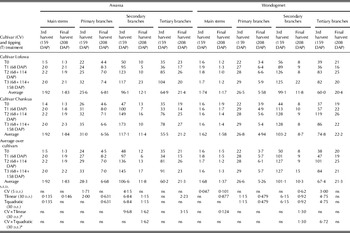
At 159 and 208 DAP, the number of main stems per hole was increased significantly by the tipping treatments in Awassa (Table 1), with no difference in the number of main stems between the frequencies of tipping. In Wondogenet, the number of main stems was not affected by tipping at 159 DAP in either cultivar, whereas at 208 DAP the number of main stems per hole was not affected by tipping in cvar Lofuwa, but was lower for higher frequencies of tipping in cvar Chankua (Table 1). There were no significant differences between cultivars in the number of main stems in Awassa, whereas in Wondogenet Chankua had fewer stems than Lofuwa at 159 DAP, but still had more stems than Lofuwa for the zero tipping and lower frequencies of tipping at 208 DAP (Table 1).
Number of main stems and different order branches per hole of the P. edulis cultivars Lofuwa and Chankua as affected by zero (T0), one (T1), two (T2) and three tippings (T3) for two harvests in Awassa and Wondogenet

DAP, days after planting.
* For comparisons of tipping treatments within a cultivar only.
Number of branches
For all types of branches, the number of branches per hole was highest at 159 DAP and had decreased at the final harvest due to crop senescence. Primary branches were already present in the first harvest at 68 DAP (data not shown). At 159 and 208 DAP, tipping had significantly increased the number of primary branches per hole as compared with zero tipping at both sites (Table 1). The first secondary branches were observed in the harvest at 114 DAP (data not shown). Tipping also increased the number of secondary branches at 159 DAP, but had no consistent effect on the number of secondary branches remaining at 208 DAP (Table 1). Tertiary branches were not observed at 68 and 114 DAP. The number of tertiary branches at 159 DAP was increased by tipping twice or thrice in Awassa and in cvar Lofuwa in Wondogenet, and by all tipping frequencies in cvar Chankua in Wondogenet (Table 1), but there were no consistent effects at 208 DAP.
Number of green leaves
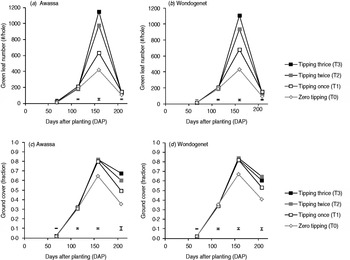
The number of green leaves per hole was highest at 159 DAP (Fig. 1a, b). At this harvest date, the number of leaves per hole both in Awassa and Wondogenet showed significant interaction between cultivar and tipping. The more frequent the tipping was, the more green leaves per hole, especially for Chankua. There were significant correlations between the number of secondary branches at 159 DAP and the total number of leaves within individual cultivar×location combinations (r=0·822–0·889, n=24).
Effect of zero, one, two and three tippings on development of green leaf number per hole (a, b) and fraction ground cover (c, d) of P. edulis with time in Awassa (a, c) and Wondogenet (b, d). Average values over two cultivars. Bars: s.e.d. (30 d.f.).

Ground cover
Significant differences due to tipping only appeared later in the growing season (Fig. 1). This was true for both sites. Tipping increased both the maximum ground cover recorded and the ground cover in the period during which leaves senesced.
Below-ground development
Number of stolons
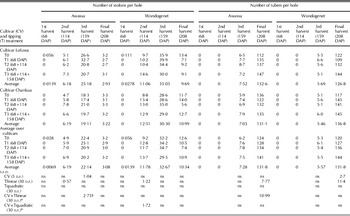
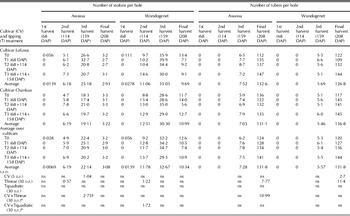
Stolons generally did not appear until after the 1st harvest (Table 2). At 114 DAP, a small number of stolons had appeared and the number was significantly higher in tipped plants than in control plants (Table 2). Stolon numbers were maximum at 159 DAP. Tipping no longer had any effect on the number of stolons at 159 DAP in Wondogenet and in cvar Chankua in Awassa. For Lofuwa at Awassa, higher tipping frequencies resulted in fewer stolons at 159 DAP (Table 2).
Number of stolons and tubers per hole of the P. edulis cultivars Lofuwa and Chankua as affected by zero (T0), one (T1), two (T2) and three (T3) tippings in four harvests in Awassa and Wondogenet
DAP, days after planting.
* For comparisons of tipping treatments within a cultivar only.
† 28 d.f.
Number of tubers
Tubers did not appear until after 114 DAP. Only a few tubers had appeared at 159 DAP and tipping had no effect on that number. The number of tubers was highest at 208 DAP, when there was a linear increase in the number of tubers with an increase in the frequency of tipping in both cultivars in Wondogenet and in cvar Lofuwa in Awassa (Table 2). At the final harvest in Wondogenet, the number of tubers was significantly higher for Chankua than for Lofuwa (Table 2).
Yield components and dry matter production
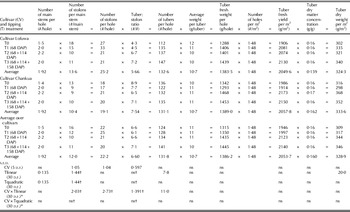
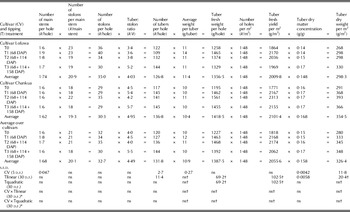
In Awassa, tipping increased the number of main stems per hole, decreased the number of stolons per main stem in cvar Lofuwa, and had no effect on the number of stolons per hole in cvar Chankua and an inconsistent effect in cvar Lofuwa (Table 3). In Wondogenet, tipping had no effect on the number of main stems per hole, and did not affect the number of stolons per main stem or per hole (Table 4). Effects of tipping on the tuber:stolon ratio were inconsistent over cultivars in Awassa and absent in Wondogenet (Tables 3 and 4). Nevertheless, there was a linear increase in the number of tubers with an increase in the frequency of tipping for cvar Lofuwa in Awassa and for both cultivars in Wondogenet (Tables 3 and 4). Within individual combinations of cultivar and location, the number of tubers per hole was correlated with the tuber:stolon ratio for both cultivars in Awassa and cvar Lofuwa in Wondogenet (r=0·446–0·719, n=22–24), but not with the number of stolons per hole (r=0·087–0·260, n=24). No effect of tipping on the average weight per tuber was found (Tables 3 and 4). There was no detectable effect of tipping on fresh tuber yield in Awassa (Table 3), but tipping increased fresh tuber yield in Wondogenet. The quadratic nature of the effect showed that optimum tipping frequencies were one or two, with two tippings leading to only limited yield increase compared with one (Table 4). Also the tuber dry matter concentration was not affected significantly by tipping in Awassa, but increased significantly with increase in the tipping frequency in Wondogenet (Tables 3 and 4). The tuber dry weight per hole increased with increase in tipping frequency at both sites (Tables 3 and 4). Within individual combinations of cultivar and location, tuber dry weight was correlated with tuber dry matter concentration (r=0·427–0·644, n=23–24), and with tuber fresh weight per hole (r=0·702–0·920, n=23–24).
Yield characteristics of the P. edulis cultivars Lofuwa and Chankua as affected by zero (T0), one (T1), two (T3) and three (T3) tippings in Awassa. Stem and stolon data from the harvest at 159 DAP, tuber data are from the final harvest at 208 DAP

DAP, days after planting.
* For comparisons of tipping treatments within a cultivar only.
† 28 d.f.
Given product values are not the same as the ones found after re-calculation based on the averages in this and the following table, because (A1×B1+···+An×Bn)/n is mathematically unequal to [(A1+···+An)/n]×[(B1+···+Bn)/n].
Yield characteristics of the P. edulis cultivars Lofuwa and Chankua as affected by zero (T0), one (T1), two (T3) and three (T3) tippings in Wondogenet. Stem and stolon data from the harvest at 159 DAP, tuber data are from the final harvest at 208 DAP

DAP, days after planting.
* For comparisons of tipping treatments within a cultivar only.
† 29 d.f.
In Awassa, the number of stolons produced per main stem was significantly higher for cvar Lofuwa than for cvar Chankua in the zero tipping and tipping once treatments, and so was the number of stolons per hole (Tables 3 and 4). The tuber:stolon ratio, however, was significantly higher for cvar Chankua than for cvar Lofuwa in the zero tipping and tipping once treatments. There were no differences between cultivars in any of the other production components in Awassa. At Wondogenet, cvar Chankua produced fewer main stems, but more tubers per hole than Lofuwa, had a smaller average tuber size, and had a higher tuber dry matter concentration and a higher tuber dry matter yield (Table 4).
DISCUSSION
Canopy development
Tipping enhanced the number of main stems in Awassa, but not in Wondogenet (Table 1). Tipping, however, clearly enhanced branching in both experiments (Table 1), most likely due to the breaking of apical dominance, which stimulates branching in many crops (e.g. Bryan et al. Reference Bryan, Meléndez and Jackson1981; Dun et al. Reference Dun, Ferguson and Beveridge2006; Lommen & Struik Reference Lommen and Struik2007). Due to increased branching there were also more leaves (Fig. 1a, b). This enhanced branching and leaf production increased the canopy cover and probably delayed crop senescence (Fig. 1). This is consistent with findings in okra (Abelmoschus esculentus (L.) Moench), where apical bud removal is applied in combination with leaf removal to prolong the growing period (Olasantan & Salau Reference Olasantan and Salau2008).
Below-ground development
Below-ground development was affected less by tipping than above-ground development. Tipping increased stolon numbers in the earlier phases of growth, whereas by the time of the 3rd harvest (when stolon numbers were maximum and the first tubers were initiated) effects of tipping on stolon numbers were no longer visible (Table 2). More main stems – as found in Awassa – tended to reduce the number of stolons per stem, thus counterbalancing the positive effect of tipping on the number of main stems.
The number of tubers obtained from these stolons increased with increase in the frequency of tipping in cvar Lofuwa in Awassa (Table 3) and in both cultivars in Wondogenet (Table 4). This increase was not related to an increase in the number of stolons: the positive effects of tipping on stolon numbers early in the growing season were no longer obvious by the time the first tubers were initiated, and across all tipping treatments, there were no significant correlations between the numbers of tubers and stolons per hole. This is different from what is commonly found in potato, where there is generally a close relationship between the number of stolons and the number of tubers (e.g. Haverkort et al. Reference Haverkort, Van de Waart and Bodlaender1990). An increase in tuber number per hole was more likely to be associated with more tubers per stolon. Although direct effects of tipping on the tuber:stolon ratios were inconsistent in Awassa and not significant in Wondogenet, significant correlations between the tuber:stolon ratio and the number of tubers per hole were found over tipping treatments in Awassa and one cultivar in Wondogenet. It seems likely that more tubers were initiated in the tipped treatments because of the higher light interception by the individual plants. This might be because of a higher rate of tuber initiation because of the increased canopy cover or because of a longer duration of tuber initiation because of the delayed senescence. In Irish potato, a higher light interception at the moment of tuber initiation – because of a larger canopy (e.g. as a result of a lower plant density) or because of less shading in shading experiments – was thought to increase the number of tubers initiated (Burstall et al. Reference Burstall, Thomas and Allen1987; O'Brien et al. Reference O'Brien, Firman and Allen1998; Van der Veeken & Lommen Reference Van der Veeken and Lommen2009). The increase in number of tubers is consistent with the positive effect found by Menzel (Reference Menzel1981) on number of tubers in potato after decapitating potato plants growing at high temperatures. This effect was attributed by Menzel (Reference Menzel1981) to lowering of the gibberellin concentrations in the stolon, where they inhibit tuberization.
Intercepted radiation and yield
More leaves were produced on tipped plants than on non-tipped plants (Fig. 1a, b) and, as a result, more light was intercepted by tipped plants (Fig. 1c, d). Also, the stem parts of the extra branches (Table 1) may have contributed to the greater light interception, explaining the relatively small differences in green leaf numbers at the final harvest compared with the still larger difference in ground cover by the green canopy (Fig. 1). The heavy foliage formed by the tipping treatments increased tuber dry matter yield at both sites by an accumulation of small effects on tuber fresh yield and tuber dry matter concentration (Tables 3 and 4).
Besides tipping, other cultural techniques might also enhance canopy cover and therefore radiation interception and yield. Alternatives could be to increase planting density (e.g. Bremner & Taha Reference Bremner and Taha1966; Van der Veeken & Lommen Reference Van der Veeken and Lommen2009) or changing to a more evenly distributed planting pattern than the conventional planting of three tuber pieces per hole with a between-hole spacing of 0·75 m within a row and 0·90 m between rows. Also, changing the weight and pre-treatment of the seed tuber (pieces) are candidates for further investigation, because they are known to affect the number of main stems and/or canopy cover in potato (e.g. Bremner & Taha Reference Bremner and Taha1966; Allen et al. Reference Allen, Bean, Griffith and O'Brien1979; Lommen & Struik Reference Lommen and Struik1994).
Practical implications
Tipping stimulated the production of stems and branches and thus contributed to leaf area development and radiation interception and may have reduced weed problems. Tuber dry matter production and tuber numbers increased at both sites with an increase in the frequency of tipping, whereas the average tuber size was not affected. Fresh tuber yields obtained at 208 DAP without tipping were 1·90–1·98 kg/m2 in Awassa and 1·86–1·77 kg/m2 in Wondogenet. Tipping on average increased the fresh tuber yields by 17% in Wondogenet, but had no significant effect in Awassa (P=0·094). Slightly later harvesting might have increased the differences in tuber yield between the tipped treatments and the control, because the ground cover of tipped plants was still higher than that of control plants at the final harvest. The results obtained in the present experiments confirm the farmers’ perception that tipping will not only stimulate canopy development but also increase tuber yield. The latter, however, was only shown for tuber dry matter yield. For fresh tuber yield, limiting the tipping frequency to one early tipping when plants are 0·15 m tall might suffice, as more frequent tipping did not result in higher yields and would require more time and labour.
We gratefully acknowledge the financial support from the Norwegian Agency for Development and Corporation (NORAD).