



Sensitive and responsive caregiving during infancy and toddlerhood are critical for the development of children’s social and emotional skills (e.g., Sroufe, Reference Sroufe1996), such that the maturation of brain architecture and neural pathways underlying social and emotional functioning is thought to be dependent on warm and supportive interactions between caregivers and children (Gee & Cohodes, Reference Gee and Cohodes2021; Somers et al., Reference Somers, Curci, Winstone and Luecken2021). If supportive caregiving experiences are not present, or these experiences are greatly diminished, the early development of social and emotional competence may be hindered (Maheu et al., Reference Maheu, Dozier, Guyer, Mandell, Peloso, Poeth, Jenness, Lau, Ackerman, Pine and Ernst2010). Early institutional care is one context that may impede socioemotional development given that it is characterized by very few one-on-one interactions, little stimulation, and minimal caregiver-child emotional exchanges. Indeed, previously institutionalized (PI) children have been found to be at greater risk for social and emotional deficits including emotion regulation (Batki, Reference Batki2018; Koss et al., Reference Koss, Lawler and Gunnar2020; Perry et al., Reference Perry, Donzella, Parenteau, Desjardins and Gunnar2019; Tottenham et al., Reference Tottenham, Hare, Quinn, McCarry, Nurse, Gilhooly, Millner, Galvan, Davidson, Eigsti, Thomas, Freed, Booma, Gunnar, Altemus, Aronson and Casey2010).
Emotion regulation processes develop rapidly in early childhood and incorporate complex biological and behavioral responses that are both automatic and effortful, and serve to maintain, inhibit, or enhance the intensity of emotional experiences in an effort to accomplish an individual’s goals (Perry & Calkins, Reference Perry and Calkins2018). The development of emotion regulation is embedded within the caregiver–child dyad (Sroufe, Reference Sroufe1996). Specifically, there is thought to be a gradual transition from primary reliance on a caregiver to help modulate emotional experiences, to an increase in children’s own ability to regulate emotion (Sameroff, Reference Sameroff2010). That is, in typical rearing conditions, caregivers assist in the regulation of arousal and emotional behavior as young children attempt to find a balance between generating emotional responses to the environment and maintaining homeostasis. Over time, and through repeated interactions, emotion regulation processes that were once facilitated by caregiver support are thought to become ingrained in the child’s own self-regulatory skill set, allowing for greater independent regulation of emotion by the time children enter formal schooling. For instance, if a young child is upset about not having a turn with a toy, a caregiver may talk to the child about other toys they can play with while they wait, help them find a new activity, or think through all the fun things they can try with the toy when it is their turn. These adaptive behavioral strategies may then be used when a caregiver is unavailable to assist. Moreover, consistent caregiver responses increase a child’s expectation that their caregiver will intervene and successfully help dampen their emotional arousal should they need assistance, which provides children with a sense of security that allows them to explore their environment more freely and practice modulating arousal and behavior on their own. Previously institutionalized children do not experience these dyadic and supportive behavioral exchanges. Thus, their behavioral regulation strategies may be less effective or refined compared to their non-adopted peers.
Caregiver intervention during emotionally charged contexts may also help dampen children’s biological arousal. For example, scientists have posited that responsive social interactions with caregivers can calm young children’s physiological states and may facilitate greater myelination of vagal fibers (Porges & Furman, Reference Porges and Furman2011). A greater increase in myelinated vagal fibers may improve the modulation of arousal and enable children to engage in greater emotional regulation independently. A substantial body of work has also shown that deprivation in the form of institutional rearing may get under the skin by altering PI children’s hypothalamic-pituitary-adrenal axis’s functioning (Shirtcliff et al., Reference Shirtcliff, Hanson, Phan, Ruttle and Pollak2021; Wade et al., Reference Wade, Carroll, Fox, Zeanah and Nelson2021). Specifically, PI children frequently demonstrate a blunted cortisol stress response in early childhood (Koss et al., Reference Koss, Mliner, Donzella and Gunnar2016; McLaughlin et al., Reference McLaughlin, Sheridan, Tibu, Fox, Zeanah and Nelson2015), hypothesized to be a consequence of chronic activation due to the stress associated with caregiving that fails to make children feel safe and secure. Taken together, theoretical and empirical work provides strong evidence that the early development of important biobehavioral emotion regulation competencies requires responsive and emotionally sensitive caregiver behavior. Because PI youth are deprived of supportive interactions during early childhood when emotion regulation is rapidly developing, they may be at greater risk for emotion regulation challenges.
Poor emotion regulation has been found to be associated with children’s mental health (Calkins & Perry, Reference Calkins and Perry2016). Children with poor emotion regulation may find it harder to engage in academic settings with less frustration, learn efficiently, and develop healthy interpersonal relationships with parents, teachers, and peers. In turn, this is likely to result in increased displays of both externalizing behaviors (i.e., behavior problems characterized by aggression and acting-out) and internalizing behaviors (i.e., behavior problems characterized by anxiety and depression) (Calkins & Perry, Reference Calkins and Perry2016). Indeed, previous work demonstrates that children who experience early institutional care have greater internalizing (e.g., Zeanah et al., Reference Zeanah, Egger, Smyke, Nelson, Fox, Marshall and Guthrie2009), and externalizing symptoms (e.g., Wiik et al., Reference Wiik, Loman, Van Ryzin, Armstrong, Essex, Pollak, S. and Gunnar2011), when compared to their typically reared peers. Thus, if early deprivation results in lower, less effective, or altered emotion regulation competencies, it may help to explain the higher incidence of mental health problems in PI youth, and may be one mechanism that leads to a greater likelihood of maladaptive trajectories of psychopathology into adolescence and early adulthood. More work is needed to better understand the predictive nature of specific emotion regulation processes in long-term pathways to mental health. This is especially true if emotion regulation is to be a key intervention target for PI children.
Relatively few studies investigate longitudinal trajectories of internalizing and externalizing behaviors across multiple developmental periods in PI populations, and even fewer consider their predictors. The longitudinal studies that have been conducted have focused solely on children adopted from Romania. The English and Romanian Adoptee Study followed children adopted from extremely depriving Romanian institutions in the early 1990’s until early adulthood (Sonuga-Barke et al., Reference Sonuga-Barke, Kennedy, Kumsta, Knights, Golm, Rutter, Maughan, Schlotz and Kreppner2017). Romanian adoptees adopted under 6 months of age did not differ from comparison youth and had relatively similar levels of emotional and behavioral problems. Those adopted after 6 months of age showed a marked increase in emotional problems as they entered young adulthood. A subsequent analysis of this sample showed that the pathway from early deprivation to emotional problems in adulthood operated through the impact of deprivation on neurodevelopmental problems including attention deficit problems and social cognitive deficits (Golm et al., Reference Golm, Maughan, Barker, Hill, Kennedy, Knights, Kreppner, Kumsta, Schlotz, Rutter and Sonuga‐Barke2020).
Recent work from the Bucharest Early Intervention Project (BEIP), a randomized controlled trial in which infants reared in Romanian institutions were randomly assigned to receive high-quality foster-care intervention or to continue to receive care as usual, has also provided important insight into the link between early institutional care and later mental health. Examining the associations between early psychosocial deprivation and psychiatric problems and risk-taking behaviors in late adolescence, Wade et al. (Reference Wade, Carroll, Fox, Zeanah and Nelson2021) identified three subgroups of children: low-, medium-, and high-morbidity. Nearly half of the ever-institutionalized children belonged to the high or medium-morbidity subgroups, and were significantly more likely to belong to one of these profiles than never-institutionalized children. Moreover, compared to the low-morbidity group, membership in the medium-morbidity profile was associated with higher levels of risk-taking behaviors at age 16 (Wade et al., Reference Wade, Carroll, Fox, Zeanah and Nelson2021). In a study specifically investigating trajectories of psychopathology, the same group of researchers showed that youth who never experienced institutional care had less problematic trajectories of externalizing-type behaviors from middle childhood to adolescence than children removed from institutional care and those that continued institutional care. Youth who were removed from institutional care showed modest declines in externalizing symptoms from age 8 to age 16, resulting in fewer problematic behaviors at age 16 than youth who remained in care-as-usual and showed relatively stable trajectories. The authors reported no observed differences in internalizing behaviors (Wade et al., Reference Wade, Fox, Zeanah and Nelson2018).
Taken together, current literature suggests that PI youth are more likely to display greater psychopathology than typically reared youth, particularly with regard to behavioral regulatory problems. We know very little, however, about the developmental mechanisms through which early institutional care leads to psychopathology, primarily because the majority of this work has focused on identifying social, emotional, or behavior problems caused by early institutional rearing, rather than focusing on distinct developmental differences in processes that might explain why and how early experiences may lead to increased maladaptation.
A recent study using BEIP data is one of the first, to our knowledge, to directly test a developmental process model by examining whether changes in caregiver-reported self-regulation from age 8 to age 16 mediated the association between early adverse care, and social skills and psychopathology at age 16. A significant indirect effect of early foster care intervention on psychopathology emerged such that foster care intervention (i.e., removal from institutional care to foster care) contributed to increased self-regulatory growth over the course of adolescence, which, in turn, was associated with reduced peer difficulties and general psychopathology symptoms in adolescence (Mukerji et al., Reference Mukerji, Wade, Fox, Zeanah and Nelson2021). Thus, there is some evidence to suggest that better self-regulation is associated with better social interactions and subsequently better mental health in PI youth. Although informative, this study is limited such that self-regulation was measured broadly and only via caregiver report. Unique associations with internalizing and externalizing symptoms were also not considered. Further, the sample is again focused on children raised within one country, Romania, and its institutional and foster care environments.
Given that researchers found peer difficulties to be one mechanism through which PI youth’s self-regulation was associated with general psychopathology (Mukerji et al., Reference Mukerji, Wade, Fox, Zeanah and Nelson2021), the control of emotional arousal and behavior in peer contexts might be particularly important, especially when predicting outwardly observed externalizing-type symptoms. Therefore, PI youths’ greater difficulties regulating emotional arousal and behavior during social stress, in particular, may be one developmental mechanism underlying the link between early adverse care and mental health difficulties. In a previous cross-sectional study using the first assessment of the data presented here, we directly examined the way in which biobehavioral emotion regulation in PI youth may help to explain individual differences in behavior problems. We showed that PI youth who had greater observed emotion regulation, also had higher cortisol reactivity to a social stressor designed to elicit anxiety (Perry et al., Reference Perry, Donzella, Parenteau, Desjardins and Gunnar2019). This suggests that a greater cortisol response to social stress may serve as one biological regulator of emotional experience that aids in more adaptive social behavior during an emotionally charged context. Moreover, greater observed emotion regulation predicted fewer behavior problems for PI youth, but not for NA youth, suggesting that emotion regulation may be a particularly important predictor and potential point of intervention when targeting developmental psychopathology in PI children.
Although this initial study was informative, it was limited such that internalizing and externalizing behaviors were considered in combination with one another, which did not allow us to test their unique associations with emotion regulation processes. Given that prior literature suggests that PI youth show higher externalizing behaviors than their non-adopted peers more consistently than internalizing behaviors (e.g., Ellis et al., Reference Ellis, Fisher and Zaharie2004), it is possible that poor emotion regulation abilities lead to more behavioral outbursts, but are less predictive of internal mental health symptoms such as anxiety and depression. Indeed, the association between emotion regulation and internalizing behavior is not as clear such that the process mechanisms through which maladaptive emotion regulation strategies (e.g., emotional suppression) might relate to anxiety and depression are often left unspecified (Calkins & Perry, Reference Calkins and Perry2016). However, scientists have shown that children high in anxiety but lacking the ability to down-regulate that arousal are more likely to suppress the expression of negative affect or internalize these negative emotions (Eisenberg et al., Reference Eisenberg, Spinrad and Eggum2010), suggesting it may also be the case that it is simply more difficult to measure the impact of emotion regulation on internalizing symptoms.
The first study we conducted was also limited in that it was cross-sectional. Since the publication of this work, we have access to three additional data points assessing PI youths’ mental health. Thus, we are now able to test whether earlier biobehavioral emotion regulation skills predict the pattern of behavior problems across multiple developmental periods, and whether individual differences in emotion regulation are associated with youths’ mental health in the same way as NA youth. If emotion regulation emerges as a more consistent predictor of PI mental health trajectories, findings would suggest that for children who experience early adverse care, targeting improvements in early emotion regulation abilities may have a significant impact on psychopathology spanning from middle childhood to early adulthood.
The current study expanded on our initial work and addressed these limitations. Specifically, we tested whether distinct aspects of emotion regulation (global, observed, and biological regulation) during an emotionally charged social stressor predicted trajectories of PI youths’ internalizing and externalizing behaviors across 4 time points when children ranged from 7- to 21-years-old. For comparison purposes, we also tested these same associations in NA youth. Given findings from our previous work, we predicted that for PI youth, better biobehavioral emotion regulation skills at the first assessment would be associated with a greater likelihood of following a developmental trajectory characterized by lower externalizing and internalizing behaviors throughout middle childhood, adolescence, and young adulthood. We also hypothesized that these associations might not be as evident for NA youth, highlighting emotion regulation as a particularly important predictor for developmental longitudinal patterns of psychopathology in PI populations.
Method
Participants
Participants in the current study were initially part of a short-term accelerated longitudinal design examining the association between puberty and stress reactivity in children who experienced early institutional care (see Figure 1 for study timeline and measures). As part of the original study, measures were obtained at each of three sessions, with approximately 1 year between visits (M = 12.23 months, SD = .90 months). The children ranged from 7.08 to 15.12 years at the initial assessment (T1). The 4th assessment of remote data collection (T4) took place between 2 and 4 years after the last in-person assessment (M = 3.4 years, SD = .69, range 1.9–4.6 years later), when participants were 12–21 years of age (M = 16.47 years, SD = 2.35 years).
Study timeline and measures.

At study onset (T1), the sample consisted of 307 typically developing children; 132 (89 female) children were adopted internationally from institutional (i.e., orphanage) care (previously institutionalized, PI) into the United States, and 175 (91 female) children were non-adopted (NA) and had been born and raised with their biological families. We excluded children with known prenatal conditions such as FAS, congenital disorders, and diagnosed cognitive delays, and those currently using steroid medications. Both PI and NA groups were raised in the same Midwestern area. PI children spent at least 50% of their pre-adoption lives in institutionalized care, versus foster care or other arrangements (M = 95%, range 50–100%). Age at adoption ranged from 5.5 months to 59 months (M = 19.24 months, SD = 12.44). The mean ages at the initial assessment did not differ for the two groups (Mpi = 11.3 years, SD = 2.4 years; Mna = 11.2 years, SD = 2.3 years, t(294) = .42, ns). At T1 a nurse conducted Tanner staging to determine pubertal development, and groups did not differ, (M = 2.53, SD = 1.51, range 1–5, t (302) = .74, ns). The mean family income for the two groups also did not differ (χ2(9) = 6.7, p = .67) and was $100,000–$150,000 per year. Parental education did not differ between groups, with over 75% of the parents in both groups having a 4-year college degree or higher. Parents reported that 90% of NA youth were White, 7% were more than one race, 2% were Black, African, or African American, and 1% were Asian. In contrast, 40% of the PI children were White, 41% were Asian, 11% indigenous to the Americas, 5% Black or African, and 3% were of more than one race. Groups differ on race, (χ2(5) = 124.6, p < .001). Regarding country of birth, 28% of PI youth were adopted from Russia, 16.7% from China, 8.3% from India, and 4.5% from Guatemala, 2.3% from Ukraine, 2.3% from Colombia, 3.3% from Vietnam, 2.3% from Ethiopia, and less than 2% each from other countries including: Ecuador, Haiti, Kazakhstan, Nepal, and Slovakia. The racial distribution of the parents in both groups did not differ and was overwhelmingly white.
By the third in-person visit (T3), the sample had reduced to 238 or 77% of the original sample, and the attrition did not result in differences in sample characteristics described above. For the 4th wave of remote data collection (T4), the full sample was approached for participation, and 215 (69% of the original sample, 90% of the third wave) responded. Again, the attrition did not result in differences in sample characteristics described above. Requirements to be included in the current study were: (1) having at least 1 time point of externalizing or internalizing data across sessions T1–T4 (8% had 2, 29% had 3, and 57% had all 4 timepoints) and (2) having data for at least 1 regulation variable at T1. Thus, the total sample for current study was 307 (132 PI youth and 175 NA youth). Participants who had all four time points did not differ from those who were missing at least one time point on any demographic or predictor variable with one exception: age at study entry. Participants with all data points entered the study at a younger age: All = 10.90 years, SD = 2.24, Missing = 11.70, SD = 2.39, t (305) = 3.03, p = .003. Descriptive statistics for each variable can be found in Tables 1 and 2 for both PI and NA youth.
Correlations and descriptive statistics for PI youth

Note. *p < .05, **p < .01.
Correlations and descriptive statistics for NA youth

Note. *p < .05, **p < .01.
Procedures
Trier Social Stress Test. Children participated in a modified version of the Trier Social Stress Test for Children (TSST-C; Yim et al., Reference Yim, Quas, Rush, Granger and Skoluda2015) at T1, a commonly used laboratory procedure to induce significant psychological stress and changes in cortisol concentration (Kirschbaum et al., Reference Kirschbaum, Pirke and Hellhammer1993). In this social evaluative task, participants give a 5-min speech, pretending to introduce themselves to an imaginary classroom. Participants were given 5 min to prepare for their speech and write notes but could not use the notes during the speech period. The speech was given in a small room with a one-way mirror and visible camera (see Yim et al., Reference Yim, Quas, Cahill and Hayakawa2010). The experimenter stood behind the mirror, gave instructions through a speaker, and rated the speech for quality and effectiveness. Participants were told that the experimenter was behind the mirror with a teacher who would also be watching and judging their speech. Instructions before the speech were played from a recording of a male’s voice (the teacher) to ensure that all participants heard the same instructions and perceived someone else was behind the mirror to judge their speech. The recording also told children that they were being videotaped so that other students could rate them, adding to the social-evaluative stress of the task. If participants stopped their speech before 5 min, they were told to “continue” by the experimenter over the speaker. The experimenters remained neutral which increased the uncertainty about performance. After the speech section, participants performed a verbal arithmetic task aloud for an additional 5 min, a standard part of the TSST-C.
Video-taping. The speech portion of the TSST-C was videotaped and retained for later scoring. Of the 307 youth participating in the current study, malfunction of video equipment/experimenter error, resulted in either no video, or insufficient video, to code (N = 11), leaving children 296 with videotaped data.
Cortisol collection. Salivary cortisol was collected five times (−5, +20, +40, +60, and +80 min relative to the start of the stressor) surrounding the TSST-C. Because cortisol varies by time-of-day, sessions were constrained to afternoon, when the majority of youth would be available to attend and time-of-day influence is minimal (14:34–17:23 range, M = 15:55, SD = 0:33). Whole unstimulated samples were obtained. Participants were asked to refrain from eating or drinking during the session and reported on recent food consumption, medication intake, and day of session activities. Participants reported no fever/illness, tobacco use, and little caffeine use (13% reported use on the day). The last food/drink prior to the session ranged from .67 to 8 hr (M = 3.35 hr, SD = 1.51); neither caffeine use or time since last meal related to the size of the cortisol response to the TSST-C. For medication use, a summary risk score was calculated for each participant following guidelines of Granger et al. (Reference Granger, Hibel, Fortunato and Kapelewski2009), in which each medication was rated regarding its likelihood of affecting cortisol production (0 = no concerns; 1 = unlikely concern; 2 = likely influence); sum scores ranged 0–8, M = 0.54, SD = 1.23, with 80% of the sample on no medications at all. Medication use was unrelated to the size of the cortisol response to the TSST-C. The samples were kept frozen at −20°C until being shipped to the University of Trier, Germany to be assayed using a time-resolved fluorescence immunoassay (DELFIA), with intra- and inter-assay CV < 10%. All of the samples from each participant were included in the same assay batch. Samples were assayed in duplicate and averaged. All samples were within biologic range (less than 2.0 ug/dL) and none were Winsorized.
Questionnaires. At all four assessments, parents filled out the MacArthur Health and Behavior Questionnaire (HBQ-P 2.1l; Essex et al., Reference Essex, Klein, Cho and Kalin2002), which measures mental health/psychological symptoms. The Emotion Regulation Checklist (ERC; Shields & Cicchetti, Reference Shields and Cicchetti1997) was also completed by parents at T1.
Measures
Indicators for externalizing and internalizing trajectories
From the HBQ-P 2.1l (Essex et al., Reference Essex, Klein, Cho and Kalin2002), we used the Externalizing and Internalizing scales, where parents selected “never or not true”, “sometimes or somewhat true”, or “often or very true” to each question. The Externalizing scale was composed of four subscales: Opposition/Defiance, Conduct Problems, Overt Hostility, and Relational Aggression, and had good internal reliability within our sample (38 items, α range across 4 assessments = .90–.92). Using the clinical cutoff of .68 for the Externalizing scale of the HBQ-P that was reported by Lemery-Chalfant et al. (Reference Lemery-Chalfant, Schreiber, Schmidt, Van Hulle, Essex and Goldsmith2007), only 5% of PI youth and 1% of NA youth at each session could be classified at a clinical level. The Internalizing scale is composed of two subscales: Depression and Overanxiousness, and also had good internal reliability within our sample (42 items, α range across 4 assessments = .92–.93). Using the clinical cutoff of .72 for the Internalizing scale of the HBQ-P that was reported by Lemery-Chalfant et al. (Reference Lemery-Chalfant, Schreiber, Schmidt, Van Hulle, Essex and Goldsmith2007), only 12% of PI youth and 9% of NA youth at each session could be classified at a clinical level.
Emotion regulation predictors of externalizing and internalizing trajectories
Observed behavioral control of emotion. The TSST-C was designed to elicit psychosocial stress and anxiety through a social speech and math task. We chose to code children’s behavior during the 5-min speech portion rather than the math portion of the TSST-C given that emotion regulation is defined as modulating biological and behavioral states of emotion in service of accomplishing affect-related or social goals (Eisenberg & Spinrad, Reference Eisenberg and Spinrad2004). Thus, the open-ended nature of the speech portion of the TSST-C was most appropriate because it requires regulation of induced social anxiety to achieve the desired goal of delivering a speech that is judged by an audience for its quality. Further, the speech task allowed for a wider range of regulatory behaviors youth could employ.
Importantly, our primary goal in this study was not to examine how anxious the speech made youth, but rather to assess their ability to manage anxiety in a way that allowed them to still accomplish the social goal of delivering a speech that would be well-received. Coders watched numerous videos of children of various ages completing the TSST-C and coded two scales (positive expressivity and social engagement) reflecting emotion regulation. Positive expressivity included smiling, laughing, and conveying positive expression through vocalizations, while social engagement reflected the use of tone and emotion to convey meaning in their speech, in addition to gesturing and smoothness of delivery. During the speech task, children were asked to imagine they were standing in front of a new classroom, to introduce themselves, and to explain why they would be liked by the other children in class. Thus, while social engagement and positive expressivity out of context may not necessarily be considered regulatory, in this context, these behaviors are necessary for youth to deliver a speech that was effective in communicating their likeability to their peers. Further, these behaviors are indicative of affect-related regulation such that they can only be displayed if children are successfully regulating their anxiety in a way that frees up the mental and behavioral capacity to display them.
Positive expressivity and social engagement were scored qualitatively, after the coder had viewed the whole 5-min speech. These measures are scaled 0 to 3, with 0 reflecting no evidence of the behavior, 1 reflecting low intensity/frequency, 2 reflecting moderate intensity/frequency, and 3 reflecting high intensity/frequency. Thus, each measure received a qualitative score of 0–3 to reflect the speech. To evaluate reliability, 22% of the videotapes were double coded and the intraclass correlations (using a two-way mixed effect ICC model with consistent agreement) were .84 and .85 for positive expressivity and engagement respectively. An observed emotion regulation composite was created by deriving a mean composite of positive expressivity and social engagement during the social stressor (r = .59). Higher scores indicated a greater ability to control anxiety to a social stressor to effectively deliver a speech that was engaging and positive, the single goal of the speech task.
Cortisol reactivity response to emotion. The HPA is sensitive to social threat, and the release of cortisol in response to challenge prepares the body for increased energy use, which supports behavioral and emotional regulation. Although we recognize that cortisol reactivity is not the same as emotion regulation, we use the ability to mount a cortisol response to a social stressor as an indicator of biological regulation during an emotionally charged context. To categorize those who did or did not have a biological response to the emotional challenge, participants were classified as Responders or Non-Responders to the TSST-C using criteria established by Miller et al. (Reference Miller, Plessow, Kirschbaum and Stalder2013). The salivary cortisol sample prior to the TSST-C was considered baseline, and occurred approximately 30 min after consent, allowing sufficient time for any cortisol response to lab arrival to settle. Participants were classified as Responders if their peak response across the set of TSST-C samples was greater than 115.5% of the baseline level (Miller et al., Reference Miller, Plessow, Kirschbaum and Stalder2013); 50% of participants were classified as Responders, with a mean rise over baseline of 217% (SD = 109%, range = 116%–692%).
We chose to classify participants as Responders vs. Non-Responders using a standard apriori level of 115.5% because youth who reach this level are considered able to mount a functional biological response. Anything below this level would be considered a weak response and classified as insufficient. Classifying low responding individuals as functionally nonresponsive allows for the focus to be on the ability to mount a high enough biological response to emotional challenge or not, and subsequently test whether that functional response is predictive of internalizing and externalizing trajectories.
Chi-square and t-tests revealed no significant differences between responder groups on descriptor variables (i.e., sex, race, ethnicity, household income, medication, caffeine, or tobacco use, fever/recent illness, time-since-food consumption, or session day activities such as exercise or stressful events). However, responders were an average of 7 months older (Responder M = 11.56 years, SD = 2.34; Non-Responder M = 10.98 years, SD = 2.28, t (283) = −2.1, p = .02), and reported greater psychological stress in response to the speech & math portions of the TSST-C on a 5-pt scale (Responder M = 3.64, SD = .99, Non-Responder M = 3.34, SD = .92, t (281) = −2.37, p = .02).
Parent-reported global control of emotion. The Emotion Regulation Checklist (ERC; Shields & Cicchetti, Reference Shields and Cicchetti1997) was used to assess parent-report of children’s global emotion regulation abilities. This measure assesses parent’s perception of the child’s emotionality and regulation and includes 24 items rated on a 4-point Likert scale indicating how frequently the behaviors occur (1 = almost always to 4 = never). The emotion regulation subscale includes eight items that assess aspects of emotion understanding and display. The lability/negativity subscale focuses on children’s ability to control negative emotionality and emotion intensity. Questions in the negativity/lability subscale include “can recover quickly from times of upset or distress,” “is prone to angry outbursts or tantrums,” and “is impulsive.” Given that behavioral regulation of emotional intensity fit the closest with behavioral regulation in the TSST-C, the current study focused on the negativity/lability subscale. The negativity/lability subscale is composed of 16 items (α = .87). In our models, mean scores were multiplied by −1 so that greater scores indicated less emotional negativity and better global emotional control, which was consistent with the direction of our observational measure of emotion regulation in the TSST-C.
Analytic strategy
Semiparametric group-based methods (SPGM; Nagin, Reference Nagin2005) were used to identify the number and shape of distinct trajectories of externalizing and internalizing behaviors across 4 assessments. SPGM is a data-driven statistical technique that uses a clustering algorithm to identify groups of individuals that follow similar patterns of behavior across time. Using this modeling technique, we estimated the probability that each individual belongs to a particular group (representing different trajectories) based on the data and the derived maximum-likelihood parameter estimates associated with group membership (i.e., posterior probabilities). Because raw scores are thought to be ideal for growth modeling (Seltzer et al., Reference Seltzer, Frank and Bryk1994), latent class growth analysis (LCGA) models were estimated with raw externalizing and internalizing scores. Up to a 5-class solution was examined. Evaluation of the best fitting model was based on consideration of the following criteria: (1) the adjusted Bayesian information criterion (BIC); (2) the Bootstrap likelihood ratio test; (3) Akaike information criterion (AIC); (4) entropy; and (5) conceptual clarity. Given that specific covariates such as age at adoption need to be included when looking at trajectories of behavior problems for PI youth, and PI youth have been shown to be more likely to display behavior problems than NA youth (Gunnar & van Dulmen, Reference Gunnar and van Dulmen2007), separate models for NA and PI youth were conducted.
To examine whether unique aspects of emotion regulation (global, observed, and biological) were differentially associated with membership in the externalizing and internalizing trajectory groups, we simultaneously estimated the effect of each regulation variable in multinomial logistic regression models separated by PI/NA group status. We chose the lowest mean level trajectory as the reference group for both externalizing and internalizing models given its association with the most optimal adjustment. By using the lowest group as the reference group, we are better able to address whether emotion regulation skills continue to predict decreases or stability in low levels of behavior problems across middle childhood and adolescence in a sample of youth who are at risk for both poorer emotion regulation and greater behavioral difficulties. Emotion regulation variables at T1 were chosen as the focal independent variables for two reasons. First, we believed being able to regulate earlier in development would have the strongest impact on trajectories of behavior problems over time, as this has been shown in previous empirical work (Perry et al., Reference Perry, Nelson, Calkins, Leerkes, O’Brien and Marcovitch2014). Second, using the earliest emotion regulation variables honors the assumption of temporal precedence in our longitudinal models.
Because there were differences in the proportion of boys and girls in the externalizing and internalizing trajectory groups for both groups, the predictive significance of each emotion regulation covariate was examined in combination with child sex to determine any potential interactive associations. No interactions between sex and emotion regulation emerged for any model. Thus, interaction terms were removed from the models for parsimony and child sex was included as a covariate in all models. Although the same amount of time passed for each child from one assessment to the next, children were assessed at different ages at T1, and age was significantly higher for children who were categorized as a cortisol responder. Thus, age at T1 was also included as a covariate. Finally, because PI children were removed from institutional care at various ages, age at adoption was also included as a covariate for PI children. Family income, session score, and self-reported stress ratings were all considered as potential covariates but did not change results so they were removed from the final model for parsimony.
All analyses were conducted in Mplus version 8 (Muthén et al., Reference Muthén, Muthén and Asparouhov2017) and full information maximum likelihood (FIML) was used to handle missing data. FIML estimation utilizes all available information to account for missing data and does not exclude participants with partial data, resulting in unbiased parameter estimates and appropriate standard errors (Schafer & Graham, Reference Schafer and Graham2002).
Results
Tables 1 and 2 contain descriptive statistics and correlations among all externalizing, internalizing, and emotion regulation variables for PI and NA youth. As depicted in these tables, externalizing and internalizing behaviors across ages were moderately to highly correlated for PI and NA groups, indicating stability in these measures. Parent-reported global emotion regulation, observed emotion regulation, and cortisol reactivity to social anxiety were not correlated with each other in the PI or NA group, suggesting that these measures are distinct components that measure different aspects of children’s emotion-related regulatory functioning.
Identifying the externalizing group-based trajectory models
PI Youth. Fit indices for a 2-trajectory model (Adjusted BIC = −371.46; AIC = −367.25; bootstrap-LRT, p < .05; entropy = .94), 3-trajectory model (Adjusted BIC = −429.68; AIC = −424.08; bootstrap-LRT, p < .05; entropy = .94), 4-trajectory model (Adjusted BIC = −458.21; AIC = −451.20; bootstrap-LRT, p < .05; entropy = .94); and 5-trajectory model (Adjusted BIC = −473.80; AIC = −465.39; bootstrap-LRT, p < .05; entropy = .90) were compared for PI youth. Although the 5-class solution has the lowest adjusted BIC and AIC, it also had the lowest entropy and made less theoretical sense than the 4-class solution. Moreover, the sample size of the 5th class was small enough that it was not statistically useful. Thus, evaluation of model fit statistics and theoretical utility suggested that a 4-class solution for externalizing behaviors was empirically and theoretically justified (see Figure 2).
Four-class group trajectory model of externalizing behaviors for PI youth.
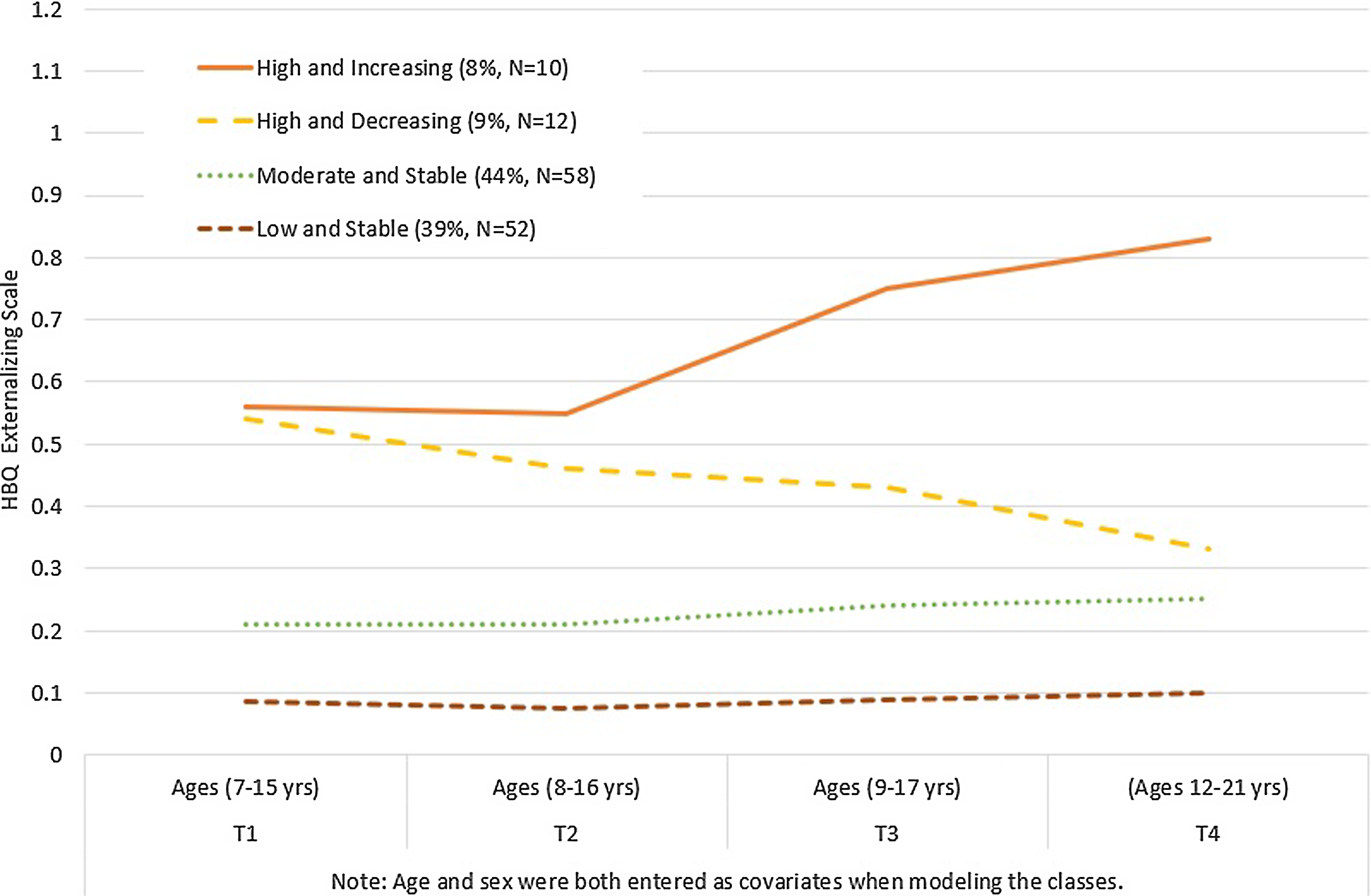
In the 4-class trajectory model, the majority of children demonstrated a moderate and stable level of externalizing behaviors across childhood and into adolescence (44% of the sample; n = 58), with the second largest group demonstrating a low and stable (39% of the sample; n = 52) trajectory. The two remaining classes showed opposite trajectories, or patterns. The third largest group followed a high and decreasing pattern of externalizing behaviors across childhood and adolescence (9% of the sample; n = 12). The fourth group displayed a high and increasing pattern in their externalizing behavior (8% of the sample; n = 10). Examination of the posterior probabilities indicated that individuals were well matched (Nagin, Reference Nagin2005) to their group (.97 for the low and stable trajectory, .96 for the moderate and stable trajectory, .97 for the high decreasing trajectory, and .99 for the high and increasing trajectory).
NA youth. Fit indices for a 2-trajectory model did not converge so we moved to a 3-trajectory model. Fit indices for a 3-trajectory (Adjusted BIC = −972.40; AIC = −972.36; bootstrap-LRT, p < .05; entropy = .94), 4-trajectory model (Adjusted BIC = −992.05; AIC = −991.96; bootstrap-LRT, p < .05; entropy = .90); and 5-trajectory model (Adjusted BIC = −1005.22; AIC = −1005.16; bootstrap-LRT, p < .05; entropy = .90) were then compared for NA youth. Again, although the 5-class solution has the lowest adjusted BIC and AIC, the sample size of the 5th class was small enough that it was not theoretically or statistically useful. Thus, evaluation of model fit statistics suggested that a 4-class solution fit the data well while also being theoretically justified (see Figure 3).
Four-class group trajectory model of externalizing behaviors for NA youth.

In the 4-class trajectory model, the majority of NA children demonstrated a low and stable level of externalizing behaviors from childhood into adolescence (63% of the sample; n = 110), with the second largest group demonstrating a moderate and stable (25% of the sample; n = 45) trajectory. The third largest group followed a moderate and increasing pattern of externalizing behaviors across childhood and adolescence (7% of the sample; n = 12). The fourth group displayed a high and stable pattern (5% of the sample; n = 8) of externalizing behaviors. Examination of the posterior probabilities indicated that individuals were well matched (Nagin, Reference Nagin2005) to their group (.92 for the low and stable trajectory, .90 for the moderate and stable trajectory, .96 for the moderate and increasing trajectory, and .94 for the high and stable trajectory).
Regulatory predictors associated with externalizing trajectory group membership
PI Youth. Results indicated being male (male = 1, female = 0) was associated with an increase in the relative log odds of being classified in the moderate stable, high increasing, and high decreasing externalizing pattern groups as compared to the low-stable group (see Table 3 for all multinomial logistic output for externalizing behaviors including the odds ratios for the predictors). Children who were older at T1 were more likely to be in the low stable group than the moderate stable, high increasing, or high decreasing groups. Although age at adoption was not significant in any group comparisons, we believed it was necessary to retain it in the model given the previous work that has found this to be a significant variable (Merz et al., Reference Merz, McCall, Wright and Luna2013).
Multinomial logistic regression of externalizing behavior trajectory groups with self-regulatory abilities at T1

Note. Bold font indicates significance.
All comparisons were made against the most adaptive low-stable trajectory. The relative log odds of being in the moderate-stable group decreased −6.72 for every one unit increase in parent’s reports of PI children’s global emotion regulation, −1.61 for every one unit increase in PI children’s observed emotion regulation, and −2.00 for being categorized as having a functional cortisol response to the TSST-C. The relative log odds of being in the high and decreasing group decreased −13.07 for every one unit increase in parent’s reports of PI children’s global emotion regulation, and −4.03 for being categorized as having a functional cortisol response to the TSST-C. Observed emotion regulation was significant at a marginal level, but followed the same pattern of effects. The relative log odds of being in the high and increasing group decreased −16.93 for every one unit increase in parent’s reports of PI children’s global emotion regulation, −2.92 for every one unit increase in PI children’s observed emotion regulation, and −4.91 for being categorized as having a functional cortisol response to the TSST-C. Overall, these findings indicate that better behavioral, biological, and global regulatory abilities make it more likely PI children will be in the low-stable externalizing trajectory than follow a more maladaptive externalizing pattern.
NA youth. Results indicated being male (male = 1, female = 0) was associated with an increase in the relative log odds of being in the high-stable group as compared to the low-stable group (see Table 3 for all multinomial logistic output for externalizing behaviors). However, child sex was not a significant predictor when comparing the low stable group to the moderate-increasing or moderate-stable groups. Children who were older at T1 were also more likely to be in the low stable group than the high-stable group, but child age did not change the odds of being in the low stable group as compared to the moderate increasing or the moderate stable group.
Similar to the PI model, all comparisons were made against the most adaptive low-stable trajectory. The relative log odds of being in the high stable group decreased −13.90 for every one unit increase in parent’s reports of NA children’s global emotion regulation, and decreased −3.42 for being categorized as having a functional cortisol response to the TSST-C. Observed emotion regulation did not significantly change the odds of being in the high and stable group. The relative log odds of being in the moderate increasing and moderate stable groups only decreased as parents reported greater global emotion regulation (see Table 3); a one unit increase in parent’s reports of children’s global emotion regulation was associated with a −7.49 decrease in the relative log odds of being in the moderate and increasing trajectory, and a −4.46 decrease in the relative log odds of being in the moderate and stable trajectory. Taken together, this suggests that biological emotion regulation was only able to decrease the odds of being in the most maladaptive externalizing trajectory for NA youth, and biological or observed emotion regulation did not significantly change children’s odds of being in any other maladaptive pattern.
Identifying the internalizing group-based trajectory models
PI youth. Fit indices for a two-trajectory model (Adjusted BIC = −44.24; AIC = −40.04; bootstrap-LRT, p < .05; entropy = .86), 3-trajectory model (Adjusted BIC = −101.96; AIC = −96.36; bootstrap-LRT, p < .05; entropy = .93), 4-trajectory model (Adjusted BIC = −123.92; AIC = −116.91; bootstrap-LRT, p < .05; entropy = .85); and 5-trajectory model (Adjusted BIC = −124.87; AIC = −116.47; bootstrap-LRT, p < .05; entropy = .87) were compared for PI youth. The model fit of the 4-class and 5-class solution were nearly identical. Thus, the five-class solution was not any better than the simpler four-class solution and was no longer considered. The four-class solution had the lowest adjusted BIC and AIC, but it also had the lowest entropy and made less theoretical sense than the three-class solution. Moreover, the sample size of the 4th class was small enough that it was not statistically useful. Thus, evaluation of model fit statistics and theoretical utility suggested that a three-class solution for internalizing behaviors was empirically and theoretically justified (see Figure 4).
Three-class group trajectory model of internalizing behaviors for PI youth.

In the three-class trajectory model, the vast majority of PI children demonstrated a low but increasing level of internalizing behaviors across childhood and into adolescence (65% of the sample; n = 85), with the second largest group demonstrating a moderate and increasing (33% of the sample; n = 43) internalizing pattern. The third group followed a high and decreasing pattern of internalizing behaviors across childhood and adolescence (2% of the sample; n = 4). Examination of the posterior probabilities indicated that individuals were well matched (Nagin, Reference Nagin2005) to their group (.97 for the low and increasing trajectory, .99 for the moderate and increasing trajectory, and .95 for the high and decreasing trajectory).
NA youth. Fit indices for a two-trajectory model (Adjusted BIC = −273.22; AIC = −273.19; bootstrap-LRT, p < .05; entropy = .90), 3-trajectory model (Adjusted BIC = −333.44; AIC = −333.32; bootstrap-LRT, p < .05; entropy = .90), 4-trajectory model (Adjusted BIC = −340.81; AIC = −339.76; bootstrap-LRT, p < .05; entropy = .83); and 5-trajectory model (Adjusted BIC = −349.55; AIC = 348.50; bootstrap-LRT, p < .05; entropy = .75) were then compared for NA youth. Again, although the four- and five-class solution has the lowest adjusted BIC and AIC, the entropy was low and the sample size of the 4th and 5th classes were too small that they were not theoretically useful. Thus, evaluation of model fit statistics suggested that a three-class solution fit the data well while also being theoretically justified (see Figure 5).
Three-class group trajectory model of internalizing behaviors for NA youth.

Similar to the PI model, in the three-class trajectory model, the vast majority of NA children demonstrated a low but increasing level of internalizing behaviors across childhood and into adolescence (71% of the sample; n = 125), with the second largest group demonstrating a moderate and increasing pattern (23% of the sample; n = 40). The third group followed a high and decreasing pattern of internalizing behaviors across childhood and adolescence (6% of the sample; n = 10). Examination of the posterior probabilities indicated that individuals were well matched (Nagin, Reference Nagin2005) to their group (.97 for the low and increasing trajectory, .90 for the moderate and increasing trajectory, and .92 for the high and decreasing trajectory).
Regulatory predictors associated with internalizing trajectory group membership
PI Youth. Results indicated that child sex was not associated with an increase in the relative log odds of being classified in the moderate-increasing or high and decreasing groups as compared to the low and increasing pattern. Child age at T1, or age at adoption were also not significant predictors of class membership (see Table 4 for all multinomial logistic output for internalizing behaviors including the odds ratios for the predictors).
Multinomial logistic regression of internalizing behavior trajectory groups with self-regulatory abilities at T1

Note. Bold font indicates significance.
All comparisons were made against the most adaptive low-increasing trajectory. The relative log odds of being in the high and decreasing group decreased −6.50 for every one unit increase in parent’s reports of PI children’s global emotion regulation, and decreased −1.31 for every one unit increase in PI children’s observed emotion regulation. A one unit increase in parent’s reports of PI children’s emotion regulation was associated with a −2.19 decrease in the relative log odds of being in the moderate and increasing trajectory. Being classified as having a functional cortisol response did not significantly change PI children’s odds of being in any other maladaptive pattern.
NA youth. Results indicated that child sex was not associated with an increase in the relative log odds of being classified in the moderate-increasing or high and decreasing groups as compared to the low and increasing pattern. Child age at T1 was also not a significant predictor of class membership (see Table 4 for all multinomial logistic output for internalizing behaviors).
All comparisons were made against the most adaptive low-increasing trajectory. The relative log odds of being in the high and decreasing group decreased −5.74, and the relative log odds of being in the moderate increasing group decreased −2.27, for every one unit increase in parent’s reports of PI children’s global emotion regulation. Being classified as having a functional cortisol response or showing increases in observed emotion regulation did not significantly change NA children’s odds of being in any other maladaptive pattern.
Discussion
A considerable amount of research shows that children who experience early institutional care are more likely to struggle socially, have a harder time controlling their behavior and impulses, and are at greater risk for displaying externalizing and internalizing behaviors (e.g., Wiik et al., Reference Wiik, Loman, Van Ryzin, Armstrong, Essex, Pollak, S. and Gunnar2011; Zeanah et al., Reference Zeanah, Egger, Smyke, Nelson, Fox, Marshall and Guthrie2009). Although this work has provided important insight regarding the potential consequences of early deprivation on child development, empirical work examining specific developmental mechanisms that might help explain why and how early institutional care may be associated with maladaptive outcomes across domains is significantly lacking. Moreover, research examining these links is frequently cross-sectional, primarily because there are few studies in this area with longitudinal data spanning multiple developmental periods. Thus, while it is clear that early institutional care is associated with greater risk of psychopathology and socioemotional problems, less is known regarding the trajectories of mental health in PI youth and how those trajectories may be similar or different from their never-institutionalized peers. Given the limitations of the existing literature, the goals of the current study were to not only identify longitudinal patterns of psychopathology in PI youth from middle childhood through early adulthood, but to also examine biobehavioral emotion regulation processes as developmental mechanisms that help to predict the likelihood of following specific mental health trajectories. In doing so, researchers may be better able to identify points of intervention that may alter the course of developmental psychopathology for PI youth.
When modeling the group-based externalizing trajectories, four unique patterns emerged for PI youth. The majority of PI youth demonstrated a moderate and stable level of externalizing behaviors (44%), with the second largest group demonstrating a low and stable trajectory (39%). In total, 83% of PI youth remained somewhat stable in their externalizing trajectories, a point further supported by the high correlations in PI youths’ externalizing behaviors over time. Although more PI youth were classified in the moderate and stable externalizing subgroup rather than the more adaptive low and stable subgroup, it is important to acknowledge that a large subset of PI youth show resilience and display relatively low and stable externalizing behaviors over time, a finding that can often get lost if simply looking at mean level differences across NA and PI populations.
The two remaining PI trajectories showed opposite patterns; the third largest group followed a high and decreasing pattern of externalizing behaviors (9%) and the fourth group displayed a high and increasing pattern in their externalizing behaviors (8%). The fact that some youth increase and others decrease in externalizing symptoms over time, highlights the need for a group-based person-centered approach. Variable-centered approaches focusing on the relation among variables would not be able to capture the significant contrast in variation in PI youths’ trajectories, or allow for the identification of predictors of maladaptive and adaptive trajectories. Thus, this work elucidates variation in a developmental pattern, rather than simply identifying poorer mental health in PI youth.
Upon the identification of distinct longitudinal externalizing trajectories, the next logical step is to determine whether factors can be identified that increase the likelihood of youth following a more adaptive trajectory. It is clear that a subgroup of PI youth do remain relatively low in their externalizing displays. What skills or deficits help to explain why and how PI youth are more likely to follow one trajectory than another? Given that the development of adaptive emotion regulation is heavily embedded within the context of warm and consistent caregiver–child interactions during early childhood (Sroufe, Reference Sroufe1996), a context that PI children did not experience, and that poor emotion regulation has been theoretically and empirically identified as a risk factor for developmental psychopathology, we tested whether biobehavioral emotion regulation processes may play a significant role in predicting the likelihood of following specific mental health patterns. In general, we found that a functional cortisol response to social stress, greater observed emotion regulation, and greater parent-reported global emotion regulation were each associated with a greater likelihood of being in the low and stable externalizing trajectory compared to the high-increasing, high-decreasing, or even moderate-stable externalizing trajectory. Biological, observed, and reported emotion regulation variables were also not correlated with one another, suggesting that each represents a distinct component of emotion regulation that may play a role in differentiating developmental trajectories of mental health.
Importantly, the strongest effects of all emotion regulation processes emerged when predicting membership in the most maladaptive externalizing pattern (i.e., high and increasing) compared to the most adaptive pattern (i.e., low and stable). For example, although cortisol reactivity was a significant predictor in every comparison, mounting a functional cortisol response was associated with a −4.91 decrease in the log odds of following the high and increasing externalizing trajectory compared to the low and stable trajectory, but only a −2.00 decrease in the log odds of following the moderate and stable trajectory compared to the low and stable trajectory. The same pattern emerged for observed and global behavioral regulation. These findings suggest a graded association such that the likelihood PI children will be in the most adaptive low and stable trajectory increases gradually the better they are at regulating biologically and behaviorally. Further, the finding that increases in emotion regulation were associated with a greater likelihood of following the low-stable trajectory when compared to the moderate and stable trajectory has significant intervention and prevention implications because it suggests that better emotion regulation can matter for even distinguishing the least problematic or most mild trajectory from the most optimal.
Because we wanted to know how these various trajectories might differ for NA youth, and whether emotion regulation skills predict the likelihood of following different externalizing trajectories in the same way they do for PI youth, we conducted the same analyses with a NA sample. Although no direct comparisons were examined, visual comparisons showed similar patterns emerged, as expected, a higher proportion of NA youth were classified in the subgroup following the most optimal low and stable externalizing trajectory. However, we still questioned whether biobehavioral emotion regulation processes would predict the likelihood NA youth would follow the low and stable trajectory compared to less optimal ones. In general, only parent-reported global emotion regulation significantly increased the likelihood of NA youth following the low and stable pattern of externalizing behaviors when compared to high-stable, moderate-increasing, and moderate-stable patterns. There was one exception; mounting a functional cortisol response to social stress increased the likelihood of being in the low and stable subgroup when compared to the most maladaptive high and stable externalizing group. The link between lower cortisol responses and externalizing behaviors in never-institutionalized samples has been previously demonstrated (Konzok et al., Reference Konzok, Henze, Peter, Giglberger, Bärtl, Massau, Kärgel, Schiffer, Eisenbarth, Wüst and Kudielka2021), and fits with the current findings.
In general, results could mean that broader global regulation is most important for NA youths’ externalizing patterns. For PI youth, global regulation in addition to the context-specific biological and observed emotion regulation in the TSST-C were important predictors of variation in externalizing trajectories. It is not entirely clear why biobehavioral emotion regulation processes might matter more for PI youths’ externalizing trajectories. The dorsal striatum is part of the mesolimbic system, which is known to be sensitive to environmental adversity (Konzok et al., Reference Konzok, Henze, Peter, Giglberger, Bärtl, Massau, Kärgel, Schiffer, Eisenbarth, Wüst and Kudielka2021). Thus, early adverse environments experienced by PI youth may affect dorsal striatum activity to an even greater extent than in NA samples, resulting in a stronger link between the cortisol stress response and variation in externalizing patterns in PI populations. Or perhaps, a broader general control of emotion is all that is needed for typically-reared children who show more typical biological and social responses to stress. For PI youth, a population with a greater propensity to display non-typical biological stress responses across neurobiological systems (Koss et al., Reference Koss, Mliner, Donzella and Gunnar2016) and difficulties in social interactions (Cáceres et al., Reference Cáceres, Román, Moreno, Bukowski and Palacios2021; Pitula et al., Reference Pitula, DePasquale, Mliner and Gunnar2019), neurobiological regulation and control of social behavior may be particularly important predictors of externalizing behaviors, especially in emotionally-charged social contexts where appropriate social interaction is both expected and the goal.
It is also possible that in order to capture the influence of these distinct regulatory processes for NA youth, we may have to look earlier in development; we may be witnessing PI youth relying on emotion-regulation skills they refined post adoption to “catch-up” to their typically-reared peers. Indeed, previous work has linked better emotion regulation with fewer behavior problems in early childhood for NA youth (Gartstein et al., Reference Gartstein, Putnam and Rothbart2012; Perry, Dollor, et al., Reference Perry, Dollar, Calkins, Keane and Shanahan2020; te Brinke et al., Reference te Brinke, Menting, Schuiringa, Deković, Weisz and de Castro2021), and provided evidence that the normative decline in externalizing behaviors across childhood may be a function of NA youths’ early emerging self-regulatory abilities (e.g., Calkins & Dedmon, Reference Calkins and Dedmon2000; Perry, Dollor, et al., Reference Perry, Dollar, Calkins, Keane and Shanahan2020).
When modeling trajectories of internalizing symptoms, a three-class trajectory was the best fit for both NA and PI youth. The specific patterns within the PI and NA models were also similar. The majority of PI (65%) and NA (71%) youth demonstrated a low but increasing trajectory. The second largest group for both PI (33%) and NA (23%) youth showed a moderate but increasing trajectory. The largest increases for both of these trajectories across both the PI and NA models occurred from assessment 3 to assessment 4. These data were collected between July of 2020 and September of 2020, a time that directly coincided with the most invasive lock-down period of the coronavirus pandemic. Because we know that youth report pandemic-related stress in the form of both increased anxiety and depression (Crescentini et al., Reference Crescentini, Feruglio, Matiz, Paschetto, Vidal, Cogo and Fabbro2020; Racine et al., Reference Racine, Cooke, Eirich, Korczak, McArthur and Madigan2020; Weissman et al., Reference Weissman, Rodman, Rosen, Kasparek, Mayes, Sheridan, Lengua, Meltzoff and McLaughlin2021), it is probable that some of the increase in internalizing behaviors displayed from assessment 3 to assessment 4 in both groups is related to pandemic stress.
The low and increasing PI trajectory showed a slight increase in internalizing symptoms from assessment 2 to assessment 3 when youth were 8–17-years-old. Interestingly, we have also found evidence that increases in PI youths’ cortisol reactivity across adolescence are associated with increased internalizing-type symptoms and socially anxious behaviors (Perry, Depasquale, et al., Reference Perry, Depasquale, Donzella and Gunnar2020; Perry et al., Reference Perry, Depasquale, Donzella and Gunnar2022). Thus, it is possible that brain structure adapted to hypocortisolism early in life and increases in cortisol reactivity to more typical levels in middle childhood and adolescence may be considered “too much,” thereby exacerbating internalizing, but not necessarily externalizing, symptoms (Strüber et al., Reference Strüber, Strüber and Roth2014). It is also possible that the lack of association between cortisol responding and internalizing symptoms found in the current study, can be partially explained by pubertal effects on PI youths’ HPA functioning and mental health. Future research is needed to better elucidate these associations.
The last trajectory identified for both PI (2%) and NA (6%) youth was characterized by a high and decreasing pattern. On average, PI youth in this trajectory displayed higher internalizing behaviors than the NA youth on the same trajectory, and these individuals remained high even after showing a decrease. NA youth on the high and decreasing trajectory showed levels similar to those in the moderate and increasing trajectory by assessment 4. Because very few individuals fell into these trajectories in both the PI and the NA model, caution should be taken when interpreting these findings. Additional empirical work is needed to better understand youth experiencing the highest and most consistent externalizing behaviors from childhood through young adulthood.
Although biological, behavioral, and global emotion regulation processes distinctly predicted the likelihood of PI youth following unique externalizing trajectories, generally, only parent-reported global emotion regulation was a significant predictor of internalizing trajectories for both PI and NA populations. Thus, overall, findings suggest that emotion regulation processes, particularly biological stress-responding and observed emotion regulation behaviors during social contexts may be more important for PI youths’ externalizing behaviors than their internalizing behaviors. This may be because biological and behavioral regulation during social exchanges allows youth to display more appropriate behavior, reducing the likelihood of PI youth engaging in aggression or defiance. These specific emotion regulation skills, over and above a general global ability to control emotion, may not be as influential for internalizing symptoms that are often not as evident, or seen as troublesome, to social partners.
The current study had a considerable number of strengths including: (1) the longitudinal four-assessment design spanning ages 7–21-years-old, (2) the multimethod approach that allowed for the investigation of the associations between specific biological, behavioral, and global emotion regulation processes and youths’ mental health trajectories, (3) the inclusion of a NA sample to model unique trajectories of mental health problems within early institutionalized and non-institutionalized samples, and (4) the examination of internalizing and externalizing trajectories by group, to not only gain a clearer picture of how patterns in each change over time, but also to identify the predictive salience of biobehavioral emotion regulation for each.
Despite these strengths, the study was also limited in that we relied on parent-report to assess youths’ internalizing and externalizing behaviors as well as their global emotion regulation. Thus, the consistent and significant prediction of both internalizing and externalizing trajectories, across both PI and NA youth by global emotion regulation could be attributed, at least in part, to inflated parameter estimates that resulted from shared method variance. Moreover, parents’ beliefs about the effects of early institutional care may have biased their reports of their children’s internalizing and externalizing behaviors. It is also possible that fewer internalizing findings emerged because parents are not as aware of internalizing symptoms in their children as they are the more easily observable externalizing symptoms. However, our findings fit well with research showing increased psychopathology in PI youth using more objective measures such as teacher and child self-report (Gagnon-Oosterwaal et al., Reference Gagnon-Oosterwaal, Cossette, Smolla, Pomerleau, Malcuit, Chicoine, Jéliu, Belhumeur and Berthiaume2012; Kjelsberg & Nygren, Reference Kjelsberg and Nygren2004; Wiik et al., Reference Wiik, Loman, Van Ryzin, Armstrong, Essex, Pollak, S. and Gunnar2011). Further, while we did exclude children with known prenatal conditions such as fetal alcohol syndrome, congenital disorders, and diagnosed cognitive delays, the full prenatal history of PI children is unknown. Thus, there may be additional factors (e.g., genetics, variation in risk) that led to institutionalization that contributed to patterns of psychopathology observed in the current study. Moreover, previously institutionalized youth who are adopted by predominantly white families may also face challenges related to racial differences and feelings of being an outsider in their adopted family, which may further contribute to mental health. Future work using a non-PI adoption control group may help provide important insight and increase generalizability of findings. Children’s communication skills may also play a role in the association between observed performance in the stress paradigm and mental health. Unfortunately, the study is limited such that we do not have additional measures of children’s communication to use as a baseline comparison. To better understand the role of children’s communication, future work is needed that separates the two constructs. Finally, the cell sizes in some of the most maladaptive group-based trajectories were small, influencing parameter estimates and making it harder to detect and interpret the effect of individual biobehavioral emotion regulation components. Future work conducted with more children who follow the most maladaptive trajectories may shed more light on these associations.
Conclusions
The present study adds to a small but growing literature aiming to investigate the effects of early institutional rearing on longitudinal trajectories of developmental psychopathology and is one of few to investigate potential process mechanisms that help to identify the way in which early institutional care is associated with subsequent maladjustment. This work provides evidence that emotion regulation processes functioning at the biological, behavioral, and global level, are predictive of variation in PI youths’ externalizing trajectories over time. Moreover, findings from this study suggest that targeting distinct emotion regulation competencies may have a unique and significant impact for interventions aiming to improve mental health in PI populations.
Acknowledgements
The authors wish to thank the families who devoted many hours to the original longitudinal study from which the current data were taken. Special thanks to Bao Moua, Teresa Grunklee, and Abby Cavanaugh who helped recruit, collect, and process the data from the 4th follow-up assessment, and to Megan Gunnar who provided comments on a draft of this manuscript. Carrie DePasquale was an integral part of the design and collection of the data used in this study, particularly at the 4th follow-up assessment, and passed away in September of 2020 before the write-up of this work.
Funding statement
This research was supported by a grant from the National Institute of Child Health and Human Development through the National Institutes of Health [5R01 HD075349] to Megan Gunnar.
Conflicts of interest
None.



