Child maltreatment is characterized by severe dysfunction in parenting and a substantial disturbance in the parent–child relationship that may eventuate in aberrant biological and psychological development and psychopathology across the life span (Azar, Reference Azar and Bornstein2002; Cicchetti & Valentino, Reference Cicchetti, Valentino, Cicchetti and Cohen2006; Cyr, Euser, Bakermans-Kranenburg, & van IJzendoorn, Reference Cyr, Euser, Bakermans-Kranenburg and Van IJzendoorn2010; Rogosch, Cicchetti, Shields, & Toth, Reference Rogosch, Cicchetti, Shields, Toth and Bornstein1995; Toth, Cicchetti, Macfie, Maughan, & van Meenen, Reference Toth, Cicchetti, Macfie, Maughan and VanMeenan2000). The provision of sensitive, emotionally secure, and protective parenting is woefully lacking in the caregiving environments of maltreated infants (Cicchetti & Lynch, Reference Cicchetti, Lynch, Cicchetti and Cohen1995; Cicchetti & Toth, Reference Cicchetti and Toth2005; Davies, Winter, & Cicchetti, Reference Davies, Winter and Cicchetti2006), and maltreating parents may be considered to be an aberration of the supportive, nurturant adults that are expected by infants in the evolutionary context of species-typical development (Cicchetti & Lynch, Reference Cicchetti, Lynch, Cicchetti and Cohen1995; Tarullo & Gunnar, Reference Tarullo and Gunnar2006). Infants and children who have been maltreated may be regarded as “caretaking casualties” (Cicchetti & Rizley, Reference Cicchetti and Rizley1981; Egeland, Cicchetti, & Taraldson, Reference Egeland, Cicchetti and Taraldson1976; Sameroff & Chandler, Reference Sameroff, Chandler and Horowitz1975).
In contrast to what is anticipated in response to an expectable environment, the biological, psychological, and social conditions associated with child maltreatment usher in motion a probabilistic path of epigenesis for abused and neglected children that increases the likelihood of repeated disruptions in the positive mastery of the stage-salient issues of each successive developmental period (Cicchetti & Lynch, Reference Cicchetti and Lynch1993; Cicchetti & Toth, Reference Cicchetti and Toth1995). Failures in the successful resolution of these developmental tasks may create a developmental cascade of maladaptation across diverse domains of biological, socioemotional, and cognitive development and increase the probability of psychopathology as negative transactions continue to ensue between maltreated children and their environments (Masten & Cicchetti, Reference Masten and Cicchetti2010; Rogosch, Oshri, & Cicchetti, Reference Rogosch, Oshri and Cicchetti2010).
In addition to adverse effects on socioemotional and cognitive development, infants and children who either are maltreated or who reside in maltreating environments encounter numerous stressful experiences that can exert harmful impacts upon neurobiological development and gene expression (Beach, Brody, Todorov, Gunter, & Phillibert, Reference Beach, Brody, Todorov, Gunter and Philibert2009; Cicchetti, 2002; Cicchetti & Curtis, Reference Cicchetti and Curtis2005; Cicchetti & Rogosch, Reference Cicchetti and Rogosch2001; DeBellis, Reference DeBellis2001, Reference DeBellis2005; McCrory, DeBrito, & Viding, Reference McCrory, DeBrito and Viding2010; Trickett, Noll, Susman, Shenk, & Putnam, Reference Trickett, Noll, Susman, Shenk and Putnam2010). In particular, maltreated infants may be particularly vulnerable to the effects of stressful experiences during periods of rapid creation or modification of neuronal connections, such as those that take place during the course of the first years of life (Black, Jones, Nelson, & Greenough, Reference Black, Jones, Nelson, Greenough, Alessi, Coyle, Harrison and Eth1998; Cicchetti, Reference Cicchetti, Hartup and Weinberg2002; Stiles, Reference Stiles2008; Thompson & Nelson, Reference Thompson and Nelson2001). Extremely adverse, overwhelming, and traumatic experiences may become part of a vicious cycle, as the pathology induced in brain structure may distort the maltreated child's experience of the world, with subsequent alternations in cognitive functioning (Cicchetti, Rogosch, Maughan, Toth, & Bruce, Reference Cicchetti, Rogosch, Maughan, Toth and Bruce2003; Jaffee & Maikovich-Fong, Reference Jaffee and Maikovich-Fong2011; Pollak, Cicchetti, Klorman, & Brumaghim, Reference Pollak, Cicchetti, Klorman and Brumaghim1997; Rieder & Cicchetti, Reference Rieder and Cicchetti1989; Toth, Pickreign Stronach, Rogosch, Caplan, & Cicchetti, in press) and social interactions (Rogosch, Cicchetti, & Aber, Reference Rogosch, Cicchetti and Aber1995; Teisl & Cicchetti, Reference Teisl and Cicchetti2008) contributing to further detrimental experiences and additional brain pathology (Black et al., Reference Black, Jones, Nelson, Greenough, Alessi, Coyle, Harrison and Eth1998; Cicchetti & Tucker, Reference Cicchetti and Tucker1994).
During infancy and early childhood, the developing hypothalamic–pituitary–adrenal (HPA) axis is under powerful social regulation (Levine, Reference Levine2005; Tarullo & Gunnar, Reference Tarullo and Gunnar2006). As such, the HPA axis of maltreated youngsters is vulnerable to disturbance given the relative lack of sensitive and emotionally supportive caregiving provided. Incidents of maltreatment may engender massive acute and chronic stress in infants and children who reside in such environments. Stressful, threatening, or frightening experiences, such as those associated with child abuse and neglect, create significant challenges to adaptive development (Gunnar & Vazquez, Reference Gunnar, Vazquez, Cicchetti and Cohen2006). Consequently, allostatic load processes may be unfolding very early in the development of maltreated infants and children, setting up the potential for life-long difficulties in the regulation of physiological stress systems (Juster, McEwen, & Lupien, Reference Juster, McEwen and Lupien2009) and the emergence of concomitant neurobiological, emotional, cognitive, and physical health problems throughout the life course (Felitti et al., Reference Felitti, Anda, Nordenberg, Williamson, Spitz and Edwards1998).
Given that maltreated children experience a magnitude of stressors that often are present during infancy, the capacity to regulate the stress hormone, cortisol (which exerts impacts on nearly all organs and tissues of the body, including the brain), is of critical importance for these youngsters. Research with rodents, nonhuman primates, and humans, has shown that parental caregiving mediates the regulation of the HPA axis (see, e.g., Francis, Diorio, Plotsky, & Meaney, Reference Francis, Diorio, Plotsky and Meaney2002; Levine, Reference Levine2005; Meaney & Szyf, Reference Meaney and Szyf2005; Sanchez, Reference Sanchez2006). The disruption of maternal care in rodents results in an HPA system that is not buffered against stress. Abusive or harsh treatment of monkey infants also interferes with the buffering function provided by the typical monkey mother (see, e.g., Levine, Reference Levine2005; McCormack et al., Reference McCormack, Grand, LaPrairie, Fulks, Graff and Maestripieri2003; Sanchez et al., Reference Sanchez, McCormack, Grand, Fulks, Graff and Maestripieri2010). Likewise, sensitive and emotionally secure parental caregiving also has been demonstrated to protect the HPA axis in human infants and young children, whereas the HPA axis of youngsters who do not receive responsive caregiving, such as those who are abused and neglected, is not safeguarded against stress (Brand et al., Reference Brand, Brennan, Newport, Smith, Weiss and Stowe2010; Bugental, Martorell, & Barraza, Reference Bugental, Martorell and Barraza2003; Hart, Gunnar, & Cicchetti, Reference Hart, Gunnar and Cicchetti1995; Tarullo & Gunnar, Reference Tarullo and Gunnar2006).
Research on the impact of early caregiving adversity in humans has revealed that the HPA axis is highly likely to exhibit evidence of dysregulation and that this dysregulation may entail both hyper- and hypofunctioning (Cicchetti & Rogosch, Reference Cicchetti and Rogosch2001; Cicchetti, Rogosch, Gunnar, & Toth, Reference Cicchetti, Rogosch, Gunnar and Toth2010; Gunnar & Vazquez, Reference Gunnar and Vazquez2001; Heim, Newport, Mletzko, Miller, & Nemeroff, Reference Heim, Newport, Mletzko, Miller and Nemeroff2008). Levels of cortisol, the final hormonal product of the neuroendocrine system, that are chronically elevated during development, when neural circuits are still in the process of maturing, exert an impact on brain development by affecting neurotropic factors and regulating gene transcription, thereby influencing the manner in which neural circuits perceive and interpret environmental threat and the magnitude and duration of future stress responses (Tarullo & Gunnar, Reference Tarullo and Gunnar2006). In addition, chronically low levels of basal cortisol also can eventuate in harmful effects on the brain, as well as on physical and mental health and behavior (Juster et al., Reference Juster, McEwen and Lupien2009, Reference Juster, Bizik, Picard, Arsenault-Lapierre, Sindi and Trepanier2011; Lupien et al., Reference Lupien, Ouellet-Morin, Hupbach, Tu, Buss, Walker, Cicchetti and Cohen2006). Both hyper- and hypocortisolism can reflect allostatic load, typically defined as the result of chronic exposure to fluctuating or heightened neural or neuroendocrine responses that emerge in response to chronic environmental challenges that are perceived as especially stressful (McEwen & Stellar, Reference McEwen and Stellar1993).
Heightened fear and activation of the HPA system as a function of early adverse care may produce an increase in allostatic load over the life span (Trickett et al., Reference Trickett, Noll, Susman, Shenk and Putnam2010). The HPA axis tends to downregulate in response to prolonged hyperactivation. Consequently, chronic stressors such as child maltreatment initially evoke hyperactivity of the HPA axis, followed by later hypoactivity (Trickett et al., Reference Trickett, Noll, Susman, Shenk and Putnam2010). It is important to note that the dysregulation in HPA axis functioning commonly observed in maltreated infants and children, although often harmful in adulthood, initially may have served as an adaptive alteration (Tarullo & Gunnar, Reference Tarullo and Gunnar2006). A major difficulty lies in the fact that, because the HPA stress system begins from a state of immaturity at birth and because the developing neural circuitry is influenced by early experience, the manner in which the brain will respond to stress over time may no longer be adaptive outside of the maltreating environment (Tarullo & Gunnar, Reference Tarullo and Gunnar2006).
The plethora of studies documenting the neuroendocrine disturbances following child maltreatment, in concert with the likely harmful developmental sequelae of these HPA axis disturbances and the accompanying sustained allostatic load, underscore the criticality of implementing randomized control trial (RCTs) preventive interventions in order to ascertain whether they can modify and reorganize the alterations in HPA axis functioning (Cicchetti & Gunnar, Reference Cicchetti and Gunnar2008). In the human literature, evidence is beginning to accrue suggesting that efficacious interventions with children in foster care may modify not only maladaptive behavior, but also the neuroendocrine correlates of behavior (Dozier, Peloso, Lewis, Laurenceau, & Levine, Reference Dozier, Peloso, Lewis, Laurenceau and Levine2008; Fisher, Gunnar, Dozier, Bruce, & Pears, Reference Fisher, Gunnar, Dozier, Bruce and Pears2006; Fisher, Stoolmiller, Gunnar, & Burraston, Reference Fisher, Stoolmiller, Gunnar and Burraston2007). Methodologically rigorous RCTs that incorporate a multilevel measurement battery have begun to provide a unique lens through which the processes responsible for the development, maintenance, and modification of both typical and atypical functional neuroendocrine outcomes can be discerned (Gunnar, Fisher, & the Early Experience, Stress, and Prevention Network, Reference Gunnar and Fisher2006).
Investigations with rodents, nonhuman primates, and human children have discovered that early separations from caregivers may lead to alterations in the functioning of the HPA system (Gunnar & Quevedo, Reference Gunnar and Quevedo2007; Sanchez, Ladd, & Plotsky, Reference Sanchez, Ladd and Plotsky2001). In an innovative illustration of the capability of psychosocial interventions to modify diurnal cortisol activity, Fisher et al. (Reference Fisher, Stoolmiller, Gunnar and Burraston2007) conducted a 6- to 9-month RCT of a family-based foster care therapeutic intervention for preschool children. The therapeutic intervention was compared to a regular foster care condition and a demographically comparable group of same-aged, nonmaltreated preschool children from low-socioeconomic status families. Fisher et al. (Reference Fisher, Stoolmiller, Gunnar and Burraston2007) collected and assayed early-morning and evening cortisol levels from the preschool children (mean age = 4.4 years) on a monthly basis from the baseline until the end of the intervention. One common disturbed cortisol pattern that emanates from disruptions in caregiving is a low early-morning cortisol that displays minimal change across the day. Fisher and colleagues (2007) found that the foster children who received the family-based therapeutic intervention exhibited cortisol activity that became comparable to the nonmaltreated comparison (NC) children over the course of the intervention. In contrast, children who received routine services in state foster care (e.g., weekly individual psychotherapy; developmental screening for delays with the subsequent provision of special education services, if needed) displayed an increasingly flattened pattern of early morning to evening cortisol activity throughout the course of the RCT. The results of this psychosocial intervention demonstrate that improvements in caregiving following the experience of early adversity have the potential to reverse or prevent disturbances in the HPA system (Fisher et al., Reference Fisher, Stoolmiller, Gunnar and Burraston2007).
The study of child maltreatment as a “natural experiment” provides a valuable lens into the relations between sensitive caregiving and stress regulation and reveals insights for translation of basic empirical findings into RCTs aimed are reorganizing and normalizing these relations. Moreover, the conduct of RCTs, such as that described above, yields important knowledge regarding the malleability of developmental processes. Psychosocial randomized preventive interventions with previously maltreated children placed in foster care provide important opportunities for children who have transitioned into a changed environment to manifest competent biological and behavioral functioning. For children in foster care, there may be variability with respect to the presence of continued stressful experiences. For example, the move to foster care may be traumatic for some children even if they have been placed in a better setting than their previous home or foster care experience.
In the current investigation, we report the findings of a 12-month RCT intervention with maltreated infants. One intervention, child–parent psychotherapy (CPP), is an attachment-based, nondirective approach that encourages sensitive interactions between caregivers and their children by helping parents form positive representations of themselves and the caregiver–child relationship. The second intervention, psychoeducational parenting intervention (PPI), is a didactic intervention that teaches parenting skills, relaxation techniques, and behaviors that promote social support. At postintervention, both CPP and PPI were found to be efficacious in improving secure attachments and in decreasing disorganized attachment (Cicchetti, Rogosch, & Toth, Reference Cicchetti, Rogosch and Toth2006). In contrast to the maltreated children participating in the foster care interventions described above, the maltreated children in our RCT all resided in their natural homes with their biological caregiver(s). The infants in the intervention groups were compared to a group of maltreated children receiving the community standard intervention typically provided when maltreatment is identified by the local Department of Human Services. An additional nonmaltreated demographically comparable group of infants also was included. Morning cortisol was assayed at baseline, at 6 months midintervention, at postintervention, and at 1 year after the completion of the RCT.
Hypotheses
Our work was guided by the following hypotheses:
1. Maltreated infants will display lower a.m. cortisol levels in comparison to those of the NCs.
2. The maltreated infants who received the relational or the parenting interventions will not differ from NC s in their a.m. cortisol levels, either at the end of the intervention or at the 1-year postintervention follow-up assessment.
3. The a.m. cortisol levels of the maltreated children receiving the community standard will exhibit increasingly lower levels of cortisol throughout the intervention and at the postintervention follow-up.
Method
Participants
Infants in maltreating families and their mothers were recruited for a study of the effects of child maltreatment on infant development and for an evaluation study of the efficacy of two preventive interventions designed to optimize mother–infant relationships and improve parenting. In the current report, the maltreatment sample consisted of 91 infants (43 boys, 48 girls) and their mothers. An NC group of 52 infants (28 boys, 24 girls) and their mothers also were recruited. During the initial assessment, infants were on average 13.3 months of age (SD = 0.80).
In order to recruit 1-year-old infants in maltreating families and their mothers, a Department of Human Services (DHS) recruitment liaison was retained. As an employee of DHS, the liaison was able to access DHS Child Protective Service (CPS) and preventive service records in order to identify all infants known to have been maltreated and/or who were living in maltreating families with their biological mothers. Infants who had been placed in foster care were not targeted for inclusion because of the limited ongoing contact with their mothers. The DHS liaison contacted eligible families and explained the project to mothers. Mothers who were interested in participating signed a release form in order for their names to be given to project staff. During the initial contact by project staff, the mothers provided informed consent and permission for their infant's participation. Mothers also signed a release allowing project staff to have access to DHS records regarding the family's CPS and preventive service involvement.
Maltreatment determinations
All DHS records pertaining to the family were accessed and independently coded by trained research staff. The Maltreatment Classification System (MCS; Barnett, Manly, & Cicchetti, Reference Barnett, Manly, Cicchetti, Cicchetti and Toth1993) was utilized to identify all forms of maltreatment that had occurred in the family and that the infant had experienced. Based on operational criteria, the MCS designates all subtypes of maltreatment (i.e., neglect, emotional maltreatment, physical abuse, sexual abuse). Coding of the DHS records was conducted by trained research staff, doctoral students, and clinical psychologists. Adequate reliability has been obtained (weighted kappas ranging from 0.86 to 0.98). Other investigators have demonstrated that the MCS is reliable and valid in classifying maltreatment (Bolger, Patterson, & Kupersmidt, Reference Bolger, Patterson and Kupersmidt1998; Dubowitz et al., Reference Dubowitz, Pitts, Litrownik, Cox, Runyan and Black2005; English et al., Reference English, Upadhyaya, Litrownik, Marshall, Runyan and Graham2005; Manly, Reference Manly2005; Smith & Thornberry, Reference Smith and Thornberry1995).
In terms of the subtypes of maltreatment, neglect involves failure to provide for the child's basic physical needs for adequate food, clothing, shelter, and medical treatment. In addition to inadequate attention to physical needs, forms of this subtype include lack of supervision, moral–legal neglect, and education neglect. Emotional maltreatment involves extreme thwarting of children's basic emotional needs for psychological safety and security, acceptance, and self-esteem, and age-appropriate autonomy. Examples of emotional maltreatment of increasing severity include belittling and ridiculing the child, extreme negativity and hostility, exposure to severe marital violence, abandoning the child, and suicidal or homicidal threats. Physical abuse involves the nonaccidental infliction of physical injury on the child (e.g., bruises, welts, burns, choking, broken bones). Injuries range from minor and temporary to permanently disfiguring. Finally, sexual abuse involves attempted or actual sexual contact between the child and caregiver for purposes of the caregiver's sexual satisfaction or financial benefit. Events range from exposure to pornography or adult sexual activity, to sexual touching and fondling, to forced intercourse with the child.
In the recruited sample, we considered specific subtypes of maltreatment that had been experienced by the targeted infant (individual level), as well as subtypes of maltreatment that also had occurred among all children in the family (family level), in order to characterize the broader maltreating family context. For infants in the maltreatment sample, 71.4% had directly experienced abuse and/or neglect during the first year of life. For these infants with individual level maltreatment, none had been sexually abused, whereas 10.8% had been physically abused, 83.1% had been neglected, and 69.2% had been emotionally maltreated. The majority of these infants, 55.4%, had experienced more than one subtype of maltreatment. Few cases of physical abuse were present in the subgroup of infants with individual level maltreatment because of the high likelihood of foster care placement when infants are subjected to physical abuse. The remaining subgroup of infants (28.6%) in the maltreatment sample were living in families where legally documented abuse and neglect had been experienced by siblings, that is, at the family level only.
Despite variation in the presence of individual level abuse/neglect among the infants in the maltreatment sample, the rates of abuse and neglect occurring more broadly at the family level across siblings in these families were substantial. For the subgroup of families with infants with individual level maltreatment (71.4%) versus the subgroup of families with infants where family level maltreatment only had occurred (28.6%), the rate of family level sexual abuse, physical abuse, and/or emotional maltreatment, among children in the family was high in both groups (89.2% and 84.6%, respectively), as was the rate of family level neglect (92.3% and 88.5%, respectively). Thus, extensive child maltreatment across family members had been documented in the families comprising the maltreatment sample.
Recruitment of nonmaltreating families
Because of the predominance of poverty in the sample of maltreating families, a demographically comparable sample of mothers and infants in low-income families was recruited through the rolls of families receiving Temporary Assistance to Needy Families (TANF). The DHS liaison identified families with infants from the TANF rolls and screened these families for child maltreatment. The DHS liaison then contacted eligible families, explained the study, and for interested mothers, obtained a signed release form in order for the family's name to be given to the research staff. Subsequently, project staff obtained informed consent and signed permission for all DHS records pertaining to the family to be reviewed. DHS and preventive records were thoroughly screened to rule out the existence of documented child maltreatment in these families. Mothers also were interviewed utilizing the Maternal Maltreatment Classification Interview (Cicchetti, Toth, & Manly, Reference Cicchetti, Toth and Manly2003) regarding maltreatment and any DHS involvement to further validate nonmaltreatment status.
Sample characteristics
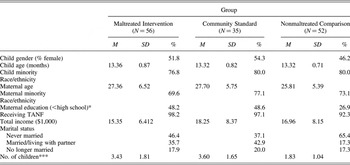
Following completion of baseline assessments, the mothers and infants recruited for the maltreatment sample were randomly assigned to one of three groups: CPP, PPI, and standard services typically provided in the community, community standard (CS). Some mothers assigned to receive one of the theoretically informed preventive interventions (CPP or PPI) declined to participate in treatment. Because of the noncompliance with random group assignment, these mothers (n = 46) and their infants were not included in the current report. The resulting group sizes in the current investigation were: CPP (n = 32), PPI (n = 24), and CS (n = 35). Because prior research with this sample (Cicchetti et al., Reference Cicchetti, Rogosch and Toth2006) demonstrated comparable postintervention effects for the CPP and PPI groups in improving the mother–child relationship, and because the two groups did not differ in cortisol levels across time, as discussed below, these two interventions were combined into one maltreated intervention group (MI: n = 56). The MI, CS, and NC groups were comparable on a range of demographic variables, as shown in Table 1. The groups did not differ on child gender, child minority race/ethnicity, or age at the initial assessment. Furthermore, the groups did not differ on maternal age, maternal minority race/ethnicity, current receipt of TANF, total family income, or marital status. Mothers on average were 26.90 years of age (SD = 5.96), 72.5% were of minority race/ethnicity, and 30.81% of mothers were currently married or living with a partner. The average family income was $16,646.00, including welfare benefits, and 95.8% of the families were currently receiving TANF. Overall, 40.6% of the mothers had less than a high school education. However, a difference among the groups emerged, χ2 (2, N = 143) = 6.30, p = .04. The MI and the CS groups had more mothers with less than a high school education than the NC group. Finally, the groups differed on the number of children to whom the mothers had given birth, F (2, 140) = 21.65, p < .001. Post hoc tests indicated that mothers in the NC group had fewer children than the mothers in the MI and CS groups. Maternal education and number of children were not significantly correlated with cortisol levels at any of the periods of assessment, and thus, these variables were not considered further. Overall, the families in the sample are characterized by poverty, relatively large family size, and single parent mothers.
Demographic characteristics

Note: TANF, Temporary Assistance for Needy Families.
*p < .05. ***p < .001.
Procedures
During the baseline assessment period, home- and center-based research sessions were conducted with the mothers and infants. During interviews conducted in the home by trained research assistants, mothers completed demographic interviews and a variety of self-report questionnaires. For a subsequent center-based laboratory session, mothers and infants were transported by private car to the center in the midmorning. Given transportation time and acclimation to the center in the initial interview room, infant saliva sampling did not occur during the cortisol awakening period. During the session, mothers and infants participated in mother–child observational paradigms and other research assessments. After the mother and child had arrived for the center-based session, saliva samples were obtained from infants before beginning the laboratory assessments. For uniformity of saliva collection times, all center-based sessions were scheduled in the morning as close to 10:00 a.m. as possible (M sample time = 9:53, SD = 0:36). Identical procedures for timing and sampling of saliva were followed at subsequent time periods of assessment: T2, when infants were approximately 19 months of age (midintervention; M saliva sample time = 9:59, SD = 0:37); T3, when children were approximately 26 months of age (postintervention; M saliva sample time = 9:59, SD = 0:36); and at T4, when children were approximately 38 months of age (1-year postintervention follow-up; M saliva sample time = 9:56, SD = 0:40).
Preventive interventions
CPP
This model of intervention is derived from the work of Selma Fraiberg (Fraiberg, Adelson, & Shapiro, Reference Fraiberg, Adelson and Shapiro1975) and Alicia Lieberman (Reference Lieberman1992). A guiding assumption of CPP is that difficulties in the parent–infant relationship do not result from deficits in parenting knowledge and skill alone. Rather, the problems that maltreating mothers have in relating sensitively and responsively to their infants stem from insecure internal representational models that evolved in response to the mother's own experiences in childhood. In CPP, the patient is not the mother or the infant, but rather it is the relationship between the mother and her baby. Masters level therapists met weekly with mothers and their infants during sessions conducted in the home over the course of approximately 1 year (M = 46.42 weeks, SD = 7.36 weeks). The approach is supportive, nondirective, and nondidactic, and includes developmental guidance based on the mother's concerns. During the sessions, the therapist and the mother engage in joint observation of the infant. Through respect, empathic concern, and unfailing positive regard, the therapeutic relationship provides the mother with a corrective emotional experience, through which the mother is able to differentiate current from past relationships, form positive internal representations of herself and of herself in relationship to others, particularly her infant. As a result of this process, mothers are able to expand their responsiveness, sensitivity, and attunement to the infant, fostering security in the mother–child relationship and promoting emerging autonomy in the child.
PPI
This model of preventive intervention is derived from the preventive intervention work of David Olds and colleagues (Olds et al., Reference Olds, Eckenrode, Henderson, Kitzman, Powers and Cole1997, Reference Olds, Henderson, Cole, Eckenrode, Kitzman and Luckey1998; Olds & Kitzman, Reference Olds and Kitzman1990), in which nurses provided a home-based education program on infant physical and psychological development and parenting, encouraged mothers to seek further education and employment, and enhanced informal social support. From this home-based model, the PPI intervention was supplemented by a variety of cognitive and behavioral techniques in order to address parenting skill deficits and social–ecological factors, such as limited personal resources, poor social support, and stresses in the home, associated with maltreatment. Masters level therapists, experienced in working with multiproblem families, conducted home visits scheduled weekly over a 12-month period (M = 49.36 weeks, SD = 4.81 weeks). The PPI model was psychoeducationally based, striving to address current concerns, provide parental education and parenting skill training, reduce maternal stress, foster social support, and increase life satisfaction. The approach is didactic in nature, and involved training in parenting techniques, problem solving, and relaxation.
Both the CPP and PPI interventions were manualized, with central components and core principles of each approach specified. Therapists participated in individual and group supervision on a weekly basis, and checks on the fidelity of the intervention implementation for each approach were conducted throughout the course of intervention. Extensive outreach was typically necessary to engage mothers in the interventions. Both the CPP and PPI interventions were found to be efficacious in fostering secure attachment in toddlers in maltreating families (Cicchetti et al., Reference Cicchetti, Rogosch and Toth2006).
CS
Mothers and infants randomized to the CS group did not receive enhanced services. Rather, families continued to receive services that were typically available to maltreating families in the community. Families may have continued to be monitored by CPS and may have participated in other preventive services programs.
Measures
Demographics interview
This measure has been used extensively in research with high-risk, low-income populations. Information obtained includes: family composition, gender, race/ethnicity, birth dates, parent's education and occupation, income level, and receipt of public assistance.
Saliva sampling for cortisol assay
After mothers and infants acclimated to an interview room upon arrival to the center, saliva sampling procedures with the infant were begun. When saliva sampling began, infants had not had any food or drink in their mouths since the time that they had been picked up for transportation to the center (~45 min). A research assistant wearing latex gloves dabbed a cotton roll in a container of Kool Aid crystals to get a few grains on the end of the cotton roll, in order to stimulate the child's saliva production. Then the infant was allowed to suck on the cotton roll until it was saturated. Subsequently, the cotton roll was placed in a syringe, and the saliva was expressed into two 500-μl collection vials. The samples were immediately frozen and stored at −80°C. The same procedures were utilized at each of the subsequent longitudinal assessments.
Subsequently, the samples were shipped overnight on dry ice for next day delivery to Salimetrics Laboratories (State College, PA) for assay. Cortisol was assayed in duplicate by Salimetrics, Inc. (State College, PA) using an enzyme immunoassay. This assay has a lower limit of sensitivity of 0.007 µg/dl (range = up to 1.8 µg/dl), and average intra- and interassay coefficients of variation less than 5.0% and 10.0%, respectively. Units of cortisol are expressed in micrograms per deciliter (μg/dl). As cortisol values were positively skewed and leptokurtotic, logarithmic transformations (log10) of cortisol values were used for all statistical analyses.
At the baseline assessments at age 13 months, mean values for morning cortisol were 0–0.313 µg/dl (SD = 0.235), with a median of 0.235, 5th percentile of 0.092, and 95th percentile of 0.834. A recent study has provided normative data on cortisol levels in 300 infants over the first year, with multiple assessments obtained at 11:00 a.m. at age 6 weeks, 5 months, and 10–12 months (Tollenaar, Jansen, Beijers, Risken-Walraven, & de Weerth, 2010). A general decline in cortisol levels was observed across these longitudinal assessments. At age 10–12 months, the median morning cortisol was 0.283 µg/dl, with a 5th percentile of 0.127 and 95th percentile of 0.851. Thus, in comparison to this distribution, the morning cortisol levels at 13 months in the current study are generally consistent with normative levels of morning cortisol observed in the Tollenaar et al. (Reference Tollenaar, Jansen, Beijers, Riksen-Walraven and de Weerth2010) study.
Results
In a preliminary examination of cortisol levels over time, we investigated whether the two active intervention groups, CPP and PPI, differed in morning cortisol levels at each of the four assessment periods. At each of these time points, the difference between the two groups was not statistically significant, with p values ranging from .30 to .94. Accordingly, based on power considerations, there was further justification for combining the two intervention groups into one MI group for statistical purposes.
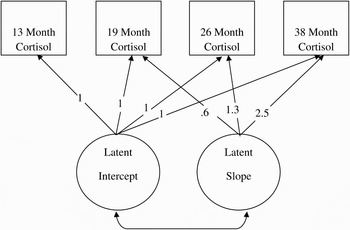
Our primary data analytic strategy utilized latent growth curves (LGC). Group differences in children's basal cortisol levels were examined using LGC analyses, which explore the existence of continuous underlying trajectories of change in longitudinal data (Meredith & Tisak, Reference Meredith and Tisak1990). LGC analyses model both fixed-effects (group-level change) and random-effects (individual variability in change) components of the trajectory model (see Figure 1). Unconditional LGC analyses account for the nonindependence of within-person observations over time through specifying separate estimates of both within-subject and between-subject variation through the following equations:
The conceptual model of unconditional, linear latent growth curve model across four assessment points.

Level 1 (within individual):

where cortit represents the value of the trajectory variable cort for the ith case at time t, αi is the random intercept for case i, βi is the random slope for case i, and λt is a constant that codes the trajectory at time i.
Level 2 (between individuals):
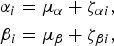
where μα and μβ are the average intercept and slope values across all cases, and ζαi and ζβi models sample variability around the average intercept and slope parameters, respectively.
Unconditional LGC models of cortisol measures across the four assessment points were specified within each group (e.g., MI, CS, NC) using AMOS 19.0 (Arbuckle, Reference Arbuckle2006). Thus, within the unconditional growth curve model, we can examine the existence and significance of the average intercept and slope within each group. Finally, in the present study, λt was coded such that the slope trajectory was indicated by the spacing interval in months across the assessments (e.g., 0.6, 1.3, 2.5)
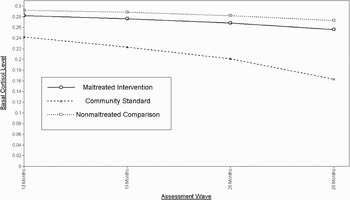
Analyses first revealed that the unconditional linear growth curve model fit the data well, χ2 (15, N = 143) = 20.80, p = .14 (comparative fix index = 0.96, root mean square error of approximation = 0.05). Latent intercept values across the different groups were positive and significant (μαs range = 0.25–0.29; p < .05), suggesting that cortisol values differed from zero at baseline (see Figure 1). Of importance, pairwise parameter comparisons among the different groups revealed no significant differences in intercept values (zs ranged from 0.13 to 1.66) suggesting that across the three conditions, children evidenced similar basal cortisol levels at baseline assessments. Thus, the effectiveness of our randomization of infants in the maltreatment sample to treatment condition was supported for initial values of cortisol, allowing us to further explore whether treatment condition is related to change in basal cortisol levels over time. Examination of the average linear slopes of cortisol assessments over time revealed interesting differences across the three groups. First, the means of the slope factors for MI group, CS group, and NC group were; μ = −0.009 (SE = 0.008, p = .31), μ = −0.035 (SE = 0.009, p < .001), and μ = −0.003 (SE = 0.010, p = .80), respectively. These findings suggested that only the CS group experienced a statistically significant linear decline in basal cortisol levels over time, whereas average slopes for the MI and NC groups were not significantly different from zero. In addition, pairwise parameter comparisons of the average slope values across the three groups also revealed that slopes for the MI and NC groups were significantly different from the CS group (zs = 1.97 and 2.27, respectively), and were not statistically different from one another (z = 0.79). Model-implied trajectories of cortisol levels across the three groups are plotted in Figure 2.
Latent growth curve model implied trajectories of basal cortisol values over time for the maltreated intervention, community standard, and nonmaltreated comparison group.

In order to pinpoint the measurement interval in which the treatment effect upon basal cortisol level manifested itself, we utilized the latent growth curve model and respecified the intercept value in a series of model analyses. For example, to explore basal levels at Wave 2, λt was coded such that the slope trajectory was centered (path constrained to 0) at Wave 2 (e.g., −0.6, 0, 0.7, 1.9). Centering was then moved to Wave 3 and Wave 4 in subsequent model runs. This allowed us to compare the groups across each timepoint within the same modeling framework. Analyses revealed significant differences in basal cortisol levels between the NC group and the CS group starting at Wave 2 and continuing at each subsequent assessment point (zs = 3.07, 4.50, and 4.40, respectively). Furthermore, significant differences between the MI group and the CS group on basal cortisol levels were also present at Wave 2 and continued over each assessment (zs = 2.83, 4.39, and 4.31, respectively). Finally, a nonsignificant difference between the MI and NC groups in basal cortisol levels was uncovered at Wave 2, and continued over the remaining two assessments (zs = 0.51, 0.92, and 1.09, respectively). These results indicated that the treatment effect on basal cortisol was evident at the first assessment postbaseline and maintained throughout the course of the study.
Discussion
Contrary to our first hypothesis, we did not observe differences between the maltreated groups (MI and CS) and the nonmaltreated group (NC) at the baseline assessment. One sample of morning cortisol at 13 months may have been insufficient to adequately detect early signs of variation in cortisol regulation based on maltreatment at this stage of development. However, infants in the maltreated group who received the CS intervention exhibited a steady decline in basal morning cortisol levels over the course of the a 2-year period of investigation. These findings may be indicative of an ongoing process of higher allostatic load in the CS group of infants and toddlers. Moreover, the differences among the MI, CS, and NC groups were apparent at the first cortisol assessment that took place at 19 months, 6 months following entry into the intervention. Furthermore, these relative decrements in basal cortisol in the CS group remained significantly different over time, with the gap widening sequentially. Thus, in the MI group, evidence of progressive allostatic load effects was averted. Finally, for infants in the MI group, cortisol levels were normalized (i.e., not different from the NC group) and remained so even at the 1-year postintervention follow-up period. The normalization of morning cortisol over time in the MI group bears a striking similarity to the results obtained by Fisher et al. (Reference Fisher, Stoolmiller, Gunnar and Burraston2007) in their RCT with maltreated preschool children in foster care. Compared to preschoolers receiving the regular foster care intervention, those randomized to a family-based therapeutic intervention displayed cortisol levels that became comparable to those exhibited by nonmaltreated children. Our findings, in concert with those of Fisher and colleagues (2007), suggest that interventions designed to improve caregiving following experiences of early adversity can reverse or prevent disruptions in HPA functioning.
The ability of psychosocial interventions to reorganize the functioning of the HPA axis provides further evidence that physiological processes are not immutable (Cicchetti, Reference Cicchetti, Hartup and Weinberg2002; Cicchetti & Gunnar, Reference Cicchetti and Gunnar2008). Psychosocial interventions can avert decline in normative neuroendocrine regulation, normalizing HPA functioning in high-risk infants receiving RCT preventive interventions. Thus, it is conceivable that the efficacy of any preventive intervention ultimately depends on the ability of the nervous system, either at the cellular, metabolic, or anatomical level, to be modified by experience. Such modifications are adaptive for the ongoing survival and optimal functioning of the organism (Cicchetti & Curtis, Reference Cicchetti, Curtis, Cicchetti and Cohen2006; Huttenlocher, Reference Huttenlocher2002; Stiles, Reference Stiles2008). Given the numerous negative physical and mental health sequelae associated with allostatic load, it is highly probable that the youngsters in the MI group will have a greater likelihood of improved functioning across varying domains of development.
Within the intervention group, there are a number of possible mechanisms that may have produced changes in the ability of the brain to process information it confronts during stressful situations. The interventions likely reduced the stress experienced in the child rearing environment. In addition, mothers in the intervention may have become better able to cope with the demands of rearing infants and toddlers. As a consequence, these mothers could have become more able to pay greater attention and become more responsive to infant/toddler needs. Likewise, changes in parenting or mother–child relational processes may have promoted positive self-representations in the caregiver as well as positive representations of her infant/toddler, resulting in improved functioning of the child's HPA axis through the concomitant reduction in relational stress.
The achievement of normalized HPA functioning and the prevention of an extended process of allostatic load in the MI group also is likely to exert a positive influence on other aspects of stress neurobiology and related biological systems such as immune, metabolic, and cardiovascular functioning (Herman & Cullinan, Reference Herman and Cullinan1997; Juster et al., Reference Juster, McEwen and Lupien2009; Shonkoff, Boyce, & McEwen, Reference Shonkoff, Boyce and McEwen2009). Furthermore, the intervention received by the MI group served not only a protective function by preventing prolonged allostatic load, but also may have helped to avoid the longer term physical and mental health problems typically accompanying hypocortisolism (Cicchetti & Rogosch, Reference Cicchetti and Rogosch2001; Gunnar & Vazquez, Reference Gunnar and Vazquez2001). In contrast, the infants in the community standard intervention group, who exhibited a steady decrease in morning cortisol levels over a 2-year period, are at high risk for developing future mental and physical health problems (Danese et al., Reference Danese, Moffitt, Pariante, Ambler, Poulton and Caspi2008, Reference Danese, Caspi, Williams, Ambler, Sugden and Mika2011; Danese, Pariante, Caspi, Taylor, & Poulton, Reference Danese, Pariante, Caspi, Taylor and Poulton2007; Miller et al., Reference Miller, Chen, Fok, Walker, Lim and Nicholls2009).
Infants in the MI group very likely develop enhanced self-righting capacities that may promote the development of resilient functioning (Cicchetti, Reference Cicchetti2010; Cicchetti & Rogosch, Reference Cicchetti and Rogosch1997). The normalization of the HPA axis in these youngsters may aid in their ability to perceive threat accurately and to regulate their stress systems so as not to be overly sensitive to adverse experience (Cicchetti & Rogosch, Reference Cicchetti and Rogosch2007). In contrast, infants in the CS group are highly likely not to manifest improvement in their self-righting abilities, succumbing to allostatic load processes and exhibiting a sequential worsening of morning cortisol regulation over time (Cicchetti & Rogosch, Reference Cicchetti and Rogosch2001). Moreover, the infants in the CS group are likely to have fewer self-righting capabilities and this bodes poorly for their ability to function in a resilient fashion (Cicchetti, Reference Cicchetti2010). The several year process of increasing HPA dysregulation is not likely to be the result of an acute reaction. Rather, this HPA dysregulation may eventuate in life-long neurobiological problems in the absence of having a more developmentally appropriate and intensive intervention, such as that received by infants in the MI group, provided.
Despite its strengths, our RCT does possess several limitations. Only one cortisol sample was collected and assayed at each time period assessed. Nonetheless, the consistency in the time of collection across the four assessment waves is remarkable. In addition, we did not include other biomarkers of allostatic load assessed throughout the duration of the RCT. Moreover, we were not able to delineate definitive mechanisms of change contributing to our differential patterns of cortisol regulation over time. Finally, because maltreated infants in foster care were excluded, and because these infants are likely to have experienced more severe early maltreatment, our findings may not be generalizable to maltreated infants residing in foster care. Of importance, however, the results of our RCT with home-reared maltreated infants are markedly similar to the results obtained by Fisher and colleagues (2007) with early morning cortisol in their RCT with maltreated preschoolers in foster care.
In future research, it will be critical to assess other aspects of HPA axis functioning, such as diurnal variation and reactivity and recovery from stressors. Moreover, additional biomarkers of allostatic load should also be assessed (see Juster et al., Reference Juster, McEwen and Lupien2009, Reference Juster, Bizik, Picard, Arsenault-Lapierre, Sindi and Trepanier2011). A multilevel perspective, consisting of assessments of other psychological and biological systems in conjunction with HPA axis functioning, would provide vital information on cross-system relationships and shed light on the next wave of transdisciplinary multiple levels of analysis research on the effects of psychosocial interventions.
Finally, it will be important for researchers to investigate the longer term effects of intervention on promoting psychological and physical health. In this regard, the positive effects obtained in our RCT may be epigenetic in nature and illustrative of the processes by which a markedly altered environment (i.e., achieved through intervention) can influence methylation and modify gene expression (Meaney, Reference Meaney2010). Consequently, as part of future long-term follow-ups of RCTs, DNA and RNA should be collected and assayed during each assessment point of the longitudinal investigation (e.g., baseline, postintervention, 1-year follow-up). Examining the nature of genetic and epigenetic effects, in conjunction with other psychological and biological domains, has the potential to advance the field with respect to understanding the multiple systems that are influenced by psychosocial interventions. Such work is currently being conducted in our laboratory.
The identification of stress-sensitive neural processes may provide a firm empirical basis for the development of interventions to prevent and to ameliorate the deleterious effects of early maltreatment experiences. Moreover, the inclusion of neurobiological assessments in evaluations of preventive interventions designed to normalize the developmental trajectories of children experiencing maltreatment will enable researchers to discover whether the various components of multifaceted interventions each exert a differential impact on separate brain systems. As it is increasingly demonstrated that the nervous system can be modified by experience, then successful preventive interventions could be conceptualized as examples of experience-dependent neural plasticity (Cicchetti & Curtis, Reference Cicchetti, Curtis, Cicchetti and Cohen2006).
The growing body of research demonstrating that behavioral interventions may positively alter not only psychological processes, but also neurobiological functioning, possesses important implications for the social policy arena. Because resources may be more readily expended for the prevention of negative physical rather than mental health consequences, findings such as those reported herein may ultimately increase the availability of resources that can be directed toward the prevention of child abuse and neglect and toward the extensive treatment needs of these vulnerable children.