INTRODUCTION
The search for general determinants of community structure and species assembly rules remains a central challenge for ecologists (Lawton, 1999; Tokeshi, 1999; Weiher and Keddy, 1999). In recent years, Tokeshi (1990, 1993, 1999) introduced a series of niche-oriented stochastic models to fit species abundance patterns. Tokeshi's niche apportionment models are mechanistic models that allow simulations of the processes thought to be assembling communities. In these models, the abundance of each species is proportional to the fraction of the total niche that they apportion; each model is based on different apportionment rules, representing a spectrum of possibilities ranging from complete independence among species to strong species interactions (Tokeshi, 1999). When the communities simulated according to a particular apportionment model have patterns of species abundance that differ significantly from that of the real community under investigation, then this model and the ecological mechanisms it represents can be excluded as possible structuring forces.
Recently, Mouillot, George-Nascimento and Poulin (2003) were the first to apply niche apportionment models to parasite community structure. They found that one model, the random assortment model, provided a good fit to the observed patterns of species abundance in the communities of metazoan parasites on 3 of the 6 host fish species investigated; no other model fitted the observed patterns. The random assortment model mimics a situation where the abundances of the different species in a community vary independently of each other (Tokeshi, 1999). This finding supported some earlier studies that suggested that interspecific interactions played very minor roles in structuring parasite communities, these communities often being non-saturated with species and with many empty niches (Poulin, 1996; Rohde, 2001; Gotelli and Rohde, 2002).
The study of Mouillot et al. (2003) was innovative for another reason: it was one of the first (see also Rohde et al. 1994) to use biomass as a measure of abundance in an investigation of parasite community ecology. Previous studies almost exclusively used numerical abundance, i.e. numbers of individuals per species (see reviews in Esch, Bush and Aho, 1990; Poulin, 1998). There are many reasons to believe that community patterns depend on the measure of abundance chosen, and that using biomass will lead to different results than using numbers. First, studies on plant communities have highlighted the influence of abundance measure on the quantification of community properties (e.g. Chiarucci et al. 1999; Mason et al. 2002). Second, differences in biomass between coexisting parasite species are often much more pronounced than those among members of free-living animal communities. For instance, the mean individual body volume of cestodes of different species co-occurring in the gut of the fish Brama australis showed a 3500-fold size difference between the largest and smallest species (George-Nascimento, Garcías and Muñoz, 2002). Similar results were found in cestodes of the fish Hemigymnus melapterus, which ranged over four orders of magnitude, the largest species being about 2800 times larger than the smallest (Muñoz and Cribb, 2005). Surely, equal numbers of these cestode species in a fish could not possibly represent evenness in abundance. Third, models based on resource use, such as Tokeshi's (1999) niche apportionment models, require a measure of abundance that is proportional to the resources apportioned by a species; biomass would provide a more appropriate measure than numerical abundance for such models.
Here, we used data on the metazoan communities of 14 species of fish (family Labridae) to answer 3 general questions about parasite community structure. (1) Is the random assortment model of niche apportionment consistently providing the best fit to the observed relative distribution of abundances in parasite communities? Our study will test the generality of the findings of Mouillot et al. (2003) by extending the approach to numerous other fish species. (2) Are patterns of community structure and their fit to niche apportionment models dependent on how the parasite community is defined? If one considers the entire fish host as the resource, then all metazoan parasite species in or on that fish form a community; however, perhaps the community should be restricted to potentially interacting species, such as only those occurring in the gastrointestinal tract or inhabiting the gills. We will repeat our analyses using endoparasites and ectoparasites separately as well as together, to illustrate how important the distinction is with respect to resource use. (3) Does the choice of abundance measure affect the fit of observed patterns to niche apportionment models? We will repeat our analyses using both biomass and numbers of individuals, and compare the results obtained with the two measures. This will represent one of the first tests of the influence of abundance measures on the quantification of community structure patterns in animal communities.
MATERIALS AND METHODS
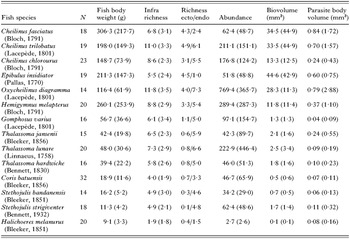
In total, 264 fishes comprising 14 species were collected between August 2002 and May 2004 on the Great Barrier Reef, around Lizard Island, Australia (14 °40′S, 145 °28′E). Fish were caught using a spear gun while snorkelling or a net while diving. They were then individually placed into a plastic bag to minimize loss of ectoparasites during handling. The sample size per species was 14–32 individuals (Table 1).
Table 1. Sample size (N) and weight of fishes collected at Lizard Island (Average of infracommunity richness of all parasites and for ectoparasites and endoparasites (ecto/endo), average of abundance, biovolume of parasites and parasite body volume (standard deviations) for each fish species.)

Each fish individual was weighed and dissected to collect all the metazoan parasites. Ectoparasites were sought on the body surface and gills, whereas endoparasites were sought in the gut, gall-bladder, body cavity, heart, gonads, muscles and flesh. All parasites were preserved in 5% formalin for later identification.
Each parasite species was measured for length and width to estimate its body volume. The body volume was estimated using a geometric formula according to parasite body shape. Thus, gnathiids, copepods and digeneans resemble ellipsoids; tranversotrematids and monogeneans resemble flat-ellipsoids; nematodes, acanthocephalans, and cestodes resemble a cylinder. The body volumes of each parasite species were measured for each host species. The volume of the parasite body was expressed as mm3.
Total prevalence is defined as the percentage of fish in a host sample (1 host species) parasitized with at least 1 parasite of any species. Abundance of parasites was calculated as the number of parasite individuals of a given species (Bush et al. 1997), and biovolume of parasites was calculated as mean abundance×mean parasite body volume for a given species expressed as mm3 of parasites (George-Nascimento et al. 2002; Poulin, Mouillot and George-Nascimento, 2003). Within each host species the unit of replication was the host individual, or the parasite infracommunity, i.e. all parasites of all species within one individual host.
To evaluate the relationships between some variables across fish species, we used the independent contrasts method to control for the influence of host phylogeny. We built a phylogeny of the 14 fish species based on molecular data (Bernardi et al. 2004; Westneat and Alfaro, 2005) and one morphometric study (Westneat, 1993), and then computed contrasts using the CAIC 2.0 software (Purvis and Rambaut, 1994). We related the contrasts in mean infracommunity richness, abundance and biovolume of parasites with contrasts in host body weight, and between the mean parasite body volume, richness, abundance and biovolume of parasites. For multiple comparisons, P-value adjustments were applied following Bonferroni's criterion (P=0·05/10 tests per each data set) setting a significance level of 0·005.
Five niche-orientated stochastic models were considered: Dominance decay (DD), MacArthur fraction (MF), random fraction (RF), random assortment (RA) and dominance pre-emption (DP) (Tokeshi, 1990, 1993, 1995, 1999). Although Tokeshi (1999) proposed other models, these 5 models cover the range of possibilities regarding the importance of interspecific interactions in community structure. We followed the fitting procedures proposed by, and described by, Mouillot et al. (2003). These models can only be applied to infracommunities composed of at least 2 parasite species because they rest on the assumption that niche apportionment occurs between species (Tokeshi, 1990; Mouillot et al. 2003). Details of the assumptions and limitations of the models here applied can be found in Tokeshi (1990, 1999) and Mouillot et al. (2003). After excluding host individuals harbouring only a single parasite species, tests were only performed on fish species represented by at least 10 infracommunities, because the ability of the test to discriminate among models is limited with smaller samples. The goodness of fit of the parasite communities of the 14 fish species was tested against the 5 models using a Monte-Carlo procedure. We generated 9999 simulated communities for each fish species and each model. In each test, the mean and variance in the relative abundance (or biovolume) for each parasite species in a community were computed; species were then ranked by their mean relative abundance (or biovolume) to fit the models. When an observed community did not depart significantly from the simulated communities based on one model, for both the mean and variance in relative abundance (or biovolume), then that model was judged to fit the observed pattern. Detailed explanations are given by Mouillot et al. (2003). Tests were performed separately for endoparasites, ectoparasites and all parasites, as well as with numerical abundance and biovolume.
RESULTS
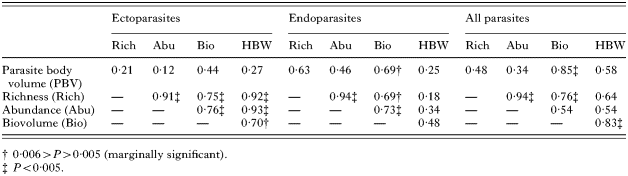
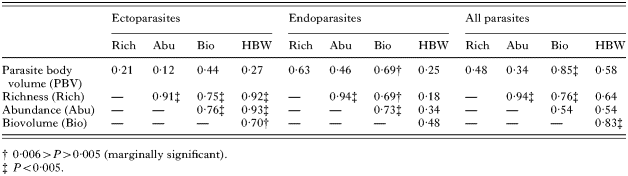
Fish body weight greatly varied among species (Table 1). In total, 27 ectoparasite species and 71 endoparasite species were found in the 264 fish collected. Ectoparasites inhabited mainly the body surface and most endoparasites were in the gut. Most fish individuals were parasitized with at least 1 parasite species (100% total prevalence), although Coris batuensis, Stethojulis bandanensis and Halichoeres melanurus had prevalences of 97, 93 and 80% respectively. Component community richness of ectoparasites varied between 1 and 17 species and for endoparasites between 11 and 32. Larvae of gnathiid isopods and tetraphyllidean cestodes were common parasites in most wrasse species. Generally, ectoparasite richness and abundance was lower than those for endoparasites, although Epibulus insidiator and Cheilinus fasciatus were exceptions (Table 1). The mean abundance of all parasites varied among host species from 3 to 289 individuals per fish. Most parasite species exhibited small body volumes, although some fish harboured parasite species with great variations in body sizes (Table 1). The mean biovolume of parasites was small for most fish species, although mean abundance and biovolume varied over 2 orders of magnitude each across the fish species (Table 1). Infracommunity richness, abundance and biovolume of parasites were generally all correlated to one other after controlling for the host phylogeny, however all these descriptors of ectoparasites were correlated with host body weight only (Table 2). Some differences in the correlations among parasitological descriptors were found for ecto-, endoparasites and all parasites (Table 2). When ecto- and endoparasites were analysed together, abundance and biovolume were not correlated, although significant correlations between these descriptors were found for ecto- and endoparasites considered separately. Mean parasite body volume was not correlated with mean abundance of all parasites, although it was significantly correlated with biovolume (Table 2). There were no significant correlations between ecto- and endoparasites for any of the parameters (mean individual parasite body volume, component community richness, mean infracommunity richness, abundance or biovolume; all P>0·37).
Table 2. Correlation coefficient between mean infracommunity richness, abundance and biovolume of parasites, mean individual parasite body volume, and host body weight (HBW), for ecto- and endo- and all parasites (Correlations performed on contrasts data (n=13), after controlling for the host phylogeny.)
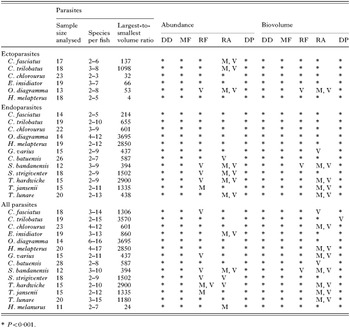
Considering that 85% of all endoparasite individuals and 62% of all endoparasite species were larvae, we considered all endoparasites together because they are at the same stage of maturity, which implies similar transmission to the host. The random assortment model (RA) could not be rejected for parasite communities in several fish species: it was by far the model providing the best and the most consistent fit to parasite community patterns (Table 3). Only in Thalassoma hardwicke when the whole parasite community is considered was another model not rejected for both the mean and variance of species ranks: the random fraction model (RF) could not be rejected when numerical abundance of parasites was considered (Table 3). The abundance of ectoparasites of 3 fish species could be fitted with the RA model, but in only 1 fish was this true when biovolume of parasites was used instead. The endoparasites of 4 fish species could be fitted with the RA model when either abundance or biovolume of parasites were used (Table 3). When all parasites (ecto- and endoparasites) were considered together as one community, the main result was that using biovolume resulted in the RA model providing a good fit to the observed pattern in 7 fish species, whereas using abundance provided fewer instances where the model could not be rejected (Table 3).
Table 3. Results of goodness-of-fit tests based on mean (M) and variance (V) of species ranks in parasite communities (ecto-, endo- and all parasites) for 14 fish species regarding 5 niche apportionment models (Tokeshi's models; see text) (Results are presented separately for tests involving parasite abundance and those involving biovolume. Models not rejected (P>0·05) are indicated by letters for mean and variances. Models that fit actual parasite communities should not be rejected for both mean and variances.)

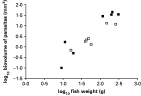
Communities of parasites for which the RA model could not be rejected do not differ from those for which the model proved inadequate. For instance, whether or not the RA model is rejected appears to be independent of the amount of resource available measured as body sizes (Fig. 1). The same is true for other variables (see Table 3).

Fig. 1. Relationship between mean biovolume of all parasites per fish individual and mean host body weight, across 14 fish species. Parasite communities that could be fitted with the RA model are represented by open squares.
DISCUSSION
Niche apportionment models are based on different rules of community structure, from complete independence among species to strong species interactions (Tokeshi, 1990). When real communities have patterns of species abundance that depart from those simulated according to a given model, then some particular ecological mechanisms that this model represents may be excluded as possible structuring forces. In this study we found that the RA model could not be rejected for 7 host species, mainly when we used the biovolume of parasites as a measure of abundance, and when we considered the whole community of parasites (Table 3). Similarly, Mouillot et al. (2003) showed that this model fitted well the whole parasite communities in 3 of 6 fish species, the latter having different ecological characteristics from the labrid fishes investigated here. These results are important because the RA model seems to be widely applicable to parasite communities in fish, whereas the other 4 models considered (DD, MF, RF and DP models) always being rejected, except the RF model for T. hardwicke. Thus, in answer to the 3 questions we presented as our objectives, the random assortment model is indeed consistently providing a good fit to patterns of relative species abundances in parasite communities, regardless of how a parasite community is defined or which abundance measure is used.
Generally, ecto- and endoparasites have been considered non-interactive communities because they are not in contact with each other since they inhabit different part of the host body. Hence, these communities have been studied separately. However, ecto- and endoparasites are using the same host body, i.e. the same resource, at the same time. In this study both parasite communities were considered separately and also together because the host was taken as the resource in a niche-partitioning analysis. Only one study has investigated the indirect links between ecto- and endoparasites of fishes. Larsen, Bresciani and Buchmann (2002) found that infections by monogeneans are lower in fishes parasitized by nematodes than in non-parasitized fishes. From that point of view, it is not always clear when ecto- and endoparasite communities should or should not be considered separately. Similarly, endoparasites from the body cavity and those from the gut may interact indirectly, since any effect of a body cavity on host health has indirect implications for gut parasites, but no studies have addressed this issue.
We found that no infracommunity descriptors (richness, abundance and biovolume) or mean parasite body size showed correlations between these two groups of parasites. This finding indicates that at least in wrasses, ecto- and endoparasite communities may not be interactive. The communities of ecto- and endoparasites (separately) of some fish species could be fitted with the RA model and there was no real difference in the number of hosts for which this model was not rejected between each group of parasites. However, the most consistent fit was obtained for the whole parasite communities, perhaps because the independence of both groups (ecto- and endoparasites) fits with the assumptions of the RA model.
Tokeshi (1990) demonstrated that abundance and biomass of chironomid species could be fitted to different niche apportionment models. In our study, the body volume of parasites varied greatly among parasite species. Abundance was correlated with the biovolume of parasites in ecto- and endoparasites, but was not correlated when all parasites were used. Even though, in ectoparasites for example, abundance and biovolume of parasites were correlated, the number of hosts that fit the RA model differed, indicating that there are variations in patterns between abundance and biovolume of parasites at the infracommunity level. On the other hand, in the whole parasite community a host species can harbour a high abundance of parasites, but this does not mean that their biovolume will be high. Thus, biovolume of parasites may be a better measurement for tests of the niche-partitioning hypothesis because generally the number of parasites is not equivalent to biovolume and biovolume is the parameter that relates with the use of resources (e.g. energetic demands according to body size). Communities of parasites that exhibited the largest variation in body sizes could not necessarily be fitted with the RA model. This is because there is no correlation between abundance and body size among parasite species (Rohde et al. 1994; George-Nascimento et al. 2004; Muñoz and Cribb, 2005). In fact, in most host species of this study, 1–2 parasite species were highly abundant, but 3–5 parasite species had high biovolume (data not shown here). For example, Muñoz and Cribb (2005) showed that only 2 species of parasites were highly abundant but 4 species contributed mostly and in similar proportions to the total parasite biovolume in Hemigymnus melapterus. This fact suggests that those 4 parasite species utilize similar proportions of the available resources, but none of them achieves dominance. In general, organisms with large bodies need more energy and more of other resources than small organisms. Parasites extract all these resources from the host body, so that large parasite individuals extract more resources per capita than small ones (see George-Nascimento et al. 2004). However the largest parasites are not the most abundant (see George-Nascimento et al. 2004; Muñoz and Cribb, 2005), and at the community level, it is the total biomass of a species, and not its body size, that matters. This could explain why the RA model provided a better fit when parasite biovolumes were used.
The most important issue is to understand the biological significance of the RA model and what may be its implications for parasite communities. The theoretical basis of this model is that parasites can use the remaining resources or those resources available in the system because there is no hierarchical structure of species, and niche partitioning is a dynamic process under a highly variable environment (Tokeshi, 1990, 1993). For example, some parasite species can inhabit hosts of different ages, sex, habitat, geographical distribution or even different host species. Most parasites can also use a host species that is already infected by other parasite species (i.e. different parasite communities in different host species). Parasites have evolved in variable microhabitats (i.e. host body characteristics), so they have become flexible in their use of resources and are thus independent of the abundance of other parasite species. However, flexibility in the use of the niche may apply to generalist parasites. In our wrasse species, most endoparasite species were cestode larvae and most ectoparasites were gnathiid larvae; both groups were found, although in different abundances, in several host species. Even though it is known that many parasite species are specific to certain niche characteristics (Rohde, 1994), this does not necessarily imply that parasites cannot inhabit changeable niches. The process underlying the RA model is that total resources are limited while at the same time species have a maximum level of independence of niches (Tokeshi, 1990). However, the picture may be different in some parasite communities composed mainly of specialist parasites. For example, Sasal et al. (1999) showed that the relationship between host and parasite body sizes changed when generalist or specialist monogeneans were analysed separately. Thus, different patterns of niche partitioning may apply to communities composed of specialist and generalist parasites.
The innovation of the study of Mouillot et al. (2003) was the application of theoretical models of niche partitioning to parasite communities. Some of these models may or may not suggest interaction among species: the DD, MF, and RF models assume that invading species use some part of the niche of other species whereas the DP model assumes that one species is dominant and uses a large niche space (Tokeshi, 1993). According to the RA model, parasites can use niches that are not occupied by other species (Tokeshi, 1990) and communities are unsaturated with species because of the continual variation of niches and their use (Tokeshi, 1990, 1993). Thus the niches of each parasite species, after recruitment in their hosts, are independent of each other. Consequently interspecific interactions among parasites from wrasses are reduced or are not important in the niche fractioning. This may be true for most parasite communities of fishes because similar results have been previously reported based on various analyses (e.g. Rohde, 1979; Rohde et al. 1994; Kennedy and Guegan, 1996; Morand et al. 1999; Gotelli and Rohde, 2002). Moreover, other studies have concluded that parasite community structure is mostly determined by intraspecific competition rather than interspecific interactions (e.g. Rohde, 1979; Adamson and Noble, 1993; Haukisalmi and Henttonen, 1993; Morand et al. 1999). In parasite communities characterized by higher richness and greater abundance, in birds for example, both interspecific and intraspecific interactions among parasites become important forces in structuring communities (e.g. Bush and Holmes, 1986; Stock and Holmes, 1988).
In this study, in only 1 fish species (i.e. Thalassoma hardwicke) of the 14 studied here, the parasite community fitted with the RF model. The failure to reject this model implies that an invading species takes any niche space randomly that is or not used by other species. Consequently this model suggests competition between species (Tokeshi, 1993). Still, the fact that the RA model is predominantly the one fitting the data across most fish species indicates that interspecific interactions are usually not important.
The RA model fitted parasite communities of both small and large fishes in this study, because parasites can use variable niches (as discussed previously). Therefore, it does not matter whether the niche space is small or large, parasites simply use the niche independently and randomly from the other species present in the system. Thus this model may fit communities of parasites in larger vertebrates considering that most parasite communities share similar characteristics, particularly those that support the RA model assumptions. Given that other niche models, such as Hubbell's (2001) neutral model, are based on assumptions that clearly do not apply to parasites (see Poulin, 2004), the widespread fit of the RA model to parasite communities suggests strongly that interspecific interactions are generally unimportant in community structure.
G. Muñoz thanks a Travel Award (GSRTA) granted by the Graduate School, University of Queensland.