Implications
Excessive flavour in lamb meat can impede consumer acceptance. Lambs grazing alfalfa are prone to flavour taint and are exposed to parasites. Here we demonstrate that supplementary feeding of tannin-rich sainfoin pellets to lambs that are concurrently grazing alfalfa is effective in reducing meat volatile indoles but not in reducing excessive flavour. Sainfoin pellet supplementation also delayed the onset of nematode and coccidian infections.
Introduction
Pasture-fed lambs are prone to odour and flavour taint (Young et al., Reference Young, Berdagué, Viallon, Rousset-Akrim and Theriez1997; Young et al., Reference Young, Lane, Priolo and Fraser2003) which can be an impediment to consumer acceptance. The ruminal production of skatole and indole, which are responsible for pastoral off-odours and off-flavours of lamb meat is dependent on the forage that is consumed. Differences in rumen production of skatole and indole occur due to differences between forage plants for protein content, solubilisation and rumen degradability. White clover and alfalfa consistently result in greater formations of skatole and indole due to their high-protein content which is rapidly solubilised and degraded in the rumen (Schreurs et al., Reference Schreurs, Lane, Tavendale, Barry and McNabb2008). Consequently, skatole and indole accumulate more in the fat of lambs raised on white clover or alfalfa (Schreurs et al., Reference Schreurs, Lane, Tavendale, Barry and McNabb2008; Prache et al., Reference Prache, Gatellier, Thomas, Picard and Bauchart2011; Devincenzi et al., Reference Devincenzi, Prunier, Meteau, Nabinger and Prache2014 and Reference Devincenzi, Prunier, Meteau and Prache2019), this being an issue for low-input and organic grassland-based farming systems relying on leguminous species in the pastures (Prache et al., Reference Prache, Gatellier, Thomas, Picard and Bauchart2011). A recent study investigated whether barley supplementation could decrease the concentration of these compounds in the fat by mitigating the excess of degradable protein over energy, but the results were inconclusive (Devincenzi et al., Reference Devincenzi, Prunier, Meteau and Prache2019). Another option is the utilization of condensed tannin (CT)-rich forages. Several studies have actually shown that the ruminal formation of skatole and indole and the concentration of these compounds in the fat are reduced when lambs graze CT-rich forages (Schreurs et al., Reference Schreurs, Lane, Tavendale, Barry and McNabb2008; Girard et al., Reference Girard, Dohme-Meier, Silacci, Ampuero Kragten, Kreuzer and Bee2016). Condensed tannins lower the ruminal formation of skatole and indole by (i) forming insoluble complexes with plant protein thereby slowing the degradation of the plant protein and (ii) inhibiting the microbes involved in proteolysis or in skatole and indole formation from amino acids (Schreurs et al., Reference Schreurs, Lane, Tavendale, Barry and McNabb2008). Sainfoin (Onobrychis viciifolia) has been one of the most studied CT-rich forages for feeding lambs. Its cultivation however necessitates a specific range of soil pH and is difficult on acid soils. In this study, we therefore investigated whether dehydrated CT-rich sainfoin pellet supplementation to lambs grazing alfalfa could be effective in reducing fat skatole and indole concentrations and improving the odour and flavour of the meat. Moreover, as diets containing CT have sometimes been shown to increase meat lightness and protect the meat against lipid-protein oxidative deterioration (Vasta et al., Reference Vasta, Nudda, Cannas, Lanza and Priolo2008), we tested the hypothesis that supplementary feeding of CT-rich sainfoin pellets to lambs that are concurrently grazing alfalfa would further influence the quality traits by improving meat colour and meat colour stability. Finally, a recent study in lambs found a potential interest for delaying coccidian infections (Saratsis et al., Reference Saratsis, Voutzourakis, Theodosiou, Stefanakis and Sotiraki2016), beyond that already observed for gastro-intestinal nematodes in small ruminants (Hoste et al., Reference Hoste, Torres-Acosta, Sandoval-Castro, Mueller-Harvey, Sotiraki, Louvandini, Thamsborg and Terrill2015). This study thus further examined the potential of supplementary feeding of CT-rich sainfoin pellets to naturally infected lambs to control nematode and coccidian infections.
Material and methods
The study was conducted at the Herbipôle Experimental Unit situated in Saint-Genès-Champanelle (850 m a.s.l) and run by the Auvergne–Rhône–Alpes INRA Centre in France. The animals were handled by specialised staff who ensured good welfare practices in accordance with the EU Directive 86/609/EEC. All animal procedures were approved by the C2EA-02 Ethics Committee (No. 5287-2016050318599795V2).
Experimental design, animals and diets
Three feeding regimes were compared from 10-day post-weaning until slaughter: alfalfa (Medicago sativa) grazing (AF), alfalfa grazing + supplementation with dehydrated pellets of sainfoin (O. viciifolia) (AS) and stall-feeding with concentrate and grass hay (SI). The dehydrated pellets of sainfoin were provided by MG2Mix-Multifolia (Chateaubourg, France). They contained 42 g of CT/kg of dry matter (DM) and the daily level offered to the AS lambs was calculated at 15 g DM/kg live weight (LW). The SI lambs were given concentrate at a level that was adjusted weekly to achieve similar average growth paths as in the AF lambs, and hay was given ad libitum. Each feeding regime comprised 18 lambs plus one additional lamb in the AF group to guard against possible mortality because of bloating.
We used 55 male Romane lambs from nine sires which were born between the 10 and 18 April. From birth up to 22 May, the animals were managed uniformly and housed in a sheepfold with their dams. The ewes had access to concentrate and hay, and the lambs had access to a commercial concentrate in an area where the ewes did not have access. All the lambs were treated for Coccidia (using Vecoxan-active substance: diclazuril – at the manufacturer recommended dose of 1 ml/2.5 kg LW) on 12 May. On 23 May, the lambs were assigned to 18 blocks of similar animals according to suckling mode (single or twins), litter birth weight, litter LW on 17 May. They were then randomly assigned from within the blocks to one of the three feeding treatments, and the AS lambs were given sainfoin pellets for 5 days in addition to the concentrate for them to become accustomed to this feed. As the sainfoin pellets were well consumed, the AF and AS lambs were turned out to a pasture (composed mainly of gramineae), without any supplementation, from 25 May to 20 June so that they get used to grazing, whereas the SI lambs remained in stalls. The lambs were weaned on 15 June. From 20 June, the AF and AS lambs were progressively allowed more time on alfalfa pasture over 5 days, and grazed alfalfa exclusively from 25 June onwards. Sainfoin supplementation of AS lambs started on 21 June (day 0, D0). Concomitantly, the SI lambs stayed in stalls and received a commercial concentrate containing barley, wheat, sugar beet pulp, rapeseed meal, sunflower meal, bran, corn, sugar cane molasses, calcium carbonate, minerals, vitamins and salt, along with grass hay. All groups of lambs had ad libitum access to water and salt blocks. Mean lamb birth weight was 4.2 kg (SD 0.96) and average daily gain (ADG) between birth and weaning was 290 g (SD 54.8). At weaning, the lambs weighed 21.9 kg (SD 3.76) and were 61 days old (SD 1.6) on average.
The alfalfa plots were grazed rotationally and grazing management ensured ad libitum availability of green leaves. Each plot was divided into two sub-plots and the AF and AS groups were switched between the two sub-plots three times per week (on Monday, Wednesday and Friday) to avoid confounding effects of (i) sward characteristics (particularly the availability of green leaves) and (ii) pasture parasite contamination level. The plots were mechanically topped and the trimmings removed after each grazing period to ensure good-quality regrowth. Mean voluntary intake level of the forage-grazing lambs was estimated at 78.125 g DM/LW0.75, where LW is the average LW of the group (Hassoun and Bocquier Reference Hassoun and Bocquier2007). The daily level of sainfoin pellets offered to the AS lambs was calculated from weekly weighings, at 15 g DM/kg LW. Sainfoin pellets were distributed every day at 09:00 h am in circular collective feeding racks, the length of the racks being sufficient to ensure that all the AS lambs had equal opportunity to access the sainfoin. All the forage-grazing lambs were treated for digestive nematodes and Moniezia (using Panacur-active substance: fenbendazole – at the manufacturer recommended dose of 9 ml per lamb) on D3 and then got naturally infected. A faecal sample was collected on D41 then every 2 weeks from the rectum of each forage-grazing lamb to measure the nematode faecal egg count (from D41 onwards) and the faecal oocyst count (from D56 onwards) for each lamb, according to Raynaud (Reference Raynaud1970). A targeted anthelmintic drench was performed for the lambs whose nematode faecal egg count was above 550 eggs/g of faeces, a cut-off value already used by Devincenzi et al. (Reference Devincenzi, Prunier, Meteau and Prache2019) in similar conditions. For these targeted treatments, we use Hapadex-active substance: neotibim – at the manufacturer recommended dose of 7.5 ml per lamb on D43, and Valbazen-active substance: albendazole – at the manufacturer recommended dose of 10 ml per lamb on D58, D71 and D85. No anticoccidial drench was used after the lambs were turned out to pasture. All the forage-grazing lambs were treated for Moniezia (using Cestocur-active substance: praziquantel – at the manufacturer recommended dose of 7.5 ml per lamb) on D48.
Slaughter procedures
Lamb groups balanced for the three feeding regimes were selected for slaughter on the basis of LW, with the priority given to the highest lambs, and slaughtered at the experimental slaughterhouse according to the EU welfare guidelines. There were five slaughter sessions, on D76 (n = 9), D83 (n = 12), D90 (n = 9), D97 (n = 12) and D104 (n = 12). The lambs were thus slaughtered at a mean age of 158 (SD 10.1) days after an average experimental period of 90 (range 76 to 104) days. The lambs had access to food and water until about 30 min before slaughter and were transported by truck to the slaughterhouse located ~500 m from the experimental site. The lambs were electrically stunned and slaughtered by throat cutting. The carcasses were placed in a refrigerated room at 4°C up to 24 h following slaughter and were kept in the dark.
Measurements
Animal BW, behaviour and feed intake
The lambs were weighed at birth, then on 17 May, at weaning, once weekly in the morning before sainfoin distribution and at slaughter. The time spent eating the sainfoin pellets was measured for all the supplemented animals using visual scan sampling at 5 min intervals between 08:45 and 16:30 on D9 and D30. The feed tubs of both the AS and SI lambs were emptied every day and any refusals were weighed, recorded and discarded. Samples of sainfoin, concentrate and hay offered and samples of concentrate and hay refused (when present) were taken once a week. Samples of sainfoin pellets refused (when present) were taken daily. The feed samples were oven-dried at 60°C for 72 h, then weighed for DM estimation. Daily feed intake was calculated for each lamb group as the difference between DM offered and DM refusals.
Carcass characteristics and colour of fat and longissimus thoracic et lumborum muscle
At 24 h postmortem, we measured carcass weight, perirenal fat weight and subcutaneous dorsal fat thickness over the last thoracic rib, pH of longissimus thoracis et lumborum (LTL) muscle (pHu) and dorsal fat firmness using a finger test on a scale from 3 (oily) to 15 (very hard). The colour coordinates of the subcutaneous caudal fat (SCF) from the tail root and LTL muscle were measured using a MINOLTA CM-700d spectrophotometer (illuminant: D65, observer angle: 10°; Minolta France S.A., Carrières-sur-Seine, France) using five measurements made at randomly selected locations. Colour coordinates were expressed as lightness (L*), redness (a*), yellowness (b*), chroma (C*) and hue angle (hue). The instrument was fitted with protective glass to shield the eye of the apparatus from the sample. For SCF, the measurements were made at 24 h postmortem. For LTL muscle, a 1-cm thick sample was taken at 24 h postmortem from the right side of the carcass between the 12th and 13th rib and then stored on a tray covered with an oxygen-permeable film kept in the dark for 9 days after slaughter. Longissimus thoracic et lumborum muscle colour coordinates were measured after 2 h blooming (1st day of display, DD1), then on DD2, DD3, DD6, DD7, DD8 and DD9.
Fat volatile indoles concentration
Perirenal and subcutaneous dorsal fat samples of approximately 15 g were taken from all the lambs at 24 h postmortem, wrapped in aluminium foil, vacuum-packed in sealable polyamide bags, snap-frozen and stored at −20°C until analysis. Fat skatole and indole concentrations were measured by HPLC according to the method described by Batorek et al. (Reference Batorek, Škrlep, Prunier, Louveau, Noblet, Bonneau and Čandek-Potokar2012) (Supplementary Material S1). Concentrations were expressed in µg per gram of lipid fraction from adipose tissue. Limit of detection was 0.03 µg/g of liquid fat.
Lamb chop sensory evaluation
The saddles (muscle, fat and bones) were removed from the posterior end of the loin from the right side of the carcass, cut into nine chops, stored on a tray covered with oxygen-permeable film and kept in the dark for 3 days at 4°C. They were then individually wrapped and vacuum-packed in sealable polyamide bags, snap-frozen and stored at −20°C up to the sensory evaluation. The lamb chop sensory evaluation was performed by 12 trained panellists at the INRA Magneraud Experimental Unit, according to the rules set out in standards NF ISO 8586-1 and ISO 8586-2. The panellists were 11 women and one man of an average age of 54 years. Before evaluation of the experimental chops, two preliminary sessions were held, using (i) two small bottles, one containing water and the other containing a solution of 3-methylindole (skatole, 0.2 μg/l) (Sigma-Aldrich, Saint-Quentin Fallavier, France), and (ii) additional chops from one lamb with a high perirenal fat skatole concentration and one lamb with a low perirenal fat skatole concentration, for the panellists to experience perceptions linked to skatole.
The lamb chop sensory evaluation was performed on eight chops per lamb in 18 panel sessions. At each panel session, each panellist evaluated one lamb from each treatment group, with the lambs from each group being presented in random order. The samples were prepared as described by Devincenzi et al. (Reference Devincenzi, Prunier, Meteau, Nabinger and Prache2014). The panellists used a 10 cm unstructured line scale (from 0 to 10) to evaluate the intensity of tenderness, juiciness, abnormal odour and animal odour of the lean part, the intensity of abnormal odour, animal odour and the intensity of six flavour attributes (typical lamb, rancid, liver, milky, fatty, animal) of the fat part and the intensity of the odour-liking of the fat part, the flavour liking of the fat part and overall liking of the chop. Assessments were subsequently scanned and scored as the distance in cm from the left end of the line using FIZZ® software. Panellists were asked to drink water and eat toast and a piece of apple between assessments to ensure that each sample was assessed with a cleansed palate.
Data analysis
The data for ADG, carcass characteristics and fat colour were analysed by ANOVA using a mixed model (SAS Institute Inc, Reference SAS Institute Inc2014; Supplementary Material S2) with treatment as fixed factor and slaughter session as random factor. The colour difference between two feeding regimes (ΔEab*) was calculated as ΔEab* = ((ΔL*)2+(Δa*)2+(Δb*)2)0.5, where the Δ quantities in the right-hand part of the formula represent the differences between the corresponding coordinates of the two feeding regimes (Brainard, Reference Brainard2003). The data for LTL muscle colour were analysed by ANOVA using a mixed model with treatment and day of display as fixed factor (with repeated measures on day of display) and slaughter session as random factor. The data for lamb chop sensory evaluation were analysed by ANOVA using a mixed model, with treatment and panel session as fixed factors and panellist as random factor. Pairwise comparisons were performed using a Tukey test.
As the variance for fat volatile indoles concentrations differed between the forage-grazing and stall-fed lambs and was not stabilised using the natural logarithmic transformation, we used non-parametric statistics (Kruskall–Wallis test) to test for a treatment effect. However, as the variance for fat volatile indoles concentrations did not differ between the AF and AS feeding regimes, we used ANOVA to compare these two feeding regimes using a mixed model with feeding regime and measurement site as fixed factor (with repeated measures on measurement site) and slaughter session as random factor.
For the forage-grazing lambs, we used a t-test to compare the number of individual anthelmintic drenches, faecal and oocyst counts and animal live-weight between the AS and AF lambs, and a χ 2 test to compare the frequency distribution between the AS and AF lambs of the number of anthelmintic drenches per lamb within two classes (≤1 or ≥2). When the variance for faecal egg count or for faecal oocyst count differed between the AS and AF lambs and was not stabilised using the natural logarithmic transformation, we used non-parametric statistics (Wilcoxon test) to compare these two feeding regimes.
Results
Lamb feed intake and carcass characteristics
One AS lamb died from causes unrelated to the experimental treatment. For SI lambs, mean concentrate and hay intake from weaning to slaughter were 101.56 kg DM/lamb and 27.30 kg DM/lamb, respectively. All the AS lambs consumed the sainfoin pellets with time spent eating them ranging from 15 to 25 min on D9, and 35 to 45 min on D30. Mean sainfoin pellet intake over the whole experimental period was 37.54 kg DM per lamb and refusals represented on average 22.2% of the pellets offered. Mean daily sainfoin pellet intake was 439 g DM/lamb, ranging from 244 g DM/lamb at the beginning to 679 g DM/lamb at the end of the experiment. Sainfoin represented on average 36% of the diet of the AS lambs, assuming a mean voluntary intake of 78.125 g of DM/LW0.75; the average amount of CT in the diet was therefore 15.1 g/kg DM. Carcass weight was higher in the AS lambs than the SI and AF lambs (P < 0.001 for both comparisons), but not significantly different between the SI and AF lambs (Table 1). Dorsal fat thickness, perirenal fat weight, subcutaneous fat firmness and LTL muscle pHu did not differ between feeding regimes.
Lamb performance and carcass characteristics according to the treatment

SI = stall-feeding concentrate and grass hay indoors; AF = alfalfa (Medicago sativa) grazing; AS = alfalfa (Medicago sativa) grazing + supplementation with sainfoin (Onobrychis viciifolia) pellets.
***For P-value<0.001; ns for P-value>0.05.
A,BValues within a row with different superscript differ significantly at P < 0.001.
Fat skatole and indole concentration
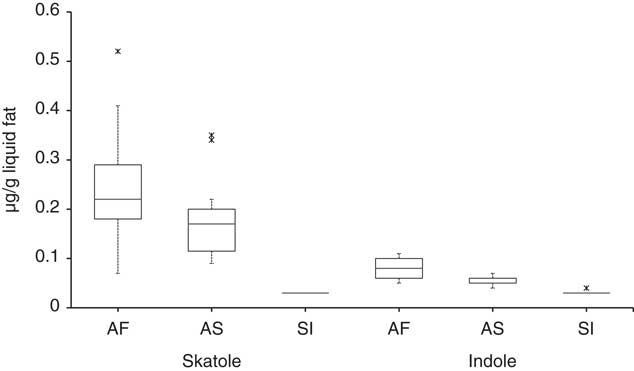
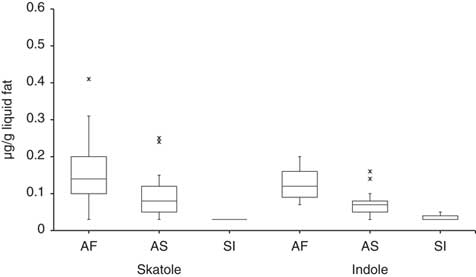
There was a treatment effect on the skatole concentration for both dorsal (Figure 1) and perirenal (Figure 2) fat (P < 0.001 for both fat tissues). Skatole was detected in the dorsal fat of all the AF and AS lambs, whereas it was not detected in any of the SI lambs. Skatole was detected in the perirenal fat of 16 out of 19 of the AF lambs and 14 out of 17 of the AS lambs, whereas it was not detected in any of the SI lambs. For the lambs grazing alfalfa, the fat skatole concentration was lower in the AS than the AF lambs (P < 0.025), and lower in perirenal than dorsal fat (P < 0.001) with the interaction between both factors being not significant (Table 2).
Boxplots of the subcutaneous dorsal fat skatole (left) and indole (right) concentrations in lambs, according to the feeding treatment (alfalfa-grazing (AF), alfalfa-grazing + supplementation with tannin-rich sainfoin pellets (AS), stall-feeding with concentrate and grass hay (SI)). The box contains the middle 50% of the data (between 25th and the 75th percentiles), the upper and lower whiskers represent the extreme values, the line in the box represents the median and the stars outside the upper and lower lines indicate the outliers.

Boxplots of the perirenal fat skatole (left) and indole (right) concentrations in lambs, according to the feeding treatment (alfalfa-grazing (AF), alfalfa-grazing + supplementation with tannin-rich sainfoin pellets (AS), stall-feeding with concentrate and grass hay (SI)). The box contains the middle 50% of the data (between 25th and the 75th percentiles), the upper and lower whiskers represent the extreme values, the line in the box represents the median and the stars outside the upper and lower lines indicate the outliers.

Effect of treatment and tissue on lamb fat skatole and indole concentration (µg/g of liquid fat)

AF = alfalfa (Medicago sativa) grazing; AS = alfalfa (Medicago sativa) grazing + supplementation with sainfoin (Onobrychis viciifolia) pellets; D = dorsal fat; P = perirenal fat.
*For P-value<0.025, ***for P-value<0.001, ns for P-value>0.05.
There was a treatment effect on the indole concentration for both dorsal (Figure 1) and perirenal (Figure 2) fat (P < 0.001 for both fat tissues). Indole was detected in the dorsal fat of all the AF and 15 out of 17 of the AS lambs, whereas it was detected in 1 out of 18 of the SI lambs. Indole was detected in the perirenal fat of all the AF lambs, 15 out of 17 of the AS lambs and 5 out of 18 of the SI lambs. For the lambs grazing alfalfa, the fat indole concentration was lower in the AS than the AF lambs (P < 0.001), and lower in dorsal than in perirenal fat (P < 0.001) with the interaction between both factors being not significant (Table 2).
Lamb chop sensory evaluation
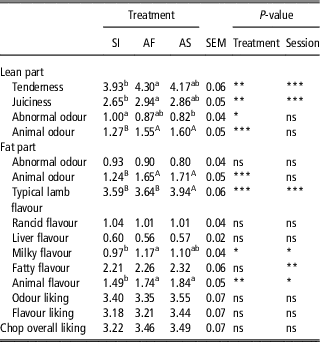
The intensity of ‘animal’ odour in both the lean and the fat part of the chops and of ‘animal’ flavour in the fat part of the chops were lower in the SI lambs than the forage-grazing (AF and AS) lambs (P < 0.001, P < 0.001 and P < 0.05, respectively), but were not significantly different between the AF and AS lambs (Table 3). The intensity of typical lamb flavour was higher in the AS lambs than the SI and AF lambs (P < 0.001 for both comparisons), but were not significantly different between the SI and AF lambs. The intensity of milky flavour was higher in the AF lambs than the SI lambs (P < 0.05) with the AS lambs being intermediate and not significantly different from the other two groups. The intensity of abnormal odour of the lean part of the chops was lower in the AS lambs than the SI lambs (P < 0.05) with the AF lambs being intermediate and not significantly different from the other two groups.
Effect of treatment and sensory panel session on evaluation of lamb chops (0 to 10 scale of increasing intensity)

SI = stall-feeding concentrate and grass hay indoors; AF = alfalfa (Medicago sativa) grazing; AS = alfalfa (Medicago sativa) grazing + supplementation with sainfoin (Onobrychis viciifolia) pellets.
***For P-value<0.001, **for P-value<0.01, *for P-value<0.05, ns for P-value>0.05.
A,BValues within a row with different superscript differ significantly at P < 0.001.
a,bValues within a row with different superscript differ significantly at P < 0.05.
Colour of fat and of longissimus thoracic et lumborum muscle
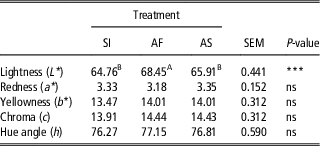
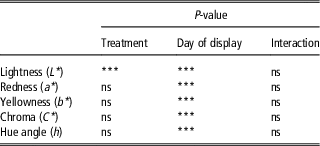
Subcutaneous caudal fat lightness (L*) was higher in the AF lambs than the SI and AS lambs (P < 0.001 for both comparisons) (Table 4). There was no treatment effect on the other SCF colour coordinates. The SCF ΔEab* values were 3.72 and 2.53 for the comparison between the SI and AF lambs and AS and AF lambs, respectively. There was no interaction between treatment and day of display on LTL muscle colour coordinates (Table 5). Longissimus thoracic et lumborum muscle lightness (L*) was higher in the SI lambs than the AF and AS lambs (by 1.55 and 1.35 units, respectively, P < 0.001 for both comparisons) but not significantly different between the AF and AS lambs. There was no treatment effect on the other LTL muscle colour coordinates. All LTL muscle colour coordinates were affected by day of display (P < 0.001 for all variables).
Lamb subcutaneous caudal fat colour at 24 h postmortem according to the treatment

SI = stall-feeding concentrate and grass hay indoors; AF = alfalfa (Medicago sativa) grazing; AS = alfalfa (Medicago sativa) grazing + supplementation with sainfoin (Onobrychis viciifolia) pellets.
***For P-value<0.001, ns for P-value>0.05.
A,BValues within a row with different superscript differ significantly at P < 0.001.
Statistical effects of treatment and day of display on lamb Longissimus thoracis et lumborum muscle colour

***For P-value<0.001, ns for P-value>0.05.
Parasitism
In forage-grazing lambs, the number of individual anthelmintic drenches ranged from 0 to 3 depending on the animal. It was higher in the AF lambs than the AS lambs, averaging 1.63 per lamb in the AF and 0.94 per lamb in the AS (P < 0.001). Frequency distribution in the two classes (zero or 1 drench v. at least 2 drenches) differed between the AF and AS lambs (P < 0.001): 58% of the AF lambs, whereas only 12% of the AS lambs received at least two anthelmintic drenches. Faecal egg count was lower for the AF lambs on D41 and D56 (P < 0.05 and P < 0.01, respectively) and was not significantly different between both groups on D69, D83 and D97 (Table 6). Faecal oocyst count was lower in the AS lambs than the AF lambs on D56 (P < 0.001) and was not significantly different between both groups on D69, D83 and D97.
Parasites faecal excretion level, number of lambs receiving an anthelmintic drench and lamb live weight according to the feeding treatment and the number of days since the beginning of the experiment (day 0 on 21 June, D0)1

1 Mean ± SD.
AF = alfalfa (Medicago sativa) grazing; AS = alfalfa (Medicago sativa) grazing + supplementation with sainfoin (Onobrychis viciifolia) pellets.
***For P-value<0.001, **for P-value<0.01, *for P-value<0.05, ns for P-value>0.05.
Discussion
This study was conducted to investigate the effects of daily CT-rich sainfoin pellet supplementation to lambs grazing alfalfa on meat sensory quality traits and digestive parasitism level. Condensed tannin-rich sainfoin pellets were consumed by all the AS lambs and the mean level of refusals (22.2%) indicated that the animals were supplemented ad libitum. As planned, there were no significant differences between the SI and AF groups in carcass weight and degree of fattening. Sainfoin supplementation led to a higher average carcass weight, however, the dorsal fat thickness and perirenal fat weight were similar to those of the SI and AF lambs. Skatole was detected in dorsal fat for all the forage-grazing lambs, whereas it was not detected in any of the SI lambs, confirming the risks of off-odours and off-flavours associated with alfalfa grazing, as already observed by Devincenzi et al. (Reference Devincenzi, Prunier, Meteau, Nabinger and Prache2014 and 2019). This result is consistent with the lamb chop sensory evaluation, where the intensity of ‘animal’ odour in both the lean and the fat parts and the intensity of ‘animal’ flavour in the fat part were higher for the lambs having grazed alfalfa than the SI lambs. ‘Animal’ odour and ‘animal’ flavour were actually the criteria chosen by the panellists when they experienced perceptions linked to the evaluation of chops from one lamb with a high skatole concentration in perirenal fat v. chops from one lamb with a low skatole concentration in perirenal fat (Devincenzi et al., Reference Devincenzi, Prunier, Meteau, Nabinger and Prache2014).
One of the main results of the study is that the consumption of CT-rich sainfoin pellets at a level representing on average 36% of the diet in lambs grazing alfalfa reduced fat skatole concentration by 26% (dorsal) to 36% (perirenal) and indole concentration by 38% (dorsal) to 42% (perirenal). Such an effect may have been mediated via a direct effect of CT and an indirect effect due to a decrease in the alfalfa intake level because of a partial substitution of alfalfa by supplement. A previous study, however, in similar experimental conditions showed that barley supplementation in lambs concurrently grazing alfalfa did not reduce fat skatole and indole concentrations (Devincenzi et al., Reference Devincenzi, Prunier, Meteau and Prache2019), undermining the hypothesis of an indirect effect linked to a reduction in the alfalfa intake level.
Although CT-rich sainfoin supplementation led to a decrease in fat skatole and indole concentrations, we did not observe any corresponding reduction in the intensity of ‘animal’ odour, neither in the lean nor in the fat parts of the chop and in the intensity of ‘animal’ flavour of the fat part of the chop. We can relate that to the study by Girard et al. (Reference Girard, Dohme-Meier, Silacci, Ampuero Kragten, Kreuzer and Bee2016), where lambs fed sainfoin silage had half the skatole levels in the perirenal fat and presented a lower ‘sheepy odour’ (but no differences in ‘sheepy flavour’) than lambs fed alfalfa silage. Moreover, in the study by Priolo et al. (Reference Priolo, Vasta, Fasone, Lanza, Scerra, Biondi, Bella and Whittington2009) tannin addition to the diet of lambs reduced fat skatole and indole concentrations and the ‘sheep meat’ odour, but had no effect on the flavour attributes. Research is still needed to investigate the relationship between the fat volatile indoles concentration and the intensity of the corresponding odour and flavour in lamb meat. Note however that in the present study (i) the CT concentration of sainfoin pellets was high, (ii) the animals were supplemented ad libitum and (iii) the supplementation lasted throughout the fattening period (90 days on average), making it difficult to envisage a greater dietary CT supply using sainfoin pellets and/or a longer duration of supplementation. The milky flavour intensity was higher in the forage-grazing lambs than the SI lambs, contrary to results obtained by Priolo et al. (Reference Priolo, Micol, Agabriel, Prache and Dransfield2002), but did not differ between the AS and AF lambs, in line with Girard et al. (Reference Girard, Dohme-Meier, Silacci, Ampuero Kragten, Kreuzer and Bee2016). Although the relative degree of carcass fattening was similar between treatment groups, the tenderness and juiciness of the lean part of the chops was found to be higher in the AF lambs than the SI lambs, contrary to previous results of Devincenzi et al. (Reference Devincenzi, Prunier, Meteau and Prache2019) obtained in similar conditions.
There was a treatment effect on the LTL muscle lightness, but no significant interaction between treatment and day of display, indicating that the differences between the feeding regimes may be considered relatively constant throughout the 9-day display period. The specific antioxidants in the AS lamb diet thus did not improve the colour stability of the meat over the 9-day display period. Longissimus thoracic et lumborum muscle lightness was lower in the forage-grazing lambs than the SI lambs, in line with a previous study (Priolo et al., Reference Priolo, Micol, Agabriel, Prache and Dransfield2002). In this study, however, there were no differences in LTL muscle colour coordinates between the AS and AF lambs. Some confusion exists in the literature regarding the effect of diets containing CT on lamb meat colour, with some authors reporting an increase in meat lightness, even when tannins are present in low dietary amounts (Vasta et al., Reference Vasta, Nudda, Cannas, Lanza and Priolo2008), and others no change (Girard et al., Reference Girard, Dohme-Meier, Silacci, Ampuero Kragten, Kreuzer and Bee2016). Lightness of SCF was higher in the AF lambs than the AS and SI lambs with the difference between the SI and AS lambs being not significant. The underlying reasons for this treatment effect are unclear, however, this effect was of low biological amplitude, as ΔEab* values were lower than the threshold of 5.9 suggested by Schwarz et al. (Reference Schwarz, Cowan and Beatty1987) as enabling visual appraisal on fat to find significant differences.
Condensed tannin-rich sainfoin pellet supplementation in naturally infected forage-grazing lambs led to delay the onset of both helminth and coccidian infections, confirming recent findings (Hoste et al., Reference Hoste, Torres-Acosta, Sandoval-Castro, Mueller-Harvey, Sotiraki, Louvandini, Thamsborg and Terrill2015, for nematode infections; Saratsis et al., Reference Saratsis, Voutzourakis, Theodosiou, Stefanakis and Sotiraki2016, for coccidial infections). In the present study, this effect may have been mediated via (i) a direct anthelmintic and anti-coccidial effect of sainfoin supplement and (ii) an indirect effect due to a decrease in the pasture herbage intake level because of a partial substitution of pasture herbage by supplement. Note, however, that, in similar conditions, Devincenzi et al. (Reference Devincenzi, Prunier, Meteau and Prache2019) did not observe any effect of barley supplementation on parasitism level, therefore undermining this indirect effect.
Conclusion
This study confirmed that lambs grazing alfalfa accumulate high levels of volatile indoles in their fat, inducing a higher intensity of ‘animal’ odour and ‘animal’ flavour than in stall-fed lambs. The use of CT-rich sainfoin pellets (at 36% of total diet) to supplement lambs that are concurrently grazing alfalfa reduced fat volatile indoles concentrations but did not change the intensity of ‘animal’ odour and ‘animal’ flavour of the chops. The meat and fat colour in lambs grazing alfalfa were not or only slightly influenced by CT-rich sainfoin pellet supplementation. This study also showed that CT-rich sainfoin pellet supplementation delayed the onset of both helminth and coccidian infections.
Acknowledgements
This work was funded by the Special Assignment Account for ‘Agricultural and Rural Development’ (CASDAR) of the French Ministry of Agriculture, Agrifood and Forestry, under project CASDAR IP 5560 – ECOLAGNO. The authors thank the MG2Mix (Chateaubourg, France) and Multifolia (Viapres Le Petit, France) companies for providing the dehydrated sainfoin pellets. The authors thank all the colleagues involved in the experiment management, data collection and analysis, especially L. Lavelle, A. Cercy, B. Viallard, M. Bernard, C. Coustet, C. Labonne, S. Faure and W. Gros. The first author is thankful to the Brazilian Ministry of Science and Technology ‘Conselho Nacional de Desenvolvimento Científíco e Tecnológico’ (CNPq) for scholarship funding.
Declaration of interest
None.
Ethics statement
This study received ethical approval from Ethical Review Committee of the French Ministry of Higher Education, Research and Innovation (ethic committee approval No. 5287-2016050318599795V2).
Software and data repository resources
None.
Supplementary material
To view supplementary material for this article, please visit https://doi.org/10.1017/S1751731118003543