Introduction
Large language models (LLMs) are artificial intelligence (AI) models designed to process coherent text and generate human-like responses. Reference Rodriguez-Nava, Egoryan, Goodman, Morgan and Salinas1,Reference Naveed, Khan and Qiu2 In medicine, LLMs can streamline clinical tasks such as ambient listening during history taking, summarizing health records, and clinical decision-making assistance. Reference Bedi, Liu and Orr-Ewing3
LLMs may enhance infection preventionists (IPs) surveillance activities. Central line—associated bloodstream infection (CLABSI) surveillance is a labor-intensive component of infection prevention. Reference Wiemken and Carrico4,Reference Marra, Nori, Langford, Kobayashi and Bearman5 Accurate surveillance requires expert application of National Healthcare Safety Network (NHSN) criteria, review of clinical data, and determination whether bacteremia is attributable to a central line or secondary to another infection source, requiring significant IPs time and expertise.
Lurie Children’s Hospital of Chicago implemented a secure LLM tool integrated with electronic medical records (EMR) to support CLABSI surveillance. We compared the accuracy and timeliness of LLM-assisted surveillance with manual review.
Methods
At Lurie Children’s, a possible CLABSI is flagged based on positive blood culture in a patient with a central line admitted for >48 hours. The IP conducts a manual review from the EMR and determines if the infection is a CLABSI or a secondary bloodstream infection (BSI) based on NHSN criteria.
We implemented a secure decision assistance system for CLABSI surveillance utilizing the Azure OpenAI o1 model with advanced reasoning capabilities embedded with NHSN surveillance definitions and connected to the EMR. All patient EMR data is migrated to Snowflake (cloud data warehouse) through nightly updates (supplement 1). A daily processing runs in Snowflake identifying patients with positive blood cultures and central lines within NHSN-defined time windows. Case summaries including culture and line details are created. IPs prompt the model about clinical data (e.g. imaging, culture results), determination of CLABSI per NHSN criteria and rationale for determination (supplement 2).
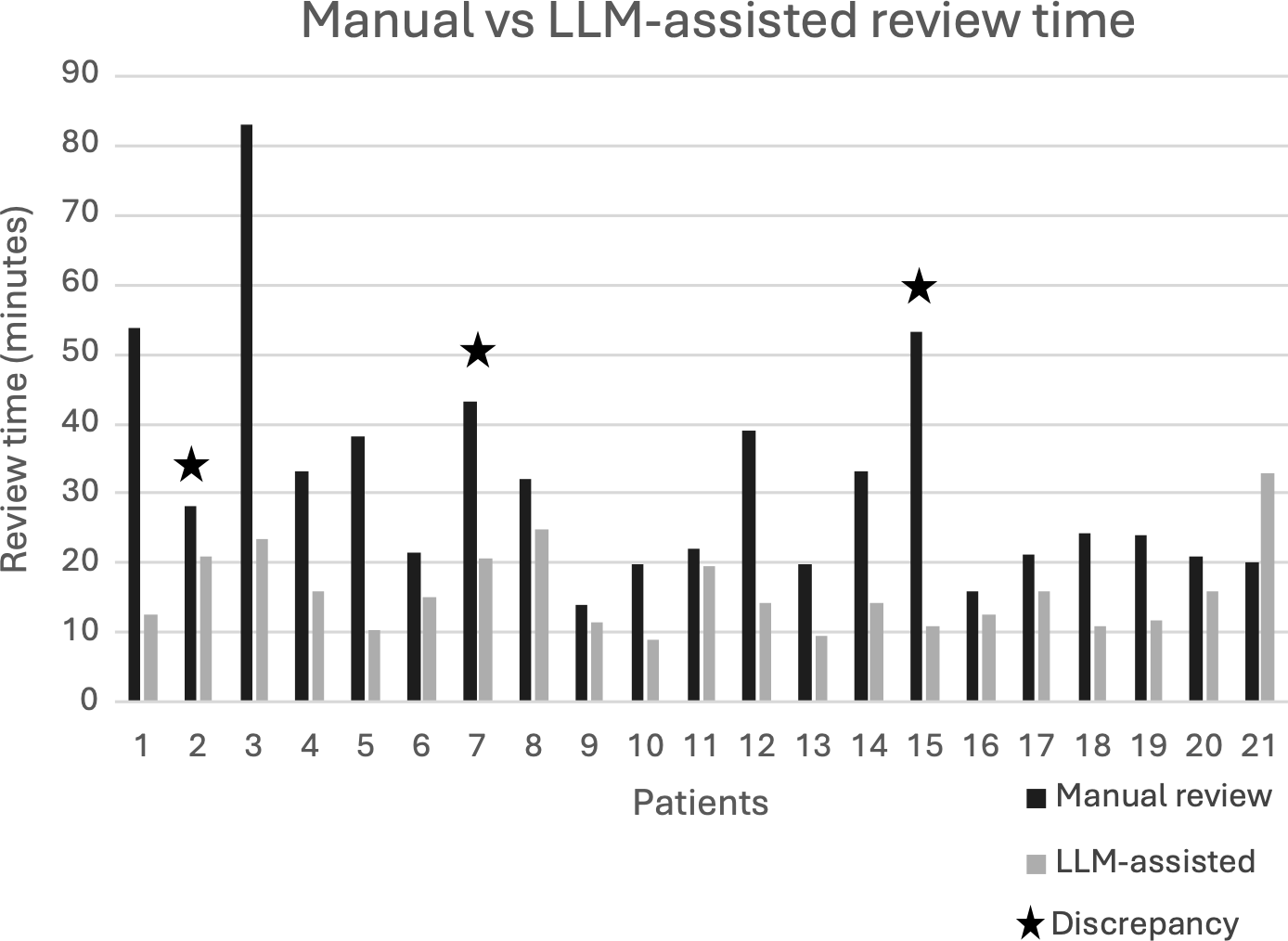
During the tool assessment period (May to August 2025), 21 patients were flagged for CLABSI review. Each case was evaluated by two IPs: one using a manual approach and the other an LLM-assisted approach. IP pairs were matched by years of infection-control experience, and all IPs completed both manual and LLM-assisted reviews to allow for crossover. Review time and accuracy were compared between manual and LLM-assisted review. Review time was measured using a stopwatch, with predetermined standardized start and stop rules. Using paired t-test, we compared the review time between the LLM and manual review (Figure 1).
Review times for 21 suspected CLABSI cases. Each case was assigned to two IPs and reviewed manually or LLM-assisted. The graph shows the review time in minutes. Cases marked with a star represent discrepancy in CLABSI determination between the manual and the LLM-assisted reviews.

Figure 1 Long description
A bar graph compares manual and LLM-assisted review times for 21 patients. The x-axis represents patients numbered from 1 to 21, and the y-axis represents review time in minutes, ranging from 0 to 90. Each patient has two bars: a black bar for manual review and a gray bar for LLM-assisted review. The graph shows that manual review times are generally higher than LLM-assisted review times. Notable discrepancies in CLABSI determination between manual and LLM-assisted reviews are marked with stars for patients 2, 7, and 15. For example, patient 3 has a manual review time of approximately 80 minutes, while the LLM-assisted review time is around 20 minutes. Patient 7 shows a manual review time of about 50 minutes and an LLM-assisted review time of around 30 minutes. Patient 15 has a manual review time of approximately 60 minutes and an LLM-assisted review time of around 20 minutes. The data indicates that LLM-assisted reviews consistently reduce review times compared to manual reviews. All values are approximated.
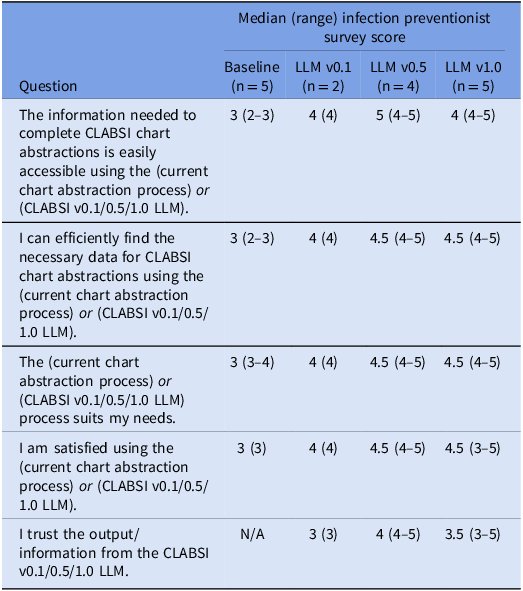
A survey was conducted before the LLM was created and after each version of the LLM was completed (v0.1, v0.5 and v1.0) to evaluate IPs satisfaction and perceived usability. Responses were recorded on a 5-point Likert scale and summarized descriptively using median and range. Formal statistical comparisons were not performed due to the small number of respondents (Table 1).
Infection preventionists (IPs) survey results across versions of the LLM CLABSI review tool. IPs rated their level of agreement with statements assessing usability, efficiency, satisfaction, and trust using a 5-point Likert scale (1 = strongly disagree to 5 = strongly agree). The baseline column shows IP responses during manual CLABSI chart review prior to LLM implementation. Subsequent columns show responses following introduction of different versions of the LLM-assisted review tool (v0.1, v0.5 and v1.0). Results are presented as the median and range of IPs responses. By v1.0, most IPs strongly agreed that information extracted from the LLM was easier to access and agreed or strongly agreed that it improved efficiency, suitability, satisfaction, and trust

Table 1 Long description
The table presents survey results from infection preventionists (IPs) evaluating different versions of the LLM CLABSI review tool. It includes five columns: Baseline, LLM v0.1, LLM v0.5, and LLM v1.0, each showing median and range scores on a 5-point Likert scale. The rows represent questions about the ease of accessing information, efficiency, suitability, satisfaction, and trust. The baseline column shows scores before LLM implementation, while subsequent columns show scores after introducing versions v0.1, v0.5, and v1.0 of the LLM tool. Notable trends include increased median scores and reduced ranges as the LLM versions progress, indicating improved usability, efficiency, satisfaction, and trust among IPs.
Results
Throughout the study period, the LLM identified 13 of 15 CLABSIs, and 5 of 6 secondary BSI. We observed an 85.7% (18/21, 95% CI 63.6%–97.0%) agreement between LLM and IP. The LLM had a 83.3% specificity and 86.7% sensitivity. Positive and negative predictive values were 92.9% and 71.4% respectively.
There were two CLABSIs identified by manual review that the LLM failed to identify. For one case, the LLM stated that it met BSI secondary to a skin infection; however, the matching wound culture was taken at the ventricular assist device site, a site excluded per NHSN. For the other discordant case identified as CLABSI by manual review, the LLM stated that the BSI was secondary to pneumonia (PNU).
There was one case the LLM identified as CLABSI where the manual review determined PNU. Modifications were made to the LLM to ensure that it included all key information, and the LLM was able to identify PNU 3/5 times.
In the 5 cases where both LLM and manual review identified a secondary BSI, they reached the same secondary source -necrotizing enterocolitis (NEC) x2 and PNUx3.
The median (interquartile range) time it took for the IPs to manually perform a CLABSI review was 24.3 (21.1, 38.2) minutes compared to 14.4 (11.5, 19.7) minutes for LLM-assisted review (P < .05). LLM was associated with a median (interquartile range) decline in review time by 52% (24.8%, 56.8%).
By the last version of the LLM, most IPs agreed or strongly agreed it made information easier to access and improved efficiency, and that the LLM was suitable, satisfactory, and trustable (Table 1).
Discussion
Our study suggests that LLM augmented with NHSN criteria can support accurate and time-saving review of suspected CLABSIs, including the ability to identify secondary BSIs.
Traditional CLABSI surveillance is time-consuming, requiring rigorous EMR review, integration of clinical, laboratory, and radiographic data, and expert judgment to determine whether a BSI meets NHSN CLABSI definitions or is secondary to infection from another site. Surveillance activities occupy 25–50% of IP work hours. Reference Wiemken and Carrico4,Reference Knighton, Engle, Berkson and Bartles6 Accurate surveillance is critical, both for guiding infection prevention interventions and for ensuring the validity of publicly reported outcomes.
In our implementation, we fine-tuned the LLM to extract data from the EMR and apply NHSN definitions to suspected CLABSI cases, effectively functioning as a secondary reviewer. This is a retrieval-augmented generation strategy that directs the LLM to draw from reliable sources to reduce risk of inaccuracies. Reference Abosi, Kobayashi and Ross7,Reference Gao, Xiong and Gao8 Prompt engineering allowed for building guardrails into the LLM context and for targeted data extraction, minimizing missed elements and synthesizing information across the medical chart. The tool resembled “consulting another IP” with built-in knowledge of NHSN criteria, but without bias.
The use of LLMs in infection prevention is not yet widespread. Rodriguez-Nava et al. demonstrated the ability of a secure version of ChatGPT to identify CLABSI using real life notes. Their method had higher sensitivity (80%) than specificity (35%), taking only 5 minutes for data input and review. Reference Rodriguez-Nava, Egoryan, Goodman, Morgan and Salinas1,Reference Wu, Langford, Shenoy, Carey and Branch-Elliman9 Abosi et al used educational scenarios to evaluate the accuracy of four LLMs, concluding that LLMs show promise as supplemental tools for infection prevention programs. Reference Abosi, Kobayashi and Ross7 Our study expands on this early work by demonstrating performance in live operational settings, accuracy in identifying CLABSI and attribution of secondary BSIs, an area requiring nuanced human judgment. While more complex cases still necessitate IP adjudication, our findings suggest that LLMs can reliably streamline the initial stages of review.
Potential benefits to LLM tools include reallocation of IP time to prevention activities. Reference Wiemken and Carrico4,Reference Marra, Nori, Langford, Kobayashi and Bearman5 LLMs offer consistency in applying surveillance definitions reducing inter-rater variability. By continuous exposure to new cases and data, LLMs are able to learn and improve. Reference Abosi, Kobayashi and Ross7 However, the use of LLMs with protected health information requires safeguards to assure data security, Reference Marra, Nori, Langford, Kobayashi and Bearman5 model inaccuracies or hallucinations remain a risk, and reliance on AI without human oversight could compromise surveillance integrity. Reference Marra, Nori, Langford, Kobayashi and Bearman5
Our study was limited by its small sample size and single-center design, and larger, multicenter evaluations are needed for generalizability. This study is an early-stage evaluation of the LLM tool. Continued refinement of IPs’ prompting and LLM data extraction will improve performance.
Future directions include refinement of prompts to enhance accuracy, LLM integration for other HAIs, and assessment of broader impact on IP workload and institutional outcomes. Our LLM tool does not automatically screen the EMR and determines CLABSI cases, however continued learning from applications such as this may advance future use of proactive AI surveillance.
In conclusion, an LLM augmented with NHSN criteria can accurately and efficiently support CLABSI surveillance. Such tools can help improve IP efficiency and maintain surveillance accuracy in increasingly resource-constrained healthcare environments.
Supplementary material
The supplementary material for this article can be found at https://doi.org/10.1017/ice.2026.10435.
Acknowledgements
The authors thank the members of the Data Insights and Artificial Intelligence Department at Ann & Robert H. Lurie Children’s Hospital of Chicago for their collaboration.
Author contribution
Manuscript preparation. AA, SS and EM, employees of Impact Advisors, provided assistance in preparing and editing the manuscript.
During the preparation of this work the authors used ChatGPT in order to improve readability and language. After using this tool, the authors reviewed and edited the content as needed and take full responsibility for the content of the publication.
Competing interests
Potential conflicts of interest. AA, SS and EM are employees of Impact Advisors, the company that developed the LLM tool evaluated in this project. To mitigate potential bias data analysis was conducted independently by the Infection Prevention team.
All other authors report no conflicts of interest relevant to this article.
Ethical standard
All authors have read and approved the submission of the manuscript to ICHE.