


INTRODUCTION
Pavan's home is set deep within the serpentine alleyways of Ganpati, one of the largest slums in the north Indian city of Jaipur. With exposed brick walls, chipping paint, and a corrugated steel roof held by stones, the shanty is almost indistinguishable from others in the settlement. What differentiates it is the inscription on Pavan's front door. The sign displays his name, his position as adyaksh (president), and a lotus flower—the symbol of the Bharatiya Janata Party (BJP). Pavan is an informal slum leader. He helps residents secure government IDs and demand public services from the state. In a handful of folders, Pavan keeps copies of petitions, official correspondence, and notes from party meetings, detailing his efforts to improve the slum. He has built a large following through these activities and is expected to translate his support into votes for the BJP. Pavan, however, cannot rest on his laurels. He must maintain his clients’ approval or risk losing them to one of Ganpati's many other slum leaders, who vie to expand their personal following—their source of rents, patronage, and political sway.Footnote 1
A burgeoning literature in comparative politics establishes the pervasiveness of political brokers like Pavan, who facilitate the exchange of electoral support for access to goods, services, and protection in clientelistic settings (Nichter Reference Nichter2008; Stokes et al. Reference Stokes, Dunning, Nazareno and Brusco2013; Camp Reference Camp2015; Holland and Palmer-Rubin Reference Holland and Palmer-Rubin2015; Szwarcberg Reference Szwarcberg2015; Larreguy, Marshall, and Querubin Reference Larreguy, Marshall and Querubin2016). While these studies advance our understanding of clientelism, they tend to view machine politics—and the hierarchies of brokers who enable it—from a top-down, party-centered perspective. Consequently, they predominantly conceptualize poor voters as passive recipients of election-time handouts, targeted by intermediaries operating in their neighborhoods. The agency of poor voters in selecting the local brokers they support and turn to for help has largely been overlooked.
In this paper, we argue that clients play a meaningful role in selecting the brokers that staff electoral machines. The neglect of client agency in broker selection stems from a lack of recognition of the intense competition among brokers for client support in many parts of the world. Such competition enables clients to choose which broker to seek help from and follow. Recognition of such choice compels analyzing the underlying preferences that inform broker selection by clients, which have not been systematically theorized or tested.
We provide a theoretical framework for analyzing client preferences for brokers, distinguishing two concerns that jointly structure such support. The first is efficacy oriented: How likely is a broker to be able to successfully demand and secure public goods and services from the state? We argue evaluations of efficacy hinge on client perceptions of a broker's capability in making claims, their bureaucratic connectedness to local municipal officials, and their partisan connectedness to the incumbent political party. The second concern is distributive: how likely is a broker to channel secured benefits to a client's household? We focus on shared partisan or ethnic identities between the broker and client as determinants of these distributive expectations.
Empirically, we examine client preferences for brokers through a study of a substantively important class of intermediaries: informal slum leaders. Poor urban neighborhoods are iconic settings for theories of clientelism, making them especially important arenas to examine (Stokes Reference Stokes1995, Auyero Reference Auyero2000). Slums are estimated to house approximately 850 million people worldwide, making their leaders central figures in the distributive politics of developing cities.Footnote 2 For residents, slum leaders are focal points for fighting eviction and demanding development. For politicians, they are uniquely positioned to influence residents, encourage turnout, and organize rallies. Through a combined three years of qualitative fieldwork in Indian slums, we found settlement leadership to be contested, multifocal, and rapidly constructed to push back against eviction and claim public services. In such competitive brokerage environments, Indian slum residents wield significant agency and choice in selecting whom they approach for problem-solving.
To assess the relative salience of efficacy and distributive concerns in shaping slum resident preferences for brokers, we conducted an ethnographically informed conjoint survey experiment with 2,199 individuals across 110 slums in two north Indian cities. Survey respondents were asked to choose between two hypothetical candidates running for the informal position of slum president (adyaksh). We use ethnographic insights to operationalize contextual indicators of each candidate's ethnicity and partisanship, their claim-making capability, and their connectivity to both local bureaucrats and the incumbent party. A parallel experiment asked respondents to choose between two hypothetical residents as potential neighbors, allowing us to distinguish political preferences for leaders from social preferences for neighbors. Finally, we subject our experimental findings to further scrutiny using data from a survey of 629 slum leaders, whom we surveyed across our 110 settlements. Specifically, we assess whether client-preferred traits distinguish actual slum leaders from ordinary residents.
This paper advances the study of distributive, ethnic, and urban politics. Theoretically, we draw attention to the neglected phenomenon of broker selection by clients. We build on important work showing that clients often have nontrivial agency (Auyero Reference Auyero2000), ranging from initiating requests for services (Nichter and Peress Reference Nichter and Peress2017) to defecting from nonresponsive machines (Taylor-Robinson Reference Taylor-Robinson2010). We extend this scholarship by arguing clients can also shape who staffs the local machine, especially in competitive brokerage conditions. When clients can exercise choice in broker selection, we argue it is important to analyze their preferences for specific broker attributes. We provide a theoretical framework for understanding those preferences centered on the distributive and efficacy concerns of clients.
Our results, interpreted through this distinction between efficacy and distributive concerns, are also theoretically significant. First, our findings challenge conventional wisdom on Asian and African politics that anticipates distributive expectations based on coethnicity will overwhelmingly shape political preferences (Chandra Reference Chandra2004; Posner Reference Posner2005). While clients do prefer coethnics, we find they value certain nonethnic indicators of a slum leader's efficacy, particularly their education, even more highly. We also find, contra some prior studies, that the benefits for good performance do not exclusively accrue to coethnics (Adida et al. Reference Adida, Gottlieb, Kramon and McClendon2017; Carlson Reference Carlson2015). Indeed, we find capability and connectivity can even compensate for a lack of coethnicity. This latter finding is especially important, given that our broker survey reveals the supply of coethnic brokers in diverse slum settlements is more constrained than that of capable brokers.
Second, our findings on education suggest variation in broker efficacy for their clients should receive greater attention in models of clientelism. Extant studies have focused on conceptualizing broker efficacy from the perspective of parties (Camp Reference Camp2015; Larreguy, Marshall, and Querubin Reference Larreguy, Marshall and Querubin2016). Variation in client-facing efficacy is further obscured by a preoccupation with top-down, episodic forms of distributive politics such as vote buying. Such activities mute the importance of individual skills in advancing client claims, a primary role brokers play between elections. Our findings support recent calls for paying greater attention to such everyday lobbying roles, and not simply a brokers’ episodic roles as dispensers of election-time handouts (Berenschot Reference Berenschot2010; Nichter Reference Nichter2014; Bussell Reference Bussell2018; Kruks-Wisner Reference Kruks-Wisner2018).
Empirically, our study provides the first systematic analysis, to our knowledge, of client preferences for brokers. We hope to spark a research agenda on the determinants of client preferences for informal leaders across varied national and local contexts. We also seek to contribute to our empirical understanding of distributive politics within urban slums and migrant communities, an understudied electorate that is proliferating across much of the developing world (Thachil Reference Thachil2017).Footnote 3 In this arena, we present evidence from the first large and representative survey of slum leaders ever conducted.
CLIENT PREFERENCES MATTER
Conventional models of clientelism afford little agency to poor voters in selecting the brokers they seek help from and follow. Influential studies assume the presence of brokers without probing the nature of their support (Stokes Reference Stokes2005; Nichter Reference Nichter2008), or analyze how parties select brokers to include within their organizational networks (Camp Reference Camp2015; Szwarcberg Reference Szwarcberg2015; Larreguy, Marshall, and Querubin Reference Larreguy, Marshall and Querubin2016). In sharp contrast, there have been no efforts to systematically theorize and examine client preferences for brokers. Auyero's (Reference Auyero2000, 153) assertion, made nearly two decades ago, that studies of clientelism rarely take the agency of clients seriously still rings true today.
This neglect of client preferences stems from insufficient recognition of competition among brokers for clients, which enables a degree of choice in who clients can turn to for help (Scott Reference Scott1977). Many influential studies of clientelism model interactions between voters and a single dominant machine (Stokes Reference Stokes2005; Nichter Reference Nichter2008; Stokes et al. Reference Stokes, Dunning, Nazareno and Brusco2013; Gans-Morse, Mazzuca, and Nichter Reference Gans-Morse, Mazzuca and Nichter2014). In such settings, client choice can only occur via intra-party competition among brokers, which is rarely examined. Other frameworks specify a single broker (Gingerich and Medina Reference Gingerich and Medina2013; Rueda Reference Rueda2015) or multiple brokers who each hold spatially distinct monopolies over clients (Gans-Morse, Mazzuca, and Nichter Reference Gans-Morse, Mazzuca and Nichter2014; Camp Reference Camp2015). Across all of these models, clients are bereft of options, rendering their preferences—and efforts to investigate them—redundant.
However, assumptions of single-party or single-broker dominance do not align with the political realities of many countries and communities. An expert survey (Kitschelt Reference Kitschelt2011) documents competitive “bilateral or multilateral” clientelistic party systems as more common than “unilateral clientelism.”Footnote 4 Further, even within “unilateral machines,” ethnographic studies find evidence of microlevel competition among brokers (Auyero Reference Auyero2000; Zarazaga Reference Zarazaga2014). In our study setting, we found slum dwellers reside in highly competitive brokerage environments. Our survey respondents provided nearly 1,000 slum leader names, or roughly 9 per settlement, and most slums had leaders with formal affiliations to each of the city's major political parties.
Competition grants clients a degree of choice in choosing whom they seek assistance from. In interviews, Indian slum residents repeatedly noted they actively selected their leaders:
Resident 1: Slum leaders help us because the residents of the basti [slum] have chosen them as their leader.Footnote 5
*
Resident 2: We chose them so that they can help us when there is a problem.Footnote 6
*
Resident 3: Leaders help poor people who have no one in the government to go to. . .We have chosen them for a reason.Footnote 7
In neglecting this reality of client choice in selecting brokers, party-centric studies have overlooked the client preferences empowered by such choice. At most, these studies anticipate clients will prefer a broker with connections to party organizations. Such connections unlock the top-down flow of party handouts during elections that are seen to motivate resident support. Client approval of a broker should therefore hinge upon a party's prior approval, especially from the resource-rich incumbent at the center of most top-down models.
By contrast, in competitive brokerage environments, client approval does not simply flow axiomatically from prior party approval. Slum leaders, for example, must attract a following through entrepreneurial sweat, by advancing everyday resident demands through local lobbying and competing with others in the settlement who seek to engage in netagiri, or politicking. Indeed, party leaders frequently consider a slum leader's local popularity with clients in their own organizational decisions. Party leaders in our study cities noted they could not manufacture client support for any individual simply by granting them a position within their local organization. Instead they noted the need for brokers to be from the slum itself, and the importance of resident approval in shaping their own evaluations:
Party Elite 1: See, there would always be some leadership in the bastis; some people who were active and working for people. Our party needed someone like this in the settlement. It was through such people that we strengthened our position in the bastis. . .These are the people we would select for a party position.Footnote 8
*
Party Elite 2: Someone from the community emerges as a strong leader, has a public following, and has strong influence. In that case, we must approach him and offer him a position.
Author: You mean when there is someone the local people already support, you then approach him and bring him into the party?
Party Elite 2: Yes, somehow we have to make him part of the party.Footnote 9
*
Party Elite 3: We [the party] can't make someone a neta [leader] just by giving him neta clothes and making him stand on the road. In that case he would just be a statue. They must first have the support of residents to be a leader.Footnote 10
Evidence from our survey of 629 slum leaders (detailed below) provides further corroboration of the importance of client support in solidifying a broker's appeal to political parties. We asked slum leaders what the biggest reason was for securing a position (pad) within a party. 56.8% said popularity within the slum (the next most frequent item accounted for 10.11% of responses). Only 9.56% said top-down, preexisting ties to party leaders.
These observations also align with an earlier wave of scholarship on urban politics in Latin America, which described slums as competitive brokerage environments in which leaders were local residents who had to work to gain client approval (Ray Reference Ray1969; Cornelius Reference Cornelius1975; Gay Reference Gay1994). These studies, however, stop short of theorizing and testing the implications of competitive brokerage for processes of client selection and the nature of client preferences. Our argument also aligns with recent studies underscoring that clients have nontrivial agency, ranging from initiating requests for services (Nichter and Peress Reference Nichter and Peress2017) to defecting from machines that do not reward them (Taylor-Robinson Reference Taylor-Robinson2010) and other mechanisms of constrained accountability (Hilgers Reference Hilgers2012). However, these studies have focused on how such agency affects the downward responsiveness of party machines toward clients. None have theoretically linked competition between brokers with client agency in selecting local leaders, or empirically examined the preferences guiding such bottom-up selection decisions.
In sum, brokers in competitive environments must often vie for the client support that underpins their local authority. In generating choice, competition affords clients an opportunity to select brokers they most prefer, rather than accept a broker anointed by political elites. How, then, is client choice exercised?
We found two primary alternatives within our study setting. The first are discrete moments of selection, principally informal elections and community meetings. Seventy-seven percent of the 1,925 respondents to a 2012 author survey of slum residents across our two study cities (Auerbach Reference Auerbach2016) acknowledged informal leadership in their settlement. Over half of this subset reported selecting their leaders through informal elections or community meetings. This figure matches our slum leader survey, where 38% of respondents claimed they were selected through informal elections or community meetings. Research on slums in India and Latin America has described similar selection processes (Ray Reference Ray1969; Gay Reference Gay1994; Burgwal Reference Burgwal1995; Jha, Rao, and Woolcock Reference Jha, Rao and Woolcock2007). The second pathway of broker selection is through iterative, everyday choices made by clients in whom to seek help from. These individual choices aggregate into a distribution of support for slum leaders.
Irrespective of whether brokers are selected through informal elections, community meetings, or decentralized day-to-day resident decisions, their success in competitive settings hinges on client preferences. We now turn to providing a theoretical framework for analyzing such preferences.
WHICH BROKERS WILL THE URBAN POOR PREFER?
We pinpoint two key concerns that shape client preferences for brokers. Each provides a client-centered corollary to previously articulated concerns that parties hold in their top-down evaluations of brokers. The first is a distribution-based concern: How likely am I (the client) to be included within a broker's distributive network? The second is an efficacy-based concern: How likely is this broker to acquire material benefits to distribute? While these concerns can be complementary, each highlights distinct attributes clients will value in their local broker.
Distributive Concerns
Studies of how parties evaluate brokers have emphasized the importance of a broker's efficiency in converting party resources into votes (Stokes et al. Reference Stokes, Dunning, Nazareno and Brusco2013; Larreguy, Marshall, and Querubin Reference Larreguy, Marshall and Querubin2016). Given it is neither feasible nor efficient for parties to provide benefits to all voters, brokers can help ensure benefits reach those the party wishes to cultivate as clients. Accordingly, parties are said to prefer brokers with pre-poll information about client partisan preferences (Nichter Reference Nichter2008; Stokes et al. Reference Stokes, Dunning, Nazareno and Brusco2013), post-poll information about electoral compliance (Stokes Reference Stokes2005), and probity in passing on party resources to voters (Rueda Reference Rueda2015; Larreguy, Marshall, and Querubin Reference Larreguy, Marshall and Querubin2016).
Switching to a client's perspective, excludable targeting raises a distributive concern: which broker's network am I most likely to be included within? Under competitive conditions, such expectations can shape the preferences clients draw on to choose which broker to support. What indicators might clients draw on in formulating these distributive expectations?
Past literature suggests commitment problems in quid pro quo protocols are ameliorated when brokers and voters are embedded within the same social or organizational network. Consequently, scholars anticipate shared partisan affiliations as central to structuring clientelist transactions. Risk-averse parties (Cox and McCubbins Reference Cox and McCubbins1986) and brokers (Dunning and Nilekani Reference Dunning and Nilekani2013; Stokes et al. Reference Stokes, Dunning, Nazareno and Brusco2013) are argued to favor copartisan clients most likely to reciprocate at the polls. From the client's perspective, citizens who share partisan affiliations with their broker will therefore hold higher expectations of getting benefits than those who do not (Calvo and Murillo Reference Calvo and Murillo2013). Thus, we expect residents to prefer slum leaders of the same partisan affiliation.Footnote 11
Studies of clientelism in South Asia and Africa similarly emphasize the utility of shared ethnic networks. The stickiness and visibility of ethnic markers bestow an informational advantage over nonethnic categories such as class. Such advantages are argued to solve commitment problems within clientelist pacts (Chandra Reference Chandra2004; Posner Reference Posner2005; Carlson Reference Carlson2015). Additionally, coethnics are often embedded within dense social networks, enabling them to build trust (Fershtman and Gneezy Reference Fershtman and Gneezy2001). These and related arguments have primarily been made with regard to shared ethnicity between voters and political candidates (Chauchard Reference Chauchard2016). However, their logic suggests slum residents will also prefer coethnic local leaders, whom they expect to favor them in the distribution of resources.
Efficacy Concerns
Scholars theorizing how parties evaluate brokers also discuss the importance of a broker's efficacy, typically conceived in terms of their ability to mobilize voters during elections and rallies (Szwarcberg Reference Szwarcberg2015), and monitor their compliance at the ballot box (Stokes et al. Reference Stokes, Dunning, Nazareno and Brusco2013). This focus on a broker's electoral efficacy is enabled by a preoccupation with vote buying, a top-down strategy in which parties deliver handouts to brokers, and brokers distribute them to clients.
This “handout model” of clientelism paints brokers as election-time distributive nodes with little individual lobbying power (Gonzalez-Ocantos et al. Reference Gonzalez-Ocantos, de Jonge, Melendez, Osorio and Nickerson2012; Larreguy, Marshall, and Querubin Reference Larreguy, Marshall and Querubin2016). The benefits involved—petty cash, sacks of grain, liquor—are modest. Further, their allocation is often managed by campaign operatives, who distribute them to brokers as either a fixed allotment or variable handouts determined by client demographics (Gans-Morse, Mazzuca, and Nichter Reference Gans-Morse, Mazzuca and Nichter2014). A broker's individual skill thus plays little role in determining the benefits they have to distribute. Recent models of vote-buying even explicitly assume all brokers to be equally capable, and explain variation in their efficacy (again conceptualized from the party's perspective) as dependent on the extent to which party superiors can monitor and punish them (Larreguy, Marshall, and Querubin Reference Larreguy, Marshall and Querubin2016, 165).
A client-centered perspective widens the aperture of observation to broker activities between the votes. This focus reveals the importance of their individual capabilities in everyday acts of problem-solving in response to resident demands. These demands reverse the flow of activity upward, revealing the importance of a broker's efficacy in bringing requests to the notice of political elites. Such skill is central to securing resources for clients, and thereby popularity among them. Popularity is the basis upon which brokers attract party patronage, promotions within party organizations, and day-to-day rents from residents seeking help (Auerbach Reference Auerbach2016).Footnote 12
We are hardly the first to acknowledge the significance of routine problem-solving in the repertoire of broker activities (Auyero Reference Auyero2000; Krishna Reference Krishna2002), as well as the importance of broker efficacy in generating a following (Ray Reference Ray1969; Cornelius Reference Cornelius1975). Yet most prior studies simply describe such activities as essential, without theorizing the implications of variable client-facing efficacy. More recent studies of Argentine brokers note that broker popularity is a function of variable abilities to secure resources (Zarazaga Reference Zarazaga2014; Camp Reference Camp2015; Szwarcberg Reference Szwarcberg2015). But even this recognition has not yielded insights into how clients assess broker efficacy and the degree to which such evaluations guide broker selection by clients.
Instead, prior scholarship has primarily assumed clients can rely on a broker's past performance in determining their future efficacy (Stokes et al. Reference Stokes, Dunning, Nazareno and Brusco2013). Established slum leaders can and do rely on prior successes to recruit supporters. However, if clients exclusively privilege past accomplishments, aspiring brokers with no record stand little chance of poaching support from even minimally competent existing leaders. This model predicts a convergence to a low-turnover brokerage environment. We observe the opposite in our field sites, where new leaders constantly surface to compete against—and often displace—existing leaders. Our survey of slum leaders found evidence of new cohorts of leaders and consistent competition among leaders.Footnote 13
This data aligns with the phenomenon of a bulging class of ambitious yet unemployed Indian youth who often turn to politics to generate income and connections (Jeffrey Reference Jeffrey2010). These rising leaders can break into the current structure of leadership if they can signal the potential to get things done better than current alternatives. Take Hari Singh, who rose to power by snatching supporters from a preexisting slum leader:
[There is] one leader who people stopped following after I came to the slum because I knew more than him. . .I know everything about the system, whether you go to the Municipal Corporation, Electricity Board, Development Authority, or Collectorate. I know how to solve problems related to these departments. Hence, that leader became less popular.Footnote 14
The fluid and competitive nature of slum leadership thus affords residents ongoing choices in which slum leader they view as most efficacious.Footnote 15
What characteristics do residents use to form comparisons of the relative efficacy of the array of leaders—both established and aspiring—who jostle for power in their localities? We argue that clients evaluate efficacy potential via attributes that indicate a broker's connectivity to actors controlling government benefits, and capability for effectively making claims. First, clients may prefer brokers with incumbent partisan connectivity, namely ties to the incumbent party. Clients might anticipate such connectivity will help brokers access state resources. Indeed, to the degree top-down models expect clients to have any preferences, such incumbent connectivity should head the list. If client support is a mechanical response to targeted handouts entirely controlled by party elites, then a broker's efficacy is largely a function of their ties to these elites. However, broker connectivity can also be established through nonpartisan channels. For example, voters might prefer brokers with bureaucratic connectivity to government departments responsible for public service delivery (Stokes Reference Stokes1995).
Our client-centric perspective also highlights a broker's individual claim-making capabilities in informing their efficacy in lobbying for their clients (Auyero Reference Auyero2000; Krishna Reference Krishna2002). Prior studies have noted education, in particular, can improve a broker's ability to effectively petition for state services. These studies range from rural India (Manor Reference Manor2000; Krishna Reference Krishna2002) to Peruvian and Venezuelan slums (Ray Reference Ray1969; Stokes Reference Stokes1995). In Indian slums, Jha, Rao, and Woolcock (Reference Jha, Rao and Woolcock2007) also describe informal leaders as well educated. Yet these studies do not examine whether this descriptive fact is fueled by client preferences for educated leaders, or assess the weight of education vis-à-vis other concerns in shaping broker selection.
RESEARCH DESIGN
How can we precisely identify the relative weight of coethnicity, copartisanship, capability, and incumbent partisan and bureaucratic connectivity within client preferences for brokers? We address this question through a forced-choice conjoint survey experiment. In this setup, respondents are presented with information regarding randomized attributes of two slum leaders. Respondents were then asked which of the two they prefer.
This approach has become increasingly popular in the study of political behavior, because it enables researchers to estimate the causal effects of several treatment components simultaneously (Hainmueller and Hopkins Reference Hainmueller and Hopkins2015). This design also allows us to disentangle the effects of observationally correlated attributes, such as caste and party preference. Furthermore, conjoint experiments have the potential to reduce social desirability concerns because they offer respondents the confidentiality of several potential justifications for a decision.
Despite these advantages, we are cognizant of concerns with increasingly complex survey experiments. These concerns often stem from boilerplate designs that prioritize a researcher's theoretical interest at the expense of contextual resonance. Such construct validity concerns are especially high when working with poorly understood communities.
To improve the validity of our design, we draw on a combined three years of fieldwork among India's urban poor to enhance our design in three respects.Footnote 16 First, prior fieldwork informed our selection of a forced-choice design. Such frameworks better approximate the competitive and voluntary processes that define slum leader selection in India. Irrespective of whether they selected leaders through community meetings or everyday decisions, slum residents made defined choices about whom to seek help from, consistent with our experimental setup.
Second, ethnography provided us with a context-sensitive way in which to operationalize this selection procedure. We presented respondents with two hypothetical slum residents running to be president of a vikas samiti (development committee). These neighborhood associations are common organizations through which Indian slum dwellers make claims.Footnote 17 We leverage the structure of the development committee—headed by a president—to ground our experiment in a process of leadership selection familiar to respondents. Third, our ethnography helped us operationalize core concepts into simple, contextually meaningful candidate attributes. Respondents were given five pieces of randomized information about each candidate, and then asked to select which would make a better leader (full question wording in SI Section S.1). Below, we describe how each concept was operationalized (SI Section S.3 provides the list of treatments).
Ethnicity
India houses several forms of ethnic categorization. Prior studies sometimes use the term “ethnic” to refer to single dimensions of ethnicity, notably caste (Chandra Reference Chandra2004) or religion (Wilkinson Reference Wilkinson2004). Here, we compare multiple dimensions of ethnicity in slum leader selection. First, we examine the salience of jatis, endogamous subcastes that denote traditional occupations, are highly localized, and number in the hundreds across India. Jatis are nested within broader caste status groups, indicating whether a jati is considered high or low caste.
Our treatments varied a leader's name, which indicates their subcaste. Respondents were assigned (with equal probability) to evaluate a potential slum leader from their own jati,Footnote 18 one of three well-known upper caste Hindu jatis, one of three well-known lower caste Hindu jatis, or one of three well-known Muslim jatis.Footnote 19 This created a jati match or mismatch between the respondent and leaders. These names also identified a candidate as Hindu or Muslim. This treatment allowed us to classify respondents as ethnic matches or mismatches on the broader dimension of religion.
Finally, given the multiregional nature of Indian slums, we assess the salience of region-of-origin differences by randomizing each leader's home state. Slum leaders were randomly assigned to come from the respondent's home state, the state of the study city, another prominent source state within north India's “Hindi belt,” or a prominent source state from a different linguistic region of India.
The salience of shared jati, faith, or regional identities is provided by the difference in probability of a leader being preferred when they are coethnics with a respondent on that dimension, compared to when they are not.
Each of these treatments assesses the horizontal concept of coethnicity. However, ethnic categories also vertically partition society into groups of unequal status. In India, lower caste Hindus and Muslims are socioeconomically marginalized, relative to upper caste Hindus. Our experiment's design allows us to assess how this vertical hierarchy affects respondent preferences. To do so, we include dummy variables identifying lower caste and Muslim leaders.
Partisanship
We randomly assign leaders to be affiliated with one of the two major parties in our study cities, the Indian National Congress (INC) and Bharatiya Janata Party (BJP), or to be nonpartisan independents. Copartisanship was then coded by matching leader partisan profiles with the partisan preferences expressed by residents.
This treatment also indicated whether the leader was affiliated with the local incumbent party. Slum leaders who enjoy such partisan connectivity might find it easier to have requests met. The BJP was the incumbent party at the state and municipal levels in our study cities. We therefore coded all hypothetical leaders belonging to the BJP as incumbents, those belonging to the Congress as opposition, and the rest as nonpartisan independents.
Capability
Our fieldwork revealed that slum residents were concerned with whether a broker possessed the raw capability to lobby public officials.
We have chosen them as leaders for a reason—they have information and knowledge, and perhaps connections, so they should get our work done.Footnote 20
In interviews, slum leaders underscored how their educational qualifications were often used as a measure of such capabilities:
See, here in the slum, we have only poor people. Most people are uneducated. So when there is an issue, they need help in writing applications. So they began coming to me, saying brother fill out this application for me. . .slowly people told others [I do] this kind of work. . .that's how I built my early support base.Footnote 21
Education is valued because it is seen to improve a leader's practical abilities to engage in written claim-making.Footnote 22 Our fieldwork unearthed numerous examples of claims made through leader-written applications.Footnote 23 For example:
Since last year we have been suffering from water scarcity. At times, we have to go to the factories or the cremation grounds for water. . .We are in trouble and request that you take action.Footnote 24
Education also signals a slum leader's ability to navigate complex state institutions, interact with public officials, and stay abreast with government policies for the urban poor:
I was educated. So I knew about the policies. . .I was always in search for any loans with which people could find employment and gain something. . .There are many policies through which our worker brothers can benefit.Footnote 25
To vary a leader's claim-making capability, we manipulated their level of education. Leaders were randomly assigned to have no schooling, an eighth grade education, or a college B.A. Our fieldwork confirmed that each of these manipulations was realistic: our survey found 40% of slum residents had at least an eighth grade education and 8.9% had at least some college education.Footnote 26
(Bureaucratic) Connectivity
A final attribute we sought to manipulate was perceptions of a candidate's connectedness to urban bureaucracies. Residents may value leaders whom they perceive to be connected with municipal authorities. Bureaucratically connected brokers may be regarded as more likely to be informed about the dizzying array of government benefits residents might be eligible for, and better able to pressure municipal personnel into providing benefits.
Our fieldwork revealed occupations to be a useful indicator of bureaucratic connectivity. The range of jobs we found Indian slum leaders engaging in enabled realistic experimental variations of each leader's job, and hence perceptions of their connectivity. We preferred this conceptualization to several alternatives. First, using a treatment that explicitly specified a level of connectivity (Candidate A has a high/medium/low level of connectivity) can induce social desirability bias. Such evaluative statements that provide an ordering of candidates carry strong normative connotations that one trait (and candidate) is more desirable than another. Second, such treatments are abstract, raising the construct validity concerns we sought to avoid. Residents cannot directly observe a leader's connectivity, and leaders have every incentive to exaggerate their connections. Residents must thus infer a broker's potential connectivity from observable traits.Footnote 27 We therefore prefer a nonevaluative and observable measure of connectivity, such as occupation.
We assign leaders one of three broad occupational types, each of which indicates an increasing level of bureaucratic connectivity. The first are occupations entirely contained within the slum, which provide little scope for external connections. Ubiquitous examples are owners of informal shops catering to residents. Our manipulations include three such jobs: corner shop owner, tea stall owner, and cigarette-paan Footnote 28 stand owner.
The second are occupations located outside the slum, but not explicitly connected to municipal authorities. Three common examples we selected were: street vendor, auto rickshaw driver, and unskilled house painter. These professions require residents to circulate outside the slum, providing greater opportunities to gather information about developments within the city than “internal” professions. These jobs indicate an intermediate level of connectivity.
Finally, we include high connectivity occupations that are external to the slum and directly connected to municipal authorities. For example, leaders who work within municipal offices could plausibly be seen as having greater knowledge of how to get demands met than those without these direct ties. As one interviewee told us:
Even if a man is just a chowkidar [security guard] at the municipal office, his bosses will be important people he sees everyday. So if he asks them to make sure the municipality sends sweepers to clean our gutters, won't it be more likely they listen to him?Footnote 29
Poor slum residents are unlikely to hold significant positions within the municipal government, but can work in low-level jobs within these offices. Our manipulations include three such jobs: clerk (chaprasi), sweeper (safai karamchari), and security guard in the municipal office.
Research Sites and Survey Sampling
We conducted our study in the north Indian cities of Jaipur and Bhopal for several reasons. First, most Indian slum residents live in an expanding number of smaller cities spread throughout the country, not in the megacities of Bangalore, Delhi, and Mumbai (2011 Census of India). Second, Jaipur and Bhopal share similarities that facilitate their joint study: both are state capitals, comparably sized, and situated within India's “Hindi belt.” Third, the authors have conducted a combined three years of fieldwork in urban India, including in Jaipur and Bhopal. Prior fieldwork was crucial for the design and execution of the survey.
We administered our conjoint survey experiment during the summer of 2015 to 2,199 households across 110 slums, 60 in Bhopal (Figure S.4), and 50 in Jaipur (Figure S.5). We first collected recent official slum lists in each city.Footnote 30 The category of slum includes housing conditions that vary in their origins and formality. We focus on squatter settlements: spontaneous areas constructed by residents in an unsanctioned, unplanned fashion. We isolated a sampling frame of 307 such settlements from the wider slum list through intensive field visits, interviews, and examinations of satellite images. Settlements were then selected through multistage random sampling stratified on population and geographic area.
We sampled 20 households per slum by generating Google Earth satellite images for each settlement (Figure S.3). Using a digital drawing program, we measured pixel widths and lengths of each image. We then randomly selected width and length pixel points to mark on each image. New points were selected if a point fell on a vacant area or outside the settlement.
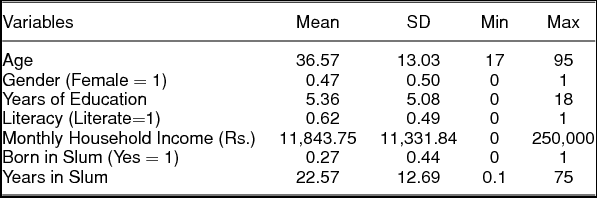
We trained team leaders to navigate the satellite images and place enumerators at their randomly selected households. If respondents were unavailable or unwilling, enumerators approached an adjacent house. Seventy-three percent of initially selected households were interviewed (only 9% were refusals). The survey was conducted in the afternoon and early evening to balance access to individuals who stay at home with those working outside the settlement. Enumerators selected individuals within each household based on availability and an eye to ensuring gender balance. At least one author and a supervisor accompanied the survey teams in the field for the duration of the study. Table 1 provides some descriptive statistics regarding our survey sample.
Descriptive Statistics of Resident Survey Respondents (N = 2194)

QUALITATIVE VIGNETTE
To briefly show how ethnography informed our theory and experiment design, we present an ethnographic narrative from Saraswati, a slum in Jaipur. This vignette illustrates the relevance of particular attributes and their observable indicators, local processes of competitive leadership selection, and the importance of resident agency within such procedures.
Migrants first settled Saraswati in the late 1970s to work as miners in nearby stone quarries. The population of the slum now stands at 2,600 residents, and is diverse in caste and regional terms. Saraswati is located on land administered by the Forest Department, which became increasingly vigilant in protecting the area surrounding the settlement from encroachment in the mid-2000s. This culminated in the demolition of recently constructed shanties, after which officials turned their attention to reclaiming land lost to earlier waves of squatters.
In response, residents planned an informal election in December 2007 to select a slum president to fight the impending eviction. A group of residents first created a list of election rules (Figure S.8), which provide insights into their preferences for informal leadership. The rules included that the president should be a slum resident, work for the settlement's betterment, not engage in antisocial activities, be above 21, and be literate.
Two residents fought in the election. Jagdish, the first candidate, is a high school graduate and a private school teacher in his late 20s. Jagdish is one of the most educated residents in Saraswati, and a member of the Berwa jati, a prominent Scheduled Caste [former “untouchable” caste, SC]. With a slight frame, quiet confidence, and reputation for honesty, Jagdish strays from the thuggish slum leaders depicted in Bollywood films.
Prem, the second candidate, had been an informal leader in Saraswati for several years. He is a Rajput, one of Rajasthan's dominant upper castes. Part of Prem's appeal to residents flowed from his work as a chauffeur for government officials.Footnote 31 Prem's initial rise in Saraswati illustrates leadership formation through the second pathway we mentioned: everyday decisions of residents. There was never a moment in which residents collectively selected him as a leader.
On January 8, 2008, most adult residents of Saraswati voted in the informal election—almost 800 people in total. Jagdish beat Prem, by 458 to 317 votes. Both Jagdish and Prem were supporters of the BJP, and so partisan support cannot explain the outcome. Some of Jagdish's support stemmed from his coethnic appeal to SC residents.Footnote 32 Yet this factor could have only taken him so far within Saraswati, where no one ethnic group is especially large. Indeed, support from upper castes, including Sharma, an influential Brahmin, was crucial to Jagdish's success. Instead, his victory stemmed from the larger appeal of his education and perceived capability.Footnote 33
Following the informal election, Jagdish's council petitioned officials for public services. An example petition he wrote sought to improve local sanitation:
We have been neglected and that is why it is hell to stay here. . .You told us before the elections that the sewer line will be laid, but up until now nothing has been done. Please solve this problem.Footnote 34
The construction of leadership in Saraswati illustrates several elements of our research design. First, it demonstrates the importance of resident agency and preferences in leadership selection, both through individual (Prem) and community selection procedures (Jagdish).
Second, our narrative highlights key attributes residents consider in leader selection. The demand for educated leaders was woven into Saraswati's election rules. The winner was the more educated candidate, and the runner-up's base of support stemmed from bureaucratic connectivity. Our narrative also suggests the limits of coethnic support in diverse slums. Jagdish's ethnicity may have helped with coethnics, but his victory depended on support from noncoethnic residents.
RESULTS AND DISCUSSION
We now return to the survey experiment. Our primary interest is in estimating the average marginal component effect (ACME): the marginal effect of an attribute averaged over the joint distribution of the remaining attributes. Since our attributes were randomized independently, we estimate the AMCEs for all included attributes simultaneously through a simple linear regression (Hainmueller, Hopkins, and Yamamoto Reference Hainmueller, Hopkins and Yamamoto2014). Our unit of analysis is a rated profile, and our dependent variable is coded 1 for leader profiles respondents preferred within a pair and 0 for those they did not. The independent variables are dummy variables for each attribute. We cluster standard errors by respondent.
Main Results
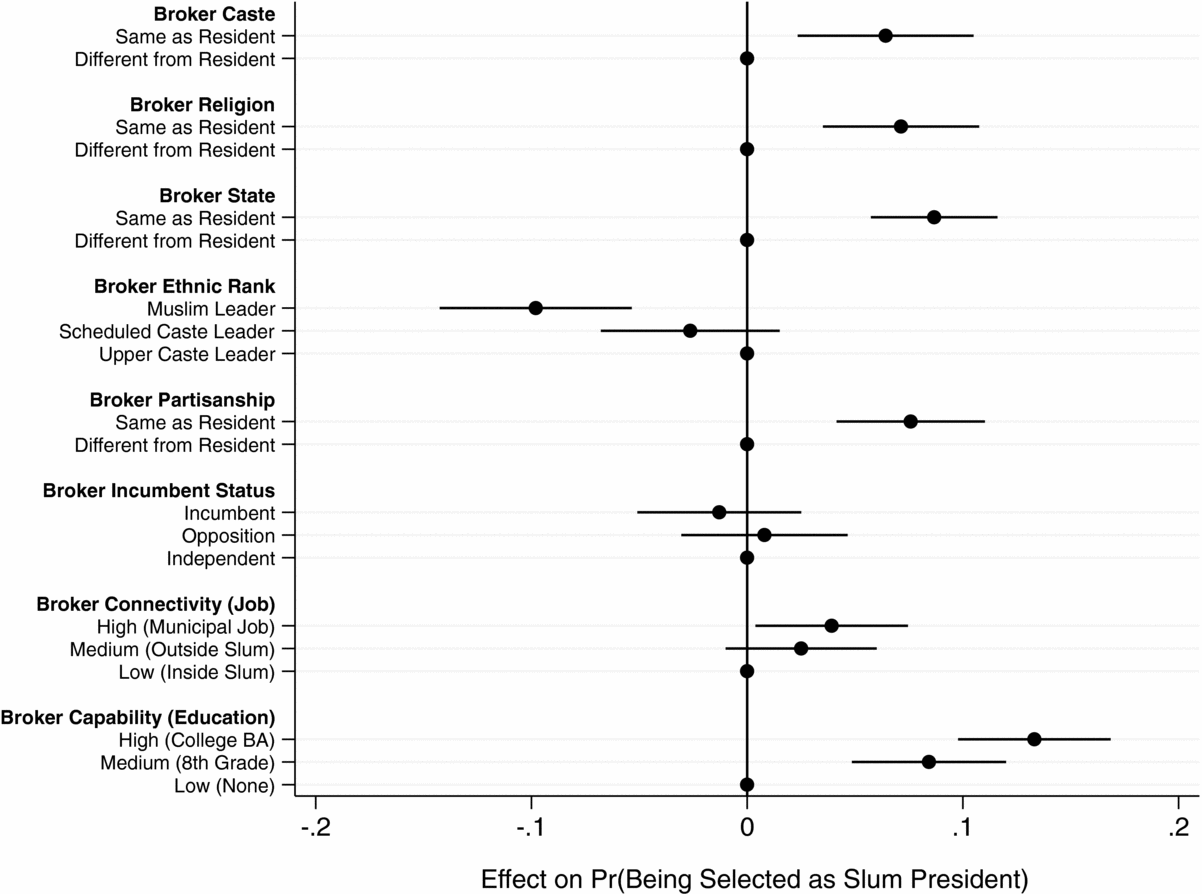
Figure 1 shows how each attribute affects the likelihood of a leader being preferred to serve as president of the slum development committee. The figure displays both the AMCEs (points) and the 95% confidence intervals (bars).Footnote 35
Effect of Broker Attributes on Probability of Being Preferred for Development Council Presidency

First, we find that ethnic identities structuring village life remain politically salient within urban slums. Slum residents prefer leaders who come from the same jati (6.4 percentage points (pp), p = 0.002) and religion (7.1 pp, p < 0.000) to those who do not. Second, we find region-of-origin divisions that have not structured rural politics prove salient among urban populations (8.7 pp, p < 0.000).Footnote 36 Third, we find slum residents discriminate against leaders from Muslim groups (− 9.8 pp, p < 0.000), relative to upper caste Hindus. Scheduled Caste leaders were also disfavored, but not significantly so (–2.6 pp, p = 0.212). We will later unpack this discrimination result.
Our next set of results concern the impact of a leader's partisan affiliation. We find residents favor copartisan leaders (7.6 pp, p < 0.000), consistent with prior studies of India's countryside (Dunning and Nilekani Reference Dunning and Nilekani2013). Interestingly, residents do not favor leaders who are affiliated to the local incumbent party, relative to independent, nonpartisan candidates (–1.3 pp, p = 0.505). We also do not find residents preferring brokers with opposition party affiliations to independent brokers (0.8 pp, p = 0.683). Thus, independent brokers do not face a disadvantage relative to party-affiliated brokers. This result cuts against top-down theories that expect a broker's efficacy to stem largely from party approval. These findings also suggest that partisanship plays a greater role as an indicator of distributive inclusion than as an indicator of efficacy in securing resources.
The low importance clients place on incumbent ties is especially surprising. One explanation could be India's highly volatile electoral system, where residents may view incumbent connectivity as more fleeting than connectivity to low-turnover, unelected bureaucracies. Alternatively, incumbent connectivity may be confounded by partisanship, especially as incumbency was equivalent to supporting the BJP in both cities. Among BJP supporters, we find the incumbency effect is positive and significant (5.3 pp, p = 0.022). For all other voters, the incumbency effect is negative and significant (–4.3 pp, p = 0.043). This latter result is still informative, in that it suggests the attraction of incumbent affiliation is clearly insufficient for bridging the partisan divide.
Most strikingly, our analysis reveals the importance of factors that have received far less attention in the study of developing democracies than shared ethnicity and partisanship. Most arresting is the high value slum residents place on indicators of leader lobbying capability, operationalized by level of education. Leaders with secondary (8.4 pp, p < 0.000) and college education (13.3 pp, p < 0.000) are substantially preferred to uneducated slum leaders.Footnote 37 The AMCE for college education exhibits the single largest impact, and is significantly greater than that of all other attributes at the 95% level.Footnote 38
Our analysis finds uneven evidence of the importance of occupationally informed bureaucratic connectivity. We find positive and significant AMCEs for “high connectivity” leaders working in low-level positions in the municipal government, relative to leaders whose work is confined within slum boundaries (3.9 pp, p = 0.030). However, while the AMCE is also positive for “medium connectivity” leaders with externally situated jobs that force them to circulate across the city, it is insignificant (2.5 pp, p = 0.161).
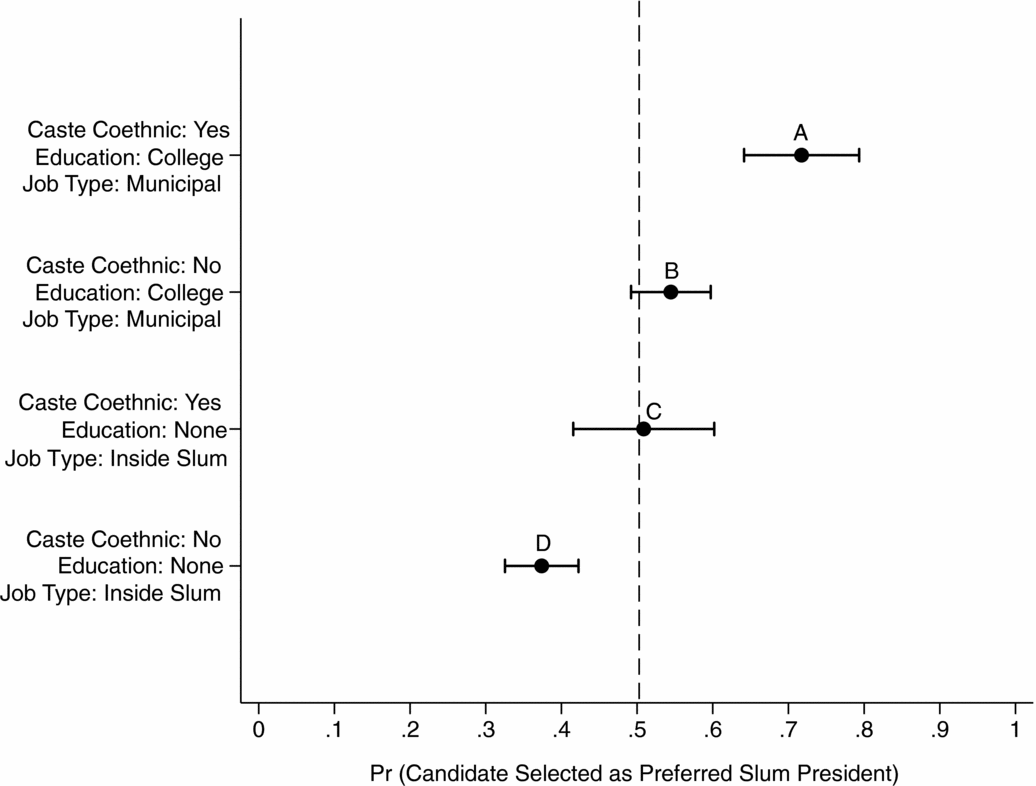
The combined impact of the factors we analyze is also substantial. Figure 2 charts the average probability of particular types of candidates being preferred by residents. The figure shows that a candidate who is the respondent's caste coethnic, college-educated, and employed in a municipal job is 71.74% (Candidate A), nearly double that of a candidate who is from a different caste, uneducated, and employed within the slum (Candidate B, 37.40%).
Probability of Being Preferred for Selected Slum Leader Profiles

Figure 2 further suggests that the benefits of efficacy do not accrue exclusively, or even disproportionately, for coethnics (Carlson Reference Carlson2015; Adida et al. Reference Adida, Gottlieb, Kramon and McClendon2017). A caste coethnic with high capability and connectivity (A) is preferred by 18.8 pp over a caste coethnic with low capability and connectivity (C). The equivalent differential for a noncoethnic is 16.5 pp (B–D). Indeed, capability and connectivity even seem able to compensate for a lack of shared ethnicity. A caste coethnic who is uneducated and works within the confines of the slum is preferred 52.9% of the time (Candidate C). This is statistically indistinguishable from the 54.5% expected success of a college-educated, municipality-employed leader from a different caste (Candidate B). Far from conditional on shared ethnicity, efficacy can substitute for it in slum broker selection.
Comparing Vertical and Horizontal Preferences
An important concern for our analysis is whether it captures resident assessments for slum leaders specifically, or merely a general set of preferences for other slum residents. This is a possibility that plagues most candidate choice experiments, which lack benchmarks of social preferences. To counter such concerns, we conducted a second experiment. We asked respondents to evaluate two people looking to move into the slum with their families. Respondents were asked to indicate which person they would prefer as a neighbor (full text in SI Section S.2).Footnote 39 The attributes manipulated in this experiment perfectly replicated those on the slum leader question.
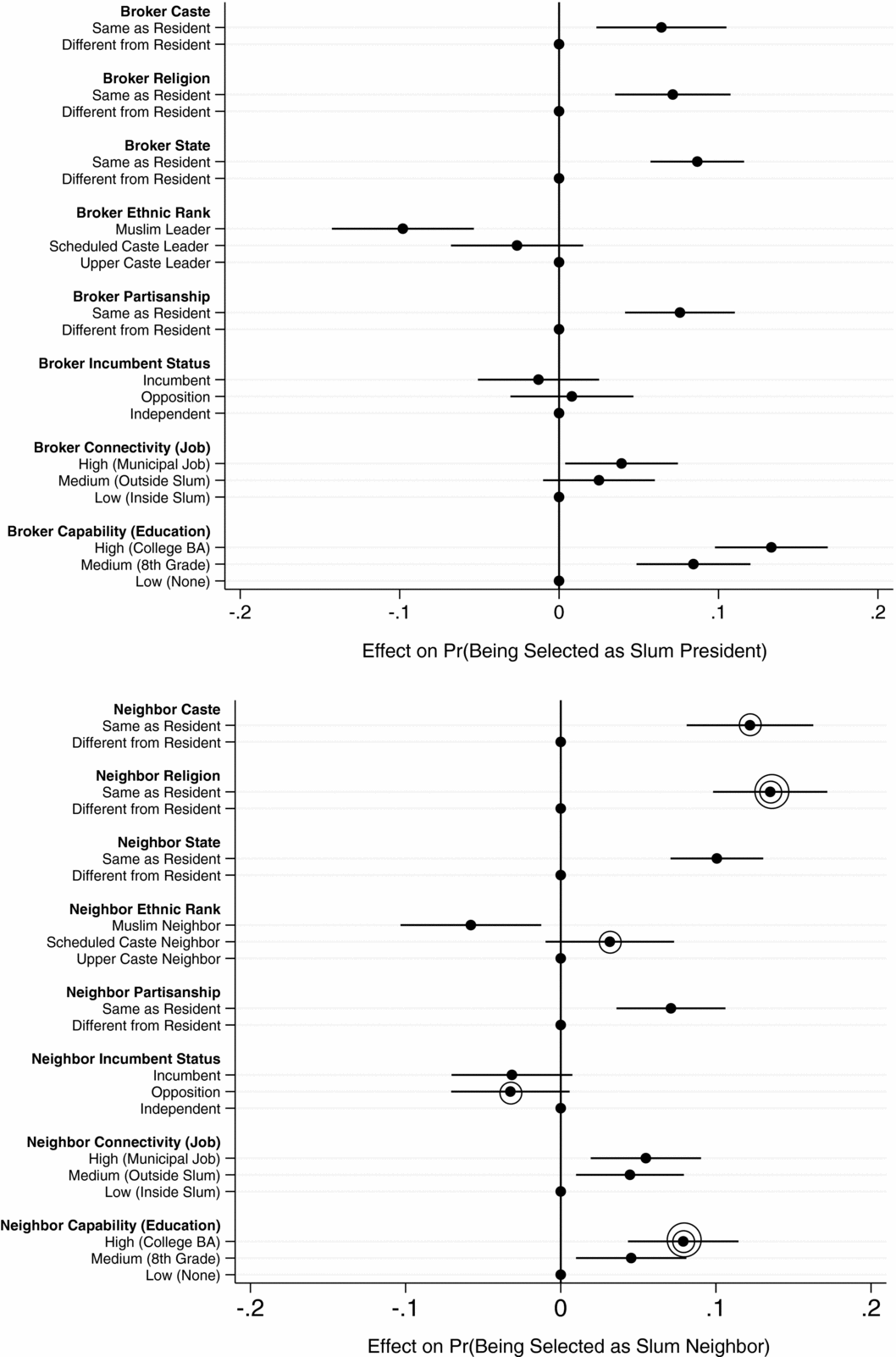
Figure 3 shows some clear differences between vertical preferences for slum leaders and horizontal preferences for neighbors. Coethnicity appears more important when evaluating potential neighbors than leaders. Shared jati is nearly twice as impactful in boosting preferences for a neighbor (12.2 pp) as for a leader (6.4 pp). This difference was significant at the 90% level (p = 0.098).Footnote 40 The salience of shared religion is also significantly higher in neighbor (13.5 pp) than leader selection (7.1 pp) at the 95% level (p = 0.015). This result cautions against reading the preference for coethnic leaders as especially political. If anything, this social preference for coethnics appears to diminish when clients make political decisions.
Comparing Preferences for Slum Leaders (Top) and Slum Neighbors (Bottom)

By contrast, the impact of college education is higher when selecting leaders (13.3 pp) than neighbors (7.9 pp), a significant difference at the 95% level (p = 0.041). These findings clarify that the education result in the leader experiment is not simply an artifact of a general social preference among residents for well-educated people in their settlement. Such preferences exist, but a specific political preference for well-educated slum leaders is stronger.
Overall, an F-test reveals the differences in the 12 AMCEs across the neighbor and leader experiments are jointly distinguishable from zero (p = 0.030). These overall divergences increase confidence that our initial experiment captures political preferences for slum leaders, and strengthens the importance of broker capability relative to distributive concerns.
That said, the neighbor experiment suggests interpreting other efficacy-related results from our first experiment with caution. In particular, the AMCE for leaders with high-connectivity municipal jobs is not distinguishable from those for neighbors. Residents appear to hold social preferences for occupationally higher-status neighbors, precluding us from asserting they hold specifically political preferences for occupationally connected leaders.
Figure 3 also provides some evidence on how to distinguish between the forms of discrimination faced by leaders from Scheduled Caste (SC) and Muslim groups. Patterns of discrimination are not central to our distributive/efficacy framework. However, the ranked nature of ethnicity in India makes it important to consider potential prejudices. Overall, Figure 3 shows no social penalty against SC neighbors, and the AMCE is significantly different from the political penalty for SC leaders. This finding suggests the political penalty against SC leaders may reflect concerns other than social prejudice. For example, residents may worry that SC leaders will themselves face discrimination from officials, who are often from higher castes. By contrast, the penalty against Muslim neighbors was statistically indistinguishable from the political penalty against Muslim leaders, suggesting social prejudice may underpin the bias against Muslim slum leaders.
Design Effects
Supplement S.5 outlines several robustness checks to guard against particular design effects. First, we conduct a randomization balance check by regressing important respondent attributes on indicator variables for all leader profile attributes (Table S.2). We also examine experiment (Table S.4), profile (Table S.5), and attribute order effects. Overall, our diagnostics find little evidence of systematic effects. We specified attribute options that were plausible in any combination. While all combinations are not equally typical, this is not a requirement for effective conjoint analysis (Hainmueller, Hopkins, and Yamamoto Reference Hainmueller, Hopkins and Yamamoto2014). However, our results are robust to excluding decisions featuring potentially implausible brokers (Table S.6).
Public vs. Private Goods
We examine whether our results are sensitive to the type of benefit a client seeks. The relative weight of distributive concerns may be muted when respondents think about slumwide goods, and heightened when they think of household-level private goods. We posed two follow-up questions asking respondents which leader they thought would be better at providing people like themselves with (a) a voter ID card (private good) and (b) piped water to the slum (collective good). This analysis (Table S.15) found no significant differences in the AMCEs of all 12 attributes between the private and public good treatments.
Settlement Effects
We test and find our results are robust to the inclusion of settlement fixed effects (Table S.9). We also examined whether our individual-level findings were conditioned by a settlement's age (Table S.12), development level (Section S.13), and ethnic diversity (Section S.14). In these models, we individually interact the settlement-level variable with each attribute indicator, and include settlement fixed effects. Due to the limited number of slum-level observations, we only include one of these interaction terms per model. Overall, we find little evidence that our results are conditioned by settlement-level characteristics.
The forced-choice design of our experiment helped elicit a defined client preference in a way that mimicked real-life processes many residents experienced. Further, we expect the inferential reach of our study to go beyond those settlements with informal community elections to any settlement where residents can choose which leader to seek help from. To assess this, we compare slums that did and did not hold elections, as reported by our surveyed slum leaders. Table S.10 shows no differences across a number of variables. Table S.11 also shows resident preferences for leaders are largely similar between slums that do and do not hold elections.
MAPPING RESIDENT PREFERENCES TO SLUM LEADER CHARACTERISTICS
To what extent do resident preferences overlap with the characteristics of those who actually become slum leaders? To examine this question, we draw on a survey of 629 slum leaders across the 110 sampled settlements.Footnote 41 Our assessment runs along four fronts: educational attainment, occupational differences, the role of ethnicity in linking residents to slum leaders, and partisanship. We show that some key resident-preferred traits do distinguish actual leaders from the larger pool of residents.
We note at the outset that finding brokers are distinguished from ordinary residents by client-desired traits cannot alone prove that client preferences are the reasons for brokers having those traits. Further, data constraints prevent us from a more ideal comparison between actual brokers and the subset of slum residents who aspired to be brokers and failed.Footnote 42 Still, these comparisons can help test an empirical implication of our argument. After all, finding no client-preferred traits distinguish brokers (even from ordinary residents) would counter our argument about client preferences influencing broker selection. Thus, our data on a large, representative sample of brokers does provide an opportunity to push beyond our experimental findings.
Before presenting the comparisons, we first describe our sample. India's slum leaders represent a remarkable diversity of castes and religions. One hundred sixty distinct jati populate our sample, representing all strata of the Hindu caste hierarchy and a number of Scheduled Tribes and Muslim zat. Of our sample, 70.75% is Hindu, while the remainder is mostly Muslim (26.87%). Most are from Rajasthan (58.19%) and Madhya Pradesh (26.71%). Others migrated from Bihar, Chhattisgarh, Delhi, Gujarat, Haryana, Maharashtra, Tamil Nadu, and Uttar Pradesh.
Of the sample leaders, 87.76% were men, closely matching the gender distribution of our sample frame. The average sampled slum leader was 48 years old, with a standard deviation of 12 years. The youngest was just 22; the oldest was 90. Most (73.61%) were first-generation migrants, though these nonnatives had lived in their settlement for an average of 30 years.
The vast majority of slum leaders in our sample had a connection to a political party (86.49%). Of the 544 sampled leaders with a party affiliation, 215 expressed support for the INC and 321 for the BJP. 415 leaders (76.29%) were party padadhikari, or position holders.
Many self-reported activities of our sampled slum leaders mirror those stressed in the literature. The majority reported mobilizing residents for rallies (84.74%), canvassing door-to-door during elections (94.30%), and bringing residents to the polls (91.18%). Less emphasized in prior works, but equally frequently mentioned by leaders, are their efforts to spearheaded local claim-making between elections. In our sample of slum leaders, 66.45% reported having organized protests for public services, 86.17% had filed a petition, and 93.20% had organized community meetings to discuss local problems. Among their most common activities were helping residents secure ration cards and government IDs (93.80%), making claims for public services (93.32%), and resolving disputes (97.62%). Fewer leaders reported direct efforts to buy votes (16.91%), likely an underestimate due to desirability concerns, as a far higher number reported observing vote-buying in their settlement (47.85%).
Educational Differences
The average slum leader in our sample was educated for 8.37 years. This exceeds the average education of sampled residents by three years (a 60% increase), equal to 60% of a standard deviation in resident education.Footnote 43 Of the sampled slum leaders, 90% were literate, compared to 61.85% of residents.Footnote 44 Figure S.9 shows that slum leaders were significantly less likely to be uneducated than residents (p < 0.000), and significantly more likely to have at least some secondary schooling (6–8 years, p < 0.000), or some high school education (9–12 years, p < 0.000). They were also twice as likely to have some college education (over 12 years, p < 0.000).
Occupational Differences
Compared to everyday residents, we found slum leaders more likely to be in connected jobs. Of surveyed slum leaders, 6.68% held government jobs, 3.50% held professional jobs—lawyers, doctors, accountants, engineers—and another 2.07% were educators. In contrast, 1.77% of ordinary residents held government jobs, 0.41% were professionals, and 1.00% were educators. Slum leaders are thus roughly four times (12.25% versus 3.18%) more likely to have one of these scarce, higher-status occupations (58% of a standard deviation)Footnote 45—jobs that better connect them to the circuits of city officialdom.Footnote 46
Slum leaders are also more likely than everyday residents to have medium-status small businesses that are typically run outside the slum, such as owners of mechanic or barber shops, and small electronic and auto part stores. Of our sampled slum leaders, 14.47% had such businesses, compared to only 4.32% of residents, a significant difference (p < 0.000). Such small businesses are “medium connectivity” jobs that provide less exposure to officials than small-time government positions and professional jobs, but nevertheless afford a greater likelihood of generating ties with city elites than unskilled laborers or jobs contained within the settlement.
By contrast, few slum leaders toil in the most precarious and least connected jobs. The most common profession among residents was that of unskilled laborers. Slum leaders are four times less likely to hold such jobs (7.15%) than residents (30.70%), representing a difference of 65% of a standard deviation.Footnote 47 We saw similar discrepancies among women. Most sampled female residents were homemakers (52.00%), yet not a single female slum leader fell in this category. Homemakers are particularly deprived of opportunities to foster vertical connectivity. By contrast, female slum leaders were more likely to be in connected, higher-status jobs (9.09% to 3.00%) and medium-status small businesses (6.49% to 2.23%) than female residents.
These comparisons of slum leaders and residents broadly align with our experimental findings. If client preferences matter in broker selection, then higher educational attainment and occupational connectivity should probabilistically increase the chance of selection as a local leader. Consistent with this expectation, we find leaders appear to be disproportionately drawn from the pool of relatively educated and occupationally connected residents.
Ethnicity
Our experimental findings demonstrate that residents systematically prefer coethnic leaders. Yet our broker survey revealed this preference may be restricted by supply-side dynamics. Most residents simply do not have a co-jati leader to seek help from. Only 27.71% of residents have at least one leader from their jati in the settlement. This constraint partially stems from the high diversity of settlements (the average jati ELF index was 0.81). Of course, supply side constraints can affect any client-demanded attribute. That said, these constraints seem especially pronounced for ethnicity. For example, 87.27% of slums had at least one leader with an eighth grade education, and 62% of slums had at least one leader with some college education. Occupation-based connectivity constraints fall in between education and ethnicity: 41% of residents had at least one slum leader in a high status government or professional job, and 68% had at least one slum leader who had either a highly connected job or a medium status small business job.
Interestingly, residents do not appear deterred when coethnic leaders are not available. Among respondents who acknowledge slum leadership (1519 respondents), 60% who had a co-jati leader reported visiting a slum leader for help. The corresponding figure for respondents without a coethnic leader is 58%, and the difference is not statistically significant.Footnote 48
Partisanship
Our experimental findings suggested residents do not prefer brokers who have ties to the incumbent, but do prefer copartisan leaders. This finding would be contravened if the partisan distribution of actual brokers did not correspond to those of clients, and instead disproportionately clustered with the incumbent. However, we do not see evidence of highly disproportionate incumbent alignment among surveyed brokers. Instead, the percentage of slum leaders affiliated to the incumbent BJP (51%) roughly mirrors that of residents who support the party (47%).
We observe similar mirroring patterns within slums. Even in city-wide conditions of BJP dominance, we find most slums continue to house active leaders who are not affiliated with the incumbent. Seventy-one percent of our 110 slums had at least one slum leader from the rival Congress party (compared to 87% who had at least one slum leader from the BJP). The majority of slums had leaders from both parties. Further, we find settlements without brokers of a given party to have lower resident partisan support for that party. In settlements with no BJP leaders, 29% of resident respondents supported the BJP. In settlements with at least one BJP leader, 49% of residents support the BJP. Importantly, these differentials are highly comparable for the opposition Congress. In settlements with no Congress leaders, 30% of residents supported the Congress, compared to 47% in settlements with at least one Congress leader.
Before concluding, it is useful to triangulate the findings across our leader and neighbor experiments, and our survey of slum leaders. With respect to education, our findings are most consistent: education is the strongest preference expressed by residents (Figure 1), and is a specifically political preference for slum leaders (Figure 3). We find leaders are on average more educated than residents (Figure S.9), which is consistent with, if not confirmation of, client preferences driving the selection of such leaders. We also find evidence broadly consistent with stronger client preferences for copartisan brokers, not simply those aligned with the incumbent.
By contrast, our initial findings on the political importance of coethnicity are weakened by subsequent analyses. Figure 3 shows that preferences for caste and religious coethnics are far stronger for neighbors than leaders, suggesting preferences for coethnic leaders may reflect broad social preferences rather than specific political inclinations. Such social preferences for coethnic leaders might still lead to supporting brokers from one's own narrow group. However, social heterogeneity appears to leave most residents without the option of a coethnic leader.
Finally, our results are somewhat ambiguous with respect to bureaucratic connectivity. Figure 3 suggests we cannot infer preferences for municipal workers are especially political, as they may be driven by broader social preferences. That said, as with ethnicity, social preferences might still drive some measure of support for occupationally connected leaders. Our descriptive data of slum leaders suggests this may be the case. Leaders are more likely to be in better-connected government and professional jobs, and less likely to toil in low-connectivity jobs.
CONCLUSION
The political broker has become a central figure within the study of distributive politics. Yet our understanding of the relationship between brokers and their local communities remains underdeveloped. Existing scholarship on machine politics has neglected how competition between brokers confers clients with the ability to select their local leaders. We argued that recognizing client agency in broker selection further compelled us to study the processes through which clients make choices, and the preferences driving their selection decisions. Next, we provided a theoretical framework for studying client preferences, distinguishing two primary client concerns. The first centers on inclusion within a broker's distributive network, the second on the efficacy of a broker in securing resources for clients.
We analyzed client preferences for local brokers within urban India, an iconic developing democracy. We specifically focused on slum leaders, a pervasive class of brokers in developing cities. An ethnographically informed experiment with residents confirmed the importance of distributive concerns shaped by shared ethnicity and partisanship. More strikingly, our analysis revealed the salience of nonethnic indicators of broker efficacy, especially education, that have received relatively little attention within studies of political behavior in the developing world. Data from a novel survey of actual slum leaders revealed their distinguishing traits aligned with many of the preferences expressed by residents.
Our study suggests several paths for future research. Most obviously, we hope to spark further scholarship on client preferences for brokers within clientelistic settings. Choice experiments have proliferated for formal candidates, but have yet to be applied to the study of informal intermediaries. We anticipate value to replicating our study in a number of contexts. Doing so would enable comparative assessments of how specific contextual factors affect the relative importance of distributive and efficacy concerns in broker selection. We recognize that urban slums are an especially productive setting to examine broker selection by clients, as they are highly competitive environments. Brokers within India's diverse slums are poor migrants who cannot fall back on prefabricated forms of authority based on hereditary titles or longstanding social hierarchies. Instead, they must routinely demonstrate efficacy in problem-solving to secure a following for themselves, in competition with other local brokers.
While urban slums are a substantively crucial population in their own right, we anticipate our argument to resonate in other contexts. The scope conditions of our theory are few—poor neighborhoods in developing democracies where access to the state is discretionary and mediated, and competition between brokers provides clients with choices. Such spaces need not be exclusively urban, and studies from South Asia itself caution against assuming villages are static societies governed by customary authority, and bereft of broker competition and client agency (Manor Reference Manor2000; Krishna Reference Krishna2002). Our framework is, however, less likely to have purchase in spaces where a single broker monopolizes authority through coercion or custom—for example, in localities controlled by a single gang or village head.
Another important line for future inquiry is to more explicitly study how bottom-up client selection shapes elite evaluations of brokers. Our interview and broker survey evidence suggests client selection of brokers can shape the pool of candidates parties evaluate when deciding whom to include in their organizations. Future studies could empirically investigate elite preferences for brokers in the manner we have done for clients. Doing so will help more precisely pinpoint the degree to which elite preferences are shaped by clients—an important channel of bottom-up accountability that may partially counter the perverse accountability Stokes (Reference Stokes2005) has influentially ascribed to clientelism. These analyses may also reveal divergences in elite and client preferences, prompting further inquiry into how such tradeoffs are resolved.
Finally, our study adds to other calls to move from studying clientelism during elections to between them. Our own analysis specifically calls for increased attention to conceptualizing broker efficacy for clients (heightened between elections), and not simply for parties (heightened during elections). Indeed, we argue the salience of education stems from its impact in increasing effective claim-making for clients. Such findings suggest the value of conceptualizing contextually relevant indicators of client-facing efficacy. Doing so shifts attention from a broker's much-studied episodic role as dispenser of campaign handouts to their everyday role as problem solvers.
SUPPLEMENTARY MATERIAL
To view supplementary material for this article, please visit https://doi.org/10.1017/S000305541800028X.
Replication materials can be found on Dataverse at: https://doi.org/10.7910/DVN/RUQ2KP.




Comments
No Comments have been published for this article.