

In his celebrated book Bowling Alone, Robert Putnam points to what he calls the rise and fall of social capital in America over the course of the twentieth century, arguing that Americans over the last three decades are participating far less in civic organizations than did their parents. Putnam uses the patterns of membership in the Boy Scouts of America (BSA) and the Girl Scouts of the United States of America (GSUSA) (among many other groups) as evidence for his thesis, combining these groups into one variable in his analysis.Footnote 1 As I hope to show, however, there are profound differences between these organizations, with regard to their early histories and their policies and membership patterns over the last forty years, and these differences provide important insights into gender and diversity in American civic society over the second half of the twentieth century.Footnote 2
While membership in the BSA and GSUSA developed in parallel fashion for most of the twentieth century—growing exponentially from their inception in the Progressive Era to the end of the sixties and collapsing by between a third and a half between 1970 and 1980 (consistent with Putnam's thesis of growth and decline)—over the last three decades membership patterns have diverged, as the Boy Scouts membership plateaued and declined while the Girl Scouts grew steadily, reaching near record numbers in 2003. This article seeks, therefore, to answer two interrelated questions: Why did both organizations decline so precipitously within a single decade (1970–80)? And why has there been such a significant divergence in membership since? By examining these questions, I also intend to raise broader questions about the relationship between gender and political organizing and to highlight the extent to which the effectiveness of the Girl Scouts has been due to its flexibility in dealing with questions of gender and diversity.
Let's begin with the numbers. The Girl Scouts of the United States (GSUSA) grew from 34,000 total members in 1918 to nearly 4 million by 1970, but between 1970 and 1980, membership declined to just under 3 million. The BSA grew from 182,000 in 1915 to 6.3 million by 1970, and declined to just over 4 million by 1980.Footnote 3
Why this decline? Putnam argues that it is caused by several factors: television (and later computer/video game use), an increase in dual career families, an increase in suburban sprawl and mobility, and, most importantly, “generational change,” by which he means that an older “long civic” generation that participated more gave way to a younger generation that was less “other” oriented and participated less. Putnam's thesis, however, does not explain why the decline occurred within a single decade (given that the factors he identifies generally increase after 1980), nor why the GSUSA would recover its membership and the BSA would not.
I would like to propose an alternative hypothesis rooted in path dependency theory: that the 1970s were not simply one decade out of ten in the 20th century but a “critical juncture” in American history.Footnote 4 For the 1970s ushered in a “civil rights” generationFootnote 5 with a new post-materialist set of values that sought to rectify the injustices associated with war, race, gender, sexual orientation, and disability. And these new values generated challenges to the existing norms of American society including, I hypothesize, those governing traditional organizations such as the BSA and GSUSA. One consequence was a decline in the memberships of these organizations. I also hypothesize that the divergence between these organizations occurred because the GSUSA ultimately embraced this generation's new values while the BSA rejected them.
As Paul Pierson argues in his seminal work on path dependency, ‘increasing returns’ mean not only that ‘history matters’ but that in any given institution or organization the timing and sequence of events are crucial, and ‘formative moments’ strongly shape the trajectory of future developments.Footnote 6 Following Pierson, I will attend carefully to the origins of both organizations, for only if we first understand the substantive values and governance models established by both organizations at their inceptions is it possible to ascertain a) the degree to which the values and governance structures of either group were at odds with the values of the civil rights generation and b) how easy it would be for either organization to respond to change.Footnote 7
The Origins of the Boy Scouts: Robert Baden-Powell and British Imperialism
While the Boy Scouts, as envisioned by Robert Baden Powell, has long been identified with America, in reality its earliest roots were in imperial Britain. Baden Powell was a British imperial military officer who served in both Africa and India. After his famous victory in Mafeking, South Africa, he published Scouting for Boys in 1908, the original handbook for the Boy Scouts.Footnote 8 Using a military scout as his model, Baden Powell argued that the current generation of British boys was in need of a new kind of training, because the empire was under threat and boys were becoming “soft”. Scouting was a program by which boys would be uniformed and toughened up through outdoor activities.
The purpose of Boy Scout training was explicit—to create tough men capable of defending their “race” and empire from various threats, including claims to racial equality on the part of colonized populations. Thus, from its inception scouting was born out of twin anxieties over the potential loss of “masculinity” in the UK on the one hand and “imperial/racial superiority” at the frontiers of the empire on the other—two concerns deeply intertwined in Baden-Powell's own mind. As Elke Boehmer comments, “The closing chapter of Scouting for Boys does not cease to press home that the ‘deterioration of [the] race’ [is] reflected in the physical breakdown of the ‘rising generation’, and by implication, the reduction in their masculinity.”Footnote 9 As Baden Powell himself writes in the conclusion of Scouting for Boys, “Wishy-washy slackers without any … patriotism in them” will lose the “Empire” for Britain.Footnote 10
The degree of imperial racism at the origins of the Boy Scouts is explicit in the dramatic vignettes (to be performed by Boy Scout troops) included in the first edition of the Scouts Handbook. Under the subtitle “How the Empire Must be Held,” Baden-Powell pens a short “display” based on a true story, of the humiliation of Mehtab Singh, a Sikh leader, at the hands of a British imperial leader John Nicholson, who forced Singh to remove his shoes in the company of his English superiors in order to demonstrate his racial inferiority and subservience. This “display” was designed to help boys learn “the might of Britain [to be] powerful for [the] good of the world.”Footnote 11
A second play involved Boy Scout troops reenacting the “triumph” of English colonist John Smith over the American “Indian”. In this vignette, Smith describes his role in the colonization of indigenous peoples as a “duty to my King and God” (the first sentence of the Scout's oath), and presents “our [British imperial] mission” as a duty “to clean the world!”Footnote 12 Clean is an interesting choice of word (italicized in the original text) since this “cleansing” mission will become one of the central “laws” of the British Boy Scouts under Baden Powell and will take on enormous importance nearly a century later when the American Boy Scouts use this word (and law) in various court cases to defend its right to exclude gay men and boys from the organization, as I will discuss below.
The Boy Scouts, from its earliest origins, thus created through its oath, laws, and handbook an extremely narrow path with an organizational culture that was imperial, defensive, and strongly hierarchical, and whose purpose was to produce a generation of obedient men that would defend “God and Empire” from various threats through a tightly scripted “muscular” and racialized masculinity.
The Boy Scouts of America: Defending God, Country and Masculinity
The American Boy Scouts was founded in 1910 and would use Baden-Powell's handbook, oath, and laws as the basis for its own organization. Like its British counterpart, the BSA was born in a context of general anxiety over “masculinity” and a particular kind of racialized nation (white, Northern European Protestant) perceived to be at risk from changes in demography and values. Urbanization, first wave feminism, and new immigrants from Southern and Eastern Europe were seen as threats to the existing racialized and gendered order at the beginning of the twentieth century. David Macleod, in his history of the Boy Scouts, argues that these concerns over race and gender were intertwined in the minds of the early supporters of the BSA, including Teddy Roosevelt:
Fears concerning women added to the masculine sense of confinement … Women's rights did begin to undercut the simplistic equation of masculinity and power. Women invaded the white-collar world, trebling in numbers there from 1900 to 1920. Male anxieties were exacerbated by the “race suicide” panic of the early 1900s, as alarmists led by Roosevelt blamed women for reducing birthrates to levels which would leave the old stock too weak to hold its own against immigrants.Footnote 13
Jay Mechling concurs: “The Boys Scouts … was born in a period of extreme anxiety and confusion over the meaning of masculinity.”Footnote 14
If in Britain, the specific catalyst for anxiety over masculinity was the decline of empire, in America, Macleod argues, it was the loss of the western frontier. “In Britain, upper-class fear of rival empire gave Boy Scouting its initial impetus. In America … the purported closing of the frontier by 1890 punctured the dream of endless space for manly self-assertion. Yet to an era rife with notions of survival through superior fitness, wilderness appeared a vital source of virility and toughness.”Footnote 15 Macleod's point is an interesting one. Certainly, the quintessential image of American masculinity repeated in movies and advertisements has long been that of the pioneer or cowboy on the frontier, and it is one that fits well with the emphasis on outdoor survival in Baden-Powell's original scouting handbook.
But it is not only the “cowboy” but, as Philip Deloria argues, the “Indian” who was key to the BSA and its founders as they appropriated “Indian” folklore and ritual for their own purposes.Footnote 16 Thus, like the British scouting movement, the racialized dimensions were present, but manifested in America in the Scouts' tendency to “play Indian” through the appropriation of indigenous ritual. If civilization made men feeble, the BSA deployed the myth of the wild “noble savage” as a foil to save the emasculated male of urbanized life.
James West was an absolutely critical figure in the early development of the BSA. He became Chief Scout Executive in 1911 and remained there until 1943. During his tenure the BSA Oath and Laws were implemented. The BSA oath (which has remained virtually unchanged since its inception) was the same as the British (duty to God and country, obeying the laws, and helping others) but added one critically important sentence: “To keep myself physically strong, mentally awake and morally straight.” The final two words reflect a moral dimension of American scouting different from the British, namely a belief that “social order depended upon the moral behavior of self directing individuals” as opposed to the strict “obedience” of Baden-Powell's scouts in Britain. In other words, a uniquely American emphasis on self-discipline, with boys disciplining themselves to keep to the “straight and narrow,” has been present in the BSA from its inception until today. The Boy Scout Laws, like the Oath, have hardly changedFootnote 17 since the beginning and include the duties to be courteous, kind, cheerful, thrifty, brave, trustworthy, friendly, “clean,” reverent, and loyal–duties that would become important in later political and legal battles.
West also created an organizational structure that was extremely centralized and top-down, ensuring that the BSA executive was financed independently of the money collected from local councils and that each Boy Scout troop had to register annually with the BSA executive in order to continue to exist. As West wrote of this latter decision: “Oh how fortunate it is that we put that last provision in … [the] burden of proof was always on the other fellow to show why the commission should be renewed.”Footnote 18 This hierarchical form of governance remains today, as the national office can revoke an organization's charter if it refuses to fall in line with national policy. A final point in terms of governance was the fact that the organization was racially segregated. This was an explicit choice by West who, despite the advice of William Boyce (the original founder of Boy Scouts) to the contrary, decided that school policies with regard to segregation would apply to the Boy Scout troops. While some troops were desegregated in the north earlier, most troops remained segregated in the South until the 1960s.Footnote 19
Thus, the founders and early leaders of the BSA, fearing a range of threats to American masculinity, created a racially segregated training program for boys in which a conception of “muscular” Christian masculinityFootnote 20 and a defense of a narrowly defined and traditional “America” were deeply intertwined. To defend this narrow path, it was necessary to create a governance model within which local troops towed the national line absolutely and without exception, and individual boys and men had to live according to a specific set of moral strictures that left little room for either diversity of moral beliefs or regional variation. Through these early decisions, the BSA constructed a decidedly narrow organizational path that saw change as negative and new values and peoples as threats rather than opportunities. Finally, the “bedrock” of the organization was its belief in the immutability of its Oath and Law, a trajectory that would also limit its leaders' capacity to negotiate future challenges.
Girl Guides: Origins and Evolution
While the birth of the British Girl Scouts organization coincided with that of its male counterpart, its moment of self-creation was quite different. The very first rally organized by Baden-Powell in 1909 to launch the Scouting movement was meant to be for boys only, but at the tail end of the march of 10,000 boys, girls appeared declaring their interest in becoming “scouts.” The Girl Guide History of Canada records the moment in the following way:
Great astonishment was caused by a group at the end of the long parade—girls! While their brothers had been busily occupied with Scouting, these girls had been copying them, usually in secret. Girls at that time were expected to be ladylike, doing needlework and art. Their place was definitely in the home, not outdoors dressed in outlandish costumes…Both their mothers and the general public were shocked and horrified at the girls' escapades and appearance—skirts hiked up, wearing Scout hats, carrying stout broomsticks, hung about with whistles, knives and enormous haversacks decorated with large red crosses. These daring girls pleaded with Baden Powell to be allowed to join the Scouts.Footnote 21
Thus, while scouting fit well with a particular kind of “masculinity,” it fit awkwardly with dominant Edwardian notions of femininity. Because of his own identification of scouting with boys and the construction of a particular conception of masculinity, Baden-Powell initially resisted the inclusion of girls within scouting. But he eventually yielded and asked his sister Agnes to create the Girl Guides (using the word “guide” to imply a more supportive role) in order that girls might also protect and preserve the British empire.
The British Girl Guides were from their infancy, however, defined by a paradoxical commitment to a “radical” kind of politics (challenging existing norms of membership and defying gender norms through the scouting activities and values they endorsed), while simultaneously embracing a set of traditional norms (defense of British empire along with activities linked to traditional feminine values and roles).Footnote 22 The Boy Scouts and Girl Guides were thus born at the same time in Britain, but with a very different trajectory and with paths that varied enormously in width. Whereas the Boy Scouts were constructed in order to reinforce traditional notions of masculinity and patriotic service against perceived threats to the existing order, the Girl Scouts—in order to exist at all—had to challenge the very same social order, including their own gender-defined roles and norms of membership while simultaneously embracing traditional feminine activities and values. Thus while the former created a narrow path for itself, the latter created (through its contradictory commitments) a much wider path within which to negotiate identity in response to change decades later.
Girl Scouts of the United States of America: Contradictions in Identity
The Girl Scouts of the United States was created in 1915. Like Baden-Powell, only more so, James West believed that scouting was something only boys could do, and strongly resisted the creation of the American Girl Scouts, arguing that scouting was singularly ill-suited for girls and would tend to turn them into “tomboys”. Juliette Low-Gordon ignored this advice and began the Girl Guides in 1912, changing the group's name to Girl Scouts by 1915. West continued to fight the use of the word “scouts” and through the BSA executive created a rival organization called the Camp Fire Girls.
The GSUSA, like its British counterpart, had a contradictory nature. On the one hand, it was a quasi-militaristic organization where values such as loyalty to God and country and traditional gendered norms—being supportive, obedient, and “cheerful”—were emphasized through the Promise and Laws, while traditional female activities were encouraged through badges for domestic duties. On the other hand, gender roles were challenged and even defied—by insisting on the right to be called “scouts” in the first place and by promoting rugged and traditionally masculine activities. The handbooks were also contradictory, calling on girl scouts to be “womanly”—meaning “sweet and tender” and also maternal—but also recommending that “housekeeping should [not] take up all of a woman's time.” Similarly, GSUSA badges emphasized traditional domestic duties (cooking, “dairy maid”, “invalid cooking”), but also included “rifle-shot” and “artist”.Footnote 23 Thus, in a variety of ways, the GSUSA embraced both traditional and “progressive” ideas.
Gordon Low, being hearing impaired, was also dedicated to creating an organization that included girls different from the “norm” of American society. She thus “welcomed girls with disabilities at a time when they were excluded from many other activities.”Footnote 24 Her early commitment to disabled girls, as well as her decision to publish the handbook in multiple languages, introduced into the organization a commitment to an embryonic idea of diversity from the start. Kathy Cloninger, the current CEO of the Girl Scouts of the USA, observes, “Diversity has been a core value of Girl Scouts since Juliette Gordon Low gathered together the first troop … well in advance of the landmark civil rights legislation … The commitment to diversity that Juliette Gordon Low established runs throughout Girl Scouting to this day.”Footnote 25 At the same time, like the BSA, the Girl Scouts were racially segregated, with separate African American and American Indian troops created in the first decade, even though the GSUSA began to desegregate earlier than the BSA, beginning in the 1950s.Footnote 26
Finally, the GSUSA “promise”, unlike the BSA version, did not require its members to be “physically strong, mentally awake and morally straight.” This difference surely reflects the way that gender was perceived in early twentieth century America by the leaders of these two organizations. While the GSUSA decided that girls did not need to swear an oath to be “morally straight”, the BSA seemed concerned that American boys faced strong temptations to wander from the straight and narrow.
In these ways the GSUSA was a broader and more flexible organization than the BSA, enabling a future generation of Girl Scouts and their leaders to better negotiate the challenges of changing demographics and new values in the 1970s. While the evolution of both organizations was thus path dependent, the GSUSA's path was wider, more adaptable, and thus quite different than that of its male counterpart.
The Decline of the BSA/GSUSA: The Impact of the Civil Rights Generation
Given the foundational commitments of both the GSUSA and BSA (loyalty to the state; quasi-militarism as reflected in the uniforms, insignia, and badges; traditional gender roles; and racial segregation), it is not surprising that the civil rights generation—with its commitment to second wave feminism and racial equality and its skepticism toward the Vietnam war—would reject the norms governing both organizations. As Heather MacDonald, a supporter of traditional scouting, comments:
The 1960s counterculture and the Boy Scouts of America were a train wreck waiting to happen. Here was a supremely patriotic, service- and family-oriented institution suddenly up against a movement celebrating rebellion … The official scout response to the assault on everything the scouts stood for was understandably confused. Though a 1968 annual report scoffed at the “impractical flower world of the Hippie,” officials worried deeply about that bogus sixties concept, “relevance” … In 1969, membership dropped for the first time in history; it nose-dived throughout the 1970s.Footnote 27
The BSA, under the leadership of then-Chief Scout Executive Alden Barber (1967–1976), knew from its own surveys that the organization was dropping in membership because it was perceived to be out of touch with the times.Footnote 28 Barber was indeed so concerned about this that he implemented organizational changes and commissioned a revised edition of the Handbook in order to make the BSA “relevant”.
The GSUSA also experienced significant declines in membership as the new generation rejected many of its traditional tenets. The GSUSA's stated purpose at the beginning of the 1970s was to inspire girls “with the highest ideals of character, conduct, patriotism and service that they may become happy and resourceful citizens.” It is not surprising that the civil rights generation would reject such an uncritical loyalty to country.Footnote 29 The Girl Scouts also faced a new generation of girls and women who, under the influence of second wave feminism, questioned Girl Scouting norms that required Scouts to be “cheerful” and “obedient” and rewarded traditional feminine virtues and domestic skills. Once again, GSUSA executives recognized the effect of these changing values on their decline in membership. Elisabeth Kastor of the Washington Post observed that
Like the leaders of the Boy Scouts and other youth organizations whose memberships suffered comparable declines, Girl Scout organizers point to rapid and dramatic demographic and social changes to explain the drop. “The whole society was in turmoil,” says Frances Hesselbein, national executive director of the Girl Scouts of the U.S.A. “As the children of the baby boom became adults … many women and girls who had grown up on the antiwar and women's movement found the old image of the cheerful, obedient, uniformed girl less than inspiring.” Like other youth organizations, GSUSA seemed to have lost touch with the times.Footnote 30
And as one study notes, the surveys commissioned by the GSUSA also confirmed that a changing generation was the cause of their declining membership: “The image of white girls in knee socks tying knots … seemed out of touch with the times. And nothing reflected these attitudes more dramatically than the 33 percent percent drop in membership … The organization and its programs had to focus on reaching out to girls from all social and ethnic backgrounds.”Footnote 31 Scouting's leaders and its most astute observers thus concur that the precipitous decline of both BSUSA and GSUSA within a single decade was caused by a new generation who rejected the traditional norms governing both organizations. Scouting was thus perceived to be out of touch with the times.
Divergence in Membership (1985–2006): Critical Junctures and Distinct Legacies
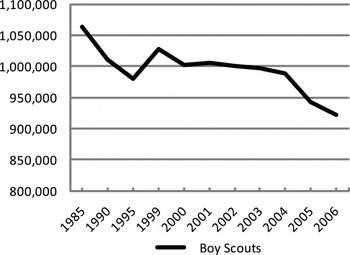
The graphs below provide a visual image of the divergent membership patterns from 1985 to the present.Footnote 32 According to official figures, membership in the Boy Scouts (11–17 year olds) declined by 14 percent percent from 1985 to 2006 (from over 1.05 million to just over 900,000 members), with much of the decline occurring after the year 2000.Footnote 33
Decline in Boy Scouts (11–17 year-olds) membership, 1985–2006
Increase in GSUSA membership, 1985–2005

During the same period, the Girl Scouts total membership grew by 38 percent percent (from 2.8 to 3.85 million), reaching close to their highest membership in 2003.Footnote 34
In the next section, I argue that it is the different responses of these two organizations to the challenges of the civil rights era that explains their divergent membership patterns. Ruth and David Collier argue that a critical juncture (a “period of significant change”) creates specific paths in different institutional or geographic settings that lead to “distinct legacies.” The 1970s were a period of significant demographic and value change, and, as the BSA and GSUSA responded to these changes, two distinct—indeed, nearly oppositional—legacies were established.
While Collier and Collier, along with Pierson, emphasize the path dependence of organizational responses to critical junctures, recent work by James Mahoney, Giovanni Cappocia, and Daniel Klemen emphasizes the agency of organizational leaders. As Mahoney comments, “Critical junctures are moments of relative structural indeterminism when willful actors shape outcomes in a more voluntaristic fashion than normal circumstances permit … these choices demonstrate the power of agency.”Footnote 35 Cappocia and Klemen similarly argue that agents have a “broader than typical range of feasible options … and their choices … are likely to have a significant impact” during a critical juncture.Footnote 36 In the analysis of divergence that follows, I argue that both kinds of determinations are important. While the early histories of both organizations shaped the degree to which either was able to adapt, key actors within the GSUSA took advantage of the space available to them to make a real difference in helping the organization to meet the challenges of the civil rights era.
The BSA's Response: Defending God, Country, and Masculinity from New Threats
The Boy Scouts attempted to adapt to the demands of the new generation. In 1968 Alden Barber, the Chief Scout Executive from 1967–1976, responded to the organization's decline in membership by introducing a program called “Boypower '76” aimed at increasing membership by 2 million boys by 1976.Footnote 37 Barber also commissioned the Scouts Handbook 8 th Edition (1972–1979) in order to make Scouting “in tune with the times,” dropping “to be square” from the Cub's oath, making outdoor skills optional, emphasizing “inner-city” programming, dropping the word “boy” from both the handbook title and the organization itself (so it became known for a short time as Scouting USA), and introducing programs that addressed ethnic diversity.
While these changes may have had some appeal among the larger society, a backlash quickly followed among many of BSA's members, who viewed them as inconsistent with the Boy Scouts' historic identity and purpose. According to Heather MacDonald, “Traditional scoutmasters left the movement in droves”. Barber found his leadership questioned and ultimately retired.Footnote 38 Thus, the rather limited attempts to modernize the BSA went against the grain established by James West and other movement founders. Departing from this historic path, such changes were strongly opposed, leading by the middle of the 1970s to a hard return to “traditional” values.
Indeed, when Barber's successor, Harvey Price, took office, he commissioned William Hillcourt (who had written the first Handbook for Patrol Leaders in 1929) to write a 9th edition of the Handbook to replace Barber's 8th edition as quickly as possible. As Nelson Block notes in his obituary of Hillcourt, he and his old guard allies were determined to return the organization to its origins and to downplay urban youth and ethnic diversity by re-emphasizing the outdoors and the military “scout” of Baden-Powell's original vision.Footnote 39 The BSA reached back to 1970 to find a cover for this 9th edition, using an iconic Norman Rockwell image depicting Scouts cooking and canoeing.Footnote 40 The choice was not coincidental for, as Hillcourt had written elsewhere, Rockwell's paintings combine a “duty to God” with “duty to county”—and were thus ideal for a traditional image of Boy Scouting.Footnote 41 In 1979, the BSA moved their national office from New York to Irving, Texas providing further evidence, Mechling claims, of their choosing ‘sides in the culture wars’.Footnote 42
The narrow path established at the BSA's foundation (including a hierarchical organizational structure and a narrow conception of masculinity, Christianity, and patriotism) thus meant that when the “critical juncture” of the civil rights era arrived, the BSA, despite attempts by one leader to make modest changes, ultimately had little room to maneuver within its own narrowly conceived organizational identity. It thus responded defensively to the changed environment in which it found itself.
During the 1980s, the leaders of the BSA saw themselves, like their founders a century earlier, as defending their organization and America itself from new threats to “masculinity” and “faith”, namely homosexuality and atheism, respectively. Animated by powerful antipathy towards homosexuality and atheism, they defended their right to exclude homosexuals and atheists from their troops on the grounds that the BSA, a private organization whose freedom of expression and religion, articulated in its fundamental and unchanging oath and bylaws, would be violated if gays or atheists were allowed to join. An internal memorandum from the National Director of Relationships/Marketing in 1991 articulates the BSA's position regarding gay men:
We believe that homosexual conduct is inconsistent with the requirements in the Scout Oath that a Scout be morally straight and in the Scout Law that a Scout be clean in word and deed, and that homosexuals do not provide a desirable role model for Scouts. Because of these beliefs, the Boy Scouts of America does not accept homosexuals as members or as leaders, whether in volunteer or professional capacities.Footnote 43
The duty to be “morally straight,” long central to the BSA's self-understanding, thus justified in their view the exclusion of gay men, who threatened the BSA's conceptions of morality and masculinity. The second argument (a duty ‘to be clean’) is deeply disturbing, for it implies (as Baden Powell originally did in articulating this law) the avoidance of ‘doing anything dirty’. The ascription of “dirt” to certain groups of people has an extremely long and ugly history. Such dehumanizing language can be found across a broad spectrum of cases of exclusion, but it is always rooted in hatred and fear of religious, racial, or cultural differences.Footnote 44 When Baden-Powell invoked the metaphors of “clean” and “dirty,” he was defending the British empire's mission with respect to the indigenous people of America. Thus, by using this particular duty to defend the exclusion of gay men, the BSA goes beyond an argument rooted in religious or moral belief to partake in a long tradition of ugly, hate-based language.
The BSA responded in a similarly defensive way to the legal and cultural challenge presented by cases of atheists seeking to belong. In 1985, Paul Trout of Charlottesville, Virginia was informed by BSA authorities that he “should be expelled from the Scouts because he doesn't believe in God.” In this case and in others like it, the BSA pointed to the Scout Oath and Law, specifically the scout's duty to be “loyal to God” and “reverent,” as grounds for the exclusion of non-believers, asserting the Constitutional right of free association.Footnote 45
In commenting on this strongly exclusionary response of BSA officials to demands for greater inclusion, Jay Mechling notes that the “historical connection between Christianity and an aggressive version of masculinity” was forged at the BSA's inception and reinforced at critical junctures in American history.Footnote 46 In the 1950s, for example, the BSA joined a chorus of American groups who sought to assert the individual's duty to God and country as part of the Cold War struggle against “Godless” Communism.Footnote 47 And during the “culture wars” of the 1980s and 1990s, the BSA once again returned to its roots, coming down firmly on the side of the religious right.Footnote 48 At the core of the BSA's identity, and a primary source of its continued defensiveness, was a narrow and unchanging conception of masculinity, Christianity, and patriotism. From this vantage point any change in society with respect to these traditional values became, by definition, a threat to the organization's very identity. As Mechling concludes, “If religion, masculinity, and citizenship are as tangled as the rhetoric of the Boy Scouts … make them [out] … in which white [heterosexual] males feel like the beleaguered class, then it makes sense that the men running the Boy Scouts see the atheists [and homosexuals] … as agents of an assault upon masculinity.”Footnote 49 Such defensiveness was further reinforced by the organization's historic commitment to a hierarchical organizational vision according to which the executive allows no deviation from national policy. A February 2002 BSA press release announced that:
The BSA reaffirmed its view that an avowed homosexual cannot serve as a role model for the traditional moral values espoused in the Scout Oath and Law and that these values cannot be subject to local option choices. In affirming its existing standards of leadership, the board also agreed that duty to God is not a mere ideal for those choosing to associate with the Boy Scouts of America; it is an obligation, which has defined good character throughout the BSA's 92-year history.Footnote 50
Even Alden Barber, the former Chief Scout Executive who had tried to institute small changes in the late 1960s, argued in 2001 that in the case of local scout councils who try to defy the ban on homosexuals, “the National Council [should] revoke their charter.”Footnote 51 The organizational structure bequeathed by James West thus continues to encourage an hostility towards independence and an almost automatic invocation of the national council's right to enforce rigid and exclusionary policies and to overrule local decisions. There is perhaps, no better metaphor, for what the BSA stood for in America at the end of the 20th century than the image of ‘bedrock’ as articulated in the ‘Bedrock of Scouting Values’ speech by the BSA executive in 2001-bedrock is not only something that does not change over time but anchors every single thing built on its foundation.
In 2000, the Supreme Court of the United States ruled in favour of the BSA. Membership declined significantly within the first year following this ruling.Footnote 52 This initial exodus was compounded as both private and public sponsors reduced funding and/or withdrew facilities. Sponsorship was withdrawn by Fleet Bank, Wells Fargo, Levi Strauss, the United Way and cities such as San Francisco, Chicago and San Diego along with nearly 400 school districts in ten states withdrew funding and/or facilities.Footnote 53 Thus, overall membership in traditional scouting since 2000 has declined by 17% based on the BSA's own statistics.Footnote 54 Thus, while the BSA won the Supreme Court decision, it may have been a Pyrrhic victory if it came at such a steep price in terms of both public and private support and its significant decline since.
Girl Scouts: Embracing Change and the Civil Rights Generation
The GSUSA provides a very different picture of organizational values and practices and membership norms over the same time period (1985–2006). In an article in the National Review, Kathryn Jean Lopez summarizes the differences: “The Girl Scouts of America have avoided the beleaguered status of the Boy Scouts only because the organization has surrendered to exactly the cultural forces the Boy Scouts are resisting.”Footnote 55 Lopez criticizes this evolution, charging the Girl Scouts with “going PC” and creating “shock troops [for] an ongoing feminist revolution.” Consistent with Pierson's theory of path dependence, the GSUSA's greater capacity for change can be explained in part by its distinctive origins and identity.
Given the way it incorporated traditional and radical dimensions from its inception, the GSUSA had much wider leeway within which to negotiate fundamental value change in society. Having more freedom to maneuver than did the BSA, the GSUSA did not need to fundamentally redefine itself in order to adapt to the challenges presented by the civil rights era. Indeed, in deepening its commitment to gender equality, and in reaching out to a public increasingly unmoved by more traditional “feminine” values, the GSUSA could appeal to Juliette Gordon Low's original commitment to diversity. By doing so, the GSUSA was able to reinvent virtually every aspect of its organization—from the promise and laws, to the uniforms, badges, and governing policies—and to embrace the new values of a younger generation.
It is important to recognize, however, that while the relatively wide path created at its inception was a necessary condition of the GSUSA's adaptive success, it was far from sufficient. The other key ingredient was a handful of extraordinary leaders—especially Frances Hesselbein (National Executive Director, 1976–1990), Marsha (Marty) Evans (National Executive Director, 1998–2002) and Kathy Cloninger (CEO, 2003–present)—each of whom pushed the organization to embrace the demographic and value changes occurring in American society during their respective tenures, and to change in response to them.
Faced with the choice of adaptation or decline during the critical juncture of the late 1960s, the GSUSA embraced the second wave principles of gender quality and women's independence and moved away from more traditional ideas of obedience and cheerfulness. In 1970 Betty Friedan, the first president of the National Organization for Women, was appointed to the national board of the Girl Scouts, where she served until 1982. During this time, the Girl Scouts changed its uniforms, introduced new badges that challenged traditional gender roles, forged relationships with Planned Parenthood, and emphasized the empowerment of girls and their equality with boys. In 1972, the GSUSA also began to change its bylaws to reflect this new emphasis on gender equality and girl's independence, replacing the duty “to be loyal” with “I will do my best to be honest and fair.” This shift reflected a new emphasis on girls choosing for themselves what morality required of them rather than being “loyal” to an existing set of laws or authorities. This distinction was significant in light of not only second wave feminists' emphasis on empowerment but also the Vietnam War generation's questioning of any kind of uncritical loyalty to the state.Footnote 56
Changes were also made during the early 1970s to “encourage girls to examine and clarify ethical concepts for themselves.”Footnote 57 Laws were not to be obeyed blindly but could and should be questioned and changed. Significantly, the GSUSA replaced the injunction to be “clean in thought, word and deed” (the law originally coined by Baden Powell and used by the BSA to defend their exclusion of gay men and boys) with “I will do my best to show respect for myself and others through my words and actions.”Footnote 58 This change was diametrically opposed to the BSA's defensive and exclusionary reiteration of the importance of cleanliness. It also involved a new and richer conception of freedom that linked the tolerance of others with the recognition of one's own self-worth. This change announced two key commitments that defined the GSUSA in the 1980s and 1990s: a commitment to girls' equality and independence and a commitment to respect for difference and cultural diversity. Where these two principles conflicted, the GSUSA depended on a decentralized model of governance that allowed local councils to democratically deliberate to determine the best solutions for specific cases.Footnote 59
When Frances Hesselbein began her tenure in 1976, membership had declined by 33 percent percent since the Girl Scouts' peak. While the reaction of the Boy Scouts' Harvey Price was to return his organization to traditional values, Hesselbein's first initiative was to re-examine the organization's key mission through a highly democratic process involving representatives of all 333 local councils. In an interview, Hesselbein states that within this process and the organization as a whole she saw herself less as the “head” of the GSUSA than its “heart” or center—a profoundly different vision of organizational structure than that held by BSA leaders, who issued national edicts and revoked charters if councils disobeyed them.Footnote 60 Hesselbein appealed to the original mission of 1912 “to help girls grow and reach their highest potential” as the anchor for her administration.
For Hesselbein the key to both reversing the membership decline and helping more American girls reach their full potential was the creation of an organization in which all girls could see themselves. Thus, she set about to ensure that every aspect of the GSUSA—from the Board to the management team to all material published by the Girl Scouts—would reflect the full diversity of the American population. She went further and commissioned research into how various ethnic and racial minority groups viewed the Girl Scouts and set about changing the organization to respond to any negative impressions. As she commented, “If we respect you, we respect your culture.” This language reflected a new awareness in liberal political theory that the recognition of cultural diversity is necessary to the full flourishing of individual autonomy.Footnote 61 By the time Hesselbein left office in 1990, the organization was more diverse than it had been in its entire history.
The multicultural focus continued and expanded in the 1990s, as the GSUSA began to embrace what might be described as a “politics of recognition” (associated with political philosopher Charles Taylor) whereby ethnic and racial minorities were recognized not just as individuals but as groups. Thus in the early 1990s, when “Muslim and atheist Scouts balked at reciting the Girl Scouts promise” the GSUSA did not require that all Scouts swear an oath to God (as the BSA had done), but chose instead to accommodate different religious groups.Footnote 62 As a result, in every version of the Promise since 1992 an asterisk appears beside the word “God” with an explanation that reads, “The word ‘God’ can be interpreted in a number of ways, depending on one's spiritual beliefs. When reciting the Girl Scout Promise, it is okay to replace the word ‘God’ with whatever word your spiritual beliefs dictate.”Footnote 63 The GSUSA thereby created a promise that recognized difference and allowed both Muslim girls to declare their allegiance to Allah and agnostics and atheists to avoid the word God altogether. As Neil MacFarquhar writes in the New York Times of the former, fifteen years after these changes were made, “Scouts offer [Muslim girls] a chance to fit in.”Footnote 64
Marsha (Marty) Evans, who became executive director of the GSUSA in 1998, embraced the recognition of difference by moving the organization towards affirmative action with respect to ethnic and racial diversity. As a former recruiter for the Navy who worked on affirmative action issues, she used her previous experience to launch a program entitled “For every girl, everywhere”. The GSUSA focused particularly on Hispanic/Latino Americans (given they were only 6.6 percent of Girl Scout membership compared to 17 percent of the population) and undertook to change aspects of the organization that were obstacles to their inclusion. As Evans commented, “It's a grass roots enterprise, and the grass is different in every location.”Footnote 65 Examples of modifications for Hispanic communities included changing the green colored military uniforms, because to some Hispanic mothers “they … stir up memories of … US immigration officials.”Footnote 66 The effort sought to transform the Girl Scouts into something truly multicultural rather than simply translating the existing program into Spanish. Varel Hudson, the market specialist who helped the Girl Scouts on this campaign, suggested, “It's all part of … being ‘in-culture’ rather than being simply ‘in-language.’”Footnote 67
In the 1990s the GSUSA also faced the issue of whether to allow lesbians as scout leaders. While the Boy Scouts chose to exclude all gay men and boys, the Girl Scouts took a different approach. In February 1998, the GSUSA issued a news release reaffirming a non-discriminatory policy with respect to sexual orientation. At the same time it made clear that the GSUSA did not “endorse” any lifestyle nor recruit lesbians as a group to be scout leaders:
The Girl Scout organization does not discriminate, but we do not endorse any particular lifestyle and we do not recruit lesbians as a group. We have firm standards relating to appropriate conduct … These are private matters for girls and their families to address. Girl Scout volunteers and staff must at all times serve as appropriate role models for girls.Footnote 68
This statement caused some concern within the lesbian community, because while it endorsed the principle of non-discrimination, it also seemed to imply that to be a lesbian was a “lifestyle choice” and that lesbianism was a purely “private” matter.
The GSUSA differed from the BSA on the issue of homosexuality in a second important way that reflected its different governance model. Rather than setting a national policy that must be followed by every single local council, the GSUSA executive allowed local councils to decide for themselves whether to include lesbian women in their organization. Some argued that such a policy “sidesteps the issue,” a kind of “junior league ‘don't ask, don't tell’”Footnote 69 that could still result in a lesbian counselor being fired. Others, including the leadership of the Girl Scouts, viewed this policy as fundamentally democratic in that it recognized a diversity of views but left it up to local communities to decide. As Newsweek reported, “Christie Ach [spokeswoman for the Girl Scouts USA] says that in a grass roots organization … the ‘norms of each community’ must determine whether gays can be excluded.”Footnote 70 At the same time that this policy of local autonomy was promoted, the national leadership supported an allocation of resources that reflected and embraced diverse kinds of families, including same-sex couples.Footnote 71
Finally, the GSUSA under Evans' leadership continued to emphasize girls' independence. The Girl Sports initiative, for example, encouraged Girl Scout troops to host sports and fitness events in their local communities. In 1999, 2300 sporting events were held with 100,000 participants. By 2000 this had grown to 5000 events. The general emphasis on female empowerment, fitness, and strength even impacted those famous cookies. One report announced:
On the newly designed boxes, consumers will see Girl Scouts playing high adventure sports, exploring careers as aviators, firefighters, broadcast journalists and veterinarians. The message displayed on each box reads: “You'd be surprised what a Girl Scout cookie can build: strong values, strong minds, strong bodies, strong spirits, strong friendships, strong skills, strong leadership, strong community.”Footnote 72
Kathy Cloninger became the CEO of GSUSA in 2003 and stated on the first-year anniversary of her appointment that her “biggest challenge” was to “preserve the Girl Scouts tradition … yet, to keep changing … It's a constant day to day challenge for me to think about that balance.”Footnote 73 In 2007, she published a report entitled Architecture for Inclusion, in which she stated, “Our number one priority at Girl Scouts of the USA is a full and ongoing commitment to diversity and serving every girl in every community.”Footnote 74 In explaining this commitment to diversity, Cloninger appeals to the example and the legacy of Juliette Gordon Low, citing her inclusion of disabled girls and her early translation of the Handbook into different languages. The trajectory set in the GSUSA's foundational years thus underpins this report published in the twenty-first century.
A final example of multicultural recognition under Cloninger's leadership is the Girl Scouts of Minneapolis, where the local Girl Scouts Council established “special outreach coordinators” for a range of minorities, most particularly in the local Muslim community. Sensitive to Muslim parents' concern that joining the Girl Scouts would undermine the Muslim faith and culture of their daughters, the local council sought ways to ensure that Islamic traditions could be made central to their activities. According to one New York Times report:
Troop leaders win over parents by explaining that various activities incorporate Muslim traditions. In Minneapolis, for instance, Ms Hakeem helped develop the Khadija Club, named for the first wife of the Prophet Muhammad, which exposes older girls to the history of prominent Muslim women.Footnote 75
New badges were created to reward Scouts who could memorize the Koran's last verse and who studied Ramadan traditions. The result was the creation of ten Muslim troops with 280 girls in Minneapolis between 2004 and 2009.
How successful has the GSUSA been in embracing diversity? To answer this question, the Girl Scouts Annual Reports—in contrast to those of the BSA—provide a breakdown of membership based on “race/ethnicity”. This allows the GSUSA not only to set targets for creating a membership that is reflective of a diverse American population but to be publicly accountable for whether their goals have been achieved. It is clear from these statistics that the policies implemented by the GSUSA have been successful. The dramatic rise in Hispanic American membership—which increased by 10.3 percent in 2000, 13.6 percent in 2003, and a further 17 percent in 2007—is merely one example.Footnote 76
In instituting the range of the measures outlined above, the GSUSA's adaptations to the value changes of the civil rights era are in dramatic contrast to the conservative responses of the BSA. This capacity for change was rooted in the organization's early history and in the flexibility it developed over time, which provided both the symbolic resources and the institutional space for leaders like Hesselbein, Evans, and Cloninger to champion the principles of equality and the recognition of difference decades later.
Conclusion
This article began with two questions: What caused such a precipitous decline in membership in both the BSA and GSUSA in the 1970s? And what explains their divergent membership patterns ever since? I have argued that the Girl Scouts and Boy Scouts experienced a decline in membership because a civil rights generation rejected many of the traditionalist norms on which the Scout organizations were based. And I have explained the success of the GSUSA in growing its membership in terms of that organization's willingness to adapt to the challenges posed by this new generation, in contrast to the BSA, which rejected change in favor of keeping faith with its traditional views.
Following Paul Pierson's principle that early events matter most, I have shown how the GSUSA came into existence as a result of Juliet Low Gordon's successful challenge to exclusion based on gender and the norms of appropriate feminine behavior. From its inception, the GSUSA embraced both traditional and gender-defying roles through its promise, bylaws, handbooks, badges, and activities. It was this complex and contradictory foundation that in turn created a wider path that enabled later leaders of the GSUSA to negotiate changing values and demographics more easily than their BSA counterparts, who were limited by the very narrow (exclusive, hierarchical, defensive, and unitary) path forged by their organization from the beginning. While the BSA would have been required to radically redefine its identity in order to embrace the new values of the civil rights generation, the GSUSA simply needed to shift emphasis from its more traditional dimensions to its more radical ones.
It is for this reason that I propose it might be useful for scholars employing path dependency theory to consider, in some instances, not only the trajectory embarked upon at an organization's founding, but also the width or narrowness of the path and what implications this might have for critical junctures, specifically the potential for creative human agency. I have emphasized in the preceding analysis that although a wider path may open up the space for change at a moment of critical juncture, change also requires visionary leadership and organizational support and have shown how three key leaders within the GSUSA were critically important to the changes that did occur because of the ways in which they responded to the profound transformations taking place in American society. Such an approach to path dependency helps us to understand how and why the BSA experienced dramatic decline while the GSUSA was able to successfully adapt to changing circumstances and maintain and even increase its membership.
The account of how and why these two groups evolved and diverged over time is much more than a narrative of organizational adaptation. For it sheds light on some broader questions related to the diverse forms of social capital, the challenges of multiculturalism, and the intersection of gender and politics in post-World War II American society. Robert Putnam argues that there has been a “strange disappearance of civic America” since the 1970s, and that its primary cause was the passing of a “long civic generation” who participated in social and political life more frequently and deeply than their children.Footnote 77 Yet my analysis suggests that it was not so much that the younger generation participated less than their parents, but that it engaged more through self-conscious decisions not to join traditional organizations governed by outdated norms and to associate only with organizations whose norms reflected a new generation's values—organizations like the GSUSA, which did not decline in the manner of its male counterpart. Such variation substantially deepens, and qualifies, Putnam's somewhat gloomy prognosis.
Further, while some scholars within the social capital literature—such as Putnam and Theda Skocpol—view the post-1970s decline in membership in traditional organizations (such as the Boy Scouts and Girl Scouts) as negative,Footnote 78 my analysis suggests it should be seen, at least in part, as positive. In the case of the GSUSA, the decline in membership created the conditions through which a more inclusive and diverse organization could be formed. Moreover, it also shows that traditional organizations can recover from a “collapse” of social capital, though only if they initiate fundamental changes in their organizational culture and practice to better reflect social shifts in demography and values. In this sense, the continued decline in the BSA is also positive to the extent that it reflects alienation from exclusive practices and, at the same time, may yet lead the organization to adapt and become more inclusive of all American boys and men. Still, my analysis suggests that such adaptation is in many ways much harder for the BSA than it was for the GSUSA, given its early history and the historical path of its development.
The successful adaptation of the GSUSA also speaks to questions of multiculturalism, for it suggests a way in which organizations, even traditional ones, might negotiate an increasingly diverse American civil society—namely by explicitly recognizing cultural difference rather than being blind, if not hostile, to it. This dimension of my analysis speaks not only to the broad debate in political theory about cultural difference exemplified in the work of Will Kymlicka and Charles Taylor, but also to the academic literature on race, gender, and politics in post-New Deal America, exemplified in the work of scholars such as Suzanne Mettler and Ira Katznelson.
Will Kymlicka has argued that the protection of cultural diversity is important not only for minority groups themselves but for the full actualization of individual autonomy in a liberal democratic society. He suggests that without access to the culture that gives meaning to our individual as well as collective lives, we diminish individual freedom.Footnote 79 The GSUSA under Hesselbein's leadership reflected such a liberal multiculturalism when it insisted that helping all girls “reach their full potential” meant embracing diverse cultures and religions within which any particular girl might individually flourish. Charles Taylor's “politics of recognition”, through which majority cultures recognize and embrace the difference of cultural minorities,Footnote 80 has likewise been embraced by GSUSA leaders in their efforts to incorporate Hispanic culture or to reach out to the distinctive concerns and symbols of local Muslim groups.
As such, the GSUSA provides a useful empirical counterpoint to those political scientists and theorists who argue that multiculturalism cannot work in a liberal democracy because the recognition of difference undermines either individual autonomy or the solidarity and unity necessary to a healthy civil society, which in America was first rooted, after all, in the words “e pluribus unum”. From Samuel Huntington's Who Are We: The Challenge to American Identity to Richard Rorty's Achieving Our Country, and from Todd Gitlin's The Twilight of Common Dreams to Brian Barry's Culture and Equality: An Egalitarian Critique of Multiculturalism, the argument has been made on both the left and right of the political spectrum that difference and multiculturalism have gone too far. On this view America needs, within both its civic and political life, to reassert a single set of core values that are not only blind to difference but transcend it. But by putting an asterisk beside the word “God” in their foundational promise and leaving it to be defined in any number of ways, the GSUSA does not undermine solidarity in their organization or in American civic life. To the contrary, it enhances the inclusionary character of both their organization and the broader society, by creating the conditions under which girls from diverse backgrounds are able to see themselves reflected in what it is to be a “girl scout.”
Finally, in its emphasis on the positive aspects of the GSUSA's decline and renewal, my argument intersects with the work of those, like Ira Katznelson and Suzanne Mettler, who challenge the idea that the post-World War II period was a “golden age” for America.Footnote 81 Both Katznelson and Mettler argue that the state was central to the ways in which race and gender were constructed through the New Deal, the G.I. Bill and other social programs that may have created a society more just economically, but enormously unjust with respect to race and gender.Footnote 82 My analysis parallels this general thesis but adds that traditional organizations also contributed to the injustice in American civil society through their defense of outdated gendered and racialized norms. In this sense, the divisive politics of the civil rights generation was required to challenge not only the gendered and racialized norms of public policy but also the gendered and racialized features of traditional civic organizations themselves. In challenging these forms of exclusion, the civil rights generation profoundly transformed both the American state and American society. And the story of the Girl Scouts is an object lesson of how even traditional organizations can flourish if they are willing to open themselves up. In so doing, they enhance their own missions and, at the same time, contribute to the enhancement of democratic politics.
Supplementary Materials
• Explanatory File http://journals.cambridge.org/pps2010001
• Data File http://journals.cambridge.org/pps2010002



