Introduction
Head and neck cancer is the sixth commonest cancer in the UK, with approximately 8800 new cases diagnosed per annum. 1 Whilst the majority of patients with head and neck cancer present on an out-patient basis, a proportion of patients present through an emergency environment, including accident and emergency departments, primary care referral to hospital ward clinics, and in-patient referrals.
In otolaryngology, airway obstruction has traditionally been described as the principal emergency presentation of head and neck cancer. However, in our experience, patients with head and neck cancer present on an emergency basis with a variety of different symptoms.
Comparatively little work has been published on emergency presentations of head and neck cancer; the few previous studies have presented only small case series and discussed single presenting symptoms or individual tumours.Reference Al-Janabi and Brown 2 – Reference Soon, Kanagalingam, Johari and Yuen 4 Here, we discuss an extended series of modern, emergency presentations of head and neck cancer, and discuss the epidemiology of this patient group.
Materials and methods
A retrospective review of our regional head and neck cancer database for cases that presented between January 2010 and December 2014 was conducted. The following data were assessed: patients’ sex, method of presentation, tumour site, histology, tumour stage, the treatment provided, time from presentation until start of treatment, and patient outcome. Emergency presentations were defined as patients who were admitted to our service acutely, or following referral from another hospital service whilst an in-patient, who were subsequently (during their treatment) diagnosed with head and neck cancer (this being the cause of their condition).
Only patients with head and neck cancer who presented to our otolaryngology service were included in the study. Presentations of thyroid cancer were excluded as these are managed by the general surgery department in our hospital. Cases of metastases to the head and neck from other primary tumour sites were also excluded, as were cases of haematological tumours manifesting in the head and neck region.
Results
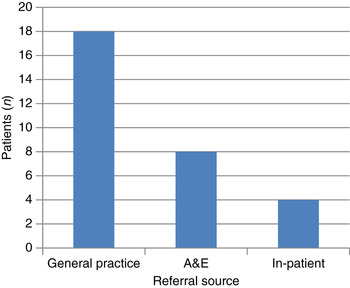
A total of 532 new cases of head and neck cancer were diagnosed during the 60-month study period (342 males (64 per cent) and 190 females (36 per cent)). Thirty of these cases (7 per cent) presented through an emergency pathway to our otolaryngology service. The commonest referral source was general practitioners (utilising our on-call/emergency service), followed by the hospital accident and emergency department, and hospital wards (Figure 1). Twenty-one patients (70 per cent) were male and nine (30 per cent) were female, which is in keeping with the overall gender proportion (p = 0.45). There was no difference in patient age and risk factors between the emergency and non-emergency presentations. The emergency presentation group showed a greater proportion of female patients compared to the non-emergency presentation group (30 vs 15 per cent).
Referral source of emergency presentations. A&E = accident and emergency department

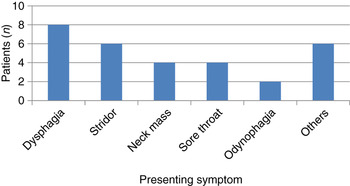
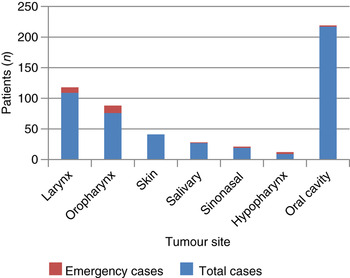
Patients presented with a variety of symptoms, though dysphagia rather than stridor caused by acute airway obstruction was the commonest presenting symptom in this series (Figure 2). The commonest tumour site in this series of emergency presentations was the oropharynx (43 per cent), followed by the larynx and hypopharynx (Figure 3).
Presenting symptoms of emergency pathway patients.

Tumour site in emergency presentations.

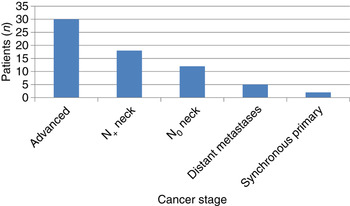
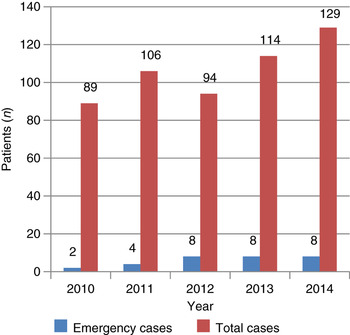
All patients presenting on an emergency basis had cancers staged at level 3 or 4, based on the Union for International Cancer Control staging system. Eighteen patients (60 per cent) presented with cervical metastases, with five patients (17 per cent) demonstrating pulmonary metastases. Two patients (7 per cent) presented with synchronous primary cancers of the lung (Figure 4). The commonest tumour pathology was squamous cell carcinoma (90 per cent), in keeping with the national incidence, with only single cases of melanoma, small cell carcinoma and rhabdomyosarcoma. In this series, the annual number of emergency presentations broadly increased over time, with an increasing number of new head and neck cancer diagnoses per annum (Figure 5).
Cancer stage in emergency presentations. N+ = node-positive; N0 = node-negative

Annual incidence of head and neck cancer (2010–2014).

The mortality of the patients in this series (who presented on an emergency basis) was high (63 per cent (n = 19) at the time of writing), in keeping with the advanced stages of cancer with which this patient group suffered. The average duration of survival from presentation was 168 days (range, 6–485 days). This was considerably shorter when compared to the duration of survival in patients with stage 3 or 4 head and neck cancer who presented through other pathways (e.g. specialist head and neck clinics, or urgent referrals to general otolaryngology clinics). The average duration of survival from presentation in the latter group of patients who had died by the time of writing was 357 days (range, 27–1208 days). The difference in survival duration between emergency presentation patients and those who presented through other referral pathways was significant (p < 0.0001; two-tailed t-test). Emergency presentation patients lived less than half as long as other patients with advanced disease who did not survive their disease.
The requirement for admission to hospital for supportive care during and after treatment with radiotherapy (with or without chemotherapy) is well established. In our unit, 38 per cent of patients required in-patient admission for supportive care because of chemo-radiotherapy complications (e.g. mucositis, dysphagia, malnutrition or neutropaenic sepsis). This rose to 68 per cent in the emergency presentation patients. This difference in the need for supportive care between emergency presentation patients and in-patients was significant (p = 0.03; two-tailed t-test).
Discussion
The emergency presentation of cancer is a significant burden, accounting for 24 per cent of new diagnoses in England, including 14 per cent and 20 per cent of new diagnoses of gastric and colorectal cancer respectively.Reference Elliss-Brookes, McPhail, Ives, Greenslade, Shelton and Hiom 5 – Reference Hogan, Samaha, Burke, Chang, Condon and Waldron 7 The higher level of emergency presentations in the UK compared to other European countries has been identified as contributing to poorer survival rates.Reference Dinsdale 8
Emergency presentation is associated with a poorer prognosis and reduced five-year survival for patients, including in head and neck cancer cases.Reference Hogan, Samaha, Burke, Chang, Condon and Waldron 7 , Reference Narula, Sheppard, West and Bradley 9 – Reference Nouraei, Middleton, Hudovsky, Darzi, Stewart and Kaddour 11 Amri et al. identified emergency presentations of colorectal cancer as being associated with longer in-patient hospital stays, frequent readmissions to hospital and greater healthcare costs.Reference Amri, Bordeianou, Sylla and Berger 12 Patients presenting in such a way, requiring intensive care admission, have a higher mortality risk.Reference Bos, De Keizer, Meynaar, Bakhshi-Raiez and De Jonge 13 Savage et al. reported that head and neck cancer cases account for 2.3 per cent of emergency presentations, one of the lowest rates and slightly below the national incidence (2.9 per cent).Reference Savage, Sharkey, Kua, Papanastasopoulos, McDonald-Burrows and Hassan 10
Emergency presentation is reported to be associated with a greater number of patient co-morbidities and with Caucasian ethnicity. It appears to be unrelated to patients’ symptoms and their duration. This concurs with established presentation patterns for head and neck cancer, and includes cases where patients present late despite persistent and worsening symptoms.Reference Dolan, Vaughan and Fuleihan 14 – Reference Tokuda, Chinen, Obara and Joishy 16 However, emergency admissions to hospital for cancer patients may be an indication of diagnostic delay in primary care.Reference Hamilton 17 In our region, we noted that a number of patients with oropharyngeal cancer were misdiagnosed as suffering acute tonsillitis and reputedly treated with antibiotics, despite not being in the accepted age group for this acute infection.Reference Bannister and Ah-See 18 Other factors associated with emergency presentation include rural location and older age, which broadly correlates with the patient profile in our series.Reference Bannister and Ah-See 18 These factors may account for the advanced stages of cancers seen in all presentations.
The proportion of head and neck cancer patients presenting through emergency pathways in this study is favourable compared to other reports.Reference Bannister and Ah-See 18 , Reference Bottle, Tsang, Parsons, Majeed, Soljak and Aylin 19 However, over the study period, there was a trend towards a greater proportion of patients presenting through emergency pathways, from 2.2 per cent in 2010 to 6.2 per cent in 2014. This increase is difficult to account for, but may be related to the rise in oropharyngeal cancer cases diagnosed in the latter years of the study. These tumours generally cause less dramatic and more insidious symptoms when compared to laryngeal and oral cavity cancers.
-
• Head and neck cancer cases presenting as an emergency appear to be increasing; the reason for this is unclear
-
• The commonest tumour site in emergency presentations was the oropharynx, rather than the larynx as classically described
-
• This may be a result of the increase in human papilloma virus associated squamous cell carcinoma, affecting the oropharynx
-
• The clinical features of patients presenting on an emergency basis are varied, potentially leading to delays in presentation to secondary care and diagnosis
-
• In emergency presentation patients, tumours commonly present at an advanced stage, with a poorer overall prognosis
Patients in this study had a reduced life expectancy and were more likely to spend a significant part of the remainder of their life in hospital as in-patients. This is important and requires further study. Increased mortality and the need for hospital care in this group may be related to patient co-morbidities, tumour bulk or symptom duration before presentation. Awareness of such emergency presentations should influence staff training, and lead to improved investigation and management of such patients’ conditions. Older patients presenting with clinical features of upper aerodigestive tract infection should be examined fully to assess for malignancy in these areas. The rise in cases of squamous cell carcinoma of the oropharynx may lead to additional similar emergency presentations that would require further assessment and investigation too. Larger, prospective studies in this area of patient care should be performed to assess how such presentations can be avoided. This may provide greater awareness of head and neck cancer in UK primary care and in the general population.