School counsellors play an important role in supporting student mental health, particularly during the secondary school years, as 50% of mental illnesses emerge before age 18 (Lawrence et al., Reference Lawrence, Hafekost, Johnson, Saw, Buckingham, Sawyer, Ainley and Zubrick2016; Rickwood, Deane, Wilson, & Ciarrochi, Reference Rickwood, Deane, Wilson and Ciarrochi2005; Sawyer, Miller-Lewis, & Clark, Reference Sawyer, Miller-Lewis and Clark2007). Currently, all secondary schools in New South Wales (NSW), Australia employ at least one school counsellor or psychologist to provide support to students within school hours. School counselling is a multispecialist role (Campbell & Colmar, Reference Campbell and Colmar2014; DeKruyf, Auger, & Trice-Black, Reference DeKruyf, Auger and Trice-Black2013) involving individual consults, crisis intervention, liaison with families and external services, cognitive and behavioural assessments, and the delivery of workshops (NSW Department of Education and Communities, 2011). These competing responsibilities can lead to role ambiguity and conflict (Coll & Freeman, Reference Coll and Freeman1997; Thielking & Jimerson, Reference Thielking and Jimerson2006). In addition, the average school counsellor-to-student ratio in NSW (1:1,030) exceeds recommendations (1:500), leaving many school counsellors time poor and rendering their services inaccessible to a large portion of students (Australian Psychological Society [APS], 2013). This pressure is compounded by professional issues, such as uncertainty of tenure and lack of clinical supervision (Campbell & Colmar, Reference Campbell and Colmar2014; Thielking & Jimerson, Reference Thielking and Jimerson2006). School counsellors are typically located in separate spaces, isolating them from other school staff (Kimber & Campbell, Reference Kimber and Campbell2014; Mara, Reference Mara1991). Further, those working in rural locations frequently cover multiple schools in regions where external services are often scant (Gulliver, Griffiths, & Christensen, Reference Gulliver, Griffiths and Christensen2010). Unsurprisingly, school counsellors report high levels of stress and are vulnerable to experiencing burnout (Butler & Constantine, Reference Butler and Constantine2005; Earle, Reference Earle2017; Wilkerson & Bellini, Reference Wilkerson and Bellini2006).
Burnout is defined as ‘a state of physical, emotional and mental exhaustion that results from long-term involvement in work situations that are emotionally demanding’ (Schaufeli & Greenglass, Reference Schaufeli and Greenglass2001, p. 501). Maslach and Jackson (Reference Maslach and Jackson1981) describe burnout as encompassing three dimensions: emotional exhaustion, depersonalisation, and reduced personal accomplishment. Burnout lowers an individual's capacity for work by affecting their mental and physical wellbeing, increasing absenteeism and staff turnover (Maslach, Reference Maslach1982). It may also reduce the quality of care provided, as empathy is diminished, and detachment and cynicism increase (Maslach & Jackson, Reference Maslach and Jackson1981; Maslach, Schaufeli, & Leiter, Reference Maslach, Schaufeli and Leiter2001). Among school counsellors, several factors for burnout have been investigated. Wilkerson and Bellini (Reference Wilkerson and Bellini2006) categorised these as organisational, demographic, or intrapersonal, with the majority of past research focusing on organisational factors. Within the school context, role ambiguity (Wilkerson & Bellini, Reference Wilkerson and Bellini2006), inadequate supervision (Moyer, Reference Moyer2011), limited organisational support (Lambie, Reference Lambie2007), a larger caseload, and performing additional non-counselling duties (Bardhoshi et al., Reference Bardhoshi, Schweinle and Duncan2014) have been associated with increased burnout. Conversely, clinical supervision and professional development have been shown to reduce job stress (Young & Lambie, Reference Young and Lambie2007). Little is known about the link between burnout and school type or school size.
The relationship between burnout and demographic or background factors also remains unclear. In an American sample, burnout was found to be associated with a younger age and less experience in the role (Huberty & Huebner, Reference Huberty and Huebner1988). In contrast, Butler and Constantine (Reference Butler and Constantine2005) found higher rates of burnout among American school counsellors with 20 years or more experience, while research conducted in Jordan found no relationship between burnout and age or counselling experience (Haddad, Reference Haddad1998). In Australia, location may increase likelihood of burnout, as school counsellors in rural areas have reported higher rates of burnout compared to those in urban and metropolitan areas (Earle, Reference Earle2017). However, it is not yet well established whether education qualifications, gender, relationship status, registration as a psychologist, or full-time or part-time workload is associated with burnout in school counsellors. Certain intrapersonal factors, behaviours, and coping strategies, such as practising self-care (e.g., spending time in self-reflection), taking regular holidays, discussing work frustrations with a partner, and putting aside thoughts of the students outside of work, have been found to be protective against burnout (Earle, Reference Earle2017; Rodd, Reference Rodd2017). Similarly, school counsellors who perceive themselves as valuable to their organisation experience lower job-related stress (Rayle, Reference Rayle2006). Occupational support also appears to be protective against burnout within this group (Lambie, Reference Lambie2007). However, little is known about the links between burnout and other school counselling practices such as parental engagement, providing care outside of school hours, support from external services, and the counsellor's satisfaction with their school's approach to student mental healthcare.
As outlined, it is likely that various other factors contribute to or lower burnout among school counsellors, although these have not yet received much attention in the literature. In child-service workers, burnout has been found to be reduced using evidence-based practices (EBPs; Aarons, McDonald, Sheehan, & Walrath-Greene, Reference Aarons, McDonald, Sheehan and Walrath-Greene2007), which are practices that have demonstrated clinical efficacy. The use of EBPs may indirectly lower burnout by increasing school counsellors’ capacity to reach students (Glasheen, Campbell, & Shochet, Reference Glasheen, Campbell and Shochet2015). Burnout may also be reduced by the use of internet-based resources for mental health (e.g., psychoeducation websites, mobile phone apps, or online counselling), as school counsellors can use these to improve students’ mental health literacy, provide care beyond school hours, and increase engagement with care (Glasheen et al., Reference Glasheen, Campbell and Shochet2015). However, little is known about school counsellors’ use of EBPs or online therapies and the relationship with burnout. In addition, there is a significant lack of research on burnout among school counsellors in an Australian context (Earle, Reference Earle2017; Rodd, Reference Rodd2017).
The Current Study
Given the emotional demands of school counselling, it is important to identify the factors that may reduce the risk of burnout. A greater awareness of both the modifiable and non-modifiable risk factors for burnout will facilitate the development of targeted protective measures. This will help to both prevent mental health problems in counsellors themselves, and to ensure that school counsellors remain in the school system where they can support student mental health needs. The current study aimed to explore the factors associated with burnout among school counsellors working in secondary schools in NSW, Australia. It was hypothesised that factors related to the intensification or overextension of workload, lower professional and personal support, and less experience in the role would be associated with higher rates of burnout, whereas greater use of EBPs or online resources, practice of self-care, and increased satisfaction with school mental healthcare would be associated with lower levels of burnout. These findings will help to inform future efforts to lower burnout among school counsellors and support their capacity to maintain a high level of care for students with mental health issues. It is hoped this study will also contribute to the literature by exploring whether the use of more modern EBPs might influence burnout in school counsellors.
Method
Study Design
This is a secondary analysis from a large cross-sectional, online survey. Ethics approval was obtained from the University of New South Wales (HC15456) and the NSW Department of Education (SERAP 2015369).
Participants, Recruitment, and Procedure
Participants were school counsellors currently working in NSW secondary schools, aged over 18 years, and fluent in English. Recruitment took place between July and October 2016 via the Black Dog Institute website and social media channels, alongside a direct email mailout to key networks. The online survey was administered using the Key Survey platform (WorldAPP Key Survey, 2017) and was accessible on any internet-enabled device. The survey URL was included in recruitment material, such that participants were automatically directed to the survey website. Participants provided online consent prior to beginning the survey. The entire survey took approximately 45 minutes to complete and participants did not receive any financial reimbursement for participation.
Survey
The entire survey consisted of 91 self-report questions. It was designed internally by the research team to assess the acceptability of a proposed online mental health service and the feasibility of implementing such a service within the school context (O'Dea, King, Subotic-Kerry, O'Moore, & Christensen, Reference O'Dea, King, Subotic-Kerry, O'Moore and Christensen2017). The current article outlines a secondary analysis relating to burnout only. A total of 36 questions from the original survey are included in this article. Burnout: Given the survey length, burnout was directly assessed by one question: ‘Have you ever experienced burnout, that is, physical and/or emotional exhaustion resulting from work related to your role as a school counsellor?’ (answered yes, no, unsure or I'd rather not say). Demographics: Age, gender, relationship status, Aboriginal or Torres Strait Islander (ATSI) identification, country of birth, education qualifications, location (Sydney metropolitan or regional NSW). School counsellor background: Registration status, years of experience, employment status (part-time or full-time). School context: School type (single-sex or co-educational), education sector (government or independent), number of students in school. School counselling practice: Number of sessions per day. Frequency of practicing deliberate self-care, providing care outside of school hours, providing personal contact details to students, referring students to external services, and engaging with parents, (answered never, rarely, sometimes, often, always). Level of support from external services, parents, and other teachers, answered on a scale ranging from (1) not at all, to (5) entirely. Level of workload manageability, the extent that work stress impacts on health and wellbeing, and satisfaction with school mental healthcare, answered on a scale ranging from (1) not at all, to (5) entirely. Use of online mental health resources: Frequency of use of mental health websites, peer support forums, mobile phone apps, symptom-focused programs, online counselling (i.e., counselling via internet-based mediums such as email or web-chat), and videoconferencing services, answered on a 4-point scale from ranging from (1) never, to (4) always. Openness to evidence-based practice: The openness subscale of the Evidence-Based Practice Attitude Scale (EBPAS; Aarons, Reference Aarons2004; Aarons et al., Reference Aarons, McDonald, Sheehan and Walrath-Greene2007) was included, in which four items that measure the extent to which respondents will try or use new therapies or interventions are answered using a 5-point scale from (0) not at all, to (4) a very great extent. This scale has good internal consistency (α = .78; Aarons, Reference Aarons2004). In the current study, the Cronbach's alpha coefficient was .87.
Data Analysis
Data were analysed using IBM SPSS Statistics Version 22 (IBM Corp, 2013). Basic descriptives were calculated and reported for all variables. To examine the categorical factors associated with burnout, a series of chi-square tests were computed, while a series of independent t tests were conducted for all continuous variables. Spearman's rho correlations were used to explore the relationship with the use of online resources. For five of the survey questions (frequency of self-care, provision of care outside of school hours, providing personal contact to students, engagement with external services, and engagement with parents), response options were collapsed into two categories: high frequency (often and always) and low frequency (rarely and never).
Results
Participants
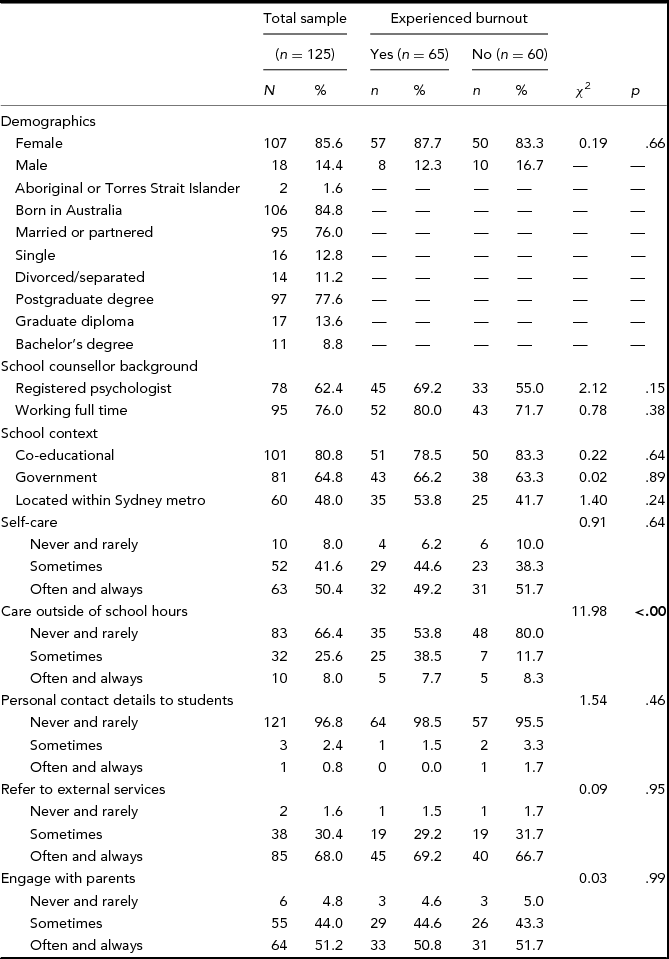
A total of 145 school counsellors completed the survey. Of these, 45% (n = 65) reported that they had experienced burnout, 41% (n = 60) had not, 13% (n = 19) were unsure, and 1% (n = 1) reported ‘I'd rather not say’. The final sample for this paper consisted of the school counsellors (N = 125) who reported ‘Yes’ or ‘No’ to having experienced burnout. Participant demographics are presented in Tables 1 and 2.
Categorical Factors Associated With Burnout Among NSW Secondary School Counsellors (n = 125)

Note: Bold = significant p < .05.
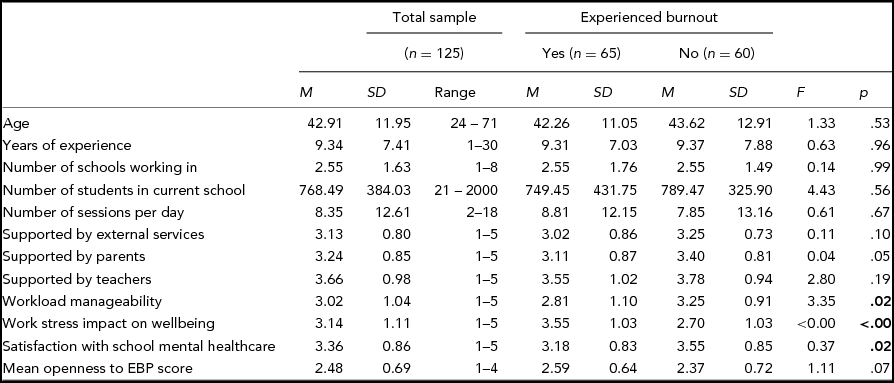
Continuous Variables Associated With Burnout Among NSW School Counsellors (n = 125)

Note: Bold type = significant p < .05.
Demographic, Organisational, and Interpersonal Factors Associated With Burnout
As outlined in Table 1, school counsellors experiencing burnout were found to provide care outside of school hours more frequently than those who had not experienced burnout. As outlined in Table 2, burnout was also associated with lower workload manageability (M diff = 0.44), and a greater likelihood of work stress impacting health and wellbeing (M diff = 0.85). School counsellors who reported burnout also reported lower satisfaction with the way their school addressed student mental healthcare (M diff = 0.37). No other significant associations or differences were found (p = .05–.99).
Association Between Use of EBPs, Online Resources, and Burnout
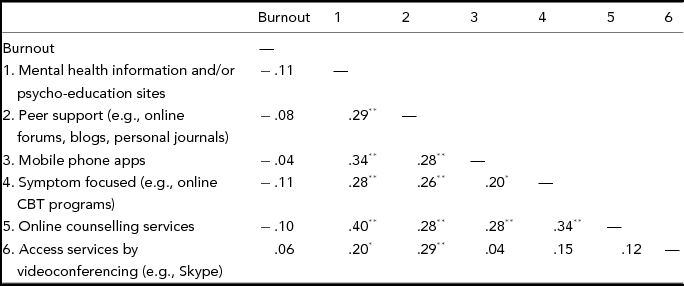
The most frequently used online resources were psychoeducation/mental health websites (58%, n = 73), and mobile phone apps (57%, n = 71). Peer support forums (12%, n = 15), symptom-focused programs (18%, n = 22), online counselling (22%, n = 28), and video-conferencing services (2%, n = 3) were less frequently used or recommended. As outlined in Table 3, there were no significant associations between burnout and school counsellors’ use of online resources (p = .23–.52). Lastly, there was no significant relationship between burnout and counsellors’ mean level of openness to EBPs (M diff = 0.22).
Spearman's Rho Correlations Between Burnout and Use of Online Mental Health Resources (n = 125)

Note: **Correlation is significant at the .01 level (2-tailed), *Correlation is significant at the .05 level (2-tailed).
Discussion
This study aimed to explore some of the organisational, demographic and intrapersonal factors associated with the experience of burnout among NSW secondary school counsellors. Importantly, almost half of the sample reported that they had experienced burnout in their role as a school counsellor. This is slightly higher than the rates previously found in an Australian sample (37%; Earle, Reference Earle2017) and an American sample (40%; Wilkerson & Bellini, Reference Wilkerson and Bellini2006), and reinforces the notion that school counsellors are vulnerable to experiencing professional burnout. Burnout was found to be associated with four factors: provision of care outside of school hours, low workload manageability, greater impact of work stress, and poorer satisfaction with school mental healthcare. Although they are not required to provide care beyond school hours, this study suggests that some school counsellors are indeed doing so, and that this may have a negative impact on their wellbeing. Burnout may be reduced if school counsellors have additional support for students who require care outside of the school day. These findings also confirm the importance of school policies that discourage school counsellors from extending the hours of their care.
Burnout was also associated with low workload manageability, which is likely to reflect job overload and emphasises the need for additional organisational support. In the current study, school counsellors who reported burnout also reported that their work had a greater impact on their health and wellbeing, which aligns with previous findings (Bardhoshi, Schweinle, & Duncan, Reference Bardhoshi, Schweinle and Duncan2014). Taken together, these results suggest that measuring job overload and perceived work stress may help to identify school counsellors at risk of burnout and indicates where preventative measures may be warranted. Further, ensuring that all school counsellors have access to adequate supervision for their clinical work is likely to mitigate the job stress they are experiencing (Herlihy, Gray, & McCollum, Reference Herlihy, Gray and McCollum2002; Lambie, Reference Lambie2007). School counsellors reporting burnout were also more likely to describe lower satisfaction with their school's approach to student mental health. This may be a direct consequence of feeling burned out; or alternatively, may reflect a core component of the burnout experience, such as a reduced sense of personal accomplishment (Maslach & Jackson, Reference Maslach and Jackson1981). A longitudinal study would help to determine whether such dissatisfaction is a risk factor or direct result of burnout.
Many of the non-significant findings within the current study contrast with past studies (e.g., Bardhoshi et al., Reference Bardhoshi, Schweinle and Duncan2014; Butler & Constantine, Reference Butler and Constantine2005; Huberty & Huebner, Reference Huberty and Huebner1988; Lambie, Reference Lambie2007). First, rates of burnout did not differ among locations, with rural and regional school counsellors no more likely to report burnout than metropolitan counsellors, in contrast to the previous findings of Earle (Reference Earle2017). Second, years of experience were not associated with burnout, also conflicting with previous findings (Butler & Constantine, Reference Butler and Constantine2005; Huberty & Huebner, Reference Huberty and Huebner1988). Further, despite that more than two thirds of school counsellors were already recommending various online resources to students, no relationship between usage and burnout was found. There was also no relationship between higher levels of openness to EBPs and burnout, suggesting that school counsellors’ attitudes toward different therapies and the use of novel online resources do not significantly impact upon their stress levels, as was expected. Combined, these findings suggest that burnout in NSW school counsellors may be more related to intrapersonal factors rather than the organisational or demographic factors found in previous studies.
Overall, these findings imply that burnout among NSW school counsellors is a complex experience and is likely to be attributed to the dynamic interplay between personal background characteristics (e.g., professional experience), organisational variables and stressors (e.g., job overload), and intrapersonal factors or behaviours (e.g., practising self-care). However, the current findings must be considered within the context of the study limitations. First, burnout was captured with a single question rather than a comprehensive or validated measure, which may have introduced a bias and precluded us from measuring whether the other dimensions of burnout, such as depersonalisation and reduced personal accomplishment (Maslach & Jackson, Reference Maslach and Jackson1981), were affected by the factors we explored. This may also account for the contrasting results found here as compared to previous research studies, in which burnout was often measured in greater detail. Second, more than one in ten school counsellors reported they were unsure about their history with burnout in the first instance, suggesting there may be a need for increased general literacy about this topic. Further, participation was limited to school counsellors based in NSW and therefore the findings may not be widely generalisable, particularly to regions or countries in which the school counselling role is structured differently. Finally, school counsellors who were currently experiencing the symptoms of burnout may not have had the capacity to partake, potentially leading to self-selection bias.
Conclusion
School counsellors are vital for supporting student mental health in the school. They also face various challenges in their role and many are at risk of experiencing burnout. This may be particularly true among those who feel affected by work-related stress and consider their workload unmanageable, and for those whose work extends beyond school hours. Schoolwide efforts that seek to improve the support provided to school counsellors may reduce the prevalence of burnout. Future research should focus on initiatives that aim to increase care for students outside of school hours, foster coping skills among school counsellors, and improve resource allocation to reduce the job demands and overload associated with the role. By reducing school counsellors’ stress and improving their sustainability, such efforts will help to ensure that students receive the mental healthcare they require.
Acknowledgments
CK and BOD contributed to all aspects of study design including project inception, as well as research operations including recruitment, data collection, analyses, and authorship of the report. MSK was involved in project management and report preparation. The research team acknowledges the efforts of all NSW school counsellors who participated in the study.
Financial Support
Funding for the project was provided by HSBC. BOD is funded by Society for Mental Health Research Early Career Fellowship and an OPTYMISE Postdoctoral Fellowship.
Conflicts of Interest
There are no conflicts of interest to report.