Introduction
Parasite community ecology is a recent discipline that defines the patterns in parasite community structure, richness and diversity (Esch et al., Reference Esch, Bush and Aho1990; Kennedy, Reference Kennedy1995). To date most data on parasite communities of freshwater fish are known from the northern temperate regions (Bush et al., Reference Bush, Aho and Kennedy1990; Kennedy, Reference Kennedy, Esch, Bush and Aho1990; Nelson & Dick, Reference Nelson and Dick2002; Johnson et al., Reference Johnson, Nelson and Dick2004). In the tropics, work from South America, particularly Brazil (Alves & Luque, Reference Alves and Luque2001; Alves et al., Reference Alves, Luque and Paraguassú2002; Luque et al., Reference Luque, Alves and Ribeiro2003), Mexico (Salgado-Maldonado & Kennedy, Reference Salgado-Maldonado and Kennedy1997) and Australia (Kennedy, Reference Kennedy1995) have examined the composition and diversity of parasite communities in tropical fish. However, very little is known from Africa, with the work of Guégan & Hugueny (Reference Guégan and Hugueny1994) being the exception. No such studies are known from the Lake Victoria basin.
According to Takemoto et al. (Reference Takemoto, Pavanelli, Lizama, Luque and Poulin2005) the currently available results are inconsistent. One reason for these inconsistencies is that most data sets used have come from many different sources; but also from different host species and from different geographical areas, which add elements of variability to data sets used in the analysis. To minimize the above discrepancies, Takemoto et al. (Reference Takemoto, Pavanelli, Lizama, Luque and Poulin2005) urge examining variation in parasite species richness among a group of host species from the same area, all examined in the same way. Factors that promote the richness of parasite communities include host features such as host body size, geographical range and breadth of diet (Esch et al., Reference Esch, Bush and Aho1990; Poulin, Reference Poulin1995; Choudhury & Dick, Reference Choudhury and Dick1998; Nelson & Dick, Reference Nelson and Dick2002; Johnson et al., Reference Johnson, Nelson and Dick2004). Host population density (Takemoto et al., Reference Takemoto, Pavanelli, Lizama, Luque and Poulin2005) has also been implicated, with host species occurring at high density expected to have richer parasite communities. In addition, the characteristics of the environment (Marcogliese & Cone, Reference Marcogliese and Cone1991; Machado et al., Reference Machado, Pavanelli and Takemoto1995) may also determine the structure of parasite assemblages.
Despite the extensive information available on the ecology and biology of fishes in Lake Victoria (Kolding et al., Reference Kolding, van Zwieten, Manyala, Okedi, Mgaya and Orach-Meza2005; Katunzi et al., Reference Katunzi, Van Densen, Wanink and Witte2006), studies on the parasites of fish species in this lake are relatively few. The literature includes the works of Khalil & Thurston (Reference Khalil and Thurston1973), Paperna (Reference Paperna1974, Reference Paperna1980) and Mbahinzireki (Reference Mbahinzireki1984), who reported some helminths of tilapine, cyprinid, siluroid and haplochromine fish from the lake. These studies only list occurrence, while giving little or no information on parasite community ecology.
The Clariidae or walking catfishes present a good model to study parasite communities in Lake Victoria as they form a closely related group with varying feeding habits, they are widely distributed and occupy a variety of habitats in the lake. For instance, Clariallabes sp. inhabits stony areas in rivers and wave-washed shores, Clarias species (Clarias gariepinus, C. alluaudi, C. werneri and C. liocephalus) prefer shallow, muddy and vegetated lake margins, and Xenoclarias sp. occupies deeper waters (Eccles, Reference Eccles1992). This therefore presents an ideal situation for studying interspecific variation in parasite assemblages in a group of host species occupying the same area (Takemoto et al., Reference Takemoto, Pavanelli, Lizama, Luque and Poulin2005).
The objective of the present study, therefore, was to describe the factors that influence the structure of parasite communities of the clariid fishes of Lake Victoria, both at the infra-, component and compound community levels. The ecological factors investigated were those considered to have a direct influence on local parasite community richness, namely host size, diet, habitat and mean number of parasite individuals per host (Aho et al., Reference Aho, Bush and Wolfe1991; Bell & Burt, Reference Bell and Burt1991).
Study area
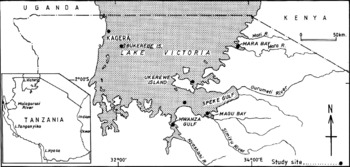
Lake Victoria, the largest tropical lake in the world, is shared between Tanzania, Uganda and Kenya. The lake lies in a shallow continental sag between the two arms of the Great Rift Valley, 1170 m above sea level. The lake has a maximum depth of 84 m, a volume of 2750 km3, and a surface area of 68,800 km2. Primary inflows to the basin include rivers such as the Kagera in the west and the Mara in the east. All outflows are to the north along the Nile through Lake Kyoga. The mean surface temperature is about 25 °C while the temperature of deeper layers is about 1–2 °C lower (Witte & Van Densen, Reference Witte and Van Densen1995). The present study covered the surroundings of Bukoba town, the Mwanza Gulf, Speke Gulf, parts of Ukerewe Island and the delta of Mara River (fig. 1).
Map of Lake Victoria showing the sampling sites.

Materials and methods
Fish collection, examination for parasites and identification followed standard procedures (Khalil & Polling, Reference Khalil and Polling1997). Fish samples were collected monthly between August 2003 and February 2005 and the size of fish examined ranged between 55 and 1300 mm standard length. The number of species and mean number of parasite individuals infecting an individual host were determined by counting and used as a measure of species richness of each infracommunity (Bush et al., Reference Bush, Aho and Kennedy1990). The diversity of parasites was determined by the Shannon–Wiener index H. Predictability was determined by the number of core species, defined as the parasites with prevalence higher than 10% (Bush et al., Reference Bush, Aho and Kennedy1990). Standard length was used as a measure of body size of the fish species examined. The host and parasite data were log(x+1) transformed before analysis. Despite the transformation, the data did not meet normality and homoscedasticity criteria, consequently they were analysed by Friedman's randomized block analysis of variance (ANOVA) (Zar, Reference Zar1996).
Jaccard's similarity index was used to compare similarities between parasite species richness and sampling localities. This was only performed for C. gariepinus, which was collected from all localities sampled. Distance between pairs of host populations was calculated as a linear distance between sampling localities obtained from a map (fig. 1).
A community of parasites was regarded as rich or poor, based on the number of species and/or individuals of parasites present in a community (Bush et al., Reference Bush, Fernandez, Esch and Seed2001). Analysis of community structure was carried out at the infra-, component and compound community levels. For data analysis only those with a significant level of P ≤ 0.05 were considered significant. The computer program used for statistical tests was Statistica (StatSoft Inc., Tulsa, Oklahoma, USA). Parasite ecological terms used were those defined by Margolis et al. (Reference Margolis, Esch, Holmes, Kuris and Schad1982) and Bush et al. (Reference Bush, Fernandez, Esch and Seed2001).
Results
Host attributes
Clariid fishes examined consisted of 319 females and 337 males and the distribution was such that C. gariepinus was found from all the localities surveyed, C. liocephalus from three localities, namely Mara Bay, Mwanza Gulf and Kagera. Clarias werneri and C. alluaudi were obtained from the Mara Bay and Mwanza Gulf. In addition, two specimens of Clariallabes petricola were obtained from the Mwanza Gulf, a specimen of Heterobranchus longifilis from the Malagarasi River and 19 specimens of Bagrus docmac were obtained from the Mwanza Gulf and Kagera. The majority of parasites recovered occurred in fish of between 120 and 200 mm standard length.
Parasite attributes
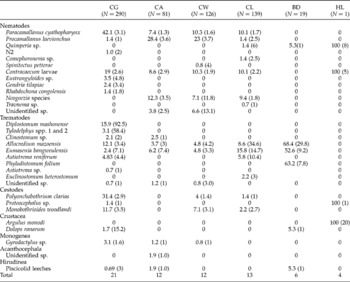
Thirty-one parasite species were found from 656 fish examined. Table 1 shows the prevalence and mean number of parasites infecting the seven species of fish examined. Among the 31 parasite species, ten were considered core and predictable, namely Paracamallanus cyathopharynx, Procamallanus laevionchus, Contracaecum larvae, Neogoezia sp., Diplostomum mashonense, Allocredium mazoensis, Eumasenia bangweulensis, Phylodistomum folium, Polyonchobothrium clarias and Monobothrioides woodlandi. The trematodes, Diplostomum mashonense and Tylodelphys species were recovered from the cranial cavity of C. gariepinus only. The crustaceans were recovered from the oral cavity of C. gariepinus, B. docmac and H. longifilis; Gyrodactylus sp. and Clinostomum sp. infected the gills; leeches (Hirudinea: Piscolidae) were recovered from the skin; Eustrongyloides and Contracaecum larvae, and Euclinostomum heterostomum were recovered from the musculature; and the rest of the parasites were isolated from the gut.
Prevalence (%) and mean number (in parentheses) of parasites infecting six species of fish examined from Lake Victoria. CG, Clarias gariepinus; CA, C. alluaudi; CW, C. werneri; CL, C. liocephalus; BD, Bagrus docmac; HL, Heterobranchus longifilis (from the Malagarasi River).

Infra-, component and compound communities
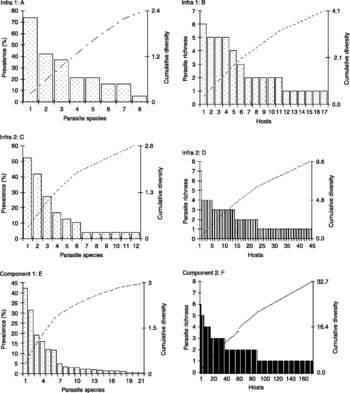
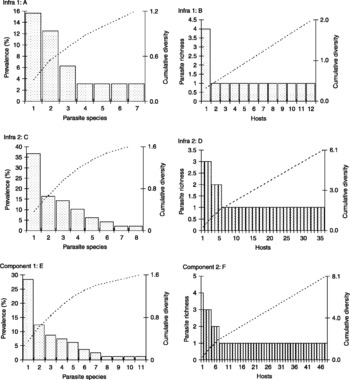
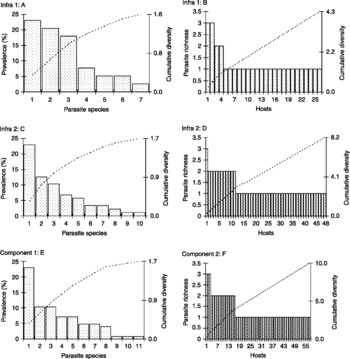
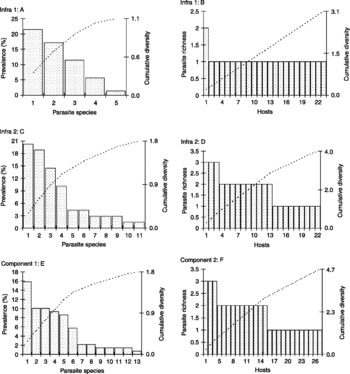
Diversity indices (H) at the infracommunity level ranged between 2.6 in C. gariepinus and 1.1 in C. liocephalus for the parasites and between 9.6 in C. gariepinus and 3.1 in C. liocephalus for the host fish (figs 2–5). The observed component diversity ranged from 2.9 in C. gariepinus and 1.6 in C. alluaudi (fig. 3) for the parasites and between 32.7 and 4.6 in C. gariepinus and C. liocephalus, respectively, for the host fishes (figs 2–5).
Clarias gariepinus infra- and component community prevalence (A, C, E) and richness (B, D, F) distributions in relation to cumulative diversity (dotted lines) for the parasites and host individuals.

Clarias alluaudi infra- and component community prevalence (A, C, E) and richness (B, D, F) distributions in relation to cumulative diversity (dotted lines) for the parasites and host individuals.

Clarias werneri infra- and component community prevalence (A, C, E) and richness (B, D, F) distributions in relation to cumulative diversity (dotted lines) for the parasites and host individuals.

Clarias liocephalus infra- and component community prevalence (A, C, E) and richness (B, D, F) distributions in relation to cumulative diversity (dotted lines) for the parasites and host individuals.

The infracommunity diversity indicated that at least six parasites had a prevalence of more than 10% in C. gariepinus, four in C. liocephalus, three in C. werneri and two in C. alluaudi. These parasites were present in most of the component communities and hence considered core and predictable. The infracommunity and component richness values were more uniform than the prevalence values in all clariid fishes examined and created a linear increase in host diversity compared to the parasite diversity (figs 2–5).
The maximum number of species per host was seven at the infracommunity level and the mean species richness ranged from 1.2 to 2.1. The levels of similarities in parasite species richness at the component community level ranged from 29.6 to 61.5%. Clarias werneri was closely related to C. alluaudi in terms of parasite species richness, sharing about 61.5% of their parasite fauna. The mean number of shared species of parasites at the compound community level was 7.8; C. gariepinus shared 26% of its parasites with other clariid fishes, C. liocephalus shared 28%, C. alluaudi 32%, and C. werneri shared 37% of its parasites with other clariid fishes.
Body size and parasite species richness
Regression of parasite species richness on host size at the compound community level was significant (F (1,195) = 19.7, P = 0.000015) with a negative slope ( − 0.3 ± 0.17); hence parasite species richness declined by a factor of 1/3 as the standard length of the fish host increased. However, host size contributed about 9.2% of the variance in parasite species richness among the fish species examined. At the component community level, parasite species richness increased with the host's body size in some host species. For instance, in C. gariepinus, body size contributed about 64.9% of the variance in parasite species richness, 26.6% in C. alluaudi, 21.7% and 66.7% in C. werneri and C. liocephalus, respectively. However, as for the compound regression analysis, the contribution of body size was negative in C. werneri and C. liocephalus, where parasite species richness declined with increasing fish size.
Geographical distance and parasite species richness
The distance between sampling localities influenced the similarities of parasite species richness among the samples of C. gariepinus. As the distance between sampling localities (host habitat) increased, similarities in parasite species richness among the samples analysed also increased, at a rate of 3.6% per kilometre change in distance. In general, geographical distance explained about 2.9% of the variance in parasite species richness, at least in C. gariepinus. The parasite similarities among sampling localities for C. gariepinus showed that the highest parasite species similarities were between the Mwanza Gulf and Mara Bay and between the Mara Bay and Speke Gulf. Similarly, the two sites, Mwanza Gulf and Mara Bay had similar clariid species.
Abiotic parameters
Total nitrogen (TN) ranged from 701.5 to 1487.3 μg l− 1, with the highest values recorded in Mwanza Gulf. Magu Bay recorded the highest phosphate and nitrate values (74–205.2 μg l− 1), where turbidity was also high. Mara and Kagera Bays had the lowest values in abiotic parameters. However, mean parasite prevalence and mean species richness were highest at Mara Bay and lowest at Magu Bay.
Influence of host food on parasite species richness
This analysis was only performed for C. gariepinus, data were insufficient for other clariid species. The values of parasite species richness and the type of feed were log(x+1) transformed before regression analysis. Feeding was classified as: gut contents full of purely plant matter (0), plant matter more than animal matter (1), plant and animal matter in equal amounts (2), animal matter more than plant matter (3), and the gut content full of purely animal matter (4). The parasite species richness was found to increase at a rate of 7.1% with an increase in the amount of animal matter in the feed. Nevertheless, the type of feed contributed only 0.6% to the variance of parasite species richness.
Discussion
The clariid fishes studied were parasitized by a wide range of parasites, mostly as generalists and few specialists, those with direct as well as complex life cycles. Among the clariids investigated, C. gariepinus harboured the highest parasite species richness at both the infra- and component community levels, whereas the opposite was true for the smaller clariid fishes such as C. werneri and C. alluaudi. Furthermore, most gut parasites came from C. gariepinus. This is not surprising as C. gariepinus is an omnivore that is increasingly carnivorous with increasing size, and thus likely to be infected by a variety of parasites from the wide range of intermediate hosts it feeds upon. C. gariepinus, a highly vagile species, was also collected from all five localities, whereas the smaller clariids, such as C. werneri, C. alluaudi and C. liocephalus, were limited in distribution and fed on an increasingly plant diet.
The present study showed that ten parasite species were present in ≥ 50% of the component communities analysed, and as a result were considered core and predictable. According to Nelson & Dick (Reference Nelson and Dick2002) a predictable system is supported by high diversity estimates and shared parasites at the infra- and component community levels. The present results are therefore in agreement with the above assertion, as they showed that parasite species richness were more uniform and created a linear increase in diversity indices. The infracommunities analysed were relatively rich and consistent, possibly a result of random distribution of intermediate and definitive hosts, dietary overlap and similar ecology of the clariid fishes, which further ensure homogeneous infracommunities (Nelson & Dick, Reference Nelson and Dick2002; Klimpel et al., Reference Klimpel, Seehagen and Palm2003).
Although all the five clariids examined occupied relatively similar habitats, the trematodes Diplostomum mashonense and Tylodelphys species infected only C. gariepinus. Poulin (Reference Poulin1992) argued that host specificity is highly linked with cospeciation processes; however, the above two specialist trematodes do not exhibit cospeciation pattern with their hosts (Mwita, unpublished data, 2006). Desdevises et al. (Reference Desdevises, Morad, Jousson and Legendre2002) suggested that processes leading to specificity do not necessarily lead to host–parasite cospeciation. The specificity of D. mashonense and Tylodelphys species to C. gariepinus observed might therefore represent a strong ecological host–parasite association (Brooks, Reference Brooks1979).
The ecological characteristics of a host fish, such as size, diet and habitat, are considered important determinants of the parasite richness (Aho et al., Reference Aho, Bush and Wolfe1991; Poulin, Reference Poulin1995; Choudhury & Dick, Reference Choudhury and Dick1998). The results of the present study showed that size had minimal influence on parasite community structure at the component and compound community levels, since it accounted for only 9.2% of the variation in parasite species richness among the clariid fishes. This is attributable to sampling bias of the fishes examined. All sampled fish were sorted to fit a subsequent morphometric experiment, which required that they be of a similar size range. It is most likely that the relatively large proportion of smaller-sized fishes muffled the influence of the smaller proportion of larger fish in the samples. When the individual members of the clariid fish species were examined separately, size significantly influenced the parasite community structure at the infracommunity level in larger species such as C. gariepinus and C. alluaudi but not in smaller species like C. werneri and C. liocephalus, in which the influence of size was low. The larger surface area (hence more niches), vagility and an increasingly animal diet in larger species might explain the differences observed. In addition, the high population density of C. gariepinus most likely promotes a richer and diverse parasite community in this species (Takemoto et al., Reference Takemoto, Pavanelli, Lizama, Luque and Poulin2005).
Parasite species richness in communities of a host may vary between sampling localities. Poulin (Reference Poulin2003) asserts that the decline in the proportion of shared parasite species with increasing geographical distance is a feature of natural systems. On the contrary, the results of the present study indicated that similarities in parasite species richness, in C. gariepinus, increased at a rate of 3.6% with the increase in distance in Lake Victoria. A couple of factors may explain this observation: first that Lake Victoria is a single mass of water with uniform conditions brought about by the intermixing of water from one season to another due to wind movements; second, C. gariepinus is a vagile fish capable of migrating long distances, consequently collecting a variety of parasites from all the localities it traverses in the basin (Mwita, Reference Mwita2002). The distribution and vagility of C. gariepinus in particular can account for the lack of differences in parasite species richness between localities investigated in this study, rendering habitat differences of little consequence in determining parasite community richness, at least for this species, but also for other clariids as they are infected by similar parasites.
Some workers (Zander, Reference Zander1998; Zander et al., Reference Zander, Reimer and Barz1999, Reference Zander, Reimer, Barz, Dietel and Strohbach2000) have shown that specialist parasites are more sensitive to environmental stressors such as increasing eutrophication induced by the release of nitrogen and phosphorus from sewage wastes, farming and even traffic. However, in the present study highest species richness was recorded in Mwanza Gulf in which abiotic factors such TP and TN were also high. Other workers (Wootten, Reference Wootten1973; Marcogliese & Cone, Reference Marcogliese and Cone1991; Machado et al., Reference Machado, Pavanelli and Takemoto1995) have suggested that the individual history and characteristics of the lake might influence the parasite community structure of a freshwater fish. This is most likely the case in Lake Victoria, for reasons given above.
In conclusion, clariids harbour mainly generalist parasites; at the infracommunity level, and particularly in larger clariids like C. gariepinus, host size, mobility and diet influenced the parasite species richness. At the component and compound community levels the characteristics of the lake (intermixing of the waters), the vagility and predominance of C. gariepinus play a crucial role in structuring the parasite assemblages of clariids.