

Introduction
The girth strap has been used to stabilize the saddle since about 700 BC by Assyrian warriors, and since then the saddle has undergone vast improvements to provide comfort and stabilization for the rider. There are numerous guidelines for saddle fitting, but information relating to the fitting and tension of the girth is limited. Anecdotal evidence suggests that the girth lies 10 cm. behind the horse's elbow, and the girth should be done up quite firmly to ensure that the saddle does not slip. The tension applied to the girth is usually based on an individual's experience rather than by scientific measurement or procedure, although one scientific study reported that the average girth tension applied in racing stables was 13.4 kgReference Bowers and Slocombe1.
A tight girth may pull the saddle down further on the back of the horse, putting more pressure on the musculoskeletal system and impinging on the muscles that lie underneath the saddleReference Wyche2 and girth, for example the latissimus dorsi and the pectoralis descendens. Muscles that lie under the saddle and girth are also responsible for locomotion, and therefore impingement on these muscles by a tight girth may result in alterations to locomotionReference Wyche2, Reference Pilliner, Elmhurst and Davies3.
Adverse behaviours, such as attempting to bite, flinching, misbehavingReference Sutor4, tail swishing, kicking out and trying to move away, are commonly observed when doing the girth up. Behaviours like these may be a result of learnt responses due to previous discomfort while girthingReference Sutor4 or may be activated natural responses if the horse feels frightened or threatenedReference Spier, Berger, Villarroel and Pusterla5–Reference Cook7. Horses in locomotion can also display adverse behaviours and may buck during the initial stages of training in response to girth pressureReference McGreevy and McLean8.
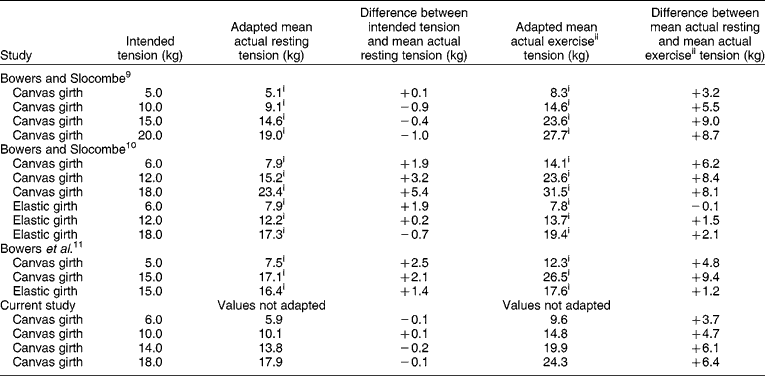
Research into girth tension is limited, and average girth tension applied in racing stables was 13.4 kgReference Bowers and Slocombe1, yet girth tensions of 10 kg or more adversely affect the performance of racehorses, expressed as decreased run time to fatigueReference Bowers and Slocombe9. Types of girth also influence performance, elasticated girths producing better run times to fatigue than standard canvas girthsReference Bowers and Slocombe10. The thorax is restricted by a tight girth; however, respiratory air flow does not seem to be compromisedReference Bowers, Slocombe, Sides, Bayly and Kingston11, Reference Hoffman, Swanson, Bruns, Kuehn and Bedenice12. These studies have provided valuable information relating to girth tensions; however, the actual recorded girth tensions applied at end exhalation when standing vary from the tension to which the girth was intended to be tightened at rest, while standing (Table 1), possibly as a result of gaps between one hole and another in the girth straps on the saddle, which make it difficult to apply the girth tension intendedReference Bowers and Slocombe9–Reference Bowers, Slocombe, Sides, Bayly and Kingston11.
Comparison of intended tensions and adapted mean actual tensions from this study and three other studies
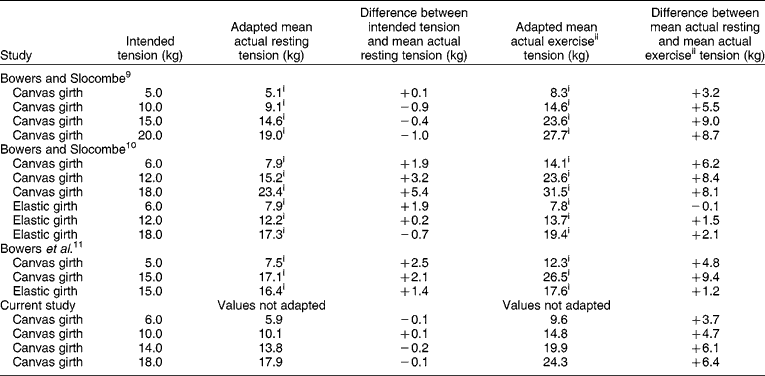
i Adapted values obtained by averaging peak inhalation and minimum exhalation tensions from each study.
ii Exercise protocols varied between studies: exercise at 2.4 and 5 m s− 1, then 80% HRmaxReference Bowers and Slocombe9, Reference Bowers and Slocombe10; exercise at 40 and 110 VO2maxReference Bowers, Slocombe, Sides, Bayly and Kingston11; in this study canter data averaged 5.2 m s− 1.
Variations in recorded girth tensions have also been found with respiration and exerciseReference Bowers and Slocombe9–Reference Bowers, Slocombe, Sides, Bayly and Kingston11; this was evident by larger tensions recorded at end inhalation during exercise than at end inhalation at restReference Bowers and Slocombe9, Reference Bowers, Slocombe, Sides, Bayly and Kingston11 (Table 1), which could be due to thoracic circumference variation as a result of respirationReference Bowers, Slocombe, Sides, Bayly and Kingston11, Reference Marlin, Schroter, Cashman, Deaton, Poole and Kindig13, breath holdingReference Bowers and Slocombe9, muscular contraction and consequent thickening of muscles during forelimb retraction, and speed and gaitReference Colborne, Allen, Wilson, Marlin and Franklin14. Changes in total thoracic dimensions were reported from pre-exercise standing (3 cm), walk (2 cm), trot (3.5 cm), canter and gallop (5 cm) and post-exercise standing (6–7 cm)Reference Colborne, Allen, Wilson, Marlin and Franklin14. Interestingly, in an unpublished girth pressure study, the overall average total force increased 18.17 N from walk to trot and increased 39.96 N from trot to canter, resulting in pressure increases of 0.10 and 0.51 kPA, respectivelyReference White15. Similarly, pressure distribution under a saddle increased with each gait with increasing speedReference Fruehwirth, Peham, Scheidl and Schobesberger16. Changes such as these could result in variations from the original intended girth tensions during locomotion. This study was undertaken to determine the variability of the actual live recorded girth tension at rest and during walk, trot and canter (actual tension) from the original tension to which the girth was intended to be tightened at rest (intended tension).
Materials and methods
The proposal for this study was approved by the Moulton College Ethics Committee (Moulton College, Northampton, UK).
Sample population
A total of 19 clinically sound Hanoverian horses (14 mares, 3 geldings and 2 stallions) aged 8 ± 3 years (mean ± SD); height 164 ± 6 cm and bodyweight 498 ± 53 kg were selected from a Hanoverian breeding and competition yard (Parkland Stud, Middleton, Staffs, UK) based on their ability to be lunged in walk, trot and canter for up to 30 min day− 1, as determined during the 3-week preparation period.
Girth tension equipment
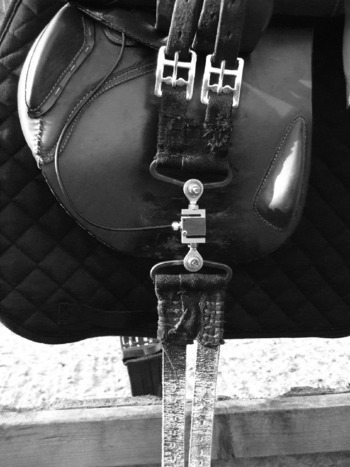
Actual girth tension was continually recorded using a calibrated in-line load cell, transmitter and receiver (Applied Measurements Ltd, Aldermaston, Berkshire, UK). The manufacturers of the load cell recommend its use for a range up to 50 kg, although the load cell would record data from − 75 to +75 kg. The load cell was positioned under the saddle flap on the left side (near side) of the horse (Fig. 1), and it had a wire connection to the transmitter positioned on top of the saddle. Data were remotely transmitted to a telemetry receiver, which was plugged into a Fujitsu Siemens laptop to give a continuous real-time live reading of the actual girth tension. The load cell can record at 200 Hz, providing 200 readings on the data log on the laptop per second; however, a pilot study revealed that this provided a vast amount of data, and the data obtained were not significantly different (P>0.05) from the data obtained with a slower sampling frequency of 1 reading s− 1 (1 Hz); therefore, for the purposes of this study, the load cell was set to record the actual live tension reading once per second to aid data analysis. Tension data were logged from the time the saddle was applied to the horse until it was removed; however, the data used for this study were 1 reading s− 1 for 60 s while at rest, and during each gait, on each rein, as per the exercise protocol (Table 2). The 60 readings min− 1 were averaged to obtain the mean girth tension for each gait, for each individual horse. The mean data of all horses were then pooled collectively to obtain overall mean girth tensions.
In-line load cell with wire connection to transmitter fitted to the left side of the saddle (Wright, 2009)

Exercise protocol for warm-up and experimental condition

During warm-up, this protocol was followed; however, no data were collected. The preparation period was the time taken to calibrate and apply equipment to the warmed-up horse in preparation for the experimental condition.
The load cell was calibrated at manufacture and then calibrated against known weights and an Ultimate Electronic Digital Scale (Ultimate Angling Ltd, Lincoln, Lincolnshire, UK) during the preparation period between each horse. To reduce torsional forces, the load cell was connected with rod end bearings and was pre-tested with known weights at angles between 5 and 45° (5° increments); torsional forces did not seem to affect the load cell readings. On the right side (off side) of the horse, a sliding buckle was applied to counteract the unevenness of girth strap holes, and a cam buckle was attached to allow minute adjustments in order to obtain an actual girth tension reading as close to the intended girth tension as possible while at rest, and to equalize the weight and length of the in-line load cell that was on the left side.
Experimental design
The study was carried out at Parkland Stud, Wood Farm, Coppice Lane, Middleton, Staffs, B78 2BT, UK, in an all-weather outdoor arena. Wooden jumping poles were raised on Polepods® (Whitakers Equestrian Services, Aylesbury, UK) to deter the horses from cutting in on the circle; these set the internal perimeter of two 20 m circles, one in the warm-up area and the other in the experimental condition area (either end of the arena).
A 3-week pilot study was used to determine horses' suitability for being lunged (each horse lunged once) and to test equipment and protocols, and the horses were not exposed to any of the tension equipment during this period. During the data collection period (5 days), the horses maintained their usual daily routine, and for five consecutive days each horse was lunged on a 20 m circle in walk, trot and canter on both reins (Table 2). The order the horses came out, the first rein the horse went on, and the nominal tensions were randomized.
Protocol
All the horses were exposed to the same exercise protocol (Table 2). The horse was warmed up using a Cottage Craft lunge cavesson (Matchmakers International Limited, Bradford, UK) and brushing boots. Following warm-up, the horse was taken to the experimental condition area and tacked up. When intended tensions 6, 10, 14 and 18 kg were applied, an English General Purpose Saddle with a Deluxe Cotton Saddlecloth (Matchmakers International Limited) was positioned above the midline of the horse in a standard manner. The girth tension equipment was activated to log data, and the load cell, transmitter and cam buckle were applied to the saddle, and the parallel airflow girth (Matchmakers International Limited) was then fastened. The saddle was assessed by a qualified saddle fitter prior to the trial commencing and was deemed to be of a suitable fit for all horses for the purpose of lungeing. A period of 3 min was allowed for numnah compression and saddle and girth settlement. Within this time, the horse walked for 1 min, and then the girth tension was re-evaluated and adjusted if necessary until the required intended tension was obtained, at end exhalation. Actual girth tension was recorded for 1 min at rest (while standing) prior to exercise commencing. The lunger was blind to the tensions applied to the horse. A stopwatch was used to coordinate the exercise protocol (Table 2), and the researcher manually recorded the time for each change in gait.
Statistical analysis
Individual data were tested for normality using the Anderson–Darling test, and data were normally distributed. Data were analysed using analysis of variance of repeated measures and Tukey's post hoc test. Further analysis was carried out using a paired t-test. A P-value of < 0.05 was considered statistically significant in all statistical tests. Analyses of data were carried out using the statistical software package Minitab (Minitab Ltd, Coventry, UK).
Results
Nominal and applied girth tension
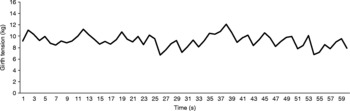
Mean actual girth tensions while standing at rest were not significantly different to the intended girth tensions, with only small variations of − 0.1, 0.1, − 0.2 and − 0.1 kg for intended tensions 6, 10, 14 and 18 kg, respectively (Table 3). Individual horse tension readings were not static but fluctuated (Fig. 2), although there were no obvious inter-individual variations.
Intended and actual girth tensions at rest while standing, and during walk, trot and canter (mean±SD of both reins)

a,b,c,d,e,f,g,h,i Significant differences in actual tensions between walk, trot and canter at intended tension 6 kg (a P < 0.01; b,c P < 0.001); intended tension 10 kg (d,e P < 0.001); intended tension 14 kg (f,g P < 0.001); intended tension 18 kg (h,i P < 0.001).
Fluctuations in actual girth tension while standing at intended tension 10 kg

Girth tension during exercise
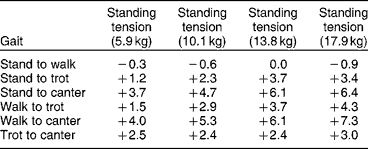
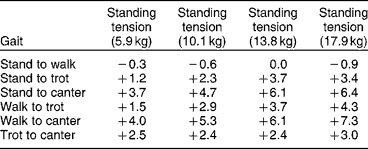
Following an initial trend for mean actual girth tension to decrease from stand to walk, mean actual tensions then increased significantly (P < 0.001) between stand and trot, stand and canter, walk and trot, walk and canter, and trot and canter for all intended tensions except stand to trot for intended tension 6 kg, where the significance level was P < 0.01 (Tables 3 and 4). Therefore, at a given intended tension, the actual tension increased significantly between all gaits except from stand to walk. The differences in actual measured tension between gaits and between all standing tensions tended to decrease (standing to walk only) or increase incrementally (all other gaits), with the exception of standing tension 13.8 kg from stand to walk, stand to trot and trot to canter. Incremental increases between gaits for each tension were also evident, except between walk and trot and between trot and canter, where differences decreased for tensions 10.1, 13.8 and 17.9 kg (Tables 1 and 4).
Differences in actual girth tension between different gaits at varying standing tensions (mean of both reins)
Girth tension differences between left and right rein
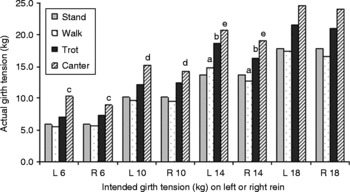
Actual girth tension was significantly higher on the left rein than on the right rein during walk at intended tension 14 kg (14.8 and 12.7 kg, respectively; P < 0.001), trot at intended tension 14 kg (18.6 and 16.3 kg, respectively; P < 0.01), and canter at intended tension 6 kg (10.2 and 8.9 kg, respectively; P < 0.001), intended tension 10 kg (15.3 and 14.3 kg, respectively; P < 0.05) and intended tension 14 kg (20.7 and 19.0 kg, respectively; P < 0.05). There were no significant differences between the left and right reins for all other actual tension variables; however, there was a trend for actual tensions to be higher on the left rein (Fig. 3).
Girth tensions on the left and right reins at stand, walk, trot and canter. a,b,c,d,e Significant differences in actual girth tensions between the left (L) and right (R) reins at a given intended tension (a,b,c P < 0.001; d,e P < 0.05)

Discussion
Tension measurement
Intended tensions used in this study were inline with intended tensions applied in other studies, within a range up to 22 kgReference Bowers and Slocombe1, Reference Bowers and Slocombe9–Reference Bowers, Slocombe, Sides, Bayly and Kingston11. Mean actual tensions at rest while standing were not significantly different to the intended tensions, with only small variations of 0.1–0.2 kg shown in this study, compared with variations of 0.1–5.4 kg in previous studiesReference Bowers and Slocombe9–Reference Bowers, Slocombe, Sides, Bayly and Kingston11 (Table 1). The larger discrepancy between intended and actual resting tensions in other studies could be due to the gaps between one hole and another on the saddle girth strapsReference Bowers and Slocombe9–Reference Bowers, Slocombe, Sides, Bayly and Kingston11. This study incorporated a cam buckle to counteract this problem, as it allows the handler to make minute adjustments until the actual tension while standing is as close as possible to the intended tension.
Previous methods of measuring girth tensions involved measuring four inspiratory peak tensions and four expiratory minimum tensions to obtain average inspiratory and average expiratory tensions, and therefore girth tension is thought to mirror the respiratory pattern of horsesReference Bowers and Slocombe9–Reference Bowers, Slocombe, Sides, Bayly and Kingston11. The focus of this study was not on respiration, and this method would have been extremely time consuming to produce the same amount of data points as obtained in this study. In addition, the fluctuations shown in the girth tension recordings are not only a result of respiration, in which the chest circumference increases with inspiration and decreases with expiration at restReference Marlin, Schroter, Cashman, Deaton, Poole and Kindig13, but are also a result of any movements the horse makes. It would be difficult to discriminate between tension peaks and troughs relevant to respiration or movement, and therefore actual live tension was recorded every second and averaged to produce a mean tension.
The sampling frequency of the load cell of 1 reading s− 1 could have reduced the range of tensions recorded in this study. A faster sampling frequency could result in higher peaks and lower troughs, and therefore it could be possible that the range of tensions recorded for each individual horse in this study is larger than reported. Faster sampling frequencies were used in a pilot study to determine the implications on actual mean girth tensions, with data recorded at 200 Hz not significantly different from the data obtained with a slower sampling frequency of 1 Hz, although this does not rule out the possibility that using a sampling frequency of 1 Hz may have restricted the range of tensions recorded. There were no observed discrepancies in load cell recordings throughout this study, indicating that the load cell was reading accurately.
Girth tensions during exercise
Following an initial trend for mean actual tension to decrease from standing to walk, mean actual girth tension then increased significantly between all incremental gaits for all intended tensions (Tables 1, 3 and 4). Increased actual girth tensions from standing to exercise have previously been observed ranging from 3.2 to 9.0 kgReference Bowers and Slocombe9, − 0.1 to 8.4 kgReference Bowers and Slocombe10 and 1.2 to 9.4 kgReference Bowers, Slocombe, Sides, Bayly and Kingston11 (Table 1). These studiesReference Bowers and Slocombe9–Reference Bowers, Slocombe, Sides, Bayly and Kingston11 averaged their exercise data rather than them separating into different speeds or gaits, making direct comparisons to this study difficult. The method of averaging girth tension over different speeds could possibly skew the mean results, so may not accurately reflect actual girth tensions, as tension appears to change with gait and speed. Reflecting the pattern of girth tension in this study, thoracic circumference decreased from standing to walk, and increased from walk to trot and from trot to canter in another studyReference Colborne, Allen, Wilson, Marlin and Franklin14. Similarly, mean thoracic circumference above resting circumference for walk, trot, canter and gallop was found in another study of thoracic and abdominal circumference movement during ventilationReference Marlin, Schroter, Cashman, Deaton, Poole and Kindig13.
Although increases in thoracic circumference with inspiration and decreases with expiration have previously been observed, the dimension of the thorax is not entirely reflective of the change in lung volume during exercise, due to mechanisms such as caudal displacement of the diaphragm and the chest being held rigid during canter and gallop by respiratory musclesReference Marlin, Schroter, Cashman, Deaton, Poole and Kindig13. The equine thorax is reported to be fairly stiff and rigidReference Bramble17, with only small increases of 1–2Reference Marlin, Schroter, Cashman, Deaton, Poole and Kindig13 and 2–3 cmReference Colborne, Allen, Wilson, Marlin and Franklin14, Reference Thorpe, Marlin, Franklin and Colborne18 in thoracic circumference being observed.
While it is evident that actual girth tension increases during exercise because actual exercise tensions are higher than actual standing tensions (Tables 1, 3 and 4), it is not clear whether this is a result of respiration alone, or whether locomotory mechanics influence the tensions recorded. Colborne et al. Reference Colborne, Allen, Wilson, Marlin and Franklin14 suggest that contraction and subsequent thickening of the latissimus dorsi and the serratus ventralis during limb retraction may have caused some of the observed increases in thoracic circumference.
During walk and trot, there are no constant-phase relationships between respiration and locomotion, because as one forelimb is protracting the other is retracting resulting in minimal back flexion and extension, and therefore respiration is not forcedReference Attenburrow19, Reference Attenburrow, Snow, Persson and Rose20. With this in mind, back flexion and extension could be a reason for the highest actual girth tensions occurring during canter, and lower actual girth tensions during walk and trot, when back flexion and extension are not as obvious.
Interestingly, when measuring pressure under the saddleReference Fruehwirth, Peham, Scheidl and Schobesberger16 and girthReference White15, overall force increased from walk to trot, and from trot to canter, and this was reported to be due to either increased activation of more senselsReference White15 or vertical acceleration of the saddle during motion, showing an up-and-down motionReference Fruehwirth, Peham, Scheidl and Schobesberger16. It is possible for this up-and-down motion of the saddle to cause an impact on actual girth tension readings. The regular peaks and troughs observed in the actual girth tension readings (Fig. 2) are reported to be inspiratory peaks and expiratory minimum valuesReference Bowers and Slocombe9–Reference Bowers, Slocombe, Sides, Bayly and Kingston11; however, the vertical acceleration of the saddle during motion could add to or interfere with the tension values, and so may not be directly related to respiration, an interesting area for further study. With the finding that actual girth tension increases during exercise in this study, it seems more likely that the increases in force observed by Fruehwirth et al. Reference Fruehwirth, Peham, Scheidl and Schobesberger16, and WhiteReference White15 were actually increases in pressure as the horse's thorax pushes against the saddle and girth or the saddle and girth push against the thorax, rather than activation of more sensels. Further investigation is needed to study the effects of different girth tensions on the pressures exerted by the girth and saddle, and to determine optimal application for the benefit of the horse.
An interesting area for further research is the reasoning behind the trend of incremental increases in the differences in actual girth tension between different gaits and different tensions, as observed in this study (Tables 1 and 4). It is possible that the horse is pushing the thoracic wall outwards (similar to blowing out) against the tighter tensions.
Blowing out (breath holding) upon application of the girth has previously been observedReference Bowers and Slocombe9, Reference Bowers and Slocombe10, and this may be a reason for the decrease in actual girth tension from standing to walk. Upon walking, the requirement for movement and ventilation could override the blowing out mechanism, resulting in decreased thorax dimensions and ultimately lower tension recordings, although this is purely supposition. A period of 3 min was allowed for numnah compression and saddle and girth settlement, and the horse walked for 1 min prior to standing tension being recorded, so it would be unlikely that blowing out occurred during the recorded standing phase.
Tension differences between left and right rein
Actual girth tension was generally higher (tighter) on the left rein than on the right rein (Fig. 3). Actual standing tensions used in this study were the same for both the left and right reins, as the girth was not readjusted between exercise on both reins; consequently, the possibility of the left rein actual tension being tighter prior to exercise was ruled out. The rein that each horse worked on first was randomized to account for learning effect, fatigue, effect of progressing exercise and disruption to the ground surface.
The load cell was located on the left side of the horse, and this may have resulted in more interference from the horse when on the left rein due to left bend and possible movement of the girth and saddle during ipsilateral forelimb retraction, possibly causing torsional forces, although the tension data did not show any obvious signs of interruption or interference when examined more closely, and the load cell was previously tested for torsional forces. Further trials could randomize the side of the horse on which the load cell is located, although this would double the trial duration as all tensions would need to be measured with the load cell on both sides.
Lateralized preferences have been observed in horsesReference Murphy, Sutherland and Arking21–Reference Crawford and Leach24, and there is a trend for the horse to place larger loads on the left forelimb than on the right forelimb, although this was thought to be due to uneven rider weight distribution or uneven musculature of the horseReference Fruehwirth, Peham, Scheidl and Schobesberger16. Thoracic hemi-diameter is larger on the side of the trailing forelimb during canter; however, this is offset by the decreased hemi-diameter of the leading forelimb, resulting in an overall thoracic diameter that is smaller than that measured on the side of the trailing forelimbReference Colborne, Allen, Wilson, Marlin and Franklin14. Therefore, on the left rein, the thorax bulges out laterally to the right and the left side decreases, and vice versa for the right rein. Another factor that may account for the asymmetries reportedReference Colborne, Allen, Wilson, Marlin and Franklin14 is the location of the heart, which is offset to the left. During left rein locomotion, the presence of the heart may impede thoracic compression compared with that of the right rein. The implication this may have on evenness of girth tension on either rein is unknown and requires further investigation. Colborne et al. Reference Colborne, Allen, Wilson, Marlin and Franklin14 had a small sample size (n = 2), and there seemed to be large differences between each horse, Horse 2 had significantly more right side rib motion in trot, whereas horse 1 rib motion was symmetrical. Horse 2 also had smaller standing thoracic diameter values than horse 1. Both horses ran on a treadmill, and therefore did not perform on left or right reins. It is unclear whether the asymmetry observed during trot in horse 2 (larger right side) was due to head position while on the treadmill or due to other undisclosed factors; more research with larger sample sizes will reinforce the important work of this study.
Mares have a preference for right-sided responses, whereas males preferred leftReference Murphy, Sutherland and Arking21. The preference of females being more right lateralized and males more left lateralized is thought to be due to differences in the brainReference Witelson25, although the exact differences are not completely clear. The horses in this study were not separated for gender difference due to the unequal numbers: there were 14 mares, 3 geldings and 2 stallions. Therefore, the dataset as a whole was predominantly mares, which have a preference for right-sided responsesReference Murphy, Sutherland and Arking21; however, how this relates to higher girth tensions on the left rein needs further investigation.
The lunger was blind to the tensions applied, and may have a tendency to be lateralized themselves. It is necessary that the impact of this and the increased girth tensions on the left rein receive further investigation.
Asymmetries have been found between left and right limbs in 8-month-old untrained Standardbreds, suggesting congenital sidedness, and when some of these horses were trained 18 months later the asymmetries were more pronounced in the trained horses, but not in the untrained horsesReference Drevemo, Fredricson, Hjerten and McMiken23. The horses used in this study were trained Hanoverian performance horses with a mean age of 8 years and were schooled at various levels of Dressage and Showjumping, and therefore the differences between the left and right rein observed in this study may be due to training effects. All the horses used in this study are usually lead from the left, which is routine practiceReference Klimke26; however, leading should occur from both sides in an attempt to balance lateralnessReference Murphy, Sutherland and Arking21. Exercise on the left and right reins in this study was randomized, and therefore learning effect, fatigue or effect of progressing exercise should not affect girth tension parameters.
Conclusion
Actual girth tension varies from the intended girth tension while standing and during locomotion. It is possible to obtain actual standing tensions closer to intended tensions with the application of a cam buckle, resulting in more accurate applied tensions. The tension of the girth varies during locomotion, generally decreasing from standing to walk, and then increasing from walk to trot and increasing further from trot to canter. The thorax is a dynamic structure, and girth tension variation could be due to multiple factors such as respiration, breath holding, muscular contraction, speed, gait and vertical acceleration of the saddle. There were differences between the left and right reins, in that girth tension was higher on the left rein. This may be a result of sidedness in the horse, lunger influence or load cell location. Girth tension is a relatively new area of research, and there are many opportunities for further research, such as the mechanisms behind the increases in tension during exercise and the incremental increases from standing tensions, whether peaks and troughs in tension readings relate to the vertical motion of the saddle or respiration, effects of girth tensions on the pressures exerted by the girth and saddle, and more detailed research on girth tension on different reins. Further research should focus on reporting actual tensions rather than intended tensions, for more realistic and accurate comparisons and conclusions.
Acknowledgements
I thank Parkland Stud for the use of their horses and facilities, and Matchmakers International Limited for providing the Cottage Craft equipment. Also, thanks go to all who contributed their time and effort in the project, specifically Stuart Booth, Deborah Hancox, Alison Reddy, Polena Grzyb and Jaime Bird.