


Introduction
A commonly-used method for gathering anxiety ratings within exposure sessions is the Subjective Units of Distress/Disturbance Scale (SUDS). SUDS ratings require both child and adult clients to indicate their level of anxiety on a scale ranging from “no distress” to “extreme distress”. A visual analogue scale, such as the “feelings thermometer”, can facilitate the explanation of the SUDS rating system for youth (see Kendall et al., Reference Kendall, Robin, Hedtke, Suveg, Flannery-Schroeder and Gosch2005). Additionally, the use of a small range (e.g. 0 to 8) with personalized anchors (e.g. “not at all scary” for 0 and “the scariest” for 8) for children is encouraged to simplify the rating system and ease decision making. SUDS ratings are often used in cognitive-behavioral therapy (CBT) for anxiety as part of an exposure task – when the youth faces a feared situation while using anxiety management skills (e.g. problem solving, coping self-talk, challenging anxious cognitions). During such a task, SUDS data are obtained at baseline, at intervals during the exposure task, and following completion of the exposure task.
A goal of one version of CBT for child anxiety, the Coping Cat Program (Kendall and Hedtke, Reference Kendall and Hedtke2006), is for the child to remain in the context of the feared situation until a reasonable level of comfort is achieved (often measured practically by a 50% reduction in SUDS). This reduction can occur within a single exposure task or with repetition (across several exposure tasks). Once this level of comfort is achieved, the therapist moves on to a more difficult exposure task in a hierarchal fashion. Early efforts and exposure tasks are designed to elicit low levels of anxiety in order to bolster the child's confidence and sense of mastery.
Although the use of SUDS is often recommended in CBT for youth (e.g. Kendall and Hedtke, Reference Kendall and Hedtke2006), research on its utility with children is sparse. The only study examining patterns of SUDS with children examined parental involvement in the treatment of four children with obsessive-compulsive disorder (OCD; Knox, Albano and Barlow, Reference Knox, Albano and Barlow1996). They found that youth experienced between-session habituation, and between-session habituation was not associated with lower posttreatment anxiety ratings.
The present study examined (a) the pattern of SUDS across exposure sessions (i.e. between-sessions) and (b) predictors of SUDS in anxiety-disordered youth treated with CBT. In regard to the pattern of SUDS between-sessions, we hypothesized that mean highest SUDS and change in SUDS would increase, consistent with the manual-based recommendations of a graded hierarchy for exposure tasks in anxiety-disordered youth described earlier. We also examined SUDS data in relation to participant variables (e.g. age, gender) and specific principal diagnoses. Given the limited research on SUDS in youth, analyses examining SUDS data in relation to participant variables are exploratory.
Method
Participants
Participants were 99 youth (aged 7–14, M = 10.39; 42% female; 86.9% Caucasian) who received manual-based individual (ICBT) or family cognitive-behavioral therapy (FCBT) as part of an Institutional Review Board approved randomized clinical trial (RCT; see Kendall, Hudson, Gosch, Flannery-Schroeder and Suveg, Reference Kendall, Robin, Hedtke, Suveg, Flannery-Schroeder and Gosch2008 for more details on participants, procedures, and outcomes). All participants had a principal diagnosis of social phobia (SP; n = 28), generalized anxiety disorder (GAD; n = 47), or separation anxiety disorder (SAD; n = 24) at pretreatment. The larger RCT, within which these data were collected, examined the relative efficacy of ICBT, FCBT, and a family-based education/support/attention (FESA) active control for treating anxiety-disordered youth. Reported outcome analyses demonstrated that FCBT and ICBT were significantly superior to FESA in reducing the presence of the principal anxiety disorder and in reducing the principality of the primary anxiety disorder in the child's diagnostic profile (see Kendall et al., Reference Kendall, Hudson, Gosch, Flannery-Schroeder and Suveg2008).
Procedure
Youth were treated with the Coping Cat Program, a 16-session version of CBT for anxious youth (Kendall and Hedtke, Reference Kendall and Hedtke2006). The last eight sessions focused on exposing the child to anxiety provoking situations while using skills learned in the first eight sessions. The Coping Cat Program follows a model of gradual exposure in which the child progresses through a graded hierarchy of anxiety provoking situations. By the end of treatment, the youth will have completed low, medium, and highly rated anxiety-provoking situations in a graduated fashion (i.e. beginning with low rated situations and proceeding to high rated situations). See Kendall et al. (Reference Kendall, Robin, Hedtke, Suveg, Flannery-Schroeder and Gosch2005) for more information regarding conducting exposures within the context of the Coping Cat Program.
Measures
Diagnoses were determined using the Anxiety Disorders Interview Schedule for Children (ADIS-C/P; Silverman and Albano, Reference Silverman and Albano1997), a semi-structured interview administered separately to parents and children. Diagnosticians provided a Clinical Severity Rating (CSR) on a 9-point scale (0–8) with a minimum rating of 4 required for a clinical diagnosis. The ADIS-C/P has demonstrated favorable psychometric properties, including retest reliability (Silverman, Saavedra and Pina, Reference Silverman, Saavedra and Pina2001), convergent validity (Wood, Piacentini, Bergman, McCracken and Barrios, Reference Wood, Piacentini, Bergman, McCracken and Barrios2002), and inter-rater reliability (Rapee, Barrett, Dadds and Evans, Reference Rapee, Barrett, Dadds and Evans1994). Diagnosticians also rated the child's level of global functioning using the Children's Global Assessment Scale (CGAS; Shaffer et al., Reference Shaffer, Gould, Brasic, Ambrosini, Fisher, Bird and Aluwahlia1983), a 1–100 scale with anchor points and behavioral descriptions. Diagnostic training followed recommended guidelines. Experienced diagnosticians were trainers: they observed practice administrations among trainees and with actual clients, provided feedback and supervision on the practice interviews, and conducted reliability assessments. Trainees were required to reach interrater reliability of 0.85 (Cohen's Kappa) or above. Ongoing diagnostic reliability checks were conducted by the head diagnostic interviewer by examining randomly selected diagnostic interviews. A random reliability check during the study indicated that all diagnosticians maintained their initial reliability (i.e. kappa ≥.85). Children provided self-report ratings of their anxiety using the Multidimensional Anxiety Scale for Children (MASC; March, Parker, Sullivan, Stallings and Conners, Reference March, Parker, Sullivan, Stallings and Conners1997), a 39-item inventory.
SUDS were provided by the child using a 0–8 scale (0 = no anxiety; 8 = maximum anxiety). SUDS were gathered at each session before the exposure task, every 2 minutes during the exposure task, and at post-exposure. Three scores were calculated based on the SUDS for the first exposure task in each of the exposure sessions: (a) the peak (i.e. highest) SUDS score; (b) the lowest SUDS score (calculated for the purpose of computing a change in SUDS score); and (c) a change in SUDS score (computed by subtracting the lowest SUDS from the peak SUDS). SUDS scores were converted to z-scores prior to data analyses. For most children, the peak SUDS occurred prior to the lowest SUDS; however, there was some variability (e.g. a child could experience multiple peaks during an exposure).
Data analytic strategy
Analyses were conducted using hierarchical linear modeling (HLM) to account for the nested nature of the observations within participants and the missing data at some exposure sessions. Hierarchical linear models with fixed effects for exposure session and child characteristics (age, sex, clinical severity rating of the principal anxiety disorder, level of global functioning, self-reported pretreatment total MASC score, and principal anxiety disorder) were fitted to the peak SUDS per session as well as the change in SUDS for each session in order to examine the pattern of SUDS across sessions and the child characteristics that may predict this pattern.
Analyses were conducted using a random slope model of the form:
Level 1:

Level 2:


Session represents the effect of increasing treatment sessions, AGE, SEX, CSR, CGAS, and MASC represent the child's age, sex, clinical severity rating of the principal anxiety disorder, level of global functioning, and self-report of anxiety symptoms respectively, and GAD and SAD are indicator variables for the presence of GAD, SAD or SP as the principal anxiety disorder. The Level 1 equation models the within-subject effect of increasing treatment sessions on the peak SUDS ratings (or change in SUDS) for each participant. The Level 2 equations model the between-subject moderating effects of the child characteristics on the Level 1 relationships. In the first Level 2 equation, β01, β02, β03, β04, β05, β06, and β07 are cross-level interaction terms that represent the effects of the child characteristic predictors on the SUDS intercept (in this case, peak SUDS within the first exposure session). In the second Level 2 equation, β11, β12, β13, β14, β15, β16, β17, are cross-level interaction terms that represent the moderating effects of the child characteristic predictors on the slope of the relationship between the session variable and the peak SUDS rating (or change in SUDS).
Results
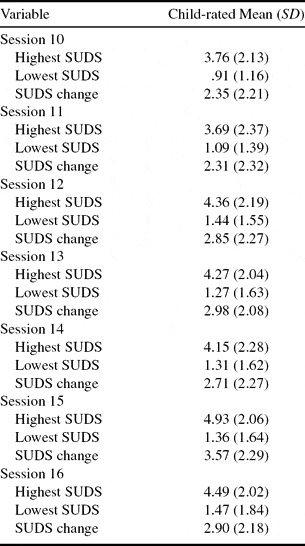
For all sessions, the mean peak level of anxiety scores, the mean lowest level of anxiety scores, and the mean change of anxiety scores (i.e. high anxiety score minus low anxiety score) were computed (see Table 1).
Child-rated highest SUDS, lowest SUDS, and change in SUDS for sessions 10 through 16

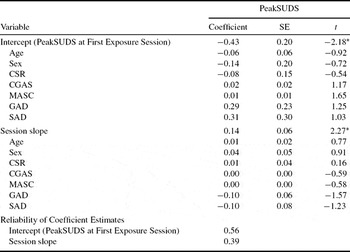
Analyses revealed a significant main effect of Session on peak SUDS (t (91) = 2.27, p < .05), such that with each increasing exposure session, youth's peak SUDS increased. There were no significant main effects of child characteristics on peak SUDS, suggesting that youth's peak SUDS within the first exposure session does not differ based on age, sex, disorder severity, level of functioning, pretreatment total MASC score, or principal anxiety disorder. There were no significant effects of child characteristics on the slope of peak SUDS between-session, suggesting that the pattern of youth's peak SUDS across exposure sessions is not moderated by age, sex, disorder severity, level of functioning, pretreatment total MASC score, or principal anxiety disorder (see Table 2).
Effect of child characteristics on peak SUDS

Note. CSR = Clinical Severity Rating; CGAS = Children's Global Assessment Scale;
MASC = Multidimensional Anxiety Scale for Children; GAD = generalized anxiety disorder;
SAD = separation anxiety disorder; PeakSUDS was z-scored.
*p < .05. † p < .10
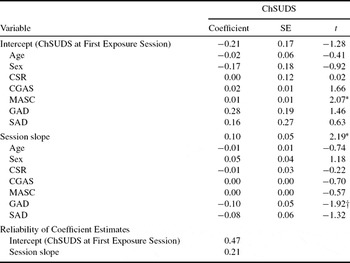
Analyses revealed a significant main effect of Session on change in SUDS (t (91) = 2.19, p < .05), such that with each increasing exposure session youth reported greater change in SUDS. Analyses revealed a significant main effect of pretreatment total MASC score on change in SUDS within the first exposure session (t (91) = 2.07, p < .05), such that youth with higher total scores on the MASC at pretreatment experienced greater change in SUDS within the first exposure session. None of the other child characteristics predicted change in SUDS within the first exposure session. Analyses revealed that a principal diagnosis of GAD marginally moderated the effect of session on change in SUDS (t (91) = -1.92, p < .10), such that youth with primary GAD experienced less change in SUDS across exposure sessions than youth with primary SAD or SP. None of the other child characteristics moderated the effect of session on change in SUDS (see Table 3).
Effect of child characteristics on change in SUDS

Note. CSR = Clinical Severity Rating; CGAS = Children's Global Assessment Scale;
MASC = Multidimensional Anxiety Scale for Children; GAD = generalized anxiety disorder;
SAD = separation anxiety disorder; ChSUDS = change in SUDS. ChSUDS was z-scored.
*p < .05. † p <.10
Discussion
The present results indicate that children's peak SUDS and magnitude of change in SUDS significantly increased between-session, contrary to the findings of Knox et al. (Reference Knox, Albano and Barlow1996). However, this pattern is consistent with our hypotheses and the manual-based treatment recommendation that exposures progress through a fear hierarchy of increasingly anxiety-provoking tasks (e.g. Kendall and Hedtke, Reference Kendall and Hedtke2006). Results also suggest that, on average, SUDS were halved over the course of the exposure within-session, also consistent with the manual recommendation (i.e. to remain in feared situation until SUDS decrease approximately 50%) and clinical lore. Given the previously reported beneficial gains of treatment (Kendall et al, Reference Kendall, Hudson, Gosch, Flannery-Schroeder and Suveg2008), the present results suggest that therapists and researchers gather SUDS and strive for halving them via exposure tasks.
Youth with higher total MASC scores at pretreatment reported greater change in SUDS within the first exposure session. This suggests that higher child reported pretreatment anxiety symptoms are associated with increased first exposure within-session habituation. It is possible that youth who report more severe anxiety are more motivated for or amenable to exposure therapy. Youth with principal GAD experienced less increase in the magnitude of between-session change in SUDS. This may be a reflection of the different types of exposures used in treating anxious youth (i.e. in-vivo and imaginal). GAD youth may require more imaginal exposure work because of the abstract nature of common GAD worries (e.g. worry about natural disasters), which may elicit less between-session habituation than in-vivo exposures. Future research would benefit from looking at patterns and predictors of SUDS in imaginal versus in-vivo exposures. Child age, sex, level of functioning, and diagnostic severity did not predict SUDS patterns, suggesting youth experience the recommended change in SUDS within- and between-session regardless of these factors. It should be noted that the change in SUDS was rather low for some sessions, and this may have limited our ability to find significant results regarding child characteristics.
Several potential limitations exist: participants were primarily Caucasian and moderate to high SES; participants with primary anxiety disorders other than GAD, SAD, and SP were excluded; and SUDS ratings were self-reported (therapist SUDS were available but excluded as therapists were not blind to the child's SUDS). Variations in exposure tasks (e.g. length of exposure task, relational factors) were not examined in the present study. Previous research suggests that, with the exception of children's use of safety-seeking behavior, variations in child behavior and most characteristics of exposure tasks (e.g. length of exposure task) are not related to outcomes for anxious youth (see Hedtke, Kendall and Tiwari, Reference Hedtke, Kendall and Tiwari2009; Tiwari and Kendall, in preparation). As SUDS have been scantly researched with youth, data on their psychometric properties remain unknown. Our results provide important preliminary data on patterns and predictors of SUDS in youth.
Acknowledgements
Philip C. Kendall is a co-author of the treatment materials and receives royalties from their sales. This research was supported by National Institute of Mental Health Grant MH 59087 awarded to Philip C. Kendall.



Comments
No Comments have been published for this article.