INTRODUCTION
The consequences of habitat degradation (sensu Haila Reference HAILA2002) on biodiversity are well-researched (reviewed in Debinski & Holt Reference DEBINSKI and HOLT2000, Fahrig Reference FAHRIG2003, Turner Reference TURNER1996) but relatively little is known about its influence on interspecific relationships (Maldonado-Coelho & Marini Reference MALDONADO-COELHO and MARINI2004). Such information is important because subtle changes in interactions between species could have cascading effects on entire communities (Terborgh et al. Reference TERBORGH, LOPEZ, NUÑEZ, RAO, SHAHABUDDIN, ORIHUELA, RIVEROS, ASCANIO, ADLER, LAMBERT and BALBAS2001). Mixed-species bird flocks (flocks hereafter) are associations of different species which form for foraging or anti-predatory benefits (Morse Reference MORSE1977). Flocks reach their highest complexity in tropical rain forests (Terborgh Reference TERBORGH1990). Studies, mainly from the Neotropics, have shown that rain-forest flocks occur year-round, have large number of participating species, maintain flock territories jointly and include obligate flock participants (Develey & Peres Reference DEVELEY and PERES2000, Jullien & Thiollay Reference JULLIEN and THIOLLAY1998, Munn & Terborgh Reference MUNN and TERBORGH1979, Powell Reference POWELL1979, Terborgh Reference TERBORGH1990). Flocking could also be a driver of life history traits of rain-forest birds such as high adult survival and low fecundity (Jullien & Clobert Reference JULLIEN and CLOBERT2000) and for the high diversity of rain-forest avifaunas (Powell Reference POWELL1989). Given their significant role in rain-forest bird communities, it is important to understand how flocks are affected by degradation of rain forests occurring worldwide (Achard et al. Reference ACHARD, EVA, STIBIG, MAYAUX, GALLEGO, RICHARDS and MALINGREAU2002).
Habitat degradation affects flocks through two mechanisms: (1) changes in abundance and presence of species which participate in flocks (Thiollay Reference THIOLLAY1997, Reference THIOLLAY1999a; Van Houtan et al. Reference VAN HOUTAN, PIMM, BIERREGAARD, LOVEJOY and STOUFFER2006); (2) changes in propensities of species to flock (Thiollay Reference THIOLLAY1999b). These mechanisms could also interact to cause feedback effects. For example, absence of flocks in an area, could lead to the extinction of obligate flock participants (Jullien & Thiollay Reference JULLIEN and THIOLLAY1998, Munn & Terborgh Reference MUNN and TERBORGH1979). Instead, absence of a species important for flock formation or maintenance (nuclear species sensu Moynihan Reference MOYNIHAN1962) might prevent other species from flocking (Lovejoy et al. Reference LOVEJOY, BIERREGAARD, RYLANDS, MALCOLM, QUINTELA, HARPER, BROWN, POWELL, POWELL, SCHUBART, HAYS and Soulé1986, Maldonado-Coelho & Marini Reference MALDONADO-COELHO and MARINI2004, Stouffer & Bierregaard Reference STOUFFER and BIERREGAARD1995).
Studies so far have failed to distinguish between these different routes through which flocks change following habitat degradation (Fernández-Juricic Reference FERNÁNDEZ–JURICIC2000, Kotagama & Goodale Reference KOTAGAMA and GOODALE2004, Lee et al. Reference LEE, SOH, SODHI, KOH and LIM2005, Maldonado-Coelho & Marini Reference MALDONADO-COELHO and MARINI2000, Tellería et al. Reference TELLERÍA, VIRGÓS, CARBONELL, PÉREZ-TRIS and SANTOS2001, but see Maldonado-Coelho & Marini Reference MALDONADO-COELHO and MARINI2004). In this study, we attempt to do so for flocks in rain-forest fragments which vary in area, habitat structure and bird community composition. The mechanisms described ultimately alter flock variables such as richness, size, composition, and encounter rate. We therefore use these variables to characterize flocks in rain-forest fragments. We predict that, if habitat degradation affects flocks mainly through changes in abundance and persistence of flock participants, then flock variables should be strongly related to bird community composition variables. On the other hand, if habitat degradation affects flocks through changes in propensity of species to flock, then flock variables will be strongly related to patch characteristics such as area and habitat structure. For example, habitat disturbance might lead to a reduction in canopy cover, improve the detectability of predators by birds, and therefore reduce propensity of species to flock (Thiollay Reference THIOLLAY1999b). Before examining flock responses, we first evaluate how the potential determinants of flock variables (area, habitat structure and bird community composition) have responded to habitat degradation.
Compared with the Neotropics, little information is available on the response of old world mixed-species bird flocks to habitat disturbance (Kotagama & Goodale Reference KOTAGAMA and GOODALE2004, Lee et al. Reference LEE, SOH, SODHI, KOH and LIM2005). One such palaeotropical forest landscape that has undergone rapid change is the Western Ghats in India. This chain of mountains along the west coast of India is recognized as a global biodiversity hotspot (Myers et al. Reference MYERS, MITTERMEIER, MITTERMEIER, DA FONSECA and KENT2000) and an endemic bird area (Stattersfield et al. Reference STATTERSFIELD, CROSBY, LONG and WEGE1998). The tropical rain forests of the Western Ghats are home to 14 of 16 endemic bird species found in the Western Ghats. Deforestation and habitat conversion in the past has resulted in a major portion of this rain forest surviving today as fragments in a matrix of plantations of coffee, tea and Eucalpytus, human habitation, reservoirs and other forms of development (Nair Reference NAIR1991). Earlier studies have shown that many rain-forest bird species including all endemics persist in such rain-forest fragments (Raman Reference RAMAN2001). This study was conducted in one such fragmented rain-forest landscape in the Anamalai hills in the Western Ghats.
STUDY AREA
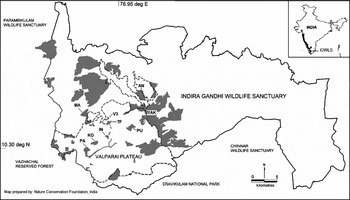
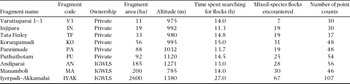
The Indira Gandhi Wildlife Sanctuary (IGWLS, 10°12′N–10°35′N, 76°49′E–77°24′E) and adjoining Valparai Plateau area in the Anamalai Hills, Western Ghats, India constituted the study area (Figure 1). Rain forests of the Cullenia–Mesua–Palaquium type (Pascal Reference PASCAL1988), in which this study was conducted, are found in relatively large patches in the western portion of IGWLS and in fragments within a matrix of privately owned plantations of tea, coffee and Eucalpytus on the Valparai plateau (Figure 1). The study area receives approximately 3500 mm of rain annually, distributed over two monsoons between June–September and October–December. The period between January–May is relatively dry. This study was conducted between December 2004 and April 2005 when most resident birds breed and migrant richness and abundance is at its peak. Nine rain-forest fragments, three within IGWLS and six on private land of the Valparai Plateau, were chosen for the study (Table 1). The number of fragments represented a compromise between adequately representing the range in fragment areas available (0.1–2600 ha) and allowing repeated sampling of each fragment to record sufficient number of flocks. IGWLS fragments were bordered by other natural vegetation types (grasslands and moist deciduous forests) and plantations while all private fragments were surrounded by plantations and partially by water bodies in two cases (TF and PA). Three fragments on private land (IN, KO, and PU) were partly covered by abandoned cardamom plantations and possessed a high percentage of exotic trees such as Maesopsis eminii, Spathodea campanulata and Eucalyptus sp. in the canopy. They were also three of the four smallest fragments sampled.
Map of the Indira Gandhi Wildlife Sanctuary (IGWLS), Anamalai hills, Western Ghats, India showing location of Valparai plateau (area within dashed line). Rain-forest fragments are shaded black. Unshaded areas within the Valparai Plateau indicate plantations while unshaded areas within IGWLS indicate other natural vegetation types. Fragment codes as in Table 1.

Fragment characteristics and sampling effort in rain-forest fragments in the Anamalai hills, Western Ghats, India.

METHODS
Habitat structure sampling
Point-Centred Quarters (PCQ, Krebs Reference KREBS1989) were used to measure densities of trees greater than 30 cm diameter at breast height (dbh at 1.3 m). Twenty-five PCQ plots were laid in all fragments except IYAK (50) and V3 (14). At each PCQ plot other habitat variables were also recorded. The presence of foliage was recorded in height classes of 0–1, 1–2, 2–4, 4–8, 8–16, 16–24, 24–32 and >32 m in an imaginary cylinder of 0.5 m radius around the observer. Canopy overlap was ranked as 1 when no canopy was overhead, 2 when canopies barely touched each other, 3 when canopies overlapped but sky was visible through, and 4 when canopies completely overlapped with no sky visible (modified from Daniels et al. Reference DANIELS, JOSHI and GADGIL1992). Canopy height was measured using a range finder. Shrubs and saplings (woody plants < 30 cm dbh and > 1 m in height) were counted in a 2-m-radius circular plot. The presence of lianas, cane (Calamus sp.) and Lantana camara, an invasive exotic shrub, were recorded within a 5-m-radius circular plot. The altitude at each point was measured using an altimeter. All measurements were taken at least 20 m away from any trail or fragment edge and successive plots were at least 100 m apart.
Flock sampling
The first author surveyed each fragment at least once a month for flocks by walking along trails, streams and through the forest at a steady speed from morning (08h30) to late afternoon (15h00). Different areas of each fragment were surveyed on separate sampling occasions, to ensure independence of flocks encountered. This was not possible in the case of the smallest fragment (V3) because the entire fragment was surveyed on each sampling occasion. However, the fact that no flock remained together for more than 30 min, and that only seven out of 40 species that participated, did so in more than half the flocks, suggested that flocks were independent groupings even here. Independence of flocks within one sampling occasion in a fragment was ensured by allowing a distance of at least 100 m between successive flocks and not surveying the same area more than once. Any group of three or more species which foraged in close proximity for a period of more than 5 min was considered a flock (modified from Stotz Reference STOTZ1993). Though conventional flock definitions (Stotz Reference STOTZ1993) include associations of even two species we ignored them due to difficulty in detecting them in rain-forest habitat. Groups formed at external food aggregations such as frugivores at fruiting trees were not included. On encountering a flock, all participating species and number of individuals were recorded. When complete counting of individuals of a species was not possible, group sizes were assigned to class intervals (1–5, 6–10, 11–15, 15–20, >20) and midpoints of class intervals were used as intraspecific group sizes during analysis. Observations on a flock were restricted to 20 min as most species were detected well within that period. Species which joined flocks after they were encountered and flocks which were incompletely enumerated were excluded during analysis. Only species which remained with flocks during the entire observation period were included as participants. The total time spent walking in search of flocks, excluding time spent observing flocks and resting, was recorded on all sampling days and was used in calculation of encounter rates. Common and scientific names of bird species follow Grimmett et al. (Reference GRIMMETT, INSKIPP and INSKIPP1998) and mammal species follow Menon (Reference MENON2003).
Sampling bird communities of fragments
The bird species present in each fragment were sampled by the first author using fixed-radius (50 m) point counts distributed at regular intervals along trails. Counts were of 5-min duration from the time the observer reached the point. All birds seen or heard, perched or flying under the canopy were recorded. When complete counting of individuals was not possible, intraspecific group sizes were assigned to the same classes used for flocks and the midpoint of the class was used as group size during analysis. Between 30–107 points were sampled in each fragment (Table 1) in relation to fragment area, for a total of 456 points and 6386 detections of birds across all fragments.
Statistical analysis
Average tree densities and basal areas were calculated using the Point Quarter program in the computer software KREBSWIN (Krebs Reference KREBS1989). All other habitat variables were averaged across replicate samples in each fragment. Vertical stratification (average number of height classes with foliage) and % horizontal heterogeneity were calculated following Raman et al. (Reference RAMAN, RAWAT and JOHNSINGH1998). Principal components analysis followed by Varimax rotation, implemented through the computer program SPSS (1998, Version 8.0, SPSS Inc., Chicago, USA), was used to summarize the habitat structure data into fewer variables for use in further analysis.
All bird species recorded in flocks, point counts and incidental observations were classified as rain-forest or open-forest birds from literature (Ali & Ripley Reference ALI and RIPLEY1983). Rain-forest birds included those found naturally in primary rain forest while open-forest birds were those that did not occur naturally in primary rain forest but colonized disturbed and degraded rain-forest fragments. Flock variables of interest were the average number of species per flock, average number of individuals per flock, total number of species participating in flocks and flock encounter rate calculated separately for each fragment. The first three variables were calculated separately for total species, rain-forest species and open-forest species. Flock encounter rate for each fragment was calculated as the number of flocks encountered per hour walked. Use of raw counts was considered appropriate for total number of species participating in flocks because the number of hours spent sampling in each fragment, except the largest (IYAK), was approximately the same. Frequency of occurrence of a species in flocks in a fragment was calculated as the percentage of flocks in which the species occurred. Regularity of occurrence of a species in flocks was calculated across all fragments as the proportion of total detections in flocks contributed by that species divided by the proportion of total bird detections in point counts contributed by that species (Hart & Freed Reference HART and FREED2003). The encounter rate of flocks might be influenced by the availability of species which flock regularly. The summed density of all species with regularity of occurrence greater than two was therefore used as an independent variable in the regression involving flock encounter rate. The other bird community variables of interest were average number of species per point, number of individuals per point and fragment species richness, calculated separately for all species, rain-forest and open-forest species. Fragment species richness included all species detected in point counts, mixed-species flocks and through incidental observations. Densities of individual bird species in each fragment were estimated using a fixed-radius approach, a method which has been found appropriate in this habitat (Raman Reference RAMAN2003). Mammals were not included in the analyses as they were detected in flocks on very few occasions (Appendix 1).
Spearman's rank correlation was used to test the degree of association between flock variables and fragment area. In the case of flock composition, a Mantel matrix randomization test was used. Stepwise multiple regressions were used to test the degree of association between: (1) bird community variables and fragment characteristics (area, habitat structure and altitude; (2) flock variables against fragment characteristics and bird community variables. Since the correlations and regressions involved multiple comparisons, Bonferroni corrections were used to decide the acceptable level for a Type 1 error (Gotelli & Ellison Reference GOTELLI and ELLISON2004). The conventionally used level (P < 0.05) was divided by number of comparisons being made, to arrive at the corrected level. Altitude was included as a possible predictor as it was found to influence flock structure and composition in a similar habitat in Sri Lanka (Kotagama & Goodale Reference KOTAGAMA and GOODALE2004). All analyses were performed using the computer program SPSS. Fragment pairwise similarities in flock composition, bird community composition, habitat structure, fragment area and altitude were calculated using Bray–Curtis similarity index implemented in the program PRIMER v5 (Primer-E, Plymouth, UK). The raw data for the calculation of the similarity indices were frequency of occurrence of species in flocks over all flocks seen in a fragment, for flock composition; densities (per ha) of individual species, for bird community composition; mean values of habitat variables, for habitat structure; fragment area, and altitude. Mantel matrix randomization test was carried out using the software RT (West Inc., Cheyenne, USA) to examine the relative influence of bird community composition, fragment area, habitat structure and altitude on flock composition. This is a method that tests for relationships between variables by randomization procedures. The degree of association between two variables is calculated as in a simple multiple regression. The significance of the association is calculated as the proportion of randomized dependent variable matrices (1000 iterations) which show stronger degrees of association compared to the original dependent variable.
RESULTS
Variation in habitat structure across fragments
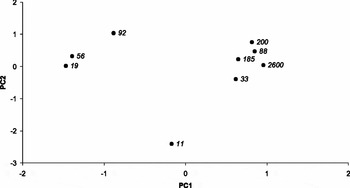
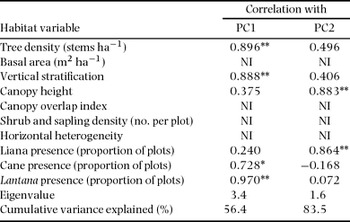
Habitat structural variables showed high variation across fragments (Figure 2, Table 2). Variables indexing structural development and volume of vegetation (tree density, basal area, canopy overlap index, vertical stratification) were higher in three large IGWLS fragments (IYAK, MA and AN) and in two private fragments (PA and TF) compared with the three fragments which were partly abandoned cardamom plantations (PU, KO and IN) and the smallest fragment (V3, Figure 2). Lantana camara presence showed the opposite trend being higher in PU, KO, IN and V3 compared with the other fragments (Figure 2). Principal component analysis extracted two components which explained more than 80% of the variance in the included variables (Table 2). Variables which did not contribute significantly to the components or which had high loading on both components were excluded from the final model. Principal component 1 (PC1) was positively correlated to tree density, vertical stratification and presence of cane and negatively to presence of Lantana. PC2 was positively correlated to canopy height and negatively to presence of lianas (Table 2). The two extracted components were used as composite habitat structure variables in all further analysis.
Ordination of rain-forest fragments based on habitat factors derived using Principal Components Analysis. Data labels refer to fragment area (ha). PC1 is positively correlated to tree density, vertical stratification and presence of cane (Calamus sp.) and negatively to presence of Lantana camara. PC2 is positively correlated to canopy height and negatively to presence of lianas. See Table 2 for strength of correlations.

Pearson's correlation of original habitat variables with derived Principal Components Analysis scores, eigenvalue and cumulative variance explained in rain-forest fragments in the Anamalai Hills, Western Ghats, India. **P < 0.01; *P < 0.05; NI = not included.

Variation in bird community composition among fragments
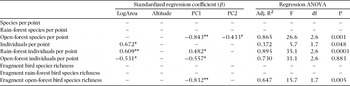
Average total species per point and rain-forest species per point were not significantly related to any of the fragment characteristics included (Table 3). Average open-forest species per point was negatively related to habitat structure (Table 3). Similarly, while fragment total bird species richness and rain-forest bird species richness were not significantly related to any fragment characteristic, open-forest bird species richness was negatively related to habitat structure (Table 3). Average rain-forest individuals per point was related to fragment area (Table 3). Average total individuals per point and open-forest individuals per point did not show strong relation to any fragment characteristic
Stepwise multiple regression of bird community variables against fragment area, altitude, and habitat structure (N = 9) in rain-forest fragments of the Anamalai Hills, Western Ghats, India. *P < 0.05; **P < 0.0055 (P-value adjusted for multiple comparisons using Bonferroni method).

Variation in flocks across fragments
Structure, species participation and encounter rate
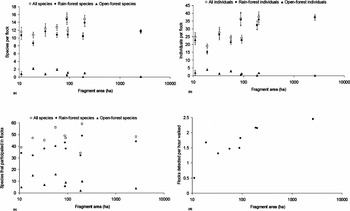
There was large variation in flock variables across fragments (Figure 3). The number of flocks seen in each fragment ranged between seven in the smallest fragment to 67 in the largest fragment (Table 1). Average total species per flock ranged between 10.8–15.2, rain-forest species per flock between 8.6–14.7, and open-forest species per flock between 0.1–2.2 (Figure 3a). Fragments with high values of average rain-forest species per flock had low values of open-forest species per flock and vice-versa, resulting in total species per flock varying only within narrow limits. The ranges of average total individuals per flock, rain-forest individuals per flock and open-forest individuals per flock were 19.0–37.6, 15.1–37.2, and 0.1–3.9 respectively (Figure 3b). The total number of species that participated in flocks ranged between 34–59, rain-forest species between 32–49 and open-forest species between 2–16 (Figure 3c). Flock encounter rate varied between 0.5 flocks h−1 in the smallest fragment to 2.4 flocks h−1 in the largest (Figure 3d). Only flock encounter rate, among the flock variables measured, was significantly related to fragment area (Spearman's rank correlation, P < 0.005).
Variation in flock variables in relation to fragment area in rain-forest fragments in the Anamalai Hills, Western Ghats, India. Average (± SE) species per flock (a), average (± SE) individuals per flock (b), species that participated across all flocks in a fragment (c) and flock encounter rate (d) in relation to fragment area (ha) plotted on logarithmic scale.

Flock composition
Overall, 87 bird and three mammal species participated in flocks across all fragments (Appendix 1). Species varied greatly in their frequency of occurrence in flocks between fragments. Only 16 bird species participated in flocks in all nine fragments. Out of these, only five species participated regularly (present in > 25% of flocks) in flocks in each of the nine fragments. None of the species was a core participant (present in > 50% of flocks) in all nine fragments. The highest level of core participation was seven fragments in the case of brown-cheeked fulvetta (Alcippe poiocephala) and velvet-fronted nuthatch (Sitta frontalis). The similarity in flock composition between fragments was not related to similarity in fragment area (Mantel matrix randomization test, P > 0.005).
Determinants of mixed-species flock variables
Flock structure, species participation and encounter rate
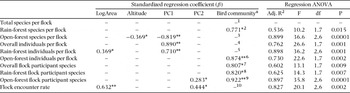
Open-forest species per flock was inversely related to habitat structure (PC1; Table 4). Total number of open-forest species that participated in flocks in a fragment was related to open-forest species richness of the fragment. Total and rain-forest individuals per flock were related to habitat structure. Fragment area strongly influenced flock encounter rate. Other flock variables were not significantly related to any independent variables. Since IYAK was of much greater area than other fragments, was at the highest altitude, and because more time was spent searching for flocks here relative to other fragments, we repeated all the analysis excluding it. The predictors of all flock variables were exactly the same as in the analysis including IYAK.
Stepwise multiple regression of mixed-species bird flock characteristics against fragment area, altitude, habitat structure and local bird community measures (N = 9) in rain-forest fragments of the Anamalai Hills, Western Ghats, India. *P < 0.05; **P < 0.005 (P-value adjusted for multiple comparisons using Bonferroni method).

aBird community measure used: 1 = number of species per point count; 2 = number of rain-forest species per point count; 3 = number of open-forest species per point count; 4 = number of individuals per point count; 5 = number of rain-forest individuals per point count; 6 = number of open-forest individuals per point count; 7 = fragment bird species richness; 8 = fragment rain-forest bird species richness; 9 = fragment open-forest bird species richness; 10 = density of species with regularity of occurrence > two.
Flock composition
Similarity in flock composition between pairs of fragments was primarily related to similarity in bird community composition and to a lesser extent to similarity in habitat structure (Table 5). Flock composition similarity between fragments was not related to similarity in fragment area or altitude (Table 5).
Relation between similarity in flock composition and similarity in bird community composition, habitat structure, fragment area and altitude for pairs of rainforest fragments (N = 36) in the Anamalai hills, Western Ghats, India.

DISCUSSION
The prominence of mixed-species flocking in the Western Ghats rain-forest bird community is highlighted by the fact that across all fragments, as many as 87 species, out of a total of 109 recorded participated in flocks. Changes in mixed-species flock parameters revealed by this study could therefore affect a large proportion of the Western Ghats rain-forest avifauna. Given that many flock variables were strongly related to site features such as fragment area and habitat structure, an important finding of this study is that habitat degradation could affect rain-forest bird communities through subtle mechanisms such as changes in the flocking propensity of species, which in turn could lead to reduction in fitness and long-term changes in abundance.
Structural changes in flocks
Average total species per flock did not vary much across fragments sampled in spite of a wide range in fragment sizes (11–2600 ha). Documented higher species richness per flock in larger fragments in previous studies (Maldonado-Coelho & Marini Reference MALDONADO-COELHO and MARINI2000, Reference MALDONADO-COELHO and MARINI2004) was mainly due to fewer species per flock in fragments below 10 ha. All fragments above 10 ha had relatively similar number of species per flock in earlier studies too (Maldonado-Coelho & Marini Reference MALDONADO-COELHO and MARINI2000, Reference MALDONADO-COELHO and MARINI2004). In our study area also, sampling of fragments below 10 ha might have resulted in a different trend. The fact that total species per flock was not strongly related to either bird community or site characteristics in this study suggests that this flock variable is maintained within a narrow range which might represent an optimum within which a flock can function as a group. Further support for this possibility, comes from the fact that disturbed (low PC1 scores) fragments such as KO and IN which had fewer rain-forest species per flock due to fewer rain-forest species available at the point level, were compensated by the presence of more open-forest species per flock. This finding suggests that the Western Ghats rain-forest flock system is fairly open and flexible with regard to membership, similar to flocks in Mexico (Hutto Reference HUTTO1994) and Hispaniola (Latta & Wunderle Reference LATTA and WUNDERLE1996) and unlike the specialized understorey flocks of the Neotropics (Jullien & Thiollay Reference JULLIEN and THIOLLAY1998, Munn & Terborgh Reference MUNN and TERBORGH1979). Open-forest flock participants however might not be able to perform the functional roles of rain-forest species they replace and might prevent flock participation by congeneric rain-forest species (Graves & Gotelli Reference GRAVES and GOTELLI1993). Low species richness and abundance of congeneric species in our study area precludes testing of this hypothesis.
Compared to number of species per flock, the number of individuals per flock showed greater variation and a distinct trend across fragments. Since rain-forest species contributed most of the individuals in flocks in all fragments, this trend was mainly reflective of the variation in rain-forest individuals per flock. Relatively undisturbed (high PC1 scores) and large fragments had more individuals per flock compared to disturbed and small fragments (Table 4). The number of individuals available per point, surprisingly, was not strongly related to number of individuals per flock Earlier studies have shown flock size to be related to fragment area and habitat structure (Fernández-Juricic Reference FERNÁNDEZ–JURICIC2000, Maldonado-Coelho & Marini Reference MALDONADO-COELHO and MARINI2000, Reference MALDONADO-COELHO and MARINI2004; Tellería et al. Reference TELLERÍA, VIRGÓS, CARBONELL, PÉREZ-TRIS and SANTOS2001) but did not examine whether availability of individuals to participate in flocks was different between fragments. The findings from this study on the other hand indicate that average flock sizes are more strongly associated with fragment area and habitat structure than the number of individuals available at a point. Larger flock sizes in intact forest therefore could be due to higher predation pressure – either higher predator abundance and/or poorer detection of predators – on birds compared to disturbed and open forests (Thiollay Reference THIOLLAY1999b). Undisturbed fragments might also offer foraging substrate for more individuals to forage together in a flock in the same area (Lee et al. Reference LEE, SOH, SODHI, KOH and LIM2005).
Species participation
At least 60% of all species and 65% of rain-forest species recorded in each fragment participated in mixed-species flocks. Richness of flock participants (total, rain forest and open forest) in each fragment was best predicted by richness of the fragment bird communities but not significantly. This still suggests that the proportion of the bird community that participates in flocks is unaffected by habitat disturbance and remains at a high level. Studies in neotropical rain forests found flock participation to be restricted to a small subset of the overall bird community and this subset to be disproportionately affected by habitat disturbance compared to other guilds (Thiollay Reference THIOLLAY1997, Reference THIOLLAY1999a; Van Houtan et al. Reference VAN HOUTAN, PIMM, BIERREGAARD, LOVEJOY and STOUFFER2006). On the other hand, the trends seen in the Western Ghats suggest that flock membership is more flexible and that flock participants are not any more susceptible to habitat disturbance than other functional guilds.
Flock encounter rate
Flock encounter rate was most strongly related to fragment area, decreasing from the largest to the smallest fragment. The availability of bird species with high flocking tendency (indexed by density of birds with regularity of occurrence > 2) did not influence flock encounter rate. Detectability of flocks is unlikely to have been influenced by habitat structure in the different fragments since flocks were highly vocal and most often detected aurally before visually. The difference in encounter rates therefore represents an actual difference in abundance of flocks in fragments. Studies in the Neotropics have shown that mixed-species flocks tend to disintegrate in fragments below a critical size either because fragments are too small to support a flock territory or due to extinction of nuclear species (Maldonado-Coelho & Marini Reference MALDONADO-COELHO and MARINI2004, Stouffer & Bierregaard Reference STOUFFER and BIERREGAARD1995). Nothing is known about flock territories in the Western Ghats, but studies suggest that, unlike in the Neotropics, palaeotropical flocks are not permanent associations and therefore are unlikely to maintain territories (McClure Reference MCCLURE1967). Observations during the present study also suggest the same, because the maximum period for which any flock stayed together was 2 h and most flocks dissociated in less than 1 h. Therefore loss of flocks in smaller fragments might not be related to territory size. In our study area, the brown-cheeked fulvetta possessed most of the characteristics thought to be important for a nuclear species (Hutto Reference HUTTO1994). It was the most frequent flock participant across all fragments (Appendix 1), is intra-specifically gregarious and possesses a loud continuous call. A flock was once seen to form around a singing brown-cheeked fulvetta individual. The same species was classified as nuclear in a study conducted in Malaysian dipterocarp rain forests (McClure Reference MCCLURE1967) while another species of the same genus (grey-cheeked fulvetta Alcippe morrisonia) was found to be nuclear in flocks in Taiwan (Chen & Hsieh Reference CHEN and HSIEH2002). Since the density of this species also showed a reducing trend with habitat degradation (Sridhar Reference SRIDHAR2005), the reduction in flock encounter rate in degraded fragments could be related to a lowering of its abundance. Playback experiments using brown-cheeked fulvetta calls are required to confirm the importance of this species for flocking, as has been done in Sri Lankan rain forests (Goodale & Kotagama Reference GOODALE and KOTAGAMA2005). Increased predation pressure in intact fragments (Jullien & Thiollay Reference JULLIEN and THIOLLAY1998, Thiollay Reference THIOLLAY1993) or changes in prey availability and dispersion (Lovejoy et al. Reference LOVEJOY, BIERREGAARD, RYLANDS, MALCOLM, QUINTELA, HARPER, BROWN, POWELL, POWELL, SCHUBART, HAYS and Soulé1986) are other possible reasons for the observed changes in flock encounter rate.
Flock composition
Few earlier studies have quantified the changes in composition of flocks following disturbance (Kotagama & Goodale Reference KOTAGAMA and GOODALE2004, Lee et al. Reference LEE, SOH, SODHI, KOH and LIM2005). Kotagama & Goodale (Reference KOTAGAMA and GOODALE2004) found little variation in flock composition 10 and 25 y after logging in a Sri Lankan rain forest, with the regular species remaining identical. In the present study however, frequency of occurrence of individual species in flocks showed high variation across fragments resulting in substantial differences in flock composition. Though these differences largely reflected differences in bird communities between fragments, some of the variation was also due to differences in habitat structure. In other words, the propensity of species to flock was influenced by the structure of the habitat. As in the case of individuals per flock and flock encounter rate, this could be related to habitat-related changes in the selective advantage of flock participation for that species. Irrespective of the mechanism through which it has happened, flock composition changes could affect the efficiency of flock functioning, because species are known to play important functional roles in flocks (Dolby & Grubb Reference DOLBY and GRUBB1998, Reference DOLBY and GRUBB1999), and influence flock dynamics such as cohesion and stability (Maldonado-Coelho & Marini Reference MALDONADO-COELHO and MARINI2004)
Determinants of flock variables: bird community vs. site and habitat characteristics
Findings of this study indicate that variation in mixed-species flocks in a fragmented landscape are brought about through different mechanisms. Changes such as increased participation of open-forest species in flocks in degraded fragments, seem to be simple consequences of alterations of fragment bird communities. Changes in flock species richness thought to be related to area and habitat structure in earlier studies (Fernández-Juricic Reference FERNÁNDEZ–JURICIC2000, Lee et al. Reference LEE, SOH, SODHI, KOH and LIM2005, Maldonado-Coelho & Marini Reference MALDONADO-COELHO and MARINI2000, Reference MALDONADO-COELHO and MARINI2004; Tellería et al. Reference TELLERÍA, VIRGÓS, CARBONELL, PÉREZ-TRIS and SANTOS2001) might therefore actually reflect bird community changes. Other flock variables were nevertheless strongly influenced by fragment area and habitat structure. A particularly important example in this context is the reduction of flock encounter rate in small fragments. The latter indicates that flocking propensities of species change as a result of habitat degradation. These results mean that conserving rain-forest bird communities in degraded landscapes will not only require an understanding of changes in diversity and composition but also knowledge of how behaviour and species interactions respond to habitat disturbance. Especially important are studies which address how the main drivers of flocking – predation pressure and prey abundance and dispersion – respond to habitat changes.
ACKNOWLEDGEMENTS
We would like to thank the Wildlife Institute of India, Tamil Nadu Forest Department and managements of Hindustan Lever, Parry Agro, Tata, and Woodbriar estates for permissions and logistic support; Kumar, T.R. Shankar Raman, Divya Mudappa, M. Anandakumar, and Vena Kapoor for help and company during fieldwork and Robin Vijayan, Rashid Raza and R. Jayapal for suggestions in design and analysis. HS would like to thank amma, appa, paati and Lakshmi for constant encouragement and support. This work was supported by a grant from Ministry of Environment and Forests, Government of India
Appendix 1. Sampling effort and frequency of occurrence (%) of species in mixed-species flocks in rain-forest fragments in the Anamalai Hills, Western Ghats, India. Species arranged in decreasing order of overall frequency of occurrence (%) across all fragments

$Open-forest species; # migrant; ^ endemic to the Western Ghats