1. Introduction
Humans naturally anthropomorphize. As David Hume (Reference Hume and Root1957, 29) put it, “There is an universal tendency among mankind to conceive all beings like themselves. … We find faces in the moon, armies in the clouds.” Philosophers and psychologists attempting to understand the minds of nonhuman animals have long worried that this tendency leads us to error. I call the human tendency to anthropomorphize intuitive anthropomorphism, and it is the specific target of this article. Existing views get intuitive anthropomorphism wrong and as a result fail to control its effect on the sciences of nonhuman minds.
To start, the term ‘anthropomorphism’ (simpliciter) needs clarification. In its strictest sense, anthropomorphism is sometimes defined as a kind of error: overestimating the intelligence of animals by attributing to them human-like traits they do not have (perhaps consciousness or belief-desire psychology). A broader sense of the term applies to the belief that a nonhuman animal possesses any of these ‘characteristically human’ traits, while allowing that that belief may be true or false. A still broader sense treats anthropomorphism as a way of thinking or a process of forming beliefs about nonhuman minds: coming to understand the minds of nonhuman animals by analogy to our own, while leaving open whatever beliefs we might form. I treat anthropomorphism as a process. Although anthropomorphism as an error is probably most often made explicit, usage of the term tends to slide between these, especially in debates over the role of anthropomorphism in science (we will see some hints of this in sec. 4.3). I view anthropomorphism as a process because it allows more productive engagement with the crucial problem.Footnote 1 I say this for three reasons.
First, this use allows me to remain agnostic about anthropomorphism generally. There is a large and contentious debate about whether there are legitimately scientific anthropomorphic strategies (e.g., de Waal Reference de Waal1991, Reference de Waal1999; Rivas and Burghardt Reference Rivas, Burghardt, Bekoff, Allen and Burghardt2002; Mitchell Reference Mitchell, Daston and Mitman2005; Burghardt Reference Burghardt2007; Wynne Reference Wynne2007). I sidestep this debate because worries about intuitive anthropomorphism are shared across attitudes about anthropomorphism more generally. Kennedy (Reference Kennedy1992) argues forcefully against any form of anthropomorphism and sees this tendency, which is “simply built into us” (28), as the reason it is so problematic. Rivas and Burghardt (Reference Rivas, Burghardt, Bekoff, Allen and Burghardt2002) believe that some forms of anthropomorphism are valuable but caution against its naive forms: “Anthropomorphism is like Satan in the bible—it comes in many guises and can catch you unawares!” (15).
Second, this view does not prematurely restrict anthropomorphism to certain posits. Intuitive anthropomorphism is a heuristic employed by our unconscious folk psychology. It can be summed up as such: our unconscious interprets behavior of nonhuman animals in the same way it interprets human behavior. It is an empirical question what effects this may have and biases it may produce. Like most cognitive heuristics, it likely leads to errors in many cases, but it does not always, and we only know how or when it does empirically. It is a mistake to assume the effects it has at the outset. In fact, intuitive anthropomorphic error is not merely a matter of overestimating intelligence by positing a set of specific mental states. The effects of intuitive anthropomorphism are complex, and the errors it produces share nothing besides their common source. Focusing on any particular kind of posit or error before we understand intuitive anthropomorphism dooms us from the start in both understanding and controlling it.
Third, this view of anthropomorphism opens a new approach to debates about it. Too often these debates proceed as follows: one theorist claims that common explanations of some behavior (read: their opponents’) are overly anthropomorphic, while another claims that anyone rejecting explanations on those grounds is overly averse to anthropomorphism. These are not really arguments about anthropomorphism itself. They are arguments about those explanations of animal cognition. Very little in comparative psychology is settled, so it should not be surprising that these debates make little headway. This approach makes sense if anthropomorphism is a kind of error: to identify instances of anthropomorphism in the field, we must first identify errors by looking at existing views. If anthropomorphism is a process, there is another approach available at the level of individual psychology. So I do not argue that the field is overly anthropomorphic; I argue that any particular judgment one makes about the psychology of nonhuman animals might be subject to the influence of intuitive anthropomorphism. As such, any particular judgment is potentially subject to an intuitive anthropomorphic bias.Footnote 2 To understand what this means, I look to the empirical literature.
Intuitive anthropomorphic bias is one kind of cognitive bias that results from reasoning heuristics applied in our unconscious (e.g., Tversky and Kahneman Reference Tversky and Kahneman1974). The literature on cognitive biases and unconscious processing generally will help us understand intuitive anthropomorphism (sec. 2). The literature on implicit social biases will help us understand how to control it. This is the largest literature on controlling unconscious biases, and it targets interventions of the right form for the current discussion (sec. 3). Collectively, this literature suggests that existing strategies for controlling intuitive anthropomorphism are ineffective (sec. 4) and can help develop new controls (sec. 5). I conclude in section 6.
2. Intuitive Anthropomorphic Bias
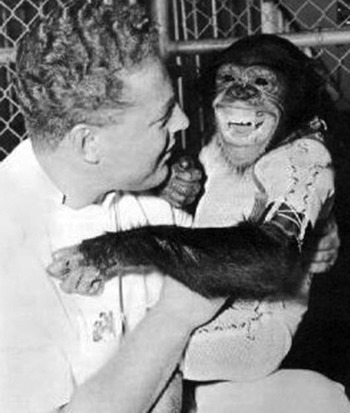
Figure 1 shows Ham the chimpanzee around the time he became the first hominid to be launched into space (in 1961). The look on his face appears to be one of happiness. Perhaps he perceives excitement in the behavior of those around him, or perhaps he is just pleased by the attention from his trainer. Unfortunately, this is unlikely. In chimpanzees, this facial expression is one of fear, sometimes known as the ‘fear grin’. As much as Ham looks pleased, and as much as we can rationalize that explanation, fear is a more likely reaction to the ordeal he is going through between training and launch (note that he is wearing his flight suit).Footnote 3
Ham the chimpanzee with his handler (photo: NASA).

This is a case in which intuitive anthropomorphism leads us astray. We see an animal grinning and it looks to us like happiness. That is a pretty good heuristic for dealing with other humans, but we go wrong because our unconscious folk psychology applies it the same way in nonhumans. Even knowing that we are wrong, the perceptual gestalt remains: Ham still looks happy. Note that we are not positing human-like capacities in Ham that he is incapable of. There is no substantive difference in the intelligence required for fear and happiness.Footnote 4 Intuitive anthropomorphism does lead us to err, and those errors do not just overestimate intelligence (although sometimes they do). We also should not think that intuitive anthropomorphism always leads us to error (anthropomorphism is a way of thinking, not a kind of error), but there is good reason to think it often does.
Daily experience with pets and cartoons demonstrates how easily we anthropomorphize falsely: we talk to our dogs and do not blink when cartoon dogs talk to their owners. Evolutionary reasoning suggests that we should anthropomorphize: intuitive anthropomorphism is the kind of fast and frugal heuristic that can work for evolutionary purposes, even if it is not up to the epistemic standards of science. As some have argued (e.g., Caporael and Heyes Reference Caporael, Heyes, Mitchell, Thompson and Miles1997; Gallup, Marion, and Eddy Reference Gallup, Marino, Eddy, Mitchell, Thompson and Miles1997), our intuitive folk psychology most likely evolved to inform social interactions with other humans and then was exapted to handle interactions with nonhuman animals. The intractable problems of interpreting other minds are prime targets for ‘good enough’ predictive strategies (Dennett [Reference Dennett1989] argues in a similar spirit).
Finally, the empirical evidence backs this up. In one of the classic studies of psychology, Heider and Simmel (Reference Heider and Simmel1944) showed that participants attributed intentional actions to a collection of two-dimensional shapes ‘interacting’ in a short cartoon. This indicates a tendency to see (quite literally) intentional action when certain cues are present. In this experiment, the cues are irregular movements that seemingly respond to one another. In general, our anthropomorphic unconscious folk psychology seems to trigger on simple or irrelevant cues, suggesting it triggers too often. Other simple cues like hands, eyes, and faces influence the attribution of conscious mental states (Arico et al. Reference Arico, Fiala, Goldberg and Nichols2011). Magnifying this, humans are wired to err in the direction of seeing faces that are not there over missing faces that are (Liu et al. Reference Liu, Li, Feng, Li, Tian and Lee2014). More generally, humans are more likely to attribute human traits to animals that are superficially like us (Eddy, Gallup, and Povinelli Reference Eddy, Gallup and Povinelli1993; Morewedge, Preston, and Wegner Reference Morewedge, Preston and Wegner2007).
Children, of course, anthropomorphize wildly (e.g., Gebhard, Nevers, and Billmann-Mahecha Reference Gebhard, Nevers, Billmann-Mahecha, Clayton and Opotow2003). And adults anthropomorphize when explaining and imagining behavior. Religious participants asked to describe God or tell stories involving God will anthropomorphize God, even when doing so contradicts their theological beliefs—anthropomorphic errors by the participants’ own lights (Barrett and Keil Reference Barrett and Keil1996). Participants presented with written descriptions of situations and asked to assess the ‘reasonableness’ of various mental-state attributions ascribe mental states to dogs that are of the same kind as they ascribe to a human child, although quantitatively simpler (Rasmussen and Rajecki Reference Rasmussen and Rajecki1995).
One might wonder whether these effects apply to scientists. In general, though, unconscious biases influence behavior even during careful deliberation by experts. The influence of social biases has been shown in hiring decisions (Bertrand and Mullainathan Reference Bertrand and Mullainathan2004) including hiring by scientists (Moss-Racusin et al. Reference Moss-Racusin, Dovidio, Brescoll, Graham and Handelsman2012), medical decision making (Green et al. Reference Green, Carney, Pallin, Ngo, Raymond, Iezzoni and Banaji2007), and the judicial process (Mitchell et al. Reference Mitchell, Haw, Pfeifer and Meissner2005; Banks, Eberhardt, and Ross Reference Banks, Eberhardt and Ross2006; Rachlinski et al. Reference Rachlinski, Johnson, Wistrich and Guthrie2009). Expertise and deliberation are not themselves sufficient to stop cognitive biases. In fact, the self-perception that one is objective increases social bias (Uhlmann and Cohen Reference Uhlmann and Cohen2007).
In addition, scientific practice is complex, and intuitive anthropomorphism can arise at every stage of research: model construction, experimental design, data gathering, and model choice. At each stage, it can arise in different ways. For instance, it may be that many cognitive models are constructed under the heavy influence of folk psychology (Penn Reference Penn, Menzel and Fischer2011). And bias at one stage will be compounded at later stages: attention and recall are biased toward stereotype-confirming evidence (Bodenhausen and Wyer Reference Bodenhausen and Wyer1985). This potential for interaction across stages, along with the subtlety of cognitive biases generally, means that the effects of intuitive anthropomorphic bias can be complex and intuitively unexpected (recall Ham).
Putting this all together, there is good reason to believe that intuitive anthropomorphism is problematic in comparative psychology. It is triggered by simple stimuli like eyes and hands, and its effects can be subtle and unpredictable. There are many stages at which it can arise. We cannot be sure whether and how any specific judgment about animal cognition is influenced. Awareness of the bias, even with deliberation and expertise, is not sufficient to control it. So what can we do?
3. Controlling Implicit Social Bias
The literature on controlling implicit biases provides the best current evidence about controlling cognitive biases, and some of the interventions discussed there are especially instructive to the current discussion; these are interventions that could plausibly be used by researchers in a laboratory setting (where one has little control over the information one is presented). So I turn to that literature now.
The Weapon Identification Task is a common test of bias. Participants identify an image as a tool or a weapon, but they are very briefly shown an image of a white or black face before. If, for instance, subjects mistakenly say that a tool is a weapon after a black face more often than a white face, that is taken as a characteristic indicator of bias.
Not all intuitively sensible interventions work. Payne, Lambert, and Jacoby (Reference Payne, Lambert and Jacoby2002) told participants in two experimental conditions that research had shown that people possess implicit racial biases that can influence performance of a task, and then they told them to either “avoid race” or “use race” in making their decision. Controls were not given any of these instructions. When pooled, the two experimental groups were statistically more likely to make errors consistent with racial bias than the control group. Thus, the authors conclude, instruction calls attention to race and activates racial stereotypes that lead to biased judgments. Similarly, Legault, Gutsell, and Inzlicht (Reference Legault, Gutsell and Inzlicht2011) showed that motivating participants to be egalitarian increases bias if they perceive the motivation as coming from an external source, but it can reduce bias if it is seen as self-generated.
Stewart and Payne (Reference Stewart and Payne2008) found a more effective approach. They used implementation intentions, which are if-then action plans that make it easier for participants to accomplish a goal than general intentions to do so. For instance, the implementation intention “if I leave work, I will stop and exercise at the gym” is more effective than the general intention “I will exercise more.” Stewart and Payne asked participants to form one of three implementation intentions. The first was, “Whenever I see a black face on the screen, I will think the word, accurate.” The second was, “Whenever I see a black face on the screen, I will think the word, quick.” The third was, “Whenever I see a black face on the screen, I will think the word, safe.” Those participants were told that “by thinking the word ‘safe,’ you are reminding yourself on each trial that you are just as safe interacting with a Black individual as with a White individual” (1336). Only the ‘think safe’ condition reduced bias.
Another effective intervention is to show participants images of admired or counterstereotypical members of the stereotyped group. Dasgupta and Greenwald (Reference Dasgupta and Greenwald2001) found this effect using the Implicit Association Test (IAT). In one manipulation, they showed participants images of admired black individuals and disliked white individuals before giving them the IAT. They found that doing so reduced bias, whether the images were presented immediately before or 24 hours before administering the IAT. Govan and Williams (Reference Govan and Williams2004) achieved a similar result using counterstereotypical examples in the experiment itself, even using nonsocial stereotypes about flowers and insects. Imagining a positive, productive interaction with members of the stereotyped group before performing an IAT can also reduce bias (Turner and Crisp Reference Turner and Crisp2010).
The effective interventions, in this small survey of the literature, are those that make counterstereotypical information salient in reasoning, like the ‘think safe’ intention, or imagined positive interactions. What does not work is demanding accuracy or egalitarianism or telling participants to not be biased. I now apply the lessons of the discussion so far to existing methods of controlling anthropomorphism.
4. Existing Controls of Intuitive Anthropomorphism
4.1. Morgan’s Canon
Perhaps the most commonly advocated method of addressing anthropomorphism is an updated version of Morgan’s Canon, a famous statement by the nineteenth-century comparative psychologist C. Lloyd Morgan (Reference Morgan1894). The modern interpretation of Morgan’s Canon counsels that researchers should adopt the model that describes the simplest psychological process that can predict behavior. This practice is widespread and is still motivated largely by concerns about anthropomorphism (Manning and Dawkins Reference Manning and Dawkins1998; Wynne Reference Wynne2007; Shettleworth Reference Shettleworth2010). In order to control anthropomorphism generally, it must control intuitive anthropomorphism specifically.
In opposition, de Waal (1999), Sober (Reference Sober, Daston and Mitman2005), and Fitzpatrick (Reference Fitzpatrick2008) have argued that Morgan’s Canon leads to errors of ‘anthropodenial’, the underestimation of animal intelligence (more on their reply in sec. 4.2). My arguments so far show why: Morgan’s Canon explicitly aims to correct errors that overestimate intelligence. But, first, intuitive anthropomorphism does not always lead to errors, and second (think of Ham), its errors need not have anything to do with intelligence. So, Morgan’s Canon sometimes aims to correct errors that were not made and sometimes aims to correct the wrong error.
My arguments suggest another problem: even in cases in which intuitive anthropomorphism has led someone to overestimate the intelligence of an animal, Morgan’s Canon may not be effective. Effective interventions to control implicit bias make counterstereotypical information salient. Morgan’s Canon does not. It is more similar to the ineffective interventions: it is a demand to make the ‘unbiased’ judgment, like the Stewart and Payne (Reference Stewart and Payne2008) ‘think accurate’ condition or the Payne et al. (Reference Payne, Lambert and Jacoby2002) ‘avoid race’ instruction. The effect Morgan’s Canon has likely depends on how it is represented by the person using it. If researchers view it as an external demand to avoid anthropomorphism, it could actually increase bias (Legault et al. Reference Legault, Gutsell and Inzlicht2011). Similarly, if researchers view it as being about anthropomorphism, it could activate anthropomorphic stereotypes and increase bias, like the “use race” and “avoid race” instructions from Payne et al. (Reference Payne, Lambert and Jacoby2002).
So, the effects likely vary on a case-by-case basis; unconscious processes are fickle. But this leaves Morgan’s Canon in a bad position. First, intuitive anthropomorphism does not always lead to error, and when it does, it does not always overestimate intelligence. In these cases, Morgan’s Canon leads to errors in the other direction. Second, even in the cases in which it should be most effective, the empirical evidence suggests that it may be ineffective or even counterproductive. Finally, as mentioned earlier, intuitive anthropomorphism can influence any stage of research. A rule about model choice, like Morgan’s Canon, does not address anthropomorphism at other stages. Morgan’s Canon should not be used to control intuitive anthropomorphism.
4.2. Evidentialism
The next control is proposed by Sober (Reference Sober, Daston and Mitman2005) and Fitzpatrick (Reference Fitzpatrick2008) as replacements for Morgan’s Canon. Sober (Reference Sober, Daston and Mitman2005, 97) concludes his paper with the memorable line, “The only prophylactic we need is empiricism.” Fitzpatrick (Reference Fitzpatrick2008, 242) frames the claim as a principle he calls ‘evidentialism’. The shared idea is that one should wait until there is sufficient evidence before adopting a hypothesis. This, of course, is good advice. The problem is that inferences about what is sufficient evidence are potentially subject to intuitive anthropomorphic bias. A hypothesis that is intuitively more plausible may be taken to need less support. We need guidelines that specifically address intuitive anthropomorphism, so evidentialism alone is not enough.
4.3. Identifying Errors
Many authors discuss more specific instantiations of anthropomorphic error. This suggests a third strategy. The more specific the errors we can identify, the better positioned we are to avoid them. Simply warning against ‘anthropomorphism’ in general is too vague to be helpful.
De Waal (Reference de Waal1999) argues against anthropocentric anthropomorphism, which is attempting to explain behavior by simply imagining how you would approach the task. He emphasizes that researchers need to consider the perspective of the animal itself. Thus, there is an identifiable difference between instances of pernicious anthropocentric anthropomorphism and what he calls animal-centric anthropomorphism. Rivas and Burghardt (Reference Rivas, Burghardt, Bekoff, Allen and Burghardt2002) describe the related anthropomorphism by omission, which assumes that the capacities of nonhuman animals are a subset of our own. In reality, nonhuman animals have many capacities that we do not.
Lockwood (Reference Lockwood, Fox and Mickley1986) distinguishes several kinds of anthropomorphism, the most interesting of these being explanatory anthropomorphism. This is the fallacy of thinking we have explained a behavior simply by giving it a (folk psychological) name. Many raise related worries about the use of folk-psychological terminology, which might make it easy to unintentionally slip into intuitive anthropomorphism. Authors worry about this to different degrees. Kennedy (Reference Kennedy1992) argues for the complete replacement of folk-psychological terminology. De Waal (Reference de Waal1999) argues for the use of neutral descriptive terminology when observing and recording data but thinks folk-psychological terminology can be used in theoretical interpretations. Finally, Bekoff (Reference Bekoff2000) argues that folk-psychological terminology can be used at any stage, as long as we are careful.
Povinelli (Reference Povinelli2012, app. 1) lists several even more specific errors, for instance, the end-point training effect: someone watching an animal perform some task can be struck by its success and forget that the behavior required hundreds or thousands of practice trials. Another he calls the Erin Moriarty effect (after a journalist who visited his lab): in tasks in which an animal has a 50/50 chance of ‘success’, trials in which it succeeds feel more meaningful.
Whether or not these specific proposals stand up, there is a useful idea here. The problem is that there is little reason to believe that we will be able to identify a list of discrete errors that exhausts intuitive anthropomorphic bias. The effects of cognitive bias are subtle, complex, and often unpredictable. And we need controls that will generalize to experiments not yet done, if we are to control intuitive anthropomorphism going forward. So, like evidentialism, identifying errors is helpful, but more is needed.
5. Building New Strategies
The discussion so far has given us some helpful tools. Getting intuitive anthropomorphism right, by adopting the view that I have argued for, is a first step. Of existing controls, Morgan’s Canon should be eliminated, while evidentialism and identifying errors can be helpful but are not enough. We need something more if are to truly address intuitive anthropomorphism. So I suggest that we look to the literature on controlling social biases for new strategies.
That literature suggests a speculative hypothesis. Imagining intelligent-seeming actions performed by a being that is (relatively) unlikely to be anthropomorphized, such as a computer, an insect, or an octopus (Eddy et al. Reference Eddy, Gallup and Povinelli1993), might reduce subsequent intuitive anthropomorphism. This is analogous to imagining positive interactions with members of stereotyped groups. The anthropomorphic stereotype could be summarized as ‘all action (especially intelligent action) is a product of human-like intelligence’ (a notion canonized in the Turing Test). This is an empirical hypothesis and is quite speculative, so it must be tested empirically.
In the meantime, there are less speculative options. Implementation intentions reduce implicit bias because they help ensure that a specific goal is implemented at the right time (Stewart and Payne Reference Stewart and Payne2008). For practicing comparative psychologists, this would be much more difficult because the goals will have to be much more complicated. So, in place of implementation intentions, I suggest checklists. Checklists have been helpful in many settings, including airplane takeoff, engineering, and surgery (Borchard et al. Reference Borchard, Schwappach, Barbir and Bezzola2012), and have been suggested as a method to reduce implicit bias in judges (Seamone Reference Seamone2006). Checklists can ensure that a large number of complicated intentions are enacted at the right time.
This checklist might include two sets of items. One set should specify alternative hypotheses that might explain the behavior. This should include hypotheses beyond the researcher’s own hypothesis and its perceived main competitor: Heyes (Reference Heyes2015) argues that many well-known effects are often ignored as candidate explanations in comparative psychology. (One could also produce new hypotheses by imagining how some being unlikely to be anthropomorphized could perform the task.) Another set of items could come from a more systematic program of identifying errors, modeled on the heuristics and biases literature (e.g., Gilovich, Griffin, and Kahneman Reference Gilovich, Griffin and Kahneman2002). A more complete taxonomy of intuitive anthropomorphic errors can help in many cases, even if it is not sufficient alone. If there is an alternative hypothesis, or there is reason to believe an error has been made, one must step back and reassess the evidence.
These suggestions of the last section need to be tested, and perhaps better measures can be found, but for now, these are the options best supported by the empirical evidence we have.
6. Conclusion
One might reasonably wonder what this discussion means for the current state of comparative psychology, a question I have avoided. This discussion does not tell us whether the field in general overestimates the intelligence of nonhuman animals. While overestimating intelligence is one effect of intuitive anthropomorphism, it is only one. It is easily identified, so its apparent prominence as an anthropomorphic error is at least partially a matter of availability. So, it is difficult to say what influence intuitive anthropomorphism has in the field at large. In general, progress will have to be made case by case.
I have sketched the way forward by describing intuitive anthropomorphism as a cognitive bias that leads to different kinds of error and by proposing new controls. Even setting aside my more specific claims, I hope to motivate a new general orientation to the problem of intuitive anthropomorphism.