INTRODUCTION
Radiation therapists (RTs) (also known as therapeutic radiographers, radiologic technologists or radiotherapy technologists) are members of the allied health workforce who provide daily radiation treatment to cancer sufferers. Roles of RTs may vary from country to country, but the process of providing treatment in Australia includes the following steps:
1. Pre-treatment simulation, usually with computerised tomography (CT) imaging, and other measurements performed to enable the precise treatment region to be defined;
2. Radiotherapy treatment planning, where computer-aided calculations are carried out, leading to the creation of a treatment plan that will provide the best possible radiation beam arrangement to give optimum dose to the tumour while minimising dose to healthy tissues;
3. Daily positioning of the patient on the treatment couch, alignment of the treatment beams, verification of the treatment region, then irradiation, and
4. Caring for the patient, in particular by providing patient education and information, observing the patient’s condition and treatment side effects and providing supportive care.1
While the role of RTs is patient-centred, it can be seen from this description of duties that there is also a strong emphasis on the application of technology. The technology used in radiation therapy is developing rapidly, so RTs require a good understanding of the underlying theory of radiation therapy and the ability to adapt quickly to new developments.Reference White and Kane2,Reference Price3 BentzenReference Bentzen4 highlighted the lack of evidence to support widely used technology in radiotherapy, and Baumann et al.Reference Baumann, Verfaillie, Heeren and Leer5 recommend the incorporation of radiotherapy technologists into multidisciplinary research teams as a key to successful integration of new research developments into radiation oncology. The rapidly changing nature of radiation therapy means that RTs should be aware of the latest research in their field, be able to interpret this research, and be interested in carrying out radiation therapy research themselves.
Using a Delphi technique, we previously identified overall research priorities for Australian RTs.Reference Cox, Halkett, Anderson and Heard6 In this process, imperfect consensus between responding centres was revealed by a low Kendall W of 0.223 (p < 0.05).Reference Cox, Halkett, Anderson and Heard6 This indicated diversity in research interests among our responders and possibly concealed group interests, in contrast to other Delphi studies in allied health which reported high levels of agreement in their identified research priorities.Reference Barrett, Kristjanson, Sinclair and Hyde7–Reference Fenwick, Butt, Downie, Monterosso and Wood9 However, although the Delphi method is often used to achieve consensus, it can also be used to polarise opinions when groups may differ.Reference Helmer10 Further exploratory cluster analysis was warranted to determine whether any group research interests could be identified. The aims of this article are therefore to (1) describe groups of RTs according to their particular research interests, and (2) identify research priorities with a more specific focus on the radiation therapy field of knowledge. An additional, unmeasured aim, was to increase RTs’ interest in research.
METHOD
This research was approved by The Human Research Ethics Committee of The University of Sydney (project number 11–2006/9516, approved 15/1/07). Two sequential questionnaires were sent to all Australian Departments of Radiation Oncology, as previously described.Reference Cox, Halkett, Anderson and Heard6,Reference Cox, Halkett and Anderson11 Participants in the first round produced 374 unranked research issues of interest to the profession.Reference Cox, Halkett and Anderson11 As part of the second study,Reference Cox, Halkett, Anderson and Heard6 these 374 issues were distilled into a list of 53 broad researchable topic areas, called ‘research areas’. Data from the second questionnaire is discussed here.
Procedure
The study’s second questionnaire was distributed to all Australian chief RTs. The ‘lead respondent’ was asked to complete the questionnaire with their colleagues using a general staff meeting or a specially called interest group meeting held within their department. This is a variation of the classic Delphi technique, as researchers commonly adapt the technique to suit their varying research projects.Reference Keeney, Hasson and McKenna12 Other Delphi studies have utilised group discussions in their methodology to ensure breadth of responses,Reference Malcolm, Forbat, Knighting and Kearney13 with further evidence of research priorities being established by group discussion.Reference Chalkidou, Whicher, Kary and Tunis14 Regardless of the approach used, the Delphi technique should achieve consensus through a building process to determine group research priorities and attitudes.Reference Keeney, Hasson and McKenna12 While there may have been some dissenting voices among the groups, each group managed to achieve consensus in responses which were then recorded by the lead respondent. A more detailed description of the procedure is found in our previous work.Reference Cox, Halkett, Anderson and Heard6 The completed questionnaires were then mailed back to the researchers. Individual departments were not identified due to ethics requirements.
Participants
All participants were working in Australian departments of radiation oncology, which together employ more than 1246 RTs.15 In order to help capture a breadth of responses, each department provided group responses rather than a single RT’s perspective. Targeting specific single individuals such as RT research coordinators (where they existed) would have limited the diversity of responses and skewed the study’s results. It was important to ascertain the research priorities of as many RTs as possible, and not just of those experienced and actively involved in research.
The questionnaire
The questionnaire analysed in this paper, and also in our previous work,Reference Cox, Halkett, Anderson and Heard6 was developed around the 53 research areas described above. The questionnaire stated the research areas, and asked three questions about each:
1. How important is this research area to patient care?
2. How important is this research area to working with colleagues?
3. How important is this research area to radiation therapy?
Responding centres were asked to rate each research area on a 7-point Likert-style scale from least important (= 1) to most important (= 7). The first research aim of this paper, the identification of subgroups within the set of responding centres, used responses to all three subscale questions. The second research aim, the comparison of the identified groups, concentrated on the third subscale question alone. The authors believe that presentation of detailed comparisons of the groups’ responses to all three subscales is too complex for a single paper. Comparison of the groups of responding centres on the subscales of ‘patient care’ and ‘working with colleagues’ will be the subject of future manuscripts.
Data analysis
Initial data analysis for this study is presented in our two previous articles.Reference Cox, Halkett, Anderson and Heard6,Reference Cox, Halkett and Anderson11 The primary analyses constituting this manuscript are (i) the revelation of groups of responders by exploratory cluster analysis; and (ii) the determination of agreement and disagreement in research area importance across the groups for the radiation therapy subscale. All statistical analysis was conducted using Statistical Package for the Social Sciences (SPSS), Version 16, 2008.
Cluster analysis is most often used when multiple cases (in this case the responding centres) have scores on a common set of measures. Its main purpose is to match the cases into small sets, called clusters, which are made up of cases that have similar responses on the measures. Similarity is measured using the unweighted average of the sum of the squared differences between the cases on the variables used in the cluster analysis. Cluster analysis was performed via the hierarchical cluster procedure as this is the most appropriate method for datasets with fewer than 200 cases.Reference Francis16 The importance scores across the three questionnaire subscales of patient care, working with colleagues and radiation therapy (out of 21) were used to derive the clusters or groups.
Once the respondents had been aggregated into groups, the nature of the differences between the groups was identified by comparing each group’s mean scores on the questionnaire’s subscale of radiation therapy using analysis of variance (ANOVA). This statistical analysis was carried out using the importance scores out of 7, because we were analysing a single subscale with a Likert ranking from 1 to 7. A significance level of 0.01 was used in the ANOVA analysis.
Post hoc Scheffe multiple comparisons were also conducted for the radiation therapy subscale to determine how each group differed from the others. A significance level of p < 0.05 was used for these follow-up tests in an attempt to balance between type I and type II errors. This enabled us to summarise the research interests of each of the groups according to their perceived importance of the research areas to radiation therapy.
The results are presented in terms of the questionnaire’s research areas; that is, broad possible topics for research projects.
RESULTS
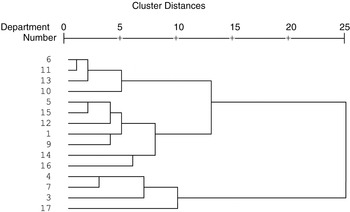
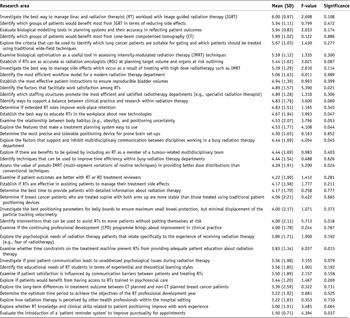
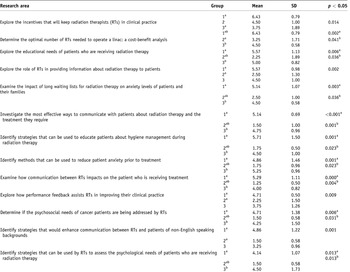
The results section is divided into two parts. The first part presents the revelation of groups based on all responses to the second questionnaire (1). In accordance with the purpose of this paper, the second part of the results section has a more specific focus on the subscale of radiation therapy, presenting agreement (section 2.1) and disagreement (section 2.2) in research area importance between the three groups for this specific subscale. (1) The revelation of groups: The hierarchical cluster procedure in SPSS produced three clusters or groups, hereafter referred to as Group 1 (seven departments), Group 2 (four departments) and Group 3 (four departments) (Figure 1). From the 18 departments that responded, only 15 were included in the cluster analysis due to three departments having missing data. Group 1 was consistently enthusiastic about research across all research areas on the three subscales, with a mean ranking of 14.91 out of a maximum of 21 (SD = 2.78), indicating stronger research interest overall and across a variety of research areas. Group 2 showed the lowest research interest with a mean ranking of 9.81 out of 21 (SD = 2.68), and Group 3 showed moderate research interest with a mean of 12.35 out of 21 (SD = 2.32). In rating the importance of research areas on the subscale of radiation therapy, the groups agreed (p > 0.01) with each other about the importance of 40 of the 53 research areas (see Table 1) and disagreed about 13 (see Table 2). (2.1) Agreement in research area importance across the groups for the subscale of radiation therapy: The groups’ agreed highest rated research area (mean 6.00 out of 7, Table 1) was related to management, but the next four research areas of highest agreed importance, with mean scores ranging from 5.94 to 5.59 (Table 1), had a strong technical orientation. They covered topics on the applications of image guided radiation therapy (IGRT), cone-beam CT, intensity-modulated radiation therapy (IMRT), respiratory gating and biological modelling tools in treatment planning systems. The six lowest ranked areas, with mean importance less than 3.5 out of 7, were more diverse, covering a range of topics (patient care, technical, education, management, and the RT role). (2.2) Disagreement in research area importance across the groups for the subscale of radiation therapy: The ANOVA analysis comparing the three groups within the questionnaire subscale of radiation therapy revealed significant group differences in the importance ratings of 13 research areas (Table 2, p < 0.01). Not one of these areas of disagreement was related to technical or patient positioning topics. Disagreement largely centred around topics relating to patient care, with significant disagreement occurring for seven research areas in this domain. The next largest topic of disagreement related to management issues (3 of 13). The post hoc Scheffe testing revealed that Group 1 rated all 13 of these research areas of significantly higher importance to radiation therapy than did the other two groups (Table 2, p < 0.05).
Dendrogram of the three clusters.

Agreement (p > 0.01, df = 2) in research area importance between the three groups for the subscale of radiation therapy by mean ranking/7

Likert scale key: 1 = low priority, 7 = high priority.
Disagreement in research area importance between the three groups for the subscale of radiation therapy with means/7

Likert scale key: 1 = low priority, 7 = high priority. For each research area, groups which share a common superscript (a or b) differ significantly at the p value given for that superscript. Unsuperscripted groups do not differ significantly from other groups.
DISCUSSION
Since radiation therapy is such a complex and rapidly changing field, there is a strong need for RTs to take active involvement in conducting and leading research. It is increasingly apparent that it is no longer appropriate for RTs to operate completely under the instruction of radiation oncologists (RO), without taking responsibility for the accurate and precise delivery of treatment.Reference White and Kane2,Reference Price3,Reference White and McKay17 This project was designed to increase RT interest in research and establish the research priorities of Australian RTs to provide guidance for those about to embark upon research. The initial list of 374 possible research topics elicited in the first surveyReference Cox, Halkett and Anderson11 demonstrated a satisfying level of RT interest and a breadth of topics that reflected the diverse nature of the profession. This interest may relate to the increasing numbers of higher degree graduates in the profession in Australia,Reference Wright, Hilder and Kolsky18 as allied health professionals with the highest levels of education have been shown to be those most involved in research.Reference Pain, Magill-Evans, Darrah, Hagler and Warren19,Reference McCleary and Brown20
The second stage of the project, where we asked RTs to prioritise the research areas identified from stage 1,Reference Cox, Halkett and Anderson11 revealed an intriguing variability of responses.Reference Cox, Halkett, Anderson and Heard6 This provided an impetus to search further for the insights this diversity might provide.
The first important finding of this study is that there is a range of levels of opinion on the importance of research of any type across the profession. It is logical to expect variation in research interests across an entire nation, and it is gratifying that the largest group (Group 1, with 7 out of 15 departments) consistently showed strong research interest. This might reflect an overall high level of research activity in these Australian centres. Research activity in Australia by ROs and medical physicists is relatively high. For instance, 25% of Australian centres have indicated involvement in clinical trials,Reference Wright, Hilder and Kolsky18 most of which operate under the auspices of the Tasman Radiation Oncology Group, which encourages RTs to participate in its projects.21 Furthermore, it is now a requirement for accreditation as a medical physicist that trainees should have a Master’s degree and must complete a research project in the work place.22 Hence many RTs are working with other members of the multidisciplinary team who are actively involved in research. Those workplaces where RTs show research interest are likely to have good collaboration between the various professional groups in these departments, and/or the presence of persons in leadership who encourage RT research. Wright et al.Reference Wright, Hilder and Kolsky18 also found that the greatest research breadth and activity in Australian centres occurred in the larger multi-site establishments, so economies of scale are a possible influencing factor.
The three initial questions asked of the RTs who completed these questionnaires were how important the various research areas were to patient care, working with colleagues, and radiation therapy. The questions were deliberately broad and designed to cover every possible aspect of radiation therapy. The radiation therapy subscale, in particular, was intended to cover the RT’s particular field of knowledge and practice.
In reality, agreement between respondents on the importance of the various areas to the radiation therapy subscale was dominated by technical research areas. Five of the top six areas ranked for importance to radiation therapy, for example, were technical topics which related to innovations taking place in radiation therapy in Australia at the time of the survey;Reference Tai, Duchesne, Turner, Kneebone, See, Gogna and Berry23–Reference Knight, Touma, Zhu, Duchesne and Cox25 particularly to the rapidly advancing area of image guidance.Reference Jaffray26,Reference Skala, Holloway, Bailey and Kneebone27 Improved imaging on the treatment machine allows optimum use of IMRT and makes avoidance of organs at risk more possible than before. It also leads to greater involvement of RTs in the decision-making process.Reference White and Kane2 Once the physicists have installed and commissioned new imaging equipment, it is the RTs who learn how to use it effectively and efficiently on a daily basis. Even though clinical decisions pertaining to such equipment and technologies primarily rest with the ROs,28 it is clear that RTs are identifying areas of research into its applications.Reference Cox, Halkett and Anderson11 RTs can bring their knowledge and skills to the multidisciplinary teams working on the translation from basic to clinical research.Reference Overgaard and Baumann29
These findings, that Australian RTs believe technology to be of high importance to radiation therapy, closely resemble those of others,Reference Wright, Hilder and Kolsky18 with 75% of RTs in one centre expressing positive attitudes towards new technology.Reference McNair, Francis and Balyckyi30 It has previously been suggested that the priority of a research area within radiation therapy is increased by the acquisition of new equipment and its potential to benefit departments and patients.Reference Wright, Hilder and Kolsky18 Thus we are seeing an emerging relationship between advancing technology and RT research priorities, with new technologies opening up additional areas of research to substantiate their implementation into clinical practice.31 The highest area of agreement was a management topic, but also related to the new imaging methods (Table 1): ‘investigate the best way to manage linac and RT workload with IGRT’.
Disagreement between groups provided valuable information on the diversity of research interests (Table 2). It is of considerable concern that the research areas with the greatest disagreement between the three groups in terms of radiation therapy related to patient care (7 of 13 areas of disagreement, Table 2). In six of these areas, group 2 scored patient care as significantly less important than did both other groups. As we are discussing here the responses to the question ‘how important is this research area to radiation therapy?’, it could therefore be postulated that RTs in the centres constituting Group 2 do not feel patient care is a very important aspect of radiation therapy at all. This could have implications for the care of their patients. It is probable that the low importance attached to patient care coincides with the increasing level of technology in the departments, which may be displacing the importance of patient care in the eyes of some RTs, and also possibly reducing the time to care for the patient. There are implications here for the future development of the RT role and movement towards advanced practice. It may be that in the future, specialisation will evolve more in technological areas than in patient care. The group comparisons showed no disagreement on the high importance of technology-related research, which supports this prediction. It is, however, important for RTs to conduct research into patient care because this could help improve RT patient care skills, which should improve the patient’s treatment experience.32 Patient care research priorities for Australian RTs previously identified in this study,Reference Cox, Halkett, Anderson and Heard6 as well as an analysis of the patient care subscale which will be submitted for publication elsewhere, will hopefully serve to guide and expedite this.
This project has generated an extensive list of research areas that could form a guide for practitioners wishing to embark on radiation therapy research. While the data was collected in Australia, it is likely to be relevant to RTs in other countries as the role definitions internationally have considerable similarity.
Our findings provide evidence that particular departments will have specific areas of interest in research. RT research activity has been shown to be increased when conducted as a group,Reference Bolderston, Harnett, Palmer, Wenz and Catton33 so it would be useful for departments to use these findings as a resource for identifying their own team research interests and projects. Those interested in the technical aspects of radiation therapy in particular will find a list of topics (Table 1) that could be adapted to fit their local interests. Research moves quickly in the medical radiation science fields, so this list will rapidly become out of date, but the methodology provides a model that could be used in future similar projects.
CONCLUSION
This work is the culmination of a series of investigations aimed at identifying and prioritising the radiation therapy research interests of Australian RTs. We have found a strong interest by RTs in technical aspects such as imaging, IMRT, biological modelling and patient positioning. We have also found that there are conflicting opinions among RTs on the importance of research in the area of patient care, which is of concern. It would be beneficial to investigate the factors that have led to the development of strong research interests within the group of Australian centres showing the greatest interest in research, because they could serve as models for others wishing to move in this direction. Cultural change may be needed in some departments to assist them in becoming more research active. We recommend our findings to those who are committed to improving RT practice and suggest that local departments use our work to help align their own research programmes with their local interests.
Acknowledgement
Associate Professor of Radiation Therapy, Dr. J. Cox, is funded by a grant from the Cancer Institute New South Wales, Australia.