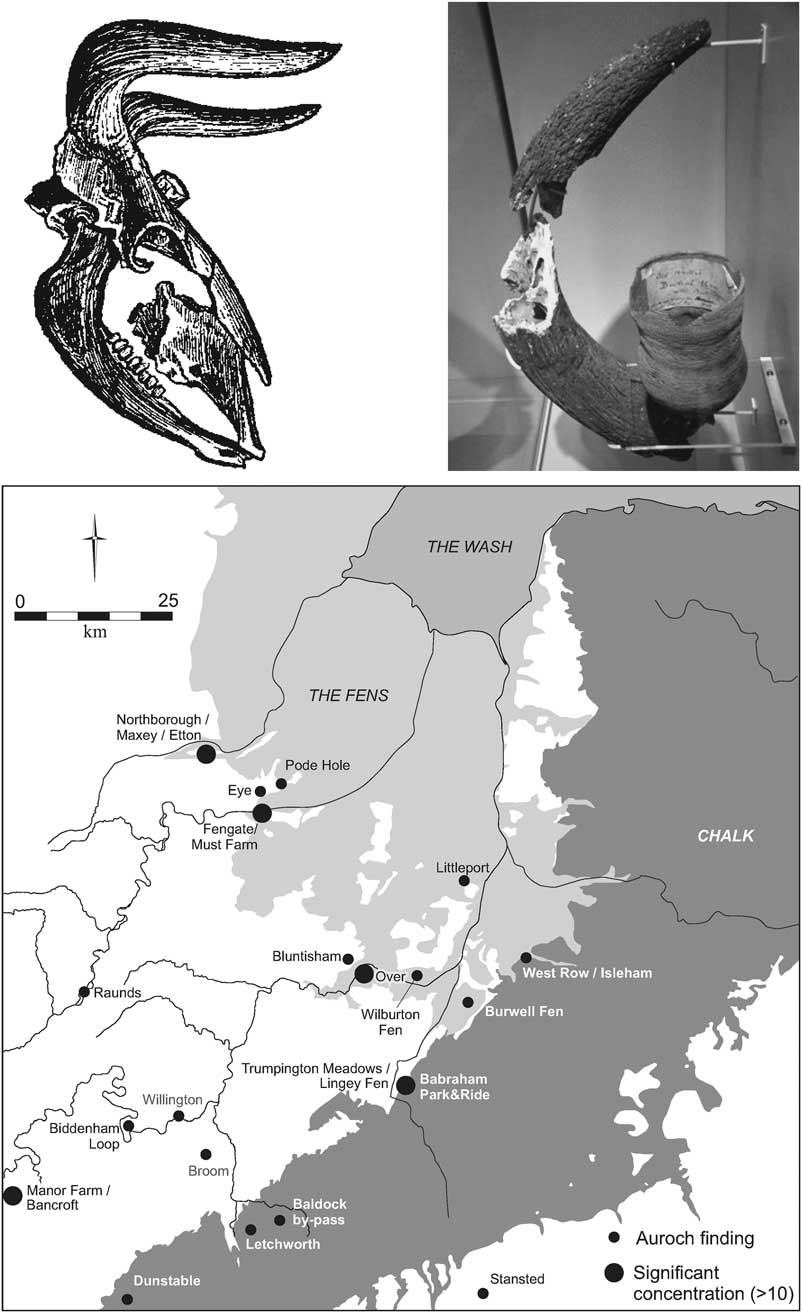


With its embedded Neolithic stone axe (Fig. 1), in many respects it is the image of the aurochs skull recovered from Burwell Fen, Cambridgeshire that has come to characterise the species’ decline (eg, Lynch et al. Reference Lynch, Hamilton and Hedges2008, 1025; Serjeantson Reference Serjeantson2011, 43–5). Yet, in recent years through developer-funded archaeology – and, with it, less emphasis on the downland monuments of Wessex – a number of earlier Bronze Age aurochs bone deposits have been recovered. It can, in fact, be argued that efforts were then made to intentionally kill them off. This potentially has enormous ramifications. Aside from insights concerning aurochs-herd dynamics, these findings therefore allow us to explore themes relating to Bronze Age communities’ attitudes towards landscape, ‘the wild’, and resources generally.
Distribution map showing main aurochs site-findings discussed in text (below) and (upper left), the Burwell Fen aurochs skull (after McKenny Hughes Reference McKenny Hughes1896). Recovered by phosphate miners in 1863, while there was apparently doubt whether the axe’s situation was fraudulent, a later adjudication by eminent geologists apparently pronounced upon its validity (see Legge Reference Legge2010, 33); the skull itself has since been dated to 3023–2491 cal. bc (BM-1525; Clutton-Brock Reference Clutton-Brock1986). (Upper right) Cambridge University Museum of Archaeology and Anthropology display of a Beaker and an aurochs horncore said to be recovered together, along with the ‘skeleton of a man in a sitting position’, from Wilburton Fen in 1847 (1919.95; see Fox Reference Fox1923, 27, pl. I). The horncore has since been dated to 1951–1456 cal. bc (BM-1524; Clutton-Brock Reference Clutton-Brock1986) and some centuries later than the likely date of the Beaker itself; therefore, their association has to be considered suspect. This dating of its bone would be close to that from Lowes Farm, Littleport, Cambridgeshire: 1741–1510 cal. bc (BM-1469; Shawcross & Higgs Reference Shawcross and Higgs1961 and Clutton-Brock Reference Clutton-Brock1986)

Without attempting to be fully comprehensive, however much the findings discussed here add to Serjeanston’s Wessex-focused review corpus (2011, 43–5) this must be gauged against the scale of recent exposures in the south-east of the country. Major tracts of land, across a variety of environmental niches – ranging from Oxfordshire’s river-terrace gravels (eg, Gravelly Guy: Lambrick & Allen Reference Lambrick and Allen2004) to Cambridgeshire’s claylands (e.g. Cambourne: Wright et al. Reference Wright, Leivers, Seager Smith and Stevens2009) – have now been investigated and have yielded no aurochs deposits whatsoever. Equally, from other huge-expanse projects, such as the route of the High Speed 1 railway (Booth et al. Reference Booth, Champion, Foreman, Garwood, Glass, Munby and Reynolds2011, 104 & 123) or the Baldock Bypass (Rackham in Phillips Reference Phillips2009, 20), only one or two such bones have been forthcoming.Footnote 1
NEOLITHIC BACKGROUND: HERD-INROADS
In order to appreciate the status of aurochs during the Bronze Age it is appropriate that their representation during the Late Neolithic in south-eastern England is first considered. Here, Pryor’s Storey’s Bar Road, Fengate, excavations (1978) is certainly one of the region’s most significant aurochs-recovery sites (see Fig. 1 for main cited locations). Associated with its Grooved Ware occupation, perhaps due to the original mis-phasing of its sequence – that site’s fieldsystem and ring-ditch originally assigned to the Late Neolithic as opposed to the Middle Bronze Age (see Evans & Pollard in Pryor Reference Pryor2001, 25–6; Evans et al. Reference Evans, Beadsmoore, Brudenell and Lucas2009, 89, fig. 3.20) – it has not received due acknowledgement. In addition to four possible wild pig specimens, some 18 aurochs bones were recovered, including radii, astragali, and metatarsals (five MNI; see Harman in Pryor Reference Pryor1978, 177–80, fig. 51 & table 60). At 30% (MNI) this is a very high representation of ‘the wild’ (with two red deer antler tines and a metatarsal of that species also present being excluded), and taking into account the site’s 26 ‘period-type’ arrowheads (Pryor Reference Pryor1978, 138–41), during the Late Neolithic it evidently served as a hunting encampment. Indeed, this interpretation is only furthered in the knowledge that from the immediate area can now also be added an aurochs metatarsal from a pit at the nearby Elliott Site (Evans et al. Reference Evans, Beadsmoore, Brudenell and Lucas2009, 75). Although not yielding any pottery, that feature was dated to 2879–2620 cal. bc (OxA-X-2182-55; Table 1) and, aside from having an oblique arrowhead amongst its flints, also had a wild boar mandible (Seetah in Evans et al. Reference Evans, Beadsmoore, Brudenell and Lucas2009, 109–10). Even more telling is that, located beside and immediately opposite the Storey’s Bar Road Site itself, the much smaller TK Packaging Plant Site included a large Grooved Ware-associated pit, wherein together with pottery, flint and animal bone, was an aurochs skull (Pryor & Trimble Reference Pryor and Trimble2000).
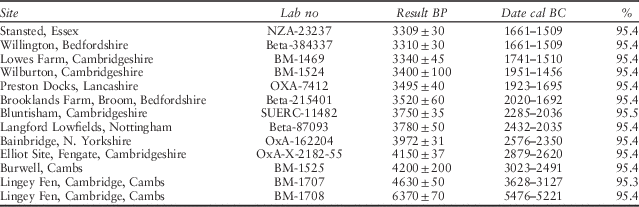
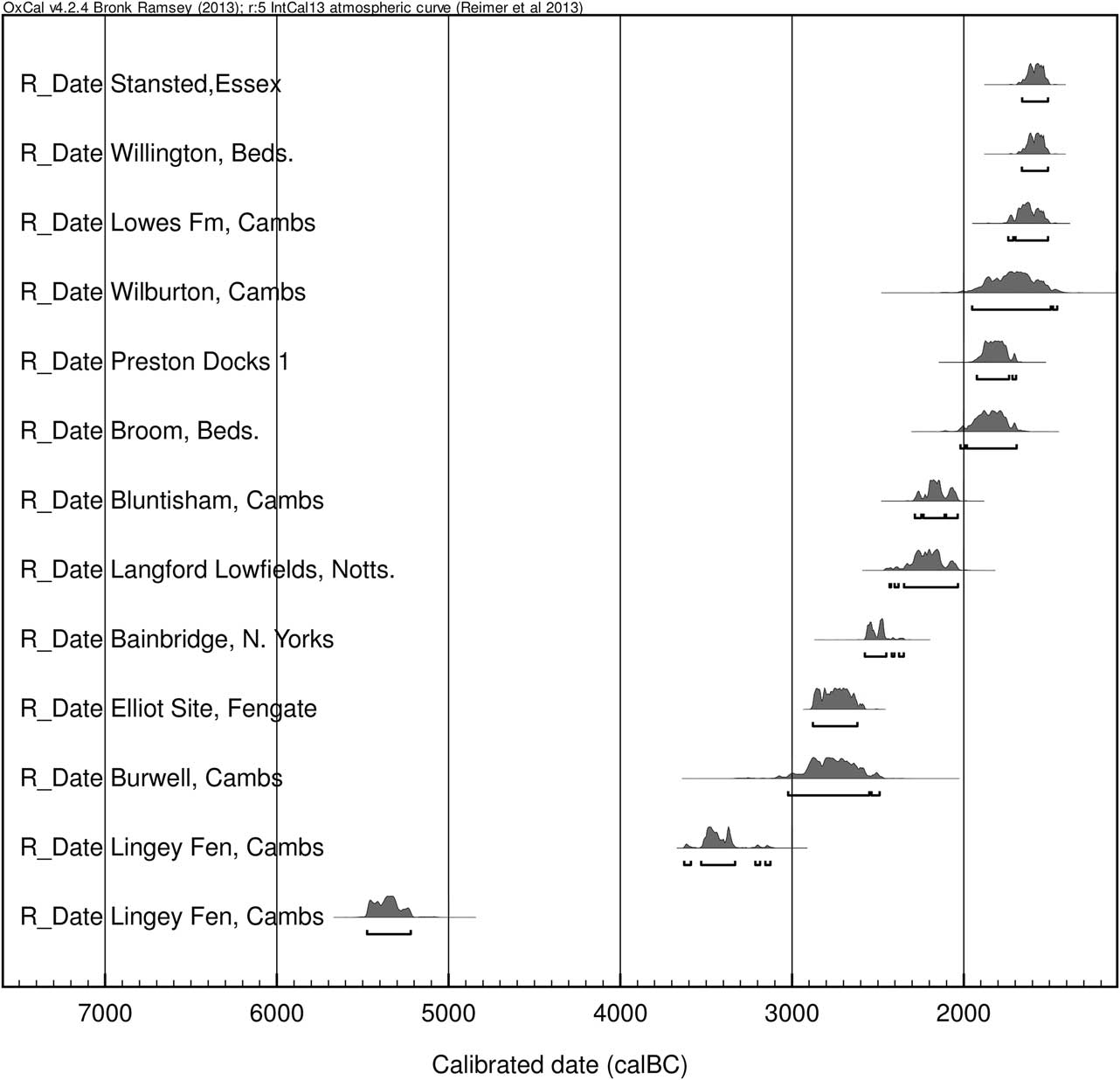
CALIBRATED RADIOCARBON DATES AT 2σ FOR PRINCIPAL AUROCHS DEPOSITS DISCUSSED IN TEXT (SEE FIG. 6)

Dates are calibrated using OxCal Online v4.2.4 (Bronk Ramsey 2013; r:5), IntCal13 atmospheric curve (Reimer et al. 2013), reservoir T=0±0.
The greater Fengate/Flag Fen Basin landscape (i.e. Lower River Nene environs) has recently produced further aurochsen findings. Thus far, five have been forthcoming from Must Farm, Whittlesey’s ‘dry’ terrace investigations (Rajkovača in Tabor Reference Tabor2010). These derive from the buried soil strata and, awaiting absolute dating, whether they relate to the site’s Late Neolithic or Early Bronze Age usage cannot be determined. However, four other aurochs bones were recovered from a tree-throw there, where they occurred with Late Neolithic flintwork and this makes it likely that all of the specimens are of that date (see Swaysland in Evans et al. Reference Evans, Brudenell, Knight and Patten2005). This attribution gains further credibility given that, in the course of the Magna Park-area evaluation, immediately to the south, among the 275 animal bones recovered from a Grooved Ware pit – including cattle, ovicaprids, pig, and red deer – were five aurochs bones (see Rajkovača & Seetah in Gibson & Knight Reference Gibson and Knight2009). Combined, therefore, the number of aurochs bones from the Fengate/Flag Fen environs currently stands at 34.
In contrast to the earlier Neolithic, the degree to which wild resource exploitation is attested in Grooved Ware sites is widely recognised (eg, Stevens & Fuller Reference Stevens and Fuller2012). Of the 15 aurochs bones recovered from the Etton causewayed enclosure – wild species only amounting to c. 1% of its more than 3120 identifiable animal bones – none was from its primary ditch contexts (Armour-Chelu in Pryor Reference Pryor1998, 273–88). Twelve were from either the Phase 2 fills of its circuit or the enclosure’s interior cut features, with most seemingly attributed to its later Neolithic/Grooved Ware-associated usage, including a double aurochs-skull pit deposit (Pryor Reference Pryor1998, 45, figs 47–50; see Ainsley & Wallace in French & Pryor Reference French and Pryor2005, 79–85 & 147–50 concerning the findings from the greater Etton landscape: six specimens in total).Footnote 2
The region’s Grooved Ware sites also show distinct economic-base variability, with not all having significant evidence of hunting. To some degree, this is apparent at Fengate itself. At the recently excavated Edgerley Drain Road Site, 0.9 km north from the Storey’s Bar Road area (Evans et al. Reference Evans, Beadsmoore, Brudenell and Lucas2009, 124–31), a 34-pit Grooved Ware occupation was investigated. While admittedly only generating a limited assemblage, no wild species were identified within its faunal remains (nor did cereals feature within its plant remains, as they did from all the other prehistoric phases on the site, including Early Neolithic, Beaker, and Collared Urn).
More convincingly as regards Grooved Ware-associated subsistence variability is the evidence from Barleycroft/Over on the River Great Ouse (Evans et al. Reference Evans, Tabor and Vander Linden2014). Of the now many pit clusters of that period that have been dug there (summarised in Garrow Reference Garrow2006, 80–118), aurochs occurred within three of the five clusters at Over Site 2. With 17 such specimens there recovered (including scapula, metatarsal, phalanx, and vertebra), in two of the clusters these coincided with wild pig bones (four total) and which also had the greatest number of red deer elements (nine each). Generally within the site’s Late Neolithic contexts, domestic species account for 66% (NISP; 53% MNI), and in the individual pit cluster-groupings the proportion of ‘the wild’ varied between 25% and 42% (NISP). Mention should also be made that, occurring singularly, two further aurochs bones have also been recovered from other of that project’s sites: associated with a Mesolithic lithics scatter and one deriving from another Grooved Ware-attributed pit cluster (Evans et al. Reference Evans, Tabor and Vander Lindenforthcoming).
One other area within the region has now also yielded substantive aurochs remains: the greater Addenbrooke’s landscape alongside the River Cam south of Cambridge (Evans et al. Reference Evans, Mackay and Webley2008, 141–6, fig. 3.1). There, with separate specimens dated to 5476–5521 and 3628–3127 cal. bc (BM-1708 & -1707; Table 1 & Fig. 6), aurochs bones had been retrieved from a deep riverside cutting in Lingey Fen during construction of the M11 motorway (see Legge in Pullinger et al. Reference Pullinger, Heal and Legge1982) and recently, beside the river at Trumpington, a burial within an Early Neolithic barrow was accompanied by three articulated aurochs foot bones (Rajkovača in Patten Reference Patten2012). The aurochs bone assemblage from the nearby Babraham Road Park-and-Ride Site, located at the foot of the Gog Magog Hills, involved 45 pieces, apparently largely derived from Late Neolithic contexts (ie, none from definite Early and Middle Bronze Age contexts; Hinman Reference Hinman2001, Baxter Reference Baxter2007; see also Lynch et al. Reference Lynch, Hamilton and Hedges2008).
In addition to the above-outlined landscape-area concentrations – Barleycroft/Over on the Ouse, Etton/Maxey, the greater Fengate/Flag Fen Basin, and Addenbrooke’s environs (Rivers Nene and Cam respectively) – in recent years impressive aurochs bone assemblages have been forthcoming from river palaeochannel investigations. Amounting to seven such specimens in the case of the Old Wolverton Quarry at Manor Farm, Milton Keynes (6% NISP, along with 39 red deer, 34 cattle, and 15 horse elements), these are unfortunately still undated. The deposits, though, lay adjacent to a cursus complex, whose ditches have yielded two definite aurochs bones (plus another from a tree-throw and four possible candidates from other features; see Hogan Reference Hogan2013). Aurochs bone featured amongst the assemblage of wild and domesticated animal bones that was part of an extraordinary ‘log-jam’ deposit within a former channel of the Trent at Langford Lowfields, Nottinghamshire, and which also included 13 human skulls. Apparently only one bone from it was dated, to 2432–2035 cal. bc (Beta-87093; Table 1 & Fig. 6); if representative of the whole, this would assign the assemblage to the cusp of the Late Neolithic/Early Bronze Age (Garton et al. Reference Garton, Howard and Pearce1996; Knight & Howard Reference Knight and Howard2004, 54–5).Footnote 3
Finally, in this capacity mention needs to be made of what sites within Bedfordshire have otherwise yielded aurochs bones. Aside from their occurrence within Grooved Ware pits at Puddlehill, Dunstable (Field et al. Reference Field, Matthews and Smith1964; Matthews Reference Matthews1976), more recently, a horncore featured within a later Neolithic pit-shaft in the Biddenham Loop investigations (Luke Reference Luke2008, 84–5 & 92, pl. 5.2; see also Legge et al. in Moss-Eccardt Reference Moss-Eccardt1989, 90–5 concerning Blackhorse Lane, Letchworth’s remains).
BRONZE AGE DEPOSITS: ERADICATION?
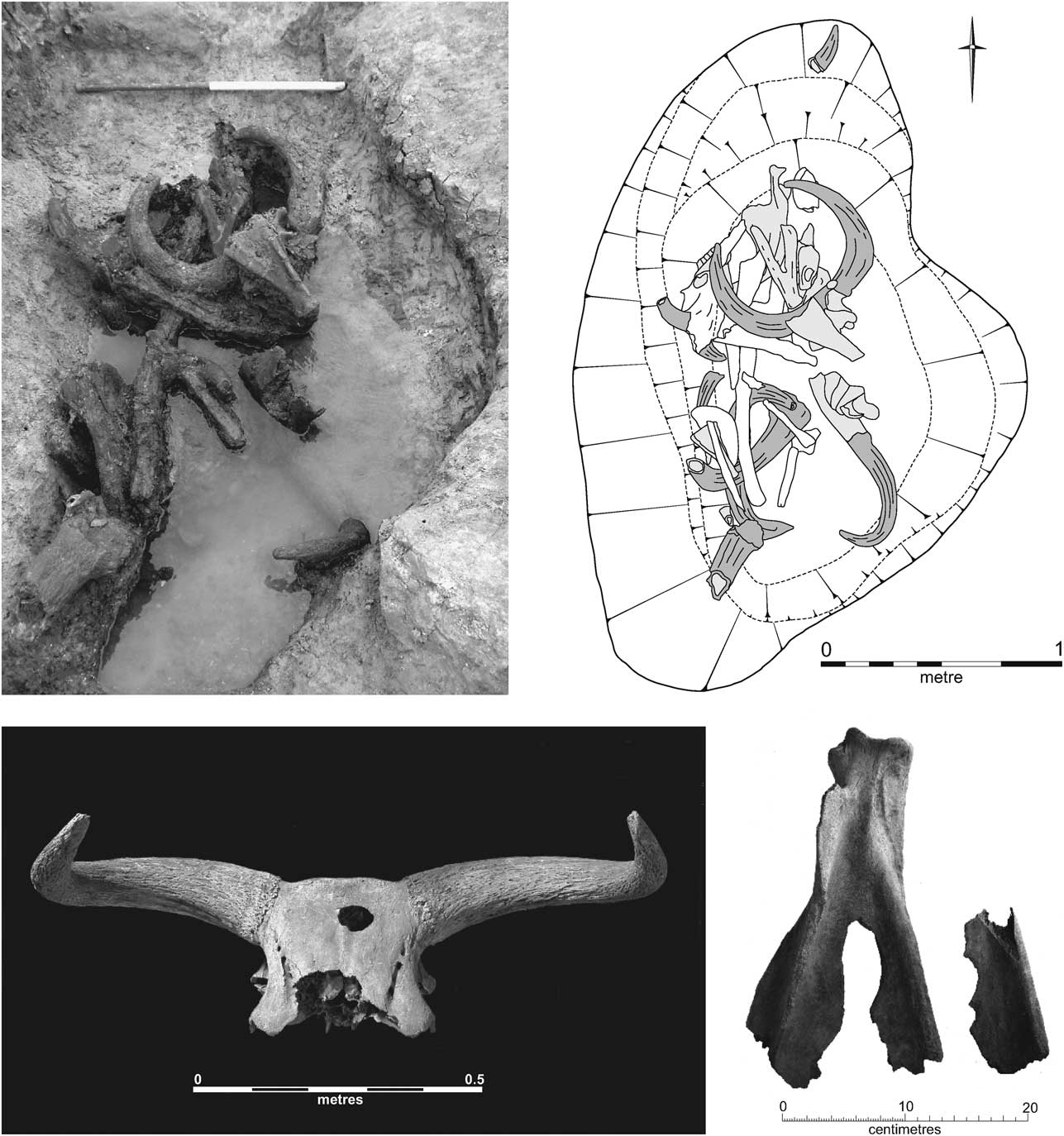
Having scene-set the Neolithic background we can now appropriately discuss the recent Bedfordshire aurochs bone-deposit findings. The first was forthcoming from Brooklands Farm, Broom, on the gravel terraces of the River Ivel south of Sandy (Fig. 1; Cooper & Edmonds Reference Cooper and Edmonds2007, 48–53). This predominately Early Bronze Age (sub-)site involved a cluster of pits and post-holes associated with a burnt flint and stone spread. Fifty-five sherds of Collared Urn were recovered from one of its burnt stone pits, which was dated to 1876–1617 cal. bc (Beta-205561). The aurochs deposit came from a large waterlogged pit (F.1091; Fig. 2). Within its primary fill were the posterior-part skulls and horncores of five aurochs – three adult males, a juvenile male, and an adult female – as well as a domestic cow. Aside from a limited number of other domestic cattle bones, these were accompanied by burnt planks; the elements seemingly jumbled together in the base of the feature, with no obvious indication of careful placement. Though the evidence is not definite, at least two of the aurochs were thought to have been killed by pole-axing, with their crania punctured by circular holes (Fig. 2). An attempt was made to date the bone itself, but this failed and instead an assay had to be obtained from one of the pit’s timbers: 2020–1692 cal. bc (Beta-215401, Table 1 & Fig. 6). Interpreting the deposit, the authors noted that the age and sex structure of its aurochs would not reflect the behavioural grouping of modern wild cattle and, instead, the ritual context of the remains as ‘trophies’ was stressed.
The Broom Quarry, F.1091 pit-deposits, with pole-axed aurochs skull (lower left); bottom right, Eye Quarry’s perforated aurochs scapulae

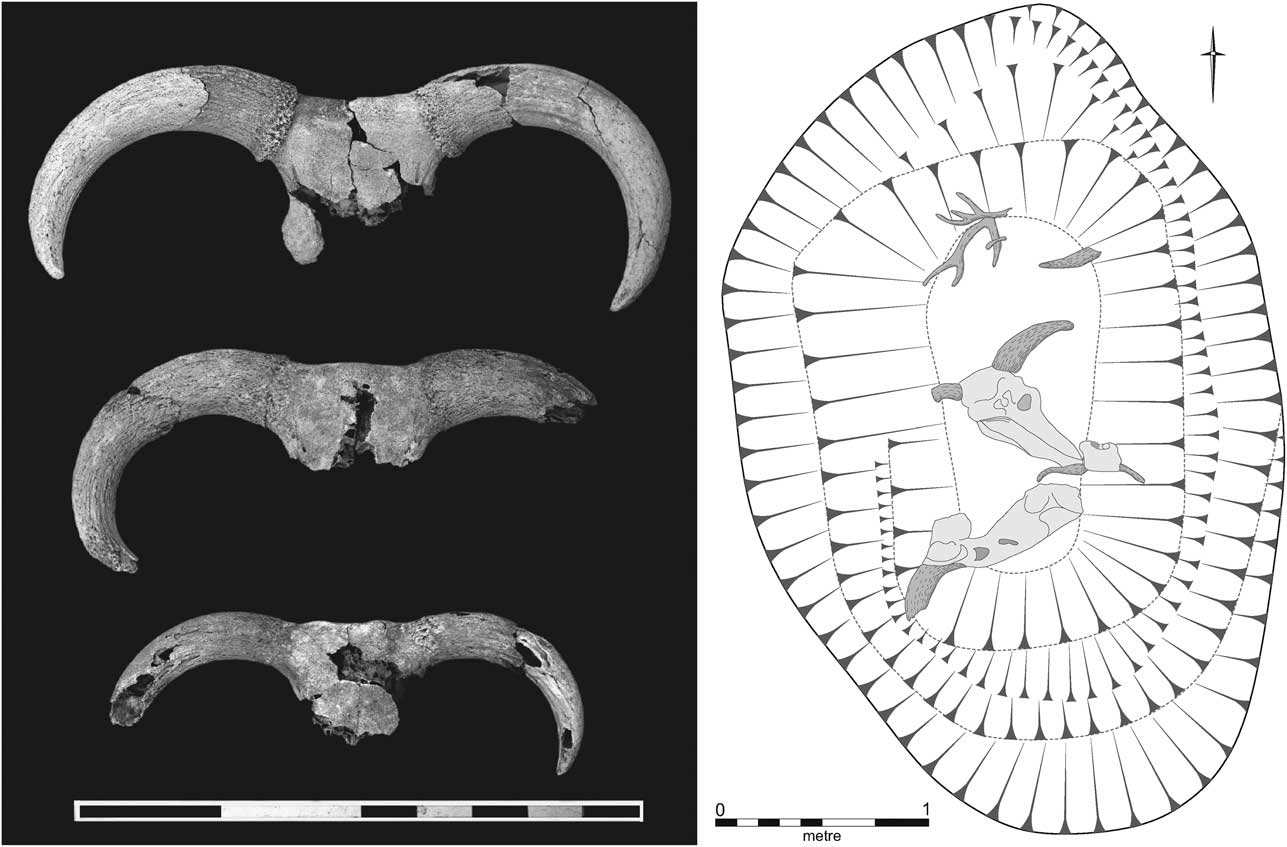
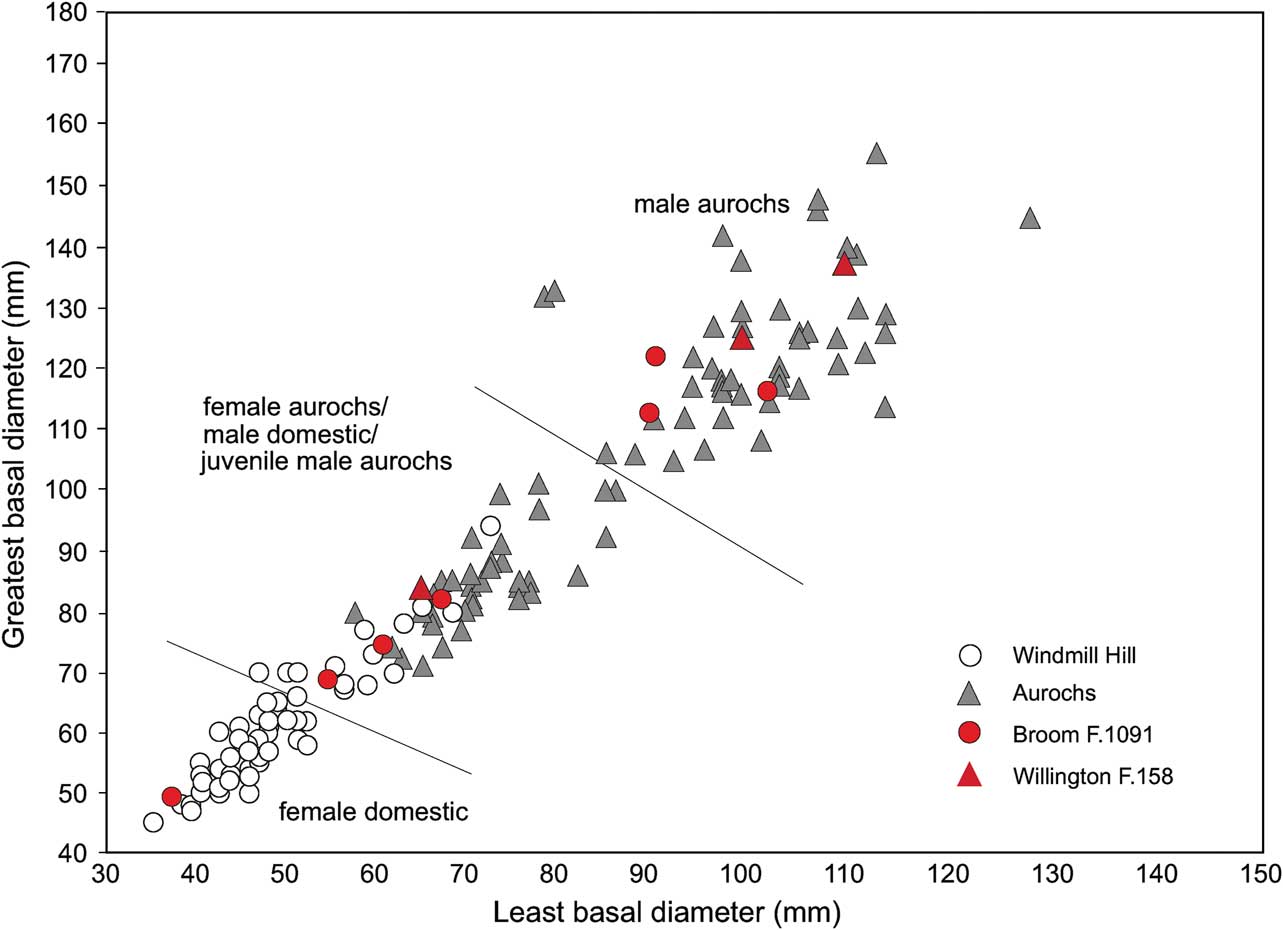
The second such aurochsen skulls finding is from the on-going quarry excavation programme at Dairy Farm, Willington, on the gravel terraces immediately north of the River Great Ouse west of Bedford and Cardington (Fig. 1). With both Upper Palaeolithic and Late Mesolithic lithic scatters excavated, as well as two Beaker burials, the area includes a number of earlier Bronze Age ring-ditches/barrows that are ‘boxed’ by the axes of a Middle Bronze Age fieldsystem. Along the site’s north edge was dug a large pit with Early Bronze Age pottery recovered from its upper fills (F.158); 1.40 m deep, this was probably a watering-hole (Fig. 3). In addition to two red deer antlers, within its basal fills were three aurochs skulls and a horncore. These seemed to be an ‘aftermath’ deposit; with no evidence of arranged placement, they appear simply to have been thrown into the feature upon its abandonment as a well. Studied by Vida Rajkovača, though the remains were fragmentary and it proved impossible to distinguish any butchery marks or pathological changes, large portions of occipital and frontal bones survived. Two were noticeably larger, with one, probably a female, somewhat smaller in size (Fig. 4). For the specific purposes of this study, bone from one of the skulls was submitted for dating and an assay of 1661–1509 cal. bc was achieved (Beta-384337; Table 1 & Fig. 6).
Aurochs from Willington Quarry F.158

Scatter diagram showing horncore measurements for aurochsen from Broom and Willington (modified after Ellis Reference Ellis2004, fig. 38, with aurochs measurements from Bökönyi Reference Bökönyi1972 and, for Windmill Hill, Grigson Reference Grigson1999)

In recent years there have been other ‘late’ aurochs pit findings, though these are rather less dramatic than the two Bedfordshire pits. This includes three such bones amongst the 3 kg of animal recovered from a large, Early Bronze Age pit at Pode Hole Quarry, Thorney, radiocarbon dated to 1950–1750 cal. bc (SUERC-12095; Daniel Reference Daniel2009, 19). Possibly occurring residually in a Late Bronze Age waterhole pit-context, only one other bone of that species was recovered there: a poorly preserved radius. Interestingly, there was a somewhat higher than average representation of hunting within that site’s Bronze Age assemblage, with 41 deer bones recovered; of these, though, 28 were antler (Rackham in Daniel Reference Daniel2009, 134–7; see also Olsen Reference Olsen1994 concerning the earlier recovery of an aurochs distal humerus from the Early Bronze Age settlement at West Fen Row, Mildenhall).
Although not as yet absolutely dated, four aurochs bones occurred within the 8.8 kg animal bone assemblage recovered from a Collared Urn-attributed pit-well nearby at Eye Quarry, west of Peterborough and also located on the Thorney ‘terrace-peninsula’ (see Gibson & Patten in Evans et al. Reference Evans, Beadsmoore, Brudenell and Lucas2009, 51, fig. 2.17 for summary). Aside from a femur and a metatarsal, there were two scapulae blades. The latter were both perforated (Fig. 2), possibly suggesting that the meat was hung for curing (Rajkovača in Patten Reference Patten2009, 74). This would though be a technique more widely associated with later-period processing practices and, pending further study, the evidence must be considered equivocal.
Given the enormous scale of exposure at Heathrow Terminal 5, it is surprising that aurochs was found in only one of its features. Generically dated to 1700–1150 BC, along with 26 red deer elements (plus three cow bones and another from a ‘large mammal’), 23 specimens occurred within one of its waterholes (180101; Framework Archaeology 2006, 136–7). These nonetheless resonate with the widely cited aurochs pit-deposit at Holloway Lane, west London (Cotton et al. Reference Cotton, Elseden, Pope and Rayner2006). Essentially dated to the Early Bronze Age on the basis of its flintwork, there six barbed-and-tanged arrowheads accompanied the largely complete, but dismembered, carcass of a young aurochs in the base of the feature, which together is held to have been a ritual deposit.Footnote 4
As regards the potential ritual status of aurochs, the employment of their remains within the burial of this period seem rare and the occurrence of aurochs bone within barrows seems to have been ‘incidental’ (eg, Ring-ditch 611 & Barrow 12 at Barrow Hills, Oxfordshire: Barclay & Halpin Reference Barclay and Halpin1999, 37, 44, 110, 111 & 272).Footnote 5 Possibly attesting to a lingering animal-species survival, the recovery of an aurochs tibia from the circuit of a small, Middle Bronze Age ring-ditch/barrow at Stansted can only be considered intriguing. While a radiocarbon assay of 1661–1509 cal. bc was achieved from wood in its ditch’s base (NZA-23237; Table 1 & Fig. 6), the bone itself was not dated and could potentially have been curated (Cooke et al. Reference Cooke, Brown and Phillpotts2008, 59 & 64). Generally though, while aurochs skulls are known from Neolithic barrows, they do not occur as such in Bronze Age burials with their various accompanying cattle head-and-hooves offerings (Piggott Reference Piggott1962; eg, Brück Reference Brück2004, 322–5; Serjeantson Reference Serjeantson2011, 70–3). Even the extraordinary bone deposit overlying a Beaker burial within the Raunds Project’s Irthlingborough Barrow 1 – located along the River Nene near Stanwick, Northamptonshire – included only one aurochs skull as opposed to 184 of domestic cattle (Davis & Payne Reference Davis and Payne1993; Harding & Healy Reference Harding and Healy2007, 29 & 153).Footnote 6
EXTINCTION AND LAND-USE DYNAMICS
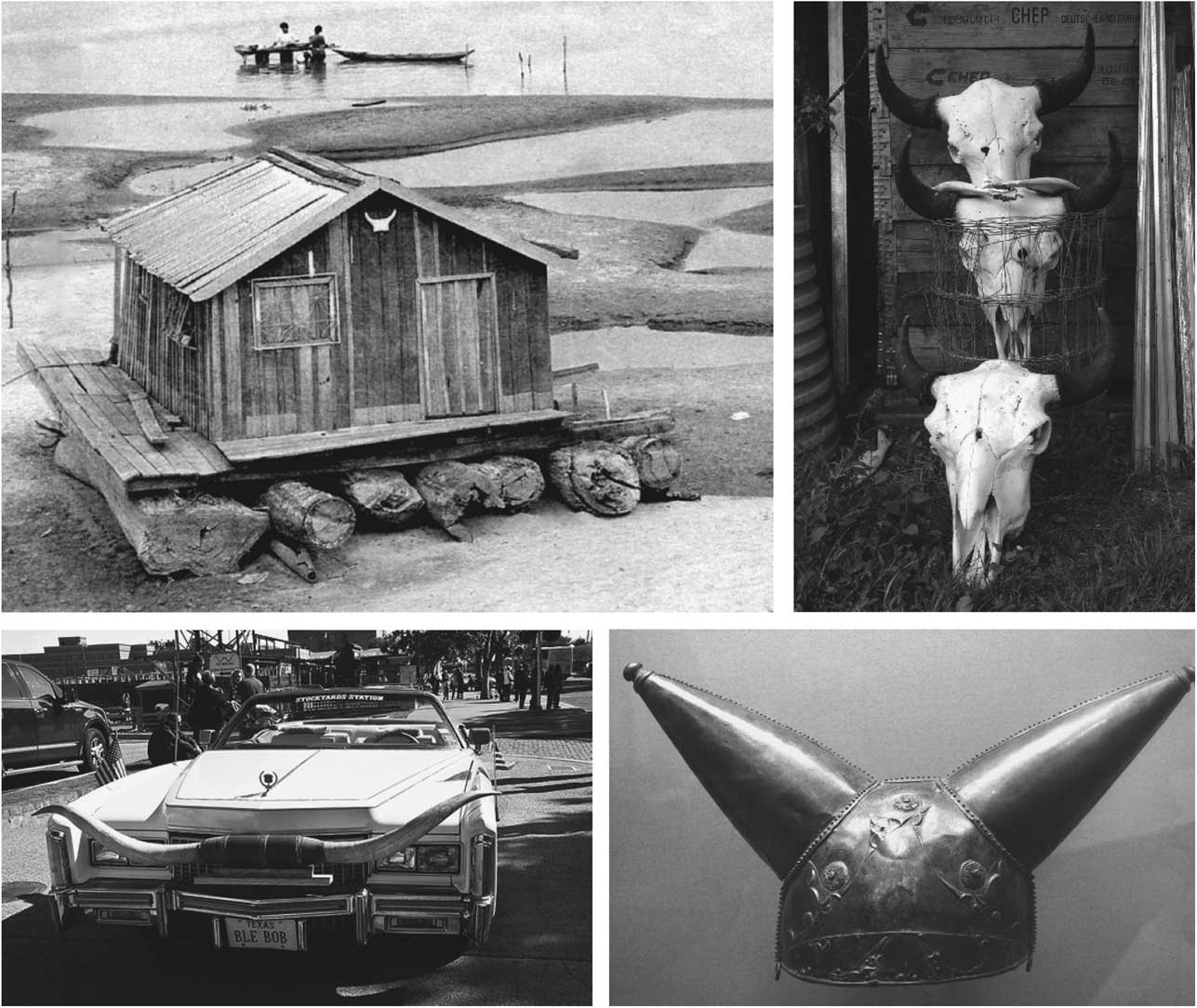
With males weighing some 1000 kg, the pursuit of aurochs would have been daunting: ‘The killing of an aurochs by an individual or a small group would have been more dangerous than the killing of a bear. It may well have represented the most dangerous activity which could be undertaken’ (Serjeantson Reference Serjeantson2011, 44).Footnote 7 Accordingly, Broom and Willington’s earlier Bronze Age multiple aurochs skull deposits would surely have had a symbolic dimension; it being highly unlikely that they were all killed at once and a degree of trophy-collection seems implicit (see Fig. 5). Yet, as outlined above, aurochs remains seem only to have had a very limited role in the main ritual venues of this period: barrows. Perhaps this was just a matter of categorisation and a different appraisal of ‘the wild’ at that time (see eg, Brittain & Overton Reference Brittain and Overton2013 on ‘interspecies participation’). Yet, even if reflecting a degree of short-term trophy-curation, what still must be most significant is that the remains of so many aurochs were deposited at once.
Trophies: (upper left) a cattle skull displayed on the gable-end of house beached though drought in the Amazon in 2006 (see Evans et al. Reference Evans, Appleby, Lucy and Regan2013, fig. 3.63; Duckworth Reference Duckworth1905 discussed the ‘real’ animal-head sources of traditional carved gable-end animal motifs; and see also Gidney Reference Gidney2013, 38–49 on aurochs ‘trophy heads’); (upper right) wild bison skulls stacked beside a barn in Als, Denmark, June 2014 (the farmer in this case ‘keeping’ a wild herd; T. Vestergaard); (bottom left) a longhorn adorned Cadillac at Fort Worth, Texas’ cattle exchange (October 2011); (lower right) the ‘horned’ Iron Age Waterloo helmet (British Museum). Of these, it is the causal retention and display of the Als bison skulls that might provide some parallel for the aurochs skull pit-deposits at Broom and Willington Quarries

The possible pole-axing of two of Broom’s aurochsen does, of course, itself pose major questions. It might suggest that at least some of these animals were not so ‘massively’ wild that they could not be captured; alternatively, they may have simply been dispatched by this kill-technique once, upon wounding, they had fallen to ground. This equally raises the possibility that attempts may have then been made to incorporate aurochsen into domestic herds. The emphasis here must, though, be on ‘attempts’. Any resultant offspring are unlikely to have produced milk and could even risk that their increased size would lead to unsuccessful births (Serjeantson Reference Serjeantson2011, 45; see also Legge Reference Legge2010, 32–3 and Gidney Reference Gidney2013); more relevant, recent genetic studies indicate that there was no domestication of the European aurochs (Edwards et al. Reference Edwards, Bollongino, Scheu, Tresset, Vigne, Baird, Larson, Ho, Heupink, Shapiro, Freeman, Thomas, Arbogast, Arndt, Bartosiewicz, Benecke, Budja, Chaix, Choyke, Coqueugniot, Döhle, Göldner, Hartz, Helmer, Herzig, Hongo, Mashkour, Ozdogan, Pucher, Roth, Schade-Lindig, Schmölcke, Schulting, Stephan, Uerpmann, Vörös, Voytek, Bradley and Burger2007). Whilst acknowledging other potential interpretations, the crucial issue remains the number of aurochsen within these Bronze Age pit deposits and whether this attests to their intentional kill-off. Quite simply, with the greater investment in land and presumably more intensified agriculture practise as marked by the advent of fieldsystem landscapes, there may have been a greater desire to control – if not eradicate – the ‘chaotic wild’.
Communities would not have wanted aurochsen trampling their crops (see eg, Uerpmann Reference Uerpmann1977), nor attempting to potentially breed with their domesticated stock. Admittedly, many of the Bronze Age aurochs deposits discussed here pre-date what is now widely held to be the c. 1600–1500 cal. bc fieldsystem ‘horizon’ (ie, Middle Bronze Age; Yates Reference Yates2007). However, the scale of Early Bronze Age agriculture is becoming ever more apparent (eg, Evans et al. Reference Evans, Tabor and Vander Lindenforthcoming), with diverse modes of plot-division also attested.Footnote 8 As opposed to subsequent periods, it can be difficult to detect its occupation traces and, at times, even distinguish settlement associated with ‘Middle-phase’ fieldsystems. The increasing density of later 3rd and 2nd millennium bc settlement and, with it, population, must nevertheless have been sufficiently high to utterly transform local environments.
Against this, a pressing issue is whether Bronze Age hunting, combined with a loss of habitat through the expansion of settlement, fieldsystems, and the decline of ‘wildwood’ generally – and against a background of locally intense Late Neolithic hunting – would actually account for the complete extinction of aurochs during the 2nd millennium bc (see, eg, Yalden 1999, 104–11, fig 4.7 & table 4.2). By what seems to be the far greater intensity of the period’s landscape ‘footprint’ in southern Britain, the animals’ lingering survival into the 1st millennium within, at least, northern England and Scotland seems possible. If so, the non-recovery of such specimens is probably due to more limited excavation there, poor bone preservation generally, and that hunting was simply much less practised during the Iron Age.Footnote 9 As regards potential late survivals, there is clearly a pressing need to absolutely date aurochs bone occurring in post-Early Bronze Age contexts in southern England, such as the above-mentioned bone within one of Pode Hole’s Late Bronze Age waterholes. To this could also be added a single aurochs atlas occurring in a Late Bronze/Early Iron Age context at Bancroft, Buckinghamshire (Holmes & Rielly in Williams & Zeepvat Reference William and Zeepvat1994), with two aurochs bones also recorded from later Bronze Age midden deposits in the Etton landscape investigations (French & Pryor Reference French and Pryor2005, 81).Footnote 10
The now rapidly accruing evidence could also suggest that aurochs herd-range adaptability was relatively restricted and, if only residing in small groups, they had limited herd-recovery capability following sustained hunting-loss. This could be inferred from the fen-edge site results. Where there is evidence of sustained Late Neolithic activity and contemporary aurochs hunting – such as at Fengate and Barleycroft/Over – then aurochs do not feature in subsequent Bronze Age phases in those immediate landscapes. Conversely, in the Thorney area (c. 3 km north-east of Fengate), whose now large-scale site-exposures seem without evidence of any substantive Late Neolithic, aurochs occur in Bronze Age features on some sites (ie, Pode Hole and Eye Quarries). Obviously, the available examples are too few to be definitive; nonetheless, the landscape-exposures of neither of the two Bedfordshire Early Bronze Age findings – Willington and Broom – have yet to register a significant Late Neolithic presence.
The location of the Bronze Age bone-deposit findings discussed here could be seen as lending support to the suggestion arising from isotope studies that aurochs predominantly inhabited floodplain and wetland environments (see Hall Reference Hall2008 and Lynch et al. Reference Lynch, Hamilton and Hedges2008), as opposed to the continental woodland habitats as cited by classical sources (eg, van Vuure Reference Vuure2005).Footnote 11 With so much of this material now variously recovered from fen-edge and river gravel quarry sites, this must though be acknowledged as an inherently biased sample. That said, river valleys would have been somewhere that these animals and humans came into regular contact through watering needs and landscape-corridor movement. Equally, the paucity of aurochs bone forthcoming from recently investigated ‘inland’ clay geology sites, whose ‘heavy’ landscapes seem generally to have only been significantly colonised during the Bronze Age and have carried extensive woodland cover probably up until at least the Iron Age, might also further support this evidence for aurochs-habitat propensity (ie, if aurochs did not favour river valleys then, by now, their traces should register more markedly within ‘interior’/off-river valley locations).
In relationship to more general species-locale issues, whereas the Fenland site-derived bone could be considered as reflective of marginal environmental survival (especially with the expansion of marshland conditions there during the 2nd millennium bc; Waller Reference Waller1994), the same is certainly not true of the recent Bedfordshire finds and by no means can its monument-dotted river valleys then have been marginal lands (see Fig. 1). Put another way, if only having the Fenland data then the idea of its marshes serving as an environmental refuge during the Bronze Age – with, along with humans, the impact of its marine flooding accelerating aurochsen extinction (see Evans Reference Evansforthcoming) – could be posited. This reasoning does not, though, seem applicable in the light of the Bedfordshire findings.
If what is being seen was an attempted Bronze Age aurochs kill-off, then this is not how we want our prehistory to be. Prehistoric communities are commonly envisaged as if they were spiritually imbued custodians of the land. This, however, flies in the face of the evidence from Bronze Age Britain, with the enormous expanses of its apparently short-lived fieldsystems (Yates Reference Yates2007), the many hundreds of thousands of timbers involved in, for example, Flag Fen’s construction (Pryor Reference Pryor2001) or the tracts of land deturfed through barrow construction (Woodward Reference Woodward2000, 52). Raising this is to verge into the territory of Krech’s The Ecological Indian arguments (1999; see also responses in Harkin & Lewis Reference Harkin and Lewis2007) and the question of whether past indigenous societies consciously tended resources to maintain ‘balance’, or if they maximised ‘takes’ within the limits of their technologies (eg, mass buffalo-jump kills or fire-aided hunting). In other words, did they, in effect, take all the prey they encountered?
It certainly seems difficult to see the inhabitants of southern Bronze Age Britain as any kind of environmentally sensitive ‘managers’ of the land (see Holst et al. Reference Holst, Raumussen, Kritiansen and Bech2013 concerning contemporary Danish ecological ‘overload’). Although aurochs hides and meat would surely have been utilised, there seems no question of them being hunted down for the purposes of wholesale resource exploitation in, for example, the manner of the North American buffalo. Their eradication might rather have been more akin to that of wolves in much of Europe (Pluskowski Reference Pluskowski2010); increasingly perceived of as a threat to crops, domestic herds, and people, they simply may have been seen as too much of a nuisance to share landscapes with. To this end, it is a matter of little consequence whether there was a ritual/symbolic content to the multiple-skull deposits discussed here. Killed by whatever motivation – spiritual or pragmatic – what ultimately counts are the results of social actions upon the world: here, the effective eradication of the aurochs as a species within Britain.
While much of what is offered here is admittedly speculative, it is crucial to recognise that our fieldwork results have the ability to engage with such now pressing public issues as mass-species extinction (eg, Monbiot Reference Monbiot2013; Kolbert Reference Kolbert2014).Footnote 12 Indeed, with archaeology singularly able to address long-term time/change, environment and culture, there surely is an onus upon us to deploy our data so that its interpretation amounts to something other than just now oft-repetitive landscape narrative ‘stories’ (see Evans Reference Evans2013).
Probability distributions of dates from principal aurochs deposits discussed in text (see also Lynch et al. 2008; dates calibrated using OxCal Online v4.2.4 (Bronk Ramsey 2013; r:5), IntCal13 atmospheric curve (Reimer et al. 2013), Reservoir T = 0±0).

Acknowledgements
A good friend and colleague, had Tony Legge still been alive this paper would only have benefitted from what would surely have been his due critique. As it is, its contents variously reflects information supplied by, and discussions with, Umberto Albarella, Philip Armitage, Miranda Armour-Chelu, Alistair Barclay, Marcus Brittain, Craig Cessford, Kasia Gdaniec, Frances Healy, Gill Hey, Lorrain Higbee, Cornelius Holtorf, Mark Knight, Ian Meadows, Sarah Percival, Josh Pollard, Elizabeth Popescu, Vida Rajkovača, Dale Serjeantson, Chris Swaysland and Torben Vestergaard. Mention should be made that the radiocarbon dating of the Cambridge University Museums’ aurochs – Burwell and Wilburton Fens’ – was originally organised by Dr C.A. Shell in the late 1970s. The paper’s graphics attest to the well-honed skills of Andy Hall; also at the Cambridge Archaeological Unit, Dave Webb is responsible for its studio photography.