












1 Introduction
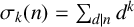
For any integer k and any positive integer n, let
$\sigma _k(n)=\sum _{d\mid n}d^k$
 . For any prime p and any positive integer m, let
$\nu _p(m)$
 be the largest integer
$\alpha $
 such that
$p^\alpha \mid m$
 . We investigate the p-adic valuation of
$\sigma _k(n)$
 . For any real number x, let
$\lceil x\rceil $
 denote the least integer not less than x. In 2021, Amdeberhan et al. [Reference Amdeberhan, Moll, Sharma and Villamizar1] proved that
$\nu _2(\sigma _1(n))\le \lceil \log _2n\rceil $
 for all positive integers n, and that, for any odd prime p and any positive integer n,
$\nu _p(\sigma _1(n))\le \lceil \log _pn\rceil $
 if n satisfies one of the following conditions:
-
(1) every prime q dividing n satisfies $\nu _p(\sigma _1(q^{\nu _q(n)}))\le \lfloor \log _p(q^{\nu _q(n)})\rfloor $
 ;
-
(2) every prime q dividing n which satisfies $\nu _p(\sigma _1(q^{\nu _q(n)}))=\lceil \log _p(q^{\nu _q(n)})\rceil $
is less than p; -
(3) there is a unique prime $q>p$
dividing n such that
$\nu _p(\sigma _1(q^{\nu _q(n)}))=\lceil \log _p(q^{\nu _q(n)})\rceil $
.


Recently, Zhao and Chen [Reference Zhao and Chen6] proved this unconditionally, that is, that for any odd prime p and any positive integer n,
$\nu _p(\sigma _1(n))\le \lceil \log _pn\rceil $
 . For more information about p-adic valuations of arithmetic functions, see [Reference Chen and Tang2, Reference Hong, Zhao and Zhao3, Reference Qiu and Hong5, Reference Zhao, Zhao and Hong7].
In this paper, the following results are proved.
Theorem 1.1. For any prime p, any positive integer
$k\ge 2$
 and any positive integer n, we have
$\nu _p(\sigma _k(n))\le \lceil k\log _p n\rceil .$

Let
$F_n=2^{2^n}+1\ (n = 0, 1, 2,\ldots $
 ) be the Fermat numbers. We call
$F_n$
 a Fermat prime if
$F_n$
 is a prime. For
$n = 0, 1, 2, 3, 4$
 , we can easily verify that the
$F_n$
 are all primes and these are the only known examples of Fermat primes.
Theorem 1.2. Let p be an odd prime. Then, there are an integer
$k\ge 2$
 and a prime q satisfying
$\nu _p(\sigma _k(q))=\lceil k\log _pq\rceil $
 if and only if p is a Fermat prime.
Theorem 1.3. Given a positive integer
$k\ge 2$
 , an odd prime p and a prime q, there is at most one positive integer l such that
$\nu _p(\sigma _k(q^l))=\lceil k\log _pq^l\rceil .$

2 Proofs
For any odd prime p, let

Lemma 2.1 [Reference Zhao and Chen6].
Let p be an odd prime, and let
$w,m,r,s$
 be positive integers with
$w\ge 2$
 ,
$m\ge 2$
 and
$r<p$
 such that

Then, m is the order of w modulo p. In particular,
$p\nmid w-1$
 and
$m\mid p-1$
 . If
$d\mid m$
 and
$1\le d<m$
 , then

Lemma 2.2. Let p be an odd prime, q a prime and
$k,l$
 two positive integers. If
$\sigma _k(q^l)\in T_p$
 , then
$p\nmid q^k-1$
 and
$l+1$
 is the order of
$q^k$
 modulo p. In addition,
$l+1$
 is a prime divisor of
$p-1$
 .
Proof. If
$\sigma _k(q^l)\in T_p$
 , then we may write

By Lemma 2.1,
$p\nmid q^k-1$
 ,
$l+1\mid p-1$
 and
$l+1$
 is the order of
$q^k$
 modulo p. Let
$d\mid l+1$
 and
$1\le d<l+1$
 . By Lemma 2.1,

Then,
$d=1$
 , so
$l+1$
 is a prime. This completes the proof of Lemma 2.2.
Lemma 2.3. Let
$p,q$
 be two primes and
$k,l$
 be two positive integers with
$k\ge 2$
 . Then,
$\nu _p(\sigma _k(q^l))=\lceil k\log _pq^l\rceil $
 if and only if
$\sigma _k(q^l)\in T_p.$

Proof. Write

where t is a positive integer and s is a nonnegative integer. If
$\nu _p(\sigma _k(q^l))=\lceil k\log _pq^l\rceil $
 , but
$\sigma _k(q^l)\notin T_p$
 , namely
$t\ge 2$
 , then

This is a contradiction. In contrast, if
$\sigma _k(q^l)\in T_p$
 , then
$t=1$
 . It follows that

and

Now,
$p^{s-1}<q^{lk}<p^s$
 , so
$\nu _p(\sigma _k(q^l))=s=\lceil k\log _pq^l\rceil .$
 This completes the proof of Lemma 2.3.
Lemma 2.4 [Reference Mihăilescu4].
Catalan’s equation
$x^m-y^n=1$
 has no other solution in positive integers except
$3^2-2^3=1$
 .
Proof of Theorem 1.1.
Let q be a prime and l be a positive integer. Write

where t is a positive integer with
$p\nmid t$
 and s is a nonnegative integer. Then,

It follows that

If
$\sigma _k(q^l)\notin T_p$
 , then
$t\ge 2$
 . By (2.1) and
$q^k/(q^k-1)\le 2$
 , we have
$\nu _p (\sigma _k(q^l))<\log _p q^{lk}$
 . Therefore,

Now, we shall show that

It is well known that

Noting that
$k\ge 2$
 , we have


that is,
$\nu _p(\sigma _k(n))\le \lceil k\log _p n\rceil .$
 This completes the proof of Theorem 1.1.
Proof of Theorem 1.2.
Let p be an odd prime. If there are an integer
$k\ge 2$
 and a prime q satisfying
$\nu _p(\sigma _k(q))=\lceil k\log _pq\rceil $
 , then by Lemma 2.2, we have
$\sigma _k(q)\in T_p$
 , that is,
$1+q^k=p^s$
 . Noting that p is odd, we get
$q=2$
 . Also, it is well known that if p is an odd prime and
$p-1$
 is a power of 2, then p is a Fermat prime. If
$s=1$
 , then
$p=1+2^k$
 is a Fermat prime. If
$s\ge 2$
 , in view of Lemma 2.4, we have
$p^s=3^2,2^k=2^3$
 . So
$p=3$
 . Hence, if there are an integer
$k\ge 2$
 and a prime q satisfying
$\nu _p(\sigma _k(q))=\lceil k\log _pq\rceil $
 , then p is a Fermat prime. Conversely, if p is an odd Fermat prime, then we may write
$p=1+2^n$
 for some positive integer n. For
$p=3$
 , take
$q=2$
 and
$k=3$
 , then

For
$p\ge 5$
 , we have
$n\ge 2$
 , then take
$q=2$
 and
$k=n$
 , so we get

This completes the proof of Theorem 1.2.
Proof of Theorem 1.3.
Let l be a positive integer. By Lemma 2.3,
$\nu _p(\sigma _k(q^l))=\lceil k\log _pq^l\rceil $
 if and only if
$\sigma _k(q^l)\in T_p.$
 Again, by Lemma 2.2, if
$\sigma _k(q^l)\in T_p$
 , then
${p\nmid q^k-1}$
 and
$l+1$
 is a prime divisor of
$p-1$
 . Thus, if
$l_1, l_2$
 are two distinct positive integers such that
$\sigma _k(q^{l_i})\in T_p$
 $(i=1,2)$
 , then
$p\mid q^{k(l_i+1)}-1\ (i=1,2)$
 . It follows that
$p\mid q^{k(l_1+1, l_2+1)}-1$
 . Since
$l_1+1$
 and
$l_2+1$
 are distinct primes, we have
$p\mid q^k-1$
 , which is a contradiction. Hence, there is at most one positive integer l such that
${\nu _p(\sigma _k(q^l))=\lceil k\log _pq^l\rceil .}$
 This completes the proof of Theorem 1.3.
Acknowledgement
I sincerely thank my supervisor Professor Yong-Gao Chen for patient guidance.



