Although Congress initially creates a new law, the effect of a new law on public life is dependent on the actions of a number of political actors outside of Congress. Agencies, for example, have some leeway in choosing how to implement the law. The president might use his bully pulpit to draw attention to specific aspects of the law or away from other aspects. And of course the courts, with their power of statutory interpretation, can dramatically affect both the effects and the durability of a law.
How a law shapes public life is in fact frequently the result of decisions that the judiciary makes. A court interpretation of a key provision in a major piece of legislation can be as important a part of a law’s effect as the drafting and enacting of the provision itself. Yet only a limited amount of attention has been paid to the life of legislation after it is enacted, and even then the focus has been on questions involving when Congress revisits and revises earlier laws. But Congress is not the only—or even the most important—institution that shapes law after its enactment. And yet scholars know very little about the conditions that make the courts more likely to shape legislation through statutory interpretation, even though this function of the courts plays a crucial role in determining the meaning, scope, and consequences of a law.
We investigate what leads the courts to weigh in with interpretations of laws that have a major effect on public life, focusing in particular on the judiciary’s statutory interpretation role. The question has important implications for work on legislative durability, which commonly focuses on legislative amendments alone. Our focus is not on trying to predict whether courts will overturn a specific law, as other scholars have done (e.g., Harvey and Friedman Reference Harvey and Friedman2006). Rather, we are interested in examining a different, although related, question: What determines the likelihood that the judiciary will be asked to interpret a major law? To answer this question, we explore why some laws take longer to reach the courts than others. By exploring the timing of judicial engagement, we gain a better understanding of the factors that determine whether the judiciary plays a key role in the life of the law. After all, some laws appear in court soon after they are enacted. Others, however, go for years without being considered by the courts or may never even reach the courts. What explains this difference?
To address this question, our analysis focuses on two broad categories of potential explanatory factors. First, we examine whether political conditions at the time a bill is enacted into law determine when courts become engaged in the interpretation of a law. Second, we examine whether a specific type of legislative provision—severability clauses—affects judicial consideration. Our work contributes to a nascent literature involving legislative durability, broadening its focus to the conditions and mechanisms that shape judicial involvement in the postenactment life of laws.
Enactment Conditions, Legislative Provisions, and the Durability of the Law
Once a bill is passed by Congress and signed into law by the president, it may remain unchanged for years, or it might be amended soon thereafter. Several recent studies have provided insight into the factors that shape legislative durability. One potential set of explanatory factors concerns the general political conditions at the time of enactment, such as whether control of government is divided. Maltzman and Shipan (Reference Maltzman and Shipan2008, Reference Maltzman, Shipan, Jenkins and Patashnik2012), for example, argue that laws created under unified government survive longer because they are more adaptable and more cohesive, while those enacted in spite of bicameral disagreement or under divided government are more likely to be interpreted and changed. Other studies provide both agreement and argument with this initial study. Ragusa (Reference Ragusa2010), for example, finds that laws are indeed sturdier and less likely to be amended in the short term if they are enacted by unified government but also that, over a longer period, laws enacted under divided government might be more durable because their enactment requires diverse support. Looking more broadly at government programs, Berry, Burden, and Howell (Reference Berry, Burden and Howell2010) find that a program created under divided government is more likely to be killed than a program created under unified government.Footnote 1 And Dodd and Schraufnagel (2009) argue that the relationship between durability and polarization might be even more complex. Moderate polarization leads to legislative activity and repeals, while high polarization leads to stalemate, and low polarization fails to create the level of ideological debate that would bring about legislative progression.
The characteristics of legislation provide another potential set of explanatory factors. Maltzman and Shipan (Reference Maltzman and Shipan2008, Reference Maltzman, Shipan, Jenkins and Patashnik2012) find, for example, that several factors specific to a law affect its durability. Laws are less durable when they are complex, when they contain sunset provisions, and when the initial passage vote demonstrates that the enacting Congress was divided over whether to adopt the law. Adler and Wilkerson (Reference Adler and Wilkerson2012) provide additional support for the effect of sunset provisions, showing that these expirations play a key role in determining when Congress amends earlier laws. And the public policy literature includes a number of insightful studies that demonstrate the ways in which initial policy choices affect later actions in the same policy area (e.g., Patashnik Reference Patashnik2003, Reference Patashnik2008).
The above literature addresses legislative and executive responses to past legislative enactments. Such studies, however, ignore another institutional actor that can significantly affect the life of a law: the courts. Some research does demonstrate how Congress attempts to plan ahead for judicial involvement in the policy-making process (e.g., Light Reference Light1992; Shipan Reference Shipan1997, Reference Shipan2000; Randazzo, Waterman, and Fine Reference Randazzo, Waterman and Fine2006; Smith Reference Smith2006). And other studies note how certain elements of legislation, such as a lack of clarity in defining key terms, can make statutory interpretation more likely in certain cases (Melnick Reference Melnick1994, 86–88; see generally Crespi Reference Crespi2000). Furthermore, there are numerous instances in which legislative histories make clear that lawmakers strike provisions that may alter the likelihood of judicial involvement because of either a disagreement between the chambers or a threat of an executive veto (e.g., Cameron Reference Cameron2000).Footnote 2
But present scholarship does not thoroughly address the likelihood that these elements consistently and systematically influence the duration of laws. This gap in the literature is troubling for a variety of reasons. It obscures a chance to add theoretical insight to a debate over legislative durability since the factors that influence how the legislature shapes legislation are potentially distinct from those influencing the judiciary. It also overlooks a key practical consideration: that the shape that most major legislation takes after its enactment, and its attendant influence on public life, is very likely influenced by the courts.
Overall, then, we are starting to gain an understanding of how initial conditions, such as divided government, can affect the length of time before Congress and the president change laws from their original form. Similarly, we have learned that features specific to a law affect its durability. What we do not know, however, is whether these sorts of factors—the conditions at time of enactment or the specific characteristics of a law—might also influence the likelihood that legislation will reach the courts. To investigate these potential effects, we next take a closer look at why and when courts examine and interpret statutes.
Judicial Interpretations of Legislation
Courts generally are leery of appearing to perform a lawmaking function. Whereas Congress explicitly alters laws with formal amendments, courts typically avoid this type of language. Nonetheless, their decision to consider a challenge to a law plays an important role in the postenactment life of legislation. The judiciary’s involvement, after all, can provide an opportunity for judges to implement their preferred outcomes, although in some instances court involvement is purely innocuous in terms of policy outcomes. But even if judicial participation is more innocuous—in the sense that it is not the result of strategic attempts by judges to implement policy that is consistent with their ideal points—involvement by the courts raises questions about the life of legislation after its enactment.
The responsibilities of courts in hearing a challenge to legislation are broad and can vary from case to case. One significant power exercised by courts involves the review of congressional legislation to determine its constitutionality. Although constitutional challenges have important implications for a law’s durability, scholars have started to gain an understanding of the factors that influence the likelihood of judicial review (Harvey and Friedman Reference Harvey and Friedman2006, Reference Harvey and Friedman2009; Segal, Westerland, and Lindquist Reference Segal, Westerland and Lindquist2011). Less attention, however, has been paid to another function of courts: offering statutory interpretations of laws, independent of their constitutionality. This gap in knowledge is significant because statutory interpretation constitutes a chief function of the courts, with major consequences for the meaning and influence of legislation. Normally, courts conduct statutory interpretation via an assessment of the plain text meaning, supplemented by their reliance on legislative histories and accepted canons of statutory construction (Eskridge and Frickey Reference Eskridge and Frickey1990; Kim Reference Kim2008). Although courts cannot strike down legislation absent a constitutional challenge, they may alter its meaning in important ways through statutory interpretation.
One form of statutory interpretation requires courts to define provisions and determine applications of vague legislation. For instance, in United States v. Weinreb (99 F. Supp. 763 [S.D.N.Y. 1951]), claimants challenged the opacity of the Federal Insecticide, Fungicide, and Rodenticide Act (FIFRA) of 1947 with respect to “economic poisons.” Nowhere in FIFRA was the word “disinfectant” used, and the defendants argued that the statute was not intended to apply to the sale and shipment of disinfectant products. The Southern District Court of New York, however, found that the statute covered disinfectants since other regulations regularly placed these substances under the umbrella of “fungicide.”
At the same time that court interpretations give meaning to legislation, they also define its scope. Many laws delegate wide-ranging powers to agencies, while others lack specific information about how broadly they should apply (Huber, Shipan, and Pfahler Reference Huber, Shipan and Pfahler2001; Huber and Shipan Reference Huber, Shipan, Weingast and Wittman2006). These features open laws to challenge in the court system, which must resolve disputes about congressional intent in defining a law’s reach. For instance, Accuracy in Media, Inc. v. FCC (521 F.2d 288 [D.C. Cir. 1975]) concerned a complaint filed by the petitioners on behalf of television stations with the Federal Communications Commission (FCC) against the Corporation for Public Broadcasting (CPB). Accuracy in Media, contended that programming provided by the CPB, which dealt with sex education and the criminal justice system, was not objective and had asked the FCC to review the CPB programming relative to the mandate of the Public Broadcasting Act of 1967. The District of Columbia Circuit Court, however, found that neither the language nor the legislative history of the Public Broadcasting Act or the Federal Communications Act authorized the enforcement of the CPB by the FCC.
Another way that courts define scope involves determining to whom the laws apply. In so doing, their interpretations determine who maintains responsibility for carrying out laws and how these actors will apply legislative provisions. Consider a dispute about the scope of the No Child Left Behind Act (NCLBA) that came before the D.C. Circuit Court of Appeals in 2005. In Center for Law and Education et al. v. U.S. Dept. of Education (253 F.3d 741 [D.C. Cir. 2001]), plaintiffs argued that the committee formed to create the regulations associated with the NCLBA did not have the proper balance of representatives of education officials, parents, and students. The Department of Education asserted that the court lacked jurisdiction in the case, as the creation of a committee to determine regulations was not a final agency action. The court agreed with the Department of Education’s claim that the NCLBA had no authority over the governance of forming a committee.
To the extent that judicial decisions engage in statutory construction, they alter the original legislative bargain reached by Congress in adopting a law.Footnote 3 Indeed, “statutory interpretation involves creative policymaking by judges and is not just the Court’s figuring out the answer that was put ‘in’ the statute by the enacting legislature” (Eskridge and Frickey 1990, 345). Although there are clearly some instances in which judicial interpretations may be relatively innocuous—such as when a court determines the meaning of a single word or phrase in a law that makes minimal difference in how it is administered—in many other instances judicial activity involves significant statutory interpretations that alter the character or scope of legislation. Furthermore, even innocuous rulings raise unanswered questions about the ability of the elected branches to shape public life.
Hypotheses
Which factors might affect whether and when a law reaches the courts? Building on the previous section, as well as the aforementioned literature on legislative durability, we focus here on two categories of factors. First, the likelihood that a law reaches the courts shortly after enactment might depend on the political conditions in existence at the time the law was passed (i.e., the initial conditions). Second, it may depend on features specific to each law.Footnote 4
Conditions at the Time of Enactment
The conditions under which a law was adopted may influence subsequent actions by both the legislative and the judicial branches. But while enactment conditions alter the willingness and ability of courts to reshape a law—much as they determine the willingness of the legislature itself to amend a law—the mechanisms are distinct. This is because courts, unlike Congress, are directly tasked with giving clarity to vague legislation and with resolving inconsistencies in laws and the disputes that may arise out of them. Furthermore, judicial involvement in the life of a law is reactive: that the judiciary depends on the willingness of parties with standing to bring challenges before it can play a role in shaping the law.
What gives rise to such vague and inconsistent legislation? Research suggests that laws enacted during periods of divided government require more legislative compromises, and these compromises may result in legislation that is less internally consistent and more vague (Sundquist Reference Sundquist1988). For instance, scholars view a range of laws adopted under divided government, from the Energy Policy and Conservation Act of 1975 to the Welfare Reform law of 1996, as “awkwardly stitched-together compromise[s]” necessitated by a need to balance competing policy interests of lawmakers (Mayhew Reference Mayhew2005, 180). However, “laws passed under unified control provide a narrower target for opponents” (Maltzman and Shipan Reference Maltzman and Shipan2008, 255). This narrow target is achieved chiefly through the detailed policy specifications that unified coalitions are able to insert into legislation.
The internal consistency and clarity of legislation is germane to its durability from an interinstitutional perspective. Narrowly tailored legislation robs courts of their ability to reshape the law. Vague legislation, however, offers more opportunities for interested parties to seek clarification over ambiguities that arise in the implementation of the law. Some of the provisions extracted by parties within a divided coalition that enacts a law may even be designed intentionally to revive legislative policy battles within the judiciary: vagueness and ambiguity create opportunities for policy-minded judges to weigh in and possibly pursue preferred outcomes, while laws that feature more specifics and fewer inconsistencies give courts more limited opportunities to engage in statutory construction. Vague legislation also creates incentives for interested parties who are troubled with all or parts of a bill to seek remedy in the courts.
In addition, although compromises may enable the legislation to garner enough support to be enacted, those involved in the implementation of the legislation may be unsatisfied with the lack of clarity on how to best carry out the provisions of the bill itself (Mayhew 2005). The confusion that results from inconsistencies in provisions will bring more controversies to the courts than would legislation that is enacted under unified government control. The importance of divided government thus reflects more than just disagreements over policy and the subsequent need for compromise. In both the House and the Senate (albeit to a greater extent in the House), majority party status confers some agenda-setting powers that provide additional leverage that can be used to extract policy concessions (e.g., Cox and McCubbins Reference Cox and McCubbins1993; Lawrence, Maltzman, and Smith Reference Lawrence, Maltzman and Smith2006; Gailmard and Jenkins Reference Gailmard and Jenkins2007; Carson, Monroe, and Robinson Reference Carson, Monroe and Robinson2011).Footnote 5 Overall, then, laws passed under divided government are likely to be more inconsistent, which in turn makes them more likely to be challenged and more likely to result in opportunities for interpretation by judicial actors.Footnote 6 We state this as our first hypothesis:
H1: Laws enacted under divided government are more likely to be interpreted by the courts than those enacted under unified government.
A related yet distinct enactment condition that influences legislative durability and speeds court involvement is bicameral difference in pivotal players’ policy preferences. Much as in the case of divided government, political compromise will be similarly necessary in times of greater bicameral differences, which creates more incentive for the chambers of Congress to make concessions on policy provisions in order to successfully pass legislation (Binder Reference Binder2003). These policy compromises result from the need to find intersecting interests, which requires the broadening of legislation to incorporate the interests required for passage (Hammond and Miller Reference Hammond and Miller1987; Tsebelis and Money Reference Tsebelis and Money1997). Vague legislation may be particularly desirable to those members of Congress who are unable to secure a policy outcome near their ideal points since such legislation may be more likely to be revisited in the future. This broadening not only widens the target for opponents of a law to bring challenges before courts, it may also lead to similar confusion on the part of policy implementers, bringing about the need for interpretation by the courts. Our second hypothesis reflects this logic:
H2: The greater the level of policy disagreement between the chambers of Congress at the time of legislative enactment, the more likely the law will be interpreted by the courts.
Law-Specific Characteristics
Although the legislative conditions under which a law is enacted can shape the timing of court action, specific characteristics and provisions of the law also may determine when the courts become involved. To begin with, some laws may be inherently more complex than others in terms of what they attempt to achieve. Certain laws, for example, may comprise a single substantive provision, while others attempt to cover a wider variety of issues through multiple provisions, which in turn shapes the likelihood that these laws will be challenged. The complexity of laws may be related to the ways in which increasing numbers of provisions may interact, resulting in more confusion about lasting effects. In addition, the more complex a law is, the more targets it provides for someone seeking to have it either clarified or overturned in the courts. Consequently, laws attempting to do more things, and more complicated things, will have a higher likelihood of being interpreted in the courts as a result, as stated in our next hypothesis:
H3: The more complex a law, the more likely it is to be interpreted by the courts.
In addition, some laws are more divisive than others, whether due to the specific policy area, the language in the bill, or other factors related to the way in which the bill was written. By definition, divisive legislation engenders more opposition to its passage and implementation. Such divisiveness is associated with an increase in the number of a law’s opponents and a potential increase in their motivation to see it overturned. If a law is particularly controversial, we expect that its opponents will seek to bring it to the courts sooner rather than later, leading to the following hypothesis:
H4: The more divisive the law, the more likely the law will be interpreted by the courts
One final factor that potentially relates to the likelihood that a law will reach the courts concerns a type of provision that explicitly speaks to judicial interpretations. Severability clauses call for the courts to leave standing a statute if they strike down one of its provisions as unconstitutional, thus “severing” the unconstitutional section from the rest of the law. Although we do not examine questions about judicial review in this article, severability clauses may still hold relevance, making statutory interpretation more likely by giving courts the freedom to examine specific provisions in legislation without concern about whether their interpretations will imperil the law as a whole.
While there is very little empirical social science research on the determinants or the effects of severability clauses, legal scholars have explored severability clauses quite extensively. This research largely suggests that both legislators and judges behave suboptimally where severability is concerned—the former by ignoring dictates that they need only include clauses to make provisions inseparable and by abdicating their responsibilities to enact constitutional legislation (Nagle Reference Nagle1993, Reference Nagle1997; Jona Reference Jona2007; Borgmann Reference Borgmann2008; Ard Reference Ard2010), and the latter by applying a muddled doctrine of evaluating legislative intent when deciding when to sever (Smith Reference Smith1987; Dorf Reference Dorf1994; Friedman Reference Friedman1997; Gans Reference Gans2007). The presence of a severability clause is designed to facilitate judicial action by enabling the judiciary to strike provisions without having to take the draconian step of completely overturning the law and without having to incur the costs associated with such an action. As a result, we hypothesize as follows:
H5: The inclusion of severability clauses in legislation increases the likelihood that the courts will play a role in shaping the law.
Data
To test our hypotheses regarding the conditions that increase a law’s likelihood of being considered by the federal judiciary, we must first begin with a set of laws to be considered, then determine whether these laws have particular features that might be mentioned in opinions, and finally ascertain when the laws have been addressed by the courts, if at all, in the time period of study. To identify laws, we use Mayhew’s list of major laws (2005) passed between 1947 and 2004. To ensure comparability of laws over their own lives, we limit our analysis to court action on laws in their original form. In particular, we want to examine the law before the time (if any) when it is amended in a significant fashion. To do this, we draw on Maltzman and Shipan’s (Reference Maltzman and Shipan2008) data, which take the Mayhew list and identify whether and when those laws have been subjected to a major amendment. Because these data are censored on major amendments or modifications to legislation by future legislative coalitions, the data lend themselves to studying how original enactment conditions affect court action while the law still represents the intent of the enactment coalition.Footnote 7 Our data set is thus composed of a series of yearly observations for each law, from its enactment year until the year the law is significantly amended (or 2008, whichever comes first). The first observation for each law occurs in the year in which it was enacted, and in this first observation the dependent variable takes a value of 0. The dependent variable continues to hold a value of 0 until the year in which it is interpreted by a federal court.
To identify when the courts first considered a law, we begin with a search for federal court case mentions of it.Footnote 8 Using Mayhew’s list, we turned to LexisNexis and searched for judicial mentions of each law during the period beginning January 1 of the year after the law’s enactment. We searched for the laws by name, with additional searches by public law number when necessary.Footnote 9
Our intent in this article is to use the length of time it takes a challenge to a law to reach the federal courts as a vehicle for empirically understanding what determines the involvement of the judiciary in the legislative process. But for reasons discussed previously, we are sensitive to the possibility that some mentions of laws in judicial opinions may be quite innocuous in that they have little practical significance or are not the product of a direct challenge to the law. For instance, in Fraternal Order of Police v. Baltimore City Police Department, a court dismissed a suit for overtime wages under the Fair Labor Standards Act. In so doing, the court cited the Unfunded Mandates Reform Act as a recent law protecting state and local governments. The brief mention of the Unfunded Mandates Reform Act did not make the law a central part of the case, and the court offered a simple statement of its meaning without considering the law in detail. Our intent is to eliminate such mentions from our data set since they constitute the most benign judicial “interpretation” of a law.
To eliminate the possibility of retrieving such trivial citations, we consider the first statutory interpretation of a law to take place when it is mentioned in the Case Summary. These summaries are written by legal experts, draw on the exact language used by the court, and contain key aspects of the case at hand, such as the procedural posture, the overview, the outcome, and core terms associated with the case. Thus, a law mentioned in the case summary is more likely to be the subject of significant statutory interpretation, in which courts determine its meaning and scope as a central feature of their decision.Footnote 10 After the law is mentioned in a case summary, the law drops out of the data set, and the variable remains dropped for the remainder of the time series.
If a law is never interpreted by a federal court before its first major legislative amendment, or if a federal court never interprets the law, the dependent variable retains the value of 0 for the length of the time series. For example, the National Service Act (PL 103-82), which has never been interpreted by a federal court nor significantly amended by Congress, is coded 0 from 1993, which is the year the law was enacted, through 2008, when our data are right censored. The Civil Liberties Act of 1988, also known as the Japanese-American Reparations Act, is coded 0 for 1988 and then receives a value of 1 for 1991, the year in which a federal court first interpreted it (Congress never offered a significant amendment of this law). After 1991, it drops out of the data set. The Social Security Amendments of 1950 (PL 81-734), while interpreted by the federal courts in 1956, drops out of the data set in 1952, the year in which it was amended. This approach allows us to capture the length of time from enactment to significant interpretation by the federal courts, contingent on the original law not having been revised or reversed by Congress. By understanding when and if the judiciary makes a decision regarding the interpretation or upholding of a law, we are able to test our hypotheses regarding what factors in the legislative process and the statutes it promulgates enhance the probability of a role for the judiciary in shaping the law.
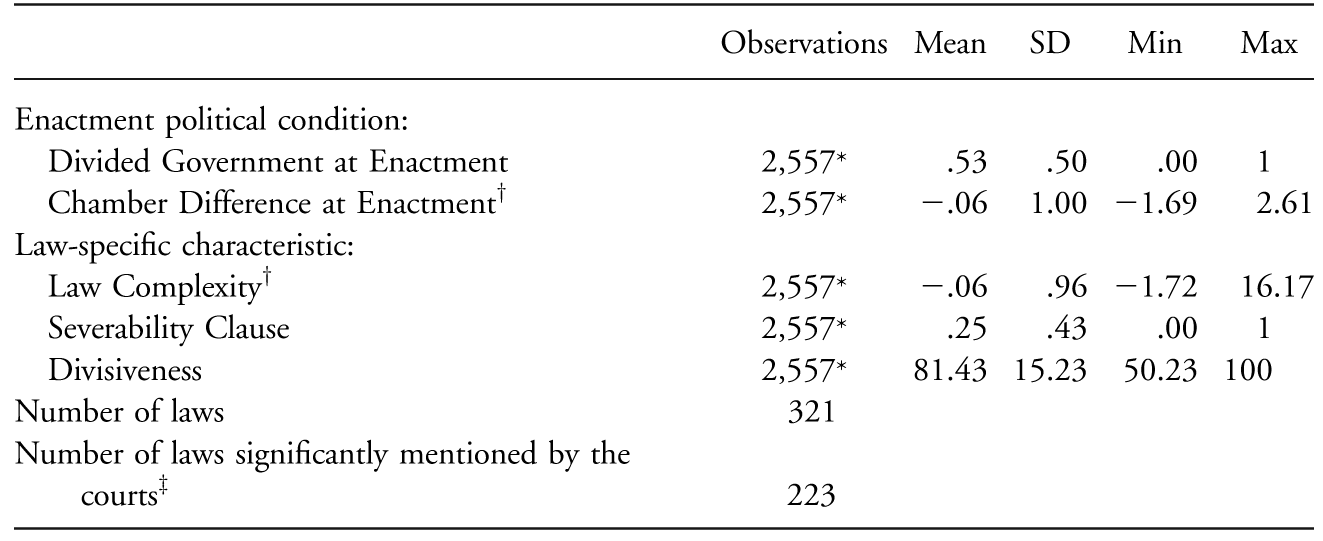
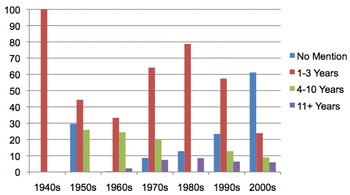
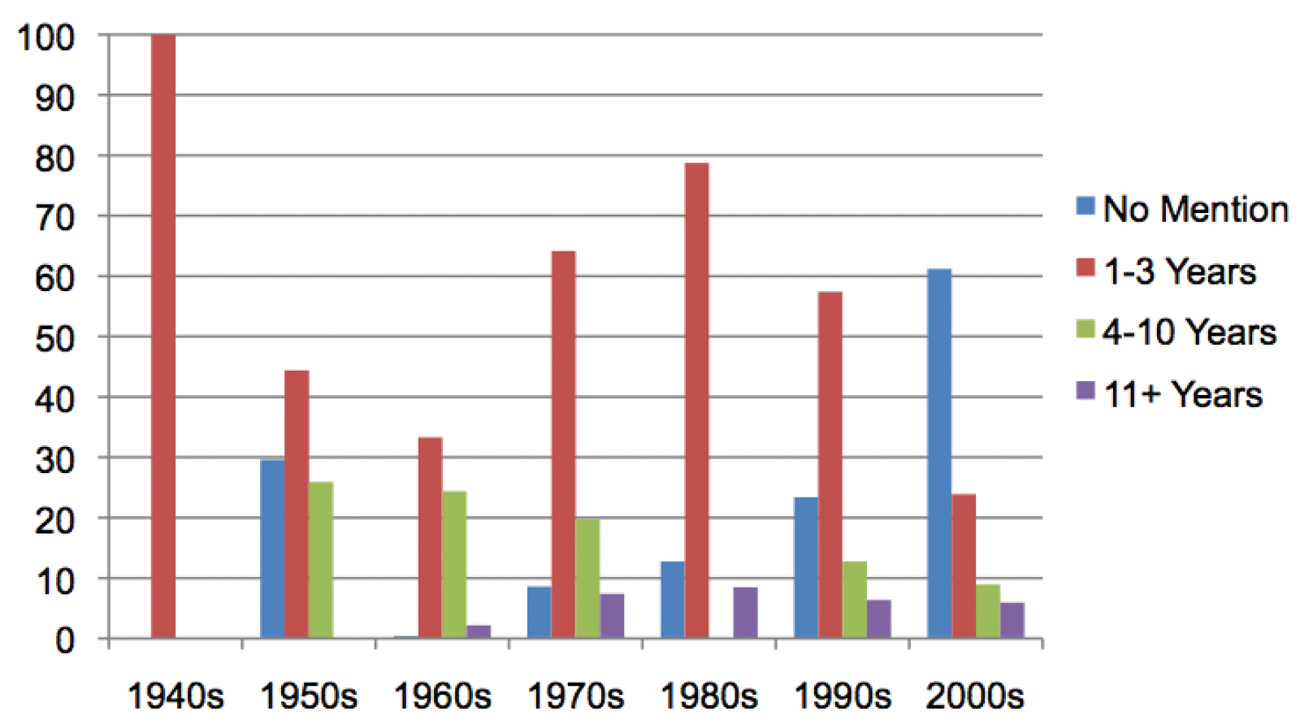
As shown in table 1, of the 321 laws in the analysis, 223 (69.4%) were mentioned by the judiciary before the first significant modification to the law by Congress. On average, judicial mentions came 3.2 years after the enactment of a law, with a standard deviation of 5.8 years.Footnote 11 Figure 1 further illustrates this relationship, showing both that in each decade the majority of laws are typically mentioned within 3 years and that laws include a range of durations within each decade.
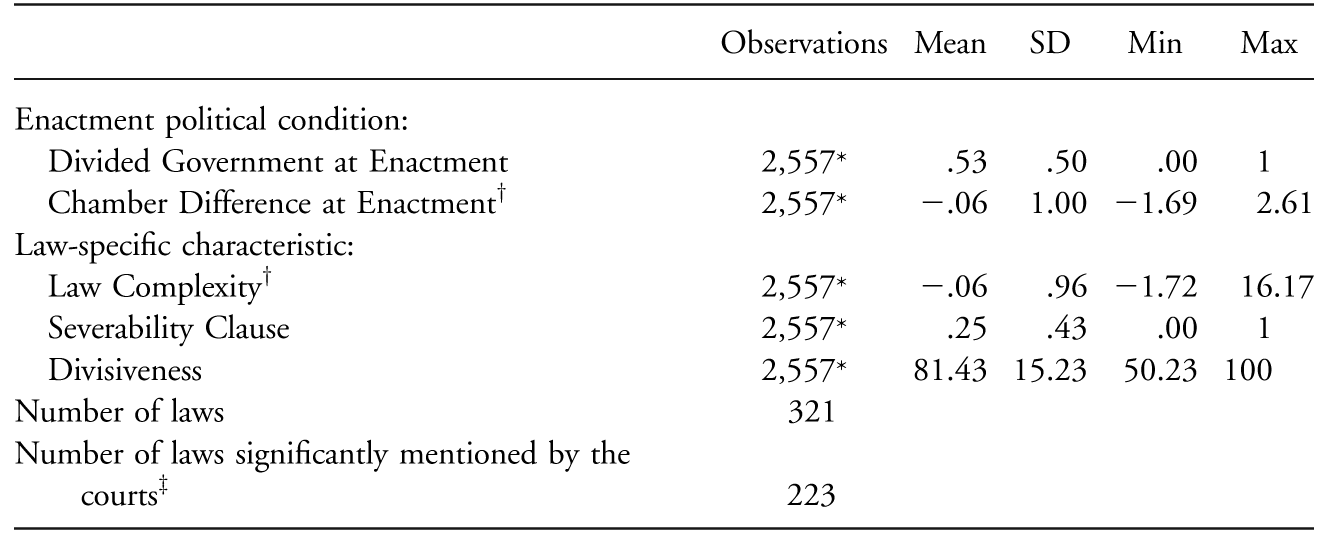
* Law-years.
† Standardized.
‡ Statutory interpretation-related mentions occurring before a significant amendment.
Proportion of laws significantly mentioned by the courts by number of years until mention and decade.
Because we are examining durations—specifically, the duration between the time a bill is enacted into law and when the courts first pay serious attention to it—we use a Cox regression. We use this approach because of its flexibility (i.e., it does not require any assumptions about the shape of the underlying hazard function) but note that we obtain similar results using a Weibull regression. The results we report in our tables are hazard ratios, so values greater than 1 indicate an increased likelihood and those less than 1 indicate a decreased likelihood.
Independent Variables: Enactment Political Characteristics
To test the hypothesis that laws adopted during periods of divided government are more likely to be subjected to statutory interpretation than those enacted during unified control, we identify the laws that were enacted during a period of divided government, or during a period when the party that controlled the White House did not also control the House and the Senate. We expect Divided Government at Enactment will have a coefficient greater than 1, or an increased likelihood of judicial interpretation.
To test whether laws are more likely to be interpreted by the judiciary when the House and Senate hold more divergent policy views at the time of enactment, we use a standardized version of Binder’s (2003) measure of bicameral differences, which measures the difference in the proportion of the House and Senate voting on the passage of a conference report, as averaged over all conference reports in a given congressional session. Higher values indicate more disagreement between the chambers, so our hypothesis predicts that the coefficient on Chamber Difference at Enactment will be above 1, with greater levels of disagreement increasing the likelihood of statutory interpretation.
Independent Variables: Law-Specific Characteristics
For our first two measures of law-specific characteristics, we draw on Maltzman and Shipan’s operationalizations. First, Law Complexity is a count of the number of pages per law as they are paginated on LexisNexis. This measure also accounts for the potential for different page formatting by standardizing the average number of words per page (see Huber and Shipan 2002). Because we expect that complex laws will be more likely to reach the courts, the coefficient on Law Complexity should be greater than 1. Second, Divisiveness first captures the level of “yea” votes in each chamber and then uses the smallest majority coalition per bill as a measure of divisiveness. Smaller values indicate higher levels of divisiveness. As a result, we predict that Divisiveness will have a value below 1, or that lower levels of divisiveness will decrease the likelihood that the courts will interpret a law.
Our measure of severability clauses is a binary variable that indicates whether there are one or more severability (or separability) clauses within a piece of legislation. Conducting content searches of laws within the data set produced this variable. Laws containing such clauses were coded 1, while those without were coded 0. Our hypothesis predicts that severability clauses will increase the likelihood of judicial interpretation, so the coefficient on Severability Clause should be greater than 1.
Results
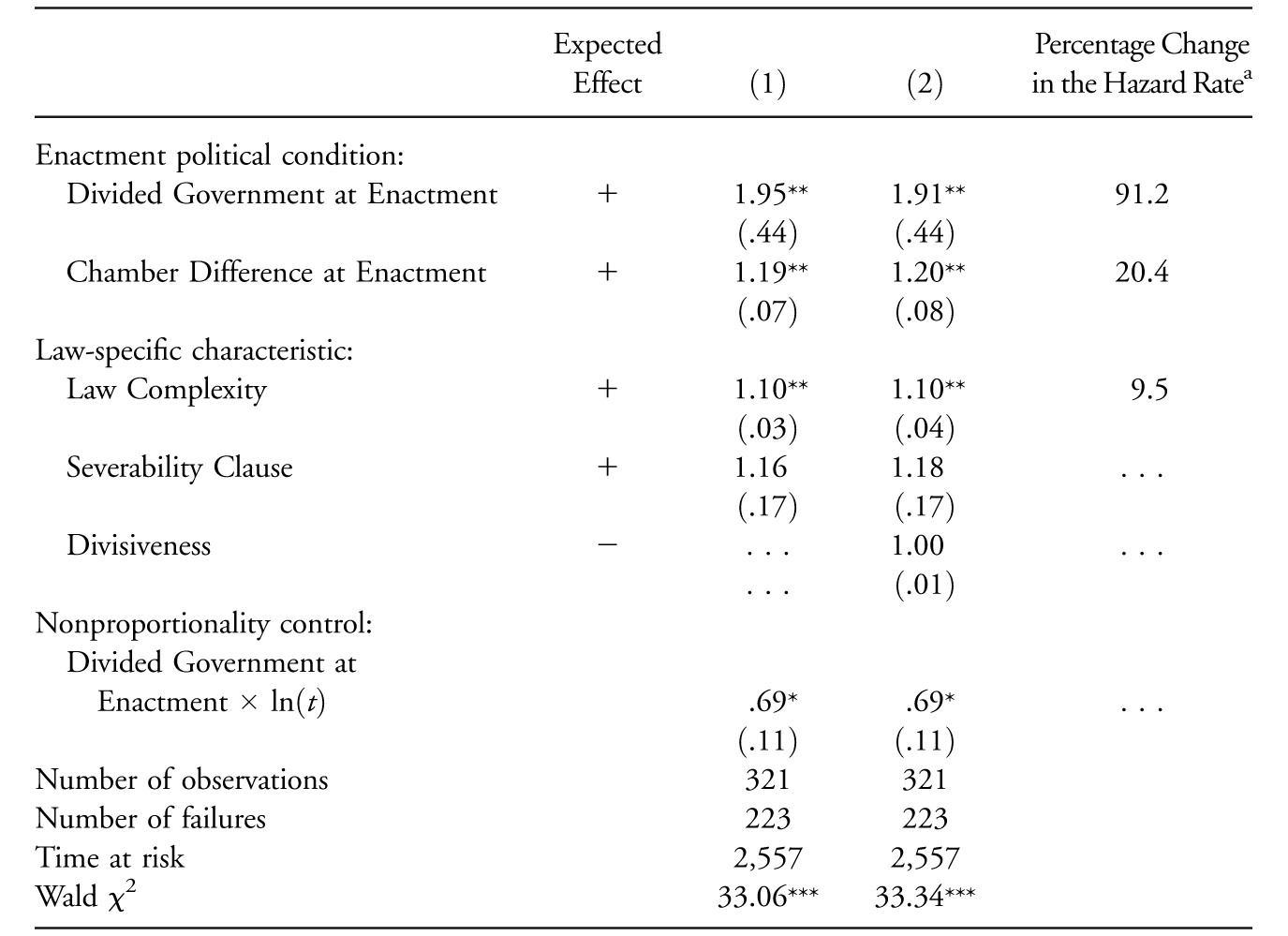
Table 2 presents our results. The coefficient for Divided Government at Enactment denotes the influence of this variable at the outset of analysis time. Tests, however, revealed that Divided Government at Enactment lacked proportionality—that is, the effect of this variable was not the same over time.Footnote 12 The solution for this problem is to interact the offending variable with the log of time, where the coefficient for the interaction term indicates how this effect changes over time. At the outset, the coefficient for Divided Government at Enactment is greater than 1 and statistically significant, indicating that the initial effect of divided government is to increase the likelihood that the court will consider a law. The interaction term, however, is significant and the hazard ratio is less than 1, indicating that the positive effect decreases over time. This result indicates that immediately after enactment, laws passed during times of divided government are considerably more likely to be interpreted by the federal courts than those enacted under unified government, but this effect diminishes over time.
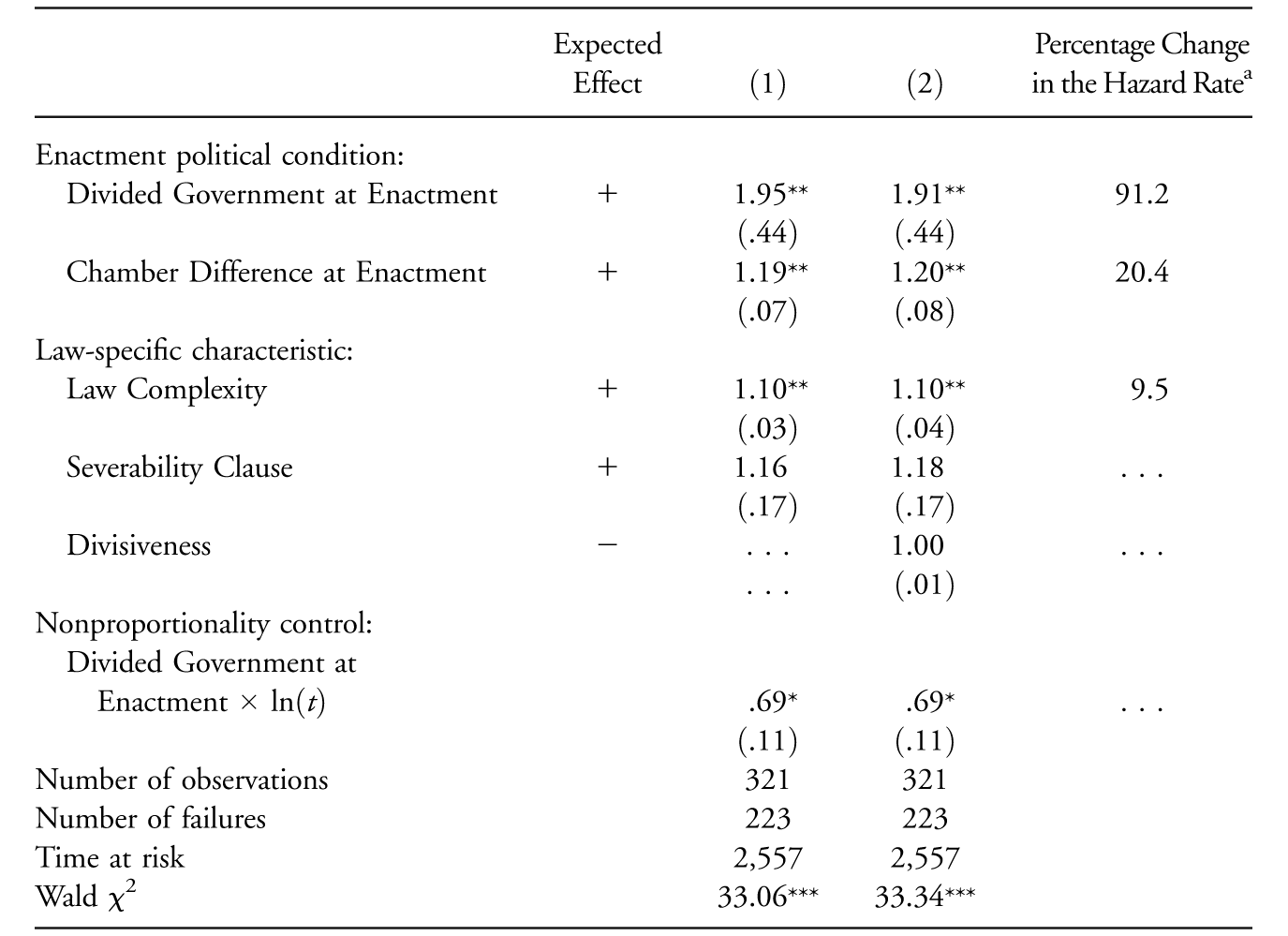
Note—Cox regression, Breslow method for ties. Results are hazard ratios; thus, coefficients greater (smaller) than 1 are consistent with expected effects that are positive (negative). Standard errors are in parentheses.
a Reflects a one-unit change in binary covariates of interest for model 2 results or a one standard deviation change when the covariate is not binary (Box-Steffensmeier and Jones 2004, 60).
* p < .10.
** p < .05.
*** p < .01, one-tailed tests.
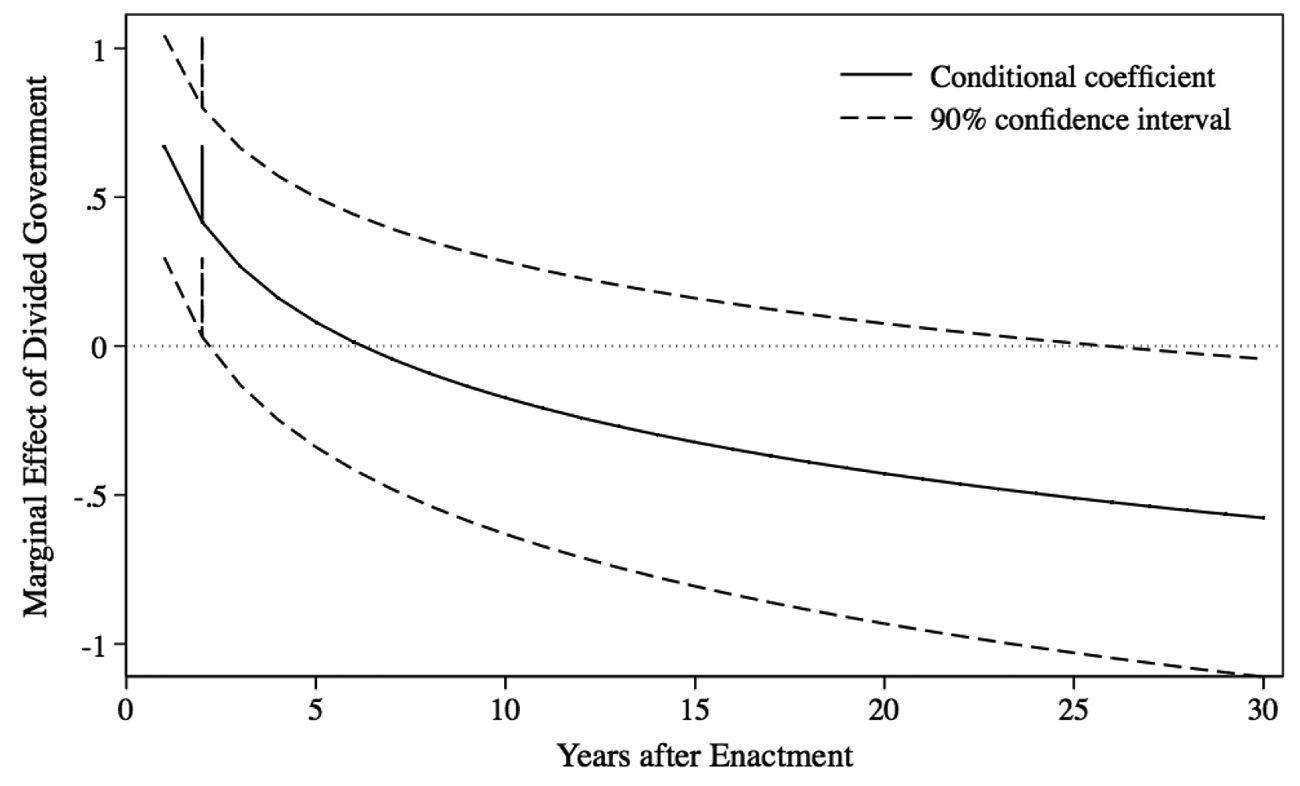
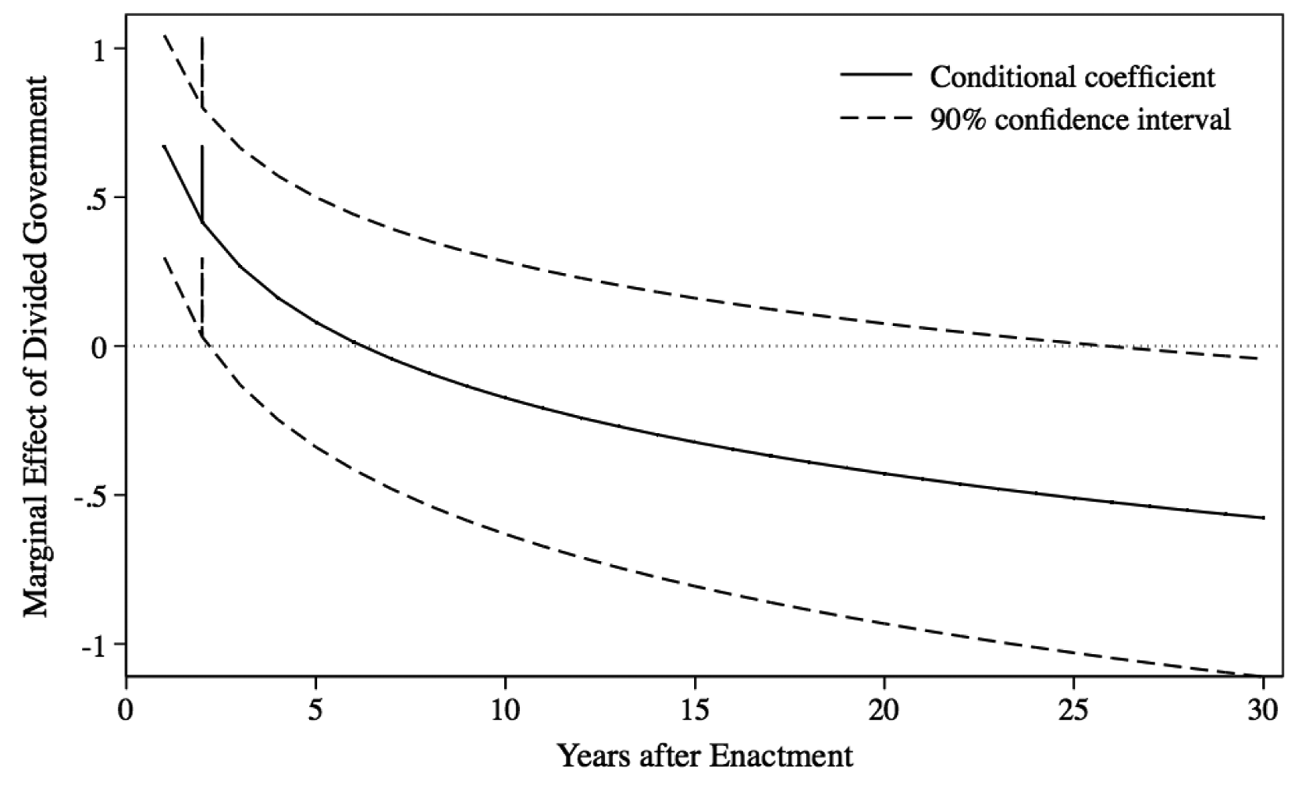
We can understand the time dynamics more fully by evaluating the incentives for a law’s opponents to bring challenges to it. In the initial period after divided coalitions enact legislation, interested parties are more interested in seeking out clarity about the law’s provisions from the courts, and opponents are more interested in challenging some of these provisions. But laws that are not the subject of statutory interpretation soon after their enactment are less likely to have been vague enough to merit court attention in the first place, and it is unlikely that they will draw the interest of the judiciary as time passes. Figure 2 illustrates the pattern graphically by charting the marginal effect (in hazard ratio form) of enactment-year divided government over time, with dashed lines indicating the 95% confidence interval.Footnote 13 The figure indicates that laws enacted under divided government are significantly more vulnerable to judicial interpretation than laws enacted under unified government until about their third year of existence, at which point the effect is no longer significant.
Marginal effect of enactment-year divided government over time
A second variable that captures enactment conditions is also significant. Higher values of Chamber Difference at Enactment, the measure of bicameral differences, increase the likelihood that the courts will interpret a law.Footnote 14 Laws enacted during times of greater policy overlap in the chambers, in contrast, are less likely to be interpreted by the courts.
Turning to law-specific characteristics, we first see that Law Complexity, as measured by the law’s length, increases the risk of a judicial interpretation by approximately 10% for each standard deviation increase in the number of pages of a law over the average number of pages in a law. In the data set, the mean length of a law was 37 pages, with a standard deviation of 78 pages.Footnote 15 However, Divisiveness, which is the measure of the smallest chamber majority coalition per law, is not statistically significant.Footnote 16
Finally, Severability Clause is not significant in the model, although the coefficient shows that the variable is moving in the hypothesized direction. This insignificant effect suggests that the federal courts do not systematically use severability clauses as cues to hear challenges to statutes more readily. Of course, this does not indicate that Congress sees severability clauses as unimportant, just that the presence of such clauses does not necessarily have the effects that one might expect.
Overall, then, the results provide support for the first three of our hypotheses.Footnote 17 The political conditions that shape the politics of legislative enactment influence the amount of time until a law appears in the courts. In particular, statutes enacted under divided government or by ideologically disparate chambers are more likely to be considered sooner, although the effect for divided government decreases and then disappears over time. Similarly, we find that the courts are more likely to consider complex laws, although not laws that include severability clauses or that were divisive.
Robustness of Results
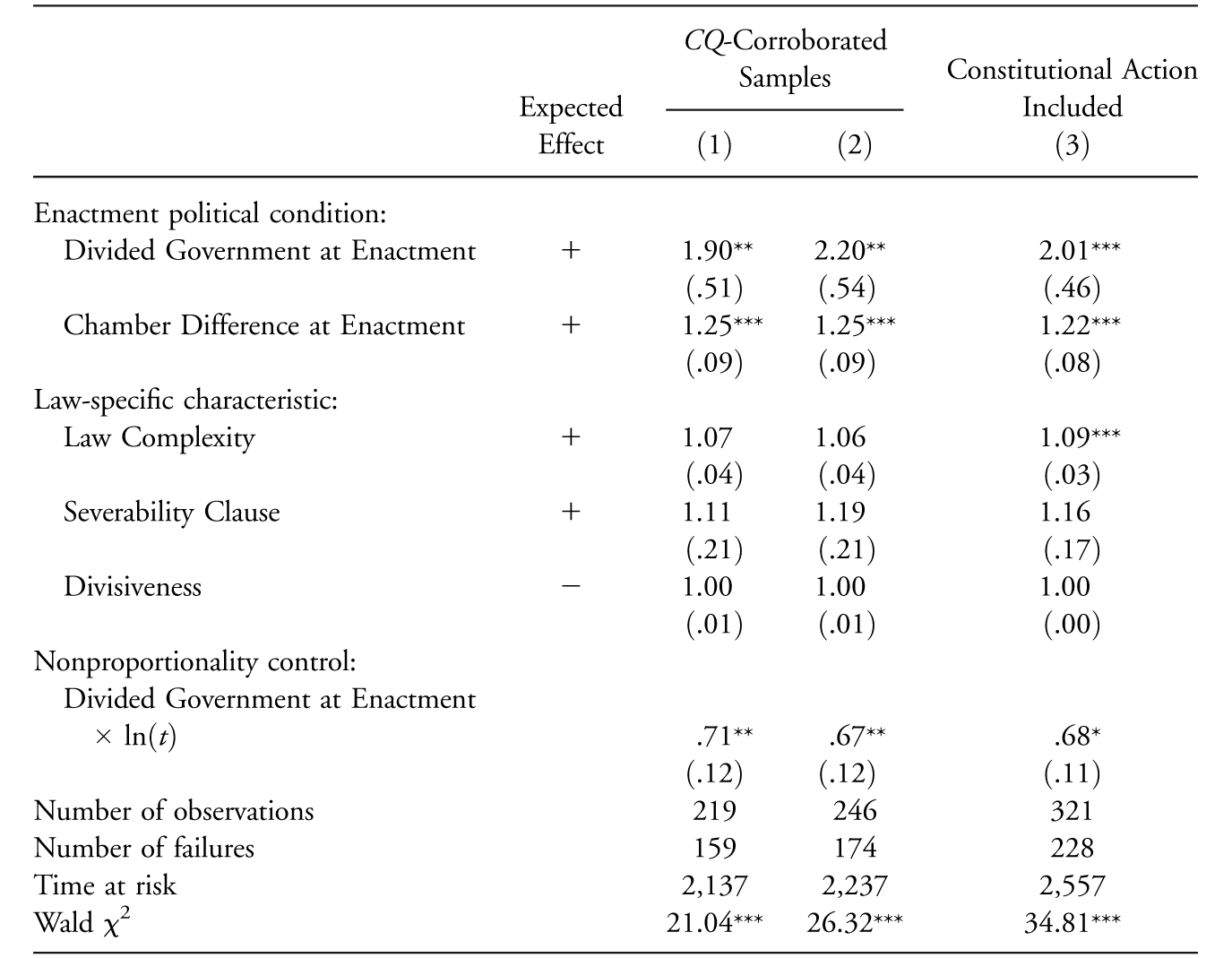
As a further check on these findings, we can restrict our sample to only those laws with the most concrete available information about their durability. Once Congress amends a law, it drops out of the data set (since this prevents courts from hearing cases about the original law). In Maltzman and Shipan’s original data set, congressional amendments are identified using LexisNexis’s “statutes at large” module (2008, 258). We supplement these data with a search of the legislative summaries provided by Congressional Quarterly (CQ). This allows us to verify the link between the original and amending laws identified in the data set. Using a stringent coding standard, we were able to find direct evidence from CQ that a subsequent law amended an earlier one for about 37% of the law pairs. With a slightly less stringent coding standard, CQ summaries suggested a link between original and amending laws for about 55% of law pairs in the data set (the 37% with direct evidence plus an additional 18%).Footnote 18
In table 3, columns 1 and 2, we present the results of our durability model for a restricted sample (i.e., the CQ-identified law pairs plus those laws that Congress never amended). This procedure guards against the potential for bias if amendments were identified incorrectly by LexisNexis, which would cause original laws to drop out of the data set in error. But such bias does not appear to be a problem; in large part, the results are similar to those we presented above.Footnote 19 The CQ-corroborated sample provides more robust evidence that enactment conditions have an important effect on court responses to legislation. Similarly, in table 3, column 3, we present the results when including laws that were eventually declared unconstitutional by the Supreme Court after lower court action (these laws had been excluded from our original analysis). We do so on the basis of the assumption that even cases of judicial review necessitate statutory interpretation by the courts (Eskridge 1987, 1484). Once again, our results remain largely unchanged, providing further evidence that the political conditions at the time of a law’s enactment affect its durability.
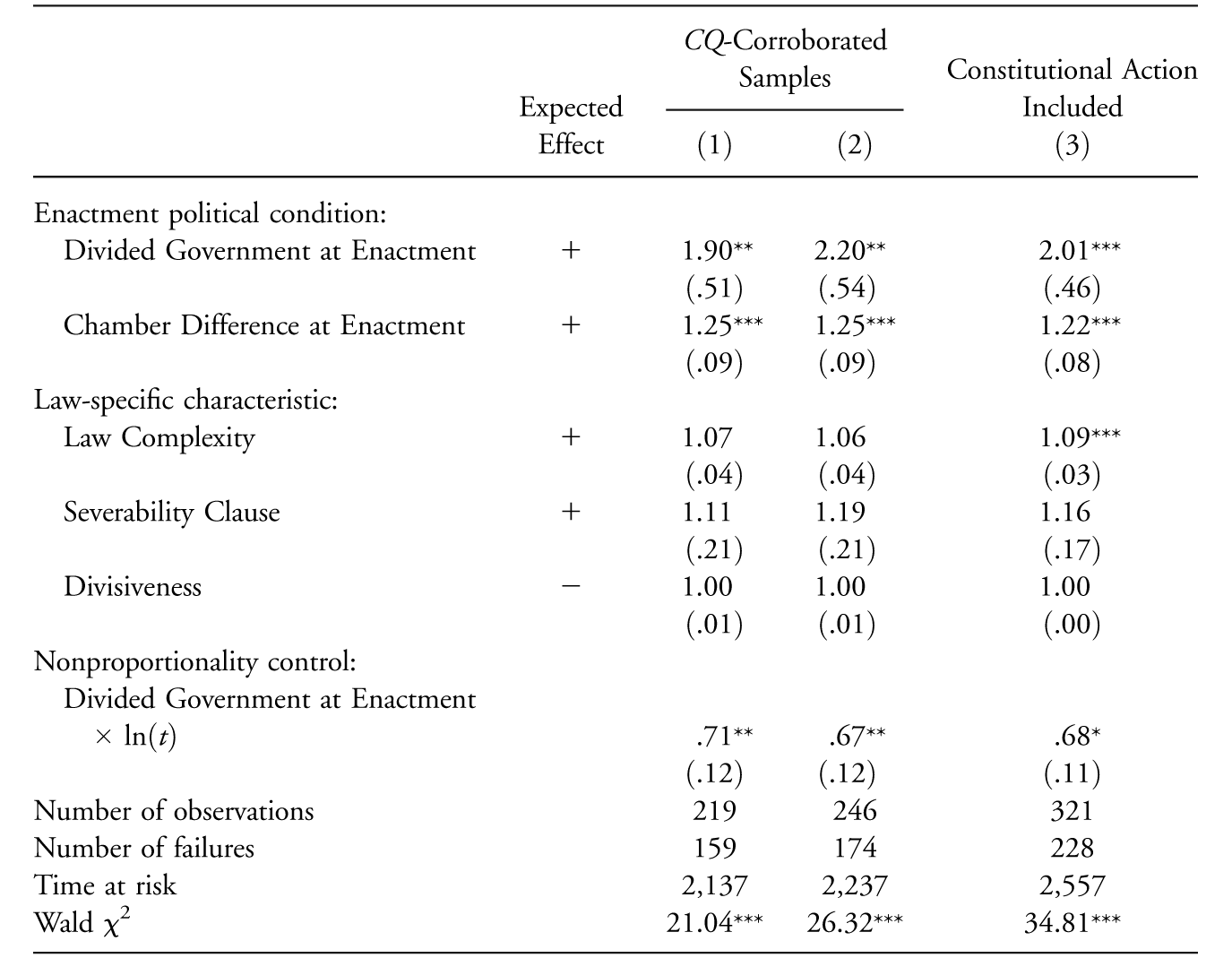
Note—Cox regression, Breslow method for ties. Model 1 includes law pairs with only direct evidence of amendment from Congressional Quarterly (CQ). Model 2 includes any law pair with a CQ-suggested link. Results are hazard ratios; thus, coefficients greater (smaller) than 1 are consistent with expected effects that are positive (negative). Model 3 includes cases in which a law was struck down as unconstitutional. Standard errors in parentheses.
* p < .10.
** p < .05.
*** p < .01, one-tailed tests.
Discussion
An emerging literature on legislative durability demonstrates how constraints in Congress affect law survival. But scholars have little understanding of when other institutions—namely, the courts—might influence the life of major laws. In this article, we focus on a piece of interinstitutional politics that bears directly on the legislative durability literature: the judiciary’s statutory interpretations of congressional legislation. The significance of our approach is both theoretical and practical, since a large number of laws are shaped and defined by courts after their enactment. It is not simply the case that the life of legislation begins at enactment and ends with amendment in the legislature; rather, we can see important shades of gray by giving attention to the courts, who have the responsibility of interpreting statutory language, defining key provisions, and determining the scope of congressional legislation. This focus broadens our understanding of the life of laws from one based on legislative amendments alone to one that offers an account of interinstitutional politics.
To the extent that courts play a role in the life of legislation, we show that conditions at enactment influence not only intrainstitutional dynamics but interinstitutional ones as well. We find evidence that both divided government and distinct interchamber preferences at the time of a law’s enactment increase the likelihood that federal courts will interject themselves into the process by interpreting legislation. The mechanism behind court intervention is tied to the branch’s reactive nature, as a law’s incoherence and inconsistency increase the speed with which courts interpret legislation. For this reason, we can distinguish between congressional responses, which can occur whenever the legislature chooses, and court reactions, which depend on plaintiffs with standing to challenge a law (Roberts Reference Roberts1992). By focusing on statutory interpretation, we show that institutions outside of Congress can step in and affect the life of legislation. At the same time, there are many notable parallels between the factors that shape judicial involvement with legislation postenactment and those that shape congressional involvement. Laws adopted under divided government and in spite of bicameral differences—those that are more likely to be internally inconsistent and vague—face a significantly higher prospect of being reshaped soon after their enactment (e.g., Mayhew Reference Mayhew2005; Ragusa Reference Ragusa2010).
Our findings have implications for the emerging literature on legislative durability by broadening the range of questions it asks. Although this work has evolved from case studies of specific programs to large-N analyses of landmark enactments, until now it has focused chiefly on legislative responses like amendments and repeals. But of course the responsibilities of statutory interpretation with which courts are tasked help to shape the meaning and impact of legislation. It is these responsibilities—vital yet often overlooked in the policy life cycle—on which we have shed light here.
Of course, much more work remains to be done. Although our test of the relationship between enactment conditions and court action provides strong support for three of our hypotheses, further analysis should refine inquiries about this kind of postenactment politics. It may be useful to consider separating out the levels of federal courts in future analyses, which would foster a sharper understanding of the mechanisms shaping judicial intervention. This targeted inquiry would also enable the addition of policy mood variables and ideological preference variables to better account for court preferences. It may also be that differences in caseloads and responsibilities lead to variations in court responses to legislation.
Future work may also take into account more fully other aspects of interinstitutional politics. We have proposed a simple account that links enactment conditions to court responses. In doing so, we pay attention to the willingness of the courts alone to address a law before it is amended by Congress. But we might consider jointly the behavior of courts and Congress, both theoretically and empirically. A more sophisticated approach might also consider other strategic options available to Congress. Can lawmakers effectively preempt the courts? How do they respond if the courts alter a statute? Consistent with other work, we find evidence here that strategic preemption by Congress—in the form of severability clauses—has little impact on the amount of time that laws survive until judicial amendment.
More importantly, this analysis suggests that courts can receive signals from both the types of coalitions that create laws and also law-specific characteristics that arise from such conditions. We have found that complex laws are more likely to be altered by the courts, as are laws enacted under divided government and larger interchamber differences. These results suggest the importance of exploring the debate over legislative durability from an interinstitutional perspective.