Introduction
The farm bill passed by Congress in 2014 was among the most hotly and lengthily contested pieces of major agricultural legislation since the New Deal. The fate of federally funded food benefits for low-income Americans—SNAP, the Supplemental Nutrition Assistance Program—was the most ideologically divisive and hard-fought partisan issue in the debates. Also on the table for consideration, however, was the historic core of America’s farm programs, a decades-old system of guaranteed direct payments to farmers. Though intended to bolster farm incomes to prevent the collapse of rural economies, non-farm observers had increasingly condemned the payments as disproportionately benefiting wealthy commercial farmers and non-farming landowners, not family farmers, at taxpayer expense. Fiscal conservatives in Congress, buoyed by Tea Party activism, demanded severe cuts to both SNAP and farm payments. Urban Democrats stood fast in support of SNAP, while rural representatives in both parties scrambled to justify farm support. For several years prior to the 2014 farm bill deliberations, major farm organizations, aware of the unpopularity of guaranteed farm payments, began publicly arguing that crop insurance could serve as a more palatable, lower-cost means of supporting farmers. One consequence of the bitter fights over the 2014 farm bill was a bipartisan decision to eliminate the most controversial forms of direct payments to farmers. Seemingly out of nowhere, at least for outside observers, crop insurance was suddenly elevated to the forefront of farm policy. Publicly subsidized crop insurance, according to a Senate agriculture committee press release, was “a commonsense risk management approach” that was intended to save taxpayers money while still shielding American farmers from disaster. Four years later, despite evidence that crop insurance did not save taxpayers nearly as much money as promised, 2018 legislation preserved the core features of the previous farm bill with only slight changes.Footnote 1
It is tempting to read the 2014 turn to crop insurance as a product of neoliberalism, an example of a “market solution” displacing the state in an era of increasing hostility to government spending and regulation. But crop insurance predates neoliberalism, as it has been a significant component of U.S. farm policy from the late New Deal onward.Footnote 2 The U.S. crop insurance program was the first of its kind in a global context, and to this day remains unique in the world in its structure and implementation. It was also, in its early years, envisioned not as a means for replacing public policies with private solutions, but as a government-subsidized, government-run system of stabilizing the nation’s rural economy. Crop insurance, in other words, was firmly embedded in the New Deal’s insistence on the importance of using state power to address failures in the marketplace.Footnote 3
The system of “all-risk” crop insurance that began in 1938 in the United States was in fact explicitly designed not to work like an efficient market. This was in large part because it was assumed that a private market for crop insurance was neither desirable nor possible to construct. Program administrators originally understood the system as a social insurance policy, a means of helping farmers navigate the uncertainties of agricultural production. The program faced significant challenges in operation, however, so that from the mid-1940s onward, the crop insurance program increasingly became a state-led means for transforming the ways in which farmers conceived of risk in agriculture. In part, this shift was due to the changing dynamics of American agriculture, as farmers became increasingly reliant on debt to finance technology-intensive agriculture. Debt-leveraged expansion produced greater exposure to financial risks. Given the possibility of losing everything in the wake of a drought or flood, the market logic of crop insurance surely made sense to most if not all farmers by mid-century. And yet, for reasons I elucidate in this paper, crop insurance repeatedly proved more appealing to policy makers than to farmers, forcing program administrators to develop mechanisms for convincing producers to change the way they thought about managing uncertainty and risk.
Thus an unintended consequence of the U.S. crop insurance program by mid-century was that it contributed to an emergent process of financialization in American agriculture.Footnote 4 Farmers repeatedly proved resistant to the market logic of crop insurance, failing to sign up in large enough numbers to make the program’s risk-pooling mechanisms self-sustaining. To make the program work, public insurance managers, farm policy makers, and private bankers promoted crop insurance after the New Deal as a means for pushing farming further from its roots in the production and trade of physical commodities into an economic activity increasingly defined by the exchange of financial instruments. In doing so, crop insurance advocates cultivated among American farmers the mentalities of risk management embedded in and promoted by financial institutions. Indeed, as explored here, bankers in the farm credit industry were key beneficiaries of the expansion of crop insurance at mid-century. Yet in contrast to much recent scholarship on the theme, my exploration of U.S. crop insurance reveals a situation in which financialization emerged not as a last-resort post-1970s neoliberal adoption of market-think as a solution to intractable political–economic problems, but as a system predicated from the start on the open embrace of government action as a means to address endemic problems of agricultural markets.Footnote 5
Financialization was not the original intent of the American crop insurance program, nor was it the explicit intent of the 2014 farm bill. From the beginning of the program to the present day, the crop insurance program has been a government solution to a market problem, not the other way around. Yet as the policy has evolved in response to changing agricultural markets and shifting conceptualizations of risk among farmers, bankers, insurers, and policy makers, it has played an increasingly important role in the financialization of American agriculture. “Risk management” was not a phrase that would have made intuitive sense to most farmers in the 1930s, but within three decades it was a foundational concept for American agricultural enterprise and farm policymaking, a conceptualization that was fully formalized in the 2014 farm bill. But financialization in agriculture did not necessarily reflect a triumph of laissez-faire free markets. Rather than simply replacing government action with market-based solutions, publicly subsidized crop insurance became a mechanism for ensuring continued government intervention in the inherently risky business of agriculture.
Uncertainty in American Agriculture and the Rise of New Deal Farm Policy
Pests, hail, too much rain, too little rain, scorching heat, freezes, disease outbreaks … any farmer could produce a nearly infinite list of forms of crop devastation. Farmers cannot know at planting time whether any given crop will produce a boom or bust harvest, or indeed any harvest at all—a significant difference from manufacturing or service industries, in which there is a predictable relationship between labor invested and outputs produced. Beyond the farm gate, markets for farm inputs and outputs are also rife with uncertainties produced by fraud, speculation, wild price swings, and difficulty assessing the quality of farm produce. Uncertainty and risk permeate every aspect of agriculture.Footnote 6
In 1921 economist Frank Knight introduced a distinction between risk and uncertainty, arguing that risks are measurable (and thus suitable for management through insurance or similar mechanisms), while uncertainties involve probabilities that may not be easily quantified.Footnote 7 Today many economists dismiss Knight’s distinction, arguing that modern technologies and techniques are available to quantify essentially any hazard. Historians, however, tend to accept Knight’s distinction as valid empirically if not theoretically; that is, given certain social and technological conditions there might be a perceived, socially valid distinction between a measurable risk and an unquantifiable uncertainty, a boundary line that can nonetheless shift over time.Footnote 8 Certainly for American farmers in the years leading up to the Great Depression, the problem of endemic uncertainty permeated every facet of the agricultural marketplace, from preproduction planning to consumer marketing. Indeed, understanding this aspect of agricultural history helps to explain not only the emergence of the federal crop insurance program in the 1930s, but also offers a coherent explanation for much of the national farm policy instituted during the New Deal.Footnote 9
As the scale and scope of American commercial agriculture increased over the course of the nineteenth century, several important off-farm, extra-local institutions emerged to help farmers address the uncertainties of agricultural production and marketing. Markets for commodities and livestock became increasingly rationalized. Institutions, including the Chicago Board of Trade, and centralized markets coordinated the flow of price information on a national scale. The creation of futures markets for agricultural commodities enabled large-scale buyers such as grain-trading firms to minimize their exposure to price volatility.Footnote 10 Farmer-owned cooperatives grew in scale and scope in the nineteenth century, enabling farmers to confront some of the uncertainties embedded in markets for farm inputs such as fertilizers and seeds. By pooling capital to produce their own scientifically mixed fertilizer, for instance, farmers in a cooperative no longer had to navigate a marketplace populated by merchants who sought to defraud farmers with adulterated products. Cooperatives also enabled individual farmers to collectively confront uncertainties in markets for their outputs. Grades, standards, and brands for produce and dairy products helped farmers stabilize prices, gain wider market access, and cultivate consumer trust.Footnote 11 Large-scale corporations also emerged in the late nineteenth century as an important coordinating mechanism in the farm economy. Industrial meatpackers, grain-trading firms, fruit and vegetable canners, breakfast cereal manufacturers, and chain grocery stores were among the large-scale firms that used vertical and horizontal integration to confront the vicissitudes of markets for farm and food products.Footnote 12
Alongside cooperatives and corporations, state and federal departments of agriculture also expanded their economic coordinating capacity in the late nineteenth century. The problem of uncertain quality was high on the agenda at multiple levels of government, as policy makers worked to develop and enforce standards and grades for farm inputs and outputs. To address uncertainties in shipping costs—a crucial matter as farmers increasingly expanded the scale of their marketing in the late nineteenth century—state and federal policy makers implemented regulation of transportation. To mitigate uncertainties in farming itself, government scientists provided farmers with new forms of knowledge about seed selection, livestock breeding and health, pest management, and even the weather.Footnote 13
Yet all these institutional efforts to confront uncertainty in the agricultural economy proved insufficient to meeting the challenges of the systemic farm crisis that gripped American agriculture from the end of World War I through the Great Depression. Prices collapsed for corn and cotton after the war, as did farm land values. Boll weevils devastated southern cotton fields, repeated droughts crippled livestock production in the West, and flooding in the Mississippi River valley destroyed livelihoods. Rural banks failed at extraordinary rates. Millions of black and white rural southerners and midwesterners left farming altogether, migrating to urban industrial centers. Centralized markets, farm cooperatives, large-scale corporations, and state and federal governments, despite their expansion in the previous decades, lacked the capacity to respond effectively to the nationwide farm problems of the 1920s.Footnote 14
The stock market crash of 1929 and the ensuing Great Depression raised the stakes of agricultural policy debates, as the ongoing farm problem became intertwined with the national collapse of industrial, housing, and financial markets. The need to boost rural purchasing power to reinvigorate the nation’s industrial economy and forestall further collapse in financial institutions led economists to consider ideas for dramatically expanding the federal government’s role in confronting the farm problem. Proposals for centralized planning and production controls gained currency among a select group of farm experts and economists—particularly John D. Black, M. L. Wilson, Mordecai Ezekiel, Rexford Tugwell, and Henry A. Wallace. When Franklin D. Roosevelt was elected president in 1932, these individuals successfully pressed their vision for an extraordinary expansion of the federal government’s role in the agricultural economy. Their proposals anchored one of the first major pieces of legislation passed in Roosevelt’s famed first 100 days, the Agricultural Adjustment Act.Footnote 15
Confronting uncertainty through supply management lay at the heart of the original New Deal farm program. Once overproduction was tamed, it was assumed, farm and food prices would stabilize. Important shifts in policy thinking nonetheless emerged in the wake of the combined effect of the Dust Bowl droughts of 1934 and 1936 and the Supreme Court’s invalidation of the original Agricultural Adjustment Act in 1936. The epic droughts of 1934 and 1936 and consequent collapse of wheat production throughout the southern Plains made clear that surplus production was not the only problem faced by farmers. The Supreme Court’s 1936 decision in U.S. v. Butler, furthermore, invalidated the first Agricultural Adjustment Act’s reliance on a tax on food processors to fund payments to farmers. Thus, farm policy makers had to approach the uncertainty of agricultural production and marketing on a more systemic basis than simply paying farmers to reduce their outputs. Stability of rural economies, measured not only in terms of farm prices but also in terms of conservation of soils and permanence of rural communities, would increasingly inform the farm policy agenda of New Dealers.Footnote 16
This was perhaps best expressed by Secretary of Agriculture Henry A. Wallace when he revived an idea for the “ever-normal granary” he had repeatedly proposed in the 1920s as publisher of the popular farm periodical Wallace’s Farmer and Homestead. His revival of the concept came partly in response to Alf Landon’s challenge to Franklin Roosevelt in the 1936 presidential election, as Landon sought to garner rural votes with promises of a generous crop insurance scheme. Although Roosevelt easily defeated Landon, the possibility of Republicans retaking rural America pushed Roosevelt’s farm advisors to speak in grander terms about the nature and purpose of New Deal farm policy. In a 1937 summary of his ever-normal granary concept, Wallace noted that for seven years, American farmers and consumers had experienced violent price swings, extreme weather, and fluctuating supplies of basic commodities. An ever-normal granary, according to Wallace, would bring stability and certainty to the agricultural economy, providing “a definite system whereby supplies following years of drought or other great calamity would be large enough to take care of the consumer, but under which the farmer would not be unduly penalized in years of favorable weather.” The system would require an expansion of federal powers to acquire farm surpluses in times of plenty and release them in times of dearth. When Congress passed the Agricultural Adjustment Act of 1938 to permanently resuscitate the farm programs previously invalidated by the Supreme Court, increased funding and power was granted to the Commodity Credit Corporation to institute the ever-normal granary concept. The explicit aim was to simultaneously stabilize farm prices and consumer food prices.Footnote 17
Throughout the complicated and controversial twists and turns in New Deal farm policy, then, a consensus emerged that government power could and should address the endemic uncertainties of the farm economy, including the possibility of catastrophic crop devastation. This context, as well the specific political push from Alf Landon’s calculated bid for rural votes, makes clear why President Franklin D. Roosevelt appointed a team of experts in 1936 to consider government-subsidized crop insurance as an experimental response to the disastrous collapse of wheat production in the Dust Bowl droughts. Members of the president’s ad hoc committee on crop insurance included Henry A. Wallace and influential New Deal agricultural economists H. R. Tolley and A. G. Black. Two broad assumptions informed the committee’s work. First, the group was tasked with developing “all-risk” crop insurance, covering more than just one “named peril” such as hail damage. In other words, the goal of the program was from the start intended to gird farmers against unpredictable threats to crops, rather than more readily quantifiable hazards such as hail damage. Second, crop insurance was meant to serve as a boost to the ever-normal granary by complementing existing commodity futures markets, which since the late nineteenth century had provided tools for managing off-farm price volatility through hedging. Crop insurance was to address uncertainty of yields on the farm itself, promising safe harbor in seasons when a farmer had little or nothing to sell due to disaster. Hedging on the future price of a bushel of wheat meant little to a farmer whose entire crop had been obliterated by drought, flood, fire, or grasshoppers.Footnote 18 Furthermore, New Dealers, including Wallace, were often skeptical that futures markets could serve farmers’ interests beyond individual speculative risk-taking; indeed, in the 1936 Commodity Exchange Act, Congress opened up commodity futures markets in ways that encouraged speculation by individual investors, rather than shoring up the futures market’s potential capacity to stabilize farm incomes.Footnote 19
New Deal crop insurance, then, was meant to be an all-purpose safety net for ordinary farmers. Reporting back to Roosevelt in December 1936, Wallace, Tolley, and Black offered a compact history of previous attempts to develop all-risk crop insurance. This included an 1888 foray in Japan and several disastrous efforts by private insurance firms in the United States in 1917 and 1920. There were three main lessons the committee drew from their historical research.Footnote 20
First, the committee recognized that the law of large numbers—the key concept behind modern insurance, enabling the profitable pooling and spreading of risk—required the population of insured farmers to be widely geographically distributed. Previous crop insurance schemes had often failed to consider the systemic nature of agricultural hazards. When drought hit, as it did during the Dust Bowl, the devastation punished a wide swath of farmers simultaneously. If an insurance firm provided coverage to farmers in just one region, the enormity of claims resulting from one large-scale disaster would wipe out the firm’s capital reserves.Footnote 21
Second, the committee recognized that previous approaches to crop insurance did not fully appreciate asymmetric information problems. What insurers call adverse selection was particularly worrisome. If farmers signed up for crop insurance knowing more about the risks they faced than did the insurer, market failure was sure to result, as farmers would be more exposed to risks than the insurers had accounted for in their premiums. In fact, failure did occur in 1917 when private firms in the Midwest wrote all-risk insurance policies for farmers who had reason to suspect substantial crop losses. When their crops indeed failed, the farmers filed indemnity claims that immediately bankrupted the insurers. Along with adverse selection, moral hazard presented an outsize problem for would-be crop insurers. If a farmer signed up for insurance at the time of planting and then neglected to weed, water, or otherwise take care of the crop, how was an insurer to know, absent costly systems of surveillance, whether resulting losses were due to the farmer’s negligence or to factors beyond the farmer’s control? The president’s committee thus thought carefully about how to solve these problems in 1936, and determined that substantial historical data on crop production on “small areas” (ideally individual farms) could minimize adverse selection and moral hazard.Footnote 22
Prior to the creation of the Agricultural Adjustment Administration in 1933, robust crop yield data simply did not exist. A handful of farmers might have reliable records, but most did not. Government statistics at their best provided only county-level data, not farm-level data, prior to the New Deal. The president’s 1936 committee on crop insurance decided, however, that the records gathered in the process of running the programs of the Agricultural Adjustment Administration would, over time, provide the necessary knowledge to craft actuarially sound premium structures. In other words, a successful all-risk crop insurer had to “see like a state” to make the logic of insurance work in a setting where experienced farmers were well equipped with tacit knowledge about difficult-to-measure uncertainties.Footnote 23
Third, the committee saw a lack of strategic vision in previous attempts to develop crop insurance. Private firms attempting to implement all-risk crop insurance had modeled themselves on companies insuring against hail damage. Crop-hail insurance proved a profitable business model in the late nineteenth century, in part because hail damage tends to be randomly distributed geographically, thus obviating the systemic risk problem. Hail insurers, furthermore, had access to meteorological studies on the frequency of hailstorms and thus had less reason to be concerned about adverse selection. But firms that sought to profit from selling farmers insurance against all unforeseeable perils were venturing into unknown (and perhaps unknowable) territory. Thus the president’s committee determined that all-risk crop insurance, rather than seek profitability, had to serve the public interest.
That public interest, as laid out for a mass audience by A. G. Black in a 1937 article in Nation’s Business, had three aspects. First, consumers and producers of food both benefited from stable farm prices. Second, the nation’s economic health depended on the purchasing power of its rural residents. Third, taxpayers were already footing hefty bills for emergency relief in the Dust Bowl region. Crop insurance, argued Black, provided a powerful tool for addressing all these concerns, but it was not a silver bullet; its logics would only benefit the public when combined with other public farm programs intended to maintain an ever-normal granary, conserve soils, and provide credit to struggling farmers. Effective crop insurance thus was understood by Black, Tolley, and Wallace as a form of social insurance, akin to bank deposit insurance or old-age insurance. Although the program would incorporate market mechanisms—farmers would have to pay into the program to receive benefits—it was at core a state-run safety net. The New Deal economists who devised the system saw clear benefits to the public interest but no obvious means for private firms to profitably overcome the challenges of adverse selection, moral hazard, and the expense of administering an unprecedented insurance scheme.Footnote 24
Rather than replacing the farm supply-management policies enacted by Congress between 1933 and 1938, the crop insurance system was intended to bolster those very programs. Henry A. Wallace explained to a farm group in Kansas City in July 1936 that crop insurance was a logical addition to New Deal farm stabilization programs, in effect an “automatic regulator” of the ever-normal granary, supporting farmers’ incomes during times of unforeseen disaster without compounding the surplus problem that drove farm prices down. The “automatic regulator” would not be costless, of course. As a 1938 memo explicitly noted, the price of establishing a nationwide crop insurance program was inherently steep, not least because it would be “necessary to explain the operation of an entirely new system” to many thousands of skeptical farmers.Footnote 25
From Confronting Uncertainty to Managing Risk
The first order of business was to construct the largest possible pool of insured farmers to spread risks. One potential method would have been a mandate, a requirement that all farmers participating in government farm programs also sign up for crop insurance. This approach was ruled out beforehand as too intrusive and potentially unfair to “efficient and far-sighted” farmers unwilling to bear “the burden of the greater risk of those who are less efficient and far-sighted.”Footnote 26 The challenge, then, was for government agents to sell crop insurance: to market not only specific policies providing coverage, but in fact to sell the very idea of all-risk crop insurance as a useful way to mitigate uncertainty, and in particular to sell the idea to “efficient and far-sighted farmers” so as not to adversely select the riskiest farmers for coverage. Thus began an unsteady process of financialization, disciplining—but not mandating—any farmer who would listen to think of crop hazards in the quantified language of insurance. For the program to work, many farmers had to be convinced that risk was not simply a natural feature of farming, but was something that could be abstracted, measured, priced, and thus managed.
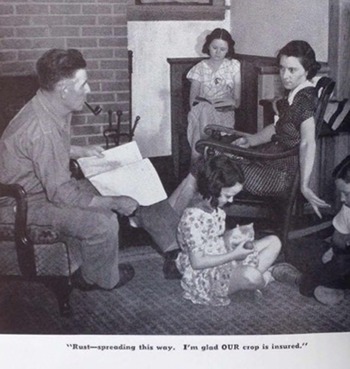
The program targeted wheat farmers first. Wheat covered a large geographical area, and the severity of the Dust Bowl droughts made wheat growers relatively receptive to the insurance concept. Extensive marketing campaigns were unrolled throughout the late 1930s and into the 1940s. Farmers in 1938, for instance, might have opened their mailbox to discover a pamphlet titled Wheat in Your Bin Every Year, which included a photograph of a farm family resting comfortably with the knowledge that “OUR crop is insured” (Figure 1). The pamphlet asked farmers to name their price for certainty: “How much does freedom from the worries of crop failure mean to you?” The price of certainty, in the early years of the program, was payable in kind—a farmer could sign up for insurance simply by committing a given amount of wheat at planting time.Footnote 27
A 1938 USDA pamphlet, Wheat in Your Bin Every Year, attempted to convince wheat farmers that crop insurance offered valuable protection from uncertainty.

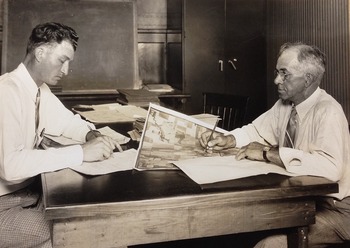
Farmers did not, however, name their own prices. The Federal Crop Insurance Corporation set premium rates, and in an attempt to prevent adverse selection, did so by carefully examining and modeling the crop yield data gathered by the Agricultural Adjustment Administration. Those data were not ideal, as a U.S. Department of Agriculture (USDA) financial officer noted in 1936; several years’ worth of crop history might seem “a long period when related to crop statistics [but] it is not a long period for an actuarial base.”Footnote 28 The system devised to overcome the data’s inadequacies was complex and labor intensive. First, economists and statisticians at the USDA established statistical models intended to smooth out the wrinkles and gaps in the available data. Here statisticians had the advantage of several decades’ worth of increasingly sophisticated techniques developed by life insurance companies—pioneers in combating adverse selection and moral hazard through actuarial science.Footnote 29 Entering data into the actuarial model was a labor-intensive process. Farm-level yield data gathered by county supervisors of the Agricultural Adjustment Administration program were hand transcribed into “summaries-of-performance” tables that were then transmitted to state-level offices for careful auditing (Figures 2 and 3). In addition to the complicated statistical apparatus bolstering these thin historical yield data, agents of the state were deployed into the field to gather more subjective information to combat moral hazard. Enumerators visiting the farms of applicants were instructed to rate not only potential crop yields, soil types, moisture levels, and so forth, but also to rank the farmer on a scale from 1 to 5. That numerical ranking was intended to sum up “the farmer’s ability as well as his physical equipment, labor, supply, etc. for doing a good job.”Footnote 30 Such analyses were clearly subjective, but crop insurance administrators insisted that at least some of the information required for workable insurance had to emerge from the field itself, not solely from the desks of government actuaries.Footnote 31
Transferring farm-level crop yield data gathered in the field by county supervisors of the Agricultural Adjustment Administration into usable actuarial tables was a labor-intensive process.

Field-level crop yield data arrived at state-level auditing offices in the form of “summaries-of-performance,” where (mostly female) computers audited the data for inaccuracies.

There was a crucial problem with this entire approach. What the Federal Crop Insurance Company was selling to farmers was a means for mitigating uncertainty, but what its actuarial tables were trying to price was risk. From the start, the managers of the Federal Crop Insurance Corporation made clear they had no intention of profiting from risk, as a private insurance firm would seek to do. Instead, sales campaigns sought to convince farmers that there was value in security. As a USDA circular noted in early 1938, the “need for crop insurance … has always existed, since farming is one of the most uncertain of all occupations.”Footnote 32 Farmers did not need to experience the severe droughts of the Dust Bowl to know that they were engaged in risky business, but what the Federal Crop Insurance Corporation had to convince them of was that insurance could provide them with security, a form of positive freedom. The 1940 Yearbook of the USDA suggested crop insurance was the farmer’s equivalent of “the unemployment insurance for industrial populations provided for in the Social Security Act.” Crop insurance, the Yearbook declared, “produces certainty in place of uncertainty.”Footnote 33 Propaganda campaigns touted the liberating potential of crop insurance. The 1938 slogan “Wheat in Your Bin Every Year” was transformed in 1942 by a wartime poster declaring “Worry Won’t Win the War,” urging farmers to “Be free … Be sure… Insure!”Footnote 34 Freedom from uncertainty, such propaganda suggested, could be purchased, for a price established by government actuaries.
But what if the price could not be clearly determined? Private insurance companies had already decided that the price of agricultural uncertainty was impossible to determine precisely enough to make the business profitable. Even farmers who bought the government sales pitch and signed up for the crop insurance system, such as Montana wheat farmer H. J. Nichol, recognized that premiums as of 1943 were not yet “reasonably accurately determined from the actual experience on the individual farm.”Footnote 35 New Dealers, spurred by the Dust Bowl disaster, had decided that government data could help address if not eliminate the problems of adverse selection and moral hazard that had plagued private crop insurers. But even so, the first managers of the Federal Crop Insurance Corporation did not expect the program to operate as a truly efficient market.
Information asymmetries plagued the program at every level. One problem was that farmers repeatedly demonstrated that their willingness to pay for insurance dissipated when they expected a good crop. A 1939 survey of farms in southwest Kansas, for instance, discovered farmers who were angry that they could not cancel their policies in the wake of rainfall that improved soil conditions after planting.Footnote 36 Such cancellations would obviously violate the principles of insurance, but their anger illustrates how many farmers at the time thought of the program not in terms of risk management but instead as a social insurance program meant to limit uncertainty and provide a barrier against calamity. Some farmers rejected the very premise of an “automatic regulator” of the ever-normal granary by applying for coverage only in years when they planted crops on flood-prone lowlands.Footnote 37
In 1942, the Federal Crop Insurance Corporation performed an in-depth fifteen-county survey of the program’s operations. Among its findings were many examples of farmers refusing to accept insurers’ statistical approach to risk. Farmers who rejected insurance because they thought the premiums too high did so because they believed that historical production records “were not representative of the loss to be expected in the future.” This optimism flew in the face of historic experience—akin to the gambler’s fallacy, whereby a bettor is convinced that losing twenty hands of blackjack is proof the twenty-first hand will turn out to his or her advantage. Of the fifteen counties surveyed, thirteen had in the past ten years experienced drought, twelve suffered hailstorms, seven had wheat rust, and six were subject to grasshopper invasions, not to mention losses due to wind, winterkill, fire, excess moisture, flood, smut, weeds, hot winds, jackrabbits, root rot, Hessian fly, and freezes.Footnote 38 Adverse selection was inevitable when risk-prone, rather than risk-averse, farmers were the primary purchasers of coverage.
By 1944 Congress was ready to pull the plug. For every year of its existence from 1938 to 1944, the federal crop insurance program paid out more in indemnities than it collected in premiums. The Federal Crop Insurance Corporation was hemorrhaging money, experiencing loss ratios that would make any private insurer blanch. Farmers were not enrolling at the expected rates, and those who were signing up were the riskiest candidates for coverage. Representative Malcolm Tarver (D-GA) bemoaned to the House Appropriations Committee in 1944 the expenditure of $40 million that he believed had “not been of very great benefit to the farmers of the country.” Quite a few in Congress were prepared to agree with Tarver’s assessment.Footnote 39
The threat of canceled funding pushed farm-district representatives to promote crop insurance as something other than subsidized social insurance. As Representative Clarence Cannon (D-MO) declared in an agriculture committee hearing in 1944, crop insurance should no longer be seen as a New Deal relief program, but instead as “a business proposition on its merits.” That “business” still had to be run by government, however, not private enterprises. As Senator Carl Hayden (D-AZ) explained, no “company organized in the United States … is ready to step in and give the farmers this kind of insurance.”Footnote 40 J. Carl Wright, chief manager of the Federal Crop Insurance Corporation, further appealed to conservatives’ instincts, noting that with crop insurance, rather than receiving a direct handout, farmers had to pay money into the system, unlike “other farm programs in which the farmers are paid for doing certain things.” Wright insisted that, with the proper data and actuarial fine-tuning, crop insurance could be made to run more like a standard insurance business, to the benefit of both farmers and taxpayers.Footnote 41
Partially convinced, Congress amended the program’s enabling legislation in 1944, allowing it to continue but dramatically reducing its scale and scope. Restricting its operation to a handful of counties, Congress urged the Federal Crop Insurance Corporation to develop better data modeling. In 1945 and 1946 Congress made additional tweaks, such as allowing the corporation to make adjustments for especially high-risk farms. And in 1947, with Public Law 320, Congress formally restricted crop insurance coverage to just 324 designated counties (down from 2,400 before the cuts) and announced that the program would henceforth be only “experimental.”Footnote 42
The thrust of this “experiment” from 1944 onward was to abandon the New Deal premise behind crop insurance. New Dealers had pitched crop insurance as a component of the ever-normal granary, intended to mitigate agricultural uncertainty; a worthwhile, if inherently expensive, project in service to a broad public interest. After 1944, Congress instead demanded that crop insurance operate like an efficient market, albeit subsidized and state run. Farmers had to be disciplined to accept the law of large numbers, paying sufficient premiums to enable an actuarially sound government-owned business in which success would be measured by a more balanced ratio between premiums and indemnities. Under such a scheme, individual farmers, not farmers or consumers or the nation as a whole, were expected to pay for and receive the benefits of risk management. In a nation becoming increasingly accustomed to the insurance principle, adopting the logic of insurance everywhere from highways to homes to hospitals, even the most conservative Congress could support such a project, at least as long as it remained “experimental.”Footnote 43
Even after Congress reframed the program in more individualistic, market-based terms in 1944, however, its administrators continued to wrestle with the persistent challenge of adverse selection. The case of Roy O. Stanberry, a wheat farmer in north Montana, neatly encapsulates the doubly damning problem of asymmetrical information. Stanberry applied for federal crop insurance in spring 1949 but was denied coverage. According to county committeemen, Stanberry was exceptionally risk prone. Without reliable data on individual farms, the Federal Crop Insurance Corporation had turned after 1945 to county committees to reject individual farmers’ applications, hoping the riskiest farmers could be barred locally from the risk pool. “Experience reveals,” explained Undersecretary of Agriculture A. J. Loveland to Montana Senator James Murray in defense of Stanberry’s rejection, “that indemnities have been paid to some producers under certain circumstances much more frequently than would be expected in view of prevailing crop conditions.” In other words, the Federal Crop Insurance Corporation was aware that certain farmers were systematically cashing in on their insurance policies. But because data were so shaky, Washington bureaucrats could not effectively determine precisely which farmers were responsible for gaming the system, and so they turned to local committeemen to cull those deemed most risky. When Murray informed Stanberry of this reasoning, Stanberry angrily retorted that he had been denied coverage not because of his risk exposure but because the members of the county committee were Republicans and he voted Democratic.Footnote 44
But in a telling slip, Stanberry further noted that the farm had been held in his wife’s family since the passage of the Homestead Act, “so we do not have to go to the U.S.D.A. to find what has been produced on this farm.” Stanberry knew more about the farm’s yield history, in other words, than the Republican county committee or any other agent of the state, and he fully expected that knowledge to provide him a means of deciding when insurance was worth the price. In 1949 Stanberry wanted insurance because he had “not raised a profitable crop since 1943.”Footnote 45 Such thinking reflected the New Deal origins of the program; it was, after all, originally framed and sold to the public as a social insurance program that would stabilize rural incomes. But Stanberry’s understanding was a fundamental problem for program administrators seeking to make crop insurance actuarially sound, not just because it obviously promoted adverse selection, but also because Stanberry had reason to feel discriminated against. Private insurers had spent decades trying to develop methods for convincing customers that any discrimination they faced in taking on insurance was due to “natural laws” of statistics, not to their race, gender, class, religion, ethnicity, or in Stanberry’s case political affiliation.Footnote 46 If crop insurers relied on naked discrimination to create sound actuarial tables, how would skeptical farmers be convinced to join the program?
In 1949 economist Harold G. Halcrow formally declared the U.S. all-risk crop insurance program an unacceptable example of market failure. Writing in the Journal of Farm Economics, Halcrow declared that all-risk crop insurance based on individual farm yield histories could “work in a satisfactory manner only under a system of conditions so exacting in their specifications that they will be found to rather limited extent in American agriculture.” Insurers could never know as much as individual farmers about farm-level yield risks, and so should instead turn to “area-yield” insurance, in which premium structures were calculated based on an area’s “normal” production over time. All farmers in that area (generally a county) would pay the same premiums. The problem of adverse selection persisted even under this formula, Halcrow acknowledged, as some farmers might be able to “estimate area yields a year or two in advance with greater accuracy than would be inherent in a formula used by the insurer.” Armed with that foresight, farmers might avidly buy insurance when they expected losses out of line with the formula’s predictions and shun insurance when they expected better outcomes than the formula predicted. To prevent such behavior, Halcrow recommended farmers be compelled to sign up for three- to five-year contracts. Doing so, Halcrow admitted, was “economically coercive,” but that coercion could “be justified” if the formula were constantly refined to more accurately predict yields two to three years in advance. Halcrow thus suggested a technical fix to the Federal Crop Insurance Corporation’s endemic information asymmetries, trying to define a workable middle ground that encouraged many farmers to sign up for insurance while using coercion to prevent the system from being gamed. This was far from a market in perfect equilibrium, but Halcrow’s research informed the approach of the Federal Crop Insurance Corporation for the next three decades.Footnote 47
Having once again accepted the imperfection of its market logics, the “experimental” crop insurance program stabilized and quietly expanded through the 1950s. From 1948 to 1961, the corporation’s income from premiums exceeded its indemnity payments overall, a significant reversal of the embarrassing loss ratios (ranging from 1.49 to 2.48) of the early 1940s. As the experiment continued, more and more farmers began to demand access to crop insurance and were thus declared eligible by Congress for coverage. By 1961, oats, rice, and raisins had been added to the program, alongside wheat, cotton, corn, tobacco, flax, dry beans, citrus, soybeans, barley, and peaches.Footnote 48 In 1961, the Federal Crop Insurance Corporation announced that “the experimental stage has passed,” noting coverage was available in 885 counties in 38 states. Throughout the presidential administrations of John F. Kennedy and Lyndon B. Johnson, crop insurance witnessed rapid expansion, so that by 1967 approximately 18 million acres of U.S. farmland were insured.Footnote 49
A powerful combination of factors helped the program expand in the 1950s and 1960s. First was what farm economist Willard Cochrane influentially labeled the “technological treadmill.” In the face of falling commodity prices, farmers responded not by reducing production (as classical economics might expect) but instead by investing ever more heavily in new technologies. Early adopters of new technologies reaped rewards, which encouraged their neighbors to buy the latest machines and chemicals, too. Soon everyone was overproducing themselves into a situation where they needed to up the technological ante.Footnote 50 A farmer with a brand-new combine harvester and the latest anhydrous ammonia sprayer had much more to lose from a drought year than did one muddling along with outdated but paid-off machinery. Insurance thus became increasingly appealing to farmers who were, season by season, putting themselves at greater and greater exposure to devastating crop failure. Risk—an abstract notion, but increasingly made real in the literal machinery of agribusiness—thus became something needing to be managed and accounted for, alongside the visibly concrete aspects of farming such as plowing, seeding, weeding, harvesting, and transporting crops. Many “efficient farmers … who strive for higher than average yields” consequently made clear that they were willing to pay for even higher levels of insurance coverage than the Federal Crop Insurance Corporation was offering by the late 1960s. Farmers were, in other words, becoming increasingly disciplined to think of yield risk in financial terms, something that not only could be, but should be, managed with the tools of actuarial science.Footnote 51
Most crucially, rural bankers stepped into the scene in the mid-1960s. The technological treadmill depended upon banks to offer farmers loans to purchase the implements and inputs of industrialized agriculture. Yet bankers, especially smaller firms in rural areas with limited capital reserves, faced intense scrutiny from examining authorities who demanded the banks reduce their exposure to substandard loans. The expanding federal crop insurance program of the 1960s provided rural bankers with a convenient means for securing potentially risky loans. As a banking journal noted in 1965, a farmer’s crop was one of the “most speculative” collaterals available for a loan, but a federally insured crop came with “additional security.”Footnote 52
Forging a direct link between farm credit and crop insurance hastened the process of financialization, and here the federal government took the lead. Government efforts to expand farmers’ access to credit first became formalized in the 1916 Federal Farm Loan Act, legislation passed in response to perceived failures of the banking system to adequately meet farmers’ needs for loans. As the nation’s first government-owned enterprise, the Farm Credit System set a precedent that was substantially expanded during and after the New Deal. Federal underwriting of rural finance infrastructure was significantly strengthened in 1933, while new government-owned enterprises, including Fannie Mae and Freddie Mac, were established during Franklin Roosevelt’s presidency to shore up the financial structures of urban housing markets. The government-backed farm credit system has received astoundingly little attention from historians, despite servicing 42 percent of contemporary farm debt in the United States. Yet what we do know of its history, as well as the broader history of financialization, suggests that government support for rural banking institutions surely played a key role in embedding the processes and institutions of financialization into the daily life of American farmers.Footnote 53
From the onset of the federal crop insurance program, policy makers had intended surer access to credit to be a result of farmers signing insurance contracts. Only in the 1960s, however, did bankers come to recognize the depth of this untapped market. They did so because the Federal Crop Insurance Corporation, seeking to expand coverage as rapidly as possible in the 1960s, began paying bankers a commission to sell federal crop insurance policies. While signing up a farmer for a loan, a banker could “strongly recommend” the farmer sign an insurance policy. If the farmer signed up, the banker received a 10 to 15 percent sales commission from the federal government.Footnote 54 Just as farm mortgage debt had lured farmers in the post–Civil War period into the life insurance market, the loans required by the post–World War II technological treadmill appear to have lured many U.S. farmers deeper into an increasingly financialized world of on-farm risk management.Footnote 55
In this vein, the 1960 USDA Yearbook of Agriculture offers a telling contrast to the 1940 Yearbook. In the 1940 Yearbook, the problem of uncertainty is foregrounded, not only in discussions of the purpose of crop insurance, but in the entire document. Indeed, the word “uncertainty” appears multiple times on the first page and then again on twenty-one additional pages, highlighting the central theme of “Farmers in a Changing World,” a world defined by an “unknown future.” “Risk” is also repeatedly mentioned in the 1940 Yearbook, appearing on twenty-six pages (with at least six of those references tied directly to crop insurance). But in the 1960 Yearbook, “uncertainty” appears only twice in relation to agriculture (specifically on weather and the availability of farm laborers), whereas “risk” appears twenty-two times, primarily with respect to capital investments in machinery and land, befitting the 1960 theme of “Power to Produce.” Perhaps even more significant, many of the references to “risk” in the 1940 document dwell sympathetically on the aversion of many farmers to incur debt in order to invest in machinery or land. The 1960 text, by contrast, emphasizes upside risk, suggesting, for instance, that “the manager of the modern commercial family farm … takes greater risks” but consequently has “more opportunity for reward.”Footnote 56 Farmers had, of course, always had to think about finances and risk when making decisions on the farm. But by the 1960s, the transformation of crop insurance from a New Deal experiment in social insurance into an increasingly necessary component of the day-to-day business of farming signaled a deep penetration of financial concepts of risk management into American agriculture. The abstract notion of risk, commodified and priced in a state-run market for insurance, increasingly became something farmers had to plan for and integrate into their business routines, rather than depending upon the government to compensate them for losses after the fact.
Conclusion
The phrase “risk management” only began to permeate general business discourse in the 1950s, so in some respects it is not surprising that the concept would have meant little to an average American farmer in the 1930s.Footnote 57 It is significant, however, that in the 1996 farm bill the Federal Crop Insurance Corporation was put under the purview of a new federal institution, the Risk Management Agency of the USDA. The 1996 farm bill, touted by congressional conservatives as the “Freedom to Farm Act,” was initially pitched as a dramatic rollback of New Deal farm policy. In reality, the 1996 act was far from a complete break with existing policy. Although farmers were provided with greater flexibility in making cropping decisions, the congressional farm bloc managed to secure continuation of direct payments and commodity loans, including the addition of new direct payments in response to falling farm prices in the late 1990s.Footnote 58 In 2014, however, sustained attacks on the expense of direct payments led Congress to push risk management—particularly the crop insurance programs that had steadily expanded since the 2000 Agricultural Risk Protection Act—to the forefront of farm support programs. In this regard, it is telling that what became the 2014 farm bill was initially known as the “Agricultural Reform and Risk Management Act.” Risk management had become the raison d’être of American national farm policy.
Much like the 1996 Freedom to Farm Act, however, the 2014 farm bill in many ways demonstrates continuity more than change in the political economy of American agriculture.Footnote 59 The premise behind prioritizing crop insurance over direct payments is that the need to pay premiums requires farmers to put “skin in the game” (as a 2014 Senate press release touting the legislation put it).Footnote 60 In the original New Deal version of crop insurance, lawmakers widely accepted that general taxpayers and not just farmers needed to put significant “skin in the game,” helping the ever-normal granary to confront the pernicious uncertainty in the agricultural marketplace that had contributed to the collapse of the farm economy in the 1920s and 1930s. What changed from 1944 onward is that the U.S. crop insurance increasingly aimed to discipline farmers to account for the risks of agriculture on individualistic terms, using internalized market logic, insurance principles, and financial models to manage risk rather than call upon the state to devise structural responses to mitigate uncertainty. This discipline would be firmly established in the 1960s as the “technological treadmill” and pressure from rural bankers, encouraged by government commissions on insurance policy sales, made financialized risk management a necessary component of American farming operations. By 2012, many farmers had so effectively internalized the insurance model that they were able to navigate (and demand) an increasingly complex landscape of insurance offerings. Currently the Risk Management Agency’s crop insurance programs include: actual revenue history insurance, area risk protection, catastrophic risk protection, common crop insurance, high-risk alternate coverage, margin protection for certain commodities, rainfall and vegetation index insurance, and whole-farm revenue protection. Growers of wheat, soy, cotton, and corn can procure coverage, but also eligible are almonds, grass seed, mint, popcorn, safflower, and tomatoes (along with dozens of others). And for growers of crops not already covered, there is the Non-Insured Crop Assistance Program, which provides insurance-like coverage for yield losses.
The quiet expansion of crop insurance over the twentieth century can be understood as just one of many institutionalized responses to the endemic problem of uncertainty in agricultural production and marketing. Since the late nineteenth century there have been multiple institutions developed in American agriculture to confront uncertainty, including centrally coordinated markets, cooperatives, corporations, and government regulations and supply management schemes. Yet crop insurance stands out for its cognitive dissonance, its simultaneous reliance on highly individualized market logics and on an expansive and expensive role for the federal government to make that “commonsense” market logic work. With contemporary farmers confronting the risks and uncertainties posed by global climate change, potential disruptions to international trade, and the rise of unprecedented hazards such as insecticide-resistant superbugs and herbicide-resistant superweeds, it seems increasingly necessary to consider very carefully whether insurance-based modes of agricultural risk management are adequate to the task.Footnote 61