

1. Introduction
The writings of Adam Smith continue to have profound influences on broad academic and policy debates over free trade, price theory, markets, tax, and the role of government in a civil society. Examining Smith’s early policy influence in the United Kingdom, Willis (Reference Willis1979, p. 506) states that if one is interested in studying ‘the popularisation of political economy, perhaps no better source exists than the parliamentary debates for they document graphically the gradual dissemination of ideas of the classical economists. They also demonstrate how the doctrines of the economists came to be used as political and ideological weapons, how complex ideas became slogans.’
To the best of our knowledge, in the four decades since Willis published his paper, no attempt has been made to document the use (and possible abuse) of Adam Smith during parliamentary speeches. This paper is a first attempt at exploring the corpus of House of Commons speeches from 1919 to 2022 using computational tools not available to Willis but still looking for the patterns of dissemination and engagement with Smith that motivated his original research. We find engagement with Smith and his ideas have a periodicity to them, with uptake in the 1920s and 1930s giving way to a quieter period, before a resurgence in the 1970s through 1990s before again trailing off. Importantly, the tone of the debate becomes more acrimonious and defensive during the 1970s as Margaret Thatcher first becomes Leader of the Opposition and then Prime Minister, the Chicago School rises to prominence, and the Adam Smith Institute becomes a fixture in the think tank environment around Westminster. Over the past decade, there is cause for optimism as speeches invoking Adam Smith or his two major works (Theory of Moral Sentiments (TMS) and The Wealth of Nations (WoN)) have become calmer as a new issue agenda involving Constitutional questions attracts mentions of this classical economist.
2. Parliament—point scoring or policy dissemination
Uses of ideas and evidence on the floor of the Houses of Commons is selective, often criticised as such, with the link between evidence to policy blurred by politics, public opinion, party manifestos, constituent priorities, and competing visions of what constitutes a ‘good’ society (Cairney, Reference Cairney2016). Rhetoric or the tone of the debates is at least if not more important than the use of evidence in Parliament. The appeal often is not so much to persuade legislators to change their minds on a vote but to shape public opinion and make a case to voters, keep face within a political party, and to support legislators’ own personal ideas (e.g. Osnabrügge et al., Reference Osnabrügge, Hobolt and Rodon2021). Rhetoricians who study legislators classify speech on the floor as ‘ornamental’ and ‘argumentative’ (e.g. Muldoon et al., Reference Muldoon, Gould and Yonai2022). A characteristic of ornamental discourse often is ‘strawmanning’ or invoking a person or their thoughts to make their case without really understanding their ideas. Argumentative discourse, in contrast, resorts to deploying evidence and reasoning to make a case. There is much nuance to these ideal types and many parliamentary speeches use a mixture of both, but examples of employing Smith in both forms of speech are present in Hansard. Examples of speeches invoking Smith or terms in his work in Parliamentary debates are:
-
1) Ornamental and positive as a ‘great man’ during a contentious debate over Scottish independence: ‘most important to the country is our people. They are innovative, inventive people, who have contributed to developing all aspects of the modern world, including the previously mentioned Robert Burns, Adam Smith, David Hume, Alexander Fleming……’ (SNP MP Allan Dorans 2 November 2022 v. 721 c. 942).Footnote 1
-
2) Ornamental but more contentious during a discussion of Universal Basic Income, with Adam Smith ‘owned’ by the political right and free market-oriented thinkers: ‘the left should regard the principle with suspicion when some of its leading champions have been right-wing economists, such as the father of free market economics, Adam Smith. There is a right-wing vision of universal basic income that is about dismantling the state and that says, ‘If we provide everyone with the income, we don’t need to provide the services centrally because people can pay for them’.’ (Labour MP Wes Streeting 18 March 2020 v. 673 c. 1029).
-
3) Leaning argumentative with a genuine reference to core ideas of his writing with little acerbity: The ‘Gentleman’s final point was about whether this Government believes…that markets can do it all. Let me assure him that no Conservative Government have ever believed that… At the risk of invoking one of my great heroes, Adam Smith, the position is that commercial society is a dynamic evolution in which forms of property are supported and recognised in law and then used to become the basis of profitable market development…the state is integral to that process.’ (Conservative MP Jesse Norman 24 March 2020 v. 674 c. 295).
3. Debates across time
Hansard serves as a historical record, where we see how the popularity of invoking Adam Smith and his most famous works—The Wealth of Nations and The Theory of Moral Sentiments—can wax and wane over time. As contemporary accounts of Smith’s importance (e.g. Liu, Reference Liu2022; Norman, Reference Norman2019) note, there is considerable difference in how Adam Smith was conceptualised in 1919, when we begin our examination of mentions in the Commons, and how Smith is seen in 2022. At the end of World War 1, Smith’s thoughts and his contribution to classical economics were well known to academics (e.g. Viner, Reference Viner1927) and present on the syllabi of elite universities that graduated many parliamentarians (Liu, Reference Liu2022). However, in this early period, the discipline of economics had not yet taken its strictly positivist turn and there still was a lively debate over whether economists should pursue normative goals and the role of morals and values. It is telling that a collection of essays celebrating the 150th birthday of The Wealth of Nations (Clark, Reference Clark, Douglas and Hollander1928) contains both the famous ‘Adam Smith and Laissez Faire’ essay by Viner (Reference Viner1927) but also one by Glenn Morrow on ‘Smith the Moral Philosopher’. This changes in the 1970s with the discipline of economics clearly taking an empirical turn and the rise of the influential Chicago school, led by scholars such as Milton Friedman and George Stigler, who idealised Smith for his contributions to price theory and free market mechanisms. The most oft-cited picture of Stigler is one where the free-market economist is clothed in a t-shirt reading ‘Adam Smith’s Best Friend’.
The policy mood in Britain also changes over time and this, we contend, associates with how Smith is referenced and employed in the Commons. In the 1920s, the UK Government favoured a return to the gold standard, a task that proved elusive when the Great Depression hit in the 1930s and people looked more to government remedies than the need to link currency to the value of precious metals. After a surge in support, classical market orthodoxy becomes passe following World War Two, with Keynesianism gaining the upper hand when the Attlee Government embraced a more expansive welfare state. A quarter-century later, there was a dramatic U-turn when Thatcher’s Conservatives embraced deregulation, free-market economics, monetarism, and privatisation. Thatcher regularly invoked Adam Smith as an inspiration and her first Minister for Industry, Sir Keith Joseph, wanted civil servants to read The Wealth of Nations, but critics were quick to point out that their use of Smith was highly selective, failing to mention his support for public goods and what he had to say about civil society in his first work The Theory of Moral Sentiments (Hershey, Reference Hershey1979). To preview our findings, an example of this comes in a Commons debate on public utility privatisation on 22 May 1989 where Labour MP Frank Dobson remarked that ‘the modern Tory Party claims to be the intellectual offspring of Adam Smith. The trouble is that it either does not know or conveniently forgets a great deal of what its father figure said’ (v. 153 c. 735).
This leads to two primary questions—was Smith and his ideas regularly employed in the Parliaments of the 20th and early 21st Century? If so, were his ideas consistently up for debate or did his mentions ebb and flow with the Governments and Parliaments of the time. Secondly, how substantive are mentions of Smith and terms associated with his writings? We answer the first question via computational text analysis, and the second with a qualitative reading of the parliamentary debates we identify in answering the first question.
4. Charting mentions of Adam Smith in the Hansard
As a preliminary evaluation of these questions, we created a corpus of parliamentary speeches using Hansard debate transcripts from the House of Commons in the UK Parliament. We collected the debate transcripts from 1919 to 2023 on the parliamentary monitoring website TheyWorkForYou.com.Footnote 2 We individually downloaded all records of debates in the Commons from February 1919 to March 2023 using the ‘rvest’ web scraping-package for RStudio Wickham (Reference Wickham2022). This text corpus consisted of 18,581 parliamentary debates over the timeframe. To identify relevant speeches, we disaggregated the debates to identify individual speakers, which further extended the corpus to more than 6,700,000 individual plenary speeches expressed in the House of Commons since 1919.
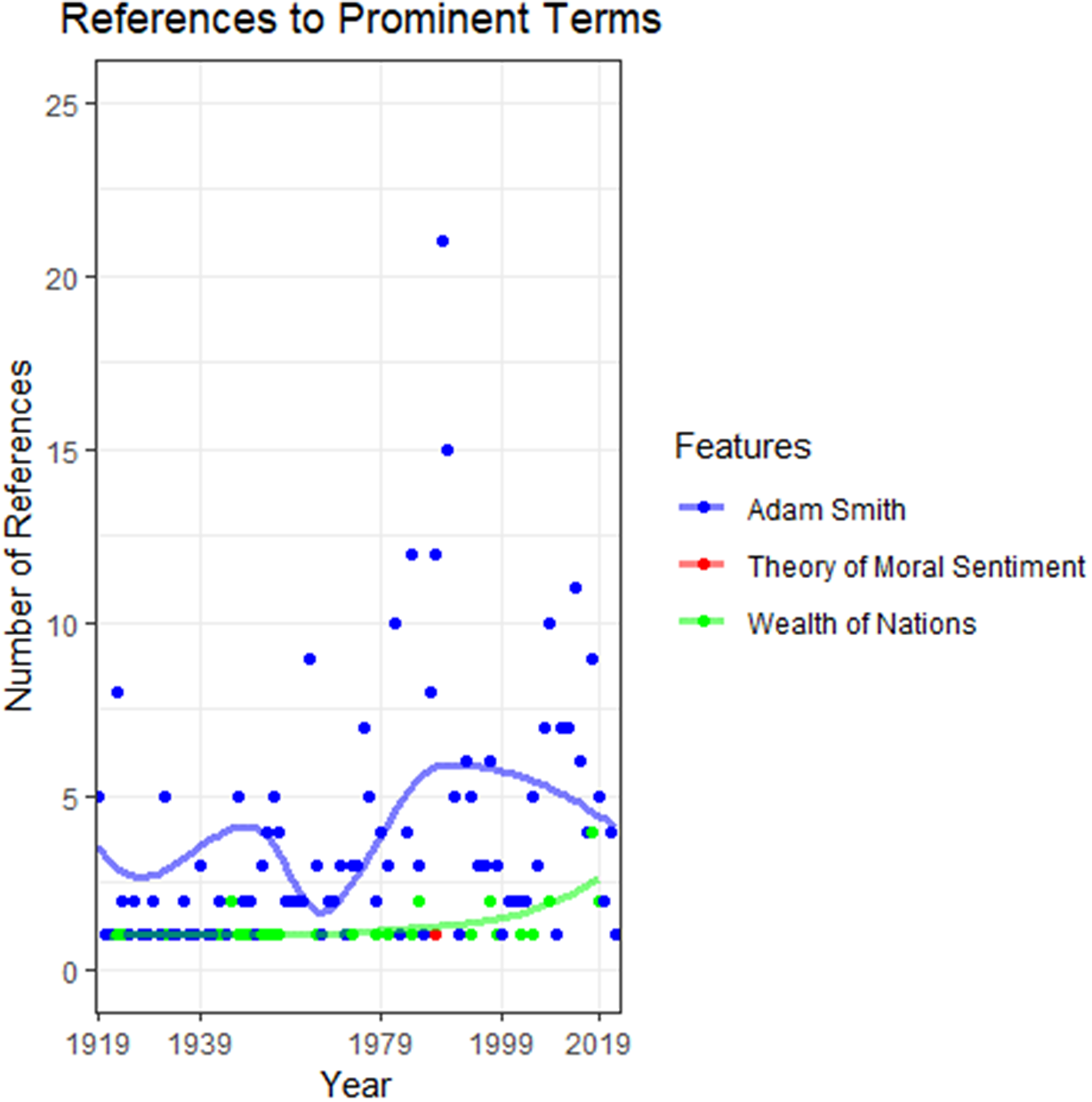
Given the substantial number of speeches, we adapt a set of computational tools for studying texts. In this paper, we use a dictionary-based approach to identify passages referencing Adam Smith using the quanteda package, a state-of-the-art tool for quantitative text analysis in R (Benoit et al., Reference Benoit, Watanabe, Wang, Nulty, Obeng, Müller and Matsuo2018). This approach allows us to search efficiently for a custom set of key-terms within large bodies of text and identify as well as isolate relevant text passages, which include one or more key-terms in the generated dictionary. To construct our Adam Smith dictionary, we included three terms: ‘Adam Smith,’ ‘Wealth of Nations,’ and ‘Theory of Moral Sentiments.’ This dictionary allows us to complete a keyword search for speeches that contain exact references to these concepts. We then construct a new dataset of only those speeches that reference one or more of the concepts within the dictionary. The resulting dataset contains approximately 725 direct or indirect references within the given speech corpus. Figure 1 describes the results of our quantitative approach.
References to Adam Smith and Major Works: 1919 to 2023

As indicated in the figure, the vast majority of mentions of Smith, and his two major books, are to the author himself. We see a periodicity to these mentions, with around 50 per decade in the 1920s and 1930s, a slight retreat to fewer per decade in the 1940s–1960s and then a significant increase in the 1970s–1990s, with over 150 mentions in the 1980s alone. We again see a decline in the 2000s before mentions pick up again in the 2010s. References to Wealth of Nations, while few, still far outnumber mentions of Theory of Moral Sentiments. Raw numerical mentions are interesting and reinforce the importance of Adam Smith in the 1970s re-emergence of classical liberalism, but the substantive backdrop of these mentions is at least as interesting.
5. Qualitative analysis—key themes and tone over the years
From 1919-World War Two: A perusal through speeches referencing Adam Smith in the prior to the 1945 election of the Labour Government shows that most mentions of Smith are of the ornamental and positive type. Discussions of Smith as one of many great economists like Ricardo and Mill are a common refrain in debates over taxation, trade, and government intervention in the economy. Even when criticisms of classical economics are made, they are light-hearted. For example, in a debate over housing subsidies and building, Conservative Sir Henry Craig (23 June 1924 v. 175 c. 162) states ‘I was brought up, I suppose, in what some would describe as a benighted age, on the orthodox teaching of political economy from Adam Smith and Ricardo down to John Stuart Mill. I was a diligent student, but not an enthusiastic disciple.’
Another form of speeches is those which Members grapple with the growing complexity of the modern industrial economy of the interwar period and earnestly ask about the relevance of classical economists to attempting to deal with contemporary economic challenges faced by the United Kingdom. Labour MP Jack Lawson (23 March 1932 v. 263 c. 1131) remarks that although as a coalminer he enjoyed immersing himself in Smith’s works, he questions the contemporary resonance of his writings. Conservative Earl Winterton (24 Nov. 1937 v. 329 c. 1358) echoes this sentiment when he drops Smith’s name in stating that policies should be geared towards the present moment and not follow ‘textbook orthodoxy.’
In our examination of parliamentary speeches, during this period, there only is one speech that can be described as deliberately contentious. This comes in 1922 (13 Dec v. 159 c. 3047) when Labour MP Gavan Duffy accuses MP Austin Hopkinson of being a ‘plaster of Paris imitation of Adam Smith’ during a heated debate over trade union power and conditions in coal mining, an early intimation that Smith was wed to pure individualist, free market ideology.
There are common themes of constructive, argumentative debates invoking Smith during the period. The first covers Smith and the degree to which he believed it was acceptable for the government to support nascent industries via limited trade barriers. Liberal Sir John Horne (Dec 7 1920 v. 135 c. 1960) notes that one can read Smith as willing to take action to protect the dye industry, an issue in both the late 18th Century and post-War Britain. Acknowledging Smith’s acceptance that infant exporting industries could be protected, Conservative Viscount Wolmer is sceptical of the effectiveness of such actions as it related to the tobacco industry in a 1922 debate.
The second line of argumentative debate during these decades centred around Smith’s principles of taxation. Members argued vociferously as to whether the taxation discussed in debates were regressive and whether they contradicted Smith’s principles by putting the onus on those least able to pay. For example, on 12 July 1922 (v. 156 c. 1390–1398), a lengthy debate broke out between Labour MP Neil Maclean and Conservative MPs Sirs Robert Horne and Patrick Hannon over what Smith meant when he said taxes should be proportionate.
Debates over the relevance of classical economics for the times also took on a more substantive tone. In the beginning of the decade, we also see luminaries such as Stanley Baldwin (13 May 13, 1930 v. 236 c. 1535) in a long theoretical oratory on whether Smith’s ideas are no longer valid for the complex and technologically advanced economy. Liberal Richard Acland (10 Feb., 1939 v. 343 c. 1279) closes the pre-war mentions of Smith expressing a similar sentiment stating that Smith’s time was ideal for his theory but now producers were likely to collude with one another to drive up prices: ‘What sort of standards of values are created when firms who, under the strict laws of Adam Smith would be competing with each other, are able to meet each other once a year round a table and decide that the prices which would be achieved under free competition shall not be the prices at which they will offer their goods to the public in the forthcoming 12 months?’Footnote 3
Mentions of Adam Smith decrease in the 1940s, with only 12 mentions in the wartime parliaments of the 1940s, with one of the mentions a different Adam Smith (19 Jan., 1944 v. 396 c. 252)! There are substantive references to the principles of taxation during debates over raising wartime revenue (e.g. Conservative MP Assheton’s mention on 14 Oct. 1943 v. 392 c. 1179). Additional substantive mentions involve MPs attempting to envision a post-war free trade environment, with Conservative MP Ian Hannah, (2 Feb 1943 v. 386 c. 838) making one of the few references not just to Adam Smith but also to The Wealth of Nations in the discussion (one of only 7 times the book is directly referenced in the 1919–1945 period).
Adam Smith During the Keynesian Consensus (1945–1970)
The post-war period begins a period of relative quiet as mentions of Adam Smith and the WoN fall (TMS receives no mentions). In terms of ornamental but constructive passing mentions, we have examples of Labour MP Robert Haworth (23 Jan 1948 v. 446 c. 591 invoking Smith’s name to imply that economics had become a value free discipline and that defeating Communism would involve appealing to morals and values, asking rhetorically ‘Where in Ricardo, Adam Smith, Marshall, or any other economist, is there a Gandhi?’ Somewhat amusingly, Conservative MP Geoffrey Hutchinson (7 July 1949 v. 466 c. 2454) invokes Smith in a speech expressing bewilderment that there were no Scots on a committee, given the nation’s ability to produce world renowned economists! In a homage to academics, Labour MP Michael Stewart (12 April 1956 v. 551 c. 531) extols Professors like Adam Smith who could take a ‘big picture’ type overview of the situation to offer sound advice rather than rely on those in industry who might be prejudiced towards their trade! Returning to a frequent refrain, Conservative MP Ian Lloyd (6 June 1967, v. 747 c. 944) lists Adam Smith’s principles of taxation, among other things, as something the Government should heed.
The period does mark the beginning of ornamental references to Smith as a guardian of free market economics, with debate moving to somewhere in between contentious and friendly. In a 1951 debate on taxes in the printing industry, Conservative MP Sir William Darling (14 Feb v. 484 c. 570) remarks ‘I feel that there will be a time, as there was in the middle of the 19th century, when all these fantastic taxes will be blown away, when the philosophy of Adam Smith will once again triumph in a free Britain.’ In a 1966 Commons speech debating the role of Government and business in society, Labour MP Tony Benn (19 Oct v. 734 c. 345) accuses a Member on the Conservative benches somewhat unflatteringly of having an ideology that was ‘a sort of mixture of Adam Smith with a bit of Bagehot and some Latin tags’ before going on to state that another Conservative Member was someone ‘whose purity in his attitude towards Government intervention is comparable to the preaching of some popular evangelist in relation to religion by that point.’
The 1960s also brought about heated debates over trade that referenced Smith and his relevance for the period. Labour’s J.T Price asks a Member to speak to the Liberal Party to inform ‘them that Adam Smith has been dead for over 200 years and that the principles he adumbrated in his age and generation do not apply to the modern world? Although many of us are greatly in favour of liberalisation of trade wherever possible, we are not in favour of sacrificing the interests of our own people to the sort of propaganda which the Liberal Party is putting out’ (8 Jun 1961 v. 641 c. 1377).
Although there is a slight turn to a more contentious tone across the political aisles during the 1940s–1960s period, we continue to see several substantive and argumentative debates. In the late 1940s, now Leader of the Opposition Winston Churchill (12 Mar 1947 v. 434 c. 1351), references Adam Smith as an observer of the idea that an economic society was a complex one, with many people doing uncoordinated things in contrast to planned economies being thought about in the post-war period. Parliamentarians also continue to reference Smith during debates over taxation, with Liberal Sir Frank Medlicott (5 April 1957 v. 568 c. 414) returning to a well-used discussion on the need for taxation to be proportionate to the citizen’s respective ability to pay.
A contentious debate on trade was held on 3 November 1965 where four members name Smith in their remarks. Then Labour stalwart Shirley Williams (v. 718 c. 1090) opens with a discussion of expanding exports and invokes the need for some central planning to enable this. She expresses, in her own words, that sceptics of planning do not consider the ‘aggregation problem’ and assumes Smith’s theories of individual exchange equate to aggregate national preferences. After Conservative Sir E. Boyle (v. 718 c. 1113) chimes in and urges Liberal George Mackie (v. 718 c. 1113) to rise in ‘hope that the hon. Gentleman, as a Liberal and a Scottish Member, will deliver Adam Smith from the many unfair things said about him,’ the latter does just that. The latter notes in a Smithian way that tariffs mean that ‘this country is at the moment having it too easy for its home industry,’ meaning that industry was not innovating because tariffs insulated British industry from competition.
Smith in the 1970s and 1980s: Smith Becomes a Free Market Icon: Mentions of Adam Smith explode in the 1970s and 1980s, reaching 100 in the 1970s and over 175 in the 1980s. The rise in Smith mentions can be linked to the ascendency of free market thought as an alternative to Keynesianism in economics departments in Britain and abroad, most notably at the University of Chicago (Liu, Reference Liu2022). In 1974, Friedrich Von Hayek won the Nobel Prize, followed two years later by Milton Friedman. Both were fans of Smith, not only regularly citing his work in their own writings but looking to claim a direct lineage from Smith to their own theories and ideas. Hayek’s and Friedman’s ideas had significant intellectual influence over the macroeconomic and microeconomic policy agenda of the Conservative Party in the 1970s, which would ultimately evolve into Thatcherism. Margaret Thatcher, a declared fan of Adam Smith becomes Leader of the Opposition in 1975 and then Prime Minister in 1979.
A second key driver of the increase in references to Adam Smith and his ideas is the rise of the Adam Smith Institute (ASI). ASI, a London-based think tank, was formed by three former students at the University of St Andrews in 1977. It advocates ‘using free markets to create a richer, freer, happier world.’ During the 1980s, whilst Friedman’s Monetarism agenda was key to the UK Government’s macroeconomic policy approach, the ASI was influential across a host of domestic microeconomic agendas. Most notable were their writings on privatisation and local taxation (which would form the basis for the highly controversial poll tax—something that would bring Smith into debates throughout the late 1980s and early 1990s). First mentioned in the Commons by Conservative David Atkinson on 21 December 1979 (v. 976 c. 1124), the ASI receives over 70 mentions during debates in the 1980s.
What is clear is that ASI has greater significance than simply increasing the number of references to Adam Smith. Combined with the policy context of the time—and the adoption of Smith as an ideological figurehead by the Thatcher Government—the linking of Adam Smith’s name to a controversial ideological think tank arguably was a key factor in leading Smith, and his ideas, to be ‘captured’ within contentious political debates.
Potentially because Thatcher’s ideas and the ASI represented a large departure from the ‘perceived wisdom’ on the activist state that had existed since the end of the Second World War, ornamental mentions of Smith shift become markedly more adversarial. Shortly after Margaret Thatcher ascended to Leader of the Opposition, we see a series of mentions in the Commons, not of the intricacies of Smith’s views on taxation or supporting nascent industry, but of big picture ideology behind Smith and his writings. For example, Labour MP Eric Heffer (5 July 1977 v. 934 c. 1114) acrimoniously takes aim at Thatcher for failing to understand that the economist she idolises: ‘Adam Smith contributed a great deal to Marxist ideas.’ He extolled her to ‘understand a little more about Marxism before she becomes involved in something that she obviously knows little about).’
Ideas coming to the forefront in the 1970s also are ascribed to Smith, and they often are associated with marketised policies. We see ornamental references to Smith by Labour MPs noting Smith’s adoption by the Conservatives and the right. Labour MP Michael Stewart mentions on 11 July 1977 (v. 935 c. 62) that Margaret Thatcher is positioning herself as an intellectual heir to Adam Smith, among others. MP Bryan Davies follows on 28 July 1977 (v. 936 c. 932), linking American capitalism with its high unemployment to following Smith. In short, the 1970s are a period where the tone of debate around Adam Smith becomes more contentious and more speeches associate him with free market economics, with Conservatives often speaking with glee and Labour playing their part when they associate Smith with the market-based ideas of the Tories.
As the WoN celebrated its 200th birthday in a Common’s debate on 15 March 1976, we also see a prolonged exchange where multiple members mention Adam Smith and the WoN. A particular contentious moment in the debate comes when Labour MP Arthur Blenkinsop accuses ‘the Conservative Party [of wanting] to return to Adam Smith…whatever the Opposition [Conservatives] may say…basically they want to return to unsullied private enterprise and the right of full exploitation’ (v. 907 c. 968). In another stage of the debate Mr. Blenkinsop accuses Conservative MP Timothy Raison of seeking ‘to tie his outlook and that of his party to a new Adam Smith’ (v. 907 c. 972). This occurs during a debate where Conservative MP Nicholas Budgen (v. 907 c. 1027) comes to the floor arguing that he did not deliberately mislead the House as members accused him of only partially representing Smith’s views on taxation that accorded with his argument. In this debate, we see the depth of Smith’s writings still coming to the fore, but the tone becoming more acrimonious and Labour accusations of Tory Adam Smith revisionism.
Unsurprisingly therefore, throughout the 1980s, and consistent with the notions of a ‘capturing of Smith’ and a portrayal of Smith as ‘right-wing’, we see an increase in negative references to Smith from Labour politicians. This includes, continuing the trend identified in the 1970s of tagging Smith to high-level political ideologies. As an example, Labour MP John Silkin remarks in a 29 June 1983 debate: ‘The Prime Minister’s view of the appropriate role for Government to play in the economy is a throwback to the days of Adam Smith. She wishes to restore a competitive market in which only the rigorous pursuit of self-interest ensures survival.’ (v. 44 c. 658). The next year, Labour MP Brian Sedgemore continues: ‘In strict economic terms the Budget can best be described as a combination of born-again Adam Smith economics and demonic monetarism’ (19 March 1984 v. 56 c. 767).
Linked to the co-optation of Smith by free marketeers are regular references to outputs from the ASI from Conservative MPs on all manner of different issues, from defence (Richard Ottoway, Conservative MP 28 November 1983 v. 49 c. 703), foreign policy (Jonathan Aitken, Conservative MP 22 December 1983 v. 51 c. 585) and tax (Marion Roe, Conservative MP 17 December 1986 v. 107 c. 1261). Hansard also documents how Labour MPs, particularly by the end of the decade, are highly critical of the ASI and its influence over: a) government—claiming that committees were ‘packed with Government’s friends from the Adam Smith Institute’ (Robin Cook, Labour MP 12 November 1987 v. 122 c.607); and b) ASI’s role shaping key policies, with Labour MP Brian Wilson exclaiming that ‘the poll tax re-emerged from the shelves of the Adam Smith Institute and was dusted off in Scotland by a handful of zealots three years ago’ (17 December 1987 v. 124 c. 1312).
We also see a new trend emerging relating Smith to negative outcomes and not just specific policy agendas: Labour MP Donald Dewar remarks in a 29 Nov. 1983 speech: ‘What has happened after five years in Scotland under the latter-day apostles of Adam Smith? Their monument is an index of industrial production more than 10 percent below the 1975 level and record levels of unemployment.’ (v.49 c.789). During this period, Smith is referenced curtly in a highly political context. Future Labour Leader Jeremy Corbyn is a notable example of offering disparaging views of Smith: ‘We are now graced with the presence of the Adam Smith look-alike, who has just returned to the Chamber but who is not even replying to the debate’ [in describing Conservative Minister Quentin Davies] (7 Dec.1989 v. 163 c. 548) and ‘Will the Minister take his nose out of the works of Adam Smith for a moment and look a little wider?’ (23 July 1987 v. 120 c. 504).
Labour was not wholly ready to cede the idea that Adam Smith was more than a free market apostle. In Commons debates, there are defences of Smith by Labour politicians, most notably those from Scotland such as John McFall, John Moxton, Lewis Moonie, Dennis Cannavan, John Smith and George Foulkes, who push back on the interpretation of Smith as an unwavering advocate for free markets and small government. Frank Dobson MP noted in a debate on 22 May 1989 that ‘the modern Tory party claims to be the intellectual offspring of Adam Smith. The trouble is that it either does not know or conveniently forgets a great deal of what its father figure said’ (v. 153 c. 735), while Labour MP John Moxton mentioned that ‘to describe his views [referencing Michael Forsyth MP] as Adam Smith economics would be to insult Adam Smith, he was so simplistic in the way that he presented them.’ (29 November 1983 v. 49, c. 840). The link between Adam Smith and the ASI is also criticised: ‘there has been a perversion of the theories of Adam Smith by the Adam Smith Institute’ (Labour MP George Foulkes, 21 October 1987 v. 120 c. 837); ‘Adam Smith would probably turn in his grave if he knew that that institute was named after him’ (Labour MP Dennis Canavan, 11 July 1984 v. 63, c. 1196).
The most detailed and eloquent critique flows from Stuart Holland (Labour MP), himself a former economist, who offers not only a critique of reading Smith as solely about ‘self-interest’ and instead discusses in detail the TMS quoting Smith directly: ‘it is not the soft power of humanity that is capable of counteracting the strongest impulse of self-love. It is a stronger power, a more forcible motive. It is reason, principle, conscience’ (16 March 1988 v. 129 c. 1192).
This is not to say that the 1970s and 1980s were devoid of substantive argumentative points. Significantly, we see a healthy mix of the profile of parliamentarians mentioning Smith, and the types of issues discussed reflect the period. The Liberal and Labour benches again come back to Smith as a protector of consumers and one willing to prop up domestic industry to allow it to compete on an even footing. In a 1973 speech, Liberal MP John Pardoe (v. 856 c. 1651) paraphrases Smith’s writings in Book 1, Ch. 10, pt. 2 stating: ‘Never are two or three businessmen gathered together but they conspire to rob the public’ to push back against criticism that a parliamentary trade advisory committee was loaded with ‘consumerists.’ In the early 1970s, we see two instances (22 April and 23 July 1971, v. 815 & 821, c. 1397 & 1877) where Labour MP Edmund Dell argues that Smith had the good ‘pragmatic Scottish attitude’ of allowing for state aid to British shipping because there was stiff competition in this sector. This debate comes as the European Economic Community was coming into being, a Community Dell favoured joining ‘on the right terms.’
Substantive debates in the 1980s include discussions over the role of government and type of society it supports. The verse from Smith: ‘By necessaries I understand, not only the commodities which are indispensably necessary for the support of life, but whatever the custom of the country renders it indecent for creditable people even of the lowest order to be without’ is referred to both by Conservative MP Tim Janman (2 January 1989 v. 146 c. 359), Labour MPs Frank Dobson (22 May 1989 v. 135 c. 735) and John McFall (22 January 1990 v. 165 c. 678) in debates about inequality with two polar opposite interpretations. The former criticises efforts by the low pay unit to increase wages of those at the bottom as ‘ridiculous, arguing that someone can have a high quality of life even though, in relative terms, they might not be as well off as others’. The latter instead makes the point that ‘necessities’ are what society deems appropriate and therefore a broader assessment of inequality that is based upon relative inequality is needed.
Labour MPs, in part in likely response to the capturing of Smith by advocates of ‘free markets’, cite Smith in detail when discussing the social implications of the economic policies of the 1980s and the implications of deindustrialisation on communities. Scottish Labour MP Dr Lewis Moonie quotes directly from the Wealth of Nations Book 1: ‘no society can surely be flourishing and happy of which the far greater part of the members are poor and miserable’ and ‘poverty is extremely unfavourable to the rearing of children. The tender plant is produced, but in so cold a soil, and so severe a climate, soon withers and dies.’ (16 July 1987 v. 119 c. 1364). Labour MP John Battle in a debate about low pay reminds Members that ‘Adam Smith, the high priest of the free market, in his ‘Theory of Moral Sentiments’, stressed that economic individualism had to be founded upon a theory of social obligation’ (10 March 1988 v. 129 c. 698).
Unsurprisingly, Smith is referenced in crucial debates over tax and importantly, the poll tax. As highlighted, the ASI was a proponent of a per capita tax for local services. We see through Hansard, Labour MPs pushing back on attributing such an idea to Smith. Labour MP Dick Douglas, in a debate on the Poll Tax, states ‘Some hon. Members misquote and misdirect the words of Adam Smith. The first canon of taxation that he enunciated was related to the ability to pay’ (18 April 1988 v. 131 c. 610). Similarly, future Prime Minister Gordon Brown cautions Conservative Members ‘that Adam Smith, the great mentor or guru, advised the Bourbons that there would be disaster if they imposed iniquitous taxes’ (6 March 1989 v. 148, c. 722).
A final topic of debate, again a major policy agenda in the 1980s, was deregulation (linked to the free market agenda of the Thatcher Government). The aforementioned quote—often paraphrased—from Book 1, Chapter 10 of the WoN: ‘People of the same trade seldom meet together, even for merriment and diversion, but the conversation ends in a conspiracy against the public, or in some contrivance to raise prices’ appears on six occasions through the 1980s. Just like the earlier quote on relative inequality it is used by both sides of the political divide. We see it used by Conservative politicians such as Neil Hamilton MP (15 April 1986 v. 95 c. 821) and Frances Maude (18 March 1988, v. 129, c. 1366) in debates over competition policy and regulation to argue for the opening of markets, including in pharma, to greater market forces. On the other side, we see opposition MPs cautioning that greater private sector competition could lead to a concentration of a small number of monopolies in key sectors and ‘prices will be raised in order to pay profits to shareholders’ (Labour MP Stuart Holland, 25 January 1988 v. 126 c. 139). Liberal Democrat MP Malcolm Bruce makes a similar argument using the same quote to conclude that ‘the Government’s proposals for merger policy show a lack of urgency about curbing monopoly’ (18 March 1988 v. 129 c. 1335).
The 1990s and 2000s: Quieting Down but Not Yet Back to The Way Things Were. As the Thatcher years recede from memory giving way to Prime Ministers John Major, Tony Blair and Gordon Brown, we see mentions of Adam Smith and his books drop off to below 75 in the 1990s and under 20 in the 2000s. More than a third of the references in the 1990s are to the Adam Smith Institute, but ASI mentions disappear in the 2000s.
The tone of the ornamental use of Smith becomes more positive in the 1990s. Even in the early 1990s, Conservative Stephen Dorrell (9 Nov 1990 v. 180 c. 308) congratulates a parliamentarian for innovative ideas stating ‘My hon. Friend the Member for Stirling (Mr. Forsyth) will particularly appreciate it when I say that the Scots, from Adam Smith onwards, have had a particularly pioneering approach to the development of new ideas’. Interestingly, a series of speeches later in the decade become rare occasions where the term ‘invisible hand’ is employed without also naming Adam Smith.
Substantively, the 1990s begins with Labour’s Merlyn Rees (22 Nov 1990 v. 181 c. 480) naming Adam Smith as one who would be against the poll tax during the period where the tax remained highly contentious. The only truly prolonged back and forth discussion of Adam Smith in the 1990s comes on 14 June 1991, and there is a mixture of ornamental and argumentative mentions. Conservative MP Dudley Fishburn (v. 192 c. 1156) opens with a discussion of the origins of the principles of fair taxation, which go back to Burke and Smith. Importantly, moderation away from Tories believing Smith as the guru of free market ideas are evident in his words: ‘I quote Adam Smith not as some great guru of the right who has been hijacked by that wing of politics, and not because the Conservative Benches are today populated by fellow Scots, but because, with Lord Keynes, he was the greatest economist that Britain or the world has produced.’ Labour’s Tam Talyell responds noting that Nobel Prize winners had ‘argued convincingly that Adam Smith could have been a socialist.’ Rather than contest this argument, Fishburn replies ‘One can do many wondrous things with history. Whatever side Adam Smith would have been on…we are agreed that…he was a great economist.’ Conservative Nicholas Fairbairn (v. 192 c. 1157), however, cannot resist and states ‘Adam Smith was wise enough not to be a socialist!’ What continues then is a back-and-forth discussion of the tax proposals before the Commons and how they squared with Smith’s ideas. In some sense, this may represent a cooling off moment after the Thatcher period, though the Members would not have been aware of the trend towards a depolarisation in employing Adam Smith during debates.
Following the 1991 debate, we see a considerable drop-off. The ASI still receives mentions in the early 1990s, but afterwards, Smith is only on occasion mentioned. One of the few substantive uses of Smith is telling: on 10 Jan 1995, Conservative MP Alan Howarth found disquiet in what he considered the punitive aspects of a jobseeker’s bill and notes ‘we serve in government with a responsibility to take care of our society. I do not believe that market forces are an invisible hand that of itself will create a worthwhile pattern out of all this. Adam Smith was a moral philosopher as well as an economist and he insisted on the need for what he called sympathy. The Bill widens inequality and deepens impoverishment’ (v. 252 c. 75). In October 1995, Mr. Howarth would cross the aisle and defect to the Labour Party (Bevins, Reference Bevins1995).
Debates mentioning Adam Smith in the 2000s are few and far in-between. Liberal Democrat Tim Farron invokes him in a 27 Oct. 2005 speech on rural housing, speaking to incidents of market failure in this area: ‘Adam Smith may have been a Liberal, but he was nevertheless wrong in this respect: no invisible hand is in evidence to correct the faults in this market—it is up to society to employ its visible hand to correct imbalances, to protect true freedom, and to ensure fairness (v. 438 c. 509). Farron returns to this line of thought in a 24 Feb 2009 debate on agriculture, noting ‘Smith famously talked about markets reaching equilibrium through the movement of the invisible hand in the marketplace. He suggested that markets will naturally ensure a fair and appropriate outcome, but I am afraid that that works only if we assume that markets are rational and that all the players are equally balanced in power’ (v. 488 c. 241). The decade closes out in the midst of a financial crisis and in this context Labour’s John McFall gives Smith one last mention of the decade on 18 Nov 2009 (v. 501 c. 42) when he stated we need to see more of the ‘visible hand’ when it comes to financial regulation. In short, the 1990s and 2000s were a cooling off period where mentions subsided and the contestation over Smith’s grand ideas fell away.
2010s: Populism in Parliament: Westminster received two populist shocks over the course of the 2010s. The 2014 Scottish independence referendum, followed by the 2015 Scottish National Party landslide win in Scotland at the general election, changed the composition of the Scottish delegation in London. The context in which Scotland’s parliamentarians sought to reference the country’s most famous economist changed as a result. Soon afterwards, the 2016 Brexit referendum paralysed the Commons, and dominated discourse over the next several years. As Brexit involved a lot of the questions Adam Smith pondered in his work, most notably trade, regulation and the role of government, parliamentarians on both sides of the Brexit debate found ways to invoke Smith in debates. Our analysis reveals 70 mentions of Smith from 2010 until the end of 2022. (WoN receives 13 mentions and TMS one).
Within those 70 speeches, 19 mention Brexit, and 14 mention Scottish nationalism. These speeches mostly use Smith in ornamental ways, with Smith often referenced as one of the ‘Great Scotsmen’ select legislators trot out as reasons to argue for Scotland’s distinct contribution to the world. Smith is referenced on the side of both unionists and nationalists in Parliament (e.g. by Conservative MP Gerald Howarth on 6 Feb 2014 v. 575 c. 480, and SNP MP Allan Dorans on 2 Nov 2022 v. 721 c. 940). He frequently is enumerated along with other historical figures such as David Hume and Robert Burns, or modern personalities such as J.K. Rowling and Andy Murray. Even though the issues are weighty and divided the UK and Scotland, the tone of some contexts in which Smith and his works are mentioned are largely positive in comparison to the Thatcher period.
This ornamentalism continues into debates on Brexit, but is not without the occasional negative tone. One of the most notable Brexiteers in Parliament, David Davis, refers to both Smith and Gladstone as Scots who would support Brexit because it would allow Scotland to ‘ditch the Scottish Government’s socialist protectionism’ and embrace free trade instead. (18 Jan 2017 v. 619 c. 926). However, this is the exception; the ASI makes its way into Commons debates, but in the 2010s, the tone of the debate is less pointed and contentious. Sometimes, the position of the ASI is used by those on the nationalist left to justify opposing the Government’s positions. For example, future SNP Commons Leader Ian Blackford, in a 29 Oct 2015 debate, quotes a position of ASI in Opposition to the Tory cuts to tax credit programmes for the working poor, goading ‘I can start with a quote from the Adam Smith Institute, which used to be much loved by Conservative Members’ (v. 601 c. 596).
Argumentative use of Smith also changes in terms of substance to match the issues of the day. In a long debate concerning the economic fallout from Brexit, the Opposition questioned the Financial Secretary to the Treasury Jesse Norman on the impact of a hard Brexit on the 250,000 businesses that traded with the EU at that point. Norman responded by saying that Smith recognised that economies are dynamic and would have to adapt to changes even as fundamental as this. He points the opposition to his own book on Smith for further details (8 Oct 2019 v. 664 c. 1655, see also Norman, Reference Norman2019).
Smith’s views on public infrastructure are also brought up in defence of some of the major works that the UK underwent in this period. The SNP MP Angus MacNeil argues for an extension of the High Speed 2 line to Scotland, by bringing up the Wealth of Nations: ‘the more markets and economies are linked, the better for all’ (31 Oct 2010 v. 569 c. 1140). Later, the Levelling Up Secretary Greg Clark argues for Crossrail 2, High Speed 3 and the Northern Powerhouse by bringing up Smith’s ‘three duties for government: the defence of the realm, the maintenance of law and order and the erection of public works’ (21 Mar 2016 v. 607 c. 1291).
There are also tinges of uniquely modern issues that appear in these debates. In January 2021, Conservative MP Tom Tugendhat, connected Smith’s need for rules-based international markets with the fact that Twitter had just banned the American president and how that reveals a need for rules-based digital markets. In this same speech he happened to mourn the erection of a trade border with the EU ‘just 30 miles south,’ which emphasises the dominance this issue had on the debate (11 Jan, 2021 v. 687 c. 82). And during the first COVID lockdown, Labour MP Chris Evans mentions Smith along Keynes and Friedman as greats who ‘make no reference to the crisis we face,’ particularly in the context of the Government’s pandemic spending (27 Apr, 2020 v. 675 c. 168).
6. Discussion and suggestions for future work
To the best of our knowledge, this paper represents a first attempt to examine mentions of Adam Smith and his two major books in Parliamentary floor speeches since Willis’ (Reference Willis1979) paper exploring Smith and his ideas in the late 18th Century. After employing quantitative computational text analysis methods to locate mentions in the House of Commons between 1919 and 1922, we qualitatively analyse the type (ornamental versus argumentative) and tone of rhetoric used by parliamentarians.
In a polarised era where misinformation is rife, we think it is a worthwhile exercise to see how great economic thinkers are employed. Members of Parliament do engage with ‘evidence,’ which is defined by Geddes (Reference Geddes2021, p. 41) ‘as an argument backed by information [that] usually has connotations of scientific-based knowledge.’ Adam Smith provided observational evidence in the 18th Century on a wide variety of topics that remain relevant in our times. As always, the use of evidence on the floor of the House of Commons is selective (Cairney, Reference Cairney2016).
Our preliminary analysis of speeches mentioning Adam Smith is that he is often mentioned ornamentally, a passive name dropping. However, the tone of this does vary over time. Up until the 1960s, it was rare that the ornamental use of Adam Smith evoked anger or was he seen as a thinker owned by the Conservative Party’s adherents to free market ideology. We see this changing as the Keynesian consensus breaks down in the 1960s, with the rise of Thatcher in the 1970s, and the prominence of the Adam Smith Institute to Conservative economic thought during the 1980s. We note too, particularly amongst Labour MPs, a fightback to protect Smith’s legacy. Optimistically, in recent times, there is some evidence of a ‘cooling off.’ Our analysis suggests that after a lull in mentions in the 1990s and 2000s, mentions of Adam Smith and his works become more catholic across the political spectrum. Normatively, we believe this is a cause for optimism as the characterisation of Adam Smith as a dogged adherent to the free market does little to grow appreciation for the depth and complexity of his works.
Substantively, when Smith is employed in an argumentative context, it was interesting to see themes of fair taxation, trade, fears over the coercive powers of producers come up repeatedly. While Smith’s core ideas around these topics are timeless and will always lurk in policy debate, it is notable that he also comes up during debates over fostering nascent industries between the World Wars and arguments over the accession into the EEC and exit from the European Union in the second half of the corpus of debates we examined. An analysis of argumentative rhetoric from the 2010s suggest Smith is relevant to the Constitutional issues Britain now faces, and it is interesting to see him invoked by those on both sides of the Scottish Independence and Brexit debates.
This paper constitutes a ‘first cut’ at analysing parliamentary speeches mentioning Adam Smith and his works. There are numerous ways these efforts can be extended. Additional quantitative analyses, some aided by modern tools of quantitative text analysis, can more comprehensively classify the speeches into policy categories to provide a more comprehensive overview than we can achieve with our qualitative analyses. More refined definitions of ornamental and argumentative speeches coupled with human and machine coding may offer a more precise breakdown of the tone and types of speeches, including by extending our examination to other phrases beyond Smith’s name and his key works. Further, extensions of this work may analyse the heretofore uncovered use of Smith in parliaments of the 19th Century, whether he gets mentioned as frequently or more substantively in the House of Lords and if American legislators invoke Smith in a similar fashion as their British counterparts.
Acknowledgements
The title from this paper comes from a 20 Nov 1980 House of Commons Speech by Liberal David Steel, who accuses Prime Minister Thatcher of ‘pervert[ing] the free market theories of Adam Smith by transplanting them to Britain in 1980…all the time in plundering the Liberal philosophical tradition, the Prime Minister has taken only those parts of it which suit her own argument’ (v. 994 c. 28). Portions of this work were supported by funding from the European Union’s Horizon 2020 research & innovation programme under grant agreement No 951832 as part of the OPTED project.
Data availability statement
Data employed in the quantitative and qualitative analyses in this paper are available here: Scotto, Thomas, 2023, ‘Mentions in the UK House of Commons for ‘Adam Smith’, ‘Wealth of Nations’, ‘Theory of Moral Sentiments’ (1919–2022)’, https://doi.org/10.7910/DVN/QITLYJ, Harvard Dataverse, V1.
Author contribution
G.R. and T.J.S. developed the original idea for the paper. Z.G. and T.S. performed the computational analysis required to extract speeches from Hansard and created the initial dataset as well as the figure in the paper. They also wrote the quantitative methods section. J.M.J., G.R., and T.J.S. performed the archival research and read the speeches, wrote up the results and the initial and final drafts of the paper.