Implication
The new approach of using mild rinsing conditions of rumen incubated nylon bags, combined with a correction for undegraded particulate matter loss during incubation based on in vitro simulation of shaking conditions, can potentially be used to determine the fractional degradation rate of nutrients in feedstuffs with a high proportion of small particles. This approach offers a possibility to evaluate the assumptions about the degradation of nutrients in small particles made in feed evaluation systems.
Introduction
Feed evaluation systems, such as Norfor (Volden, Reference Volden2011), DVE/OEB (van Duinkerken et al., Reference van Duinkerken, Blok, Bannink, Cone, Dijkstra, van Vuuren and Tamminga2011), FiM (Thomas, Reference Thomas2004) and NRC (NRC, 2001) use the in situ method to predict the nutritional value of feed ingredients and forages. The basic assumption of this method is that disappearance of substrate from porous nylon (or Dacron) bags incubated in the rumen represents actual ruminal substrate degradation by rumen microorganisms (Ørskov and McDonald, Reference Ørskov and McDonald1979; López, Reference López2005).
A fundamental problem of the in situ method is the disappearance of undegraded small particles or particulate matter loss from the nylon bag, either during incubation itself or during rinsing after rumen incubation (Michalet-Doreau and Ould-Bah, Reference Michalet-Doreau and Ould-Bah1992; Vanzant et al., Reference Vanzant, Cochran and Titgemeyer1998; López, Reference López2005). This problem occurs when there are particles in the feed material with a size smaller than the pore size of the nylon bag and can be observed as the loss of insoluble nutrients during rinsing of non-incubated bags (de Jonge et al., Reference de Jonge, van Laar, Hendriks and Dijkstra2013). Consequently, fractional degradation rate of nutrients in these small particles cannot be measured and the previously mentioned feed evaluation systems use assumptions for the degradation rate of these particles. Ruminal degradation is largely by surface erosion by bacteria, and smaller particles in a measured unit of substrate offer larger surface area and likely a faster rate of degradation (France et al., Reference France, Dhanoa, Theodorou, Lister, Davies and Isac1993) These assumptions are a potential source of uncertainty of the calculated feeding values as shown by Dhanoa et al. (Reference Dhanoa, France, Lòpez, Dijkstra, Lister, Davies and Bannink1999). This problem is especially relevant for the determination of rumen degradation of feed ingredients that contain mainly small particles, such as wheat yeast concentrates (WYC), a by-product from the bioethanol production. It would therefore be desirable to develop a rinsing method that would reduce the loss of particulate matter; however, when applying such a method the issue of loss of particulate matter during in situ incubation in the rumen remains.
The hypothesis of this study is that a modification of the in situ protocol may reduce particulate matter loss during rinsing, which after correction for small particle loss during the actual incubation enables the estimation of the rumen effective degradation (ED) of nutrients in feedstuffs with a large proportion of small particles. The modification is based on two principles: first, a reduction of the particulate matter loss during rinsing; and second, a correction for the particulate matter loss during incubation in the rumen. Reduction of losses during rinsing is realised by applying a recently described rinsing method (de Jonge et al., Reference de Jonge, van Laar, Hendriks and Dijkstra2013). Correction for the particulate matter loss during incubation is based on simulation of the in situ particulate matter loss during incubation under laboratory conditions using silica as a marker.
This study comprises three experiments. In the first experiment, the particulate matter loss during incubation was investigated using silica with different particle size distributions. In the second experiment, the particulate matter loss during incubation in the rumen was simulated in vitro at different rinsing conditions using silica. In the final experiment, the modified in situ method was used to estimate the ED of organic matter (OM) and nitrogen (N) in three WYC with and without correction for particulate matter loss.
Material and methods
Materials
The silica used include silica gel 40 (<400 mesh; silica 1) and DavisilTM grade 633 (200 to 425 mesh), both from Sigma-Aldrich (Steinheim, Germany). Davisil was divided in two fractions by sieving using a Retsch AS200 (Haan, Germany), viz. a fraction <53 μm (silica 2) and a fraction between 53 and 71 μm (silica 3). For the second and third experiment another batch of silica gel 40 was used (silica 4). For the third experiment three WYC, labelled A, B and C came from different producers and were obtained from Duynie B.V. (Alphen a/d Rijn, the Netherlands) and stored at ~4°C during the experiment.
Methods
In the first experiment, the silica 1, 2 and 3 were incubated in nylon bags in the rumen of three rumen-cannulated dairy cows for 3, 6, 24, 48 and 96 h. Incubated and non-incubated (i.e. 0 h) bags were rinsed at 40 strokes per minute (s.p.m.) according to the method of de Jonge et al. (Reference de Jonge, van Laar, Hendriks and Dijkstra2013) and the residues were analysed for ash.
In the second experiment, silica 4 was incubated in three rumen-cannulated dairy cows for 3, 6, 24 and 48 h. After incubation, bags (including non-incubated bags) were rinsed at 40 s.p.m. (method given by de Jonge et al., Reference de Jonge, van Laar, Hendriks and Dijkstra2013) and residues analysed for ash. To determine and simulate rumen particulate matter loss conditions, non-incubated bags containing silica 4 were rinsed in a beaker with 500 ml of buffer solution pH 6.2 (de Jonge et al., Reference de Jonge, van Laar, Hendriks and Dijkstra2013) in a shaking water bath at 20, 30, 40 and 50 s.p.m. for 3, 6, 24 and 48 h and subsequently dried and weighed. The comparison of the rate of disappearance of silica during rumen incubation with the disappearance of silica in vitro at four shaking speeds, gives information on the severity of ‘shaking’ conditions in the rumen expressed in water bath shaking conditions.
In the third experiment, three different WYC’s were incubated in nylon bags in three dairy cows for 2, 4, 8, 12, 24 and 48 h. Each bag contained ~5 g DM of WYC and 0.5 g silica 4 as internal marker for particulate matter loss. Afterwards, incubated bags as well as non-incubated bags (i.e. 0 h) were rinsed at 40 s.p.m. (method given by de Jonge et al., Reference de Jonge, van Laar, Hendriks and Dijkstra2013). In addition, separate non-incubated bags were rinsed with the washing machine method. All residues were analysed for dry matter (DM), ash and N. The amount of silica in the bags was analysed by the determination of ash insoluble in HCl. The loss of particulate OM and N in WYC during rumen incubation was simulated with non-incubated nylon bags rinsed in a beaker with 500 ml of buffer solution pH 6.2 at 30 and 40 s.p.m. for 2, 4, 8, 24 and 48 h, as for shaking conditions 30 and 40 s.p.m. silica loss was similar between rumen incubation and in vitro simulation (results of experiment 2).
Rumen incubations
Rumen incubations were carried out with lactating Holstein-Friesian dairy cows and were approved by the Experimental Animal Committee of Wageningen University, The Netherlands. The cows were housed indoors and fed ad libitum a mixed ration of 50% grass silage (N, 16.6 g/kg DM; NDF, 516 g/kg DM) and 50% maize silage (N, 11.5 g/kg DM; NDF, 397 g/kg DM; starch, 374 g/kg DM) at 0700 h. Cows received each day an additional 2 kg of protein-rich concentrate feed (N, 53.0 g/kg), and commercial concentrate feed (N, 29.8 g/kg) according to milk production level up to a maximum of 7 kg. Cows were 216±5 days in milk and produced 20.3±2.9 kg milk/day. All incubation times were conducted separately on different days, starting at 0900 h (~2 h after feeding) according to the all in–all out principle. Nylon bags were prepared according to the Dutch in situ protocol as described by Tas et al. (Reference Tas, Taweel, Smit, Elgersma, Dijkstra and Tamminga2006). Briefly, nylon bags with an inner size of 10×8 cm, a pore size of 40 μm and porosity of 0.30 (PA 40/30, Nybolt, Zurich, Switzerland) were filled with ~5 g of silica in the first and second experiment, and ~5 g DM WYC and 0.5 g of silica in the third experiment. Leakages of WYC during the weighing was very limited (i.e.<0.1 g) and was considered to be part of the washout fraction. The number of bags for each WYC and incubation time combination was 8/animal.
Modified rinsing methods
The modified rinsing method described by de Jonge et al. (Reference de Jonge, van Laar, Hendriks and Dijkstra2013) was used. Briefly, four nylon bags were placed in a glass vessel (Ø 19 cm, 7 cm height) containing 500 ml buffer solution (12.2 g/l NaH2PO4·H2O and 8.9 g/l Na2B4O7·10H2O and adjusted to pH 6.2 with hydrochloric acid). The vessels were placed in a mechanical shaker (Julabo SW-20c; Julabo GmbH, Seelbach, Germany) and were shaken for 60 min at 40 s.p.m. at room temperature. For WYC samples that were not incubated, the buffer solution in the vessel containing the soluble (S) and insoluble washout (W-S) fractions was centrifuged for 15 min at 20 000×g at 25°C and the supernatant containing the S fraction as well as the pellet containing the W-S fraction were quantitatively collected and weighed.
Washing machine method
The washing machine method was performed as described by Tas et al. (Reference Tas, Taweel, Smit, Elgersma, Dijkstra and Tamminga2006), using a programmable washing machine (AEG Turnamat, Nuremberg, Bavaria, Germany) with tap water at ~18°C and a gentle wool wash programme without centrifuging (40 min in~80 l tap water with three swing turns).
Sample preparation and analyses
The nylon bags after rinsing, and the pellets of the WYC after centrifugation of the rinsing fluid were air-dried for at least 48 h at 70°C and weighed. For the first and the second experiment individual bags were analysed. For the third experiment, the content of the four bags from each rinsing vessel were combined and ground to pass a 1 mm sieve, leading to two samples for each combination of WYC, cow and incubation time point. DM content was determined by drying to a constant weight at 103°C (ISO 6496, 1999). Ash content was determined by incineration to a constant weight at 550°C (ISO 5984, 2002). Ash insoluble acid was determined by incineration at 550°C during 3 h followed by boiling with 3 M HCl during 15 min and incineration of the residue at 550°C during 2 h (ISO 5985, 2002). N was measured by the Kjeldahl method (ISO 5983-2, 2005). Non-protein nitrogen (NPN) in the S fraction was determined after addition of 1 ml 4% (w/v) trichloric acetate to 10 ml of the S fraction and centrifugation at 3000×g during 10 min followed by N analysis of the supernatant by the Kjeldahl method.
Particle size distribution of the silica and WYC products was determined after suspending ~0.5 g sample into 10 ml water followed by laser diffraction using a Coulter LS 230 particle size analyser (Beckman Coulter Inc., Hialeah, Fl, USA). The particle size distribution of the W-S fraction was measured in the solution obtained after rinsing of the nylon bags by using the modified method. The particle size analyser was capable of measuring particle sizes from 0.04 to 2000 μm. The particle size distribution was expressed as a fraction of the total volume.
Statistical analyses and calculations
The fractional disappearance rate (k d ; h−1) and the undegradable fraction (U) of silica, insoluble OM and insoluble N were estimated with the PROC NLIN procedure of SAS (2002) using a first-order model:
 $$Y{\rm (}t{\rm )}=(1{\minus}U{\rm )}\,{\rm exp(}{\minus}k_{d} {\times}t{\rm ){\plus}}U$$
where Y(t) is the fractional residue of silica, insoluble OM or insoluble N after incubation during t hours expressed relative to residue after rinsing at t=0 h. For insoluble OM and N, disappearance from the bag is assumed to occur owing to degradation as well as because of particulate matter loss. For silica, disappearance is assumed to occur owing to particulate matter loss only. The particulate matter loss of undegraded insoluble OM and insoluble N of WYC during in situ rumen incubation was based on simulation of this process in a water bath at 30 and 40 s.p.m. shaking speeds, based on results of experiment 2 (see the ‘Results’ section). The fractional particulate matter loss rate (k pl ; h−1), the fraction of WYC insensitive to particulate matter loss (F IS ) and the fraction sensitive to particulate matter loss (F S ; calculated as 1–F IS ) were estimated with the PROC NLIN procedure of SAS (2002) based on the simulation data using a first-order model:
 $$Y{\rm (}t{\rm )}=F_{S} {\times}{\rm exp(}{\minus}k_{{pl}} {\times}t{\rm ){\plus}}F_{{IS}} $$
where Y(t) is the fractional residue of insoluble OM and insoluble N after rinsing during t hours. The fractional disappearance rate (k d −corr; h−1) and undegradable fraction (U−corr) corrected for particulate matter loss of insoluble OM and insoluble N was estimated with the PROC NLIN procedure of SAS (2002) using a reduced second-order model, with F S and k pl taken from the in vitro simulation:
 $$\eqalignno{ Y{\rm (}t{\rm )}& =F_{S} {\times}\exp ({\minus}(k_{d} {\minus}{\rm corr{\plus}}k_{{pl}} ){\times}t{\rm ){\plus}(1}{\minus}F_{S} {\minus}U{\minus}{\rm corr)}\cr & {\times}{\rm exp(}{\minus}k_{d} {\minus}{\rm corr}{\times}t{\rm ){\plus}}U{\minus}{\rm corr}$$
where Y(t) is the fractional residue of insoluble OM and N after incubation during t hours. The ED of OM and N was calculated as:
 $${\rm ED}=S{\rm {\plus}(1}{\minus}S{\rm )}{\times}[({\rm 1}{\minus}U{\rm )}{\times}k_{d} /(k_{d} {\plus}k_{p} )]$$
where S is the soluble fraction, U the undegradable fraction of the insoluble fraction and k p the fractional passage rate.
ANOVA was conducted using the GLM procedure of SAS (2002). In experiment 1, the model effects were type of silica (silica 1, silica 2, silica 3). In experiment 2, the model effect was the method (incubation in situ, 20, 30, 40, 50 s.p.m.). In experiment 3, the model effects were WYC product (A, B, C). When treatment effects were detected (i.e. P<0.05), in experiment 1 and 3 Tukey’s test was used to test multiple pairwise comparisons. In experiment 2, the Dunnett test was used for pairwise comparison using the in situ method as reference.
Results
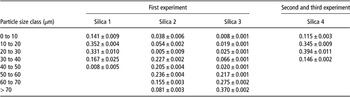
Nearly all the particles in silica 1 (viz. 99.2%) were <40 μm (Table 1). The fraction of particles >40 μm in silica 2 and silica 3 was 0.676 and 0.882, respectively. Silica 4 (used in experiments 2 and 3) had a particle size distribution that was comparable to that of silica 1 (experiment 1).
Particle size distribution (average±s.d.) of the four silicas used in the three experiments (n=4)

First experiment
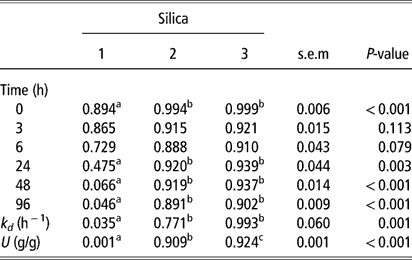
Substantial loss of silica during rinsing without incubation (t=0 h) was only observed for silica 1 (Table 2). This fractional loss (i.e. 0.106) was smaller (P<0.001) than obtained by using the washing machine (i.e. 0.627; result not shown). Only for silica 1 a marked increase in disappearance of material with incubation time was observed, which occurred mainly within the first 48 h. The mean fractional disappearance rate for silica 1 was 0.035 h−1with a range from 0.028 to 0.050 h−1 for individual animals while no substantial undegradable fraction was observed. For silica 2 and 3 the disappearance during the incubation was small and mainly between 0 and 3 h of incubation, leading to an undegradable fraction of 0.909 and 0.924, respectively. The fractional disappearance rate for the remaining fraction in silica 2 and 3 was relatively large (0.771 and 0.993 h−1).
Experiment 1: residues after in situ rumen incubation (g/g) of the three silicas at different incubation times, as well as the fractional disappearance rates (k d ) and undegradable fraction (U). Rinsing was done after incubation using the modified rinsing method at 40 s.p.m. (strokes per minute)

a,b,cMeans in the same row with different letters differ (P<0.05).
Second experiment
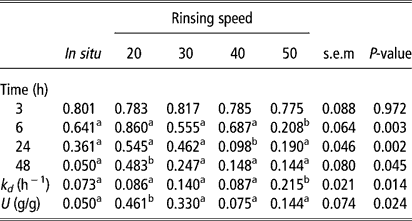
The mean in situ fractional disappearance rate and the mean undegradable fraction of silica 4 was 0.073 and 0.050 h−1, respectively (Table 3). The undegradable fraction of silica at 20 s.p.m. (0.461) was higher (P<0.05) than that obtained in situ. At 50 s.p.m., the fractional disappearance rate (0.215 h−1) was higher (P<0.05) than the in situ fractional disappearance rate. The fractional disappearance rate and undegradable fraction obtained with 30 and 40 s.p.m. did not differ (P>0.05) with the in situ fractional disappearance rate of silica, although the results found at 40 s.p.m. were numerically more comparable to those found in situ. Both shaking speeds were selected to estimate the particulate matter loss rate of insoluble OM and insoluble N in the third experiment.
Experiment 2: residues (g/g) of silica 4 after in situ incubation or after rinsing in a shaking water bath at 20, 30, 40 and 50 s.p.m. (strokes per minute) during different times, as well as the fractional disappearance rate (k d ) and the undegradable fraction (U)

a,bMeans in the same row with different letters differ from the in situ (P<0.05).
Third experiment
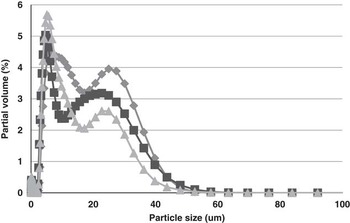
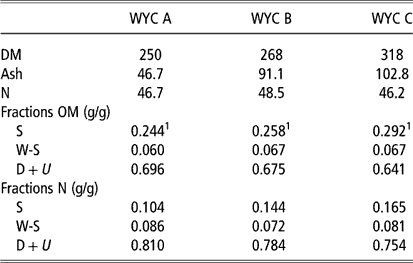
The DM and N content of the WYC ranged from 250 to 318g/kg and from 46.2 to 48.5 g/kg DM, respectively (Table 4). Using the modified rinsing procedure, the insoluble washout fraction (W-S fraction) of OM varied between 0.060 and 0.067, whereas the non-washout fraction (D+U fraction) ranged from 0.641 to 0.696 (Table 4). The mean calculated value for the soluble fraction (S fraction) of OM was 0.264. The D+U fraction of OM obtained with the washing machine (mean 0.113) was much smaller than with the modified rinsing method and varied between 0.091 and 0.150 for individual bags (results not shown). The S fraction of N varied between 0.104 and 0.165 and contained mainly NPN (0.88 to 0.98 of the total soluble N; data not shown). For N, the W-S fraction with the modified rinsing method ranged from 0.072 to 0.086 and the D+U fraction from 0.754 to 0.810. The D+U fraction of N obtained with the washing machine was much smaller (mean 0.084) and varied between 0.065 and 0.094 for individual bags (results not shown). Particle size analyses showed that the W-S fraction of these products mainly contained particles <40 μm with relative high fractions of particles <10 μm and between 20 and 30 μm (Figure 1). Differences in the particle size distribution between the products were observed but not further analysed.
Particle size distribution of the W-S fraction of the three wheat yeast concentrates (WYC A,  ; WYC B,
 ; WYC C,
 ).

Experiment 3: dry matter (DM, g/kg), ash (g/kg DM) and nitrogen (N, g/kg DM) of three wheat yeast concentrates (WYC A, WYC B and WYC C) and the soluble (S), insoluble washout (W-S) and non washout (D+U) fractions of organic matter (OM) and nitrogen (N) obtained by the modified rinsing method at 40 s.p.m. (strokes per minute)

1 Calculated value (1−(W-S)−(D+U)).
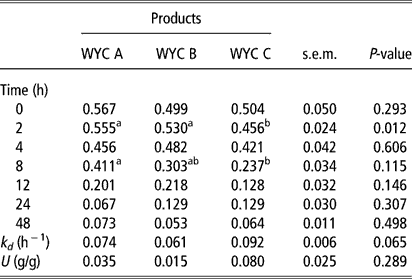
The in situ fractional disappearance rate and undegradable fraction of the silica incubated together with the WYC were not significantly different for the three WYC products, ranging from 0.061 to 0.092 h−1 and from 0.015 to 0.080, respectively (Table 5). The average fractional residue of silica incubated together with WYC after rinsing only (t=0 h) was 0.523, which was considerably less than found in the second experiment (i.e. 0.953, results not shown) when the bags contained only silica. However, the fractional disappearance rate and the undegradable fraction for silica were numerically comparable to the values found for simulation at 40 s.p.m. and in situ in the second experiment.
Experiment 3: residues after in situ rumen incubation (g/g) of silica 4 incubated together with three wheat yeast concentrates (WYC A, WYC B and WYC C) at different incubation times, the fractional disappearance rates (k d ) and undegradable fraction (U)

a,bMeans in the same row with different letters differ (P<0.05).
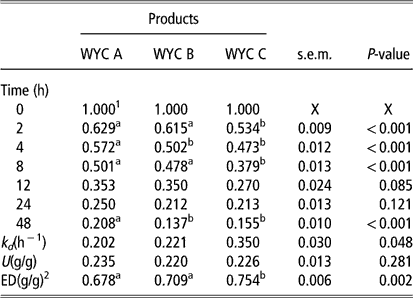
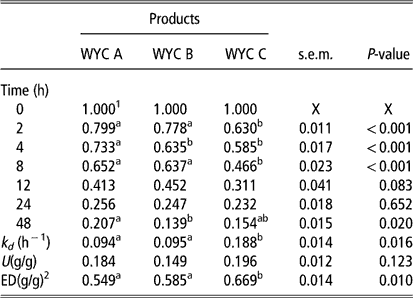
For insoluble OM and insoluble N significant differences between WYC samples were observed for residues in the nylon bags at all incubation times except 24 h and a tendency only at 12 h (Tables 6 and 7). For insoluble OM, the fractional degradation rate ranged from 0.202 to 0.350 h−1, and the undegradable fraction varied between 0.220 and 0.235. The calculated ED ranged from 0.678 to 0.754 and was higher (P<0.05) for WYC C than for both other products. For insoluble N, the fractional degradation rate ranged from 0.094 to 0.188 h−1, and the undegradable fraction varied between 0.149 and 0.196. The calculated ED ranged from 0.549 to 0.669 and (similar to the fractional degradation rate) was higher (P<0.05) for WYC C than for both other products.
Experiment 3: residues after in situ rumen incubation and rinsing at 40 s.p.m. (strokes per minute) (g/g) of insoluble organic matter of the three wheat yeast concentrates at different incubation times and the fractional disappearance rates (k d ), undegradable fraction (U) and effective degradation (ED) without correction for particulate matter loss during rumen incubation

a,bMeans in the same row with different letters differ (P<0.05).
1 Set value (total insoluble fraction).
2 Calculated as ED=S+(1−S)×[(1−U)×k d /(k d +k p )]; for S (soluble fraction) see Table 4; k p (fractional passage rate) is 0.06 h−1.
Experiment 3: residues after in situ rumen incubation and rinsing at 40 s.p.m. (strokes per minute)(g/g) of insoluble nitrogen of the three wheat yeast concentrates at different rumen incubation times and the fractional disappearance rates (k d ), undegradable fraction (U) and effective degradation (ED) without correction for particulate matter loss during rumen incubation

a,bMeans in the same row with different letters differ (P<0.05).
1 Set value (total insoluble fraction).
2 Calculated as ED=S+(1−S)×[(1−U)×k d /(k d +k p )]; for S (soluble fraction) see Table 4; k p (fractional passage rate) is 0.06/h.
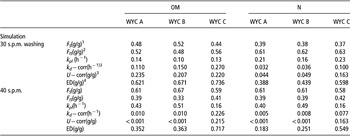
Based on the results of the second experiment, the particulate matter loss during incubation for insoluble OM and insoluble N for the WYC was estimated by rinsing at 30 and 40 s.p.m. At 30 s.p.m., the mean fraction of WYC sensitive to particulate matter loss (i.e. F S ) was 0.48 for OM and 0.38 for N, respectively (Table 8), which increased to 0.62 (OM) and to 0.60 (N) at 40 s.p.m. The mean fractional particulate matter loss rate of F S for OM was 0.12 and 0.37 h−1 at 30 and 40 s.p.m., respectively, and for N was 0.20 and 0.35 h−1 at 30 and 40 s.p.m., respectively. For insoluble OM, the mean fractional degradation rate decreased from 0.258 (Table 6) to 0.177 h−1 using 30 s.p.m. as correction, and to 0.082 h−1 using 40 s.p.m. (Table 8) while the mean undegradable fraction decreased from 0.233 to 0.221 using 30 s.p.m., and to 0.072 using 40 s.p.m. The mean ED of OM decreased from 0.714 to 0.676 using 30 s.p.m. and 0.477 using 40 s.p.m. For insoluble N, the mean fractional degradation rate decreased from 0.126 (Table 7) to 0.056 h−1 using 30 s.p.m., and to 0.030 h−1 using 40 s.p.m. while the mean undegradable fraction decreased from 0.176 to 0.085 using 30 s.p.m. and 0.054 using 40 s.p.m. The mean ED of N decreased from 0.601 to 0.475 using 30 s.p.m. and to 0.328 using 40 s.p.m. For both OM and N, applying this correction had a larger numerical effect on the ED of WYC A and B than on WYC C.
Experiment 3: fraction of the three wheat yeast concentrates (WYC) sensitive to particulate matter loss (F S ), fraction of WYC insensitive to particulate matter loss (F IS ) and the fractional particulate matter loss rate (k pl ) of F S obtained with simulation at 30 and 40 s.p.m. (strokes per minute) and the fractional degradation rate (k d −corr), undegradable fraction (U−corr) and the effective degradation (ED) for organic matter (OM) and nitrogen (N) of after correction of in situ measured data for simulated particulate matter loss during incubation

1 Expressed as fraction of the total insoluble fraction.
2 Expressed as fraction of the total insoluble fraction.
3 Calculated as Y(t)=F S ×exp[−(k pl +k d −corr)×t]+(1−F S −U−corr)×exp(−k d −corr×t).
4 Calculated as ED=S+(1−S)×[(1−U−corr)×k d −corr/(k d −corr+k p )]; for S (soluble fraction) see Table 4; k p (fractional passage rate) is 0.06/h.
Discussion
The aim of this study was to estimate the in situ ED of nutrients in small particles that in the conventional in situ nylon bag method are removed by rinsing in a washing machine. To that end a previously described modified protocol for rinsing the bags (de Jonge et al., Reference de Jonge, van Laar, Hendriks and Dijkstra2013) was applied to reduce the particulate matter loss during rinsing. If particulate matter losses during rinsing have been reduced, the subsequent issue concerns the loss of undegraded particulate matter during incubation in the cow itself. Therefore, in the present paper we studied an approach to measure and account for the undegraded particulate matter loss during in situ incubation itself. In comparison with the washing machine method, a marked reduction of the losses during rinsing for fine silica particles and for OM and N in WYC was realised by applying the modified rinsing method, which was in line with previous results for N and starch in dry feed ingredients (de Jonge et al., Reference de Jonge, van Laar, Hendriks and Dijkstra2013). The loss that still does occur for the three WYC products was mainly limited to particles smaller than ~40 μm that corresponded to observations from other studies with other feedstuffs using different rinsing methods (Michalet-Doreau and Ould-Bah,Reference Michalet-Doreau and Ould-Bah1992; de Jonge et al., Reference de Jonge, van Laar, Hendriks and Dijkstra2013). The results from experiment 1 and 2 showed that the particulate matter loss during incubation was mainly relevant for silica 1 and 4 that mainly contained particles <40 μm. The results obtained for silica 2 and 3 also indicated that this loss was limited to particles <40 μm. The mean fractional disappearance rates of silica 1 and 4 found in this study were 0.035 and 0.073 h−1. Differences between the shaking conditions in the rumen of individual cows and the particle size distribution of both silica gels could be the cause of this variation leading to different particulate matter loss rates, as was demonstrated by the simulation of this process in a water bath at different shaking speeds (Table 3).
For the silica added to the WYC in the bags, lower residues at 0 h incubation were found compared with the first two experiments where silica was present in bags without any WYC, which is an indication of an interaction with the WYC matrix. This difference was also observed for the individual incubation times, although, the fractional disappearance rates of the remaining silica when co-incubated with WYC were comparable with the results obtained from the first two experiments. This indicates that the process of particulate matter loss seems to be matrix depending and can vary between experiments.
The marked reduction of the loss of material during rinsing with the modified method might enable the estimation of the in situ degradation of nutrients in small particles in products such as WYC. However, this would require that undegraded particulate matter loss from the bags during rumen incubation itself is minimal or can be accurately corrected for. Total disappearance of substrate during the incubation in the rumen is the result of degradation and particulate matter loss, which in this study, were assumed to be two independent processes. The silica experiments showed that small particles can leave the bag during in situ rumen incubation. Thus, when using the modified rinsing method after in situ incubation, neglecting undegraded particulate matter loss leads to an overestimation of the fractional degradation rate of WYC. In vitro simulation of the particulate matter loss during in situ incubation for WYC by rinsing at 30 and 40 s.p.m. revealed that the WYC products were very sensitive to shaking conditions. Correction for this loss reduced the average ED for OM to 0.94 (30 s.p.m.) and to 0.66 (40 s.p.m.) of the value obtained without correction. For N, this correction led to values that were 0.79 (30 s.p.m.) and 0.54 (40 s.p.m.) of the value obtained without correction. Such reductions, especially for N, have a considerable impact on the calculated feeding value in protein evaluation systems. Although shaking speeds of 30 and 40 s.p.m. did not result in significant differences with rumen (in situ) shaking conditions, the ED corrected for particulate matter loss differed substantially between both shaking speeds. Numerically, the silica disappearance rates obtained with 40 s.p.m. were closer to the in situ disappearance rates than those obtained with 30 s.p.m. (Table 2).
The method described, based on reduction of particulate matter loss during rinsing and applying a correction for particulate matter loss during incubation, seems to be a potential new approach to determine the ED of nutrients in small particles in feed ingredients. A methodological challenge of this approach remains the accurate estimation of the particulate matter loss during the incubation. Although the method presented seems to be a good approach to simulate this process, additional measurements with different batches of silica and feed ingredients and comparison between the incubation in animals are needed to improve the accuracy of the simulation and to estimate the effects of variation in conditions on the results found. The marked effect of applying this correction on the calculated ED values for the WYC products emphasises the importance of this issue. Another issue for further research is the effect of the modified rinsing method on the ED values of feed ingredients. The use of this more gentle rinsing method could affect the degradation characteristics and consequently the calculated ED values for feed ingredients compared with the standard procedure that involves washing machine rinsing. A comparison between both rinsing methods using other feed ingredients is needed to fully evaluate such differences. Both issues should be the subject for further investigation before this new approach can be applied to supply data that can be used in feed evaluation systems.
The WYC products containing a large fraction of small particles showed relatively low ED values for N with a significant difference between product A and B and product C. The relatively low degradation rate for N in the WYC products could be related to the larger contribution of yeast protein to total WYC protein and the location of the proteins in yeast cells. These cells have a rigid cell wall containing mainly β1-3 and β1-6 glucans, glycoproteins and chitin (Lipke and Ovalle, Reference Lipke and Ovalle1998) that form a barrier for the degradation of the proteins in these cells. Various glucanases and proteases are required to break down the cell wall structure and release the protein inside the cell. The size of yeast cells, between 5 and 10 μm, made their disappearance from the nylon bag very sensitive to variations in the shaking conditions during the incubation. Differences in the degree of aggregation (i.e. flocculation) between the yeast cells could be a reason for variation in disappearance during rinsing of the WYC. Differences between the WYC products with respect to their in situ fractional degradation rate for N could be related to the variation of native proteins from wheat in these products. With product A and B and according to the producer, the protein fraction (i.e. gluten) of wheat was almost completely removed during the process, whereas for product C this fraction was not removed. Consequently, product C contained more native proteins compared with the other products that could be an explanation for its significantly higher k d and ED value and differences in particulate matter loss especially at 40 s.p.m. (Table 8). Other factors, such as differences between wheat, yeast types and production conditions could also contribute to the variation between the products.
Conclusions
An alternative approach for the in situ method based on reduction of the loss of particulate matter during rinsing was applied and a correction for the loss of particulate matter during in situ incubation in the rumen was developed. The in situ particulate matter loss was mainly limited to particles <40 μm and could be simulated by in vitro rinsing in a water bath at 30 and 40 s.p.m., whereas 20 and 50 s.p.m. led to a significant lower and higher disappearance rate, respectively, compared with the in situ particulate matter loss. Application of this new approach for WYC products increases the residues of OM and N in nylon bags after rinsing. Correction for the loss of undegraded particulate matter during incubation markedly reduced the calculated ED for OM and for N in all WYC products. More research work is needed to fully evaluate this alternative approach and its application in current protein evaluation systems.
Acknowledgements
The authors thank Johan Heeren for assistance during the in situ trials, Saskia van Laar and Jane-Martine Muylaert for conducting the chemical analyses, Harry Baptist for his kind assistance during the particle size analyses and the Dutch Product Board Animal Feed (PDV, Zoetermeer, The Netherlands) for financial support.