Introduction
Falls among older adults are a significant public health challenge. As well as fatal and non-fatal injuries arising from falls, there is a negative impact on self-confidence, independence, and mobility (Peel, Reference Peel2011). Worldwide, falls are a leading cause of disability with an estimated one in three people over 65 years old having at least one fall per year (World Health Organization, 2007). The aging population substantially contributes to the growing burden of injury and increasing health costs due to falls (Peel, Reference Peel2011).
Independent risk factors for falls among older people include poor cognitive functioning and cognitive decline. Even mild cognitive impairment is associated with an increased risk of falls (Anstey et al., Reference Anstey, von Sanden and Luszcz2006; Gleason et al., Reference Gleason, Gangnon, Fischer and Mahoney2009). The incidence of falls in people with cognitive disorders is approximately twice that of cognitively intact people (Shaw, Reference Shaw2002; Segev-Jacubovski et al., Reference Segev-Jacubovski, Herman, Yogev-Seligmann, Mirelman, Giladi and Hausdorff2011). In addition to being at increased risk of falls and subsequent serious injury, patients with cognitive impairment or dementia have a poorer prognosis once a fall has occurred. They are less likely to make a good functional recovery after significant injury than are cognitively normal patients who fall, and are approximately five times more likely to be institutionalized than are patients with dementia who do not fall (Shaw, Reference Shaw2002).
Cognitive impairment is a progressive condition that impacts caregivers, families, and health and social care providers, and is a critical aspect of the diagnostic criteria for dementia (Rait et al., Reference Rait2005). Estimates in the United Kingdom and United States of the prevalence of cognitive impairment in the population of people aged over 70 years range from 18% (Rait et al., Reference Rait2005) to 22% (Plassman et al., Reference Plassman2008) respectively, while dementia prevalence in Australia ranges from 6.5% of those aged 65 and older to 22% for those aged 85 and older (Australian Institute of Health and Welfare, 2007). Of those with dementia, 56% live in households in the community (as opposed to cared accommodation) (Australian Institute of Health and Welfare, 2007). An estimated 100% increase of dementia is projected between 2001 and 2040 in developed countries (Ferri et al., Reference Ferri2005).
There is an extensive body of evidence on the causes of falls and how to prevent these in older people. In a recent systematic review of randomized controlled trials (RCTs) of falls prevention interventions in community-dwelling older people (Gillespie et al., Reference Gillespie2009), it was demonstrated that, in certain contexts, exercise programs, multi-factorial interventions, taking vitamin D supplements, home safety improvements, cataract eye surgery, and prescription medication adjustments were effective. Similarly, multifactorial interventions, exercise, Vitamin D supplementation, and hip protectors have been shown to be effective in reducing falls in older people in nursing care facilities or hospitals (Oliver et al., Reference Oliver2007; Cameron et al., Reference Cameron2010). An important limitation of the majority of studies on falls prevention interventions to date is that the studies exclude older people with cognitive impairment or dementia (Shaw, Reference Shaw2007). Interventions that are effective for fit and healthy older people may not be generalizable to other populations (Shaw, Reference Shaw2007).
There are few studies that evaluate the effectiveness of fall prevention interventions for older persons with cognitive impairment living in the community (Huger et al., Reference Huger, Zieschang, Schwenk, Oster, Becker and Hauer2009). The aim of this systematic review, therefore, is to investigate studies of interventions designed to reduce falls in community-dwelling, cognitively impaired older adults.
Methods
Literature search
A literature search was conducted using Medline, CINAHL, PeDRO, Cochrane Library, and PsycINFO for original research papers published in English between 1980 and September 2011. There were slight differences in the search terms depending on the database; however, following were the general search terms: falls outcomes, cognitive impairment, intervention, and community-dwelling. A typical search strategy is shown at Appendix 1.
Criteria for inclusion/exclusion
Inclusion criteria were as follows: (1) At least 75% of the sample were aged 65 years or more; (2) participants were community-dwelling; (3) at least a subgroup of participants had cognitive impairment, confirmed by an established test; and (4) outcome measures included falls or fall proxy measures. The exclusion criteria were as follows: (1) Pharmacological intervention studies, and (2) not meeting one or more inclusion criterion. Although it is recognized that randomized controlled studies provide the best level of evidence to demonstrate effectiveness of interventions, studies using quasi-experimental designs were not excluded.
Three reviewers were involved in this systematic review. The first author (H.W.), under the supervision of the other two authors (K.W. and N.P.), identified all potentially relevant papers from search strategies of the five mentioned databases and then screened them on the basis of their titles. Next, the three reviewers independently assessed the identified papers based on their abstract, and made a decision to accept or reject by applying the inclusion and exclusion criteria. A full text version was obtained for papers that met the inclusion criteria based on their abstract. Full text was also obtained for papers where any doubt about relevance of the study existed by any of the reviewers. Finally, these papers were independently assessed by the three reviewers, and a decision to reject or accept was made. Any disagreements were discussed until consensus was reached. Gray literature was not examined for the purpose of this review. In addition, manual search was completed for all of the references of the papers retained for data extraction.
Using a standardized abstraction procedure (Zaza et al., Reference Zaza2000), one reviewer (H.W.) extracted data from each of the included studies retained for review into data extraction tables, which were then cross-checked by all authors. The data extraction form that was constructed for the purpose of this review is available from the authors on request. The results of the data abstraction process are presented in Tables 1 and 2. The studies were analyzed according to their characteristics, measures, results, and study quality. Study quality included issues related to study design, sample (composition and size), measurements, and potential biases affecting validity.
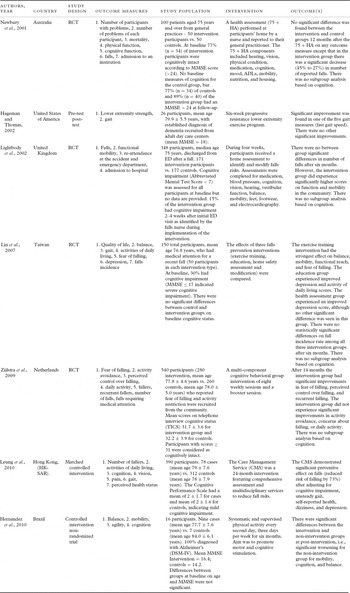
A Summary of seven studies with positive intervention effects on falls and/or falls proxy measures

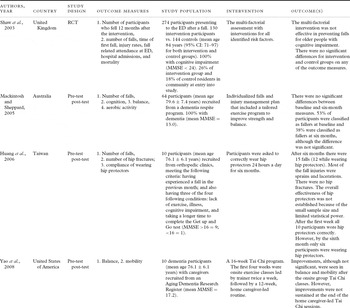
A summary of four studies with no positive intervention effects on falls and/or falls proxy measures

Results
Study characteristics
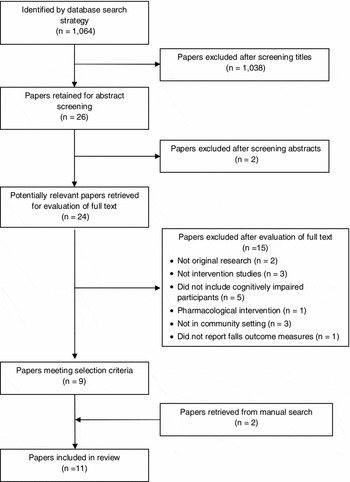
The search strategy yielded a total of 1,064 papers. The majority of these (1,038) were rejected after reading the title only, leaving 26 papers for assessment against the inclusion criteria. Two of these papers were rejected after reading the abstract, leaving 24 papers. After reading the full text of these 24 papers, an additional 15 papers were discarded, leaving nine papers that fitted the inclusion criteria. Of papers discarded, two were not original research, three were not interventions or programs, five did not have a cognitive impairment group, one was a pharmacological intervention, three were not in a community setting, and one did not report fall outcome measures. An additional two papers were retained from the manual search of references of the 24 full text papers. A total of 11 studies providing data from 1,928 participants were retained for data extraction. Results of the literature search are presented in Figure 1.
Schematic of the study selection process.

The retained studies were from Brazil, Taiwan, Hong Kong, United States, Australia, United Kingdom, and the Netherlands, and were published between 2001 and 2010. The following types of interventions were implemented: health assessment, exercise training, education, cognitive behavioral therapy, medication review and modification, hip protectors, environmental hazard assessment and modification, Tai Chi, and individualized care management plans. Study designs included five randomized controlled trials, two controlled trials (non-randomized), and four pre-test post-test studies. Seven of the selected studies (detailed in Table 1) showed an intervention effect in preventing or decreasing falls, while four studies (detailed in Table 2) were not effective.
Measures
The measurement tool used as a screening instrument for cognitive impairment in seven of the studies was the Mini-Mental State Examination (MMSE) (Folstein et al., Reference Folstein, Folstein and McHugh1975) with the majority using a cut-off point of 24 or less as indicative of cognitive impairment. Other tests used to measure cognitive status were the Abbreviated Mental Test Score (Lightbody et al., Reference Lightbody, Watkins, Leathley, Sharma and Lye2002), the Telephone Interview for Cognitive Status (Zijlstra et al., Reference Zijlstra2009), and the Cognitive Performance Scale from the interRAI Home Care Instrument (Leung et al., Reference Leung, Lou, Kin Sun, Yung and Chi2010). The Diagnostic and Statistical Manual of Mental Disorders, version IV (DSM-IV), was used by one study (Hernandez et al., Reference Hernandez, Coelho, Gobbi and Stella2010) to diagnose participants with Alzheimer's disease and dementia.
The number of falls and/or fallers among participants pre- and post-intervention was an outcome measure in eight studies (Newbury et al., Reference Newbury, Marley and Beilby2001; Lightbody et al., Reference Lightbody, Watkins, Leathley, Sharma and Lye2002; Shaw et al., Reference Shaw2003; Mackintosh and Sheppard, Reference Mackintosh and Sheppard2005; Huang et al., Reference Huang, Lee and Wu2006; Lin et al., Reference Lin, Wolf, Hwang, Gong and Chen2007; Zijlstra et al., Reference Zijlstra2009; Leung et al., Reference Leung, Lou, Kin Sun, Yung and Chi2010), with three studies (Shaw et al., Reference Shaw2003; Huang et al., Reference Huang, Lee and Wu2006; Zijlstra et al., Reference Zijlstra2009) reporting on fall-related injuries. Falls data were collected prospectively by falls diaries in five studies (Lightbody et al., Reference Lightbody, Watkins, Leathley, Sharma and Lye2002; Shaw et al., Reference Shaw2003; Mackintosh and Sheppard, Reference Mackintosh and Sheppard2005; Lin et al., Reference Lin, Wolf, Hwang, Gong and Chen2007; Zijlstra et al., Reference Zijlstra2009) and by retrospective self-report in the remaining studies. In six of the studies where the outcome was falls or fall-related injuries, falls proxy outcomes based on known risk factors for falls were also measured (Newbury et al., Reference Newbury, Marley and Beilby2001; Lightbody et al., Reference Lightbody, Watkins, Leathley, Sharma and Lye2002; Mackintosh and Sheppard, Reference Mackintosh and Sheppard2005; Lin et al., Reference Lin, Wolf, Hwang, Gong and Chen2007; Zijlstra et al., Reference Zijlstra2009; Leung et al., Reference Leung, Lou, Kin Sun, Yung and Chi2010). Falls proxy measures included physical function measures such as mobility, balance, activities of daily living, and aerobic capacity, as well as psychological factors such as fear of falling, perceived health status, quality of life, and depression. In three studies, the only outcome measures were falls proxy measures, including lower extremity strength and gait (Hageman and Thomas, Reference Hageman and Thomas2002), and mobility and balance (Yao et al., Reference Yao, Giordani and Alexander2008; Hernandez et al., Reference Hernandez, Coelho, Gobbi and Stella2010). Outcome measures for each of the selected studies are shown in Tables 1 and 2.
Intervention effects in cognitively impaired participants
In the five studies in which all participants had cognitive impairment or dementia (Hageman and Thomas, Reference Hageman and Thomas2002; Shaw et al., Reference Shaw2003; Mackintosh and Sheppard, Reference Mackintosh and Sheppard2005; Yao et al., Reference Yao, Giordani and Alexander2008; Hernandez et al., Reference Hernandez, Coelho, Gobbi and Stella2010), the evidence of an intervention effect on falls or falls proxy measures was conflicting. Two of the five studies showed positive intervention effects. In a controlled trial (Hernandez et al., Reference Hernandez, Coelho, Gobbi and Stella2010) comparing an intervention program of regular physical activity with routine care, there was a significant decline in measures of mobility, balance, and cognition in the non-intervention group. The conclusion was that physical activity could benefit cognitive function and balance and reduce the risk of falls. A pre-test post-test study (Hageman and Thomas, Reference Hageman and Thomas2002) using a resistance training program showed improvement on one measure of physical performance, i.e., fast gait speed.
The remaining three studies where all participants had cognitive impairment showed no positive intervention effects. In a large randomized controlled trial (Shaw et al., Reference Shaw2003), a multi-factorial intervention compared to usual post-discharge care was not effective in preventing falls in cognitively impaired older people. A pre-test post-test study of a tailored falls risk management plan (Mackintosh and Sheppard, Reference Mackintosh and Sheppard2005) found that there were no significant differences between baseline and six-month measures of cognition, balance, or aerobic activity. The number of people identified as fallers decreased by 15% at a six-month follow-up, but the results were not significant. Similarly, a pre-test post-test of a Tai Chi intervention using dementia-caregiver dyads (Yao et al., Reference Yao, Giordani and Alexander2008) found non-significant improvements in balance and mobility, not sustained after the exercises were continued at home.
For the six studies that included both cognitively impaired and cognitively intact participants, there was no subgroup analysis of the effects of the intervention on the cognitively impaired group. Consequently, no inferences can be drawn on the effects of the intervention on the impaired subgroup. In an intervention study (Leung et al., Reference Leung, Lou, Kin Sun, Yung and Chi2010), a control group was matched by age, gender, activities of daily living, cognitive status, and unsteady gait with an intervention group receiving a community-based care management service. Both groups had mean cognitive performance scores at baseline indicative of mild cognitive impairment. After controlling for the identified risk factors for falls (including cognitive status), intervention recipients had a lower risk of falls compared with controls who had no support from care management. In three of the included studies, no comparable information regarding cognitive status at baseline was provided for control and intervention groups. In the study by Newbury et al. (Reference Newbury, Marley and Beilby2001), data on cognitive impairment for the intervention group was collected at baseline, but not for the control group. In the studies by Lightbody et al. (Reference Lightbody, Watkins, Leathley, Sharma and Lye2002) and Lin et al. (Reference Lin, Wolf, Hwang, Gong and Chen2007) data on cognitive status were collected at baseline, but these data are not reported, although both studies reported no significant differences between groups on baseline measures. This makes it difficult to determine whether the observed effects (or absence of effects) were due to differences in cognitive impairment or the intervention.
Quality assessment
The information in the retained studies was critically assessed for factors that may have compromised the validity of results.
Study Design
Five of the studies (Newbury et al., Reference Newbury, Marley and Beilby2001; Lightbody et al., Reference Lightbody, Watkins, Leathley, Sharma and Lye2002; Shaw et al., Reference Shaw2003; Lin et al., Reference Lin, Wolf, Hwang, Gong and Chen2007; Zijlstra et al., Reference Zijlstra2009) were randomized controlled trials, the recommended methodology to demonstrate the effectiveness of interventions according to the hierarchy of levels of evidence. Other study designs, including comparative studies with concurrent controls (Hernandez et al., Reference Hernandez, Coelho, Gobbi and Stella2010; Leung et al., Reference Leung, Lou, Kin Sun, Yung and Chi2010) and case series with pre-test post-test outcomes (Hageman and Thomas, Reference Hageman and Thomas2002; Mackintosh and Sheppard, Reference Mackintosh and Sheppard2005; Huang et al., Reference Huang, Lee and Wu2006; Yao et al., Reference Yao, Giordani and Alexander2008), provide a lesser level of evidence of effectiveness because of the risk of bias.
Sample Size
Six of the 11 studies had sample sizes based on calculations that had sufficient power to detect a significant effect of the intervention on primary outcomes, including a reduction in falls (Lightbody et al., Reference Lightbody, Watkins, Leathley, Sharma and Lye2002; Shaw et al., Reference Shaw2003; Leung et al., Reference Leung, Lou, Kin Sun, Yung and Chi2010), concerns about falling (Zijlstra et al., Reference Zijlstra2009), quality of life (Lin et al., Reference Lin, Wolf, Hwang, Gong and Chen2007), and reduction in the proportion of patients with geriatric syndromes (including falls) (Newbury et al., Reference Newbury, Marley and Beilby2001). For example, Shaw and colleagues (Reference Shaw2003) estimated that at the 5% level, a sample size of 180 participants (90 in each group of the trial) would be required to give an 80% power of detecting a clinically significant reduction of 30% in the proportion who had at least one fall over the year of follow-up. The remaining studies were mainly pilot or feasibility studies with fewer than 35 participants in the analysis.
Participant Selection
The selected studies demonstrate the difficulty of recruiting a representative sample of cognitively impaired participants from the general community. In the majority of studies, participants had prior contact with health services, including an emergency department after presenting due to a fall (Lightbody et al., Reference Lightbody, Watkins, Leathley, Sharma and Lye2002; Shaw et al., Reference Shaw2003), orthopaedic clinic or other medical/health service (Newbury et al., Reference Newbury, Marley and Beilby2001; Huang et al., Reference Huang, Lee and Wu2006; Lin et al., Reference Lin, Wolf, Hwang, Gong and Chen2007; Leung et al., Reference Leung, Lou, Kin Sun, Yung and Chi2010), or dementia-specific service (Hageman and Thomas, Reference Hageman and Thomas2002; Mackintosh and Sheppard, Reference Mackintosh and Sheppard2005; Yao et al., Reference Yao, Giordani and Alexander2008; Hernandez et al., Reference Hernandez, Coelho, Gobbi and Stella2010). These participants are likely to have a higher risk of falls and may not be representative of the population of cognitively impaired community-dwellers. Therefore, there may be selection bias based on the recruitment of participants, particularly for those studies using convenience samples.
Confounding
Confounding can be a major threat to the internal validity of a study (Grimes and Schulz, Reference Grimes and Schulz2002). Only five of the studies used a randomized controlled study design to minimize the effects of participant selection bias, and only one of these studies (Shaw et al., Reference Shaw2003) specifically investigated the effect of a falls prevention intervention, where all participants were cognitively impaired. One study (Leung et al., Reference Leung, Lou, Kin Sun, Yung and Chi2010) demonstrated that comprehensive assessment and multidisciplinary case management reduced falls after controlling for identified falls risk factors, including cognitive performance. In other studies, because of insufficient power and sample size, few identified and controlled for confounders.
Recall Bias
Three of the eight studies where falls was an outcome used self-reporting techniques by the participant to collect data. These personal accounts have the potential to lead to an over representation or under representation of falls and falls-related outcomes (Peel, Reference Peel2000) due to recall bias. In addition, the risk of inaccurate information from self-reported methods might be greater in a population with cognitive impairment.
Program Adherence
Poor program adherence and loss of follow-up was a significant issue in five out of 11 studies. It can be concluded that adherence to all types of falls prevention interventions directed at this older population is a challenge due to sickness or death and the inherent problems of those with cognitive impairment, including declines in attention, psychomotor processing, problem-solving, and awareness of self and surroundings.
Discussion
The results of this review demonstrate that there is limited available evidence on interventions that reduce falls in cognitively impaired community-dwelling older people. As has been found in previous reviews of this topic that have been limited to cognitively impaired older people in hospital or long-term care facilities (Hauer et al., Reference Hauer, Becker, Lindemann and Beyer2006; Oliver et al., Reference Oliver2007), the evidence that is available is inconclusive. Two studies in the community-dwelling population (Hageman and Thomas, Reference Hageman and Thomas2002; Hernandez et al., Reference Hernandez, Coelho, Gobbi and Stella2010) showed an effect from exercise-based interventions on improving falls risk factors such as balance, mobility, agility, and gait in people with dementia. Other studies in which all participants had cognitive impairment or dementia did not show an effect of either tailored exercise (Mackintosh and Sheppard, Reference Mackintosh and Sheppard2005), Tai Chi (Yao et al., Reference Yao, Giordani and Alexander2008), or a multi-factorial intervention (Shaw et al., Reference Shaw2003) on falls or fall risk factors.
In studies which included both cognitively impaired and cognitively intact participants, there was some evidence of a positive impact of education-based interventions on improving activities of daily living and depression (Lin et al., Reference Lin, Wolf, Hwang, Gong and Chen2007). Both multi-component cognitive behavioral group interventions (Zijlstra et al., Reference Zijlstra2009) and exercise-based programs (Lin et al., Reference Lin, Wolf, Hwang, Gong and Chen2007) had a positive effect on fear of falling. Health assessment and management of falls risk resulted in a decrease in number of falls (Newbury et al., Reference Newbury, Marley and Beilby2001; Leung et al., Reference Leung, Lou, Kin Sun, Yung and Chi2010) and increase in function and mobility (Lightbody et al., Reference Lightbody, Watkins, Leathley, Sharma and Lye2002). However, it is not possible to demonstrate that beneficial effects of the intervention in these studies could be generalized to people with cognitive impairment, since no subgroup analysis was done.
Only 11 studies were identified for inclusion in this review. Meta-analyses were not appropriate due to heterogeneity in study designs, interventions, and outcome measures which contributed to variable methodological quality of the studies. The paucity of studies may be due to several factors. The search strategy may have limited the number of identified studies by excluding gray literature and papers not published in English. It is also possible that included studies were not representative of all studies that have been conducted on this topic because of publication bias. As has been noted previously (Shaw, Reference Shaw2007), cognitively impaired individuals are under-represented in community studies of falls prevention, primarily due to methodological and ethical issues. Factors that mitigate against recruitment and participation of older people in research have been well documented (Peel and Wilson, Reference Peel and Wilson2008). Of particular relevance to those with cognitive impairment are issues related to gaining informed consent, need for involvement of caregivers, and the perceived lack of ability of participants to comply with complex interventions. At a minimum, this review highlights the dearth of published studies on cognitively impaired, community-dwelling older adults in relation to falls prevention interventions, and the urgent need for further published research in this area.
Before evidence-based recommendations can be made, further well-designed and well-conducted studies (e.g., RCTs or studies with appropriate control groups) are required with adequate sample sizes of the relevant population and sufficient follow-up of both groups. It is important to use valid and reliable measures in both intervention and control groups. Objective outcome measures to minimize recall bias are preferable (e.g., using telemonitoring fall detection devices to record number of falls). Future research should also include strategies to improve intervention uptake and adherence. Involvement of caregiver and dementia-specific support groups could assist recruitment of subgroups in the community with cognitive impairment. Encouraging the participation of caregiver also helps to develop effective therapeutic interventions, enhancing the well being of the dyad (Braun et al., Reference Braun, Scholz, Bailey, Perren, Hornung and Martin2009), as well as assisting longer term maintenance of the strategies and continuation of home-based care for the person with cognitive impairment. Implementation approaches, such as using home-based programs tailored to the specific deficits of the cognitively impaired person, have been recommended to ensure safety and efficacy (Sherrington et al., Reference Sherrington, Tiedemann, Fairhall, Close and Lord2011).
An emerging and promising field of research in populations with cognitive impairment is examining the effects of cognitive interventions on recognized mediators of fall risk, such as gait and balance. If cognitive deficits are in the causal pathway and they exacerbate the risk of falls or prevent appropriate compensatory mechanisms, it could be hypothesized that improvement (with training) of at least certain aspects of cognitive abilities may improve gait and reduce the risk of falls, especially in more challenging conditions that rely on higher order cognitive processes (Segev-Jacubovski et al., Reference Segev-Jacubovski, Herman, Yogev-Seligmann, Mirelman, Giladi and Hausdorff2011). However, while easier to obtain, using falls proxy measures, such as gait or balance, as outcome measures reduces the ability to make definitive conclusions regarding the efficacy of interventions in relation to actual falls prevention so that inclusion of objective measures of falls reduction is recommended.
Conclusion
The diversity of interventions, study designs, population, and quality of the 11 studies, which met inclusion criteria, resulted in conflicting evidence and inconclusive results for falls prevention interventions in this highly complex population.
Conflict of interest
None.
Description of authors’ roles
All authors contributed equally to the study concept and design, formulation of review questions, designing the search strategy, extracting and summarizing data, and writing the paper.
Appendix 1. Typical search strategy
CINAHL and Medline via Ovid search strategy:
1. Accidental falls. mp or exp accidental falls
2. (Falls or faller* or falling or fell or slip* or trip* or stumble* or tumble*). mp
3. 1 or 2
4. Accident prevention. mp or exp accident prevention
5. (Strategy* or prevent* or intervention* or program* or campaign,* or initiative*). mp
6. 4 or 5
7. 3 and 6
8. Evaluation studies. mp or exp evaluation studies
9. Intervention. mp or exp intervention studies
10. Exp clinical trial or trial.mp
11. program*.mp
12. 8 or 9, or 10 or 11
13. Cognitive.mp or exp delirium, dementia, amnestic, cognitive disorders
14. Exp cognition or exp dementia or cognit*.mp or exp memory
15. 13 or 14
16. 7 and 12 and 15
Notes: mp: stand for “multi-purpose” and means that several fields are searched at once. exp: means “explode” a subject heading to retrieve results that contain the subject heading in combination with all of its narrower, more specific subheadings. asterisk (*): is a truncation symbol which follows a root word with multiple endings to search for all variations of the term.