

As twentieth-century British governments faced funding requirements for an unprecedented range of public services, the matter of how to structure the tax burden so as to retain public support became crucial to effective government. Where a flat rate of income tax had, until the start of the twentieth century, sufficed to raise revenue from a limited taxpayer population, as greater numbers were dragged into the tax net over succeeding decades, governments needed to consider how taxes affected different people with diverse income profiles. At its crudest, taxation of different sources of income involved distinguishing between earned and unearned income. Two broad strategies were applied which can be characterized as Thatcherite or Fabian. The Fabian approach, involving discrimination in favour of earned income, was introduced by the Liberal government in 1907 and remained a keystone of the British tax system until the early 1980s. Then, having been accepted largely without question for some seventy years, Margaret Thatcher's administration changed approach and, by the mid-1980s, the government was using tax breaks to promote a capital-owning democracy. This article considers why such a major departure from established practice occurred.
The 1907 differential tax model was predicated on the desirability of a fiscal distinction between spontaneous (investment) income from an income-producing capital asset that could pass intact to the next generation, and industrious (earned) income, which was vulnerable to depletion through age, illness, or unemployment. A lower rate of tax on industrious income was intended to encourage workers to provide for adversity by setting aside a portion of earnings. More ideological arguments for a lower tax rate on earnings were also in circulation: Henry George argued that land rents contained an element of socially created wealth, this part being a legitimate target for taxation. The notion that income accruing to one person might have been earned in part by another had been adopted by the Fabians to promote state control, but gained traction during the first half of the twentieth century, especially in relation to income arising from investments. Wide acceptance of this moral judgement underpinned the differential income tax rules that prevailed until the 1980s.
Whilst Mrs Thatcher's economic reforms, which rejected the ideological arguments supporting favourable tax treatment of earned income, only took effect in the 1980s, their design was completed in the 1970s, so that, on taking office in 1979, her first chancellor of the exchequer, Geoffrey Howe, had detailed plans for tax reform including reducing the investment income surcharge. The 1970s was the decade in which think-tank ideas about tax reform were adopted by the Conservative executive and a gulf opened up between the two major political parties, ending the Butskellist consensus which had underpinned tax policy since the 1950s. Economic turmoil, spiralling debt and oil prices, and a closer link with Europe all fed into the government funding debate, but from this difficult situation came savings tax policies which have survived subsequent changes of administration over three decades.
The primary focus for this article is the tax policies of the two main parliamentary parties: whilst tax policy is subject to multiple influences and pressures, UK tax rules are based on legislation requiring parliamentary approval. Both Labour and the Conservatives had highly influential research departments which directly shaped tax policy, and there was no shortage of other commentators: Professor James Meade oversaw the preparation of a major review of the tax system for the Institute for Fiscal Studies, and John Kay and Mervyn King (future governor of the Bank of England) wrote on the shortcomings of the prevailing system; economists looking at growth drew unfavourable comparisons with France and Germany and academics such as Bacon and Eltis commented on the growth of the state at the expense of productive capacity. Nevertheless, as these studies had little direct bearing on the development of tax law, they are cited to provide a broader perspective on contemporary thought, rather than as part of the development narrative for unearned income taxation.
In the context of exchequer receipts, the additional taxation of investment income was a small matter. The 1979 Conservative manifesto costed the abolition of the 15 per cent investment income surcharge at £310 m against total 1978–9 exchequer receipts of £32,528 m. The main targets for contemporary attention were the mix of direct and indirect tax and the concept of a negative income tax at the lower end of the income scale. However, the 15 per cent rate, when added to a top income tax rate of 83 per cent, resulted in the arguably iconic tax rate of 98 per cent on investment income which, whilst actually paid by few, symbolized Labour policy and helped to make policy change acceptable.
This article mainly considers taxes on income: in 1976, income taxes were paid by 25.9 mFootnote 1 individuals from a UK population of 56.2 mFootnote 2 and contributed the greatest share of exchequer income until overtaken by VAT in 1979. However, arguably wealth, rather than income, was the real target of discriminatory measures: taxes on wealth are therefore covered where they surfaced in the 1970s debate.
This article will argue that politico-economic events and developments in fiscal thinking during the 1970s combined to enable the reversal of differential taxation. It will analyse those shifts to establish how and when continuation of the status quo became untenable. First, the factors that came together in 1970s to allow a transition in tax policy will be examined. Part II will review the political rehabilitation of equity investments in particular, and will discuss the ways in which fiscal discrimination against shareholders was revised during the 1970s. Next, the article will consider the use of tax incentives for long-term and illiquid forms of saving. Linking to the arguments of Avner Offer on the decline of prudence and to those of Brian Cheffins on the impact of the tax system on institutional investments, this section will consider whether developments in the pre-Thatcher period launched a departure from tax breaks on prudential savings.
This article seeks to focus on aspects of the tax system that have received little attention from historians to date. Martin Daunton has written extensively on the development of the tax system and Richard Whiting's monograph, The Labour party and taxation, covers the development of Labour's thinking on taxation matters both within and outside the parliamentary party. Others have written on the economics of the 1970s, but the development of the structure of the tax burden as between earners and investors at this crucial juncture remains unconsidered.
Overall, this article deals with the 1970s as a turning point in the transition from Butskellism to Thatcherism in relation to the taxation of savings and share ownership. In the decades after the Second World War income from savings and shareholdings became a proxy for the perceived virtues and vices respectively of thrift and idleness and the taxation system took on the role of arbiter between them. Arguably, it was the culmination of these tensions in the 1970s that triggered fundamental changes in fiscal policy towards unearned income.
I
The fiscal legacy from post-Second World War administrations, satirically characterized as Butskellism, was an amalgam of the policies of two chancellors of the exchequer, Labour's Hugh Gaitskell and Conservative Rab Butler, and resulted in a capitalist economy with significant nationalized industries and high tax rates funding a redistributive social programme. In 1970, income tax and, for higher incomes, surtax operated progressively up to a top marginal rate of 90 per cent, although wages and salaries qualified for ‘earned income relief’, a discount of two-ninths. This section focuses on the way in which the 1970s cocktail of politics, economic issues, and fiscal thinking challenged the assumptions underpinning the Butskellist consensus and, with it, the bias against investment income within the UK tax system.
Evidence of a will to break with the post-war consensus on tax structure emerges from the (Tory) shadow cabinet's 1970 Selsdon Park conference: Shadow Chancellor Iain Macleod, examining high direct tax rates and the key role occupied by earned income relief, described the tax differential as a substantial disincentive to savings, and said, ‘the right course was to abolish the difference between earned and investment income and treat all income in exactly the same way’.Footnote 3 This would, he said, simplify the system, deal with the psychological disadvantage of a spurious standard rate that was in fact greater than most people paid, and pave the way for abolition of surtax.
Despite Macleod's premature death in July 1970, shortly after the Conservative election victory, the new chancellor, Anthony Barber, took up the tax reform project, replacing the dual income tax and surtax with a single progressive income tax in his 1972 budget. Although unification simplified the tax system and provided significant tangential tax benefits to unearned income recipients, it retained the bias in favour of earnings. The new system replaced the emotively named ‘earned income relief’ discount with an investment income surcharge of up to 15 per cent in addition to general income tax. Thus, although the reactions of the wider Conservative party, press, and opposition (the liberal market agenda emanating from Selsdon was condemned by Harold Wilson as the work of ‘Selsdon Man’ after the phoney Piltdown Man) had combined to raise the profile of Selsdon as the start of a proto-Thatcherite period, the Conservative leadership was not yet ready to move away from the Fabian approach to investment income. Certainly, the concepts of incentives to saving and expansion of enterprise were included in the Tories’ 1970 election manifesto, A better tomorrow: the text talked of advancing from a property-owning democracy towards the ‘capital-owning democracy of the future’ on the basis that ‘individuals and families who save and accumulate wealth serve the nation as truly as they serve themselves’.Footnote 4 However, as Ramsden observes, the response to Selsdon perhaps gave it more significance than had been intended by the party leadership.Footnote 5 Heath's chief concern seems to have been the reaction of the left-wing press to Macleod's reform proposals and their potential as election winners,Footnote 6 rather confirming Ramsden's view. Heath's concerns were not unjustified: the left swiftly made political capital from Barber's reforms, as when Frank Field termed budget day 1973, when unification became effective, ‘the worst day for the poor since 1945’, pointing out that £350 million had been distributed to ‘rich dividend holders’Footnote 7 in preference to a £2 per week family allowance increase.
The general election in February 1974 returned a minority Labour government with Denis Healey as chancellor of the exchequer, a position he retained for the following five years. Whiting notes that Labour's 1970–4 opposition period left tax policy issues unresolvedFootnote 8 and Healey found himself having to develop tax policies quickly in the face of competing pressures. Now in government, Labour were burdened with a shopping list of social expenditure demands nominated by various sections of the party, pressure coming, as Whiting observes, from disappointment with the 1964–70 Labour administration's slow progress towards equality.Footnote 9 The party's response at its annual conference was a call for reversal of Conservative taxation reforms including Barber's concessions on unearned income.Footnote 10 Although the detailed conference demands did not appear in Labour's February 1974 manifesto, the bias against rentiers living on investment income, particularly from annuities or dividends, survived with the promise of redistribution via taxes on wealth.
The proposed wealth tax in fact highlighted internal nuances of opinion between the Trades Union Congress (TUC) and Militant/Tribune groups and mainstream Labour. Both main political parties had considered the idea of an annual wealth tax during the 1960s, but, while Conservatives had rejected the concept as a vehicle for incentivization, the Labour left adopted it with enthusiasm as a route to greater equality. Redistribution through income taxation alone had done little to narrow the wealth gap and, at tax rates prevailing since 1945, accumulation of capital out of income was virtually impossible. This led many within the Labour party to conclude that income-only taxation ‘fossilizes the existing inequalities of wealth’, and that taxation of wealth itself was necessary.Footnote 11 Although the wealth tax was vociferously supported by the TUC and backed by manifesto commitment, once in office, Denis Healey appears to have been increasingly luke-warm about it: he notes, ‘he found it impossible to draft [a wealth tax] which would yield enough revenue to be worth the administrative cost and political hassle’.Footnote 12 The implication is that he never thought the exercise worthwhile purely for the sake of egalitarianism.
Healey's first budget on 26 March 1974 redeemed redistributive election pledges with increased pensions and benefits funded by higher personal and corporate taxation rates. While announcing that the Labour party's social programme could only be undertaken with tax increases which ‘could not be confined to the very rich’,Footnote 13 Healey appeased the party faithful and the TUC by increasing the burden on unearned income, halving the threshold for the investment income surcharge to £1,000 (£1,500 for the elderly), and increasing the top rate of income tax to 83 per cent. One consequence of this new rate, in conjunction with the 15 per cent investment income surcharge was a marginal tax rate of 98 per cent for top rate taxpayers receiving investment income. Whilst this rate was actually paid by very few – the inland revenue estimated 30,000 in 1978–9Footnote 14 – the impact of what was seen as an egregiously high rate went beyond revenue-raising. Arguably, the 98 per cent rate damaged the Labour party's attempts to portray itself as a party of aspiration for a generation and references to the 98 per cent rate can still be found in media articles decades after it ceased to be chargeable.Footnote 15 The effects were noticed at the time: in a report for the Institute of Fiscal Studies, Professor Meade noted in 1978 that the effect of the surcharge was not limited to the wealthiest, and that the addition of a flat rate surcharge
on top of the progressively rising rate of income tax makes the value of investment income relatively to the value of earned income diminish very greatly as the taxpayer goes up the income scale. Thus to obtain £1,600 after tax requires an investment income which is only 4 per cent greater than earned income; but to obtain £7,500 after tax requires an investment income which is 100 per cent greater than the equivalent earned income.Footnote 16
Of the problems facing the 1974–9 Wilson/Callaghan government, inflation, which never dipped below 10 per cent between 1973 and 1978, was one of the most intractable and its impact became apparent almost immediately. Threshold agreements, negotiated by the outgoing Heath government, automatically increased wages if inflation rose above a fixed level, exacerbating the inflation problem. Also, as Healey recalls, Britain's economy during this period ‘was continually buffeted by shocks from the outside world’, which ‘produced lurches in our exchange rate of a size and frequency which would have been inconceivable before the seventies’.Footnote 17 Inflation continued to rise, peaking in August 1975 at over 25 per cent and severely damaging savers’ returns. The Meade committee's report included a table of savings returns for 1973–7 which showed that, at prevailing bank rates, even a non-taxpayer would have experienced a negative post-tax real rate of return during each year other than 1973. Taxpaying savers were worse off in real terms in every year, and by as much as 22.27 per cent in 1976.Footnote 18 Effectively, within a year of Labour taking office, the rentier was looking more like a victim than a fiscal target, and, in any case, the 1974 measures had left no headroom for tax increases at the top end.Footnote 19 Denis Healey found himself searching for alternative sources of funds: fixed sum taxes, such as the road fund licence, were giving a lower real yield, thereby aggravating budget problems, and avenues for taking on further debt were diminishing. As revenues shrank in real terms, yet grassroots demands for social commitments continued, the government was forced to rely on fiscal drag, the technique of keeping thresholds static so that inflation raises the tax take. As Joel Barnett notes, initial opposition to using fiscal drag as ‘taxation by stealth’Footnote 20 was swiftly overcome.Footnote 21 Papers prepared by the inland revenue for consideration in relation to the 1975 budget concluded that accepting windfall inflationary gains from unaltered tax thresholds was likely to be more palatable than increasing the basic rate.Footnote 22
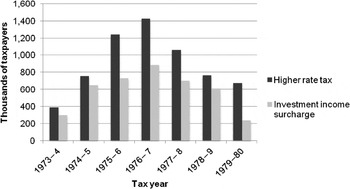
The result was a squeeze at the bottom end of the tax scale as the reduction of personal allowances in real terms dragged nearly 3 million additional people into the tax net between 1973–4 and 1978–9.Footnote 23 As the change in the higher rate threshold was below inflation until 1977–8,Footnote 24 inflation also affected those paying higher rates and investment income surcharge: Figure 1 shows the bulge in numbers affected, some 900,000 paying investment income surcharge at the peak in 1976–7. This trend reversed after 1977 when Jeff Rooker and Audrey Wise secured a Finance Bill amendment to index allowances annually unless specifically stated.
Higher rate and investment income surcharge payers, 1973–80 Source: inland revenue statistics, 1975–80.

Ultimately, although Labour's ambition to use high taxation of investment income to limit and redistribute rentier wealth was unchanged, in practical terms, it could be taken no further. Reversal of the spring 1974 increases in investment income surcharge and taxes for high earners would have been politically unacceptable to the Labour left and hard to justify after such a short interval, even if demanded by inflation. Yet, having introduced a top rate of 98 per cent, additional rentier taxation to fund social commitments was also problematical. After October 1974, the government was operating on a three-seat majority, a position subsequently eroded by by-election defeats, making radical change impossible to force through parliament. Inflation and the 1974 changes had effectively combined to freeze the government's policy on investment income taxation for the duration of the administration.
In the interim, the Tories used their period in opposition to build a blueprint for government predicated on private wealth. The pivotal moment came in 1975 with the election of Margaret Thatcher to replace Edward Heath as party leader, marking a shift to the right in Conservative policy, just as the left was gaining ground within the grassroots Labour movement. E. H. H. Green points out that Tory dissatisfaction with the economic aspects of the post-war consensus had been evident since the 1950s. However, he concedes that the trigger for the rightward shift and Thatcher's leadership victory may have been the party's reaction to the failures of 1970–4. He also acknowledges the contribution of the 1970s’ economic difficulties which ‘posed problems for the dominant Keynsian paradigm’, noting that the result was a ‘renaissance of liberal market and monetarist economics’.Footnote 25
The process of refining future taxation proposals in readiness for government accelerated after Thatcher succeeded Heath and continued until 1979, spearheaded by Geoffrey Howe with Thatcher's direct input. Whilst Barber's tax reforms had failed to end differential taxation of investment income, they had brought, as Daunton notes, ‘a release from the attempt to ensure that no one lost from any change in the tax system’.Footnote 26 Designing tax policy in preparation for government, Thatcher and Howe were able to develop the concept of incentives, where necessary at the expense of social integration and thus, prior to the 1979 election, the Conservatives were in a position to offer an alternative approach to savings taxation. Having costed the abolition of investment income surcharge at £310 m,Footnote 27 their 1979 manifesto pledged to encourage saving by reducing ‘the burden of the investment income surcharge’,Footnote 28 targeting the aspirations of pensioners living off life-time savings. Nigel Lawson notes in his memoirs that honouring this commitment in 1984 cost relatively little, was meekly accepted by the Labour opposition despite generations of discrimination against unearned income,Footnote 29 and benefited retired people in large numbers: more than half of those who had paid the surcharge were over sixty-five and of these half would otherwise have paid only basic rate tax.Footnote 30
Steinmo, in his comparative work on the UK, American, and Swedish tax systems, notes that a lack of obligation to compromise is inherent in the British constitution and ‘first-past-the-post’ electoral rules. He says that, ‘The British tax system – its instability, its inefficiencies, and its ever-changing distribution of the tax burdens – is a product of these party government institutions.’Footnote 31 Given that the March 1974 general election returned a left-leaning Labour government, more radical reversal of the Conservative taxation reforms might have been expected. The early Healey budgets did attempt to mollify the grassroots party, but with no decisive majority, and faced with an unprecedented combination of debt, inflation, and unemployment, the impetus for redistribution stalled. The additional tax charge on savings and investment income, and the consequent 98 per cent maximum tax rate, remained the peak of the 1974–9 Labour administration's efforts at redistribution. With Labour under pressure from the left and the Conservatives shifting rightward post-Selsdon and under Thatcher, the Butskellist consensus on savings taxation looked as though it had run its course, and the prospect of abandonment of Fabianism came closer.
II
As Whiting has noted, ‘Taxes embody value judgements about the legitimacy or otherwise of certain kinds of economic activity’Footnote 32 and the fiscal climate for quoted company shareholdings post-1945 was hostile, reflecting the prevailing views of the left that share ownership, and in particular distribution of corporate profits, lacked moral legitimacy. The 1970s saw an effective challenge to that paradigm and this section aims to determine when and how official antipathy to shareholders was overcome, and to comment on the way in which tax reliefs for share ownership became politically feasible. Two key areas are considered: control of dividend income and the movement for wider share ownership.
The tensions between and within political parties surrounding the concept of share ownership were rooted, first, in the nature and acceptability of a capitalist system, which, in post-war Britain, was by no means regarded as inevitable, and, secondly, in the mechanism for distribution of capital. Labour's post-war plans to replace the stock market with a central authority (National Investment Board or NIB) to direct investment were shelved in favour of promoting retention of company profits via lower taxation, but the separation of ownership and control inherent in quoted securities continued to generate hostility. Ownership without effort was considered to give rise to functionless and unproductive wealth, an approach consistent with the view promoted by Sydney Webb, socialist and early member of the Fabian Society, that markets were instruments of speculation and waste. The Butskellist compromise tolerated private shareholdings, but the left's residual opposition remained, particularly as regards profit distribution. Although, as Daunton notes, by 1951, Labour advisers and officials began to question whether restricting profit distribution could deliver growth, fiscal policy on dividends continued to be driven by a preference for retention of profits in the hands of ‘efficient managers and technicians concerned for long-term growth’Footnote 33 until the mid-1970s. Anthony Barber, as chancellor of the exchequer between 1970 and 1974, continued the Butskellist approach to dividends established since the war. However, Barber intervened in two arguably contradictory ways: he changed the way in which dividends were taxed, easing the impact of the corporation tax system on shareholders’ extraction of corporate profits, but reintroduced formal dividend restraint.
Although Barber's revised tax system prevented dividends being taxed at both corporate and personal level, dividend income remained subject to investment income surcharge, in addition to income tax at general rates. Barber also froze dividend levels in line with the freeze on earned income as part of the 1972 prices and incomes policy. Such measures were thought essential to curb rising inflation: for all post-war governments, avoiding mass unemployment had been a priority, but full employment had tended to create inflation within the economy as unions pressed for higher wages, driving up export prices and exacerbating balance of payments problems. Barber's prices and incomes policy echoed the 1940s solution, a policy of austerity, suppressing consumption to avert demands for higher wages and, so as to create equality of sacrifice, controlling dividend levels. However, where dividend and wage restraint had generally preserved jobs and low inflation in the closed economy of the 1940s and 1950s, these policies struggled in an era of floating exchange rates and increasingly mobile capital: by mid-1973 annual inflation was heading towards 10 per centFootnote 34 and unemployment hovered around the 1 million level.Footnote 35 The mechanism for dividend control regulations required annual renewal but allowed for adjustment. Barber used this flexibility to relax the dividend freeze in 1973 to permit up to 5 per cent year on year increases.
When Heath handed over to Wilson in February 1974 dividend control mechanisms were already in place and Labour, pressed to demonstrate affinity with workers rather than rentiers, had no incentive to remove them, although the economic case for dividend control remained controversial throughout. The idea that dividend restraint could resolve underinvestment problems, acting as a substitute for the NIB and effectively forcing reinvestment of profits, was seen as failing. As the dividend control regulations came up for renewal in July 1974, First Permanent Secretary Douglas Wass advised Healey that controls were mainly cosmetic and treasury advisers noted that controls could discourage investment by holding back any stock market recovery.Footnote 36 Healey compromised, raising the limit on dividend increases from 5 per cent to 12½ per cent as part of his July 1974 ‘mini-budget’ package. The permissible dividend growth rate was reduced to 10 per cent in 1975 and stayed at this level for the rest of the Labour administration.
Hansen and Goudie's survey of the effectiveness of 1970s dividend controls indicates that the controls were ‘not widely respected with distributions in excess of allowable limits apparently accounting for over 50 per cent of the sample’.Footnote 37 Although many of these breaches were only slightly above legal limits, there appears to have been little or no effort made to enforce the controls, implying a political motive rather than an economic one. By the time renewal of the controls was being discussed in 1978, Denis Healey was able to announce a reduction in inflation to 7.4 per cent, a success that, he claimed, was due to the government's pay policy.Footnote 38 The government issued a white paper setting out pay policy for the coming year based on 5 per cent increasesFootnote 39 and retention of dividend controls. In parliament, Healey found himself one of the few defenders of the dividend measures. Conservatives had abandoned support despite voting for controls in 1973. Geoffrey Howe pointed out that dividend controls adversely affected workers’ pension prospects and Terence Higgins explained that developments since 1973 justified his opposition despite supporting controls under Heath: although dividend limits had remained constant at around 10 per cent, pay increases of 30 per cent or more were common under trade union wage claims between 1974 and 1976.Footnote 40 The Liberals introduced an amendment to reduce the period of operation of the controls to five months rather than twelve, reflecting the possibility that a change of government might force a rethink on pay, and Liberal MP Richard Wainwright expressed his belief that the measures were not only politically motivated and unnecessary, but would inhibit investment and damage job prospects.Footnote 41 In response, Healey could only articulate fears that it would be much more difficult for union leaders to observe moderation in pay demands if ‘dividends increased by 10 or 100 times the rate at which pay should be increased in the next round’.Footnote 42
It seems clear that, by 1978, the appetite for dividend control had all but gone: compliance was slack and, as Hansen and Goudie point out, there is no evidence that non-compliance encouraged the unions to reject pay restraint policies.Footnote 43 As a plan for egalitarianism, dividend restraint by whatever means contained the paradox that reinvested profits eventually found their way into shareholders’ hands as capital gains on which tax rates were invariably lower. It was therefore no surprise when control measures were allowed to lapse immediately after the Conservative election victory in 1979.
By the early 1970s, wider capital ownership was being considered to some degree by both main political parties. For Labour in opposition, as Whiting observes, ‘the energy source was the party's research department and the activity was driven by the assumption that the party had campaigned on the wrong policies in 1970’.Footnote 44 With the research department pushing a socialist agenda, it is perhaps surprising that the capital-sharing group, despite its innovative proposal to establish a workers’ fund with a levy on company share capital, had the least impact.Footnote 45 The idea of promoting wider capital ownership was more natural territory for Conservatives, who, by the early 1970s, began to see dispersed ownership of share capital, supported by tax reform, as an electoral asset. During the 1970 election preparations, Brendon Sewill noted to Edward Heath that, although savings were not a huge priority for the public,
to my mind, much of the art of the politician is to take an issue where we have a built-in advantage and where the public see a clear difference between the parties and then to build up its importance. The latest poll is particularly interesting for the strong support given to share ownership.Footnote 46
For both parties, however, there remained fundamental difficulties with active promotion of equity ownership, either directly or via unit trusts, with or without tax incentives attached: an ill-timed marketing campaign could result in financial losses by the investing public and consequent electoral ignominy. Further, any competition with National Savings could divert cash flow from the Public Sector Borrowing Requirement (PSBR) and push up government borrowing costs.
Supporters of share dispersal began to believe that wider employee share ownership was the route to overcoming the left's hostility and making share ownership palatable. Following consultations and advice from the inland revenue, Anthony Barber used his 1972 budget to introduce two employee participation schemes, one via share options and a second to allow employees to acquire shares at low cost and without income tax on growth in value. The schemes had barely made it to the statute book when the 1972 prices and incomes freeze resulted in a moratorium on further schemes. Consequently, by February 1974, when the Conservatives lost office, only five schemes were operational, although further applications continued to be submitted after the moratorium took effect, and 326 share option schemes and four share incentive schemes had been approved and were waiting for the ‘all clear’.Footnote 47 Once in office, Denis Healey accepted the view of the financial secretary, John Gilbert, that all such schemes ‘have as their principal object the translating of what is really income into capital gains’.Footnote 48 The 1974 Finance Bill duly included measures to subject the rewards of all schemes to income tax.
By February 1974, Labour party policy had opted for a wealth tax to narrow the gap between income inequality and wealth inequality, rejecting the research department's capital-sharing proposals. As Whiting notes, the TUC were suspicious of any changes to British industrial cultureFootnote 49 and party research indicated that workers receiving shares tended to convert to cash as soon as possible, raising fears of further inflation.Footnote 50 Nevertheless, the movement for employee shareholding remained alive between 1974 and 1979, stoked mainly by the Wider Share Ownership Group within the Conservative party's research department. Their ideas began to impact Conservative policy so that an internal policy document, The right approach to the economy, published in 1977, stated, ‘In the sixties we spoke not only of a property-owning democracy but of a capital-owning democracy. We now intend to strengthen this theme through tax reforms.’Footnote 51 The campaign's ultimate success can perhaps best be judged by Labour's apparent volte face in 1978 when Denis Healey introduced Approved Profit-Sharing, a tax-advantaged share incentive scheme.
The rationale for the about turn can be attributed to a number of sources. The Bullock committee on industrial democracy reported in 1977 after a two-year enquiry, and proposed a system of worker-directors modelled on the successful West German system of co-determination, a significant extension of employee involvement in the running of British companies. Employee equity participation was a logical extension of this attempt to ease industrial relations. The French were, at this time, introducing substantial tax concessions for small savers investing in shares. Liberals, John Pardoe and David Steel, keen to use any opportunity to demonstrate Liberal impact on policy, advocated profit-sharing. Moreover, whether consciously or not, the concepts of employee shares and profit-sharing became conflated. Policy papers started to talk about ‘profit-sharing’ in the context of employee participation and vice versa. Thus, The right approach to the economy talked of ‘tax reliefs to encourage employee share ownership schemes, based on profit sharing or added value sharing’.Footnote 52 With the prevailing lack of clarity, it may be that Bernard Donoughue's research finding that 74 per cent of his sample favoured profit-sharing arose from a public misconception as to what was at stake.
The government's February 1978 consultative document put forward three ‘profit-sharing’ schemes, two of which involved employee share acquisition whereas the third proposed cash bonuses out of a share of profits. Plenty of reservations about the proposals remained: Joel Barnett, for example, was concerned that tax reliefs would exclude those working in the public sector or for unquoted companies.Footnote 53 He nevertheless realized that, given the dependence on the Liberals to ensure the passage of legislation through parliament, the proposals could have been much less acceptable to traditional Labourites: the 1978 profit-sharing scheme was conditional on the delivery of share benefits to all employees, in contrast to the earlier Barber version which permitted selection. The cabinet was therefore persuaded and potential TUC opposition was pre-empted by a meeting between Michael Foot and Len Murray.
Barnett notes that, by comparison with the desire to deliver £2bn pre-election income tax cuts, profit-sharing was a ‘comparatively minor episode’. The Conservatives were keen to press for expanded schemes, but for the first time, there was consensus about a measure which gave tax relief for equity share investment. It represented a landmark shift towards share incentives: whereas all share-based incentive schemes had been dismissed as avoidance mechanisms in 1974, Callaghan's more centrist approach facilitated introduction of the scheme. With its ability to gain acceptance by all parties, the 1978 Approved Profit-Sharing scheme had an inbuilt defence mechanism against future repeal on a change of administration. It eased the path for future expanded share-based employee and other incentives under Howe and Thatcher, and was therefore a turning point in the history of tax incentives for equity participation. It endured until 2002, to be replaced with an upgraded all-employee share scheme.
III
This section takes an overview of the way in which the British state has sought to encourage its citizens to fund their own welfare in the long term. Partly, that comprised contributions to the state welfare system, detailed analysis of which is beyond the scope of this article. Part of the encouragement, however, has taken the form of tax relief for investments associated with prudent behaviour and survival without state help. Changes in the quality and quantity of state sponsorship of particular prudent investments via mortgage interest relief, pensions, and life assurance relief are analysed with particular reference to the work of Avner Offer.
Both state and state-encouraged provision relied on the working population's willingness to engage with the concepts of collectivism and prudence. Collectivism, in the sense of risk-pooling, underpinned the expansion of state saving for hardship in the form of old age pensions and welfare state benefits, particularly after implementation of the 1942 Beveridge Report's proposals for social insurance. While welfare provision also gave the state an incentive to sponsor prudence, the idea began with Gladstone. Anxious to avoid what he saw as socially divisive differential and progressive taxation, Gladstone's 1853 budget introduced tax relief for life insurance premiums to encourage everyone, regardless of source or quantity of income, to provide for their dependants. Taxpayers were thus rewarded for expressing a preference for long-term security over immediate enjoyment. What began as insurance provision for dependants following an untimely death grew to include policies with a long-term investment element. Life premium relief was joined by relief for pension contributions and mortgage interest to form a trio of prudent investments which became the mainstay of government thinking on mass saving from Attlee to Thatcher.
Whilst this article concerns itself with the history of tax and the surrounding politics, rather than social trends, it is informed by the work of Avner Offer's The challenge of affluence. Offer links and comments on the concepts of prudence and collectivism. He observes that while liberal consumer societies value freedom of choice, individual choice is fallible: people are imprudent; they make ‘myopic’ and self-defeating decisions, often preferring immediate gain to longer-term advantage. There are obstacles to rational decision-making however: it requires self-control, an unknown future must be factored in, and fees frequently impair the rewards from prudential products like pensions. Offer hypothesises, however, that ‘prudence has built up affluence, but affluence has undermined prudence’, as wealth delivers a ‘relentless flow of new and cheaper opportunities’ which arrive faster than the disciplines of prudence can be learned. He sees a transition occurring in or after the 1960s as ‘attitudes began a slow shift away from the common welfare and public service as sources of well-being, and towards private benefits’.Footnote 54 Offer's thesis that the views of consumers, voters, and politicians converged making withdrawal from long-term commitments acceptable is anecdotally plausible and makes an interesting parallel for an analysis of tax on savings and investments, although the lack of means to measure the strength of prudence or commitment technologies renders a sceptical approach advisable.
As Britain entered the 1970s, tax incentives for savings were designed to give the exchequer the best possible protection from the need to support the elderly or unfortunate and were directed almost exclusively towards life cover, pensions, and mortgages, i.e. the long term and illiquid. The 1970 Finance Act rationalized the pensions system by giving, for the first time, identical tax benefits to all schemes meeting the conditions for ‘exempt approved status’. Life assurance relief was supported by both main parties, Labour perhaps following in the Gladstonian tradition, the Conservatives arguably taking a more cynical line by supporting taxpayers’ commitment to something ‘tantamount to an irrevocable contract for regular saving’,Footnote 55 effectively the purchase of a strategy for controlling imprudent or myopic spending behaviour or, in Avner Offer's terms, a ‘commitment device’.
Home ownership emerged from the 1960s with unique tax advantages: gains on residences were tax-free and the abolition in 1963 of Schedule A tax on notional rent, coupled with retention of relief for mortgage interest, left a residual asymmetry, by partially relieving the cost of home purchase, without a commensurate charge on the benefits of ownership. The effect was to provide unlimited relief to house purchasers, the value of which increased the more the purchaser earned. Although the left generally preferred to direct state funds towards council housing, the 1966–70 Wilson administration recognized the political impossibility of reversing the situation, and introduced relief for those whose income was below the tax threshold: effectively, interest relief had become a subsidy.
Denis Healey was the first to risk encroaching on the benefits of mortgage relief. Approaching the 1974 budget, he accepted inland revenue adviceFootnote 56 that, unlike that for personal interest, mortgage interest relief could not be abolished, but he restricted benefits for the better-off, limiting relief to one main residence and introducing a loan relief cap of £25,000. Healey used his budget speech to placate the Labour left, saying, ‘when there is a universal shortage of housing for ordinary families, there can be no justification for giving tax subsidies for the provision of luxury houses or second homes’.Footnote 57 Nevertheless, with the average house price at just over £10,000 in 1974, arguably the relief remained generous. The initial impact was therefore limited although, as noted by Kay and King, the price of expensive houses fell as the benefit of the tax expenditure on mortgage relief had become capitalized within the price, so that all owners of such houses were affected whether or not they actually had a mortgage or indeed had ever taken advantage of the relief.Footnote 58
Conservative publications from the mid-1970s onwards began to draw the focus away from incentives for savings and investments with an element of collective risk and deferred gratification. Partly, this was a response to complaints that British industry was starved of capital following the oil crisis, despite decades of active effort by a fledgling venture capitalist industry to funnel funds into business. Further, as Coopey observes, tax increases had failed to cover the spending programme, resulting in a growing PSBR:Footnote 59 net purchases of public sector debt by the non-bank private sector had increased from £2.5bn in 1970 to £14bn by 1976.Footnote 60 The government was providing serious competition for funds and effectively crowding out the capital markets.Footnote 61
The 1977 Conservative publication, The right approach to the economy, which outlined an economic strategy for an incoming Conservative government, responded to these difficulties, setting out the lack of incentive to invest as part of the proposals for ‘removing the obstacles to enterprise’.Footnote 62 The proposed solution included more emphasis on active rather than passive investment. The authors noted that pensions and life assurance schemes gave most British householders the opportunity to acquire a stake in the nation's wealth but at one remove. In addition, they said, Conservatives wanted to promote more direct forms of ownership,Footnote 63 encouraging outside investors to take risk by attaching reliefs to what Kay and King describe as ‘entrepreneurs’ assets’ rather than ‘civil servants’ assets’.Footnote 64
The developing Conservative policy on savings in the late 1970s in favour of choice and enterprise, and away from prudence, also reflected the need to find a distinct and electable platform. While this shift in Tory policy can be seen as the first steps towards the real tax incentives for equity investment which Howe introduced in the 1980s, such as the Business Expansion Scheme and Personal Equity Plan, arguably, however, this early promotion of individual choice was designed to stake out the Conservatives’ position in the debate over the size and scope of state versus private provision. Howe noted, ‘there are two possible views about what provides the dynamic in any economy: we hold it to be the enterprise of the individual, whereas Mr. Benn believes it to be state direction’.Footnote 65 As Whiting observes, the hostility of wage earners to income tax meant that they were unlikely to be willing to shoulder the burden of Labour's spending programme.Footnote 66 Such workers should have been natural Labour supporters, yet were preoccupied with conflict and pay bargaining, suggesting, as Whiting says, limited engagement with ‘policies designed to ‘improve’ society as a whole’,Footnote 67 effectively a rejection of collectivism. Daunton agrees: he notes weakening support for Labour's fiscal policies such that ‘Many former Labour voters were more interested in acquiring their own property and sharing in consumption than in the transfer of resources to an active state which seemed inefficient and unreliable.’Footnote 68 Arguably, Tory strategists were exploiting the prevailing industrial strife and disillusion with the state, but the policy shift emerges as a fiscal expression of the transition towards immediate gratification noticed by Avner Offer, moving with the flow of contemporary inclination towards the market and personal consumption.
The concept of choice in provision for adversity and across the wider economy became a powerful one and enabled Margaret Thatcher to dismiss Labour's high tax policies as a ‘pocket-money society’ in which the taxpayer could not be trusted with money.Footnote 69 Whiting observes that the Tory policy of loading up VAT rather than direct taxes exploited the pervasive distrust of the state in the 1970s and, ‘however fictitiously, seemed to give an element of choice’.Footnote 70 Choice was seen as a vote-winner and opening up choices in savings and investments, particularly in pensions, pandered to the electorate's fascination with the market and individual wealth.
Moreover, there was a sense, identified by various contemporary commentators that the nation's dependence on housing, pensions, and life policies needed to be curbed. The tax system may have judged deferred gratification to be virtuous, rewarding endurance with reliefs, but that judgement did not come cheaply. By 1979, pension scheme relief was costing the government over £400 m and mortgage interest relief around twice that sum.Footnote 71 Commentators like Kay and King questioned the vast public investment in mortgage relief: the tax benefits promoted over-consumption of housing, over-borrowing, and an inflexible, non-entrepreneurial labour market.Footnote 72 There were also fears that the privileged position of housing finance skewed the debt markets: Bernard Kilroy, a London housing official, noted that ‘paradoxically, it is in the owner-occupied sector that, instead of the financial self-sufficiency claimed, forecasts indicate growing calls on the country's resources’.Footnote 73 In an era before the development of sophisticated wholesale funding markets, Kilroy expressed concern at the Housing Sector Borrowing Requirement which, by 1978, was £8bn, some two-thirds the size of the PSBR. Increased demand and rising house prices had meant that ‘five (smaller and poorer) savers are now required to finance the average mortgage as against 1.8 in 1960’.Footnote 74
The shift away from tax reliefs associated with deferred gratification and collectivism in the 1970s, whilst discernable, and something that can be construed as laying the foundations for larger shifts in the 1980s, was not a clear linear trend, and arguably commitment technologies became more, rather than less, entrenched. Brian Cheffins notes that heavy taxation of dividends in the hands of individuals may have encouraged disposal by ‘blockholders’ of stakes in family companies,Footnote 75 by implication, portraying the tax regime as a disincentive to direct share ownership generally. Pension schemes became more attractive with the more formal, post-1970, contribution relief structure and availability of tax relief at up to 98 per cent radically altered the return on pensions and life policies, both in absolute terms and relative to competitor products. It is therefore unsurprising that institutional shareholdings overtook those of UK individuals in 1975Footnote 76 and, by the late 1970s, pension saving accounted for as much as a third of personal savings.Footnote 77 Krister Andersson reviewing Cheffins's work comments that the switch in ownership patterns is not simply a UK phenomenon: Sweden experienced something similar.Footnote 78 Andersson believes that this trend is something more than an unintended consequence of high tax rates, and is part of a global paradigm. If Andersson is right, the flight to institutional investment offers evidence of the limitations of Offer's perceived drift towards private provision.
Offer's theory of hedonistic consumption supplies a partial rationalization of the incipient changes, beginning in the 1970s and continuing into the 1980s, in attitude to tax relief for savings products. The 1970s Conservative research programme, by focusing on choice, rather than tax relief for a limited range of inflexible products, fits his hypothesis well. However, the retreat from prudence was neither complete nor wholly cynical: proposals to expand home ownership for example, arguably helped to make the Tories electable, but were a key part of their policy on the spread of capital wealth. Thus, although the Conservatives could not abandon the concept of prudent saving, they could nevertheless promise a radical change of emphasis, giving tax support for direct investment into industry and wealth-creating incentives.
In terms of quantity, these ‘enterprise-based’ incentives would never match prudent products with the mass appeal of pensions and mortgages especially when high tax rates dramatically altered returns for tax-subsidized products. Much therefore remained entrenched throughout the 1970s and beyond. However, the particular issues of the 1970s pushed Tory policy towards the markets and choice and provided a stark contrast with Labour's focus on state provision. Ultimately, in 1979, as Offer observed, the general election ‘aggregated individual preferences and sent a signal to politicians that it was acceptable to withdraw from long-term commitments like the welfare state’.Footnote 79
IV
This article started by questioning why abolition of the tax system's bias against investment income was possible in the early 1980s and concludes that the experiences of the 1970s were formative for those involved in the design and maintenance of tax legislation and policy. E. H. H. Green notes that Thatcherites unanimously regard living through the Heath government as a turning point, so that, whereas Selsdon had raised expectations, disappointment at the failure of the administration to embrace market liberalism was ‘all too palpable’.Footnote 80 The backdrop of frustration and sense of betrayal lent appeal to Thatcher's offer of a break with past policies, which, as Daunton notes, had tried to offer incentives within an ‘opportunity state’ without threatening social cohesion.Footnote 81 By electing a leader from the Conservative right, any conflict between integration and incentive was resolved in favour of incentives, making possible a departure from the Fabian taxation model.
Whilst the savings tax policies that were incorporated into Thatcherism in the 1980s emerged from the blueprints and choice agenda developed by Geoffrey Howe and Margaret Thatcher in the late 1970s, a change of approach is also evident within the 1974–9 Labour cabinet. Once in office, there was a growing perception that the tax regime was not creating equality despite pushing top rates close to 100 per cent. Faced with mounting inflation and budget and balance of payments deficits, Healey became convinced that taxing savers and investors, or even simply taxing the rich, was not the panacea. It became apparent that successful fiscal strategies of the 1940s were inappropriate in an increasingly global commercial society. Although Healey was politically locked into progressive rates, particularly for investment income, shifting opinion within the centre-left induced a change of climate. The hostility to rentiers, built up as economic bugbears since the 1920s, was demonstrably irrelevant in the context of inflation which dragged increasing numbers into paying higher rate tax and investment income surcharge and which eroded capital annually, transforming return rates to negative numbers. With the crusade against investment income looking flawed, the Fabian approach to rentiers which had been deeply embedded within Labour thinking became relatively less critical: the taxation bias against unearned income could be relegated to a side-issue in future policy-making.
Abolishing discrimination within the tax system required chancellors to convince not only the electorate but also their own parties. Iain Macleod's proposal to end bias against unearned income was prescient, and may have had grassroots Tory support, but Heath and his moderate-dominated cabinet had limited appetite for such reform, and their priorities were shaped by the unprecedented combination of economic issues. Labour too were subject to a range of pressures from their own supporters, significantly the trade unions, which, as Daunton notes, were pressing for public expenditure commitments without reference to tax revenues,Footnote 82 making a balanced budget unlikely. As the primary source of Labour party funding, the trade union voice was heard and, with its vested interest in the rewards of earned income, was generally resistant to any move to tax unearned income in the same way.
The Labour left's adherence to progressive tax rates and the investment income surcharge implies a wider antipathy to saving. Closer to the truth is that saving for old age was never a target for the radical left: what post-war chancellor, Hugh Dalton, and his successors on the left were against was ‘the rich’, specifically the embedded elite of property ownership and inherited wealth. Their difficulty was hitting that target accurately, and although low levels of savings income were generally considered acceptable, those who were merely trying to accumulate capital for retirement were often prevented from so doing out of income by the prevailing tax rates. The 1974 commitment to a wealth tax was intended to resolve this situation yet proved impracticable despite pressure from the left. Dealing with Britain's low productivity and poor industrial relations culture emerged as more practical problems for the Labour government than enforcing equality, and the desire to emulate the growth rates of Germany and France meant that voicing cautious support for employee equity participation became acceptable. Although wealth and income equality remained live issues within the wider Labour movement, as Whiting states, ‘By the end of the 1970s Labour's capacity to achieve “great change” had been exhausted.’Footnote 83 With the approach of another election in 1978, it was a small step, justifiable on grounds of productivity, to add tax-incentivized share schemes to the pre-election package of tax cuts, whereas in 1974 such schemes were dismissed as tax avoidance.
Just as Callaghan's Labour administration was not against saving per se, Thatcher's policy portfolio did not include the wholesale dismantling of the commitment structures supporting prudent long-term provision. What is in evidence during this period is a change of emphasis. For the Conservatives, in search of an economic package with which to distinguish themselves from Labour, the concept of support for savers and shareholders was tuned in to the shift towards hedonism observed by Avner Offer and found backing from the electorate. The 1970s transition was subtle enough that the savings climate did not change overnight, but sufficiently dramatic that the incoming Thatcher government had a clear mandate to dismantle the tax system's prejudice against investment income and sufficiently deep that any prospect of restoring that prejudice post-Thatcher became remote.