Members of Congress delegate broad powers to agencies for a variety of reasons. Because of competing demands for their attention they may, for example, lack the time necessary to make policy themselves and prefer instead to delegate this responsibility to an agency that is dedicated specifically to the policy area in question. Relatedly, they may realize that they lack the expertise they would need in order to make informed decisions and take appropriate actions. Even those members of Congress who specialize in a policy, such as the members of congressional committees with jurisdiction over that policy, tend not to have the level of expertise found in agencies. These reasons, along with a host of others, provide members of Congress with the incentive to delegate to agencies, as well as the justification for doing so.
Because these justifications are widely accepted, delegation is usually seen as a necessary part of policymaking in a complex society. But delegation can also be seen as being at odds with a basic tenet of democracy, which holds that there should be a link between citizens and public policy. Elections provide the link between citizens and legislators; but is there a link between elected officials and bureaucrats? To answer this question, we need to know whether the bureaucrats to whom policymaking power has been given are responsive to Congress, the institution that delegated power to them in the first place. Do agency actions reflect congressional preferences? More specifically, are current agency actions responsive to the preferences of the current Congress? Congress can, of course, attempt to structure an agency in specific ways, hoping to increase the likelihood of certain kinds of outcomes. But does Congress exert contemporaneous influence, so that agency actions are influenced by the current group of elected representatives and senator? These are basic and essential normative concerns in any democratic political system in which legislatures delegate responsibilities to agencies.
Furthermore, we need to understand the mechanisms by which legislatures can delegate yet still maintain influence policy outcomes and actions. If agencies are responsive to congressional preferences, then we need to know why they are responsive. What powers allow Congress to influence agencies? And how does the internal institutional structure of Congress affect its ability to influence agency actions? Is it possible, or even likely, that agencies sometimes are constrained by Congress but other times can act autonomously? Answers to these questions will help us to achieve a better understanding of agency policymaking and the relationship between Congress and agencies.
This paper attempts to address these crucial questions about the link between elected officials and bureaucrats. The most general objective of this paper is to investigate whether the actions of bureaucrats are responsive to the preferences, and changes in the preferences, of political actors. To address this aspect of political influence, the analysis focuses on a specific power that Congress has over agencies—the threat that it will pass legislation inimical to the agency—and examines how this power causes agencies to adjust their actions. The analysis also highlights the role that congressional committees play in this process. More specifically, I develop a spatial model of committees, floors, and agencies that demonstrates that agency policymaking takes places within specific regulatory regimes and that in some of these regimes we should expect to find congressional influence and in others we should not. I then use this model to structure statistical tests of the influence of political actors on the monitoring actions of the Food and Drug Administration (FDA) over time.
STUDIES OF POLITICAL INFLUENCE
The extent to which bureaucratic decisions are affected by the preferences of Congress has been a topic of interest among political scientists for decades (see, e.g., Cushman 1941 and Herring 1936).1
Because good critical summaries of studies in this area can be found elsewhere (e.g., Krause 1999 and Spence 1997), I do not attempt to provide a comprehensive overview here but instead highlight only a few key studies.
Many of the recent studies that have analyzed this topic have argued that Congress is inattentive to agencies, thereby giving agencies a wide berth to do whatever they want. To support their arguments, these studies point out that although Congress has tools that it can use to oversee agencies, such as holding hearings, requesting reports, and passing laws, it rarely uses these tools (e.g., Dodd and Schott
1986, Ogul
1976, Scher
1963; but see Aberbach
1990,
2002).
Beginning with the work of Weingast and Moran (1983), scholars began to take a different tack in attempting to learn whether Congress exercises contemporaneous influence over regulatory agencies.2
Around the same time, Moe (1982) prompted a similar line of research on presidential influence. In this brief synopsis, I focus on studies of congressional influence, since that will be the primary focus of my theory. Later in this study, however, I also address the issue of when and how the president can influence agencies.
That is, scholars attempted to discern whether agencies take into account the preferences and powers of the current members of Congress. To examine whether such influence exists, these studies generally would take some feature of administrative action, such as the types of cases that the agency hears or the level of agency activism, and regress it on a set of political variables. The guiding idea behind this approach is that members of agencies are attuned to the preferences of elected politicians, and when the preferences of those elected politicians change, so will the agency's activities.
These studies, and those that followed in their footsteps, have used an array of innovative statistical techniques to examine contemporaneous influence. Many found clear evidence of congressional influence over agencies (e.g., Moe 1985a, Scholz 1991, Weingast and Moran 1983, and Wood and Anderson 1993). Others, however, found that Congress either exerted no influence on the activities of agencies or provided only limited support for the presence of such influence (e.g., Eisner and Meier 1990, Moe 1987, Wood 1988). Even with respect to the FDA, results have been mixed. Carpenter (1996) concludes that although presidential and congressional budgets can send signals to the agency, and the agency responds to those signals, the ideological preferences of the oversight committees have no effect on the agency's monitoring actions. Similar, he finds that the congressional variables do not influence the speed of approval of “new chemical entities” (Carpenter 2002). On the other hand, Olson shows that Congress and its committees affect FDA approval rates for drugs and medical devices (1995) and recalls (1996b) and provides some evidence that oversight committees influence the level of inspections (1996b, 1999).
Thus, a host of studies have used increasingly sophisticated statistical methods to attempt to determine the extent of congressional influence on political agencies. These investigations have provided us with a better understanding of political influence on agencies as well as the level of activities undertaken by different agencies. What they have not done, however, is settled the question of whether Congress exerts contemporaneous influence on agencies—that is, whether agencies take into account the preferences of the current Congress when taking action. Some studies find that Congress does matter; others find that it does not. What is lacking is a more nuanced examination of the conditions under which Congress might matter.
POLICYMAKING AND REGULATORY REGIMES
At the same time that empirically oriented scholars were presenting detailed statistical analyses of congressional influence on agencies, other scholars were developing spatial models of agency policymaking (e.g., Ferejohn and Shipan 1990, Hammond and Knott 1996, Steunenberg 1992). These models show how agencies make decisions within a political context and demonstrate that internal institutions, such as the committee system in Congress, may have important political repercussions. Furthermore, they incorporate the knowledge that policymaking is sequential and that because the sequence of policymaking is fixed, when the preferences of elected political actors change, an agency that is anticipating the reactions of these other actors faces a different political context. In effect, this context can be considered a regime. And under different regimes, agencies will take different actions, even if their own preferences remain the same.
Within the study of American politics, the concept of a regime has been applied most commonly (and most fruitfully) to the study of regulation (e.g., Harris and Milkis 1989 and Rabin 1986). Such studies, however, largely have been historical and sweeping in their conception of a regime. In this analysis I define a regime simply and specifically as a given configuration of institutions and preferences.3
The analyses most similar to this paper in their use of regimes are Nokken and Sala's (2000) and Snyder and Weingast's (2000) investigations of presidential appointments to agencies and Moraski and Shipan's (1999) study of the President's choice of Supreme Court nominees. See also Morris and Munger (1998) for a related theoretical exploration of the conditions under which agencies can exercise autonomy.
The concept takes on importance because, as I demonstrate in the spatial model presented below, an agency will choose a policy within a certain regime or within a given configuration of institutions and preferences. And when statistically assessing political influence on agencies, one must take into account the possibility that at different times an agency will be making decisions in different regimes.
A Spatial Model of Regulatory Regimes and Congressional Influence
A spatial model can demonstrate how agency policymaking can occur in different regimes. The model, which is adapted from Ferejohn and Shipan (1990), incorporates the following key assumptions. First, a legislature has delegated responsibility over some policy to an agency, A. I initially assume, for the sake of exposition, that this legislature is unicameral, but later add a second chamber. Second, the floor of this legislature, F, has delegated primary responsibility within the legislature to a committee, C. Later I also discuss how the president can enter into the model. Third, the policy and the actors' preferences can be aligned along a single ideological dimension.
Fourth, I assume that the committee has gatekeeping powers. This is a somewhat controversial assumption (see, e.g., Krehbiel 1998). Yet adopting such an assumption is common in spatial models (e.g., Denzau and Mackay 1981 and Shepsle and Weingast 1987) and has a theoretical as well as an empirical basis (Epstein 1997). And more importantly, it comports with the empirical regularity of how Congress functions. Numerous studies have shown that the vast majority of bills die after being referred to committees (e.g., Deering and Smith 1997) and others have shown gatekeeping to be a fairly systematic empirical phenomenon (Adler and Still 2001).
Fifth, action proceeds under an open rule. In reality, of course, rules may be closed or restricted, thereby protecting the committee's proposal from amendment. Open rules are more common, however; and more importantly, when the committee decides whether to gatekeep or report a bill, it cannot know whether it will receive an open or closed rule. Thus, the committee needs to proceed as if it will receive an open rule.4
Dion and Huber (1996) and Huxtable (1994) develop spatial models in which the choice of the rule is endogenous.
Given these players (A, C, F) and the assumptions outlined above, the game proceeds in the following stages:
Stage 1: The agency makes a proposal, a.
Stage 2: In response to the agency's proposal, the committee chooses between introducing a bill, b, and gatekeeping. If the committee gatekeeps, then the game ends and a is the outcome.
Stage 3: If the committee introduces legislation, the floor can either vote to reject the bill (producing an outcome of a), pass the bill as written (b), or pass the bill as amended (b*).
Given the sequential nature of the game, the equilibrium concept used to solve it is subgame perfection. Thus, when the agency makes its proposal, it will consider how the committee will react, and the committee will in turn condition its action on the expectation of the floor's action.
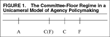
The game can be illustrated by considering the three regimes that correspond to the different relative locations of A, C, and F. Figure 1 presents an array of preferences in which A<C<F. The figure also includes an additional point, labeled C(F), which is the indifference point for the committee with respect to F and which is located at C(F)=2C−F. In this first example, A is located to the left of C(F). The situation shown in Figure 1, in which A<C(F)<C<F, is called the Committee-Floor Regime.
The committee's indifference point is of particular importance to the agency. If the agency selects a policy, a, that is equal to A, its most preferred policy, the committee will open the legislative gates and propose legislation.5
The term policy can be used to refer either to a specific policy (e.g., the FDA's decision to require more informative labels on food containers) or to a more general level of policy output (e.g., the level of FDA activism). In the empirical section of this paper, since I am interested in measuring change over time and making generalizations about political influence on agencies, I focus on the latter.
Then, under an open rule, the floor will amend the policy and F will be the outcome (i.e.,
b*=F). If, on the other hand, the agency thinks carefully and strategically about the situation, it will choose
a=C(F). The agency realizes that if it selects this point, the committee will be indifferent between inaction, which would result in C(F) becoming policy, and opening the gates and introducing legislation, which, under an open rule, would result in a policy of F. Because the committee does not prefer F to C(F), it will keep the gates closed and allow the agency's policy choice,
a=C(F), to stand.
6 Technically, the agency would locate at C(F)+ε, which the committee prefers to F. Alternatively, I assume that if the committee is indifferent between two actions, it chooses the least costly action. In this case, that would mean keeping the gates closed.
What do we learn from this example? First, the policy outcome—the subgame perfect equilibrium—is generated by the combination of the actors' preferences and the sequence of the game. The legislature's ability to respond to the decision of the agency causes the agency to choose a policy away from its most preferred point in order to avoid being saddled with a policy that is even less desirable. The agency's choice, in turn, keeps the committee from opening the gates and reporting legislation that would result in an outcome far from the agency's ideal point. Significantly, the legislature does not have to pass new legislation in order to influence the outcome. Instead, it is the potential for a new law that causes the agency to choose a different policy. The legislature might use traditional means of oversight, such as holding hearings or conducting investigations, to signal its seriousness and its preferences (e.g., Ferejohn and Shipan 1989), but the power underlying these activities is the threat of legislation.
Second, as the preferences of the legislature change, so will (at least in this regime) the agency's outputs. The model shows that as the committee moves to the right, so will the agency's output. Counterintuitively, it shows that as the floor moves to the right, the agency can locate farther to the left.7
More specifically, the agency's output is positively affected (i.e., increased) by having the committee move to the right (i.e., away from the agency's ideal point) or having the floor move to the left (i.e., toward the agency's ideal point). It is negatively affected by having the committee move to the left or the floor move to the right.
Another way to view these findings is through the lens of regression analysis. If we were to regress some measure of agency output on the preferences of the committee and the floor in this regime (i.e., where A<C(F)<
C<F), we would expect the coefficient for the committee to be positive but the coefficient for the floor to be negative.
Consider now a different configuration of preferences, one where A∈[C(F), F], which is the Gatekeeping Regime. In this second regime the agency will be able to implement its most preferred policy, A, unconstrained by the preferences of the legislature. It is able to do so because the committee prefers A, the agency's choice, to F, which would be the policy outcome under an open rule. Under these conditions, then, the agency receives a considerable amount of autonomy from the legislature, and will be unaffected by changes in congressional preferences.
Finally, consider the situation where C<F<A, which is the Floor Regime. Here, if the agency were to choose a policy equal to A, then the committee would introduce legislation to overturn the agency's action. In fact, since the committee prefers F, the legislative outcome under an open rule, to any point to the right of F, the only way the agency can avoid legislation is to locate at F. Thus, in this regime we would expect the influence of the floor to be significant and positive— as the floor moves to the right (or left), so will the agency's chair. However, we would not expect to find a significant relationship between the committee and the agency. As long as the agency and committee are located on opposite sides of the floor, a shift in the committee's preferences will not result in a shift in the agency's preferences.
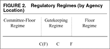
The most important result from this model is that whether an agency is affected by the legislature, and by a committee within the legislature, depends on the nature of the regime—that is, the configuration of these actors' preferences. The committee and the floor will matter, but only under certain conditions. Figure 2 sums up the discussion in the previous paragraphs. As the figure shows, there are three regimes, depending on the location of the agency relative to the committee and the floor. The Committee-Floor Regime occurs when the agency is to the left of the committee's indifference point (i.e., A<C(F)<C<F), the Gatekeeping Regime occurs when A is located between the committee's indifference point and the floor (i.e., C(F)<A<F), and the Floor Regime occurs when A is on the opposite side of the floor from the committee (i.e., C<F<A).
By now the relevance of this simple theoretical model for statistical estimations of political influence on agency policymaking should be clear. Most studies typically regress some measure of agency output on the preferences of legislative actors. Some of these models find that the preferences of legislative actors exert a significant effect on the agency; others do not. But what this model shows is that whether or not legislative institutions should influence agency actions depends on the nature of the political regime. More specifically, the model shows that we should expect the committee to influence the agency under the Committee-Floor Regime. It also shows that the floor should influence the agency under both the Floor Regime and the Committee-Floor Regime, but that it should have opposite effects under these two regimes. Thus, political influence is contingent.
As the preceding discussion makes clear, in order to achieve meaningful results—or even to expect to achieve meaningful results—the nature of the regulatory regime must be taken into account in any statistical analysis of political influence on agencies. Before proceeding to the data analysis, however, we first need to consider the effects of two other institutions: the president and bicameralism.
The President
The primary focus of the model, as mentioned earlier, is to pin down the conditions under which the legislature—in particular, the committee and the floor—influences the agency. Of course, another actor that can also play an important role in guiding agency decisions is the president. Thus, we need to consider how the president can influence agency actions.
To incorporate the president into the analysis, I assume that the president is able to set the general location of the agency's ideal point. The president influences this ideal point prior to the three stages of the game that are spelled out earlier; in fact, we could consider the president's choice of the agency's ideal point as the first stage of the game. This is a strong assumption, one that essentially means that the president is in a privileged position, relative to other political actors, with respect to the agency. It is, however, an assumption that is based on convincing empirical and descriptive accounts of the powers of presidents— or, more generally, chief executives—over executive agencies (e.g., Howell 2003, Huber and Shipan 2002, Meier 1993, and Moe 1982, 1985b). In particular, the president has the advantage of being able to act unilaterally to influence the agency's goals and preferences (e.g., Moe and Howell 1999, Moe and Wilson 1994).8
This is especially true in the case of an agency like the FDA, which is located within the executive branch.
Among other things, the president can, for example, reorganize agencies, alter jurisdictions, and, in many cases, make appointments to key positions, and can do all these things without needing the cooperation of Congress.
While I assume that the president has considerable powers in setting the agency's ideal point, I should be clear that I am not assuming that A=P, which would mean that the president is able to set the agency's ideal point so that it is exactly equal to his own. Rather than making this unrealistically (and unnecessarily) strong assumption, I make the less stringent assumption that because of the president's powers vis-à-vis the agency, the agency's ideal point will be similar to—in other words, located in the same region as—that of the president. Thus, if the president is located to the left of C(F) in the model, the agency will also be located to the left of C(F). Similarly, if the president is located between C(F) and F, or to the right of F, that is where the agency will be.9
Note that in the first and third regimes, it does not matter specifically where the agency is located; thus, the president is less concerned about the exact location of A in these regimes.
Ideally, of course, we would have some independent measure of the agency's location. Such a measure does not exist, however, and thus we need to rely on this assumption that, although giving a great deal of power to the president, is clearly defensible.10
Later I explore some alternatives, such as allowing the agency's position to be fixed and determining the agency's position by looking at the ideology of the president who was in office when the current agency head was appointed. To foreshadow these results, the data best support the use of the current president as a surrogate for the agency. See footnote 26 and the discussion of Table 2.
In addition, this assumption has three significant implications for constructing a statistical model of political influence. First, in contrast to the other two regimes, the president is most likely to be able to exert influence on the exact location of the agency's action in the Gatekeeping Regime, since in this regime the committee will not introduce legislation, giving the president his strongest ability to unilaterally influence the agency. Second, it has the practical effect of letting us examine whether there is any observable evidence of congressional influence even if we give the president the significant advantage of being able to set the agency's ideal point. And third, the main effect of assuming that the agency's ideal point is located close to the president's is to bias the coefficients for the congressional variables toward zero and to make it more difficult to find significant results for congressional variables in the Committee-Floor and Floor regimes.
11 For example, if we misclassify some Gatekeeping Regime observations as belonging to the Floor Regime, then we make it more difficult to find statistical significance for the floor in the Floor Regime. Similarly, if we misclassify Gatekeeping Regime observations as belonging to the Committee-Floor Regime, then we make it less likely that the committee and floor coefficients will turn out to be significant in the Committee-Floor Regime.
While I assume that the president sets the location of the agency, I do not include the president as a veto player in the model. To begin with, Congress frequently can pass legislation even when the president opposes it, often by bundling together different policies. Thus, by using such a logrolling approach, Congress is able to pass policies that the president might not otherwise like, and the threat of legislation remains credible. Furthermore, in the time period I examine, Congress passed dozens of laws having to do with the FDA, none of which were vetoed. It is possible, of course, that some bills were not vetoed because Congress anticipated a presidential veto and designed the bill to avoid a veto, but it is also likely that Congress passed several of these bills despite a lack of support from the president. And finally, if we were to include the president and a veto override player in the model (see, e.g., Ferejohn and Shipan 1990, Hammond and Knott 1996, Spitzer 1990), it complicates things to the point where the model is not testable given a limited number of observations.12
In effect, it creates too many distinct regimes.
Overall, then, the model overstates the president's influence by allowing him to set the agency's ideal point but understates it by not allowing for a veto.
Bicameralism
In a bicameral legislature like the U.S. Congress, the House and the Senate and their respective committees will have an interest in the agency's decisions. Such a complication obviously needs to be taken into account. At the same time, however, it causes difficulties for the analysis. Instead of having three distinct regimes—committee-floor influence, agency autonomy, and floor influence—we would have five. The agency might be influenced by the House committee and floor, the Senate committee and floor, the House floor alone, or the Senate floor alone, or it might operate entirely autonomously from both chambers of the legislature.
However, since both houses would have to pass legislation in order for a law overriding the agency to be passed, the agency need only pay attention to one house. Once that house is satisfied by the agency's action, the agency no longer needs to worry about override legislation being passed and it can disregard the preferences of the other chamber. Thus, in principle the agency might worry about both floors and both committees, but in reality it needs to worry about pleasing only one committee-floor pair (in the first regime) or one floor (in the third regime).
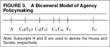
An example will illustrate this point. In terms of the model presented above, if the House committee's indifference point with respect to the House floor is labeled CH(FH) and the Senate committee's indifference point with respect to the Senate floor is labeled CS(FS), then when A<CH(FH)<CS(FS), as in Figure 3 below, the agency needs to worry about satisfying only the House committee.13
As in the case of a unicameral legislature, CH(FH)=2CH−FH. Alternatively, it could be defined as 2CH−(FH+FS)/2 (i.e., with respect to the midpoint of the interval [FH, FS]).
In this Committee-Floor Regime, we would expect the House committee and floor to influence the agency. If, however, the positions of the House and the Senate were reversed, the Senate committee and floor would be influential. Similarly, if either C
S(F
S)<
A<F
S or C
H(F
H)<
A<F
H, then the situation would be classified as a Gatekeeping Regime and the agency would be able to act independently of Congress. Finally, if F
H<A and F
S<A, then we are in the Floor Regime, where the agency would be influenced by F
H if F
S<F
H<A and by F
S if F
H<F
S<A.
Thus, even when there are two chambers, configurations of preferences can still be classified into the three regimes discussed earlier. Either there is one committee-floor pair that matters, there is one floor that matters, or the agency can act autonomously from the legislature. Collapsing the five potential regimes into three regimes has both benefits and costs. The benefit is that by focusing on only the committee and the floor that might matter, regardless of chamber, we are able to limit the statistical analysis to three regimes. This is important for two reasons: first, to preserve degrees of freedom and, second, because it is possible that there might be very few observations in any given regime, a situation that would be exacerbated by using five regimes. In addition, such an approach still gives us leverage on whether congressional institutions influence an agency. The cost, however, is that we lose the ability to determine whether this influence is coming from the House or the Senate.
Testing the Model
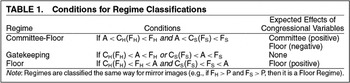
The model gives us guidance about the conditions under which committees and floors should matter, guidance that we can use to design a statistical test. Table 1 spells out the conditions under which each regime occurs and offers predictions about which congressional variables should be significant, and in which direction.
14 The model also suggests that specific variables should not matter in certain regimes. I return to this point when discussing the results.
Based on these results, the theoretical model calls for the following specification:
where DCF, DG, and DF are dummy variables set equal to one for the Committee-Floor, Gatekeeping, and Floor regimes, respectively, and zero otherwise, and where Xt represents a vector of control variables. Yt represents the level of agency outputs. As discussed in the next section, a greater value of Yt indicates a higher level of agency activity and, thus, a more liberal level of activity. The predictions for the model are: β1>0, β2<0, β3>0, and β4>0.
ESTIMATING POLITICAL INFLUENCE ON THE FDA
The Food and Drug Administration (FDA) plays a central role in setting public health policy in the United States. From drug approval to food safety to the regulation of medical devices, the agency has a hand in setting and enforcing a wide variety of policies. By the agency's own estimate, 25 cents of every consumer dollar spent in the United States is spent on products regulated by the FDA.
While the FDA has a variety of responsibilities in the policy areas it regulates, among the most important are its monitoring activities. Most notably, the agency conducts on-site inspections and also takes and analyzes product samples. It is through these activities that the agency discovers whether regulated firms are complying with directives set down by the agency, Congress, and the president. If the agency finds, through its inspections and samples, that a firm is acting illegally, or is in some other way violating regulatory rules or laws, it has a variety of enforcement options available to it, ranging from urging the firm to recall its products to seizing the firm's products.
Monitoring activities serve as excellent proxies for the overall level of agency activity. First, they represent the initial steps in a process that can ultimately lead to penalties, fines, and even criminal prosecution. Thus, they are viewed as extremely serious by the 95,000 firms that the agency regulates. Second, the agency engages in tens of thousands of these activities each year. An individual inspection or sample might not seem all that important (other than to the firm being investigated), but the combination of all of these activities over the course of the year gives a good sense of how actively the agency is regulating the firms within its jurisdiction. Thus, the measure taps into the overall level of agency activism, which matches up well with the single-dimensional approach of the model. Third, Congress itself views these activities as important and has held numerous hearings about the style and level of these activities (Carpenter 1996). More generally, the notion that these activities are the subject of much political interest has been supported by both qualitative (e.g., Magill 1995, Quirk 1980) and quantitative (e.g., Carpenter 1996, Olson 1996b) analyses.
To analyze the influence of political factors on the FDA's monitoring activities over time, I have collected data on the number of inspections and samples taken from 1947 to 1995.15
These data were drawn from FDA Yearly Reports, FDA Quarterly Activity Reports, and “A Statistical History of the Food and Drug Administration” (an unpublished FDA manuscript).
What factors might influence the quantity of monitoring activities in each year? First, there are the political variables discussed in the previous section: the preferences of the president and the committees and floors in each chamber. For estimates of these preferences, I rely on Common Space Nominate scores.
16 Common Space Nominate scores for presidents extend back to Eisenhower. However, because these scores remain constant over the course of a politician's career, for Truman I used the score calculated from his years in the Senate. In this paper I reversed the sign of these scores, so that more conservative members received negative scores and more liberal members receive positive scores. This means that, for example, all else equal, a higher score for the president should result in a greater number of inspections and samples. For recent discussions of Nominate scores, see Poole and Rosenthal 1997, 2001.
In order to test the model accurately, it is especially important to identify the primary committees in each chamber with jurisdiction over the FDA. I relied on two approaches to determine these committees. First, I used the Public Law database compiled by Baumgartner and Jones as part of their Policy Agendas project (see, e.g., Baumgartner and Jones 1993).17
These data were originally collected by Frank R. Baumgartner and Bryan D. Jones, with the support of National Science Foundation Grant SBR 9320922, and were distributed through the Center for American Politics and Public Policy at the University of Washington. Neither NSF nor the collectors of the data bear any responsibility for the analysis reported here.
Second, I used the same authors' congressional hearings database to determine which committees held hearings on topics related to the FDA. These two sources of data produced findings that were consistent with each other. In the Senate, primary oversight responsibility was held by the Labor and Public Welfare Committee until 1976 and by the Labor and Human Resources committee from 1977 to the present. And in the House, primary oversight responsibility was held by the Commerce Committees—first, Interstate and Foreign Commerce and, later, Energy and Commerce.
18 All public laws relating to the FDA that emerged from committees came from either the Senate Labor or the House Commerce committees. In addition, these committees conducted more hearings on the FDA than any other committees. The policy codes from the Baumgartner and Jones data set that I examined were 306, 400, 401, and 403. I then deleted all laws and hearings that were primarily about agriculture, an area in which the FDA has very limited jurisdiction.
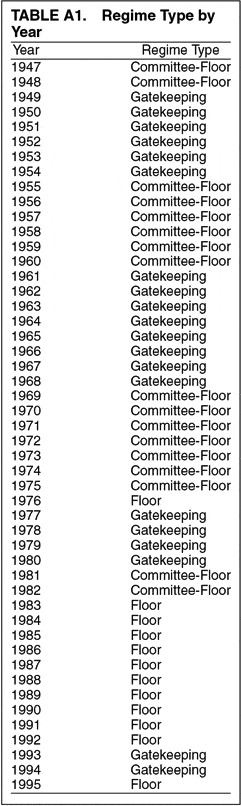
Once I obtained the ideology scores for the president, the median member of each committee, and the median member of each floor in each year, I was able to classify each observation as belonging to a particular regime. Overall, from 1947 to 1995, 17 years were classified as belonging to Committee-Floor Regime, 20 were classified as belonging to Gatekeeping Regime, and the remaining 12 were classified as belonging to the Floor Regime (see Appendix).
Of course, in addition to these political and institutional variables, a number of other political influences need to be controlled for. Olson (1995, 1996b, 1999), using an external signals model, identifies several factors that influence the activities of the FDA. First, because monitoring activities are relatively high-cost activities, the agency's budget should influence them. Second, she contends that industry size should be an important determinant of agency actions. Carpenter (1996) also argues that the budget and industry size need to be accounted for and that an additional factor that should enter into the statistical specification is the 1962 passage of the Kefauver–Harris amendments, which increased the agency's regulatory authority and led to an increased level of activism (see also Olson 1996a).19
This is consistent with a growing literature that contends that legislatures and executives design bureaucracies strategically in order to influence future outcomes. Early theories along these lines include those of McCubbins, Noll, and Weingast 1987 and Moe 1989; recent tests include those by Lewis 2002, Potoski 2002, Potoski and Woods 2001, and Wood and Bohte 2004. For a recent overview of this literature, see Huber and Shipan 2000. My empirical results remain substantially the same regardless of whether or not I include this variable.
I control for these variables as follows. First, I include the agency's budget in real dollars (using 1983 as the baseline). Second, to control for the Kefauver– Harris amendments I create a dummy variable that was set equal to zero prior to 1962 and one from 1962 on. Third, I measure industry employment by controlling for the number of workers in the food and health industries in each year.20
I obtained this information from the Bureau of Labor Statistics' Web site (http://stats.bls.gov/). The data were part of the “Nonfarm Payroll Statistics from the Current Employment Statistics (National).”
The expectation for the budget and Kefauver–Harris variables is that each will have a positive coefficient. Because Olson (
1999) finds that industry size has a negative influence on the number of inspections, while Carpenter finds that it has a positive effect, I make no predictions about the sign of the variables measuring industry size.
21 I should also note several differences between the variables I use and those used by Carpenter and Olson. First, Carpenter uses the Education and Labor Committee in the House and, in the early years of the time series, the Agriculture Committee in the Senate. Second, following Olson, I use the agency's entire budget, whereas Carpenter relies on the agency's staff budget. Third, Olson (1996b) uses the number of oversight hearings (lagged) and the number of adverse findings by the FDA. Fourth, Carpenter uses a cascade processing model, in which the agency adapts slowly over time both to the amount of the appropriations it receives and to whether appropriations have been increasing or decreasing in recent years. The model I use here is more similar to what he labels the “serial updating” model.
In addition to these variables, I include separate control variables for inspections and samples to account for different reporting methods used by the FDA over time. Prior to 1975 the agency reported the count of all samples that it collected, whereas after 1975 the agency reported only the count of samples that were physically analyzed. Thus, in the analysis of samples I include a dummy variable that takes on the value of one beginning in 1975. Prior to 1955 the agency reported factory inspections, but since 1955 the agency has reported all established inspections. Thus, I include a dummy variable for inspections, set equal to zero from 1950 to 1954 and one from 1955 to the present. I expect the dummy variable for samples to have a negative and significant coefficient and the analogous dummy variable for inspections to have a positive and significant coefficient.
RESULTS
Autocorrelation is always a potential problem with time-series data. And indeed, when the various models presented below are run using OLS, Durbin–Watson tests reveal a high level of autocorrelation. Thus, to estimate the statistical model I use the Prais– Winsten autoregressive technique, which is a GLS estimator appropriate for first-order serially correlated residuals and is especially useful with small samples.22
It is worth noting that including a lagged dependent variable with OLS produces results very similar to those obtained using Prais–Winsten. A case could also be made for using either tobit (because the dependent variable is bounded and never falls below zero) or negative binomial regression (because the dependent variable consists of count data). Results using these alternative methodologies again are substantially the same as those reported here.
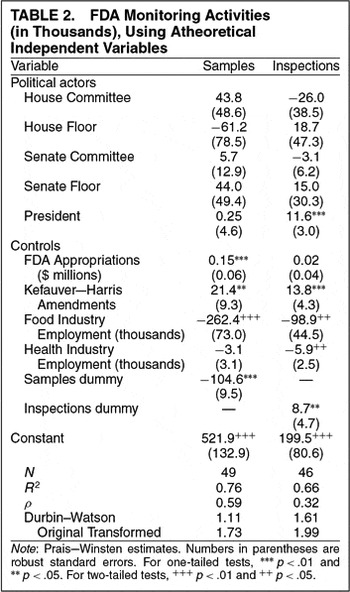
Before testing the theory, it is instructive to examine the results that obtain from an atheoretical approach. In Table 2, I present two columns of results, one for samples and one for inspections. In each of these atheoretical regressions I include the ideology for the floors and relevant oversight committees in each chamber, as well as the president. In essence, then, this regression assumes that there is a linear relationship between these variables and FDA monitoring activities and tests whether political influence is unconditional. As such, it functions as a sort of alternative to the hypotheses stated earlier—namely, these two equations test the hypotheses that these political variables matter irrespective of regime.
The results of these two regressions are striking for their lack of significance. None of the congressional variables are significant, and indeed, none are even very close to being significant. Furthermore, although the variable measuring the president's ideology is significant for inspections, it is indistinguishable from zero in the equations about samples. Importantly, the results are similarly insignificant if the regressions include only one chamber at a time, or only the two committees, or only the two floors.23
I tested these alternative specifications to make sure that the lack of significance for the political variables in Table 2 was not simply due to multicollinearity.
Thus, there appears to be no support for the hypothesis that the preferences of elected politicians influence agency actions in a linear fashion—that is, regardless of regime.
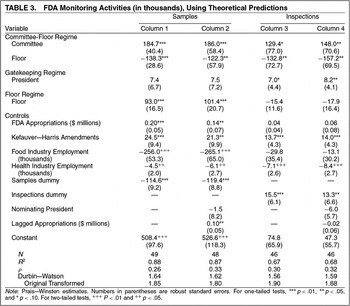
In Table 3 I turn to the task of testing the theoretical predictions. Columns 1 and 3 presents the results from the basic model, where the number of samples (in Column 1) and inspections (in Column 3) is a function of congressional committee and floor preferences in the Committee-Floor Regime, the president's preferences in the Gatekeeping Regime, and the floor's preferences in the Floor Regime. As discussed above, I also control for the agency's budget, the Kefauver–Harris amendments, the size of the industry, and the change in the FDA's reporting methods.
The results in Column 1 provide strong support for the theory's predictions. Most strikingly, the floor has a negative and significant influence in the first regime, but a positive and significant influence in the third regime. Thus, a more liberal floor will lead to a more activist agency in the Floor Regime but to a less activist agency in the Committee-Floor Regime. The coefficient for the committee is also strongly significant and positive, as predicted, in the Committee-Floor Regime. The only finding that does not comport with the theoretical predictions is that the president does not exert a significant influence on the agency in the Gatekeeping Regime. It is worth noting that if I add the president's ideology score as a main effect, in addition to including the interaction of his ideology with the dummy for the Gatekeeping Regime, neither the interacted term nor the main effect turns out to be significant. Similarly, if I include only the president's ideology score, irrespective of regime, it is not significant. In each case, however, the congressional variables remain significant in the predicted directions.
Two of the control variables are also significant in the predicted direction. The coefficient for the Kefauver– Harris amendments is significant and positive, supporting Carpenter's (1996) and Olson's (1996a) contentions that these amendments produced a more activist culture at the agency. In addition, again consistent with the work of Carpenter and Olson, the amount of money appropriated to the agency also influences the agency's level of output. The variable representing the change in the method by which samples were reported is, as predicted, negative and significant. In addition, the measures of industry employment have a negative sign, consistent with the findings of Olson (1999).
The results in Column 3, which focus on investigations rather than samples, also provide support for the theory, olbeit the support is not as strong as it is for samples. Both the committee and the floor have the predicted sign in the Committee-Floor Regime, albeit at a relatively weak level of significance. Furthermore, the president has the expected positive influence in the Gatekeeping Regime. Only the floor variable in the Floor Regime, which does not differ significantly from zero, fails to provide corroboration for the theory. Taken together, these results in Columns 1 and 3 provide strong initial confirmation for the theory by showing that in specific regimes, identified by the theory, Congress does exert influence over the agency's actions.
The results also provide some indirect support for another aspect of the theory. In addition to predicting when certain congressional variables should matter, the theory also predicts when these variables should not matter. More specifically, the House and Senate floors should not be significant under the Gatekeeping Regime, and the relevant committees should not be significant under the Gatekeeping or Floor regimes.24
Furthermore, the committee that is not pivotal in the Committee-Floor Regime also should not be significant, and the floor that is not used in the Committee-Floor or the Floor regimes should not be significant.
Unfortunately, I cannot test these additional hypotheses directly, since the inclusion of these other variables leads to unacceptably high levels of multicollinearity that make it impossible to obtain efficient estimates. But we can at least draw some tentative conclusions from a comparison of
Tables 2 and
3. The committee variables, for example, are not significant in
Table 2 (or in alternative specifications of the results presented in
Table 2). Yet the committee variable
is significant in the results reported in
Table 3. Thus, since
Table 3 shows significance for the Committee-Floor Regime, and
Table 2 shows a lack of significance overall, this implies that the variable is not significant in the predicted direction in regimes other than the Committee-Floor Regime. A similar conclusion can be drawn for the floor variable. Admittedly, this evidence is indirect, but it is also clearly consistent with the predictions of the theory. Overall, then, the results provide strong evidence that variables matter when the theory says they should matter and some indication that the variables do not matter when they should not.
Additional Tests
In order to check on the robustness of the results shown in Table 3, I examined a variety of other variables and approaches. First, a number of studies argued that political principals attempt to influence the future actions of the agency by designing specific agency structures and procedures, perhaps to set the agency on “autopilot” (e.g., McCubbins, Noll, and Weingast 1987) or perhaps to insulate it from political pressure (e.g., Moe 1989). The significance of the Kefauver–Harris amendments may be seen as partial support for this argument. Another possibility is that the president who was in office when the sitting chair of the agency was appointed still exerts influence over the agency even after a new president takes office (via the chair) and that the agency's actions still reflect that previous president's preferences.25
In some cases, a new chairman has been appointed immediately after a new president takes office. In other instances, there has been a lag of a year or two. And in still others, a chairman who served under an earlier president remains in office during the entire term of the succeeding president. Although the president did not directly appoint the FDA chair until fairly recently, he clearly had influence over this appointment, by virtue of its location within the executive branch. Consequently, I sometimes refer to this variable (e.g., in Table 3) as “Nominating President.”
Thus, to the regressions reported in Columns 1 and 3 in
Table 3, I add a variable that measures the ideology of the president who was in office when the chair took over the FDA. Second, I add a lagged version of agency appropriations. Although this does not completely capture Carpenter's (
1996) elegant argument about the budgetary signals that are passed down from political principals to agencies, it does at least roughly capture the central idea that agencies obtain information not only from the current budget, but also from past budgets.
Columns 2 and 4 show the results of the regressions containing these two other variables. In general, the results are similar to those reported in Columns 1 and 3. All of the theoretical variables except the president are significant for samples, and all except the floor are significant for inspections (with the committee and floor now achieving higher levels of significance in the Committee-Floor Regime). There is some evidence that past budgets contain information for the agency, at least in the realm of samples. But there is no support for the idea that the president who supervised the choice of the agency chair continues to exert influence over the agency's actions.26
This is also true if instead of adding the nominating president to the model, I substitute the nominating president for the current president. In an additional test, I also examined what would happen if the agency's preferences were relatively fixed over time. I set the agency's ideal point at the midpoint of the two houses of the 80th Congress, allowed it to move to the midpoint of the two chambers in 1962 (when Congress passed the Kefauver–Harris Amendment), and calculated the regimes that way. This approach produced generally insignificant results, thereby casting doubt on the idea that the agency's preferences remain fixed over time.
In the tests reported thus far I have run separate regressions for each of the two dependent variables. This follows Carpenter (1996), who makes a good case that although there is some overlap between inspections and samples, they are generally independent from each other. It is conceivable, however, that these two variables act as substitutes for each other. Indeed, Olson (1996b) has convincingly argued that the FDA has shown a pattern of substituting one type of enforcement activity for another.
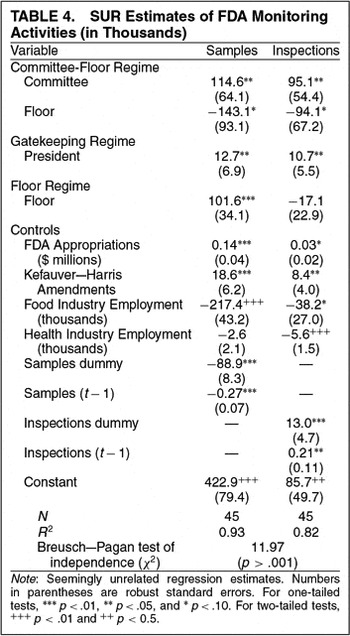
Although there is no theory that allows us to predict which monitoring tool will be used under which conditions, there is an econometric technique that allows us to account for the relationship between the two measures. Seemingly unrelated regression (SUR) is appropriate when the error terms of two separate equations are correlated. Each equation can be estimated separately; however, doing so, in effect, ignores the information that comes from knowing that the two equations are related, in particular, that the error terms in the two equations are related (Greene 1990). In this case, the FDA can substitute inspections and samples for each other. Thus, if we were to regress each of these variables separately on the set of independent variables included in the previous table, we would be ignoring this possible substitution effect. SUR can be used to estimate the two equations jointly.
To test the theory using SUR, I use the variables presented in the first and third columns in Table 3. However, I need to add one additional variable before proceeding. The results in Table 3 are derived using an autoregressive technique, Prais–Winsten, to account for autocorrelation. Since I cannot use an autoregressive technique with SUR, I include a lagged version of the dependent variable for each equation to account for autocorrelation.
The results using SUR are presented in Table 4. The equations for both samples and inspections continue to support the theoretical argument. All of the important variables, with the exception of the floor in the Floor Regime for inspections, are statistically significant in the predicted directions. The agency becomes more liberal in its monitoring activities as the committee gets more liberal and the floor more conservative in the Committee-Floor Regime, as the president becomes more liberal in the Gatekeeping Regime, and as the floor becomes more liberal in the Floor Regime (for samples). Finally, the correlation between the residuals of the two equations is 0.42. A Breusch–Pagan test of independence allows us to reject the hypothesis that the two equations are independent (p<.001), indicating that the two equations can be estimated jointly.
Finally, I also tested the statistical models shown in Tables 3 and 4 using other alternative approaches and variables. First, in an attempt to test whether the courts influence the relationship between Congress and agencies, I created a dummy variable for the Chevron case, a 1984 case in which the Supreme Court ruled that agencies should be given broad leeway when Congress delegates but does not give precise instructions to an agency. The results, however, indicate no difference in congressional influence before and after this ruling.27
More specifically, I included this dummy variable both as a main effect and as a term interacted with the regime variables. These variables were not significant. These results, as well as those discussed in the next paragraphs, are available from the author.
Still, the idea that courts can influence the relationship between legislatures and agencies is deserving for further attention, as both theoretical work (e.g., Shipan
2000) and empirical studies of courts and agencies (e.g., Canes-Wrone
2003 and Howard and Nixon
2002) indicate the potential influence of courts on agency actions.
Second, I investigated two potential alternatives to my use of the floor median, both of which represent initial investigations into institutions that are omitted from my model. One of these was the majority party median; the other was the filibuster pivot in the Senate. In each case I substituted this other variable for the floor median, used this variable to determine the regime, and then used it in the regressions in place of the floor median. The results using the filibuster rather than the Senate floor median were broadly similar to, although sometimes weaker than, those reported in this paper, while the results using the party median generally were not significant. These results lend support to the idea, central to my model, that agencies (and committees) are concerned with the median member of the floor. At the same time, these should be viewed only as preliminary tests, intended more to spur future analysis than to be viewed as definitive. The obvious next step is for scholars to think more comprehensively and systematically about how parties and other institutions like the filibuster could be incorporated into a model of agency policymaking and then to solve such a model and test its predictions (e.g., Chiou and Rothenberg 2003).
DISCUSSION AND CONCLUSION
For more than two decades, scholars have been conducting sophisticated statistical analyses of contemporaneous political influence on the actions of regulatory and administrative agencies. Using a variety of increasingly advanced statistical techniques, these studies have provided insights into the workings of a number of agencies. Findings about whether or not Congress influences agency actions, however, have been rather mixed. This paper points out one potential reason for these mixed findings: scholars have failed to identify the conditions under which influence is likely to occur. By mixing together observations in which influence is likely to occur with those in which it is not, scholars have unintentionally biased their results against finding any significant effects.
To remedy this gap, I developed a simple spatial model of agency policymaking, one that identifies a series of regulatory regimes, each of which predicts that a different set of political actors will influence the agency. In essence, the model shows that if the question is “Does Congress influence agencies?” then the answer is “Sometimes.” But importantly, the model shows when Congress can matter, and whether it is the floor or the committee that matters. Utilizing the threat of legislation, under some conditions committees can influence agencies, and under other conditions, floors can influence agencies. In addition, it shows that there are also specific conditions under which they can operate autonomously from Congress.
The statistical results support the argument that Congress can—under certain conditions—influence agency actions. In particular, when the agency is located far to the left of the committee, which is turn is located to the left of the floor, the agency will need to be sensitive to the preferences of the committee. All else equal, as the committee becomes more liberal, the agency will become more activist; and as the committee becomes more conservative, the agency will become less activist. The agency can, however, move in the opposite direction of the floor in this regime. On the other hand, if the agency is located on the opposite side of the floor from the committee, it will have to be attuned to the floor's preferences.
The results also show that agencies are influenced by other factors when deciding what sorts of policy actions to take. Obviously the president, for example, exerts an influence over the agency, as does the overall level of the agency's budget. But we also see that the agency pays attention to other influences, in addition to the preferences of elected politicians, such as the size of the industry. All told, then, agencies are sensitive to a variety of signals that they receive from the political environment.
One interesting and unexpected result that emerges from the model speaks to the recent debate about whether the floor is made better off by committees that are representative of the floor (e.g., Maltzman 1997). The theoretical model presented here indicates that if a committee and an agency are on the same side of the floor, then the floor has an incentive to make sure that the committee is as close to the floor as possible. The more distant the committee is from the floor, the more likely it is that the agency will be able to choose a policy that is far from the floor. Consequently, in order to obtain an agency output that is in line with its own preferences, the floor should prefer committees to be inliers. Furthermore, the model shows that floors should have a strong preference for committees that are located on the opposite side of the floor from the agency. Only when this is the case—when committees and agencies are countervailing—can the floor exert a positive influence on the actions of the agency or expect the agency's policy outcomes to be in line with the floor's preferences. Interestingly, although the model used in this paper assumes the absence of transaction costs, this finding is consistent with the results of Epstein and O'Halloran's (1999) innovative transaction cost approach.
Although the results are generally strong, there are several obvious directions that future research can take. First, using the ideology of the current president to determine the location of the agency works well, but it certainly would be preferable to have a more nuanced and independent measure of the agency's location. Second, solving and testing competing models that include other institutions, such as parties and courts, or the agency's structure or location, would provide insight into the effects of those other institutions on agencies. Third, this model is built around the threat of legislation. It would be useful to develop a theory centered around other means that Congress has for influencing agencies, one that, like this theory, produces testable implications about the specific conditions under which agencies will pay attention to Congress.
This paper, by setting out a model of agency policymaking and then conducting statistical tests of the implications of this model, provides a useful and adaptable approach for testing for political influence. It produces evidence that contemporaneous influence exists, that agencies are responsive to congressional preferences. Most importantly, this paper shows that the primary focus of research should not simply be whether Congress influences the agency but, rather, when, and under what conditions, influence exists.
I would like to thank Marc Turenne, Kevin Chlarson, and Andrew Bargen for valuable research assistance, Greg Adams, Scott Adler, and Dan Carpenter for graciously sharing their data, and Kathy Bawn, Fred Boehmke, Doug Dion, David Epstein, Matt Gabel, Tom Hammond, Rick Hall, John Huber, George Krause, Mary Olson, and seminar participants at Trinity College and the University of Chicago for helpful comments and discussions. In addition, I would like to acknowledge the financial support of The Robert Wood Johnson Foundation and the National Science Foundation (SES9819681).






Comments
No Comments have been published for this article.