


Introduction
Cognitive Behavioural Therapy (CBT) is now an essential part of modern mental health services and recommended by clinical guidelines (NICE, 2004a, b) based on the robust evidence base from decades of empirical research. The IAPT programme further increases access to CBT based programmes in England. In Northern Ireland a new Psychological Therapies Strategy (DHSSPS, 2009) is currently being implemented, with CBT prominently featured amongst other evidence-based approaches. In the Republic of Ireland (ROI) a recent review of mental health services recommended major changes, including closure of the remaining psychiatric hospitals, development of community care teams, and expansion of a comprehensive range of medical, psychological and social therapies, stating that “cognitive behaviour therapy and interpersonal therapies are often clinically effective as well as cost effective, and these should be available in the primary care network” (Government of Ireland, 2006, p. 63). The need for CBT training for mental health professionals in Ireland is highlighted in the recently published Vision for Psychiatric and Mental Health Nursing (HSE, 2012). There are approximately 3195 therapists accredited in the United Kingdom by the CBT professional body, BABCP, but only 39 in the Republic of Ireland (BABCP, personal communication, 11 September 2012) so it can be difficult for patients in Ireland to access evidence-based skilled therapists.
As policy changes incorporate the principle of evidence-based practice at all levels of mental health care, the training needs and competencies of the mental health workforce need to be considered. Therapist competency has been linked to improved patient outcomes (Grey, Salkovskis, Quigley, Clark and Ehlers, Reference Grey, Salkovskis, Quigley, Clark and Ehlers2008; Milne, Baker, Blackburn, James and Reichelt, Reference Milne, Baker, Blackburn, James and Reichelt1999; Trepka, Rees, Shapiro, Hardy and Barkham, Reference Trepka, Rees, Shapiro, Hardy and Barkham2004) and competency standards for cognitive behavioural therapists have been agreed (Roth and Pilling, Reference Roth and Pilling2008).
More recently, the question of how training can improve therapist competencies and patient outcomes has received attention (Bennet-Levy, McManus, Westling and Fennell, Reference Bennet-Levy, McManus, Westling and Fennell2009). The level of competence required for positive outcomes depends on the complexity of the patients’ presenting problems; for example, higher competence levels are necessary to provide effective cognitive therapy for severe, chronic, functionally impaired, depressed patients (Coffman, Martell, Dimidjian, Gallop and Hollon, Reference Coffman, Martell, Dimidjian, Gallop and Hollon2007). Competency frameworks and maps have been developed (Roth and Pilling, Reference Roth and Pilling2008), models for conceptualizing therapist skills development have been designed (Bennett-Levy et al., Reference Bennet-Levy, McManus, Westling and Fennell2009) and a range of effective training methods have been tested (Westbrook, McManus, Clark and Bennett-Levy, Reference Westbrook, McManus, Clark and Bennet-Levy2012).
Some studies have demonstrated how training can improve competencies in CBT trainees (Milne et al., Reference Milne, Baker, Blackburn, James and Reichelt1999) and in primary care staff delivering computerized CBT programmes (CCBT) (Rose et al., Reference Rose, Lang, Welch, Campbell-Sills, Chavira and Sullivan2011). Other studies have found that short CBT training programmes with supervision can develop skills and improve outcomes in clinical practice (Westbrook, Sedgewick-Taylor, Bennet-Levy, Butler and McManus, Reference Westbrook, Sedgwick-Taylor, Bennett-Levy, Butler and McManus2008; Lopez and Basco, Reference Lopez and Basco2010). In contrast, another study has found limited effects of teaching brief CBT skills for depression to general practitioners (King et al., Reference King, Davidson, Taylor, Haines, Sharp and Turner2002). A more detailed and extensive review of existing research into the efficacy and effectiveness of CBT training has been published elsewhere (Rakovshik and McManus, Reference Rakovshik and McManus2010).
A stepped care approach to mental health is now being developed throughout the UK, supported by NICE Guidelines (NICE, 2009). New and innovative CBT based services such as guided self-help and CCBT are on offer for common mental health problems such as depression and anxiety disorders. The increasing evidence base for such interventions has implications for service delivery and training implications for mental health practitioners in community mental health and primary care settings (Lovell and Richards, Reference Lovell and Richards2000).
Although there are limited data on the efficacy of CBT skills integrated into general mental health practice, new programmes are being evaluated. The SPIRIT (Structured Psychosocial InteRventions in Teams) course trains practitioners in the use of CBT self-help workbooks (Williams, Reference Williams2009) and has proven effective in a primary care randomized controlled trial (Williams et al., Reference Williams, Morrison, Wilson, McMahon, Walker and Allan2007). The SPIRIT programme also produced encouraging results when provided for a large multi-disciplinary group (n = 263) of in-patient based and community based mental health staff. Perceived subjective skills and knowledge and objective skills ratings were significantly higher than baseline scores at the end of the training and at 3-month follow-up (Williams, Martinez, Dafters and Ronald, Reference Williams, Martinez, Dafters and Ronald2011).
Aims and context
In recent years severe economic austerity measures have been introduced in Ireland, which have had implications for funding of mental health services. Despite these challenges, a Regional Centre of Nursing and Midwifery Education (RCNME) in one region of the Health Service, HSE South (Carlow, Kilkenny, South Tipperary, Waterford and Wexford) located resources to finance a CBT foundation training programme for nurses and other frontline mental health professionals. This multidisciplinary programme was comprised of basic knowledge and skills and, similar to the SPIRIT initiative (Williams et al., Reference Williams, Martinez, Dafters and Ronald2011), had a strong emphasis on enhancing participants’ existing professional repertoire. During the training period major mental health policy changes were introduced including the closure of remaining psychiatric hospitals, transfer of services from institutional to community based services, and significant changes to service delivery and role definition. Many course participants were relocated into community based work settings within the time period of the training.
As part of the preliminary negotiations for the course, important organizational measures were agreed to enable learning to transfer into the practice area: (i) the support of directors of nursing, heads of discipline and line managers for the programme was secured; (ii) participants were facilitated to integrate CBT principles and skills in their work/practice settings; and (iii) practice mentors were nominated to support participants in the integration of course learning into practice.
The purpose of the short training course was to add to the skills base of the existing workforce in contrast to the IAPT programme in England, which had secured significant funding to train and employ a new group of psychological well-being practitioners at this level of practice. The primary aim of the study was to ascertain trainee perceptions of how the training impacted on knowledge and skills. More ambitious aims to consider if any changes in knowledge and skills impacted on practice or clinical outcomes were unable to be tested by objective measures due to organizational and time restraints. Instead, trainees, mentors and clinical managers were requested to observe and record any perceived changes to practice and clinical outcomes.
Method
Study design
Participants were assessed at baseline, following the training intervention, and finally at 12 months posttraining. Baseline knowledge and skills were assessed using self-report questionnaires. Changes to knowledge and skills were monitored throughout the course by mentors who completed posttraining questionnaires immediately after the training. Observed posttraining effects on professional practice with patients/clients were measured by questionnaires completed by mentors and clinical managers. Clinical managers were also invited to respond on observed changes to outcomes.
Participants/trainees
The training programme was offered to nurses and other health/social care professionals who provided psychosocial interventions to mental health clients in the acute or community mental health settings and included staff from the voluntary and community sector. Trainees were selected by team managers in the south east of Ireland and approved by a director of nursing or equivalent senior clinical manager. A key principle underpinning the programme was to train the different professions together, reflecting the multi-disciplinary nature of service provision in community care.
In total, 300 professionals attended the training in three cohorts over a 30-month period. The first cohort started the training before agency and ethical approval were granted for evaluation of the training. The third cohort was due to commence training after the time parameters set aside for this study. Thus the study includes only the second cohort of 119 trainees, 102 of whom completed both the pre and post evaluation questionnaires (of the 17 who did not take part in the evaluation, 12 did not complete the full training programme and 5 did not return posttraining questionnaires). Forty-six trainees (45% of study participants) completed questionnaires at 1-year follow-up.
Most participants were nurses and almost half the group worked with adults with a range of mental health disorders. The professional backgrounds were listed as follows: 64 nurses, 7 counsellors, 6 addiction counsellors, 5 psychologists, 4 social workers, 4 occupational therapists, 8 ticked the “others” box, and for 4 information was not provided. The majority (85%) were female and from a nursing background. Participants described their work settings as follows: 42 worked in community mental health, 21 in acute psychiatric settings, 9 in psychiatric hospital, 6 in residential care, 4 in primary care, 3 in both hospital and community settings, 4 in general mental health, 3 in counselling services, 2 in intellectual disability, and 8 responded in the “other” category. In relation to patient and client groups, 52 worked with multiple mental health issues (e.g. depression, anxiety, bi-polar, schizophrenia, dual disorder), 15 with addictions (alcohol, drugs, gambling), 9 with old age mental health, 6 with adults with intellectual disability, 6 with children and/or adolescents (including their families), 4 with adults who have experienced childhood trauma, 4 with self-harm or suicide, 2 with adults with Asperger Syndrome, 3 with people affected by suicide, traumatic death or bereavement and 1 with offenders.
Mentors and managers
Practice mentors for the programme were from all the main mental health professional backgrounds and were expected to meet the following requirements: hold a professional qualification in mental health or social care, have 3 years post qualification experience with a sound understanding of mental health problems and current psychological interventions and have training in CBT and significant clinical experience. A variety of methods were used by mentors to facilitate application of knowledge to clinical practice; however, face to face meetings were mainly facilitated either on a one to one basis or in small groups and with telephone/e-mail/video conferencing used as a supplementary method. Mentors were asked to provide support, guidance, encourage reflective learning, and keep a collaborative record of sessions. Mentors also agreed to use case discussions, case presentations and role plays to monitor changes in trainee knowledge and skills.
As part of the study clinical managers were asked to comment on practice and outcomes because they were expected to be more informed in this respect. Managers, with direct clinical responsibility, were invited to respond based on observations of trainee interactions with patients in practice.
Course content and delivery
The content was designed by Kate Gillespie drawing on principles from Adult Learning Theory (Kolb, Reference Kolb1984) with an integration of both intellectual and experiential learning. These learning outcomes were agreed by the teaching team and course planners as appropriate for teaching cognitive behavioural knowledge and skills at this level. Key learning methods incorporated into the design of this programme were: reading and lectures, modelling, role play, self-experiential work, and reflective practice. The agreed course learning outcomes were to improve knowledge and skills in relation to the following: application of CBT principles; using a CBT framework (5 part model); goal setting; use of homework; how to build a collaborative therapeutic relationship; how to structure therapeutic work; use of Socratic dialogue; role of negative and biased thinking; re-evaluating negative automatic thoughts; and use of thought records and simple behavioural experiments.
Theoretical input and skills training were delivered over three 2-day study blocks during a 3-month period. Participants were encouraged to practise their skills in between block study periods with the support of their practice mentors and line managers. The combination of direct class contact, self-directed learning, clinical practice and practice mentoring was designed to provide theoretical knowledge and understanding, facilitate development of practical skills in each trainee's practice setting, and, finally, to provide opportunities for reflective learning on knowledge and skills development throughout the period of the training. The teaching method used a Socratic approach, trainer role plays and DVDs to demonstrate application of knowledge and skills, trainee role plays to practise techniques and skills followed by small group discussions. A single patient vignette was used for role plays throughout the 6 training days to facilitate knowledge and skills development. The use of a single case helped to promote shared experiential learning, such as how to develop problem lists and goals, present a basic CBT cross sectional formulation (5 part model), and use CBT methods such as structure, homework, Socratic dialogue and a collaborative approach. One trainee acted as observer providing feedback in a structured format from each practitioner/client role play and frequent small group exercises reported back to the larger group on specific issues such as use of Socratic dialogue. Homework tasks were agreed after each teaching day, usually to practise specific skill sets, observe, reflect and record comments, questions or learning points for discussion with mentors or at the next teaching session.
The content, sequence of inputs and delivery methods were refined on the basis of feedback from the first cohort of trainees of the course and the modified programme was offered to the second cohort who provided the data for this study.
The training was provided by a psychiatrist, a senior nurse and a social worker all of whom are qualified and experienced cognitive therapists. The training was delivered at four separate sites in the South East of Ireland to ensure accessibility across the region. The course was delivered over a 3-month period and was comprised of 36 hours training (3 × 2 day blocks), 30 hours independent reading, 24 hours clinical practice, 10 hours practice mentoring, all producing a total for all elements of training of 100 hours.
Measures
Trainee self-report questionnaires were used based on 10-point Likert-style scales (0 – 9 none to sound) to measure change at pre, post and 1-year follow-up on knowledge and skills levels (the final small group of trainees completed the FU questionnaires between 10–12 months after the course ended). The scale was constructed to measure any change in knowledge or skills in relation to each of the learning objectives described earlier. As an example, in relation to “use of homework” 8–9 indicates systematically always uses homework in clinical practice, 6–7 indicates frequently, 4–5 indicates occasionally, 2–3 seldom, and 0–1 indicates never uses homework. In relation to “knowledge of CBT principles”, zero indicates that the trainee had no prior knowledge/understanding of CBT principles and 9 indicates pretraining knowledge and understanding of all 10 principles proposed by Beck Reference Beck(1995). The only learning outcome that measured knowledge but not skills was CBT principles. On the introductory session course facilitators explained the use of the questionnaire, Likert scale and descriptors to trainees. Mentors also received a detailed description of the course content and learning outcomes. Trainees were also asked to respond to two questions, one relating to practice and one relating to outcomes and were offered space for qualitative comments in response to all questions.
Mentors used the same Likert scales to record pre to post knowledge and skills scores and were also invited to make general or thematic comments based on observations of their group of trainees. The possibilities of direct observation of practice by mentors or assessment of video recordings of trainee practice using standardized instruments such as the CTSR were not possible within the restrictions of this study
Clinical/team managers were asked to complete short questionnaires with comments on their observed impact of training on trainees’ practice and patient/client outcomes. Mentor and manager questionnaires were completed between 10 and 12 months after the training ended. All questionnaires were designed by the authors to evaluate items specific to the training provided, as no existing suitable questionnaires were located.
At the beginning and end of each teaching block trainees were asked to reflect upon development of their knowledge and skills. In addition to the end of course training questionnaires, at the end of each 2-day training block trainees were asked to complete short feedback forms specifying how the training had impacted, or not, on their knowledge/skills. Trainees reported that these summaries helped inform their final feedback at the end of the course.
Data analysis
Data were analysed using the statistical package SPSS version 15. Pre-, posttraining and follow-up scores in each of the learning outcomes for knowledge, understanding and skills were compared using paired 2-tailed t-tests. Frequency and thematic analyses were used to analyse manager and mentor responses.
Results
Trainee knowledge and skills self reported changes
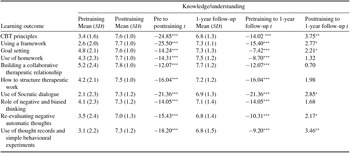
The results for changes in trainee knowledge and understanding suggest significant improvement (p < .0001) on all outcome variables following the 3-month period of the training and these pre to posttraining gains were maintained at 1-year follow-up (Table 1). The mean group gains dropped between the posttraining period and follow-up to varying degrees of significance for six outcome variables: CBT principles; using a CBT framework (5-part model); goal setting; use of Socratic dialogue; re-evaluating negative automatic thoughts; and use of thought records and simple behavioural experiments (Table 1).
Pre, post and follow-up training scores for knowledge and understanding compared using paired t-tests

***significant at p<.0001 level, ** significant at p<.001, * significant at p<.05.
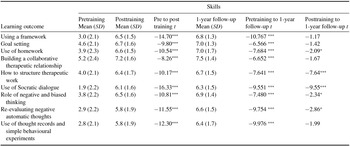
The results for changes in trainee skills suggest similar significant pre- to posttraining gains on all skills outcomes (p < .0001), which were also maintained at 1-year follow-up (Table 2). In comparison, the mean group gains in skills increased for all of the skills outcomes during the post and follow-up period, increasing to varying degrees of significance on five variables: use of homework; how to use structure; use of Socratic dialogue; role of negative and biased thinking; re-evaluating negative automatic thoughts (Table 2).
Pre, post and follow-up training scores for skills compared using paired t-tests

***significant at p<.0001 level, ** significant at p <.001, * significant at p <.05.
Mentor and manager responses
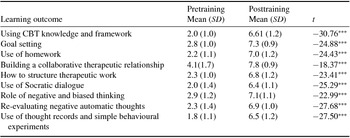
Twenty-four mentors completed questionnaires relating to 86 trainees (84% of participants) and 8 clinical managers responded relating to 33 trainees (32% of participants). The pre to post Likert scale ratings from mentors also indicate significant posttraining improvements in knowledge and skills (p<.0001) (Table 3).
Mentor ratings of trainee pre to post knowledge and skills compared using paired t-tests (24 mentors - 86 trainees)

***significant at p<.0001 level.
Perceived impact on practice
In response to the question “Has your practice changed in any way as a result of learning and applying these new skills”, all except one of the 96 trainees who responded reported that practice had improved, with 40% responding that “practice had improved substantially”, 59% responding that “practice had improved slightly” and 1 participant reporting that “practice deteriorated slightly”. The responses of mentors and managers appear to support the self-reported trainee impressions of practice improvement. The aggregated mentor (N = 24) scores for 86 trainees (84% of participants) reported that practice had improved substantially for 64%, improved slightly for 28%, and not changed for 8% of the group. The 8 managers who responded in relation to 33 trainees (32 % of participants) reported that practice had improved for all their trainees, substantially for 75%, and improved slightly for 25% of the group.
Perceived impact on outcomes
In response to the question “Have your outcomes with clients changed in any way as a result of learning and applying these new skills”, of the 93 trainees who responded 25% replied that outcomes had improved substantially, 62% replied that practice had improved slightly, 12% replied that that outcomes had not changed at all, and 1 candidate replied that outcomes had deteriorated slightly. Nine participants did not answer the question in response to outcome changes, inserting comments such as: (1) “The question is Not applicable yet”; (2) “Not enough clinical contact to justifiably quantify/rate this”; (3) “It is early days yet”.
The eight mangers who responded reported that they perceived improved outcomes with trainee patients; outcomes had improved substantially for 75% of their trainees and improved slightly for 25% of the group (N = 32 trainees).
Discussion
The participant trainees and mentors perceived a short cognitive behavioural skills training course to significantly increase trainee knowledge and skills at the end of a 3-month period of training. However, because the trainee results were based on self-report measures and the mentor observations were not systematically assessed using objective measures, these findings must also be reported with caution. Interestingly, in the period between posttraining and follow-up there was a drop in the mean scores on all trainee self-reported knowledge variables, although some of these changes were non-significant (Table 1). In contrast, there were improvements on all self-reported skills variables between posttraining and follow-up, 5 of which were statistically significant. Possibly, at the 1-year time point, these results may have simply reflected memory and recall biases. Another possibility, based on the qualitative comments, is that knowledge and understanding became less explicit over time but more implicit with practice and applied in the form of enhanced skills development.
Another interesting point was the difference between trainee and mentor pretraining ratings on all variables (see Tables 1, 2 and 3), with trainees tending to report higher perceived levels of knowledge and skills than mentor perceptions. However, the posttraining ratings of trainees and mentors were more similar on all variables particularly at 1-year follow-up, with both mentors and trainees reporting similar perceptions of posttraining increases in knowledge and skills. The impact of the training on practice and clinical outcomes could not be measured within this study by objective pre to posttraining measures.
Qualitative responses
The qualitative responses on the trainee questionnaires recorded specific examples of how the training had a perceived impact on knowledge, skills, practice and outcomes but we accept that there are reliability problems with these subjective assessments. Most qualitative comments in relation to perceived impact on practice were positive. Many of the participants had some prior form of training in counselling and the most beneficial changes reported in practice were: better structure in sessions, use of Socratic dialogue, and using a CBT framework to conceptualize clients’ problems (5-part model). Some examples of trainee comments in relation to practice were:
Before completing CBT course my sessions would have no structure and I would do a lot of the talking and I would quickly review homework; this has all changed now and I feel my clients have benefited as a result.
Now able to put a much better structure on 1:1 work - has been so beneficial re: not to just sit for an hour with someone and listen to complaints!
Aids nurses, used as a starting point and right through therapeutic relationship, focusing on achievable goals, taking small steps towards recovery.
Having the specific framework has probably made my practice more focused regarding client goals from the start of meeting clients.
Helped to structure sessions. Clients appear to value CBT as a tool. Very applicable to occupational therapy in terms of goal setting clients.
I find structure in an interview very useful and helps me focus on the important points. I realise now the importance of homework.
Use of CBT principles and 5-part model has been an invaluable tool used with clients. Increased awareness in clients, how thoughts impact how you feel, become aware of negative biased thinking and learning to challenge and replace it.
The participant who responded that his/her practice had deteriorated slightly commented:
I find that while applying skills learned I feel more disjointed in my practice. I believe that this will improve as I practice more.
Trainee qualitative responses on perceived changes in outcome were more varied than the perceived “improvements to practice” comments as the following comments indicate:
Having incorporated some CBT, another client who came depressed needed only 5 sessions. This result was amazing. I worked totally CBT with her and she loved the hand outs and homework.
Clients feel secure in the structure of the session, they are reflective in the way they learn to recognize and “catch” unhelpful thinking. The 5-part model is an effective way for them to decide on the areas and the changes they can make.
Many of my clients would have serious and enduring mental illness - any changes will be slow and laborious.
It's hard to identify if outcomes have changed. Problem behaviours are identified more quickly, so maybe.
More successful, sustained improvement for clients suffering from depression. One client has resolved very old issues with family and is now looking at reducing antidepressant medication.
Number of sessions with clients has lessened - clients appear more positive.
On discharge definite goals have been achieved.
Clients exit after 8 sessions, concern I will have no caseload! Overall dramatic improvement on structure of sessions, supporting client in homework, behavioural experiments, I notice clients more engaged in process. Thought records great insight into clients’ internal world.
The CBT course has had a significant impact on how I work with clients. My outcomes have greatly improved and as a result my satisfaction as a clinician has also significantly improved. I would welcome more training in this area and would recommend the training highly.
The participant who felt his/her client outcomes had deteriorated slightly commented that:
I think they might have deteriorated due to possibly overestimating my previous knowledge.
The comments from mentors on practice and outcomes identified the following themes:
More focussed practice through use of structure; use of homework has been beneficial; training excellent, theory to practice and reviewing process worked excellently; given mentees new skills and framework for using existing skills; need for ongoing mentoring/supervision.
The responses from clinical managers specified the following themes:
Counsellors appear more knowledgeable in CBT and have enhanced counselling skills; training has given staff confidence and framework for practice; improvement in 1/1 contact with service users, service user input and participation is enhanced; more focused and goal orientated; therapy more structured, good therapeutic results; audit suggests positive feedback from service users; staff and clients benefit hugely; would like to see all staff complete this course.
In respect of course delivery, trainees identified a number of factors as beneficial: the importance of planning role plays carefully with clarity of purpose and linked to specific skills development and teaching; seeing principles in action in demonstrations is more effective than talking about them; using one case example throughout the entire teaching block and developing the role plays around this case helped make role plays more realistic; guiding trainees how to give structured parsimonious feedback to the group provided good training in how to summarize and distil information. An attitudinal shift toward CBT and practice is summed up in this general comment from a trainee:
To be honest prior to the training, with very little knowledge of CBT I would have considered it to be a “quick fix” model “sticking plaster”. Posttraining I have a hunger for more knowledge in this area as I can see the long and short term benefits of this work for my client.
Role of mentors
Whilst all trainees were provided with 10 hours practice mentoring during the course, service managers also agreed to maintain a practice mentor or similar support role for a period after the programme. The purpose of this arrangement was to encourage trainees to continue to develop CBT skills in their practice. Posttraining reports and reviews from clinical managers suggest that most participants have continued to practise CB skills and receive mentoring support for their practice within the teams following course completion. We see this as vital in maintaining knowledge transfer and ongoing skills development. An important learning point from the study is the need for greater specificity about the knowledge and skills of mentors for such a programme and the importance of mentors using standardized objective measures to monitor and assess trainee development.
Limitations
The study design has a number of limitations, in part due to the contextual issues explained earlier. First, the findings that the trainees reported that the training improved knowledge and skills must be accepted with caution because only self-report measures were used and therapists self-rating can over-estimate their own competence (Brosan, Reynolds and Moore, Reference Brosan, Reynolds and Moore2008). Trainees were invited to provide concrete examples of skills development in qualitative comments but this is no substitute for objective measurement. Second, because it was not possible within this study to gather data using standardized measures in relation to patient care or clinical outcomes pre- and posttraining we are unable to provide evidence on the impact of the training on clinical practice or patient outcomes. Third, whilst the observations from managers and mentors were recorded to secure different perspectives on these factors, their observations were not systematically measured pre- and posttraining using standardized instruments such as the CTSR. Fourth, the study could have been strengthened by using external raters, blind to the student's stage of training on the course, but such arrangements were beyond the scope of this study which involved a large number of participants from many locations. There are other limitations linked to the responses. Some mentors returned the recorded pre- and post scores at the end of the course so there may have been scope for retrospective bias. It would also have been desirable to have had a higher follow-up response rate from trainees but in the circumstances of major organizational and staff changes the response rate is understandable. Similarly, there was a relatively low rate of manager responses but we recognize the demanding workloads on mental health managers in mental health services during the period of this study.
Conclusion
The results suggest that front line mental health practitioners welcome a short well designed CBT “skills for practice” course and perceive that it adds to their skills base. Encouragingly, the results suggest that even in a challenging economic climate and an uncertain time of major organizational restructuring staff can be motivated to participate in such a training initiative with a clear focus on improving patient care. The limitations in the study design restrict interpretation from the findings and demonstrate the importance of developing adequate data collection systems to measure effects of such courses on skills development and patient care.
This study does not suggest that such short courses should replace university postgraduate programmes to train accredited cognitive behavioural therapists. In Ireland, there is an identified gap in CBT service provision, and such short programmes should not be seen as a quick, more cost effective alternative to accredited postgraduate CBT training programmes. Nonetheless, there is a need for appropriate training to respond to patient needs at all levels of care within newly emerging stepped care models. Short CB skills courses can complement more advanced CBT training programmes and enhance skills development of staff in acute and community mental health teams.
One important general outcome from the course and this evaluation has been a recent decision by Health Service Executive in Ireland to develop a national “CBT skills for practice” programme to support clinical practice in mental health services throughout the country. The national programme will be substantially based on the learning and outcomes from this study. We recommend that the new programme be evaluated and a future study of the impact of a national training initiative be built onto the findings, but also address the limitations reported in this study.
An additional outcome of this short course has been to stimulate interest amongst participants for more advanced level postgraduate Diploma training in CBT. Both outcomes can help to increase access to evidence-based psychological therapies for mental health service users in Ireland.
Acknowledgements and support
We wish to acknowledge the following contributions: funding provided by the Centre of Nursing and Midwifery Education and the Nursing and Midwifery Planning and Development Unit in the HSE (South East); Research Assistant Ms Seaneen Sloan, Queen's University, Belfast; the programme was co-ordinated by Mr James O Shea; the course administrator was Ms. Sandra Kennedy; the lead trainer was Kate Gillespie, and training inputs were provided by Michael Duffy and Brendan Armstrong.



Comments
No Comments have been published for this article.