



%20--%3e%3c!DOCTYPE%20svg%20PUBLIC%20'-//W3C//DTD%20SVG%201.0//EN'%20'http://www.w3.org/TR/2001/REC-SVG-20010904/DTD/svg10.dtd'%3e%3csvg%20version='1.0'%20id='Layer_1'%20xmlns='http://www.w3.org/2000/svg'%20xmlns:xlink='http://www.w3.org/1999/xlink'%20x='0px'%20y='0px'%20width='64px'%20height='64px'%20viewBox='5.5%20-3.5%2064%2064'%20enable-background='new%205.5%20-3.5%2064%2064'%20xml:space='preserve'%3e%3cg%3e%3ccircle%20fill='%23FFFFFF'%20fill-opacity='0'%20cx='37.785'%20cy='28.501'%20r='28.836'/%3e%3cpath%20fill='%23595959'%20d='M37.441-3.5c8.951,0,16.572,3.125,22.857,9.372c3.008,3.009,5.295,6.448,6.857,10.314%20c1.561,3.867,2.344,7.971,2.344,12.314c0,4.381-0.773,8.486-2.314,12.313c-1.543,3.828-3.82,7.21-6.828,10.143%20c-3.123,3.085-6.666,5.448-10.629,7.086c-3.961,1.638-8.057,2.457-12.285,2.457s-8.276-0.808-12.143-2.429%20c-3.866-1.618-7.333-3.961-10.4-7.027c-3.067-3.066-5.4-6.524-7-10.372S5.5,32.767,5.5,28.5c0-4.229,0.809-8.295,2.428-12.2%20c1.619-3.905,3.972-7.4,7.057-10.486C21.08-0.394,28.565-3.5,37.441-3.5z%20M37.557,2.272c-7.314,0-13.467,2.553-18.458,7.657%20c-2.515,2.553-4.448,5.419-5.8,8.6c-1.354,3.181-2.029,6.505-2.029,9.972c0,3.429,0.675,6.734,2.029,9.913%20c1.353,3.183,3.285,6.021,5.8,8.516c2.514,2.496,5.351,4.399,8.515,5.715c3.161,1.314,6.476,1.971,9.943,1.971%20c3.428,0,6.75-0.665,9.973-1.999c3.219-1.335,6.121-3.257,8.713-5.771c4.99-4.876,7.484-10.99,7.484-18.344%20c0-3.543-0.648-6.895-1.943-10.057c-1.293-3.162-3.18-5.98-5.654-8.458C50.984,4.844,44.795,2.272,37.557,2.272z%20M37.156,23.187%20l-4.287,2.229c-0.458-0.951-1.019-1.619-1.685-2c-0.667-0.38-1.286-0.571-1.858-0.571c-2.856,0-4.286,1.885-4.286,5.657%20c0,1.714,0.362,3.084,1.085,4.113c0.724,1.029,1.791,1.544,3.201,1.544c1.867,0,3.181-0.915,3.944-2.743l3.942,2%20c-0.838,1.563-2,2.791-3.486,3.686c-1.484,0.896-3.123,1.343-4.914,1.343c-2.857,0-5.163-0.875-6.915-2.629%20c-1.752-1.752-2.628-4.19-2.628-7.313c0-3.048,0.886-5.466,2.657-7.257c1.771-1.79,4.009-2.686,6.715-2.686%20C32.604,18.558,35.441,20.101,37.156,23.187z%20M55.613,23.187l-4.229,2.229c-0.457-0.951-1.02-1.619-1.686-2%20c-0.668-0.38-1.307-0.571-1.914-0.571c-2.857,0-4.287,1.885-4.287,5.657c0,1.714,0.363,3.084,1.086,4.113%20c0.723,1.029,1.789,1.544,3.201,1.544c1.865,0,3.18-0.915,3.941-2.743l4,2c-0.875,1.563-2.057,2.791-3.541,3.686%20c-1.486,0.896-3.105,1.343-4.857,1.343c-2.896,0-5.209-0.875-6.941-2.629c-1.736-1.752-2.602-4.19-2.602-7.313%20c0-3.048,0.885-5.466,2.658-7.257c1.77-1.79,4.008-2.686,6.713-2.686C51.117,18.558,53.938,20.101,55.613,23.187z'/%3e%3c/g%3e%3c/svg%3e)
%20--%3e%3c!DOCTYPE%20svg%20PUBLIC%20'-//W3C//DTD%20SVG%201.0//EN'%20'http://www.w3.org/TR/2001/REC-SVG-20010904/DTD/svg10.dtd'%3e%3csvg%20version='1.0'%20id='Layer_1'%20xmlns='http://www.w3.org/2000/svg'%20xmlns:xlink='http://www.w3.org/1999/xlink'%20x='0px'%20y='0px'%20width='64px'%20height='64px'%20viewBox='5.5%20-3.5%2064%2064'%20enable-background='new%205.5%20-3.5%2064%2064'%20xml:space='preserve'%3e%3cg%3e%3ccircle%20fill='%23FFFFFF'%20fill-opacity='0'%20cx='37.637'%20cy='28.806'%20r='28.276'/%3e%3cg%3e%3cpath%20fill='%23595959'%20d='M37.443-3.5c8.988,0,16.57,3.085,22.742,9.257C66.393,11.967,69.5,19.548,69.5,28.5c0,8.991-3.049,16.476-9.145,22.456%20C53.879,57.319,46.242,60.5,37.443,60.5c-8.649,0-16.153-3.144-22.514-9.43C8.644,44.784,5.5,37.262,5.5,28.5%20c0-8.761,3.144-16.342,9.429-22.742C21.101-0.415,28.604-3.5,37.443-3.5z%20M37.557,2.272c-7.276,0-13.428,2.553-18.457,7.657%20c-5.22,5.334-7.829,11.525-7.829,18.572c0,7.086,2.59,13.22,7.77,18.398c5.181,5.182,11.352,7.771,18.514,7.771%20c7.123,0,13.334-2.607,18.629-7.828c5.029-4.838,7.543-10.952,7.543-18.343c0-7.276-2.553-13.465-7.656-18.571%20C50.967,4.824,44.795,2.272,37.557,2.272z%20M46.129,20.557v13.085h-3.656v15.542h-9.944V33.643h-3.656V20.557%20c0-0.572,0.2-1.057,0.599-1.457c0.401-0.399,0.887-0.6,1.457-0.6h13.144c0.533,0,1.01,0.2,1.428,0.6%20C45.918,19.5,46.129,19.986,46.129,20.557z%20M33.042,12.329c0-3.008,1.485-4.514,4.458-4.514s4.457,1.504,4.457,4.514%20c0,2.971-1.486,4.457-4.457,4.457S33.042,15.3,33.042,12.329z'/%3e%3c/g%3e%3c/g%3e%3c/svg%3e)
1. Introduction
The Alma Luminous Stars (ALS) catalogue aims to provide the most complete compilation of massive stars to date. It was first introduced by Reed (Reference Reed2003) (ALS I), who collected
 $UBV\beta$
photometry for Milky Way massive stars. After the release of Gaia DR2, a cross-match provided updated astrometric and photometric data (Pantaleoni González et al. Reference Pantaleoni González2021; ALS II), allowing the sample to be refined with high completeness in the solar neighborhood. With Gaia DR3, the catalogue reached about 14 000 massive stars (Pantaleoni González et al. Reference Pantaleoni González2025; ALS III). The study is now being extended to the Magellanic Clouds (MCs) with ALS IV, which will provide the most extensive sample of massive stars in the Large Magellanic Cloud (LMC), Small Magellanic Cloud (SMC), and Magellanic Bridge (MB).
Massive stars are defined as those above 8 M
 $_\odot$
but converting that into observational characteristics is not trivial. Here we identify OB stars (not to be confused with all stars of spectral types O and B, Maíz Apellániz et al. Reference Maíz Apellániz2026), A to M supergiants, Wolf-Rayet stars (WRs), and related types, all of them luminous objects in the Color-Magnitude Diagram (CMD).
2. Data
To build a full catalogue of massive stars in the MCs, we start with two key surveys. Gaia DR3 (Gaia Collaboration et al. 2023), which provides the photometric and astrometric data, and Simbad (Wenger et al. Reference Wenger2000), which collects data from the literature. These catalogues will be complemented with other supplementary data: UBV photometry from Zaritsky et al. (Reference Zaritsky2002); Zaritsky et al. (Reference Zaritsky2004) and other surveys, and infrared data from VISTA (Cioni et al. Reference Cioni2011) and 2MASS (Skrutskie et al. Reference Skrutskie2006), among others.
3. Filtering process
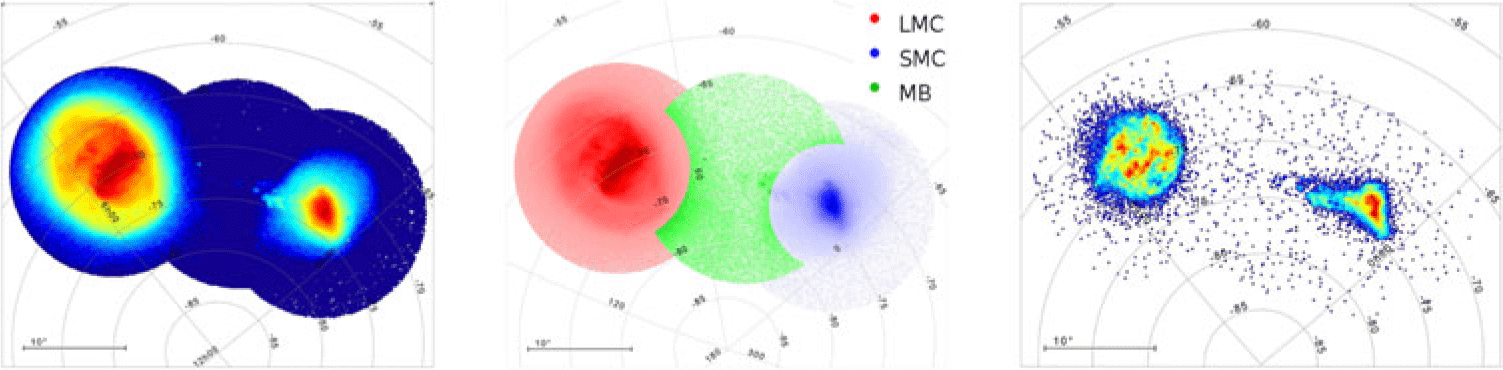
We downloaded Gaia DR3 and Simbad data for the MCs. Figure 1 shows a sky map of the Gaia sources and the defined regions for the LMC, SMC, and MB.
Sky map of the Gaia sample for the MCs (left), the defined regions (center; the intensity scales differ for each color), and the filtered LG, SG, and BG samples (right).

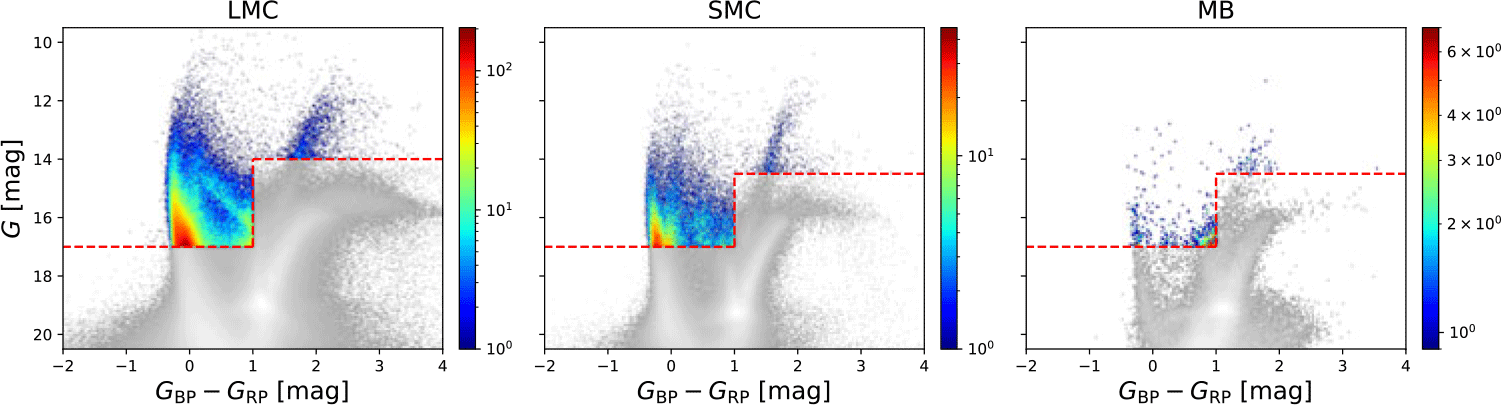
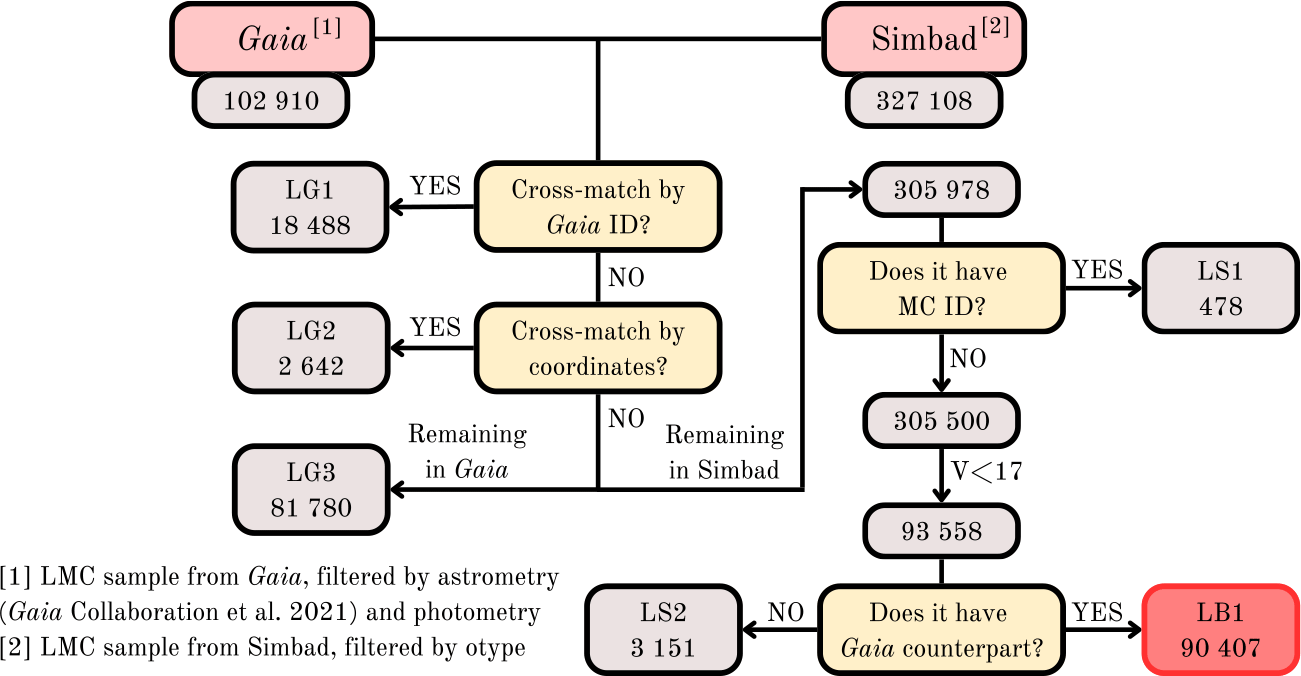
The Gaia sample is first filtered astrometrically, following the procedure described in Gaia Collaboration et al. (2021), and then photometrically, by selecting the upper part of the CMD (see Figure 2). The Simbad sample was filtered by object type, keeping only stellar-type sources. Then, a cross-match is done between these two resulting samples. Figure 3 shows the results of the cross-match performed for the case of the LMC.
Photometric cut applied to the CMD of Gaia DR3, after astrometric filtering, for the LMC (left), SMC (center), and MB (right).

Flow chart of the cross-match between Gaia DR3 (filtered astrometrically and photometrically) and Simbad (filtered by stellar objects) for the LMC.

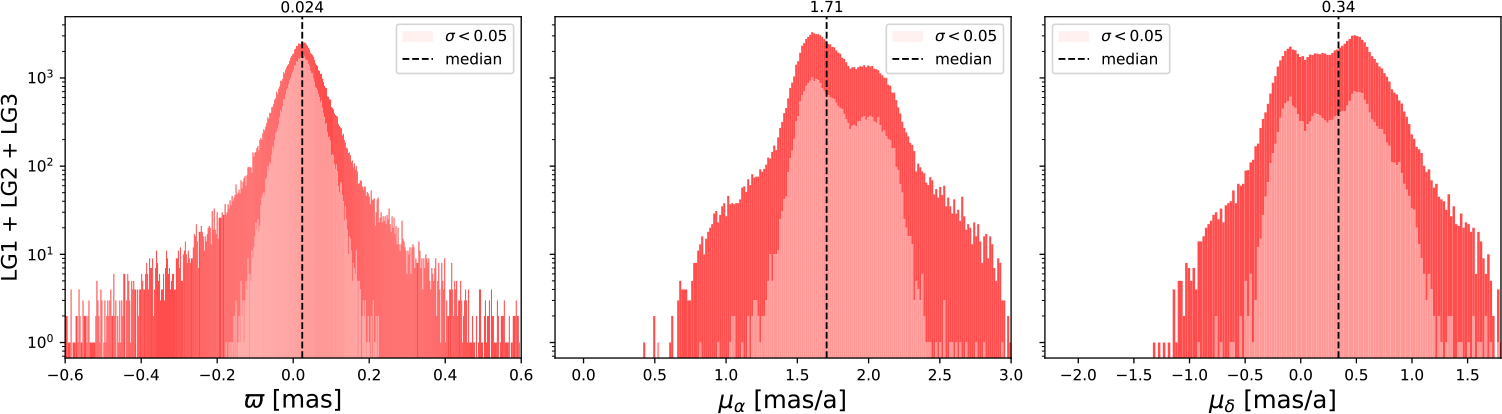
After completing the cross-match, we obtain the LG, SG, and BG samples for the LMC, SMC, and MB, respectively. Here, for brevity, we focus on the LMC, where the LG sample (LG1 + LG2 + LG3) corresponds to matches by identifier, by coordinates, and the remaining Gaia sources. Figure 4 shows the parallax and proper motion distributions for the LG sample, showing its internal dynamical behavior.
Parallax (left) and proper motion (center and right) distributions (log scale) for the combined LG sample. Light shading: low uncertainties. Dashed line: median value. The structures seen in the proper motions reflect their internal motions.

These final LG, SG, and BG samples still need cleaning, as the lower part of our photometric cut includes intermediate-mass stars. While one could apply an upper cut at the 8
 $M_\odot$
evolutionary track, extending the selection downward allows us to recover extinguished massive stars. To remove the remaining intermediate-mass objects, we use additional catalogues: UBV photometry from Zaritsky et al. (Reference Zaritsky2002); Zaritsky et al. (Reference Zaritsky2004) to trace the temperature scale to exclude later-type stars, variability data from Maíz Apellániz et al. (Reference Maíz Apellániz2023) to remove non-massive Cepheids, or infrared surveys such as VISTA and 2MASS to identify extinguished stars, among others.
For the remaining objects that are only in Simbad, the process is more complex. First, we retain all sources with Cloud-specific identifiers (e.g., RMC, AzV, etc), yielding the LS1, SS1, and BS1 samples. A flux cut is then applied to keep only the brightest sources, and those with a Gaia counterpart are excluded, since Gaia objects in the cross-match were already selected from the Clouds. This produces the final LS2, SS2, and BS2 samples, which still require a bibliographic check to confirm the nature of the objects.
4. Conclusions and Future Work
The creation of a catalogue of massive stars in the MCs is a significant contribution to the scientific community. Even with preliminary filtering, structures of interest are already visible in the sky plots and in the parallax and proper motion distributions, revealing the internal dynamics of the LMC through distinct peaks.
To complete the study, we follow two complementary paths: for LG, SG, and BG samples, data from other photometric catalogues will be combined to remove intermediate-mass stars, while for LS, SS, and BS samples, the literature spectral classifications will be checked. These procedures will yield a complete sample of massive stars, enabling detailed studies of the MCs.
Supplementary material
To view supplementary material for this article, please visit https://doi.org/10.1017/S1743921326105778


 Open access

