


Introduction
Emotional distress is an inherent part of most mental health conditions, and for some people this is the most difficult part of their experience. Distress intolerance is a perceived inability to experience negative emotions and a desperate need or urge to escape these. Distress intolerance can lead to ineffective attempts to regulate emotional arousal which may create new problems (Linehan, Reference Linehan1993; Saulsman and Nathan, Reference Saulsman and Nathan2012) and this includes self-destructive coping strategies such as self-harm and suicidal behaviour (Anestis et al., Reference Anestis, Gratz, Bagge and Tull2012). Distress intolerance is often present in those with mood disorders, and personality disorders such as emotionally unstable personality disorder (EUPD). A study investigating cognitive behaviour therapy (CBT) for depression found that patients with lower initial distress tolerance (DT) scores had higher symptomatology at baseline and post-treatment (Williams et al., Reference Williams, Thompson and Andrews2013). Higher emotional reactivity and lower DT have been found in depression compared with healthy controls (Ellis et al., Reference Ellis, Vanderlind and Beevers2013). This highlights the importance of targeting DT directly where this is an issue alongside low mood, as low DT may maintain symptomatology.
Similarly, inability to tolerate distress may be a maintaining factor in post-traumatic stress disorder (PTSD), as distress intolerance has been found to be associated with global PTSD symptom severity (Vujanovic et al., Reference Vujanovic, Hart, Potter, Berenz, Niles and Bernstein2013). In a study of veterans receiving concurrent treatment for PTSD and substance use disorder in a residential day programme, pre-treatment DT was predictive of post-treatment PTSD severity, while controlling for pre-treatment PTSD (Levy et al., Reference Levy, Wanklyn, Voluse and Connolly2018). Distress intolerance has been described as a transdiagnostic factor explaining the co-morbidity of depression, PTSD and alcohol misuse in young adult veterans (Holliday et al., Reference Holliday, Pedersen and Leventhal2016) and poor DT may confer risk for worry, anxiety and depression (Allan et al., Reference Allan, Macatee, Norr and Schmidt2014). There is preliminary evidence that DT may be associated with maladaptive use of cigarettes and behaviours related to body image concerns (Burr et al., Reference Burr, O’Keefe, Kibbey, Coniglio, Leyro and Farris2020; Cunningham et al., Reference Cunningham, Szabo, Rodgers, Franko, Eddy, Thomas, Murray and Griffiths2020).
Distress tolerance skills training was initially developed as a key part of treatment for EUPD (e.g. Linehan, Reference Linehan1993). Increased skills use has been statistically shown to be a mechanism for change in suicidal behaviour, depression and anger control (Neacsiu et al., Reference Neacsiu, Rizvi and Linehan2010). Skills training alone has been shown to be superior to psychodynamic group therapy (lower drop-out, greater improvement in mood and emotion; Soler et al., Reference Soler, Pascual, Tiana, Cebrià, Barrachina, Campins and Pérez2009). As distress intolerance is not unique to EUPD, aspects of this skills training have been adapted to other mental health conditions. A brief mental health crisis intervention package demonstrated effectiveness at increasing DT and self-management skills (Yardley et al., Reference Yardley, McCall, Savage and Newton2019). Distress tolerance interventions have also been developed aimed at improving self-management of chronic physical health conditions, but it has been reported that further research into the efficacy of these is needed (Russell et al., Reference Russell, Lincoln and Starkweather2018). Some psychological interventions delivered by non-psychologists have been evaluated, in the field of physical health (Bostick, Reference Bostick2017; Hill et al., Reference Hill, McKernan, Wang and Coronado2017).
Treatment for PTSD usually involves exposure work, but this can initially increase distress and sometimes preparatory work is needed to enable clients to cope with this. A model has been offered for integrating DBT skills with trauma exposure work to increase acceptability of treatment (Becker and Zayfert, Reference Becker and Zayfert2001). A two-phase process, where DBT skills were taught prior to narrative exposure work showed significant reductions in mood, PTSD and interpersonal symptoms (Bradley and Follingstad, Reference Bradley and Follingstad2003).
In response to increasing demands on mental health services and lengthening waiting lists for psychological input in the United Kingdom’s National Health Service (NHS), shorter interventions are being investigated. Brief psychological interventions (BPIs) have been developed using some components of longer-term therapies (such as DT) and designed for delivery by non-psychologists. Effective short-term CBT-based interventions have been developed for panic (Lessard et al., Reference Lessard, Marchand, Pelland, Belleville, Vadeboncoeur, Chauny and Lavoie2012), depression (Mihalopoulos et al., Reference Mihalopoulos, Vos, Pirkis, Smit and Carter2011) and psychosis (Waller et al., Reference Waller, Garety, Jolley, Fornells-Ambrojo, Kuipers, Onwumere and Craig2013) among others.
In summary, it has been found that distress intolerance is problematic in several mental health conditions and that specifically increasing DT can be helpful. Although several studies have identified DBT skills training as useful for EUPD and PTSD (e.g. Bradley and Follingstad, Reference Bradley and Follingstad2003; Harley et al., Reference Harley, Baity, Blais and Jacobo2007), this has not been manualised and delivered as a trans-diagnostic BPI in previous studies within a real-world secondary care mental health setting. Although DT has been linked to depression, to the authors’ knowledge DT has not been explicitly targeted in depression treatment. Furthermore, the inclusion criteria of previous studies have not reflected the breadth and complexity of presentations and co-morbidity apparent in the majority of adult secondary care mental health services.
The secondary care community mental health teams reported here have developed manualised BPIs, which are delivered by non-psychologists, under supervision of clinical psychologists. The BPIs are specific, targeted interventions to be delivered either in isolation or whilst the client is awaiting intervention from a psychologist. Distress tolerance is one of these BPIs offered to clients who have difficulties managing distressing emotions. Distress tolerance is provided to clients with a range of diagnoses and presenting problems, including those with traits of EUPD, PTSD (if DT is problematic), depression (if a main issue is intolerance of distress) or those using self-harm to escape unpleasant emotion.
The aim of the present study is to examine whether a manualised DT BPI delivered by non-psychologists within an adult community mental health team can be effective.
Method
Design
A within-subject, repeated measures design was used to compare scores on measures completed before and after the course of DT sessions to assess the effectiveness of the intervention. Pre-intervention scores and demographic data of clients who completed the intervention and those who did not were also compared to assess for differences in which clients found the intervention acceptable.
Participants
Participants were 82 consecutive clients allocated to receive DT BPI from March 2017 to March 2018 within two secondary care multi-disciplinary community mental health teams. Referrals for BPI were made internally by team members (e.g. occupational therapists, psychiatrists, psychiatric nurses). Participants’ clinical presentation was assessed through routine intake assessment and review of notes. Team clinical psychologists met weekly to decide whether BPI referrals were appropriate. Psychologists discussed cases with referrers to enable initial formulation and inform choice of BPI.
The current study focuses on distress tolerance. Efficacy of the other BPIs (anxiety management and behavioural activation) has been reported separately (Roberts et al., Reference Roberts, Travers-Hill, Troup, Coker, Masson, Casey and Kim2018). Exclusion criteria included significant and current substance use problems, need for further assessment, ongoing psychological intervention, and current personal/social difficulties better suited to another service (e.g. drug and alcohol service). Substance use services were deemed better placed to provide initial intervention when these difficulties were present due to their expertise in this area and as DT BPI was not developed for these issues. When clients reached 3 months of no substance use they were reviewed and BPI offered if appropriate, as by this point they would be more able to attend, retain information provided and better placed to try out using psychological skills rather than substances to manage distressing emotions. Due to limited resources, previous poor engagement with mental health services was an additional exclusion criterion.
Measures
All measures were self-report questionnaires routinely used in the service.
Primary measures
Two primary outcome measures were used to assess DT. The Distress Tolerance Scale (DTS) has 15 items, each rated from 1 (strongly agree) to 5 (strongly disagree), higher scores indicating greater ability to tolerate distress. Four subscales have been identified: tolerance, absorption, appraisal and regulation. Subscale scores are derived by taking the mean of relevant items. The higher-order DTS score is the mean of all subscales. The authors of the measure found support for convergent, discriminant and criterion validity, also test–re-test reliability (Simons and Gaher, Reference Simons and Gaher2005). The Difficulties in Emotion Regulation Scale (DERS; Gratz and Roemer, Reference Gratz and Roemer2004) has 36 items, and higher scores indicate more problems with emotion regulation. The authors found high internal consistency, good test–re-test reliability and adequate construct and predictive validity. Excellent internal consistency and good construct validity have also been found (Fowler et al., Reference Fowler, Charak, Elhai, Allen, Frueh and Oldham2014).
Secondary measures
Four secondary outcome measures were used. The Generalised Anxiety Disorder Assessment (GAD-7) is a commonly used 7-item measure, higher scores indicating higher levels of anxiety. It has evidence of validity and good internal consistency (Löwe et al., Reference Löwe, Decker, Müller, Brähler, Schellberg, Herzog and Herzberg2008). The Patient Health Questionnaire (PHQ-9) is a widely used 9-item measure of depression, higher scores indicating greater levels of depression symptoms. It has diagnostic validity for major depressive disorder and appears to be reliable and valid (Kroenke et al., Reference Kroenke, Spitzer and Williams2001). It is sensitive to change over time (Löwe et al., Reference Löwe, Kroenke, Herzog and Gräfe2004). The Short Warwick–Edinburgh Mental Wellbeing Scale (SWEMWBS) is a 7-item measure of mental wellbeing and functioning. Higher scores indicate greater wellbeing. SWEMWBS has interval level measurement, unidimensionality and measurement invariance (Bartram et al., Reference Bartram, Sinclair and Baldwin2013). The Work and Social Adjustment Scale (WSAS) is a 5-item measure of impaired functioning, higher scores indicating more impairment. It has been found to be a simple, reliable and valid measure of impaired functioning that is sensitive to change (Mundt et al., Reference Mundt, Marks, Shear and Greist2002).
Treatment manual
The DT BPI manual (see Supplementary material and Table 1 for a summary) was developed by two senior clinical psychologists working within adult mental health services. This manual draws on self-help modules developed by Saulsman and Nathan (Reference Saulsman and Nathan2012) and DBT ideas (e.g. Linehan, Reference Linehan1993). The manual is divided into two main sections: (1) DT for developing constructive coping strategies to manage distressing, extreme emotions and (2) emotion regulation for managing day-to-day fluctuating emotions. The aims of the manual are to (1) increase distress tolerance skills and (2) increase effective management of emotions arising from day-to-day situations. It was designed to be delivered over six to eight 1-hour sessions. Contents include introduction to distress intolerance, psychoeducation to emotions, strategies and action plans to cope with distress, introduction to the principles of emotion regulation, emotion regulation strategies and action plans.
DT BPI manual topics and descriptions

Procedure
BPIs were delivered individually by non-psychologists within the team, usually support workers (who do not have mental health professional qualifications), and on a few occasions occupational therapists and community psychiatric nurses. All clinicians who delivered BPIs had attended specific training (one day for each BPI), developed and delivered by clinical psychologists within the teams. Bi-monthly BPI group supervision was provided by clinical psychologists within the teams; this involved discussion, formulation and problem solving of ongoing cases. Compliance with the manuals was encouraged and informally monitored through group supervision. All of the above was in line with usual practice within the teams.
Results
The flow of participants is described in Fig. 1.
Participant flow diagram. DT BPI, distress tolerance brief psychological intervention.

Electronic client mental health records were used to determine whether clients had completed DT BPI.
Non-starters vs completers vs non-completers of DT BPI
The reasons documented for participants not starting the BPI were that they had disengaged (81.8%) or were accessing another service (18.2%). Of the non-starters, 27.3% of clients received alternative input from the team; 63.3% were discharged to their general practitioner (GP, family doctor) and 9.1% were referred on to Improving Access to Psychological Therapies (IAPT), a primary mental health care service.
There was no significant difference in the age of participants who did not start, did not complete or completed DT BPI (detailed in Table 2). There was a significant between-group difference in gender.
Age and gender characteristics

Across all participants, the most common presentation was depression. The second most common was depression and anxiety, followed by others (including single descriptions/combinations of anxiety, EUPD traits, PTSD, bipolar disorder, adjustment disorder and depression). There was no difference in presentation between those who did not start the BPI, did not complete and completed the intervention (p=0.819, two-tailed Fisher’s exact test).
Completers vs non-completers of BPI
The reasons documented for participants not completing the DT BPI were opting out/disengaging (57.1%); clinician judgement that the BPI was no longer suitable (32.1%); client moving away (7.1%) and client being admitted to hospital (3.6%). A proportion (28.6%) of participants who did not complete DT BPI received other input from the teams (e.g. psychology, another BPI, support with substance misuse, care-coordination), 14.3% were referred to other services (e.g. recovery coaches, personality disorder service) and 57.1% were discharged to their GP.
The mean number of sessions was significantly higher (t 68 = 7.768, p < .001) for clients who did complete the intervention (mean 6.95, SD 2.09, range 4–14) compared with those who did not (mean 3.26, SD 1.66, range 1–7). The duration of DT BPI was significantly longer (t 68 = 3.833, p < .001) for those who completed the intervention (mean 77.33 days, SD 41.84, range 14–199) compared with those who did not (mean 41.22 days, SD 31.93, range 1–113).
The proportions of different types of treating clinician did not differ significantly (p = 0.687, two-tailed Fisher’s exact test) between those who completed treatment [support, time and recovery (STR) worker 90.7%; peer support worker 2.3%; other 7.0%] and those who did not (STR worker 89.3%; peer support worker 7.1%; other 3.6%).
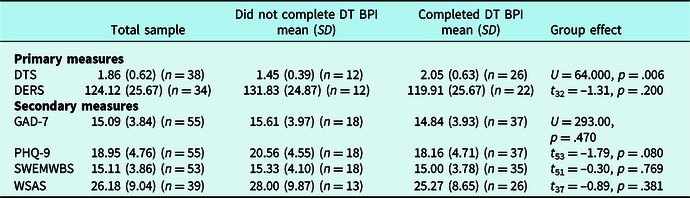
There were no significant differences between participants who did and did not complete the DT BPI on any of the measures apart from DTS (shown in Table 3). Participants who completed the DT BPI scored higher than those who started and did not complete. This indicates that participants who completed the DT BPI had a greater ability to tolerate distress pre-intervention than those who started and did not complete.
Pre-intervention scores

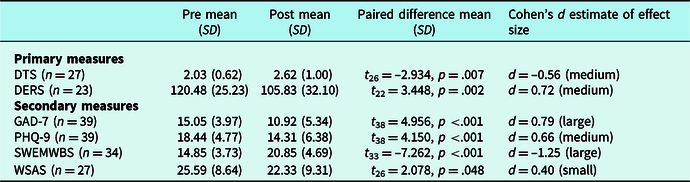
Paired sample t-tests were used to examine the differences between pre- and post-intervention scores (Table 4). Missing data were accounted for where possible by using the last observation carried forward. There were significant differences between the pre- and post-intervention scores on all measures in the direction of improvement and reduced symptoms (a higher score indicates greater wellbeing on the SWEMWBS and greater ability to tolerate distress on the DTS). Effect sizes were medium for the primary measures (DTS and DERS) and mixed for the secondary measures (small for WSAS, medium for PHQ-9 and large for GAD-7 and SWEMWBS).
Pre- and post-intervention measures for participants who completed the intervention

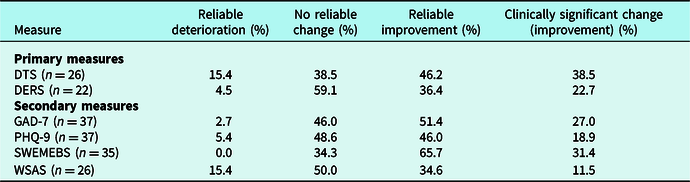
Reliable change scores were calculated for each of the measures, using the standard deviation of matched samples and reliability coefficients of the measures (see Table 5). Where changes in pre–post score exceeded these values, it was concluded that a reliable change had taken place (Jacobson and Truax, Reference Jacobson and Truax1991). It was also calculated whether changes in pre–post scores were clinically significant; and whether scores had shifted from the clinical to non-clinical range on the measure. This also involved methodology from Jacobson and Truax (Reference Jacobson and Truax1991), utilising clinical and non-clinical means and standard deviations for each measure to calculate the clinically significant change value. Where changes in pre–post score exceeded these values, it was concluded that a clinically significant change had taken place.
Reliable and clinical change

Reliable and clinical change scores for the DTS were calculated using healthy norms data (Gawrysiak et al., Reference Gawrysiak, Leong, Grassetti, Wai, Shorey and Baime2015) and clinical data from a community sample (Williams, Reference Williams2012). Healthy norms for the DERS were taken from a prospective study of emotional dysregulation (Bjureberg et al., Reference Bjureberg, Ljótsson, Tull, Hedman, Sahlin, Lundh, Bjärehed, DiLillo, Messman-Moore, Gumpert and Gratz2016); clinical norms were taken from an out-patient sample (Hallion et al., Reference Hallion, Steinman, Tolin and Diefenbach2018). Reliable change scores calculated in a large-scale study looking at recovery rates in IAPT (Gyani et al., Reference Gyani, Shafran, Layard and Clark2013) were used. In line with previous studies (e.g. Gyani et al., Reference Gyani, Shafran, Layard and Clark2013), cut-off scores were used to assess for clinical change on the GAD-7 and PHQ-9. Healthy norms for the SWEMWBS were taken from a large-scale survey (Bartram et al., Reference Bartram, Sinclair and Baldwin2013) and clinical norms were taken from an out-patient sample (Vaingankar et al., Reference Vaingankar, Abdin, Chong, Sambasivam, Seow, Jeyagurunathan, Picco, Stewart-Brown and Subramaniam2017). Healthy norms for the WSAS were taken from a control group in a study looking at complicated grief (Dell’Osso et al., Reference Dell’Osso, Carmassi, Corsi, Pergentini, Socci, Maremmani and Perugi2011) and clinical norms were taken from a study that recruited from a secondary care mental health service (Garner et al., Reference Garner, Gillmore and Lomax2016).
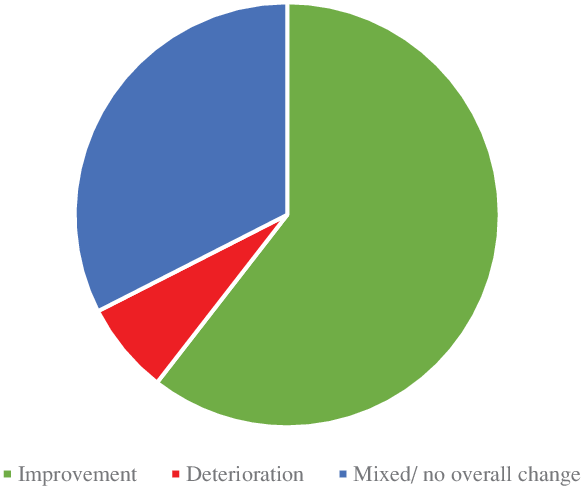
The overall pattern of change in scores across measures was examined for each of the 43 participants who completed the intervention (see Fig. 2). It was determined whether they had improved overall (reliable improvement on at least one measure, with no reliable deterioration) or deteriorated overall (reliable deterioration on at least one measure, with no reliable improvement). It was found that 60.5% had improved overall, 7.0% had deteriorated overall and the remaining 32.5% had no reliable change or mixed improvement and deterioration across measures.
Overall reliable change.

Discussion
Distress intolerance has been suggested as a potential maintaining factor in several mental health conditions (e.g. EUPD, PTSD, depression) as well as across diagnoses. There is a growing body of evidence that targeting these skills directly may be beneficial for specific diagnoses (e.g. Bradley and Follingstad, Reference Bradley and Follingstad2003; Harley et al., Reference Harley, Baity, Blais and Jacobo2007). The present study evaluated a trans-diagnostic DT BPI delivered by non-psychologists within two secondary care community mental health teams.
Data showed significant differences pre–post intervention on all measures, indicating improvements in distress tolerance, anxiety, mood, wellbeing and functioning. Effect sizes were generally medium to large. The overall pattern of change across measures was considered for each participant; more than half had shown reliable improvement on at least one measure. Although these results seem promising, they must be considered in context; they are the patterns from participants who completed the intervention only, and 39% of participants who started the intervention did not complete it. Average drop-out rates reported by meta-analyses have decreased over time, from 47% (Wierzbicki and Pekarik, Reference Wierzbicki and Pekarik1993) to 19.7% (Swift and Greenberg, Reference Swift and Greenberg2012). It would be interesting for future work to compare these rates with general clinical practice of psychologists, non-psychologists and during brief interventions, when more evidence is available.
This study was conducted within clinical practice and participants were current clients with the levels of complexity, co-morbidities and diagnoses typically seen by the service. Therefore, the findings can be considered an ecologically valid representation of DT BPI delivered by non-psychologists, supervised by psychologists. It is not possible to comment directly on effectiveness overall, due to the high level of non-completion and lack of long-term follow-up.
There are limitations to the current study which should be considered. Firstly, the majority of participants were female, particularly those who completed DT BPI, which limits the generalisability of findings. The reasons for this are unclear, but possible contributory factors from previous research include negative attitudes related to psychological openness and less favourable intentions to seek help from mental health professionals in men than women (Mackenzie et al., Reference Mackenzie, Gekoski and Knox2006) and gender differences in coping strategies and preferences for psychological treatment (Liddon et al., Reference Liddon, Kingerlee and Barry2018). Secondly, the pre-intervention scores on the DTS were significantly higher for participants who completed the DT BPI than those who did not. This may suggest that participants who did not complete the intervention had a significantly lower initial ability to tolerate distress. However, the same pattern was not seen in the DERS scores, and the reason for this discrepancy is unclear. It should be noted that the clinical and non-clinical samples used to assess clinically significant change on the DTS were not ideal; the ‘non-clinical’ sample included people who had self-referred to a stress management programme, although they did not meet a ‘clinical level of psychopathology’ (Gawrysiak et al., Reference Gawrysiak, Leong, Grassetti, Wai, Shorey and Baime2015) and the clinical sample were ‘compulsive shoppers’ who had scored above clinical cut-off (Williams, Reference Williams2012). It is unclear how the nature of these samples may have affected the proportion of participants rated as achieving clinically significant change on the DTS. It would be beneficial for future work if more representative clinical and non-clinical normative data could be obtained for this measure.
Thirdly, engagement was varied. DT BPI had a non-completion rate of 39.4% and although there were sometimes identifiable causes (e.g. relocation), for others the reasons were unknown. A common reason provided by staff for participants not completing the intervention was disengagement. The average number of sessions attended by non-completers was 3. At this point DT BPI focuses on developing strategies to allow and cope with distress (rather than avoidance of emotion). This may have been too soon for participants with the lowest levels of distress tolerance. Closer monitoring of clients with particularly high initial symptoms, discussion in supervision and consideration about whether more preparatory work is necessary may be beneficial. It would be useful to obtain feedback from participants who do not complete the intervention to explore reasons for this. It would also be interesting to expand the inclusion criteria to participants who have had previous poor engagement with mental health services. Future work in this area could explore the use of supervision for clinicians delivering BPIs. A formal system for monitoring compliance with the manuals would be beneficial, and the lack of this is a limitation of the current study.
Lastly, the lack of a control group is a key limitation to this study. It seems that the intervention contributed to decreasing symptomatology, increasing DT skills and wellbeing but it is not possible to say whether this is due to the content of the intervention. Future work could include an active control group, to allow comparison between DT BPI and an equivalent amount of supportive but non-directive individual intervention. There was also a high rate of missing data in the current study (as described in earlier sections, with explanation of how this was dealt with). Future work could also include follow-up assessment to explore the longer-term outcomes of intervention, including data on whether participants (or those who decline or drop out of brief intervention) access further support from the service subsequently.
Despite limitations, the clinical implications indicated by these results are that DT BPI can be effective and was associated with reliable change in a group of real-world clients of secondary care mental health teams. Although cost-effectiveness was not calculated, it is promising that such changes were seen following an intervention delivered mainly by support workers supervised by clinical psychologists. This approach was more economical and accessed more quickly compared with clients waiting to see a psychologist for individual therapy. The potential for services to offer quicker access to a cost-effective and efficacious evidence-based intervention warrants further research into DT BPI within secondary care mental health teams.
Acknowledgements
We thank the manual authors, Dr Lee Brosan and Dr Amanda Spong. We also thank team manager Maggie Page and service manager Kim Masson for supporting the project, and all members of the secondary adult community mental health service who delivered the intervention. Sincere thanks are extended to all participants.
Financial support
This research received no specific grant from any funding agency, commercial or not-for-profit sectors.
Conflicts of interest
None.
Ethical statement
Authors have abided by the Ethical Principles of Psychologists and Code of Conduct as set out by the BABCP and BPS. The Trust Quality Improvement Team confirmed that ethical approval was not required as the evaluation involved routinely collected clinical data and gave authorisation for the evaluation as a Quality Improvement Project.
Supplementary material
To view supplementary material for this article, please visit: https://doi.org/10.1017/S1754470X20000513
Key practice points
(1) Distress intolerance can be a maintaining factor in several mental health conditions.
(2) Targeting distress tolerance skills directly in a brief intervention can be helpful.
(3) Although preliminary, these findings offer promising evidence that a DT BPI delivered by non-psychologists in secondary care mental health services could be a beneficial, cost-effective treatment option, and warrants further large-scale investigations.






Comments
No Comments have been published for this article.