INTRODUCTION
When children acquire language, they learn how to place words in linear order to produce grammatical sentences. For instance, in Italian, a language with a relatively free word order, children learn that the answer to a question such as ‘What is happening?’ could be Un ippopotamo sta chiacchierando (‘A hippo is chatting’), where the subject precedes the verb. However, they might also learn that, to answer the same question, the subject can sometimes be placed in a different order, as in Sta arrivando un ippopotamo (Lit. ‘Is arriving a hippo’). Thus, children must learn that both subject–verb (henceforth SV) and verb–subject (henceforth VS) orders are allowed in Italian depending on various factors, such as the type of verb and discourse conditions. In simple terms, intransitive verbs are divided in two classes according to their internal syntactic properties (Burzio, Reference Burzio1986). With unaccusative verbs (e.g. ‘to come’), the verb's argument is underlyingly in the postverbal position. However, on the surface it may either follow or precede the verb. Since it is underlyingly postverbal, the VS order does not require any movement of the verb's argument, but the SV order (i.e. Un ippopotamo sta arrivando) does. In contrast, with unergatives (i.e. ‘to chat’), the verb's argument is underlyingly in the preverbal position. Like unaccusatives, unergatives permit both SV and VS word orders on the surface. Since the argument is underlyingly preverbal, the SV surface order requires no movement, but the VS order does. Therefore, to produce a sentence such as Sta chiacchierando un ippopotamo (Lit. ‘Is chatting a hippo’), it is necessary to move the argument to the postverbal position, but this movement will have crucial implications for the focus status of the verb's argument. In the current paper, we investigated the ability to repeat SV order with different kinds of intransitive verbs in four- and five-year-olds Italian children by testing predictions drawn from two linguistic analyses of intransitive verbs (Burzio, Reference Burzio1986; Belletti, Reference Belletti1988).
The difference between unergatives and unaccusatives, as proposed by the Unaccusative Hypothesis, has stimulated developmental research. Most of the previous studies have focused on children's ability to represent the movement from object to subject position with unaccusatives. However, this previous research has led to two controversial accounts (e.g. Snyder, Hyams & Crisma, Reference Snyder, Hyams, Crisma and Clark1995; Babyonyshev, Ganger, Pesetsky & Wexler, Reference Babyonyshev, Ganger, Pesetsky and Wexler2001).
According to a series of studies (e.g. Snyder et al., Reference Snyder, Hyams, Crisma and Clark1995; Hyams and Snyder, Reference Hyams and Snyder2005), children are able to distinguish between unaccusatives and unergatives from an early age; thus, it is claimed that when children produce SV order with unaccusatives, they have acquired the ability to move the argument from object to subject position. Such a view is supported by the bulk of experimental evidence in different languages. For instance, in a series of repetition tasks and analyses of spontaneous speech, Friedmann (Reference Friedmann2007) tested the acquisition of VS and SV orders with unaccusatives, unergatives, and transitives in Semitic (e.g. Hebrew, Palestinian Arabic) and Romance languages (e.g. Spanish and European Portuguese). Children appeared to be able to distinguish between the two verb types as early as age two. At this age, Hebrew and Portuguese children were able to produce both orders for unaccusatives, but could produce only SV order for unergatives. Additional evidence in Dutch and German indicates that four- to five-year-olds were able to distinguish unaccusatives from unergatives, supplying different auxiliary verbs for the two types (van Hout, Reference van Hout1996; Randall, van Hout, Baayen & Weissenborn, Reference Randall, van Hout, Baayen, Weissenborn, Alexiadou, Anagnostopoulou and Everaert2004). In Italian, Lorusso, Caprin, and Guasti (Reference Lorusso, Caprin and Guasti2004) analyzed the distribution of SV and VS orders with unaccusatives and unergatives in the spontaneous speech of Italian-speaking children aged 1;6 to 3;0. The authors observed that both SV and VS orders occurred equally with unaccusatives, whereas unergatives appeared predominantly in SV order. A longitudinal study found that Italian children between 1;8 and 2;11, and French children between 2;1 and 3;3, demonstrated adequate mastery of auxiliary selection with unergative, unaccusative, and transitive verbs (Snyder et al., Reference Snyder, Hyams, Crisma and Clark1995).
A contrasting account maintains that at least until a certain age (up to five years of age, according to Borer & Wexler, Reference Borer, Wexler, Roeper and Williams1987), children lack the ability to represent and move the argument of unaccusatives from the original postverbal internal argument position to the preverbal subject position. Under this view, the ability to move the argument from the postverbal argument position to the preverbal subject position matures with age (i.e. maturation theory: Borer & Wexler, Reference Borer and Wexler1992; Babyonyshev et al., Reference Babyonyshev, Ganger, Pesetsky and Wexler2001). One piece of evidence for this theory has been proposed by Babyonyshev et al. (Reference Babyonyshev, Ganger, Pesetsky and Wexler2001), who investigated the use of the genitive-of-negation construction in Russian. The genitive case can appear on the argument of an unaccusative and the direct object of a transitive but cannot appear on the argument of an unergative. Thus, the use of the genitive case makes it possible to distinguish whether the argument of the unaccusative verb is treated as the object or internal argument of a transitive verb. In the study of Babyonyshev et al. (Reference Babyonyshev, Ganger, Pesetsky and Wexler2001), children aged 3;0–6;6 were asked to complete the sentences with a noun phrase. The main verb was either unaccusative, unergative, or transitive. The results showed that the children used the genitive of negation much less with the single argument of unaccusative than with the object argument of transitive verbs. That is, the children did not treat the two arguments in the same manner, as required by the target grammar. The authors concluded that children failed to produce the genitive case because they analyzed the argument of the unaccusative verb as the subject argument of the unergative verb. That is, the children misanalyzed the unaccusative verb as though it were an unergative.
Note that this claim has a crucial implication for the study of SV order repetition with unaccusatives. Indeed, the finding that children may repeat SV order with unaccusatives could be attributed to the fact that they are parsing unaccusatives as unergatives (Babyonyshev et al., Reference Babyonyshev, Ganger, Pesetsky and Wexler2001). This tendency would indicate that children may not represent unaccusatives as adults do. Therefore, to test whether children are misanalyzing unaccusatives when they produce SV order, further data revealing the syntactic differences between unaccusatives and unergatives are needed.
One promising path to follow was offered by Belletti (Reference Belletti1988). Under Belletti's account, unaccusatives inherently assign partitive case to the verb's internal argument, such that the verb selects an indefinite meaning for the argument in object or internal argument position. In a sentence as in (1), when a prepositional phrase (henceforth PP) is present (e.g. ‘at the party’), the argument (i.e. un ippopotamo) of the unaccusative is in object position, parallel to the object of a transitive verb, un libro in (2):
(1) Arriva un ippopotamo alla festa.
Arrives a hippo at the party.
‘A hippo is arriving at the party.’
(2) Ho dato un libro a Gianni.
ø gave-1sg a book to Gianni.
‘I gave a book to Gianni.’
The object status of the single unaccusative argument is proven by the NE-cliticization test, which works for unaccusatives (3) as it does for the object of transitives but not for unergatives (4).
(3) Ne arriva uno alla festa.
Of them arrives one at the party.
‘One of them is arriving at the party.’
(4) *Ne chiacchiera uno alla festa.
Of them chats one at the party.
‘One of them is chatting at the party.’
Importantly, when the object argument of an unaccusative verb is assigned partitive case, it must be introduced by means of an indefinite article. Hence, in contrast to (1), (5) is not acceptable (or is syntactically degraded):
(5) *Arriva l'ippopotamo alla festa.
Arrives the hippo at the party.
‘The hippo is arriving at the party.’
Note that there is one context in which a postverbal definite NP is permitted with an unaccusative verb: when it is focused. Thus, (6) would be felicitous if the ‘hippo’ NP is focused, as in an answer to the question ‘Who is arriving at the party?’ In this case, a PP is possible, but crucially, there must be a prosodic break and a comma before it (alla festa) to indicate that the PP is in a dislocated position (that is, it has been moved), as shown in (6):
(6) Arriva l'ippopotamo, alla festa.
Therefore, according to Belletti's analysis, only in the configuration [vp V NP PP] (with V = unaccusative or passive, NP = its direct argument, and PP = subcategorized complement of V) could one be reasonably sure that the postverbal NP is in the object position of V. Conversely, in the configuration [vp V NP] the postverbal NP could be in the object position of V as well as at the right periphery in a position where also the subject of transitive and unergative verbs could be found. In this position, the subject is focused, i.e. it represents new information (Belletti, Reference Belletti, Hulk and Pollock2001). Thus, the definite argument (l'ippopotamo) in (6) is no longer in object position, but it is in the position in which an Italian postverbal focused subject commonly occurs, as in (7) (Belletti, Reference Belletti, Hulk and Pollock2001). (7) is an appropriate answer to a question such as ‘Who is chatting at the party?’:
(7) Sta chiacchierando l'ippopotamo, alla festa.
Is chatting the hippo at the party.
‘The hippo is chatting at the party.’
Notice that in (5), in contrast to (6), the PP is in its original position (there is no intonational break). As the NP in (5) is in the internal position, it should receive partitive case and be indefinite, but it does not – hence, (5) is not acceptable.
Therefore, with unaccusative verbs (e.g. uscire ‘to go out’), a configuration such as [V NP PP] would be considered acceptable only when the NP is indefinite, as in (1) and (8a). In contrast, when the NP is definite, as in (5) or (8b), the sentence is regarded as syntactically degraded because the NP is supposed to occur in the internal argument position (no intonational break is present before the PP) but cannot, because it is definite. Hence, one way to express the content of (5) or (8b) is by moving the definite and unfocused NP to the preverbal position to appear in SV order, as in (8c):
(8) a. Esce un orsetto con i suoi amici.
Goes out a little bear with its friends.
b. *Esce l'orsetto con i suoi amici.
Goes out the little bear with its friends.
c. L'orsetto esce con i suoi amici.
The little bear goes out with its friends.
‘A/the little bear is going out with its friends.’
In sum, there are two ways in which the argument of an unaccusative verb can occur postverbally. First, the argument can occur in the object position, where it receives partitive case and must be an indefinite NP, as in (1) and (8a), which corresponds to the configuration [V NP PP]. Second, it can occur in the postverbal subject position, where the subjects of all verbs can stay, provided they are focused. Thus, the argument can occur in a configuration such as [V NP, PP], exemplified in (6), or [V NP], in the absence of the PP in sentence-final position (Belletti, Reference Belletti1988). Recall that the placement of the PP is a diagnostic that the NP is in an internal argument position and is not in the postverbal focused position.Footnote 1 Therefore, it must be expressed by means of an indefinite determiner (see also Milsark, Reference Milsark1974).
With unergative verbs (such as passeggiare ‘to stroll’), there is only one way for the subject to occur postverbally, namely, by being moved to the focused postverbal subject position, as in (7) or (9a–b). In (9a–b), an intonation break must be present before the dislocated PP. The postverbal argument can never occur in object position, as shown by the ungrammaticality of the NE-cliticization of the argument in (4). Thus, with unergatives, the postverbal subject can be expressed equally well by either definite or indefinite NPs, but it must always be focused.
(9) a. Passeggia un orsetto, con i suoi amici.
Strolls around a little bear, with its friends.
b. Passeggia l'orsetto, con i suoi amici.
Strolls around the little bear, with its friends.
‘A/the little bear is strolling around with its friends.’
Sentences (10a) and (10b) display an [NP V PP] configuration involving a movement of the verb's argument from the postverbal position where it is generated to the preverbal position. Sentences (10a) and (10b) are grammatically acceptable in an unfocused context (i.e. as an answer to the question ‘What happened?’) and with neutral intonation (Frascarelli, Reference Frascarelli1997):
(10) a. Un orsetto esce con i suoi amici.
A little bear goes out with its friends.
b. L'orsetto esce con i suoi amici.
The little bear goes out with its friends.
‘A/the little bear is going out with its friends.’
Similarly, for unergatives, the [NP V PP] configuration is natural (e.g. as an answer to the question ‘What happened?’):
(11) a. Un orsetto passeggia con i suoi amici.
A little bear strolls around with its friends.
b. L'orsetto passeggia con i suoi amici.
The little bear strolls around with its friends.
‘A/the little bear is strolling around with its friends.’
Thus, the configuration [NP V PP] with an (unfocused) definite and indefinite NP is acceptable with both unaccusatives and unergatives. Therefore, in a non-focused context, a sentence with [V NP PP] order and an unergative verb would need to be changed such that the NP must be moved and must appear in SV order. As a consequence, one should expect that the VS order in the [V NP PP] configuration must be used only with unaccusatives and not with unergatives.
The analyses that we have proposed thus far permit us to make precise predictions regarding whether children master specific representations for unaccusatives and unergatives between four and five years of age. According to the Unaccusative Hypothesis, to produce SV order with unaccusatives, children must be able to move the internal argument from object to subject position. However, as Babyonyshev et al. claim, children could repeat the SV order with unaccusatives simply because they are parsing unaccusatives as unergatives. Belletti's analysis of unaccusatives offers one means of overcoming this dilemma. Under Belletti's assumption, the partitive case on the argument of unaccusatives can be realized only with indefinite NPs. Thus, if a child's parser can access the internal representation of the unaccusative verb and use the definiteness feature to determine the object status of the verb's argument, then one could predict that children may produce more repetitions with VS order when the NP argument is indefinite and with SV order when the argument is definite and unfocused. Crucially, if children access distinct representations for intransitive verb classes, then we should not find any difference with unergatives whether the argument is definite or indefinite because the verb's argument with unergatives is not an object. Note that there is another possible outcome in our experiments. Namely, one possibility could be that children extended the restriction on indefinites from unaccusative to unergatives. In such a case, we would not be able to find a difference between the two verb types simply because children are treating all indefinite postverbal arguments in the same way. This would be strong evidence that children do not distinguish the two types of verbs between four and five years of age.
None of the previous studies investigating the acquisition of SV and VS order with unaccusatives have manipulated the (in)definiteness of the verb's argument. Thus, our manipulation could be decisive for establishing the source of the SV order in children and, more generally, for determining whether children treat intransitive verb classes differently with respect to their internal properties.
We tested these predictions in two sentence repetition experiments that manipulated the order of the verb and its argument with unaccusative and unergative verbs. In addition, we manipulated whether the verb's argument was introduced by means of an indefinite NP (Experiment 1; see examples (8a), (9a), (10a), (11a)) or by means of a definite NP (Experiment 2; (8b), (9b), (10b), (11b)). As Friedmann claimed (2007), repetition involves not merely retelling but an active reconstruction of a sentence. An interesting insight into the mechanisms underlying sentence repetitions was provided in a study that tested the ability of SLI (Specific Language Impairment) children to produce subject relative clauses (Coco, Garaffa & Branigan, Reference Coco, Garraffa and Branigan2012). Crucially, SLIs were less able to repeat subject relative sentences in an explicit repetition task, compared to a syntactic priming task, in which SLIs' performance was similar to that of typically developing controls. The authors concluded that syntactic priming can be regarded as implicit learning of syntactic procedures (Chang, Dell & Bock, Reference Chang, Dell and Bock2006), whereas sentence repetition involves the online processing of a representation of an entire sentence. An interesting implication of these findings is that children are able to repeat only those structures that involve the application of syntactic procedures that they explicitly know. Note that, in the current study, we did not manipulate the information structure of our sentences (i.e. the focus status of the characters). In contrast, our sentences could be regarded as an answer to the question ‘What happened?’ That is, in our experimental items, the entire sentence could be regarded as ‘new information’. Crucially, when the entire sentence provides new information, we can consider it in presentational focus (Chomsky, Reference Chomsky and Chomsky1972). From a pragmatic perspective, the main property of sentences in presentational focus is that they introduce a new proposition into the discourse, and thus the entire clause is presented as a sentence focus. The fact that all our experimental sentences were presented in presentational focus has crucial implications for the felicity of the structures that we have used. Crucially, we assume that in a non-focused context, a speaker should prefer to repeat a sentence using the word order that is felt to be more natural according to the internal linguistic properties of the verb. Hence, a sentence involving unaccusative verb and SV order (i.e. Un orsetto esce con i suoi amici), although perfectly acceptable even under a non-focused context, could also be repeated with VS order, whereas a sentence involving an unergative verb and SV order should be repeated by maintaining the SV order. In fact, if children master the internal properties of different verb classes, then they must know that in a non-focused context, the VS order option is available for unaccusatives but not for unergatives.
Therefore, assuming that a sentence repetition task could be regarded as an implicit judgment task, we deliberately included sentences that were syntactically degraded (such as a [V NP PP] unaccusative with a definite NP; see Belletti, Reference Belletti1988). We are confident that by testing the repetition of structures that are syntactically not acceptable, one could examine whether children are able to judge whether a particular word order is legitimate and eventually choose a different order (which involves the application of a given syntactic procedure) to produce a sentence with a word order that is believed to be more acceptable. Therefore, assessing whether sentences are repeated with (or without) a change in word order can indicate the stage of acquisition of a certain word order in each verb class and can crucially determine whether children between four and five years treat these verb classes differently.
EXPERIMENT 1 – INDEFINITE NP
METHOD
Participants
The children whom we tested were twenty-five monolingual Italian-speaking children (13 males) whose ages ranged from 4;2 to 5;11 (mean age: 5;1; mean age of the four-year-olds: 4;5; mean age of the five-year-olds: 5;6). The participants were recruited from a kindergarten located in Lecco (near Milan), Italy. None of the participating children had a reported history of language disorders or any developmental delay. Parental consent was collected for all the children participating in the study.
Materials and design
The experimental materials consisted of twenty-four sets of sentences describing events involving an animal performing an intransitive action. Every set included four sentences. Each sentence contained a preamble, such as the following: C'è un bel sole nel bosco (‘It is sunny in the woods’). The preamble was followed by four possible intransitive sentences involving a subject NP introduced by an indefinite article and followed by a PP. Note that all four sentences (12 a–d) that are repeated here for convenience are grammatical, although some of them are less felicitous under a non-focused context (i.e. unergatives with VS order). Using the indefinite article in every sentence was critical here because, according to Belletti, unaccusatives assign partitive case to the object argument, and only indefinites are felicitous with partitive case-marked arguments. Thus, (12b) would be ungrammatical if the NP were definite.
(12) a. SV order, unaccusative verb
Poi un orsetto esce con i suoi amici.
‘So a little bear goes out with its friends.’
b. VS order, unaccusative verb
Poi esce un orsetto con i suoi amici.
Lit. ‘So goes out a little bear with its friends.’
c. SV order, unergative verb
Poi un orsetto passeggia con i suoi amici.
‘So a little bear strolls around with its friends.’
d. VS order, unergative verb
Poi passeggia un orsetto con i suoi amici.
Lit. ‘So strolls around a little bear with its friends.’
Thus, in the sentences used in our experiment, we manipulated (i) verb type (unaccusative vs. unergative) and (ii) order (SV vs. VS). Verbs were classified as unaccusatives or unergatives with respect to their inherent linguistic properties (e.g. Sorace, Reference Sorace2000; but see also Randall, Reference Randall and Aranovich2007). Note that beneath the syntactic distinction (Burzio, Reference Burzio1986), the unaccusative/unergative distinction lies in the semantic underpinnings of the verb and its argument, as originally observed by Perlmutter (Reference Perlmutter1978). The linguistic literature has identified a number of semantic factors, i.e. directed change (van Hout, Randall & Weissenborn, Reference van Hout, Randall, Weissenborn, Verrips and Wijnen1993), internal/external causation (Levin & Rappaport Hovav, Reference Levin and Rappaport Hovav1995), inferable eventual position or state (Lieber & Baayen, Reference Lieber and Baayen1997), telicity and controllability (Zaenen, Reference Zaenen and Pustejovsky1993), and locomotion (Randall, Reference Randall and Aranovich2007), that are involved in determining this distinction.
The independent variables were manipulated within participants and within items. For each of the sentences in each set, e.g. (12a–d), a color drawing was shown depicting the main character of the story (e.g. a little bear). In addition, the preamble was matched with a picture showing a number of animals in the background (including the main character) in an appropriate context (e.g. the woods). We chose this method to provide a visual contrast set that was needed in the case of marked structures (for instance, unergative constructions with VS order that are felicitous only under a focused and prosodically marked context). Note, however, that neither the presence of such a picture nor the use of the indefinite determiner affected the felicity of canonical structures (e.g. unaccusatives with VS order). The use of an indefinite determiner is acceptable here even though the character ‘orsetto’ appeared only in the visual scene (in the background, among other characters), but never occurred in the discourse before the experimental sentence. In fact, according to the Italian article system, some NPs can be indefinite but specific, in that they can relate to elements present in the (extralinguistic) discourse (see Chierchia, Guasti & Gualmini, Reference Chierchia, Guasti and Gualmini1999). Therefore, in Experiment 1, the indefinite NP can be acceptable if we consider that the character was overtly introduced in the (linguistic) discourse for the first time only when the children heard the experimental sentence; but it was specific in that it appeared in the visual context of the first scene (though placed in the background).
Sentences were recorded by an adult woman, and each sentence was presented to the children with its set of pictures. All the sentences could be regarded as being in presentational focus. According to Chomsky, presentational focus arises under normal intonation; that is, a sentence should involve a standard intonational contour as assigned by the Nuclear Stress Rule (Chomsky & Halle, Reference Chomsky and Halle1968). Therefore, each sentence, including the preamble, involved the intonational contour assigned by the Nuclear Stress Rule (Frascarelli, Reference Frascarelli1997), according to which the sentence accent is always realized at the right periphery of the sentence. We are aware that sentences that involve a word order that differs from the order required by the internal structure of the verb would be fully felicitous with a marked intonation (e.g. the answer to the question: Chi passeggia? Passeggia un ORSETTO con i suoi amici, Lit. ‘Who is strolling around? Strolls around a LITTLE BEAR with its friends’, with capital letters indicating a marked focused intonation). Note, however, that the use of a sentence with a marked prosody would have a crucial implication for the underlying argument structure of our sentences. First, consider the difference between L'ORSETTO passeggia con i suoi amici (with stress on the ‘orsetto’ NP) in comparison with L'orsetto passeggia con i suoi amici. In the first case, the stressed NP occurs in a left periphery marked position. In contrast, in the second example, the NP occurs in the preverbal unmarked position. Thus, in the first case, placing the stress on the NP argument would change the underlying syntactic structure of the sentence. In addition, recent experimental evidence has indicated that children as young as five are sensitive to the pitch manipulation of sentence stress, such that when an NP is perceived as more prosodically prominent in a sentence, it tends to be mentioned first in the sentence continuation as the canonical subject (Vernice, Reference Vernice2011). To avoid these possible confounding factors, we decided to maintain the prosody of all sentences aligned to the right periphery (Frascarelli, Reference Frascarelli1997), according to the intonational contour assigned by the Nuclear Stress Rule (Chomsky & Halle, Reference Chomsky and Halle1968). We return to this point in the ‘Discussion’ section.
As we discussed in the ‘Introduction’, a sentence repetition task can be regarded as an implicit judgment task. For this reason, we deliberately used some experimental sentences that were less felicitous (or overtly syntactically degraded), in contrast to others that sounded perfectly natural. Thus, if children implicitly judge whether a structure (i.e. a word order) is not (syntactically) legitimate before repeating it, then they might decide to repeat the sentence by changing the word order to one that is felt to be more natural.
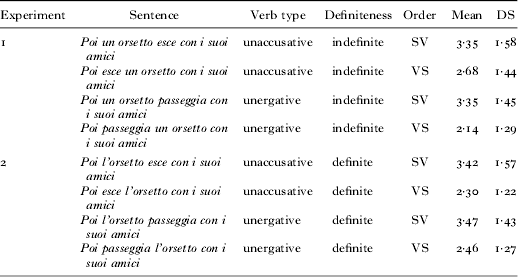
To assess the grammatical acceptability of the experimental sentences used in Experiments 1 and 2, we performed a grammaticality acceptability test. We asked nineteen adult participants (mean age: 30;4; age range: 23;3 to 40;2) to read the experimental sentences of Experiments 1 and 2 and to rate their grammatical acceptability on a Likert scale from 1 to 5. The descriptive results (reported in Table 1) indicate that a sentence with an unergative verb, an indefinite NP, and VS order is regarded as less acceptable than a sentence with an unaccusative verb, a definite NP, and VS order. Note that the first sentence is not acceptable under a non-focused contest, whereas the second sentence is not acceptable according to a syntactic analysis of unaccusatives.
Grammaticality acceptability test results for the experimental sentences used in Experiments 1 and 2

The results were fit to a linear mixed-effects regression model. As we are concerned with a continuous dependent variable (i.e. acceptability rating), the statistical significance of the fixed effects was determined using a Markov chain Monte Carlo (MCMC) sampling algorithm with 10,000 samples. The analysis revealed that there was no significant effect of verb type (unaccusative vs. unergative) (p = ·87) or definiteness (definite vs. indefinite) (p = ·76). There was a first-level effect of order (SV vs. VS). In particular, the SV order was significantly preferred to the VS order (estimate parameter = ·95, p < ·001).
All the words employed in the experiment were drawn from the Lessico Elementare (‘Elementary Lexicon’; Marconi, Ott, Pesenti, Ratti & Tavella, Reference Marconi, Ott, Pesenti, Ratti and Tavella1993). We used the total frequency usage of each word and included only words with 2 digits of frequency, ranging from 11·4 (‘hippo’) to 96·16 (‘cow’), to control for any effect of word frequency. A list of the sentences that were used in our experiment is presented in the Appendix.
We constructed four experimental lists such that each of the four experimental conditions occurred six times in each list, but one item of each set appeared only once. Thus, each subject heard twelve sentences of each type, unaccusative and unergative, six in SV order and six in VS order. The twenty-four experimental items appeared in random order for each of the twenty-five participants. The dependent variable was the proportion of repetitions with SV order out of all repetitions with SV and VS order.
As our data involved a categorical dependent variable, we analyzed the data by means of a linear mixed-effects model, which provides greater statistical robustness than an ANOVA (e.g. Blom & Baayen, Reference Blom and Baayen2012; Cherubini, Rusconi, Russo & Crippa, Reference Cherubini, Rusconi, Russo and Crippa2013). In the analysis, word order, the type of verb, the definiteness of the NP, and age (expressed as a categorical variable, i.e. four-year-olds vs. five-year-olds) were introduced as potentially significant fixed effects. The participants and items were modeled as random-effects factors. We began with a full factorial model, which was progressively simplified by removing the factors that did not significantly contribute to the goodness of fit of the model. We tested both first-level effects and the interactions between the fixed-effect factors. All the models were run in the statistical programming environment R (R Development Core Team, 2008). If children are able to access the internal properties of the two verb classes, then we should expect more SV repetitions with unergatives than with unaccusatives after a sentence with SV order. Consequently, after a sentence with VS order, we should expect more VS order repetitions with unaccusatives than with unergatives.
Procedure and scoring
Each experiment was performed in a quiet room using E-Prime software on a laptop computer. The participants were tested in individual sessions with a duration of approximately 10 to 15 minutes each. The following procedure was adopted. First, the participants received training to become familiar with the characters of the experimental items (although none of them was named). Then, the experimenter pressed the spacebar. A picture appeared on the laptop screen. Meanwhile, each child heard the previously recorded sentence that matched the picture. Subsequently, the recorded voice asked the participant to repeat the sentence that s/he had just heard to the experimenter. Sentence repetitions were recorded and scored offline.
Repetitions were scored as SV repetitions, VS repetitions, or others. To qualify as an SV repetition, the sentence had to present the subject expressed through a NP in preverbal position (e.g. un orsetto esce ‘A little bear is going out’) using the same verb and an indefinite NP. Conversely, to qualify as a VS repetition, the repetition had to present the subject in postverbal position (e.g. e poi esce un orsetto ‘So is going out a little bear’), using the same verb and an indefinite NP. All other repetitions that involved a subject other than the character mentioned in the story, that involved a different verb, or that omitted the subject (e.g. esce, Lit. ‘ø goes out’) were scored as others.
RESULTS
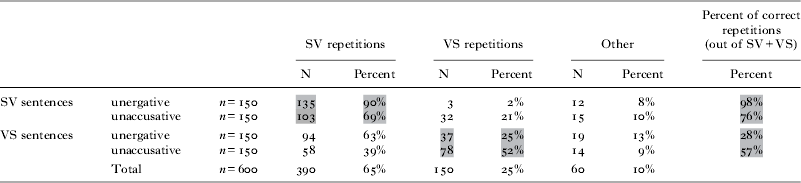
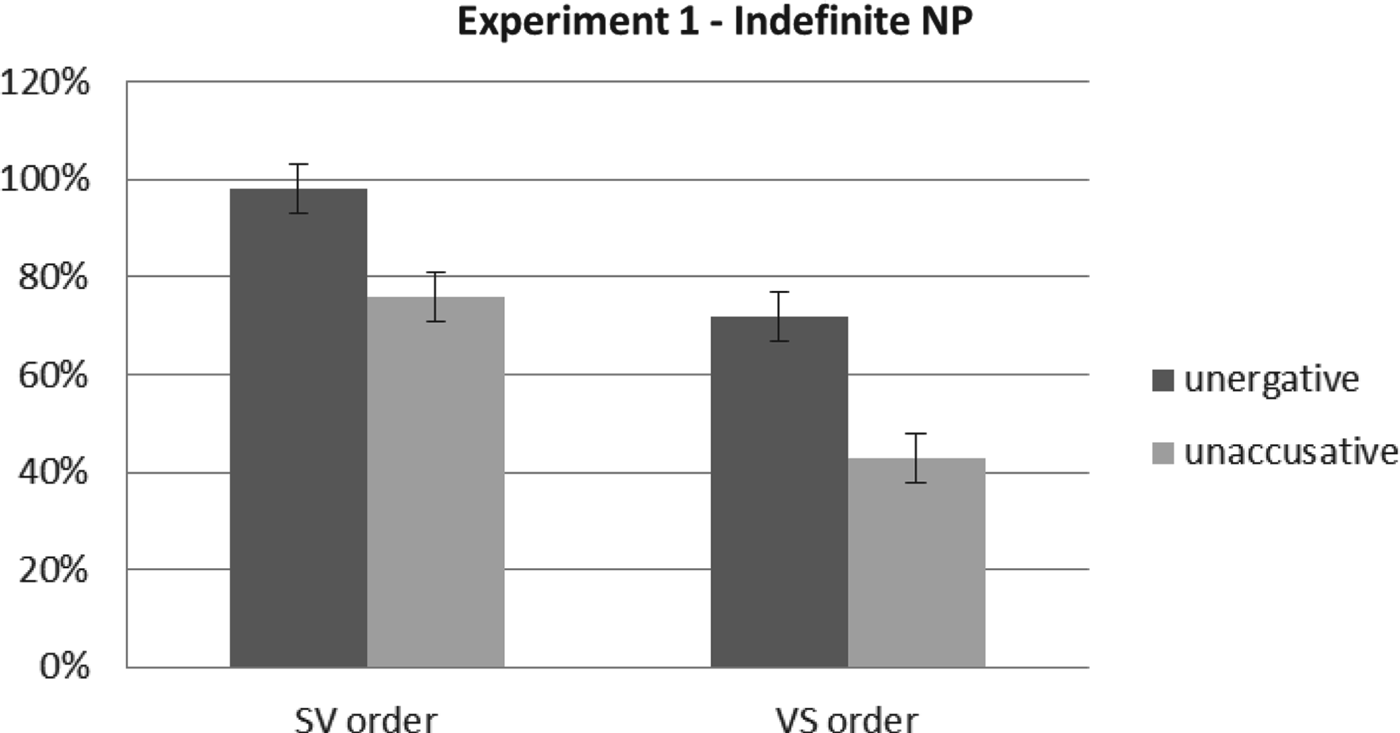
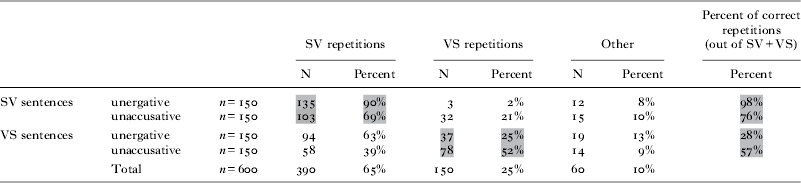
The experiment yielded 390 SV repetitions (65%), 150 VS repetitions (25%), and 60 others (10%), out of a total of 600 repetitions. There were 10% others after SV unaccusative sentences, 9% following VS unaccusative sentences, and 8% and 13% after SV and VS unergative sentences, respectively. The number and proportions of SV, VS repetitions, and others out of SV+VS responses and out of all responses are listed in Tables 2 and 3.
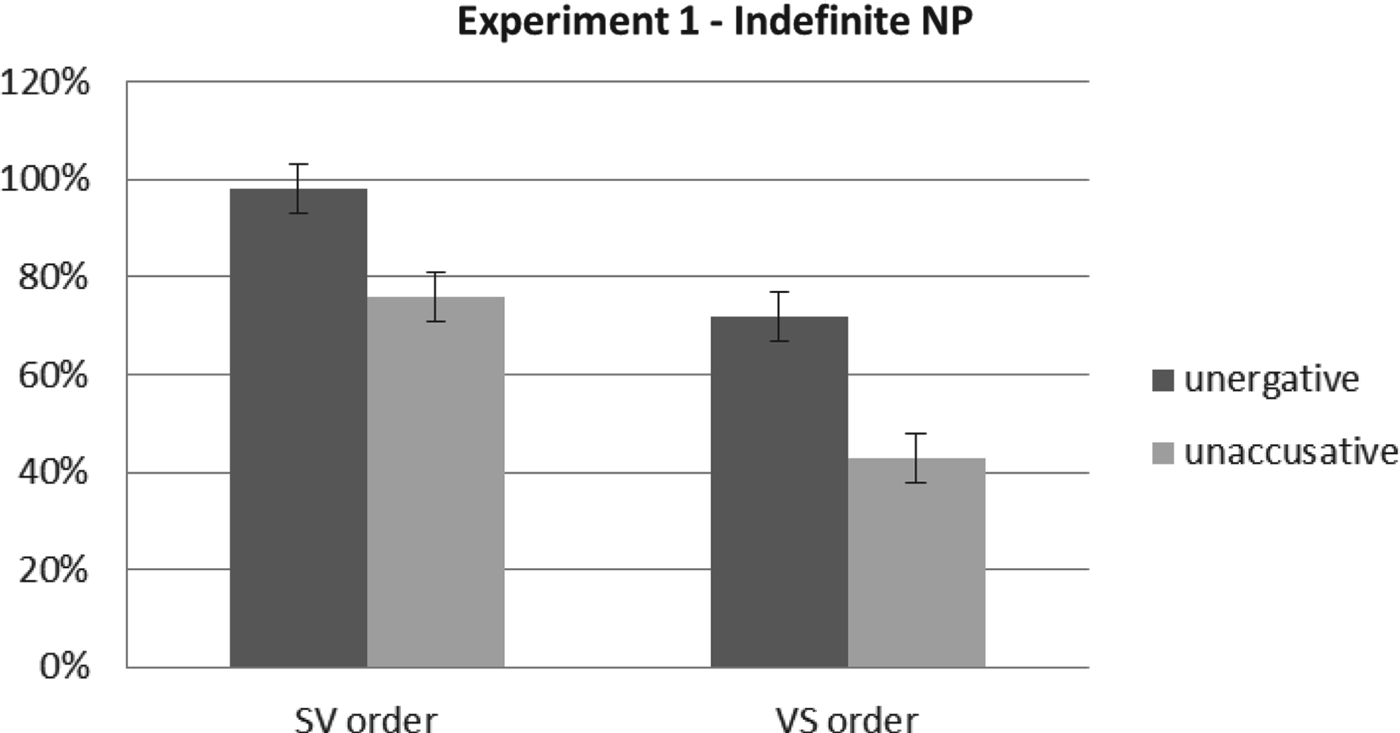
Proportions of repetitions with SV order (out of all repetitions with SV and VS order) by order and verb type in Experiment 1. Error bars refer to the Standard Error of the Mean.
Numbers and proportions of SV, VS repetitions, and Other responses for Experiment 1 (correct repetitions are shaded). The percent of correct repetitions in the rightmost column was calculated out of the total valid responses (i.e. VS + SV), instead of out of all responses (as in all the other columns)
Numbers and proportions of correct repetitions for Experiment 1 combined by order (correct repetitions are shaded). Numbers and proportions of SV repetitions by verb type

As shown in Table 2, and graphically presented in Figure 1, for the SV unergative sentences, the rate of SV repetitions was 98%, nearly at ceiling. However, for the SV unaccusatives, the repetition rate was much lower at 76%. In other words, the participants did not repeat the correct SV order for unaccusatives as successfully as they did for unergatives. For the VS order, there were 28% correct VS repetitions for unergatives in contrast to 57% for unaccusatives.
The errors were not random. Incorrect repetitions of VS as SV were greater for unergatives than for unaccusatives: 72% vs. 43%, respectively. Sentences involving an unaccusative verb and VS order elicited the lowest proportion of SV repetitions (43%), whereas sentences with an unergative verb and SV order yielded the highest proportion of SV repetitions (98%). The combined data including both verb types listed on Table 3 revealed, that for unaccusative sentences, 54% SV repetitions were observed, whereas for unergative sentences 76% SV repetitions were observed. The VS order was more difficult for both verb types, even for unaccusatives. That is, on average, after a VS sentence, there were only 38% correct (VS) repetitions. In contrast, there were 79% correct (SV) repetitions after a SV sentence (see Table 3). The preference for SV order was mirrored in the grammaticality acceptability study, which revealed a strong preference for SV order regardless of verb type.
We fit the proportions of SV repetitions to a mixed logit model. The best-fitting model included verb type (unaccusative vs. unergative) [χ 2(1) = 47·62, p < ·001], order (SV vs. VS) [χ 2(1) = 72·59, p < ·001] and the interaction of verb type and order [χ 2(1) = 4·76, p < ·03] as fixed factors, whereas age (included as a categorical variable, i.e. ‘fur-year-olds’ and ‘five-year-olds’) did not add to the fit of the model [χ 2(1) = 0·25, p = ·61]. As random effects, we included a by-items and by-subjects random intercept and a by-subjects random slope for order [χ 2(2) = 8·11, p < ·001]. The analysis revealed an effect of verb type [N = 540; log-lik = −248·5; Wald Z = 5·14; p < ·001] and order [Wald Z = 4·74; p < ·001] and a significant interaction of verb type and order [Wald Z = 2·01; p < ·04]. To unpack the interaction, we performed a separate analysis on VS sentences to determine whether the tendency to repeat VS sentences as SV was more marked for unergatives than for unaccusatives. Crucially, the analysis revealed a significant effect of verb type: children were more likely to repeat a VS sentence as SV with unergatives (72%; 100%−28%; see Table 2, fourth column) than with unaccusatives (43%; 100%−57%) [N = 267; log-lik = −165·3; Wald Z = 5·07; p < ·001].
Discussion
SV order was found to be more frequent with unergatives, whereas VS order was more frequent with unaccusatives, both when the repetition was correct and when it was incorrect. Although the children in this study appeared to be able to produce SV order with unaccusatives as well, the significant difference between verb types suggests that there were consistently more repetitions involving the SV order with unergatives. The results indicate that children do in fact distinguish between unaccusatives and unergatives by the age of four. This finding was confirmed by the evidence: when children were exposed to an SV order for an unaccusative, they were significantly less successful at encoding it correctly as SV than they were for an unergative (98% vs. 76%; 90% vs. 69% out of all responses). Conversely, when they heard an unaccusative presented in VS order, they were significantly more successful at repeating it correctly in VS order than they were for an unergative (57% vs. 28%; 52% vs. 25% out of all responses). Similarly, we observed that children were much more likely to change SV sentences to VS order with unaccusatives than with unergatives (24% vs. 2%; 21% vs. 2% out of all responses). This result suggests that children can access the internal syntactic properties of the two types of intransitive by the age of four, confirming the Unaccusativity Hypothesis. Therefore, the results of Experiment 1 indicate that children do not parse unaccusatives as unergatives (cf. Babyonyshev, Reference Babyonyshev, Ganger, Pesetsky and Wexler2001), but they treat the two verbs differently with respect to their internal linguistic properties.
In the subsequent experiment, we manipulated a further variable, namely the definiteness of the NP argument, to test whether children use definiteness information to select the (partitive) case for the postverbal NP with unaccusatives. Crucially, if children are able to use definiteness information to represent the internal argument status with unaccusatives but not with unergatives, then this finding would serve as additional evidence that children distinguish the two types of intransitives.
EXPERIMENT 2 – DEFINITE NP
Recall our claim: according to Belletti's assumption, the (postverbal) NP of an unaccusative verb receives partitive case. Hence, in the [V NP PP] configuration, the NP must be indefinite. If a child correctly represents unaccusative verbs and uses definiteness to determine the internal argument status of the NP, then we should expect that with unaccusatives, children should produce more VS repetitions when the NP argument is indefinite and should produce SV repetitions when the NP argument is definite. With unergatives, we should expect a preference for SV order regardless of whether the NP is definite or indefinite.
In this experiment, we used only definite NPs. Therefore, if children are sensitive to the constraint that definite NPs cannot occur with unaccusative verbs unless they are focused (recall that placement before a PP cannot be a focused position), then they should avoid VS order for unaccusatives, changing the sentence to SV order. For unergatives, we predict no difference based on definiteness because the verb's argument in the case of unergatives is not an object or internal argument. Moreover, with unergatives, the postverbal subject is allowed only under a focused context, which is not applicable in our case. Therefore, children should tend to change the VS order to SV in their repetitions, exactly as they did with the indefinite argument in Experiment 1. If the difference based on definiteness is present with unaccusatives but not with unergatives, then this result would serve as evidence that children treat intransitive verb classes differently with respect to their internal properties.
METHOD
Participants
A total of twenty-three monolingual Italian-speaking children (14 males) participated in the experiment. Their age ranged from 4;0 to 5;10 (mean age: 5;1; mean age of the four-year-olds: 4;4; mean age of the five-year-olds: 5;6). The participants were recruited from two kindergartens located in Lecco and Milan. None of the participating children had a reported history of speech or developmental delay.
Materials and procedure, design, and scoring
The materials and procedure, design, and scoring were nearly identical to those used in Experiment 1, except that in the experimental sentences, we changed the article that introduced the subject NP from the indefinite (un ‘a’) to the definite form (lo, il ‘the’). In addition to the procedure of Experiment 1, in a pretest familiarization phase that preceded the experiment, the participants were presented with the main characters of the sentences and were told their names (e.g. ‘orsetto’ for little bear). This step was performed to justify the presence of a definite NP in the experimental sentence. As in the previous experiment, sentences were recorded with neutral accent intonation.
RESULTS
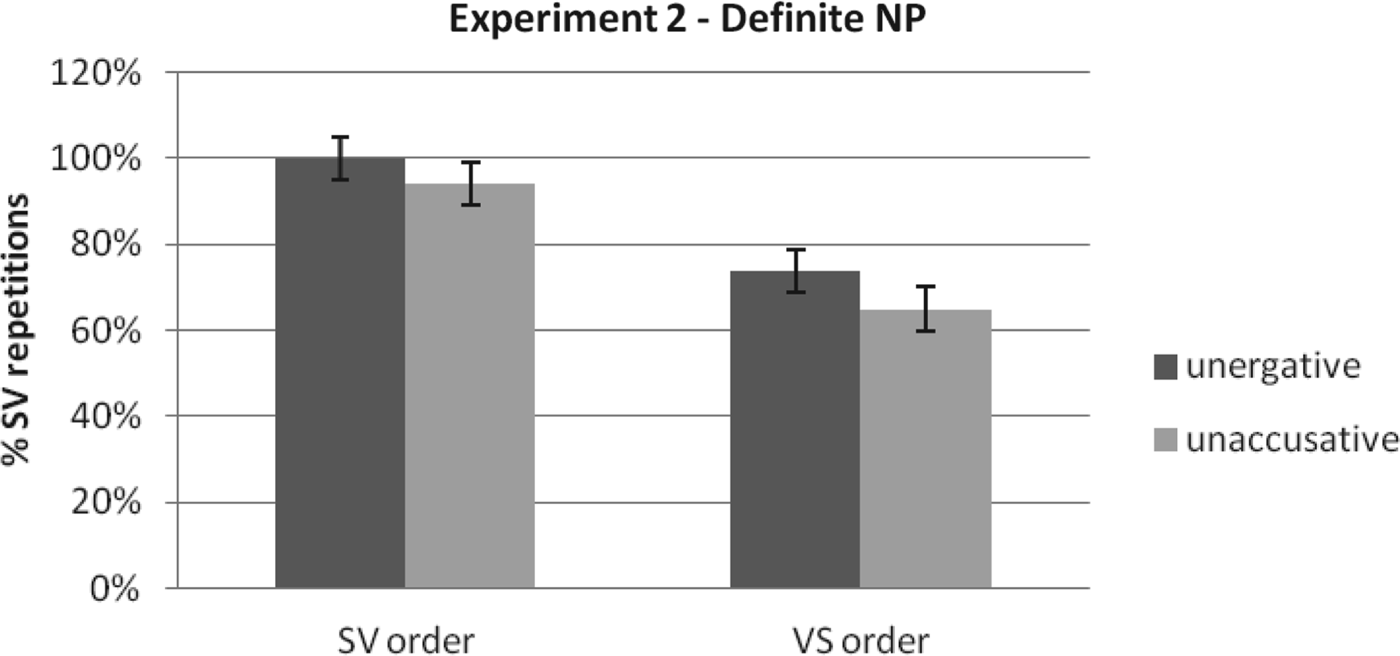
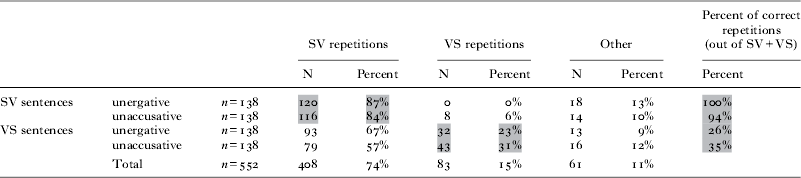
As Tables 4 and 5 show, out of a total of 552 sentences, children produced 408 SV repetitions (74%), 83 VS repetitions (15%), and 61 others (11%). The number and proportions of SV repetitions, VS repetitions, and others are listed in Tables 4 and 5, and graphically presented in Figure 2.
Proportions of repetitions with SV order (out of all repetitions with SV and VS order) by order and verb type in Experiment 2. Error bars refer to the Standard Error of the Mean.
Numbers and proportions of SV, VS repetitions, and Other responses for Experiment 2 (correct repetitions are shaded). The percent of correct repetitions in the rightmost column was calculated out of the total valid responses (i.e. VS + SV), instead that out of all responses (as in all the other columns)

Numbers and proportions of correct repetitions for Experiment 2 combined by order (correct repetitions are shaded). Numbers and proportions of SV repetitions by verb type

As shown in Table 4 for the SV unergative sentences, considering only the SV and VS repetitions and ignoring ‘other’ responses, the rate of SV repetitions was 100%; crucially, for the SV unaccusatives, the repetition rate was also at ceiling, 94%. That is, the participants successfully repeated the SV order for both unergatives and unaccusatives. With respect to the VS order, there were 26% correct repetitions for unergatives and 35% for unaccusatives. Overall, as Table 5 shows, the combined data for unaccusatives and unergatives indicate that the rate of correct repetitions after a SV sentence (86%) was higher than that of correct repetitions after a VS sentence (27%). In addition, the combined data by verb types revealed that for unaccusative sentences, the overall total included 71% SV repetitions, whereas for unergative sentences, 77% SV repetitions were observed. Again, such findings indicate a clear preference for SV order in both verb classes.
We fit the proportions of SV repetitions to a mixed logit model including verb type (unaccusative vs. unergative) [χ 2(1) = 4·12, p < ·04], order (SV vs. VS) [χ 2(1) = 79·99, p < ·001] and the interaction of order and verb type [χ 2(1) = 6·52, p < ·01] as fixed factors. Again, age did not add to the fit of the model [χ 2(1) = 2·15, p = ·14]. As random effects, we included a by-items and by-subjects random intercept and a by-items random slope for order [χ 2(2) = 7·58, p < ·02]. In the final model, there was only an effect of order [N = 491, log-lik = −173·9; Wald Z = 4·29; p < ·001]; specifically, there were more SV repetitions after a sentence displaying SV order than after a sentence involving VS order. Verb type [Wald Z = 1·68; p = ·09] and the interaction of order and verb type were not significant [Wald Z < 1]. A separate analysis considering only the VS sentences indicated that the tendency to change the VS order to SV did not differ between unergatives (74%; 100%−26%, see Table 4, fourth column) and unaccusatives (65%; 100%−35%) [N = 247, log-lik = −150·5; Wald Z = 1·59; p = ·11]. Note that this finding is consistent with our predictions: with unaccusatives, the [V NP PP] configuration is syntactically degraded by a definite NP (Belletti, Reference Belletti1988), and to correct such a sentence (that is, to make it more acceptable), one must move the NP to the preverbal position. Therefore, the lack of verb type effect confirms that for both unaccusatives and unergatives, VS order was more likely to be repeated as SV order.
DISCUSSION
Importantly, although the verb type factor appeared to contribute to the fit of the model, it was not significant: there were only 6% more SV repetitions with unergatives (77%) than with unaccusatives (71%) (see Table 5). One possible explanation for the lack of effect of verb type might be that, in contrast to the previous experiment, the children in this experiment produced SV repetitions to the same extent after sentences involving either an unaccusative or unergative verb. In this respect, recall that the sentences in Experiments 1 and 2 differed only in the definiteness of the NP. That is, the children appeared to be sensitive to the status of the unaccusative verb's argument: when it was definite, they preferred to move it to the preverbal subject position. To determine the effect of this manipulation and, in particular, to investigate whether the tendency to produce more SV order repetitions with definite than with indefinite NPs differed across verb type and order, we conducted a cross-experiment comparison.
CROSS-EXPERIMENT COMPARISON
We analyzed the combined data of Experiments 1 and 2. First, for unaccusatives, we observed the proportions of SV repetitions in Experiments 1 and 2 after sentences involving SV order. There were significantly more SV repetitions when the NP was definite (94%) than when it was indefinite (76%). That is, children were more likely to maintain the SV order with unaccusatives when the NP was definite. In contrast, with unergatives, the proportions of correct (SV) repetitions after a SV sentence were at ceiling in both experiments (i.e. 98% in Experiment 1 and 100% in Experiment 2).
The data were analyzed by means of mixed-effects models, including the definiteness of the argument as a between-subjects factor. First, for unaccusatives, we compared the proportions of SV repetitions in Experiments 1 and 2 after sentences involving SV order. There were significantly more correct SV repetitions when the NP was definite (94%) than when it was indefinite (76%) [χ 2(1) = 10·37, p < ·001; N = 259; Log-lik = −95·86; Wald Z = −3·10; p < ·001]. Crucially, definiteness also affected the tendency to produce SV repetitions after a sentence with VS order; there were significantly more SV repetitions after a sentence that presented a definite NP (65%; 100%−35%; see Table 4) than after a sentence involving an indefinite NP (43%; 100%−57%; see Table 2) [χ 2(1) = 9·83, p < ·001; N = 259; Log-lik = −159·4; Wald Z = −3·33; p < ·001]. Second, the analysis of unergatives revealed that following a sentence with SV order, the definiteness of the NP made no difference in the tendency to produce a repetition with SV order; there was 100% SV repetition with a definite NP and 98% with an indefinite NP [χ 2(1) = 2·15, p = ·14]. Similarly, after a VS sentence, the children in the study produced 74% (100%−26%; see Table 4) repetitions with SV order when the NP was definite and 72% (100%−28%; see Table 2) when it was indefinite. Thus, the analysis showed that the manipulation of the definiteness of the argument was consistent only with unaccusatives, consistent with our claim.
GENERAL DISCUSSION
The results of Experiment 1 indicated that four- and five-year-olds were able to repeat sentences with SV order involving unaccusative verbs; however, there was a preference for VS order with unaccusatives and for SV order with unergatives. The findings of Experiment 2 suggested that with unaccusatives, children were more likely to produce a SV repetition after a sentence that presented VS order and a definite NP than after a sentence involving VS order and an indefinite NP. Importantly, we did not find such a tendency for unergatives.
First, we observed that children were able to produce SV repetitions with unaccusatives and that they avoided VS order with unergatives. Thus, consistent with previous studies, children showed the ability to produce both word orders with unaccusatives but exhibited a preference for SV with unergatives (Lorusso et al. Reference Lorusso, Caprin and Guasti2004; Friedmann & Costa, Reference Friedmann and Costa2011). Therefore, such results cannot support a hypothesis proposing that unaccusatives are parsed as unergatives in the minds of children, as Babyonyshev et al. (Reference Babyonyshev, Ganger, Pesetsky and Wexler2001) claimed.
Second, the results supported the analysis of Belletti (Reference Belletti1988); the children in this study appeared to process the feature of definiteness of the verb's argument when parsing the verbal structure of the sentence. As revealed in the cross-experiment comparison, the presence of a definite NP significantly increased the preference for SV repetitions with unaccusatives, in comparison with Experiment 1, in which the NP was indefinite. In particular, we observed that with unaccusatives, when the NP was definite, children tended to avoid VS order by changing the sentence to SV order. The proportion of VS repetitions with unaccusatives with indefinite NPs was 57% (52% of all responses) and was significantly higher than the proportion of VS repetitions with definite NPs (35%) (31% of all responses). For unergatives, there was no difference across experiments based on definiteness: VS order was more likely to be repeated as SV order regardless of the definiteness of the NP: 72% (100%−28%) after a sentence with an indefinite NP and 74% (100%−26%) after a sentence involving a definite NP (63% vs. 67% out of all responses). To the best of our knowledge, this study provides the first evidence that a manipulation of the definiteness of the verb's argument could affect word order repetition (the bulk of the existing studies used, for instance, only definite NPs, e.g. Friedmann & Costa, Reference Friedmann and Costa2011).
Therefore, for unaccusatives, definite meaning appeared to be an indicator that the argument was not assigned the partitive case. Thus, the children in the study preferred to place the NP in a position that made the definite NP a subject, where it would receive nominative case. Accordingly, the indefinite NP was recognized as bearing the partitive case and was therefore allowed in postverbal position in the repetitions. As a result, there were more VS order repetitions with indefinite NPs in comparison with definite NPs. That is, the children processed a property of the status of object, such as indefiniteness, only with respect to the verb's argument of unaccusatives, but not with unergatives, which did not involve an object argument. This result definitively proved that the children had access to distinct internal representations of unaccusatives and unergatives. In other words, the children did not parse the verb's argument of an unaccusative as that of an unergative; they appeared to be able to distinguish between unaccusatives and unergatives by the age of four. Thus, we offered strong evidence for the Unaccusativity Hypothesis and for the idea that children recognize the difference between unergatives and unaccusatives by the age of four.
Moreover, our findings provided evidence for the sensitivity of four- and five-year-old children to definite/indefinite articles. As many studies have indicated, between four and five years of age, a change occurs in the sensitivity of children to the discourse appropriateness of the definite vs. indefinite article (Prat-Sala & Hahn, Reference Prat-Sala and Hahn2007). Research has revealed that at an early age, Italian children use articles more productively in comparison with children speaking Germanic languages (Chierchia et al. Reference Chierchia, Guasti and Gualmini1999; Guasti, Gavarrò, De Lange & Caprin, Reference Guasti, Gavarrò, De Lange and Caprin2008) and that Italian children at age five show an adequate pragmatic competence in the use of definite/indefinite articles (Power & Dal Martello, Reference Power and Dal Martello1986), although their ability is not fully adult-like (Surian, Reference Surian1991). Our results partly confirmed such findings. Indeed, the children in the current study were able to differentiate definite vs. indefinite NPs. However, there was a lack of developmental change across four and five years (i.e. the age factor never contributed to the models' fit). This finding could be attributed to the fact that our repetition task did not investigate article production as in past research; rather, our study investigated only sensitivity to the definite vs. indefinite meaning of the verb's argument with unaccusatives and unergatives. Based on the current findings, we could not provide evidence for a developmental change between four- and five-year-olds because both experiments indicated that age did not contribute significant information to the tendency to repeat VS vs. SV order. Further work will be needed to verify whether younger children indeed differ from older children in their ability to represent the movement from object to subject position with unaccusatives.
Before concluding the paper, we must mitigate a potential concern that might be raised in the current study. We are conscious that the sentences involving a marked word order would require a prosodically marked contour to be fully felicitous. Thus, a neutral prosodic contour could involve a misalignment of prosody to syntax in this case. To produce a structure that would align prosody to syntax with unergatives, we should have expected SV order after a VS unergatives, which is what we found. With unaccusatives, both VS and SV orders are legitimate with a neutral prosody depending on the context. For instance, after a question such as Chi è arrivato? (Lit. ‘Who arrived?’), one natural answer would be the postverbal argument: E’ arrivato uno straniero (Lit. ‘Is arrived a stranger’). Given a question such as Cosa è successo? (Lit. ‘What happened?’), one could answer equally well with a pre- or a postverbal argument (Una bomba è scoppiata in piazza, Lit. ‘A bomb exploded in the square’ or E’ scoppiata una bomba in piazza, Lit. ‘Exploded a bomb in the square.’). Thus, with unaccusatives, we are confident that this concern could be easily overcome. In summary, although we cannot completely eliminate the possibility that this concern could have influenced the current results (at least with unergatives), our data generally highlight the relevance of the argument structure of the sentence. Additionally, none of these concerns affect how children understand unaccusatives; the changes that we observed with unaccusatives in Experiment 2 in comparison with Experiment 1 are further evidence of the tendency of children to treat unaccusatives and unergatives as two different verb classes.
In conclusion, this study has provided some new empirical data on the ability of four- and five-year-old children to represent the phrasal structure of unaccusatives and unergatives. In comparison with previous research findings, our study has highlighted the theoretical relevance of the definiteness of the verb's argument in determining word order repetition with unaccusatives and has proved that children by four years of age master distinct linguistic representations for different intransitive verb classes.
APPENDIX
List of experimental sentences used in Experiments 1 (indefinite article) and 2 (definite article). Note that in each sentence the first verb is unaccusative, the second unergative.
1 C'è una festa nella giungla. Poi un/l'ippopotamo arriva/partecipa con i suoi amici.
(‘There is a party in the jungle. Then a/the hippo arrives/attends with its friends.’)
2 C'è un inseguimento nella savana. Poi una/la giraffa rimane/corre con le sue amiche.
(‘There is a chase in the savannah. Then a/the giraffe stays/runs with its friends.’)
3 C'è una lezione di nuoto. Poi una/la foca cade/scivola sul bordo della piscina.
(‘There is a swimming class. Then a/the seal falls/glides at the edge of the pool.’)
4 C'è una tempesta con tuoni e fulmini. Poi una/la tigre rimane/riposa nella sua tana.
(‘There is a storm with thunder and lightning. Then a/the tiger stays/rests in its lair.’)
5 C'è il sole nella foresta. Poi un/il passerotto torna/vola contento al suo nido.
(‘There is the sun in the forest. Then a/the sparrow gets back/flies to its nest.’)
6 C'è un antico castello nella foresta. Poi un/il riccio entra/dorme nel castello.
(‘There is an ancient castle in the forest. Then a/the hedgehog gets in/sleeps in the castle.’)
7 Di notte ci sono i pipistrelli. Poi un/il gufo impallidisce/trema per la paura.
(‘At night there are bats. Then a/the owl turns pale/trembles because of fear.’)
8 Nel bosco ogni mattina C'è un bel sole. Poi uno/lo scoiattolo esce/chiacchiera con i suoi amici.
(‘In the wood every morning there is the sun. Then a/the squirrel gets out/chats with its friends.’)
9 Ogni sera C'è un venticello fresco. Poi una/la rondine ritorna/riposa nel suo nido.
(‘Every evening there is a gentle breeze. Then a/the swallow gets back to/rests in its nest.’)
10 Nella foresta C'è un temporale. Poi un/il passerotto rimane/vola sull'albero.
(‘In the forest there is a storm. Then a/the sparrow stays/gets back to the tree.’)
11 Nella foresta C'è un brutto temporale. Poi un/l'uccellino rimane/cinguetta vicino ai suoi compagni.
(‘In the forest there is a storm. Then a/the little bird stays/chirps with its friends.’)
12 Quando piove i rami sono scivolosi. Poi uno/lo scoiattolo resta/scivola nella sua tana.
(‘When it rains, branches are slippery. Then a/the squirrel stays/glides into its hole.’)
13 Dopo la pioggia il terreno è bagnato. Poi un/il bruco sparisce/scivola in un buco).
(‘After the rain the ground is wet. Then a/the caterpillar disappears/glides in a hole.’)
14 Nell'aia gli animali giocano. Poi una/la gallina rimane/cammina con i pulcini.
(‘In the farmyard animals use to play. Then a/the hen stays/walks with its chicks.’)
15 Dopo la gara hanno nominato il vincitore. Poi un/il coniglio arrossisce/corre per l'emozione.
(‘After the competition, there is the winner's nomination. Then a/the bunny blushes/runs away for the excitement.’)
16 Nella foresta C'è un leone. Poi una/la lepre resta/corre verso la sua tana.
(‘In the forest there is a lion. Then a/the hare stays in/runs to its hole.’)
17 Gli insetti vivono in una casa abbandonata. Poi una/la mosca sale/vola in soffitta.
(‘Insects live in a derelict house. Then a/the mosquito goes up/flies to the garret.’)
18 A scuola la maestra sgrida gli animali. Poi un/il coccodrillo torna/piange a casa sua.
(‘At school the teacher scolds the animals. Then a/the crocodile gets back/cries at home.’)
19 C'è stata una grande pioggia. Poi una/la rana cade/scivola nello stagno.
(‘It was raining. Then a/the frog falls/glides in the pond.’)
20 Ci sono dei rumori strani nello stagno. Poi un’/l'anatra impallidisce/piange per la paura.
(‘There are some strange noises in the pond. Then a/the duck turns pale/cries because of fear.’)
21 C'è un bel sole nel bosco. Poi un/l'orsetto esce/passeggia con i suoi amici.
(‘There is the sun in the forest. Then a/the little bear gets out/strolls with its friends.’)
22 Alla fattoria C'è un grande pranzo. Poi una/la mucca ingrassa/ride per il pranzo abbondante.
(‘At the farm there is a big meal. Then a/the cow fattens up/laughs because of the big lunch.’)
23 Di notte i lupi ululano nella foresta. Poi un/il coniglio impallidisce/piange per il grande spavento.
(‘At night wolves howl in the forest. Then a/the bunny turns pale/cries because of fear.’)
24 In palestra gli animali fanno ginnastica. Poi un/il topolino dimagrisce/suda per la grande fatica.
(‘At the gym animals do some exercises. Then a/the little mouse becomes thinner/sweats because of the big effort.’)