

Introduction
This article discusses the representation of individual voters on the issue of European integration. Why do some people vote for a party that represents their views while others chose to vote for a party that does not? Furthermore, can individual benefits received from the EU explain the difference between perfect and imperfect substantive representation on this issue?
Of interest to this paper is the common benchmark to most forms of representation, which is the criterion of constituent-representative congruence. The similarity between voters’ preferences and representatives’ future actions is evident first and foremost in promissory representation, when electoral promises reflect the congruence between constituent and representative, but the norm of congruence applies to all forms of representation (Mansbridge, Reference Mattila and Raunio2003). Recent debates on representation focus on various forms of representing the citizenry (promissory, anticipatory, surrogate, gyroscopic representation), forms which are not completely distinct, but which may become interchangeable over time (Mansbridge, Reference Mattila and Raunio2003). A similar idea appears in other normative outlooks of representation (Saward, Reference Saward2014: 726) whereby the shape-shifting representatives deploy ‘shifting shades and aspects of a range of representative roles […] moving in and among a range of familiar roles’, from trustee and delegate to politico or informal representative in the form of advocates.
The analysis provided in this paper offers an empirical account of the level of congruence as it occurs at the time of voting, without considering any post-election action from the representatives. The framework provides individual explanations for why different levels of congruence exist. Especially in the context of European Parliament elections which use proportional representation, the party is considered to be representative of the voter’s preferences as in the responsible party government model (Dalton et al., Reference Dalton2011; Budge et al., Reference Budge, Keman, McDonald and Pennings2012).
This article complements previous research on issue representation (Thomassen and Schmitt, Reference Thomassen and Schmitt1999; Costello et al., Reference Costello, Thomassen and Rosema2012; Dalton, Reference Dalton, Farrell and McAllister2015) by adopting a different perspective centred on the voters. Whilst in most frameworks of representation the focus is on the actions and preferences of the representative, this paper places the emphasis on the input element of representation – the voter, who is ultimately the generator of the representational process. Before taking a decision about their preferred party, voters evaluate how well parties mirror their opinions. Voters do not think in aggregate terms and this justifies even more an individual approach to representation.
The contribution of this article is twofold. First, in order to explain the quality of substantive representation, the research tests explanations at the level of the principals (voters) and of the agent (parties) across EU member states. The analysis emphasizes the role of benefits and costs from integration – both individual and systemic. Second, by making use of different data sets on parties and voters, the analysis can more accurately match voters’ opinions on EU integration [European Election Study (EES) 2009] with the policy position of the exact parties they have voted for (Profiler 2009). As at the time this article was written the elite data were not yet publicly available for the 2014 elections, the matching of preferences was completed using the EES and EU Profiler 2009 data across 27 EU countries. The first section sets out the conceptual framework, while the subsequent parts test several hypotheses advanced using a cost-benefit model. The last sections present the results and discuss the implications for further research.
Imperfect representation: concepts and theory
Substantive representation is an important part in the process of delegation and accountability, a process with voters as principals and their agents who can be either members of parliament, political parties, or governments and their policies. Theories of substantive representation postulate that governments and legislatures are supposed to mirror the preferences of their citizens (Dahl, Reference Dahl1956; Pitkin, Reference Pitkin1967). Conversely, citizens are expected to vote for parties whose policy positions best represent their preferences. However, representation is never perfect, and what we find in practice is a match or mismatch between parties and voter’s preferences. It is the aim of this article to test various explanations for different degrees of representation across Europe.
This degree of match/mismatch matters for the quality of national governance and representative democracy. Explaining the quality of representation on EU integration is relevant because of a high mismatch between the opinions of voters and the opinions of Members of the European Parliament (MEPs) (Van Der Eijk and Franklin, Reference Van der Eijk and Franklin1991, Reference Van der Eijk and Franklin2004; Mattila and Raunio, Reference Leconte2006). Additionally, EU integration as a political issue is currently relevant for the future of the EU. The voter-party policy congruence is far weaker on EU integration issues than on the left-right dimension (Schmitt and Thomassen, Reference Schmitt and Thomassen1999; Mattila and Raunio, Reference Leconte2006), this allows an analysis which can disentangle various individual explanations.
The aim is to explain substantive individual representation, that is, the level of policy congruence between the voter and the actual party for which each voter has cast a ballot. This policy-based relationship (Huber and Powell, Reference Huber and Powell1994; Powell and Vanberg, Reference Powell2000; Blais and Bodet, Reference Blais and Bodet2006; Budge and McDonald, Reference Budge and McDonald2007; Powell, Reference Powell and Vanberg2009; Golder and Stramski, Reference Golder and Lloyd2010) between voters and parties is important as it is claimed to be the essence of democratic representation (Katz, Reference Katz1980). The smaller the distance between the representatives and the ideological position of voters, the higher the congruence and hence the higher the level of substantive representation. Previous scholarship has focussed mostly on the impact of institutions such as the electoral system or on the difference between consensus and majoritarian systems when explaining representation (Powell, Reference Powell and Vanberg2009). Systems using proportional representation and consensus institutions are usually associated with a higher level of congruence at the level of parliamentary parties (Golder and Stramski, Reference Golder and Lloyd2010; Golder and Lloyd, Reference Golder and Stramski2014). The electoral institutions are nevertheless less relevant in the context of European Parliament elections as most countries use proportional representation for these electoral contests.
In contrast to previous institutionally based arguments, this article provides a cost-benefit framework which explains why individuals differ in their representation within and across countries of the EU. A cost-benefit approach to representation fits the policy chosen for investigation – European integration – as this issue is relevant considering the financial crisis followed by the current immigration crisis that the EU is facing. After the 2004 and 2007 EU enlargement to Central and Eastern Europe, European integration has started to receive higher importance from both parties and voters. Equally, as enlargement and integration progressed, immigration has become a significant dimension of party competition in European Parliament elections (Barbulescu, Reference Barbulescu2009; Borz and Rose, Reference Borz and Rose2010). An additional reason for choosing this issue is the large elite-mass gap (Mattila and Raunio, Reference Leconte2006). At the time of the 2009 elections, the difference between citizens and MEPs favouring integration was 44%. Only 40% of survey respondents declared themselves supportive of further integration, while an overwhelming majority of 84% parliamentarians in Brussels want further unification. While very few politicians (15%) think that integration has gone too far, twice as many citizens share that view. The middle ground status quo supporters are large in numbers amongst EU citizens (30%), yet almost nonexistent amongst MEPs (EES 2009 and Profiler.eu).Footnote 1
In order to maximize representation, issue voting on European integration is a function of voters’ perception of the entire process of integration. The benefits and costs received from the EU following membership can play a role when voters decide to cast a vote for a party with a similar or a dissimilar position. The argument of this paper is that on the issue of European integration, voters maximize their representation based on their perceived individual and systemic utility associated with EU membership, utility which is mediated by issue salience. As representation is never perfect, explaining its extent requires an analysis in a multilevel setting. The overall policy position match is a function of individual characteristics and systemic features. In what follows, both types of utilities will be discussed in relation to substantive representation.
Systemic benefits
The gains or losses associated with EU membership may influence voters to choose a party which has a similar position on EU integration. These gains or benefits can be perceived from an individual or systemic perspective. With regards to the latter, we expect a divide between new and old EU member states. In the 12 new memberFootnote 2 states which joined the EU in 2004 and 2007, where, by and large, we find higher financial transfers from the EU budget, voters are largely EU enthusiasts and more likely to support integration. Furthermore, the elite in these countries felt consistently closer to Europe as financial transfers from the richer countries came as the means to avoid opposition to integration from these countries (Carrubba, Reference Carrubba1997). Following from this, we expect a higher voter-party match on EU integration in the new member states. Conversely, older member states, where citizens have participated in several European Parliament elections, have been more exposed to the implications of the acquis communautaire and have increasingly become more Eurosceptic (Leconte, Reference Mansbridge2010). Therefore, we expect a higher level of mismatch between their position and their party position. We therefore posit the following two hypotheses:
Hypothesis 1a: EU financial benefits: the higher the financial benefits from the EU budget, the more likely the match between the positions of voters and parties on EU integration.
Hypothesis 1b: Length of EU membership: the newer the EU membership, the more likely the match between voter and party preferences on EU integration.
Individual benefits
Individual voters across all member states may notice long-term improvements in their communities, sometimes due to an increased receipt in EU funding, other times simply by being able to enjoy the benefits of a free market or freedom of movement. More informed and educated voters who follow the news regularly may notice systemic improvements in the economic situation. Individual benefits cannot, however, be entirely classified as economic (McLaren, Reference McLaren2002). Benefits from EU integration may be associated with various geopolitical, strategic, and social cultural improvements to voters’ lives. EU membership and integration may be perceived as a good thing from a market perspective but also because integration overall can be interpreted as a return to the big European family in the case of new member states. Positive returns can also be pinned down to voters’ satisfaction that the EU institutions are taking decisions in favour of or in line with the position of their own country in Brussels. This perceived benefit gives voters a sense of efficacy, whereby each voter considers that their vote and opinions count (Finkel, Reference Finkel1985). The satisfaction acquired is mainly related to the external or system responsiveness dimension of efficacy. Furthermore, being represented by politicians who share the same opinion makes voters think they have contributed to the decision-making process and that parties and MEPs care about their opinions.
However, following the financial crisis, a large proportion of voters who consider EU integration a good thing, do not want further European integration (Rose and Borz, Reference Rose and Borz2015) and choose the status quo, which may explain different levels of representation attained on this issue. Satisfaction with the European Union and with the way several policies are handled from Brussels may make voters choose a party with a similar position to their own on European integration.
Hypothesis 2: Perception of benefits: The higher the individual perceived benefits, the higher the quality of representation by parties promoting integration.
Issue salience: the mediation factor
The impact of costs and benefits on representation can be better understood if we know whether integration is a significant issue for voters. It is important to ascertain whether a low-quality representation is indeed related to the lack of interest in the European Parliament elections, the EU as a whole (as posited by second order theories – Reif and Schmitt, Reference Reif and Schmitt1980; Hix and Marsh, Reference Hix, Noury and Roland2007; van der Brug et al., Reference Van der Brug, van der Eijk and Franklin2007) or in the process of European unification altogether (as posited by salience theories). The salience of EU integration and opinion congruence influences vote choice (Hobolt et al., Reference Hobolt, Spoon and Tilley2009; de Vries et al., Reference de Vries, van der Brug, van Egmond and van der Eijk2011). If integration is of high importance, voting for a party which shares similar opinions on the EU may prove beneficial for voters. As a consequence, the quality of representation is expected to increase as salience intensifies. If voters feel European, they will consider important be to represented on the issue of European integration; therefore a match between voters’ opinions and parties’ opinions is expected.
One has to distinguish between issue salience for voters and for parties. A perfect match is expected when voter preference and party position match and when the EU is salient for both parties and voters. The importance attributed by voters to EU integration may be influenced by the cues received from political parties. At times, parties have strategic incentives to give less attention to European issues (Franklin and Wlezien, Reference Franklin and Wlezien1997; Steenbergen and Scott, Reference Steenbergen and Scott2004; Van der Eijk and Franklin, Reference Van der Eijk and Franklin2004; Hix et al., Reference Hix and Marsh2007), hence the issue may be dormant in certain party systems. The other option is a system with all parties sharing similar positions on integration, leaving voters with no political alternatives to match their preferences. The vast majority of parties in the new EU12, which had to negotiate several reforms with the EU, are, with a few recent exceptions (in Hungary and Poland), mostly pro-integration (Borz and Rose, Reference Borz and Rose2010). In a multidimensional political space, where parties compete over several issues such as welfare, immigration, taxation, and morality policies, the salience attributed to EU integration by parties is expected to count for the quality of representation. Therefore, the hypothesis to be tested is:
Hypothesis 3: EU salience: the higher the EU salience for voters and parties, the more likely the match between voter and party preferences on EU integration.
Costs
In a similar vein with the benefits, the costs of integration can be economic (income or job insecurity), cultural (fear/thereat from other cultures), or political (decline of state sovereignty, EU democratic deficit). The creation of a new level of governance, such as European Union has led to ‘a more complex cross-cutting network of governance based upon the breakdown between domestic and foreign affairs, on mutual interference in each other’s domestic affairs, and on increasing mutual transparency’ (Wallace, Reference Wallace1999: 519). European integration means also that international actors get involved in national politics, constitutional independence diminishes, and sovereign equality and market competition are transformed. Especially in old member states, membership came with an increased level of immigration from the EU, which puts an additional strain on national states. It has been emphasized that anti-immigration attitudes are a key factor for understanding resistance to integration (de Vreese and Boomgaarden, Reference de Vreese and Boomgaarden2005; McLaren, Reference McLaren2007; Azrout et al., Reference Azrout, van Spanje and de Vreese2011). Negative attitudes towards immigration are usually in the form of perceived threats from immigrants, either because of their religion or because they would abuse social benefits (McLaren, Reference McLaren2002). Related to the threat of immigration is the evident economic argument that the open liberalized market would make those with high income benefit and those with low income lose (Gabel, Reference Gabel1998) as immigrants would first take over the low-skilled jobs in the host country. What one has to consider is also the increased immigration from outside the EU which puts an additional strain on national governments. All these arguments can be brought forward as explanations for an increased mismatch between parties and voters on EU integration.
Henceforth, if this cost of membership outweighs the benefits, it is to be expected that the level of representation will increase, mainly for those Eurosceptic voters who have the option of being represented by a party with similar views. Consequently, the hypothesis to be tested in relation to costs is as follows:
Hypothesis 4: Costs: the higher the perceived costs of integration for individuals, the higher the level of representation by anti-integration parties.
Data and empirical strategy
Empirically, this analysis provides a more accurate measure of individual substantive representation than previous studies. Existing scholarship has mostly analysed voters’ perceptions of where parties are in the policy space and compared it with voters’ own policy preferences as reported in surveys (van der Eijk and Franklin, Reference Van der Eijk and Franklin2004; Brandenburg and Johns, Reference Brandenburg and Johns2014). Additionally, most empirical research has been conducted at the aggregate party system level (Mattila and Raunio, Reference Leconte2006). But crucially, voters’ perceptions of parties’ positions may not correspond well with parties’ actual positions (Belchior, Reference Belchior2013). It is the aim of this article to investigate in detail the degree of congruence between the actual positions of parties and their voters.
Representation
The dependent variable in this study measures the quality of representation across voters and across countries. Based on party/voter match of opinions, representation is measured and conceptualized in three categories. When we have a match – in other words, individuals vote for the party which has the same policy position – then we consider this as perfect representation. This perfect match can go in both directions: for or against integration. In case of a mismatch between voters’ and parties preferences, we count this as misrepresentation. In this category, we include representation of voters in favour of integration by parties opposing integration and representation of voters against integration by parties favouring integration. The middle category are the neutral status quo voters on EU integration, who prefer the level of EU integration to stay as it is and who, mostly because they have no party to match their opinion, choose to vote for a party which is either for or against integration. In spatial terms, when one considers the measurement scale for EU integration, the voters in this middle category are closer to the party they vote for then those in the misrepresented category, as their level of mismatch is lower. We consider this category as indifferent representation.
The data for this variable has been compiled from two different data sets. Positions on EU integration for parties were derived from the EU Profiler data (www.euprofiler.eu; Trechsel and Mair, Reference Trechsel and Mair2009) and for voters from the EES 2009 (www.piredeu.eu). The EU Profiler study covers data on 156 parties with seats in the European Parliament after the 2009 elections. Their data on party positions was gathered following a triangulation process: from party manifestos, party experts, and also from parties who were asked to position themselves on 28 issue dimensions. The issue of EU integration was derived by conducting factor analysis on the EU profiler data (Borz and Rose, Reference Borz and Rose2010: 8). The factor includes questions related to EU integration being a good thing, being better off as a EU member state, the need to strengthen the European Parliament, the EU foreign policy and the relationship with Russia, the EU security and defence policy, the necessity of national referendums on EU issues, and the reduction of national vetoes in EU decision making. The original profiler coding scored parties’ position on a five-point scale from −2 (completely disagree) to +2 (completely agree). For this analysis, the EU integration dimension was subsequently recoded on a scale from −1 to +1 to reflect anti-integration, neutral, and pro-integration opinions. In the case of voters, the EES 2009 study covers 27,069 voters across 27 countries and has a clear-cut question about European Integration: some say European integration should be pushed further. Others say it has already gone too far. What is your opinion? Respondents were asked to place themselves from a scale from 0 (unification has gone too far) to 10 (unification should be pushed further), which was subsequently recoded into three categories as in the case of parties, to reflect voters pro-, neutral, and against integration. Respondents placing themselves at points 6–10 are classified as for more integration; at 0–4, in favour of less; and at point 5 or no opinion, as neutral. Only the actual voters from this study were identified together with the party they voted for. Parties’ position on EU integration was subsequently coordinated with the position of their voters in order to arrive at our variable with three categories of representation.
Independent variables: context
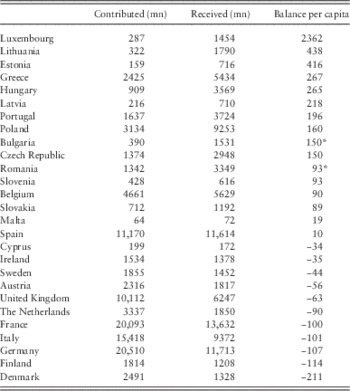
The financial benefits are calculated in euro per capita following the budget data released by the European Commission on the basis of each country’s revenues and expenditures as of 2009. The net balance per capita in euros has a minimum deficit value of −211 euros per capita in Denmark and a maximum value of 2362 euros per capita in Luxembourg. From that year’s budget figures, 16 countries are net beneficiaries, while 11 countries are net contributors to the budget.
Party competition on EU integration is coded as a dummy variable by taking into account the position of political parties on this issue. The variable shows whether parties within a country disagree or not on the issue of European integration (Borz and Rose, Reference Borz and Rose2010). An additional indicator employed for this purpose is the number of dimensions across which party competition is taking place in a system, meaning the number of issues on which parties disagree during the electoral campaign. The data comes from the Profiler database following a detailed analysis of the positions taken by 156 political parties winning seats in the European Parliament election of 2009. Positions on 23 issues differentiate parties on five underlying dimensions: European integration; socio‐economic welfare; morality; the environment; and immigration. The intensity of party competition is reported by the number of dimensions on which parties have differing positions in each country and can take values from 0–5 (for details, see Borz and Rose, Reference Borz and Rose2010).
Length of membership is coded through a dummy variable which separates the new EU12 member states from the older member states.
Independent variables: individuals
The individual benefits are measured through the satisfaction acquired from how the EU handles its affairs. The indicators show the individual evaluation of the EU, hence the EU satisfaction scale includes the number of positive responses to the EES 2009 questions on whether EU is trusted and whether EU membership represents a good thing. The EES 2009 survey question on whether individuals think that EU membership is a good thing asks individuals to evaluate EU integration in general and can be considered a measure which taps into both economic and non-economic benefits. Additional questions about the EU impact asked voters to assess EU policy influence on various policy domains such as economic conditions, health care and interest rates.
The economic, political, and cultural individual costs of EU integration are measured through perceptions of the quality of the EU’s decision making in general (whether it makes decisions in the interest of respondent’s country) and of the European Parliament in particular. The costs are further measured by voters’ opinions about immigration.
The EU salience for individual voters was measured through a battery of questions from the EES which assess the importance attributed to the EU through information about the identity of voters and whether they feel European, whether they consider which party wins the European Parliament elections important, and whether they consider the EU responsible for dealing with most important problems facing their countries (see Appendix for details).
The analysis also includes a number of control variables which have been identified in the extant literature such as information (knowledge about the EU), frequency with which voters follow news, and specifically news about European Parliament elections; satisfaction with the government; party identification; left-right position; and a few socio-economic variables such as education and standard of living.
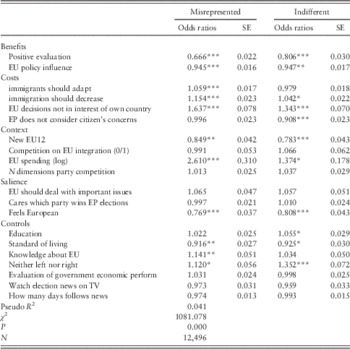
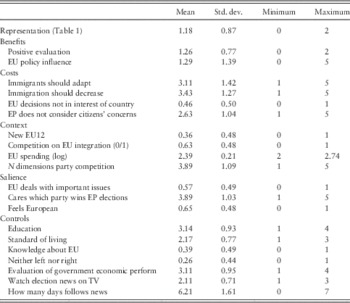
The empirical analysis of this paper proceeds in three stages. First, an overview of the quality of representation is presented across all EU member states. Second, the analysis focusses on the direct effect of individual and contextual benefits and costs of integration on the quality of representation. Both country and individual characteristics are included in a multinomial model that considers both individual and country-level variables (Table 1). The hypotheses are tested by estimating a multinomial model which is justified by the three distinct categories of the dependent variable (Gelman and Hill, Reference Gelman and Hill2007; Rabe-Hesketh and Skrondal, Reference Rabe-Hesketh and Skrondal2012). In the third stage, the pro- and anti-integration voters are divided into two samples and the same analysis is repeated, in order to better disentangle the direction and effect of integration benefits and costs on representation (Table 3). The descriptive statistics for all independent variables are provided in the Table A1.
Explaining imperfect representation through costs and benefits

Voters: European Election Study 2009, www.piredeu.eu; Parties: www.profiler.eu; multinomial model. The coefficients show odds ratios. Represented=reference category.
*P<0.05, **P<0.01, ***P<0.001.
Imperfect representation across countries
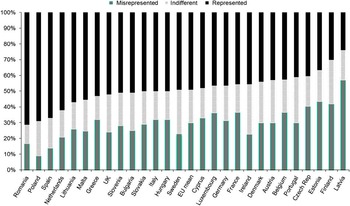
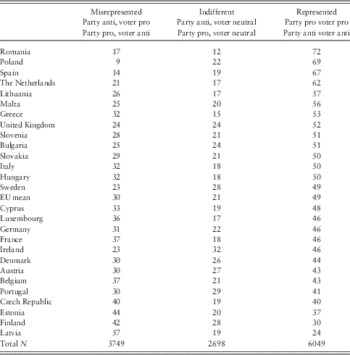
The opinions of principals (voters) and agents (MEPs) on EU integration vary greatly across countries (see Figure 1). On average, 49% of voters are represented on this issue, followed by 30% who are completely misrepresented and 21% who are indifferent. Based on our three categories, the empirical distribution of this ‘imperfect’ representation across Europe is detailed in the Appendix (Table A1) for each country.
Quality of representation across European countries. For parties: EU Profiler database (www.profiler.eu) of national programme commitments, 2009. For citizens, the data are based on the European Election Study 2009 (www.piredeu.eu).

Amongst the EU27 member states, it is Romania that has the highest percentage of represented voters (72%). At the opposite end, we find Latvia with the lowest number of represented voters (24%). Overall, only 13 EU countries have a percentage of represented voters above the European average of 49%. Conversely, 11 EU countries have their voters misrepresented above the total European average of 30% misrepresentation. What is also obvious from Figure 1, is a clear three way separation between the represented, misrepresented, and indifferent groups which can be observed across all countries (Figure 1). The indifferent group is not marginal and takes values between a minimum of 12% of voters in Romania and a maximum of 32% in Ireland. With the exception of Bulgaria, the majority of indifferent representation, above the EU average, is found mainly in West European countries. For example, United Kingdom has the highest proportion of neutral voters represented by a pro-integration party while Finland has one of the largest percentage of neutral voters represented by an anti-integration party. This clear differentiation between the three groups suggests that a dichotomy in terms of being represented or misrepresented, at least on the issue of European integration, is no longer appropriate.
The percentage of voters represented by anti-integration parties could have been higher should the option of anti-integration parties have been readily available across all EU member states. One impediment against that happening was that parties with an anti-integration stance could be identified only in 16 EU member statesFootnote 3 at the time of the 2009 elections. Their number, however, increased after the 2014 European Parliament elections, and so did the number of their voters. Similarly, the absence of status quo parties across EU member states explains the large percentage of voters in the indifferent category of representation. In 2009, there were only three parties with representation in the European parliament which declared themselves neutral in terms of EU integration, whilst the percent of voters who prefer things to stay as they were was much larger.
The impact of costs and benefits on the quality of representation
The results show support for the claim that perceived benefits are playing a role in voters’ decision, whether or not to vote for a party which has the same stance on EU integration. The perceived costs also are not negligible, especially for those voters who think of immigration as being a relevant threat.
The analysis reported in Table 1 presents the results of a multinomial logit model which considers the dependent variable with three distinct categories of representation: ‘represented’, ‘indifferent’, and ‘misrepresented’ voters. The analysis treats the represented group as the reference category. The novelty of these data allows for a clear differentiation between the three categories of representation and permits testing the strength of various explanations for belonging to each distinct category. The odds ratios (as reported in Table 1) which take values above 1 show a positive impact. Values below 1 show a negative impact of each independent variable on the probability of falling in each representation group.
Financial benefits
Financial benefits per capita calculated from the EU budget per each country do not have the expected directional influence. Contrary to our expectations, the more financial benefits a country receives from the EU, the more the voters from these countries are likely to be misrepresented. Additionally, with every unit increase in benefits from the EU, the odds of falling in the indifferent category are 37% higher than the odds of falling in the represented category (odds ratio 1.37, Table 1). This negative relationship might be related to the lack of information voters have on this matter.
Access to relevant information about the EU is important in shaping people’s preferences about European integration and in choosing their party accordingly. The influence of information on preferences also depends on the level of attention citizens are willing to give to it (Druckman and Lupia, Reference Druckman and Lupia2016). However, whether voters watch the election news on TV, or whether they follow news regularly, does not have an effect on the quality of issue representation on EU integration (Table 1). The effect clarifies when we differentiate between the pro- and anti-EU groups of voters (Table 3).
Unfortunately, the EES 2009 survey does not provide us with a question which could control for voters’ awareness of their country’s contribution to or benefit from the EU budget or about awareness of their country’s absorption of EU funds. Instead of testing the actual voter knowledge about financial benefits, the analysis controls for information by using a proxy measure on the general knowledge about EU, and as reported, the above mentioned relationship between representation and financial benefits maintains. In fact, minimal knowledge about the EU is likely to make a voter more misrepresented than represented on EU integration.
Table 2 presents a country distribution in terms of net balance per capita from/to the EU budget. Luxembourg is a clear outlier in this regard, with more than 2000 euros per capita received from the EU budget in 2009. Against conventional expectations, new member states are not all included in the group of highest beneficiaries from the EU budget. Cyprus appears as a net contributor to the EU budget, while older member states such as Luxembourg, Belgium, Spain, Portugal are net beneficiaries from the EU budget. An interaction factor between the 12 countries which have joined EU in 2004 and 2007 (New EU12) and the EU financial benefits not pass the significance threshold at 0.01 in the multinomial model.Footnote 4 This means that financial benefits are important across all EU countries and do not necessarily receive a higher importance when choosing a representative party in the new EU entrants. It is also worth mentioning that, in line with Gabel’s (Reference Gabel1998) arguments, our results also show that with every unit increase in the perceived standard of living increases across Europe, the probability of voters being misrepresented and indifferent reduces by 9 and 8%, respectively (odds ratios 0.91, 0.92, Table 1).
Net beneficiaries and net contributors to the EU budget 2009 (€)

*Balance per capita includes funds initially allocated by the European Commission prior to the suspension of funds. The net balance per capita after suspensions was 75 euros per capita for Romania and 77 euros per capita for Bulgaria.
European Commission (2009), http://ec.europa.eu/budget/library/biblio/publications/2010/fin_report/fin_report_10_data_en.pdf, http://ec.europa.eu/budget/library/biblio/documents/2007/disch_status_funds
One’s country of residence does account for the difference between represented and misrepresented. Voters in new member states are clearly more represented on the issue of EU integration than voters in older member states. They are not on average more satisfied with the EU and the majority of them think that the EU has had no positive influence on their country’s policies. They do not yet consider as extremely high the costs attached to the political side of the integration process but they do react more strongly towards the threat posed by immigration.
Voters from old member states are more likely to be indifferent and misrepresented than represented. Even when controlling for their level of satisfaction, the same holds true. Despite their approval of how the EU conducts its affairs, 23% of voters from Western countries are still more likely to prefer the status quo in terms of European integration and end up voting for a party which is either for or against integration. An additional 29% of the same voters are completely misrepresented by consenting to vote for a party with totally opposing views on EU integration. Overall, voters in old EU member states acknowledge in high numbers the political costs of integration, the increased levels of immigration and the EU influence on the latter. More than 11% of respondents in 2009 declared that one of their parents was born outside their current country of residence. The majority of these citizens reside in old member states, which constitutes evidence of immigration flows across or from outside EU and their main direction towards Western Europe.
The individual perception of costs and benefits
Individual evaluation of benefits impacts the attainment of representation in the expected direction. An individual’s positive evaluation and perception of EU’s policy influence on his country leads him to cast a vote for a party which shares his opinion. As the results in Table 1 show, the more individuals are satisfied with the way EU works, the lower the probability of falling in the misrepresented or indifferent category. For example, with one unit increase in the EU satisfaction of voters, the expected probability of being indifferent (rather than represented) decreases by 19% and the probability of being misrepresented falls even more, by 33% (Table 1, odds ratios 0.81, 0.67). Similarly, the more voters think that an increased number of national policies are being influenced by EU decisions, the higher the quality of representation. Voters who trust the EU and think that EU membership is a good thing largely tend to be represented by pro-integration parties (see Table 3, model 1).
Explaining the choice of representation by pro- and anti-integration parties

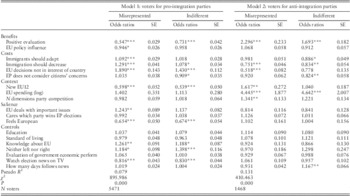
N countries=14. Voters: European Election Study 2009, www.piredeu.eu; Parties: www.profiler.eu. Models 1 and 2: multinomial models with represented=reference category.
*P<0.05, **P<0.01, ***P<0.001.
Variance in individual EU salience is another explanation which differentiates between the misrepresented and the represented category of voters. They are less likely to be misrepresented if the EU is an important issue for one’s voting decision. Those voters who identify with Europe are 24 and 20%, respectively, less probable to fall in the category of misrepresented or indifferent than those voters who do not feel Europeans (Table 1, odds ratios 0.76 and 0.80). In line with the initial expectation, the higher the salience of the EU, the higher the probability of being represented on this issue. This finding is partly in line with previous research about issue voting and issue salience (de Vries et al., Reference de Vries, van der Brug, van Egmond and van der Eijk2011). However, salience does not differentiate between the indifferent and misrepresented groups. Similar numbers, 26 and 21%, respectively, out of those who feel European are misrepresented and indifferent. The two categories may attribute similar importance to EU integration but opt for a different stance on this issue. Whilst EU salience impacts on voters’ attained level of representation, the systemic EU salience – that is, the importance that parties attribute to EU integration – does not impact on the attained level of voter representation.
This analysis points to the fact that a large number of voters for pro- and anti-integration parties are in favour of maintaining the status quo and do not want further integration. Even if they follow the news regularly, they still consent to be represented by an anti-integration party. When status quo voters choose an anti-integration party (Table 3, model 2, indifferent), their decision is not based on whether EU issues are salient or not. Therefore, EU salience cannot explain why voters fall in the indifferent category in this situation.
The perceived (non)economic costs of integration and their influence on representation is, as expected, negative. The higher the perceived threat by other cultures through immigration, the lower the level of representation attained. One-third of Europeans believe that EU has had a negative influence on the level of immigration to their own country. Out of those citizens, a majority of 60% reside in old member states, where immigration levels are much higher than in new member states. The cultural threat is widespread across all EU countries: 74% of the European electorate support the idea that immigrants should adapt to the host culture and one-third of the electorate also think that immigration has become worse and increased over the past decades (EES 2009). However, those who believe that immigration should decrease in their country are 15% more likely to be misrepresented and 4% more likely to fall in the indifferent representation category (odds ratio 1.15 and 1.04, Table 1) than to be represented. The reason behind their choice rests on the knowledge held about the EU in general (odds ratio 1.14), which could ultimately influence them to choose a pro-integration party rather than the opposite. The vote choice for a pro-integration party is further analysed in the next section.
What differentiates representation by pro- and anti-integration parties?
The analysis of costs and benefits is better reflected when the analysis of representation is conducted separately on samples with voters for pro-integration parties and the same is repeated for voters of anti-integration parties (see Table 3).
The analysis reported in Table 3 is the result of two separate multinomial logit models for representation by pro- and anti-integration parties. The number of voters and countries for both models are reduced as anti-integration parties operate only in 16 EU countriesFootnote 5 in 2009.
At the individual level, the results demonstrate the robustness of previous findings reported in Table 1. With this analysis, we are better able to explain representation in both directions. EU satisfaction works in the expected direction and has a stronger effect in the group of voters for pro-integration parties. The more satisfied with the EU, the higher the probability to vote and be represented by a pro-integration party and also the lower the likelihood to favour the status quo and vote for a party promoting integration (model 1, Table 3). Additionally, the higher the perceived costs of integration – both in terms of immigration and political implications for member states – the greater the probability of being represented by a party opposing integration (model 2, Table 3). Perceived costs in the form of threat from immigration and EU decisions taken against the interest of member states are the strongest explanations for why voters chose representation by a Eurosceptic party. In 2009, a majority of EU citizens expressed no confidence that EU decisions are in the interest of their own country.
When the perceived costs of integration are high, the probability of being represented by a party opposing integration increases. The results in Table 3, model 2, point towards perceived costs having the effect of reducing the probability of falling into the indifferent category by an average of 15%. The reverse situation, however, has a higher probability. Indifferent voters who prefer the status quo may also end up voting for pro-integration parties (Table 3, model 1). Perceived high costs makes them choose a party promoting further integration, most probably because in this case, they have some knowledge about the functioning of the EU (odds ratio 1.18), which does not make a significant difference when they chose a Eurosceptic party. Additionally, the results show that, alongside having some knowledge about the EU, status -quo voters who watch election-related news on TV are more likely to vote for a pro-integration party (model 1, Table 3). Overall, voters in the indifferent category are highly educated but do not have a clear interest in politics or a clear left or right political orientation (Table 1). They can nevertheless be mobilized by the visual media (Table 3, model 1) and subsequently influenced to choose a pro-integration party.
Citizens who prefer the status quo and vote for an anti-integration party follow news regularly from various other sources (model 2, Table 3). This draws attention to the importance of the media tone and content. TV news seem to drive the pro-EU representation while diverse news content fuels status quo votes for the Eurosceptic parties.
Misrepresentation by parties against EU integration increases significantly in party systems where competition is carried out on more than three dimensions. This is clearly an indication that other dimensions such as taxes, welfare, morality policies, or environment carry heavier weight in the eyes of the voters. In those situations, voters may choose to get informed and be represented on other dimensions which they deem to be more important.
Another significant detail which transpires when the analysis is repeated this way is that voters in the new EU12 are significantly less likely to be misrepresented or indifferent when they vote for a party for integration. Perceived benefits are an important explanation for high-quality representation when voters choose a pro-EU party. Against initial expectations, actual benefits from the EU budget do not impact on the quality of representation by pro-integration parties. These benefits, however, seem to be de facto very high in systems where voters are 4.4 times more likely to be misrepresented and 4.6 time more likely to allow an indifferent representation by anti-EU parties (Table 3, model 2).
Conclusion and implications
This article applied a novel approach to the concept of representation and has matched actual party positions with their voters’ positions on EU integration. The quality of substantive representation was measured by the degree to which the view of the voters and the parties they vote for in European Parliament elections align. Hence, the paper proposes three categories of representation: represented, misrepresented, and indifferent. The results show that the gap between elite and voters is indeed widening, especially if more and more voters prefer the status quo with regards to European integration.
By applying a cost-benefit argument to the quality of representation on European integration across the EU27, the analysis shows that the quality of representation is driven by perceptions of benefits, rather than by real benefits. Perceived benefits have a strong and positive impact on the likelihood of a match between the voter and his party’s preferences on EU integration. Conversely, high perceived costs of integration drive representation by pro-integration parties to very low levels, especially when immigration is considered a threat by the voters. The actual benefits received from the EU budget by each country were hypothesized to positively influence the match between the voter and party preferences on EU integration. At odds with initial expectations, in countries where EU spends the most per capita, we do not necessarily find better representation. In fact, where EU spending per capita is high, voters are either misrepresented or indifferent and highly likely to vote for an anti-integration party. More data collection and further research is, however, needed in order to ascertain voters’ awareness and information about actual financial benefits from the EU.
Overall, the analysis finds that represented voters on EU integration do not take into account actual EU spending in their country but have a very positive opinion about the EU’s activity in general and find a sense of efficacy in casting a vote for a party with matching attitudes towards integration. This type of voter can be found especially across new member states. The indifferent voters, who prefer the status quo and yet vote for a pro- or anti-integration party, can be mainly found in old member states and are less satisfied with the way EU works in practice. High perceived costs associated with integration make voters much more disposed to vote for a party opposing integration than to be indifferent. In other words, representation by Eurosceptic parties increases when the perceived costs are high. The misrepresented voters can be satisfied with the EU but are mainly voting for an anti-integration party, especially in countries where party competition takes place along a larger number of dimensions, some of which could be more important that the issue of European integration.
Overall, the impact of costs and benefits from integration is highly relevant for all three categories of representation. As for the mediation factor – EU salience – as expected, representation by parties promoting integration increases when EU is salient for voters and especially when voters think of themselves as Europeans. Whether the EU is salient or not for parties does not make any difference to the quality of representation. Representation can be attained even when the EU is not the most important issue addressed by parties in their programmes and campaigns. Similarly, misrepresentation can occur when the EU is salient for parties. Specifically, even when EU integration is a highly debated topic across a party system, it is the importance of other issues, cumulated with a high number of dimensions of competition, which may influence a pro-integration voter to choose an anti-integration party.
Furthermore, the salience of EU integration cannot explain voters’ choice for the indifferent category of representation, especially when status quo voters choose a Eurosceptic party. An investigation into how the three categories of representation apply to other issue dimensions constitutes an avenue for further research.
This analysis has shown that perceived benefits do drive the perfect voter-party match on EU integration while perceived costs, when high, drive the perfect match between Eurosceptic voters and likeminded parties and make voters less indifferent. The relevance of this analysis extends to the 2014 European Parliament elections, first, because the voters can be divided in the same three categories with regards to their opinion about European integration. By 2014, the number of pro-integration voters decreased by 8%, the anti-integration group gained a similar percentage and the number of status quo voters remained about the same (EES 2014, www.gesis.org). Second, the values of variables found relevant for representation by this analysis corresponds to similar levels amongst voters in 2014. Additionally, the percentage of anti-integration elite has increased as demonstrated by the larger number of Eurosceptic MEPs elected. These developments, cumulated with the findings from this analysis, push representation on European integration into the direction of being increasingly driven by perceived costs rather than benefits.
These results have implications for the future of EU integration and representation. The analysis points to the large number of indifferent (status quo voters) who, in the absence of a party with similar views, in future European Parliament elections could be driven to vote for Eurosceptic parties as a result of the perceived costs of integration. For example, recent waves of immigration following the conflict in Syria could increase the perception of costs from integration and further escalate the levels of representation by Eurosceptic parties. In order to avoid this situation in future European Parliament elections, voters could be better mobilized by increasing the level of information about the EU and the level of awareness about concrete rather than perceived benefits from EU integration.
Acknowledgements
The author would like to address special thanks for insightful comments on previous versions of this article to the editors of this special issue and to all participants in the PSA conference of the Italian Politics Specialist Group, University of Strathclyde, January 2015.
Funding
The research has received no grants from public, commercial, or non-profit agencies.
Data
The replication dataset is available at http://thedata.harvard.edu/dvn/dv/ipsr-risp.
Appendix
Imperfect representation on European integration: recoded distribution per country (%)

List of variables in the analysis