Introduction
According to the dominant narrative, the rule of law has always been cherished as one of the key institutions central to the success in transforming Hong Kong from ‘a barren rock’ into a global city. The bestowing of English laws on the colony is not only seen as leverage for advancing rationality, humanitarian concerns and social progress, but it is also on this basis that stability and development flourished. The colonial administration's respect for the principles of the rule of law, however, has been tested by sporadic political turbulence during the 150 years of British rule.Footnote 1 Due process of law and other key principles of English laws have been compromised by political expediency when the colonizers felt threatened by challenges from various sources.
The 1967 Riots was one of those difficult times. Starting as an industrial dispute, the colony was soon swamped by demonstrations, strikes and bomb attacks. The mobilization of the military and London's contemplation of an evacuation of British families and key government officials testified to the urgency of the situation. With the backing of London, the Hong Kong Governor, David Trench, was determined to contain the spread of violence and deployed an array of coercive and legal measures to combat the challenge from local communist sympathizers. Central to his response was the reactivation of various Emergency Regulations. Mostly promulgated during the early years of colonial rule, these statutes provided great leeway for law enforcement and prosecution. Such expediency, however, came at the cost of compromising key attributes of legality, for example, due process of law, and proportionality of punishment.
Based on the archival records of communication between the Foreign and Commonwealth Office and the Hong Kong Government and internal documents of the local administration and courts available in Hong Kong and London, this paper intends to revisit the implementation of these Emergency Regulations during the 1967 Riots. The paper argues that, despite the facade of public support for firmness against disturbances enjoyed by the colonial government, the exercise of some of these powers, particularly the powers to detain and deport, remained highly controversial. The handling of the prisoners in the aftermath of the confrontation is, however, most revealing of the Britain's respect, or rather lack of respect, for the rule of law in Hong Kong. With normalization of the Anglo-Chinese relationship in mind, these confrontation prisoners—persons tried and convicted in the colonial courts during the riots—now constituted a stumbling block for renewing the friendship with Beijing. Despite the contentious nature of the meaning of the rule of law, the various attempts by London at pressurizing the Hong Kong government for early release of these prisoners uncovered the prevalence of political expediency over the respect for this cherished principle under colonial rule.
Law and order as the primary concern
The disturbances in 1967 started in an artificial flower factory in Kowloon when an industrial dispute turned into a riot. The communist-dominated Federation of Trade Unions immediately intervened on behalf of the workers. Four demands were made:
1. immediate release of the workers arrested;
2. punishment of the evil doers and compensation;
3. guarantee of the workers’ personal safety;
4. no interference henceforth by the police in a labour dispute.
The turning point was the intervention of the Chinese Ministry of Foreign Affairs on 15 May 1967. A protest statement was passed to the British Chargé de Affaires in Beijing, followed by anti-British demonstrations in Beijing and Guangzhou and sympathetic editorials in the Renmin Ribao.Footnote 2 For many local radicals, these were clear signs of approval for action in Hong Kong. The formation of the All Circles Anti-Persecution Struggle Committee in Hong Kong heralded the full-scale mobilization of local communists into the territory-wide anti-colonial campaign. The labour dispute was quickly supplanted by demonstrations, strikes, marches and bomb explosions, and the original concern for industrial relations was replaced by highly politicized slogans of anti-imperialism.Footnote 3
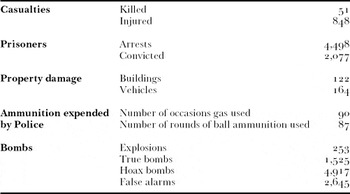
It is important to reiterate the intensity of the confrontation. The statistics summarized in Table 1 are indicative of the ferocity of aggression from both sides of the conflicts. As it became apparent that the disturbances would not subside within a short time, the colonial government decided to change its early stance of restraint to a more proactive approach in handling the situation. The clash with Chinese militia at the border on 8 July 1967, resulting in the death of five Hong Kong policemen, proved to be the turning point. The government's determination on swift and decisive action was heralded by its removal of the Police Commissioner, Edward Tyrene, on 12 July 1967. The official explanation for his retirement was medical reasons, but his immediate relief from duty was mainly attributed to the colonial administration's loss of confidence in his leadership. As uncovered in a top-secret document, ‘his reluctance to commit his forces to firm action’ and ‘anxiety about the use of excessive force’ were the major indictments. Now determined to make a swift and forceful response to the communist challenge, the Hong Kong Government was prepared to take the extreme measure of interdiction if Tyrene refused to obey orders.Footnote 4 The raids on union premises, the widespread arrests of ringleaders, and the closure of pro-Beijing newspapers that followed significantly weakened the organizing capability of communist sympathizers.
Statistics relating to disturbances in Hong Kong, 11 May 1967 to 1 June 1968

Source: The National Archives (TNA), FCO 40/53, Serial No. 115, June 1968.
Yet, the diehard supporters of this anti-colonial campaign were not easily swayed by these measures. Instead, they retaliated by escalating the disturbances to an even more extreme form of violence: bomb attacks. The severe interruption of normal life and the intended or unintended victimization of civilians by the bombing campaign only further reinforced the colonial government's determination for firm action. Public opinion was tilted in favour of the government, and opinion leaders called for tougher measures to maintain law and order. More than 600 social organizations pledged their public support to the Governor during the early weeks of the Riot.Footnote 5 Ruttonjeb, the senior unofficial member of the Legislative Council at the time, provided his assessment of the public mood on behalf of the whole Council:
[a]t the moment of crisis the people of Hong Kong stood foursquare behind you and it was then the true spirit of Hong Kong emerged. By their words and by their deeds, the public has given you, Sir, and will continue to give you, a vote of confidence of a kind and unanimity which is the stronger for not being counted in upraised hands and nodding heads. In fact one may say that the situation we faced wrought a miracle—an unanimity of spirit and purpose which never before existed.Footnote 6
In its editorial on 23 May 1967, the South China Morning Post, a leading English-language newspaper in the territory, voiced its unequivocal support for toughness:
There is only one way to deal with trouble-makers: make them pay thrice over for their trouble making. Central District is the heart of this huge trading and industrial community. Those who are out to clot its arteries are no good to Hong Kong, no good to fellow citizens. They must be treated with exemplary firmness. And if thereafter their presence here is banned in perpetuity, they will be no loss.Footnote 7
In a motion debate in the Legislative Council, Y. K. Kan, the senior unofficial member of the Council, proposed that the death penalty should be extended to those involved in bomb attacks, and argued that ‘those who perpetrate them without regard for human life must be made to realize that if they are caught they may have to pay the extreme penalty that the law can impose’.Footnote 8
Reactivating the Emergency Regulations
Reactivation of the Emergency Regulations was part of the mobilization process against the communist threat in 1967. Unlike other British colonies that were given emergency powers by London in 1939 as measures to deal with the security situation in World War II,Footnote 9 Hong Kong had a much longer history of deploying such extraordinary powers in handling crises. The Peace Preservation Ordinance was first introduced in the 1850s in response to the strikes and riots incited by the Second Opium War in 1856. This legislation provided a long list of draconian measures for tackling social unrest and hooliganism during the early years of colonial rule, including the power to arrest and deport without a warrant and the flogging of offenders. Several amendments to the Ordinance were made that extended the government's powers of censorship, and measures such as appropriation and disposition of property.Footnote 10
The Emergency Regulation Ordinance was officially passed in 1922. The Ordinance provides that ‘[o]n any occasion which the Governor-in-Council may consider to be an occasion of emergency or public danger he may make any regulations whatsoever which he may consider desirable in the public interest’.Footnote 11 The latitude enjoyed by the Governor was further strengthened by the absence of three provisions concerning the exercise of these powers. First, the Ordinance does not require the Governor to declare a state of emergency in Hong Kong before bringing these powers into effect; second, there is no provision for the Legislative Council to meet and approve any application of the Ordinance.Footnote 12 In Britain, when civil unrest occurs and the government intends to exercise the list of extraordinary powers conferred by the Emergency Powers Act 1964, the government must, in the name of the Crown, issue a proclamation declaring a state of emergency. And where a proclamation is made, parliament must be immediately informed, and if in recess, must be recalled within five days for a debate on the issue.Footnote 13 And last but not least, the European Convention on Human Rights, ratified by the British Government in 1950, was not applicable in Hong Kong.Footnote 14 In short, the Colonial Office in London was in effect the main gatekeeper against possible abuse of powers by the colonial government. Whilst, during the 1960s, a number of these emergency regulations were revoked after their provisions had been incorporated in other ordinances (such as the Public Order Ordinance), most of the regulations were codified into the Emergency (Principal) Regulations and were available for reactivation whenever the colonial government found it necessary.Footnote 15
Instigation of emergency powers appeared to be part of the standard protocol of British colonies in tackling local crises. Emergency regulations were proclaimed as a response to the insurgency in Malaya in the late 1940s, providing the colonial governor with powers to close roads, impose curfews, search premises and persons suspected of having weapons, impose restrictions on freedom of speech and assembly, and to arrest and detain persons without trial in open court.Footnote 16 Similar powers were extended to the local administration during the twilight years of British rule in Aden before its abrupt withdrawal in 1967.Footnote 17 Yet, while most colonial officials exercised these powers with restraint and moderation, the danger of allocating extreme and wide-ranging powers was fully exposed in Kenya during the Mau Mau Rebellion (1952–1960). Colonial governors had shamelessly turned the colony into a police state with ‘concentration camps’ erected across the country and countless cases of excessive brutality and infringement of human rights during this period.Footnote 18 In the case of Hong Kong, 12 emergency regulations were effected during the turbulent time of 1967. These regulations dealt with police seizure of weapons, the opening and closing of premises, the obligation to provide a name and address when approached by disciplinary forces, the regulation of assemblies, offences against the police or army, dissemination of inflammatory materials and speeches, possession of explosive materials, trial without public proceedings and, most controversially, the right to deport and detain.Footnote 19
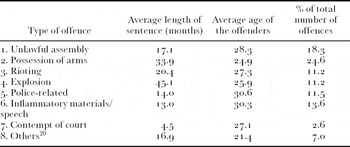
These regulations undoubtedly provided the disciplinary forces with more leeway in tackling the confrontation, and proved to be effective leverage in restoring order in the territory. The question, however, is whether the exercise of these extraordinary powers, with due process of law and individual liberty being compromised, was justified or not. Or, to put it in another way: how bad was the situation in 1967? The normal life of the city was certainly interrupted by the waves of demonstrations and sporadic violence, while stories of the death of two young girls in a bomb attack and the murder of the broadcaster Lam Bun, who was renowned for his criticism against rioters and leftists, are integral parts of the local memory of 1967. Yet there has been no systematic effort to analyze the real extent of violence in the confrontation, and these cases of extreme violence may or may not reflect the full picture of the reality. The court records available in the Hong Kong Public Records Office allow us to conduct an extensive review of the issue. These records provide information on the offences committed by 634 offenders, being 30.5 per cent of the total number of people convicted during the disturbances. In other words, an analysis of these data should provide us with a good sense of the magnitude of violence during those turbulent months.
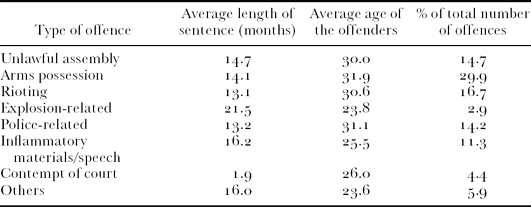
As reflected in Table 2, about one-third of the sentences were related to non-violent offences, for example, unlawful assembly, possession or display of inflammatory materials or making inflammatory speeches, and contempt of court. Offenders prosecuted for their participation in unlawful assembly were 18.3 per cent, yet it seems that they were treated no differently from those who had actually committed riotous acts or more violent conduct (Item 3, Table 2). In defence of his two clients who were sentenced to nine months’ jail for unlawful assembly, G. Hamilton of Hastings and Co. tried to argue that his clients, like many others, were simply ‘sheep’. He argued: ‘these people were those who perhaps, from a slight degree of fear, wandered into the crowd and feared for their own safety if they did not appear enthusiastic’.Footnote 21
Offences committed by disturbance prisoners

Source: Hong Kong Public Records Office (HKPRO), (HKRS) 179-1-19 (Parts I & 2), HKRS 179-1-23, HKRS 292-2-1 (Part 2), HKRS 292-2-1 (Part 3), HKRS 41-2-726 (Parts 1, 2 & 3).
The courts, however, were not prepared to accept such a lenient view. Judge A. L. Leathlean, at the Central Court, dismissed the defence argument of participation as a result of duress and claimed that:
if such people were merely to be bound to keep the peace or otherwise leniently dealt with, and were in future to be ordered to or intimated into disrupting the public peace, there must inevitably [be] the danger of their regarding the sanctions of the law as the lesser of two evils.Footnote 22
Rulings on offences related to inflammatory materials were no more merciful either. With ‘winning hearts and minds’ (as we might say today) seen as imperative for the victory against subversion, the colonial authority had adopted a very aggressive approach in prosecutions against possession and dissemination of anti-government materials. Tsang Tak Shing, an 18-year old youth, ‘won’ his hero status in the pro-communist camp with his two-year sentence for distributing anti-colonial leaflets in school. Some of these ‘inflammatory materials’ were, however, controversial.Footnote 23 In some cases, these illegitimate materials were merely cuttings from pro-Beijing newspapers that the colonial government allowed to be published in the territory.Footnote 24
There were another 47 per cent of offences that were related to the more violent acts of possession of arms, rioting and causing, or intending to cause, an explosion. The cases of possessing arms and causing, or intending to cause, an explosion were certainly the major challenges to law and order, and the relative severity of the punishment inflicted upon the offenders is indicative of the sentiment. The first life imprisonment sentence was handed to a 22-year old worker who planted a bomb in a telephone booth in Tsuen Wan on 23 November 1967. The authority's determination to deter the wave of bomb attacks was vividly reflected in another verdict made earlier.Footnote 25 A 14-year old, who had placed a bomb on a pedestrian crossing, was given a 4-year term in jail, instead of at a training centre—a correctional institution designed for juvenile delinquents—as Judge R. O'Connor believed that ‘the sentence would serve [as] a warning to others’.Footnote 26
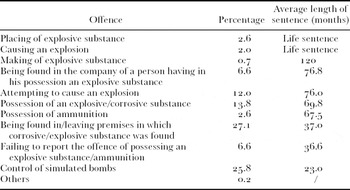
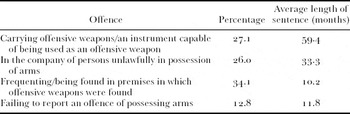
It is, however, particularly noteworthy that a considerable number of those convicted were not actually directly involved in the possession or planting of bombs (Table 3). That is, although they were not the actual perpetrators of the crimes, their involvement was regarded as, in some way, facilitating or assisting the principal offenders’ actions and thus they were held criminally liable. Of the offenders in this category, 6.6 per cent were indicted for being in the company of other persons who were in possession of an explosive substance. And it is noteworthy that these offenders received a similar, or even more severe, punishment to those who had attempted an explosion or had been found in possession of explosive materials. Another 27.1 per cent of offenders were guilty as a result of their presence in premises where explosive substances were located. A similar pattern can be seen in the offences related to arms possession (Table 4) with 60 per cent of offenders having been found guilty under similar circumstances, namely of being found in the wrong place and in the wrong company. These prosecutions were, in fact, a result of the amendments to the Emergency (Principal) Regulations made in July 1967.Footnote 27 These new powers had greatly facilitated law enforcement, the police having previously found it difficult to charge people who they believed were part of a conspiracy against public order, but who were not caught in physical possession of weapons or explosive substances. With these amendments in place, the police could now, in certain circumstances when they believed it was reasonable to presume that these suspects were, in fact, actively involved in certain subversive acts, make an arrest. From the police perspective, successful prosecution of secondary participationFootnote 28 probably helped weaken the capacity of the pro-communist camp significantly.
Breakdown of explosion-related offences

Source: Hong Kong Public Records Office, HKRS 179-1-19 (Parts I & 2), HKRS 179-1-23, HKRS 292-2-1 (Part 2), HKRS 292-2-1 (Part 3), HKRS 41-2-726 (Parts 1, 2 & 3).
Breakdown of Arms-related Offences

Source: Hong Kong Public Records Office, HKRS 179-1-19 (Parts I & 2), HKRS 179-1-23, HKRS 292-2-1 (Part 2), HKRS 292-2-1 (Part 3), HKRS 41-2-726 (Parts 1, 2 & 3).
Detention and Deportation
The greatest controversy over law enforcement during the riots, however, relates to the issue of detention without trial. Winston Churchill once described this measure as ‘in the highest degree odious, and the foundation of all totalitarian government whether Nazi or Communist’.Footnote 29 During the riots, Governor Trench had brought into effect Part III of the Emergency (Principal) Regulations that accorded him special power to detain the ringleaders of local communist organizations. Under Emergency (Principal) Regulations Nos. 29–31, the Governor could detain any person, including those who were entitled to claim citizenship of the United Kingdom and the colonies, for any period up to one year. The major controversy stems from the fact that such detention did not necessarily rest on a breach of the law, or, even if it did, it often rested on evidence that would be inadmissible in a court.
A number of key figures in the local communist camp, particularly those executive members of the ‘All Circles Anti-Persecution Struggle Committee’ (Xianggang geije tongbao fanyinh kangbao douzheng weiyuanhui),Footnote 30 were arrested when the police intensified raids on the premises of trade unions and other leftwing organizations after July 1967. The government, on the one hand, found these people of great intelligence and security interest, and believed that they could obtain a major intelligence dividend if extended interrogation were possible. On the other hand, the government had either failed to establish a firm case of these people's involvement in organizing violence and other subversive activities, or feared that such proceedings might risk exposing sensitive information provided by Special Branch or other security units.Footnote 31 A plea for such a potentially repressive power of detention without trial was promptly entertained by the Commonwealth Office in London.Footnote 32
During the whole confrontation period, a total of 52 people were detained in a special detention centre at Mount Davies, run by the Hong Kong police. The last of these detainees was not released until May 1969.Footnote 33 Chow Wai Hang, one of the detainees, recalled the conditions:
I was kept in a very small room of about 24 square feet. There were small pinholes in the walls so that the guards could watch over me anytime. The light and the electric fan were never turned off. The strong light and the wind, together with the solitary confinement, were physical and psychological tortures. . .All detainees were bombarded with endless interrogations. Detainees were summoned for questioning anytime of the day. You could be called back for further questions when you had just returned to your room after hours of interview.Footnote 34
Not all detainees were British subjects. For people in this category, the colonial government had another powerful deterrent at its disposal: deportation. The colonial administration had a long history of using this power for crime control and containment of unwelcome political activities in Hong Kong. Deportation orders had been extensively used by the Hong Kong government in 1912 to expel political activists involved with the Republican Revolution in China. With the rise of the Chinese Communist Party, local sympathizers for the communist cause soon became the major targets of such treatment. In the post-War period, a number of leftist leaders in trade unions, cultural and art circles had been deported.Footnote 35 Triad elements (gangster clusters that were closely related to the Guomindang) were another source of deportees. Frustrated by the failure to bring witnesses to testify against these criminals, the police regarded such a power as instrumental in the success of their campaign against these triad elements. Henry Heath, the Police Commissioner (1959–1966), once argued:
It is not my contention that all criminals should be deported but I do maintain that the weapon of deportation. . .is our most effective measure and the best deterrent as far as triad members are concerned. Without this we would not have been in the position we are today nor would we have accumulated the wealth of information that we now possess about these societies and personalities. . .The breakdown of deportation and the wholesale recission [sic] of orders had an adverse effect. The criminal element. . .decided that the police were powerless to deal with them by deportation and in the case of triad members they felt reasonably safe from being proceeded against in the Courts owing to the fear in which they were held by those they persecuted. Consequently, they have lost their fear or respect for the forces of order.Footnote 36
There was, however, one major problem. Deportation was not always practicable, as Communist China held the power to accept the returnees or not. For Beijing, such refusal was a testament to her non-acceptance of the legitimacy of the three unequal treaties relating to Hong Kong: the British had no right to rule Hong Kong and thus logically enjoyed no power to expel any Chinese from their homeland. As a result, the Emergency (Deportation and Detention) Regulations were introduced in 1956. These Regulations empowered the Governor-in-Council, in addition to the normal power of detention pending deportation under the current Deportation of Aliens Ordinance, to continue detention if deportation proved impracticable.
The government of Hong Kong had fully utilized these extraordinary powers for security purposes, and between 1946 and 1960, 23,462 deportation orders had been issued, and more than 40,000 people had been detained under these Regulations.Footnote 37 Governor Alexander Grantham (1947–1958) argued that these were necessary as ‘there were some thousands of these people who are banded together in societies which have no respect for law and order, are composed of desperate men, and may at any time resort to open violence when a favourable opportunity presents itself’.Footnote 38
Such administrative discretion to deprive an individual of liberty with the attendant compromising of due process of law was not without criticism. Members of justice were concerned, and in a report sent to the Legal Adviser of the Secretary of State for the Colonies, worry about possible abuse was raised, and the justification for the colonial government to maintain these powers was also questioned. In comparing it with the exercise of emergency powers in the United Kingdom, the author of the document argued that ‘as soon as the war was over no time was wasted in the U.K. in removing these powers which must be classed as obnoxious in times of peace’, and he went on to challenge the discretion continuously enjoyed by the Hong Kong colonial administration ‘given the only threats to its law and order during the last 10 years would appear to have been nothing more serious than a short lived 3 or 4 days rebellionFootnote 39 by underground “protection” societies, locally known as “triad” society’.Footnote 40
In response to these domestic and external pressures, changes were made to the administration of the system in 1962. Based on the report prepared by a working party, a recommendation by the newly formed Deportation and Detention Advisory Tribunal, which was presided over by a judicial officer with two independent members appointed by the Government, was now necessary before the Governor-in-Council could make a decision on deportation cases. And for those who were detained because a deportation could not be carried out, their cases would be reviewed by the Tribunal annually, and its recommendation would be considered by the Governor-in-Council. However, the Governor was entitled to reject the recommendation and was not required to give an explanation for his decision. He also reserved the right to rule on whether cases of ‘political sensitivity’ were suitable for the Tribunal procedure. There remained no limit on the length of detention either.Footnote 41
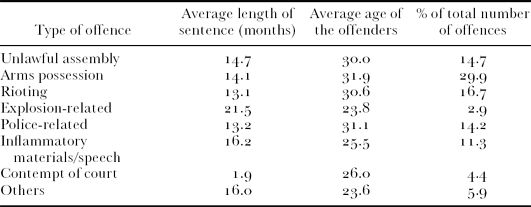
Deportation was certainly a weapon fully utilized by the colonial government during the 1967 Riots. Unfortunately, the exact figure for deportation orders issued during this period is not available. The following analysis, as summarized in Table 5 below, is based on the details of 121 cases recommended for deportation under the Deportation of Aliens Ordinance that the author managed to locate in Hong Kong.
Offences committed by persons recommended for deportationFootnote 42
Source: Hong Kong Public Records Office, HKRS 41-2-276 Parts 1, 2 & 3.
The statistics here confirm the draconian nature of the practice. As seen in Table 5, only a very small minority of cases recommended for deportation was related to explosions. And even if the offences of arms-possession and rioting are taken into consideration, offenders involved in violent crimes still constituted no more than 49.5 per cent of the total number of cases. In fact, the average length of sentence recorded here is relatively short (19 months), and the dominant majority (96 per cent) of offenders recommended for deportation were without previous criminal records.Footnote 43 In other words, whether these offenders really constituted a great menace to public security, and thus warranted such severe punishment as deportation after completion of their jail term, is highly contentious.
And factors such as the offenders’ period of residence in the Territory and the fact that deportation would separate a married man from his dependants appeared to be irrelevant. For instance, Cheung Pui was a 36-year old worker with a wife and a child who came to Hong Kong in 1946. He received a 6-month sentence for obstructing the police and possession of arms in 1967, and was recommended for deportation upon completion of his jail term.Footnote 44 Wong Yee Nei, a 25-year old mechanic, who settled in the colony five years before the Riots, met a similar fate. He got a 12-month sentence for unlawful assembly in June 1967. Despite the fact that he had a family of two dependants in Hong Kong and had no record of previous convictions, he was recommended for the extra punishment of deportation.Footnote 45 Yet there was no available evidence indicating a history of political agitation by either of the two men.
These two cases were hardly exceptional. Of the potential deportees, 27 per cent had dependants in Hong Kong. While the average age of these people was 29.5 years, the average length of residence was 14.4 years.Footnote 46 In other words, most of these people had spent half their adult life in Hong Kong and had settled in the colony by the time they were recommended for deportation. Taking these factors into account, even if these potential deportees were likely to be communist sympathizers, or even, maybe, in some way affiliated with leftist organizations, it is disputable whether these offences really justified the severe retribution of permanent expulsion.
The End Game
The elaborated accounts above appear to attest to the colonial government's determination to assert law and order in the Territory during the trying time of 1967. Ironically, the greatest challenge to the government's firmness in upholding the respect for law did not come from local communists or Beijing. The major battle for preserving the dignity of the colony's legal system was fought between the Hong Kong government and the Foreign and Commonwealth Office in London when the conclusion of the disturbances was on the horizon. By then, these confrontation prisoners were no longer seen as proof of the success of the colony's containment policy, but as an obstacle to the resumption of the Anglo-Chinese relationship.
Violence in the Territory began to show signs of subsiding from late 1967. The police raids on union premises and arrests of ringleaders had probably seriously interrupted the operation of the anti-colonial campaign. The obligation to provide for the daily needs of thousands of workers who responded to the call to strike also constituted a severe financial strain on leftist organizations. Local pro-communist papers had toned down their coverage of bomb attacks since late 1967, although rhetorical attacks on the injustice inflicted by colonial rule lingered. Optimists also took their cue from several moves by Beijing, seen as signs of moderation. Beijing had authorized negotiations with the British-side over the release of several Hong Kong police officers who were detained in China, and the Guangzhou Trade Fair, one of the few opportunities for the outside world to engage with China in the 1960s, was also given the green light in late 1967.Footnote 47
The subsiding of violence in the colony coincided with a new twist in the factional struggle in Beijing in August 1967. Mao Zedong's call for greater enthusiasm towards the Cultural Revolution in early 1967, and his decision ‘to arm the left’, had single-handedly contributed to the rising violence between different Red Guard groups.Footnote 48 In the summer of 1967, cases of armed confrontation between Red Guards and the army, and even raids on arsenals, were reported. In August, China was on the edge of civil war when serious armed conflicts broke out in major cities such as Nanjing, Changsha, Shenyang and Chongqing.Footnote 49 The escalation of violence and uncertainty over the reaction of the military prompted Mao to reconsider his revolutionary tactics. Consequently, the power balance was at least temporarily tilted in favour of the moderate faction. And, luckily for moderates like Zhou Enlai, this change provided a breather amidst the political storm. The relative tranquility in Hong Kong from late 1967 apparently coincided with these developments.
Emboldened by these developments, diplomats at the British mission in Beijing, who were always in favour of more compromise in the approach to handling the crisis, took the initiative in pressurizing the Hong Kong government to make further concessions to placate Communist China. While the colonial administration was occupied with the daunting task of reversing the adversities of the vehement anti-colonial campaign in the Territory, these diplomats perceived their primary mission as being to contain the damage by these developments in Hong Kong to the long term Anglo-Chinese relationship. In addition, they were also concerned with their own personal safety and that of a number of Britons who were held hostage by the Chinese authorities.Footnote 50 Among these British hostages was Anthony Grey, a Reuter's reporter who was under house-arrest in retaliation against Hong Kong Government's arrest of some New China News Agency journalists in the colony. As early as August 1967, Donald Hopson had tabled a proposal for the early release of the NCNA reporters as a way to secure freedom for Grey. As a face-saving tactic for Hong Kong, Hopson recommended that these prisoners should be deported to the mainland.Footnote 51 Sympathetic ears were found among officials in the Commonwealth Office, hinting at support for the suggestion made that ‘an amnesty for those serving sentences for curfew breaking or minor breaches of the peace could be made at opportune time’Footnote 52. The Foreign Office was also under growing public and parliamentary pressure to demonstrate that efforts had been made to ameliorate Grey's conditions in Beijing,Footnote 53 and to see deportation as a possible way forward to de-escalate the tension with China.Footnote 54
David Trench, Governor of Hong Kong, however, disagreed. His position was that the Hong Kong government had, in fact, made a number of concessions since late 1967. These included withdrawal of the army from frontline positions along the border and a one-month amnesty for possession of explosives, arms and ammunition.Footnote 55 Trench went further and argued that a decision in favour of the early release of confrontation prisoners ‘would be widely interpreted as a sign of weakness’ in Hong Kong, and if such a compromise were made, Beijing ‘would merely pocket the concession and ask for more’.Footnote 56 For Trench, unconditional or early release of these prisoners who had committed criminal offences and convicted in due process of legal proceeding in colonial courts was simply unacceptable. Perhaps the most convincing argument in support of Trench's position was that deportation simply would not be accepted by Beijing. This was confirmed by the failed attempt of the ‘release to China’ of two pro-Beijing film stars in March 1968. Fu Ki and Shek Wai were detained by the Hong Kong police after July 1967. The couple was chosen as a test-case to ascertain the attitude of the Chinese authorities towards deportation. The plot failed in a spectacular fashion with the couple being stopped on the Chinese border at Lo Wu and being returned to the colony after 30 hours of stalemate.Footnote 57 It was followed by an official protest from Beijing condemning the British violation of the Chinese right to reside in Hong Kong.Footnote 58 It seems that nothing short of unconditional release of these prisoners in Hong Kong could placate the Chinese authorities.
Trench's resistance was, however, greatly undermined when Britain was eventually fully convinced of China's determination to resume normalcy. A decision to re-deploy ambassadors overseas made at the 9th Congress of the Chinese Communist Party held in April 1969 heralded a dramatic shift from the radical approach of China's foreign policy. Although Trench succeeded in resisting a total retreat from his general position on the prevalence of local legal process, he certainly felt the heat, and eventually made a major concession over the early release of a number of confrontation prisoners in the summer of 1969. Under Hong Kong prison law, the Prisons Board of Review was in a position to consider remission of sentence in respect of all prisoners imprisoned for terms exceeding six years. However, in response to pressure from London, the Governor exercised his discretion as provided by Letters Patent, and instructed the Board to review the sentences of all prisoners serving sentence of four years or more. This change enabled the Board to consider more prisoners for remission and consequently led to the early release of a number of confrontation prisoners in October 1969. Among the beneficiaries was Wong Chak, a journalist whose situation the Chinese authorities had equated with that of Grey. Originally, he was given a five-year term and was not due for release until 1971. The Governor's compromise made Wong eligible for review and, more importantly, allowed him to walk free two years ahead of schedule.Footnote 59 The good news was that the release of Grey quickly followed. The bad news was that this was just the beginning of the Governor's journey on a slippery slope.
By early 1970, more and more officials within the British administration saw the confrontation prisoner issue as not only related to a British hostage in China, but as a touchstone in Anglo-Chinese relations. Although they were not yet entirely convinced of the doomsday view held by British diplomats stationed in Beijing, who regarded the issue as having led to a noticeable deterioration in the relationship with Communist China,Footnote 60 they had become increasingly enthusiastic about exploring possible options for an early conclusion to this thorny issue since the early months of 1970. Gender, physical condition and the age of prisoners had been raised by officials in London as possible grounds for the remission of sentence. Officials in the Foreign and Commonwealth Office further tightened the screw by highlighting the possible ‘exemplary’ nature of the sentences for confrontation prisoners and exploited this as justification for selective premature release of prisoners. Drawing a comparison with the situation in Cyprus in the 1950s, they raised the point that:
there is a precedent whereby, following the restoration of order after an emergency, the government of a dependent territory with the agreement of HMG has authorized the release of prisoners convicted of serious offences on the furtherance of political aims other than those involving violence against the person. . .. dependent territories are under standing instructions to bear in mind the need for review of sentences of long term prisoners where those sentences were designed primarily as a deterrent.Footnote 61
The issue had become an irritant between London and Trench. According to Arthur Maddock, Political Advisor of the Hong Kong Government (1968–1972):
The Governor took it pretty badly and he became a little neurotic, in my view, about London's desires: ‘To improve relations with China’. These became almost fighting words with Trench. . .So, the more people wrote to him from London about improving relations with China, or the more Ministers, like Anthony Royle or Lord Shepherd, came to Hong Kong and spoke in these rather general terms, the more inclined he was to think that this was a pretty undesirable effort to get some benefits for London in China at the expense of Hong Kong.Footnote 62
The pressure for a solution was certainly felt among the colonial officials as well. Deny Roberts, Attorney General of the colony, had helped to test the idea of gender as the basis of remission, a principle previously regarded as unjustifiable by Trench, at a Prison Review Board meeting while the Governor was away.Footnote 63 And it was obvious that Foreign and Commonwealth Office officials were now less convinced of Trench's argument that early release of prisoners was a sign of weakness and became more impatient with Hong Kong. They argued in late 1970 that ‘the situation is now calm, three years have passed, and pressures are muted’ and the specific suggestion that the Governor should release all remaining prisoners within 1971 was made.Footnote 64 Some officials even opined that the Governor was under no statutory obligation to follow the advice of his unofficial members of the Executive Council, who had been resentful of the pressure for the early release of prisoners.Footnote 65 As one official in the Foreign and Commonwealth Office bluntly put it, ‘the interests of Hong Kong and ourselves in this matter were not entirely the same’.Footnote 66 It takes no genius to work out which interest would eventually prevail.
The arrival of a new Governor, Murray MacLehose, in November 1971, coincided with acceleration of the release process. MacLehose appeared to be more flexible on this matter and intended to ‘work for a solution in the course of 1972’, ‘provided the opposition is not insuperable’.Footnote 67 In this same communication with the Foreign and Commonwealth Office, MacLehose made it very clear that he believed ‘failure to maintain momentum on this issue (of early release of confrontation prisoners) might prejudice my entire governorship’.Footnote 68 He went on to elaborate his approach in handling the colony's relationship with China:
The era of US confrontation of Communism in the Far East is ending so too may be the era of Chinese isolation. It is not all clear what the features of the new era will be, nor what effect these will have on China's willingness to tolerate a colony on her doorstep—however profitable its existence may be. I think that all Hong Kong government can do about this is to ensure that the advantages China obtains are maximized and the disadvantages and loss of face are minimized—consistent with the security of the colony.Footnote 69
In other words, the mood had now changed. The imminent exchange of ambassadors between London and Beijing fuelled further impetus for clemency for confrontation prisoners and, as a result, the credibility of the Prison Review Board in Hong Kong was stretched to the limit. In June 1972, the Board reduced the sentences of six of the remaining 17 prisoners which would allow them to walk free by the end of that year. There were, however, four ‘hardcore’ prisoners that the Board was very reluctant to treat leniently. All four had either killed or seriously injured police officers or members of the public and had been given long sentences.Footnote 70 The Governor's attempt to defend the Board's position on legal grounds was, however, destined to failure, given the mounting political pressure. The Governor's position was made totally untenable by the intervention of Zhou Enlai in late 1972. When the Chinese premier met the British Secretary of State in November 1972, he announced that China would soon release all remaining British detainees on the mainland. Although Zhou did not tie this in with the fate of confrontation prisoners in Hong Kong, he did express the hope that the issue could be resolved. For the British, the message was simple: the Chinese would not make a move on the release of the detainees until they saw some action from the British.Footnote 71 Compromise of the dignity of the colonial system was inevitable. Two life sentences were commuted to 8-year terms in January 1973, and with this final act of surrender, all confrontation prisoners were released on 3 May 1973.Footnote 72
Conclusion
The development of Hong Kong's criminal justice and legal system is hardly a matter of linear progression, and the stories of 1967 reveal the complexion of the path of evolution of the colony's penal system. The drive for humanity, rationality and scientific treatment inherent in penal reforms could be easily derailed by domestic security concerns or political calculation by the sovereign power. David Trench and the Hong Kong police could take pride in their success in maintaining order in the colony during the summer of 1967, and, on reflection, the unabated disturbances and random violence that culminated in the terrorism of bomb attacks certainly warranted swift and firm responses from the authorities. Yet, the imperative for stability should not blind us to the possible penal excesses, or even brutalities, in the name of law and order during the confrontation. The limited data available provide us with snapshots of the implementation of justice during the 1967 Riots, and the accounts depicted above surely justify questions regarding the colonial administration's respect for due process of law, proportionality of punishment and basic liberty during the confrontation in 1967. The dangers of exemplary punishment and broad-banding are evident in the process of administration of justice during this trying time.
The notion of incompatibility between the spirit of the rule of law and the imposition of draconian measures for maintaining order is certainly contestable. Even liberals would agree that there is no liberty except under law, and when there is a genuine threat to the very existence of the law itself, liberty may need to be temporarily compromised.Footnote 73 It depends very much on one's definition of the rule of law. Perenboom has succinctly summarized the essence of a ‘thin-theory’ of the rule of law: the concept entails transparency, general applicability, clarity, consistency, enforceability and acceptability of laws with prospective effect and formalization of procedures for law making.Footnote 74 And if we are satisfied with this notion, the various extraordinary measures implemented during the 1967 Riots should not be seen as proof of the colonial administration's disrespect for the rule of law.
However, some critics would argue that it is not just the existence of laws, but the existence of ‘good laws’ that constitutes the rule of law. Accordingly, good laws are not just laws that can maintain order, but should be grounded in some normative foundations cherished by the population under these laws; respect for human rights is probably high on the list.Footnote 75 And one should also note that even the British government, which has a history of acquiescence to its colonies’ extraordinary measures in crisis management, did not always agree that insurrection would justify all ‘necessary actions’. In the Devlin Commission Report (1959) on the colonial administration's crisis management in Nyasaland, Central Africa, it stated:
In an emergency a government is entrusted with sweeping powers of legislation. In ordinary times it is the duty of the law-maker to find a balance between the powers that should be granted to government and the freedom that should be left to the individual. The existence of an emergency does not absolve the government as law-maker altogether from this duty.Footnote 76
The Report claims that ‘there was at every level of the administration an indifference to and misuse of the law. . .and the Emergency Regulations were treated solely as a source of power to be exploited and added to if necessary and not as setting any limits to what the Government could do’.Footnote 77 Although such a candid reflection on the response to crisis and accord with the rule of law is exceptional in imperial history, this unique verdict may provoke further thoughts on the imperviousness of the argument of political expediency.
It is not the intention of this paper to jump onto the post-handover bandwagon of anti-colonialism, and it is also a misguided question to ask ‘who fired the first shot’ in triggering the violence in 1967.Footnote 78 But, by uncovering the intricacies of the implementation of justice in the trying time of colonial rule, this paper may contribute to a more nuanced understanding of the nature of the tensions during the confrontations in 1967.
At a time when the notion of accountability and popular control was deemed an alien concept for governing, expectation of self-restraint on the part of the colonial government in exercising their extensive powers may border on wishful thinking. The stories portrayed above demonstrate that, even in the name of progress and stability, draconian measures by the colonial authority may have simply fuelled further discontent and tension. For many, the irony of severe punishment for minor offences but substantial remission of sentence for murderers or bomb-makers is a vivid case of a travesty of justice. Such a sense of injustice may have provoked contempt, distrust and vengeance against the colonial state. This may be inconsistent with the official verdict on the origins of the confrontation in the summer of 1967 that regarded the disturbances merely as an ‘imported’ event: it was nothing more than a by-product of the Cultural Revolution on the mainland.Footnote 79
Such a broad-brush categorization may contain a certain truth given the dominant role of the local communists behind the anti-colonial campaign, but it may also obscure the fact that state repression was an integral part of the violence unleashed during the disturbances in 1967. Just as Wilkinson argues that the current study of social riots may have focused too much on the push factors regarding violence and ignored the relevance of state responses to the course of their development,Footnote 80 so this study may prompt us to take a new direction in analysing the dynamics of the 1967 riots.