Positron emission tomography (PET) scanning is a noninvasive imaging technique that measures the concentration of positron-emitting radioisotopes as a marker of biological activity within tissue in malignant and benign disease. Expectations about the utility of PET are high within the medical community, because this technique could detect pathologic processes still invisible for classic imaging techniques. From the patient's point of view, the major potential advantage of PET is that, in certain indications, it may avoid possibly additional invasive (diagnostic) procedures, such as biopsy or surgery.
PET is a very expensive technology: investment costs are between 1 and 3 million euros, depending on whether a cyclotron is installed on-site (Reference Bedford and Maisey10;13), and operating costs are high (11;18;21;23). Therefore, health authorities in charge of healthcare financing are concerned about the diffusion and application of this technology.
Various countries have already evaluated PET to plan the supply of PET services (1;3–9;14;16;18–20;22). In Belgium, a widespread diffusion of the technology took place before a careful health technology assessment was done. As a consequence, Belgium is one of the countries with the highest number of PET scanners per million people in the world. There are currently thirteen officially registered PET scanners and several nonregistered PET scanners for approximately 10 million inhabitants in Belgium. Healthcare policy makers started to question whether the hospitals’ push and requests for approving additional PET scanners corresponded with the medical needs for PET services in Belgium. Concerns about the appropriateness and the economic implications of the existing and additionally requested PET scanners led to a Health Technology Assessment (HTA) at the Belgian Health Care Knowledge Centre (KCE). Further details of the analysis presented in this study are available in the full Belgian HTA report (Reference Cleemput, Dargent and Poelmans12).
METHODS
The objective of this study is to present a methodology for estimating the number of PET scanners needed in a country. The methodology will be illustrated for Belgium. The estimation of the number of PET scanners needed in a country should take different elements into account: the diagnostic accuracy and clinical effectiveness of PET in different indications, the eligible population, and the production capacity of a PET scanner.
Diagnostic Accuracy of PET
Evidence of the diagnostic accuracy and clinical effectiveness of PET was obtained by means of a systematic review of the literature published up until April 2005. Assessments were made on the use of PET in oncology, cardiology, neurology, and other potential indications.
HTA reports and systematic reviews were critically appraised using, respectively, the International Network of Agencies for Health Technology Assessment checklist for HTA reports and the Dutch Cochrane checklist for systematic reviews. For the quality assessment of primary studies the Quality Assessment of Diagnostic Accuracy Studies (QUADAS) tool was used (Reference Whiting, Rutjes, Reitsma, Bossuyt and Kleijnen24). The quality of economic studies was assessed using a standard quality assessment tool for economic evaluations (Reference Drummond and Jefferson15). The search, critical appraisal, and selection of reports were done by two researchers independently. Disagreements were solved by consensus or by involving a third researcher.
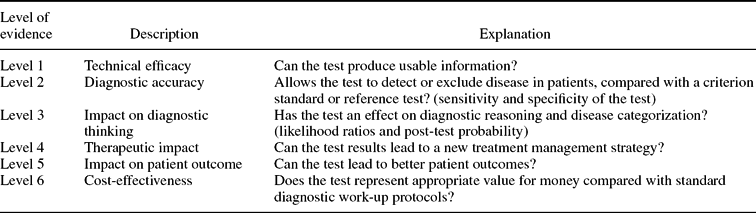
Key evidence from the selected studies was extracted and classified according to an established hierarchy of diagnostic efficacy for medical imaging technologies (Table 1) (Reference Fryback and Thornbury17). The lowest level of this classification relates to evidence limited to mere technical functioning of the technology. The highest level refers to evidence of clinical effectiveness (impact of the diagnostic technology on patient outcome) and cost-effectiveness. The level of evidence assigned to a procedure not only depends on the level reached on the hierarchic scale for diagnostic procedures but also on the quality of the existing studies. Mere existence of studies does not suggest that there is clinical evidence; more specifically, if studies are of low quality or sample sizes are too low, not enough evidence may be available for strong conclusions. On the other hand, lack of evidence does not mean that a diagnostic test may not be useful in experienced settings.
Hierarchical Model for Levels of Evidence for Diagnostic Research
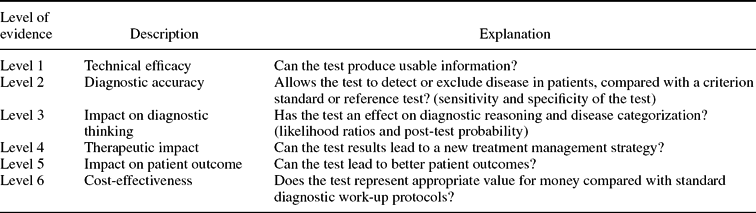
Note. Adapted from Fryback and Thornbury (Reference Fryback and Thornbury17).
Patients Eligible for PET Examinations
The situation of PET in Belgium was described and analyzed on the basis of an existing database from the Belgian Society of Nuclear Medicine–Workgroup PET and data from the National Institute for Sickness and Invalidity Insurance (RIZIV/INAMI). The Belgian Society of Nuclear Medicine–Workgroup PET provided data on the number of PET services performed between September 2003 and September 2004 for all indications, reimbursed or not by the RIZIV/INAMI, on eleven of the thirteen PET scanners. The number of PET services performed for reimbursed indications amounts to approximately 12,000 per year. The total number of scans, including PET services for nonreimbursed conditions and for research purposes, is almost 20,000 per year.
Production Capacity of PET Scanners
The production capacity of PET scanners was derived from literature and personal communication with experts in the field. When used efficiently, 1,500 to 2,000 examinations can be performed on a PET scanner per year.
RESULTS
The literature review revealed that PET is most frequently used in oncology, but the methodological quality of studies on PET in oncology is generally poor to moderate. The evidence of impact on patient management and/or patient outcome is limited to a small number of indications. More frequently, there is evidence of diagnostic accuracy, indicating that PET may offer some additional diagnostic utility compared with other diagnostic techniques or in combination with other diagnostic techniques. Several sources of bias, frequently leading to overestimation of the diagnostic efficacy of PET examinations, were identified during the literature review, except for studies on PET in lung cancer, where more studies have been conducted on larger patient numbers. These studies are generally of better quality than most studies on other cancers.
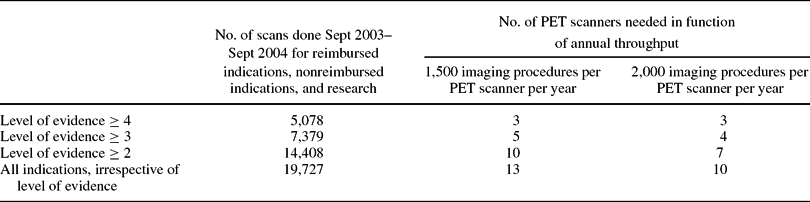
Data on the diagnostic evidence of PET in different indications and numbers of patients that had undergone a PET in 2004 were put together. Using different baseline hypotheses about the minimum level of evidence considered acceptable and the capacity or intensity of use of a PET scanner, we could estimate the number of PET scanners needed in Belgium. This strategy was a unique approach that has not been used in other studies.
Table 2 presents the estimated number of PET services needed in function of the level of evidence for PET in different indications and based on the population in Belgium that has undergone a PET examination for these indications between September 2003 and September 2004. The calculations take all PET services into account, whether or not they were reimbursed under the current reimbursement system. This means that also PET services performed for research purposes or less unequivocal clinical indications were taken into account.
Estimated Number of PET Scanners Needed in Belgium, Based on the Throughput of Eleven of Thirteen Approved PET Scanners That Were already Operational in 2004
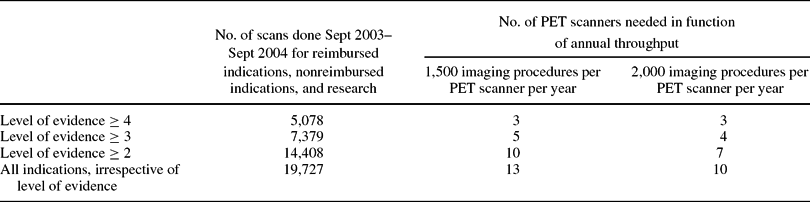
PET, positron emission tomography.
Without consideration of the level of evidence in different indications, and thus assuming that all PET services performed in 2003 were for appropriate indications, between ten and thirteen PET scanners are needed in Belgium. The actual number of PET scanners that performed that number of scans at that time was eleven.
Depending on the level of evidence considered acceptable for routine use of PET in different indications, we estimated that Belgium needs at least three and at most ten PET scanners. With the current evidence, there is no medical or scientific justification for more PET scanners in Belgium. The absolute minimal requirement is that PET imaging has proven diagnostic accuracy, that is, PET imaging is more or equally able to detect or exclude disease in patients than a reference test. Technical efficiency is clearly not enough to justify the use of PET. Allowing all indications for which PET might be useful in terms of changing or improving diagnosis leads to an estimate of no more than ten PET scanners. A more restrictive approach, requiring potential improvements in patient management and patient outcome, leads to an estimated need of three PET scanners.
For the currently reimbursed indications, a number between seven and nine PET scanners would be sufficient (in 2003, almost 12,000 PET services were reimbursed). However, some PET centers, many of which are academic, also do research, which can be used as an argument to slightly increase the number of PET scanners. According to our calculations, ten PET scanners would be sufficient for both routine clinical care and research purposes.
DISCUSSION
Evidence
The existence of evidence is the cornerstone of the proposed methodology. The stronger the evidence in favor of PET for an indication is, the stronger are the arguments for more equipment. Stronger evidence suggests a higher level on the hierarchy of diagnostic efficacy as well as good quality studies demonstrating the diagnostic efficacy. Evidence on the cost-effectiveness of PET is lacking for many indications. If cost-effectiveness is a criterion for resource allocation decisions in health care, which it increasingly is, this criterion should be taken into account in the calculation of the number of PET scanners needed in a country. If not, the decision maker should be explicit about the fact that, for decisions related to PET, cost-effectiveness is less important than for other healthcare interventions where this criterion is taken into account. Taking evidence on cost-effectiveness into account would mean that Belgium needs only three PET scanners.
Rare indications for which there is no evidence are not included in the calculations. This finding is a strength and a weakness of the methodology at the same time. It is a strength because resource allocation decisions should preferably be based, at least in part, on existing evidence for a procedure. With limited healthcare resources, policy makers cannot afford to spend resources on procedures with unproven effectiveness to the detriment of procedures with proven effectiveness. However, for some indications, it is difficult to build up evidence, for instance, for rare indications. For these indications, the classic quality assessment criteria of literature would most often lead to the conclusion that there is no evidence. Alternative assessment criteria may have to be considered.
As the evidence on PET is continuously evolving, the results of the review may no longer be up to date. However, they remain useful to illustrate the approach.
PET Scanners
The practical illustration of our methodology shows that there are more PET scanners in Belgium than needed according to the existing evidence. It was estimated that, with a capacity of 2,000 examinations per PET per year, the existence of more than ten PET scanners cannot be justified nor explained on the basis of scientific evidence or by demographic data alone. It should be noted that the estimated production capacity of 1,500 to 2,000 PET examinations per year is conservative. The actual production capacity of PET might be higher than 2,000 examinations per year. Currently, 2,000 examinations per year is considered the maximum for the safety of personnel working with PET. Combined systems, such as PET–computed tomography, have already shown a higher production capacity (2). A higher production capacity would suggest a lower number of PET scanners needed.
Excess capacity of PET will lead to inefficiencies in the allocation of healthcare resources, that is, the additional costs are not reflected in improved patient management or patient outcome. However, healthcare policy is not inspired by efficiency considerations alone.
One argument to keep the overcapacity of PET scanners is new emerging indications for PET, ageing population, and increasing incidence of current indications for PET. Maintaining or creating an overcapacity for the sake of uncertain future uncertain benefits is costly, especially given the continuing technological development in this field and a relative rapid outdating of existing equipment. The indications for which PET imaging is currently reimbursed in Belgium are more or less in accordance with the indications found in our review, at least if diagnostic accuracy (level 2) is regarded as sufficient for widespread use of PET in an indication. For future possible expansion of reimbursed indications, the impact on therapeutic management and patient outcome should be considered.
A second argument for limited overcapacity may be equitable access to high-tech expensive medical technology. In Belgium, however, the geographical dispersion of PET centers reflects in the first place the position of academic hospitals, then the position of a specialized oncology hospital, and finally the population density. There is a high concentration of PET in Brussels, the capital of Belgium, which cannot be justified by the accessibility argument.
A third argument to keep the more PET scanners than needed is research. There is clearly a need for more research in the field of PET. More specifically, research is needed on changes in patient management or patient outcome and cost-effectiveness.
Some PET scanners are kept idle for financial reasons in Belgium. Seven PET centers have no cyclotron on-site and have to purchase FDG from commercial companies. The price charged for a dose of FDG is higher than the reimbursement price. Therefore, centers prefer not to use their PET scanner at full capacity.
Other Technology
The methodology presented in this study is not only applicable to PET scanners. For multiple other medical technologies, the same logic could be followed, provided that sufficient clinical evidence and data on the eligible population is available. Collection of such data may require investments, which may prove good value for money in the longer term. For emerging technologies where the clinical evidence is rapidly evolving, frequent updating of the assessment will be necessary.
POLICY IMPLICATIONS
Based on the 2005 HTA report, Belgian health authorities decided to maintain the current number of official PET scanners. For the nonapproved PET scanners, legal measures were elaborated. To our knowledge, most of these nonapproved scanners are still operational and at least partly financed through health insurance.
CONCLUSIONS
Any healthcare system faced with limited resources and ever-increasing demands must make choices. Choices may be inspired by a combination of factors such as scientific evidence, financial considerations, pressure from stakeholders, societal values, and so on. Efficient use of scarce resources in health care calls for an approach based on clinical efficacy and efficiency. This study presents a methodological framework for estimating the number of PET scanners needed in a country, based on existing clinical evidence and eligible population for the procedure. The methodology can be extended to other expensive medical technologies. The framework illustrates the importance of clinical evidence for healthcare policy making.
CONTACT INFORMATION
Irina Cleemput, PhD (Irina.Cleemput@kce.fgov.be), Health Economist, Cécile Camberlin, MSc (Cecile.camberlin@kce.fgov.be), Data Analyst, Ann Van den Bruel, MD, PhD (Ann.vandenbruel@kce.fgov.be), Medical Expert, Dirk Ramaekers, MD, PhD (Dirk.Ramaekers@kce.fgov.be), General Director, Belgian Health Care Knowledge Centre (KCE), Wetstraat 62, 1040 Brussels, Belgium
The authors thank the authors of the HTA report on positron emission tomography of the KCE, the members of the external expert group who provided input to the scientific literature overview, and the validators who assessed the scientific validity of the report. No external funding was received for this assessment.