


1. INTRODUCTION
The present article is about the interaction between negative polarity and cliticisation in the context of imperative verb forms in French. The interaction is illustrated in (1), where the positive imperative in (1a) has enclisis (cf. the ungrammatical (1c) with proclisis), while the negative imperative in (1b) has proclisis (cf. the ungrammatical (1d) with enclisis):Footnote 2
(1)


The focus of the article is how to account for the data in (1). The analysis has implications for our understanding of inflectional features, their hierarchy, how they are checked in syntax, and their default values. The article is structured as follows: section 2 considers imperative morphology from the perspective of some apparent allomorphy within French and patterns found in languages like Spanish. Section 3 sets out my theoretical assumptions. Section 4 presents the analysis of the data in (1). Section 5 considers a regionally/stylistically marked alternative form of negative imperatives in French. The conclusions are set out in section 6.
2. IMPERATIVE MORPHOLOGY
The 2sg.imp forms of ‑re and ‑ir verbs are identical across the pos/neg divide:
(2)

In most environments, the same is true of 2sg.imp forms of -er verbs:
(3)

However, (4a–d) illustrate a context in which the 2sg.imp morphology of -er verbs changes depending on the pos/neg distinction. In these examples the verbal complements in (3) have been pronominalised and are realised as the clitics en or y:
(4)

The pos forms in (4a, b) have final orthographic -s and phonetic [-z] in the context of enclitic en/y; in the neg forms in (4c, d), where en/y are proclitic, -s/[-z] do not appear. We could be tempted to conclude that the morphology of these imp verbs is sensitive to the pos/neg distinction.
In fact, given the contrast in (1) (where clitic placement appears to be sensitive to polarity) and the contrast in (4) (where imp verbal morphology also appears to be sensitive to polarity), we might wonder whether French follows the behaviour of languages like Spanish, illustrated in (5):Footnote 3
(5)

In Spanish, positive imperatives have distinct imperative morphology, as in (5a). Such forms are sometimes called ‘true’ imperatives (Rivero, Reference Rivero1994). True imperatives are not found in negative contexts, as shown in (5b). In negative contexts, suppletive (subjunctive or infinitival) morphology is found instead, as in (5c, d). The paradigms found in negative contexts are sometimes called ‘surrogate’ imperatives (Rivero, Reference Rivero1994): non-imperative forms with irrealis mood used with imperative/exhortative force. Given that the difference between (5a) and (5b) relates to polarity, and given that positive polarity is generally regarded as the unmarked default setting, I assume that it is the presence of negation in (5b–d) which prevents the use of a true imperative, rather than the absence of negation in (5a) preventing the use of a surrogate.
However, given the identical positive/negative 2sg.imp forms of -ir and -re verbs in (2), and similarly for 1/2pl.imp forms across all verb groups, the notion of morphological sensitivity to polarity on the part of 2sg.imp forms of -er verbs is implausible. There are two ways of analysing the (4a, b) vs. (4c, d) contrast without such a notion. We could assume that 2sg.imp forms of -er verbs are non-s/[-z]-final across the board, and see the appearance of final -s/[-z] in (4a, b) as a phonological process (and its reflection in the orthography) inserting an unmotivated liaison consonant before en/y on the grounds of euphony. Overextension of the insertion of liaison consonants is attested elsewhere and popularly called pataquès, (allegedly) in reference to the example: Je ne sais pas [t] à qui est-ce [zǝnǝsϵpatak(j)ϵs], where an unmotivated [t] is inserted in the liaison context.Footnote 4 This is however problematic: pataquès (along with various other ‘errors’ in respect of liaison consonants) is a variable and socially stigmatised phenomenon, yet the pronunciation (and orthographic representation) of the -s/[-z] in (4a, b) is entirely standard and not subject to variation.
Alternatively, the (4a, b) vs. (4c, d) contrast could be thought of as uniquely orthographic: since the 2sg.imp forms of -ir and -re verbs are all orthographically s-final in all contexts, we could say that the lack of final orthographic -s on 2sg.pos.imp forms of -er verbs, as in (3) and (4c, d), is mere convention, one which is overridden in the particular context illustrated in (4a, b), where the phonological phenomenon of liaison makes the convention untenable.Footnote 5
I therefore reject the pataquès approach, and conclude that all 2sg.imp forms are morphologically [-z] final, and that the orthographic absence of -s in (3) and (4c, d) is mere convention. Thus, there is no underlying morphological contrast between pos and neg 2sg.imp verb forms in Modern French, and this cannot therefore account for the differing cliticisation patterns in (1).Footnote 6
This is a welcome conclusion in view of the wider morphology of imperatives. Most straightforwardly, it means that all 2sg imperatives have the final -s/[-z] characteristic of finite 2sg verb forms. But the resulting regularity goes further. With 1pl and 2pl imperatives, no pos/neg contrast is found anywhere. In all but four verbs (être, avoir, savoir, vouloir), 1/2pl.imp verb forms are identical to pres.ind forms.Footnote 7 With être and avoir, 1/2pl.imp verb forms are identical to the pres.sub forms. With savoir, 1plsachons and 2plsachez are uniquely imperative (cf. pres.indsavons and savez, and pres.subsachions and sachiez); with vouloir, alongside 2sgveux and 2plvoulez (suppletive pres.ind forms), we have 2sgveuille and 2plveuillez, the first of which is identical to the corresponding pres.sub (once the final -s/[-z] has been restored), while the second is a uniquely imp form. Thus, with all verbs apart from savoir and vouloir, 1/2pl.imp verb forms are identical to corresponding pres.ind/sub forms. If 2sg.imp forms of -er verbs (not followed by en/y) (as in (3) and (4c, d)) did not have an underlying final -s/[-z], then they would be unique in not being identical to corresponding pres.ind/sub forms. But if these forms do have an underlying final -s/[-z], as suggested above, then the pattern is regular across 1pl, 2pland 2sg imperatives. The pattern in (4a, b) is straightforwardly accounted for, and the pattern in (3) and (4c, d) is not disturbed because the underlying morphological final [-z] would be silent in this context anyway.
Despite the absence of any morphological contrast underlying the superficial orthographic (4a, b) vs. (4c, d) contrast, we still need to account for the enclisis vs. proclisis contrast in (1). Proclisis appears in French with finite verb forms, as in (6a); enclisis is found with positive imperatives, as in (6b); in negative imperatives with ne we find proclisis, as in (6c):
(6) a. Tu le regardes. b. Regarde-le ! c. Ne le regarde pas !
Given our conclusion that positive and negative imperative verb forms in French do not differ in underlying morphological terms (unlike Spanish), why do we see divergent cliticisation patterns (like Spanish)? The answer to this question follows from the theoretical framework set out below.
3. THEORETICAL FRAMEWORK
My assumptions are set out here in respect of the nature of lexical and grammatical projections, cliticisation, imperative verb forms, and negation. This will provide the basis for the account of the data in (1) provided in section 4.
3.1 Lexical and grammatical projections
Lexical items are drawn from the lexicon fully formed and associated with a set of thematic and grammatical features. These features drive all X′ structure building in the syntax. The set of thematic features associated with a noun or verb is its thematic grid, a list of θ roles to be projected in syntax, in a strict order determined by a universal (= UG-determined) thematic hierarchy. Each θ role is assigned to a nominal dependant via the intermediary of a θ head: the θ role encoded on the N/V licenses the merger of θ°, which in turn licenses the merger of the nominal dependant in SpecθP, as in (7):
(7)
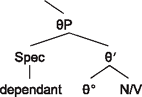
The merger of a θ head is an iterative process: each θ role in N/V's thematic grid licenses a unique θ°; as many distinct θ heads (θ°Ag, θ°Th, θ°Re) are successively merged as required by the thematic grid, a subset of those made available by UG. The topmost θP is then a lexical NP/VP shell, which I label – following Rowlett (Reference Rowlett2007) – NP*/VP*. Similarly, each lexical item is associated with a set of grammatical (including pragmatic) features, also projected in syntax, and in an order laid down by a universal grammatical hierarchy (Cinque, Reference Cinque1999). Each grammatical feature is checked via a functional head (F°), and the presence of the feature licenses the merger of the F head:
(8)
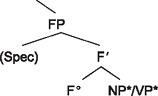
Again as above, merger of F° is an iterative process. A principle of economy requires no more structure to be generated than is needed, and grammatical features to be checked on as small a set of functional heads as possible. This means that default feature values are not encoded in syntax, and only as many distinct F heads are merged as required by the grammatical features associated with the lexical noun or verb, again, a subset of those made available by UG.Footnote 8 The topmost FP is then a complete clausal/nominal constituent, which I label CP*/KP*:
(9)

θ-role assignment and grammatical-feature checking differ in one respect: in the thematic domain there is an isomorphic mapping from θ roles to θ heads; in the grammatical domain there is not always an isomorphic mapping from grammatical features to F heads. Thus, if inflectional morphology and the universal ordering of grammatical features allow it, and UG therefore requires it (assuming the principle of economy referred to above which requires grammatical features to be checked on as small a set of functional heads as possible), then multiple grammatical features will be checked against a single F head. An example of this is found in portmanteaux forms like au(x) (cf. the non-portmanteaux à la), which encode multiple features with a single form: au(x) is drawn from the lexicon fully formed but associated with distinct case and definiteness features, which are checked against a single F head because the morphology allows it, and economy therefore requires it:
(10)
(11)


Example (11) contrasts with (12a, b) which show that the portmanteau form aux cannot co-occur in the same nominal with the universal quantifier tous, in either order:
(12)

The issue here is clearly not semantic, since the notion ‘to all the boys’ is perfectly effable, as in (13a), which presumably has the structure in (13b) (the precise label attached to the feature/projection associated with tous is irrelevant):
(13)

The issue must therefore be morphosyntactic. The nature of the problem with (12a, b) is hinted at by the word order in (13): à > tous > les. These words appear in this order because of the order in which their respective features appear within the universal grammatical hierarchy. The ungrammaticality of (12a, b) (that is, the incompatibility of the universal quantifier and the portmanteaux form aux) is due to the impossibility of reconciling (a) the morphosyntactic need for aux to check case and definiteness features against one and the same head, and (b) the need for the marked grammatical feature associated with the universal quantifier tous to be checked after definiteness but before case (reading from the bottom up). In the absence of a lexical item whose morphological feature complex allows all three features to be checked on one and the same head, the only way to satisfy (b) is for case and definiteness to be checked on separate heads, which rules out the portmanteau form, leaving a structure with distinct case and definiteness marking as the only alternative, namely, (13). In section 4 I suggest that negation has a similar impact on checking imperative morphology.Footnote 9 But now, I turn to clitics.
3.2 Clitics
I follow Shlonsky (Reference Shlonsky and Rizzi2004) in treating clitics as IP*-internal F heads:
(14)
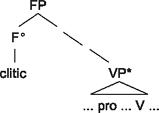
Pronominal clitics are licenced in clause structure because their host FP (hereinafter labelled CliticP) provides an environment for their verb and its non-overt dependant(s) (pro) to be identified in a spec–head configuration. In the simplest case, this involves movement of pro out of VP* to create the SpecCliticP position, and left-adjunction of the verb to the clitic in Clitic°. This results in enclisis, as in (15):
(15)
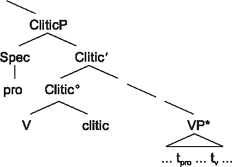
A consequence of the left-adjunction process which produces enclisis is that the verb is no longer a syntactic head; the head of the complex Clitic° node is the clitic rather than the moved verb. The left-adjoined verb is therefore ‘invisible’ to the syntax and unable to check any further grammatical features; consequently it must already have checked all its features prior to this step in the derivation. This is reflected in two necessary and sufficient conditions on enclisis:
(16) We have enclisis when:
a. the verb is inflectionally complete under the cliticization site; and,
b. the verb moves at least as far as the cliticization site.
(Shlonsky, Reference Shlonsky and Rizzi2004: 332, his (8))
Enclisis is found if the conditions in (16) are satisfied. Enclisis is not found with French finite verbs, or with infinitives (cf. Spanish) or present participles, and I assume that this is because Clitic° merges before all the verb's inflectional features have been checked and the verb is therefore inflectionally incomplete under the clitic head, thereby failing to satisfy condition (16a). Proclisis is therefore found instead. One kind of proclisis is illustrated in (the simplified structure in) (17):
(17)
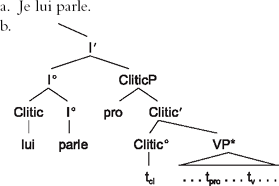
The finite verb does not left-adjoin to the clitic under Clitic°, precisely because its grammatical features have not all been checked and to do so would therefore take it into a grammatical cul-de-sac. Instead, in (17) it raises to a higher functional head (here labelled I°), where it can check its inflectional feature(s). The necessary association between the verb and the clitic, and ultimately with pro, is achieved by the clitic then raising to I° (as a proclitic).Footnote 10
3.3 Imperatives
Contrasting with declaratives, interrogatives and exclamatives, imperatives are characterised by a pragmatic property, encoded by an irr[ealis] feature. If irr is located high up within the universal grammatical hierarchy, and therefore associated with a functional head high up within clause structure (e.g. Force° within Rizzi's Reference Rizzi and Haegeman1997 split CP), it will not be checked until after several other features within CP* have been checked, and we can understand why it is sometimes associated with left-periphery phenomena, such as overt complementisers and V-to-C movement:
(18)

In terms of their morphosyntactic verbal paradigm, (‘true’) imperatives have been described as defective or impoverished with respect to their inflectional features (Rooryck, Reference Rooryck1992, Reference Rooryck2000a: 117). I take this impoverishment to relate to a minimal featural specification and a minimal inflectional richness. Taken together, these allow (and by economy therefore require) the pragmatic feature [irr] and the defective inflectional morphology [i] to be checked on the same functional head within the clause, in the same way as the case and definiteness features of au(x) in (11) could be (and therefore had to be) checked on a single functional head within the nominal.
3.4 Negation
Sentential negation in Standard French is bipartite: ne . . . pas, etc., as in (19):
(19) Jean ne fume pas/plus/jamais/guère.
Since Pollock (Reference Pollock1989) and Belletti (Reference Belletti1990), bipartite negation à la française, involving one head and one XP negative marker, has been analysed in terms of a dedicated functional projection within IP*, with negative polarity encoded as a marked feature value [neg] checked on a distinct functional head (here labelled Neg°), with the head and XP negative markers occupying head and specifier position, respectively:
(20)

Zanuttini (Reference Zanuttini1997) posits multiple negation-related FPs within IP* to host the various types of pragmatically distinct negative XP found in the dialects of Italian, not all of which have the same word-order properties. Rowlett (Reference Rowlett1993) argues that the French negative marker pas is generated in a position lower in clause structure which reflects its scope, subsequently raising to SpecNegP to endow a functional head with the [neg] feature (an issue which I ignore here, for the sake of clear tree diagrams). Cinque (Reference Cinque1999) embeds the functional projection associated with clausal negation within his much larger set of UG-ordered grammatical heads within IP*, in the same vein as Rizzi's (Reference Rizzi and Haegeman1997) exploded CP. Within the framework set out in section 3.1, I assume that it is not the functional heads themselves that are universally ordered, but rather the grammatical features encoded on them (hence the opportunity to check multiple features on a single head). The crucial idea is that [neg] is a grammatical feature hierarchically ordered with respect to other inflectional features.
4. ENCLISIS AND PROCLISIS IN POSITIVE AND NEGATIVE IMPERATIVES
We now have in place the machinery we need to account for French imperatives and clitic placement and the data in (1), repeated here as (21):
(21)

Positive imperatives display enclisis because they are ‘true’ imperatives in the sense of being morphologically impoverished, that is, inflectionally defective. On the basis of their grammatical featural make-up, they therefore license minimal inflectional structure above the lexical VP*. In an imperative sentence with unmarked positive polarity, the verb's inflectional [i] and pragmatic [irr] features can be checked on a single functional head:Footnote 11
(22)
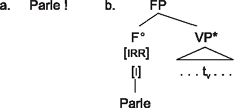
Where the imp verb has one or more non-overt dependants (= pro), as in (21a), pro needs to be identified in a spec–head checking configuration with a clitic head. Merger of Clitic° is therefore licensed, above the FP hosting [irr]/[i], and pro moves to create a SpecCliticP position. Since the morphologically impoverished imp verb has already checked all its grammatical features in F°, it is inflectionally complete and the sufficient/necessary conditions on enclisis in (16a, b) are satisfied. The imp verb therefore left-adjoins to Clitic°, resulting in enclisis:
(23)

What happens in negative contexts? Consider first the negative counterpart of (22). If the FP associated with [neg] (= NegP) merges above the FP associated with [irr] and [i] (in the same way that CliticP does), then we expect a structure like (24):
(24)

The verb raises to Neg° because it has a negative feature to check. Having checked its [irr]/[i] features under F°, it is inflectionally complete, and so left-adjoins to Neg°, resulting in enclisis and the word order *Pas parle ne !, the reverse of the actual word order: Ne parle pas !
If, instead, NegP merges below the FP associated with [irr]/[i], then we expect a structure like (25):
(25)
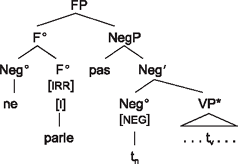
At the point at which Neg° is merged, the imp verb has not checked its [irr]/[i] features and so is not inflectionally complete. It therefore does not left-adjoin to Neg° since if it did it would be unable subsequently to check [irr]/[i]. Instead, the imp verb raises to the higher F head to check [irr]/[i]. The verb's uninterpretable negative feature is then checked as the negative marker ne also raises to the F head (thereby once again avoiding an HMC violation). This is more promising (as an interim conclusion at least) in that it involves the verb moving to the left of pas, and ne moving to the left of the verb, resulting in the correct word order: Ne parle pas !
What, then, about cases where the imp verb not only is negative but also has one or more non-overt dependants (= pro)? Simply combining the state of affairs in (23) (CliticP > FP[irr]/[i]) and (25) (FP[irr]/[i] > NegP), we might assume a straightforward CliticP > FP[irr]/[i] > NegP ordering of functional projections. This translates into (26):
(26)

The derivation proceeds as follows: the verb does not left-adjoin to Neg° since it has not checked its [irr]/[i] features and is not therefore inflectionally complete; instead, it raises to the left of pas to F[irr]/[i]° to check its grammatical features; the negative marker ne also raises to F[irr]/[i]° so that the verb's [neg] feature can be checked; the ne+parle complex in F° is now inflectionally complete and so left-adjoins to the clitic to identify pro, resulting in enclisis. This results in the incorrect surface word order: *Ne parle lui pas !
Of course, the putative structure in (26) is founded on the superficially adequate structures in (23) and (25), themselves built on the notion that, with their impoverished morphology, ‘true’ imperatives in French allow [irr] and [i] to be checked against a single head. I want to pursue the idea that, in the precise context of marked negative polarity, this is not in fact possible. More specifically, I suggest that in the universal grammatical hierarchy [neg] occupies a position between [irr] and [i] and therefore prevents [irr] and [i] from being checked against a single head, in much the same way as, in (12), the feature associated with the universal quantifier tous prevents case and definiteness features from being checked on the same head (otherwise permitted by the morphology of au(x)). Assume therefore the relative order of the pragmatic [irr] feature, the inflectional [i] feature, and [neg] in (27):
(27) [irr] > [neg] > [i]
If the morphology does not allow the [neg] feature to be checked on the same functional head as either [irr] or [i], then there will be no alternative to all three features being checked on distinct heads. This state of affairs will license the merger of three F heads to check the three features, [irr], [neg] and [i]. If this is right, then in the first instance the structure in (25) will need to be revised, as in (28):
(28)

The verb raises to I° to check [i], but still has [irr] to check and so is not inflectionally complete at the point at which the negative markers are merged. It therefore raises to the higher Irr° to check [irr], as does ne, resulting in the same (and correct) surface word order as (25): Ne parle pas ! (and a representational non-violation of the HMC; see footnote 10).
This leaves the question of how clitics are to be incorporated into (27). In view of (23), CliticP cannot be in initial position; if it were, then negative imperatives would have enclisis. Further, CliticP cannot be in final position; if it were, then positive imperatives would have proclisis. CliticP must therefore either precede or follow [neg]. Assume on the basis of surface word order that the relative order is as in (29), resulting in the structure in (30):
(29) [irr] > [neg] > [clitic] > [i]Footnote 12
(30)

Having raised to I° to check its [i] feature (but not its [irr] feature), the verb is inflectionally incomplete at the point at which CliticP and NegP are merged. The conditions for enclisis within CliticP or NegP are not therefore met, and the verb moves directly to Irr° (to the left of pas). The clitic and negative heads also raise to Irr° in order for their features to associate with the verb.
5. STYLISTIC VARIATION
Example (1b)/(21b), reproduced here as (31a), is a partial representation of negative imperatives involving cliticisation. Alternative forms are given in (31b, c):
(31)

In (31b) the negative clitic ne is absent. Ne-drop is a familiar phenomenon within French (see Armstrong, Reference Armstrong2001; Ashby, Reference Ashby1976, and Coveney, Reference Coveney2002), and parallel phenomena are common in other languages, and understood within Jespersen's cycle (Rowlett, Reference Rowlett1998: chap. 3). From the perspective of the discussion here, (31b) can be incorporated into the analysis by assuming that ne has a phonologically non-overt allomorph which is identical in all other respects. The structure of (31b) is therefore the same as (30) (lexical specifics notwithstanding). The example in (31c) is not so straightforward, since sentential negation co-occurs here with enclisis. The phenomenon is controversial and stigmatised, described as popular and/or regional (especially Québécois), but examples abound (Jones, Reference Jones1996: 255; Hirschbühler & Labelle, Reference Hirschbühler, Labelle, Pérez-Leroux and Roberge2003, Reference Hirschbühler, Labelle, Gess and Arteaga2006):
- (32)
a. Embête-nous pas avec tes questions !
b. Parle-moi-z-en pas !
c. Gênez-vous pas !
d. Fais-le pas tomber !
The position of the clitics indicates that the conditions for enclisis in (16) have been satisfied, which in turn implies that, despite the appearance of the negative marker pas, there is no [neg] feature to check. The absence of a [neg] feature is consistent with one robust property of these examples, namely, the necessary absence of ne:
- (33)
a. (***N’)embête-nous pas avec tes questions !
b. (***Ne) parle-moi-z-en pas !
c. (***Ne) gênez-vous pas !
d. (***Ne) fais-le pas tomber !
We also correctly predict the existence (and forms) of the examples in (34a, b):
(34)

Not only do en/y remain enclitic with ne excluded, but the imp verb forms are -s/[-z]-final.
There are two ways of analysing these data. First, in the context of the grammar we have been characterising hitherto, and exploiting Rowlett's (Reference Rowlett1993) idea that the negative marker pas is generated relatively low in clause structure and raises to SpecNegP to license ne and mark sentential negation, we could conclude that the crucial feature of the examples in (32) is that pas remains in its base position and has local scope.Footnote 14 On this approach, speakers would be able to use (31a), (31b) or (31c), with the (31a)/(31b) contrast relating to register, and the (31a, b)/(31c) contrast relating to scope. The second possibility is that examples like those in (32) are the output of a different, innovative grammar, one in which the formal [neg] feature projected in clause structure is so impoverished — as a consequence of the strength of pas as negative marker, and as expected within Jespersen's cycle — that its morphology allows (and by economy requires) it to be checked on one and the same functional head as [irr] and [i]. With such a grammatical status, [neg] would plausibly not require pas to raise to a specifier position.Footnote 15
(35)
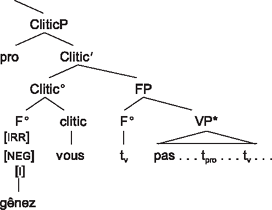
Within such a grammar, the absence of ne is not a reflection of allomorphy with a null version sitting along an overt form: ne is not part of this grammar. Here, enclisis on the imp verb form would not be blocked, and so speakers would not be able to produce (31a, b), unless they did so in an attempt to mimic a feature of an unacquired grammar deemed to be more prestigious (see Sobin, Reference Sobin1997 on grammatical viruses). Significantly, the variety of French most commonly associated with the negative imperatives in (32), namely Québécois, is also the variety in which ne drop is most deeply embedded (Sankoff & Vincent, Reference Sankoff and Vincent1977), while conversely one variety in which ne retention is strongly favoured, namely Belgian French, is not characterised by negative imperatives like (32) (Rowlett, Reference Rowlett2013: 54).
6. SUMMARY AND CONCLUSIONS
This article has focused on accounting for the correlation between polarity and clitic placement in imperatives. It has been based on theoretical foundations relating to feature checking, cliticisation, imperative mood and sentential negation. The core idea, based on Shlonsky (Reference Shlonsky and Rizzi2004), is: (a) that enclisis is found wherever its licensing conditions are satisfied; (b) that in positive imperatives these conditions are satisfied because the inflectional poverty of the verbal morphology allows all the verb's inflectional features to be checked against a single head; (c) that the conditions on enclisis are not satisfied in negative imperatives because the presence of the marked negative feature prevents the verb's inflectional features from all being checked against a single head; (d) that the proclisis found in negative imperatives is the consequence of (c); and, (e) that forms like Fais-le pas ! either have local negative scope or are the product of a radically different, innovative grammar in which the formal [neg] feature is so impoverished that it can be checked on the same functional head as [irr] and [i]. The fact that the theoretical foundations, taken together, have been able to provide an elegant account of the empirical data provides support for the assumptions made.


