

Introduction
French beans (Phaseolus vulgaris L., Fabaceae) are one of the most important horticultural crops in Kenya that are grown mainly for export. They contribute more than 55% to the value of vegetable exports and rank second after cut flowers among all export crops, with an estimated volume of 18,275 metric tonnes and a value of USD 4.4 million (HCDA, 2010). The production of French beans is mainly affected by pest thrips that cause damage through direct feeding, resulting in yield loss up to 68% (Seif et al., Reference Seif, Varela, Michalik and Löhr2001; Nyasani et al., Reference Nyasani, Meyhöfer, Subramanian and Poehling2012). In Kenya, the commonly occurring thrips species on French beans are Megalurothrips sjostedti (Trybom), Frankliniella occidentalis (Pergande), Frankliniella schultzei (Trybom) and Hydatothrips adolfifriderici (Karny) (all Thysanoptera: Thripidae) (Nyasani et al., Reference Nyasani, Meyhöfer, Subramanian and Poehling2012). Their broad host range, cryptic feeding behaviour, tendency to aggregate, small body size and high fecundity make thrips difficult to control (Hamilton et al., Reference Hamilton, Hall and Kirk2005; Brunner and Frey, Reference Brunner and Frey2010). Farmers indiscriminately use pesticides for the management of thrips (Nderitu et al., Reference Nderitu, Waturu, Olubayo, Aura, Kasina, Wesonga, Losenge, Ndung'u, Ngamau, Ombwara, Agong, Fricke, Hau and Stützel2001). The frequency of pesticide applications by farmers in a cropping cycle ranges from 4 to 15, which is not based on reliable pest monitoring (Nderitu et al., Reference Nderitu, Waturu, Olubayo, Aura, Kasina, Wesonga, Losenge, Ndung'u, Ngamau, Ombwara, Agong, Fricke, Hau and Stützel2001). Additionally, the use of pesticides leads to negative effects on non-target organisms, the development of resistance in target pests and harmful effects on the environment (Desneux et al., Reference Desneux, Decourtye and Delpuech2007; Nderitu et al., Reference Nderitu, Kasina, Nyamasyo, Waturu and Aura2008).
Accurate and reliable monitoring of the target pest is one essential component of integrated pest management (IPM) for sustainable and need-based pest management (Affandi and Emilda, Reference Affandi and Emilda2009; Bout et al., Reference Bout, Boll, Mailleret and Poncet2010). Plant-dwelling thrips use colour and scent as cues for the detection of and orientation to their host plants (Terry, Reference Terry and Lewis1997). Coloured sticky traps have been demonstrated as a rapid and cost-effective tool for the monitoring of thrips populations (Chen et al., Reference Chen, Chu, Fitzgerald, Natwick and Henneberry2004; Liu and Chu, Reference Liu and Chu2004; Chu et al., Reference Chu, Ciomperlik, Chang, Richards and Henneberry2006; Natwick et al., Reference Natwick, Byers, Chu, Lopez and Henneberry2007). They have been used for various thrips species including F. occidentalis and F. schultzei (Hoddle et al., Reference Hoddle, Robinson and Morgan2002; Chu et al., Reference Chu, Ciomperlik, Chang, Richards and Henneberry2006; Yaku et al., Reference Yaku, Walter and Najar-Rodrigueza2007; Allsopp, Reference Allsopp2010). Differential attraction of various thrips species to coloured traps on different crops has been reported previously. For instance, Natwick et al. (Reference Natwick, Byers, Chu, Lopez and Henneberry2007) reported that blue traps caught more F. occidentalis and Thrips tabaci adults than yellow traps in an onion crop. In a study conducted in an avocado orchard, Hoddle et al. (Reference Hoddle, Robinson and Morgan2002) demonstrated that yellow traps caught more Scirtothrips perseae (Nakahara), while white traps captured Franklinothrips orizabensis (Johansen) and F. occidentalis. However, studies on the response of thrips infesting French beans in Kenya are required to develop reliable monitoring and management strategies.
Semiochemicals of thrips, such as aggregation pheromones (Hamilton et al., Reference Hamilton, Hall and Kirk2005), and analogues of plant kairomones (Teulon et al., Reference Teulon, Davidson, Hedderley, James, Fletcher, Larsen, Green and Perry2007) could enhance the attraction of thrips to coloured traps. For instance, addition of pyridine compounds (methyl isonicotinate, ethyl isonicotinate and methyl 4-pyridyl ketone) to sticky traps increased the captures of F. occidentalis (Davidson et al., Reference Davidson, Perry, Larsen, Green, Butler and Teulon2007). Thripline®AMS, a synthetic species-specific aggregation pheromone, is commercially used to monitor both male and female F. occidentalis (Hamilton and Kirk, Reference Hamilton and Kirk2003). Based on methyl isonicotinate, a commercial attractant of thrips, Lurem-TR was tested successfully for attracting thrips for improved monitoring and management (Teulon et al., Reference Teulon, Davidson, Hedderley, James, Fletcher, Larsen, Green and Perry2007; Nielsen et al., Reference Nielsen, Worner, Chapman, de Kogel, Perry, Sansom, Murai, Muvea, Subramanian, Davidson and Teulon2010). However, the utility of this kairomone along with coloured sticky traps needs to be tested for monitoring thrips in Kenyan French bean crops. Development and inclusion of sampling methods that can accurately and reliably estimate the population of thrips is essential for monitoring thrips population dynamics in experimental plots, for making appropriate management decisions and for implementing IPM strategies (Joost and Riley, Reference Joost and Riley2004; Bout et al., Reference Bout, Boll, Mailleret and Poncet2010; Pizzol et al., Reference Pizzol, Nammour, Hervouet, Bout, Desneux and Mailleret2010). Therefore, this study aimed to evaluate the attraction of pest thrips infesting French beans to sticky traps with Lurem-TR, and to assess its utility for monitoring the population dynamics of thrips.
Materials and methods
Study site
The study was conducted at the Kenya Agricultural Research Institute (KARI) Centre in Thika, Kenya. The Centre is situated within the coordinates 0° 59′S and 37° 04′E at an altitude of 1548 masl. The study site receives an average annual rainfall of 1018 mm. Soils are well-drained, dark reddish-brown deep Nitosols (Jaetzold and Schmidt, Reference Jaetzold and Schmidt1983).
Experimental plots of French beans
Land was ploughed and harrowed with a tractor to a fine tilth. The field was divided into four blocks, each with six equal experimental plots measuring 6 × 6 m. There were six trapping treatments that included three coloured traps (blue, yellow and clear), with or without Lurem-TR. Each treatment was randomly assigned to individual experimental plot, and the traps were erected at the centre of each plot 7 days after crop emergence. The treatments were replicated four times. The blocks were separated by fallows of 3 × 60 m. Prior to sowing, bean seeds were treated to protect against bean fly attack and fungus using Gaucho® insecticide and Vitavax® fungicide mixtures, respectively. French beans (cultivar Serengeti) were planted at an intra-row spacing of 10 cm and an inter-row spacing of 50 cm. During sowing, diammonium phosphate (DAP) was applied to the furrows at the rate of 200 kg/ha and mixed well with the soil before planting. At 3 weeks after crop emergence (first trifoliate leaf stage), calcium ammonium nitrate was applied as a top dress at the rate of 200 kg/ha. The plants were maintained using standard agricultural practices recommended for the research area (Jaetzold et al., Reference Jaetzold, Schmidt, Hornetz and Shisanya2007). The experiments were carried out over two planting periods. The first planting period was from May to July 2010 and the second period from September to November 2010.
Monitoring of thrips populations using sticky traps and Lurem-TR
Population densities of various thrips species and their natural enemies were monitored using blue, yellow and clear sticky traps (measuring 10 × 25 cm) with or without Lurem-TR. Clear sticky traps of the same dimensions were made in the laboratory using clear lamination paper and coated with Tanglefoot® (aerosol formula; The Tanglefoot Co., Grand Rapids, Michigan, USA). The traps were mounted vertically on wooden stakes, with the bottom edge of the trap being 10 cm above the crop canopy. The traps were collected and replaced weekly for 8 weeks. After removal, the sticky traps with thrips catches were placed in transparent polythene sheets, labelled and carried to the laboratory for counting and identification. From the eight possible grids on each trap, four grids were selected at random for thrips sampling. The glue on the sticky traps was carefully dissolved using kerosene, and thrips were collected using a fine brush and transferred into vials containing 60% ethyl alcohol for further processing. Later, the specimens were macerated in 5% NaOH for 4 h followed by three washes with distilled water. The mixture was then replaced with 60% ethyl alcohol and stored for 24 h. The specimens were dehydrated through a series of alcohol concentrations (70% for 1 h, 80% for 20 min, 95% for 10 min and absolute alcohol for 5 min) and then finally transferred to clove oil for at least 30 min before slide mounting with Canada balsam. Specimens on the slides were labelled with original data and identified using LuCID keys, Pest Thrips of the World (Moritz et al., Reference Moritz, Mound, Morris and Goldarazena2004) and Pest Thrips of East Africa (Moritz et al., Reference Moritz, Brandt, Triapitsyn and Subramanian2013). The natural enemies of thrips, such as the predatory anthocorid bug Orius spp. (Hemiptera: Anthocoridae) and the eulophid parasitoid Ceranisus menes (Walker) (Hymenoptera: Eulophidae), were identified using the methods developed by Hernandez and Stonedahl (Reference Hernandez and Stonedahl1999) and Triapitsyn (Reference Triapitsyn2005), respectively.
Monitoring of thrips populations by plant sampling
Destructive sampling (picking flowers and leaves) (Steiner, Reference Steiner1990) and non-destructive sampling (tapping of the whole plant on a white enamel tray) (Pearsall and Myers, Reference Pearsall and Myers2000) methods were adopted to determine the absolute estimates of the population densities of thrips on the crop. At 3 weeks after crop emergence, samples were collected every week for a period of 8 weeks. Three leaves and three flowers were picked from the top, middle and bottom of the plant canopy within a radius of 2 m from the traps. The picked samples were carefully handled to avoid disturbing the thrips. The leaves were individually placed in plastic jars stuffed with paper towel and labelled. The flower samples were dipped in vials containing 60% alcohol with pencil labels. Thrips were extracted from flowers and leaves and then transferred into vials containing 60% ethyl alcohol for 24 h. Thrips specimens were processed, slide mounted and identified as detailed above. Voucher specimens of thrips were maintained at the International Centre of Insect Physiology and Ecology, icipe.
Statistical analysis
The numbers of key thrips species and their natural enemies captured on sticky traps with and without Lurem-TR were checked for normality and homogeneity of variance using Shapiro–Wilk and Levene tests, respectively, before being subjected to repeated-measures analysis of variance (RM-ANOVA). The replicates were included as blocking factors, and the trap colours with and without lure/plot as the treatment factor. Specific mean comparisons were made using Tukey's HSD test at the 5% significance level. To determine whether trap captures were indicative of thrips populations on leaves and flowers, the mean number of thrips/trap was correlated with the mean number of thrips/plant per week for each sampling date. Total thrips catches from the traps, tapping and destructive sampling were analysed by RM-ANOVA, with plots as blocking factors and trap colour as treatment factors. All statistical analyses were performed in R 2.15.1 (R Development Core Team, 2011) using the package Rcmdr (Fox, Reference Fox2005).
Results
Attraction of pest thrips to coloured sticky traps with and without Lurem-TR
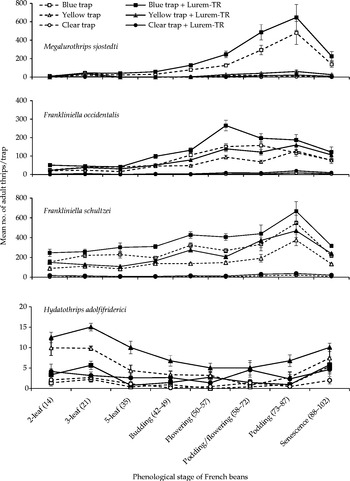
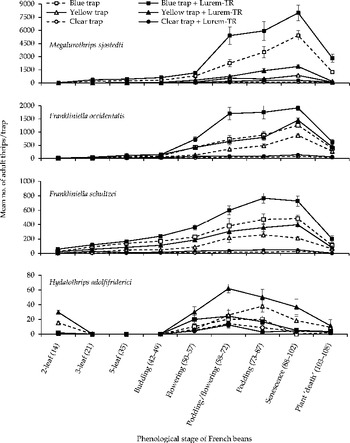
In the two planting periods, four key thrips species were caught on the sticky traps, namely F. schultzei, F. occidentalis, M. sjostedti and H. adolfifriderici. Except for H. adolfifriderici, mean population densities of all other thrips species increased 35 days after planting (DAP), which coincides with the onset of budding. Blue traps caught two and three times more thrips compared with yellow traps in planting periods 1 and 2, respectively. There were significant differences in the number of M. sjostedti caught on the different sticky traps (F= 116.8; degree of freedom (df) = 5, 15; P< 0.001 and F= 320.8; df = 5, 15; P< 0.001) for planting periods 1 and 2, respectively. Blue traps caught approximately 15 and seven times more M. sjostedti than yellow traps in planting periods 1 and 2, respectively. The addition of Lurem-TR attractants to the sticky traps increased the catches of M. sjostedti in the traps by up to 9.69 times in both planting periods (Figs 1 and 2). Significant differences were observed for captures of F. occidentalis on the sticky traps in both planting periods (F= 263.9; df = 5, 15; P< 0.001 and F= 352.8; df = 5, 15; P< 0.001). Blue traps caught 1.5 and 1.7 times more F. occidentalis than yellow traps in planting periods 1 and 2, respectively. The addition of Lurem-TR to the sticky traps significantly increased the catches of F. occidentalis by up to 1.47, 1.44 and 3.00 on blue, yellow and clear sticky traps, respectively, in planting period 1. Similarly, in planting period 2, the catches of F. occidentalis on blue, yellow and clear sticky traps were increased by up to 1.76, 1.80 and 1.90 times, respectively (Figs 1 and 2).
Means ± (SEM) of adult thrips (Megalurothrips sjostedti, Frankliniella occidentalis, Frankliniella schultzei and Hydatothrips adolfifriderici) captured per sticky trap with and without Lurem-TR in planting period 1.

Means ± (SEM) of adult thrips (Megalurothrips sjostedti, Frankliniella occidentalis, Frankliniella schultzei and Hydatothrips adolfifriderici) captured per sticky trap with and without Lurem-TR in planting period 2.

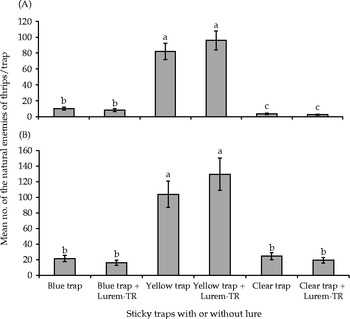
Blue traps caught more than two times the number of F. schultzei compared with yellow traps. The number of F. schultzei catches on the different sticky traps was significantly different in planting periods 1 (F= 316.4; df = 5, 15; P< 0.001) and 2 (F= 322.4; df = 5, 15; P< 0.001). Lurem-TR significantly enhanced the catches of F. schultzei by up to 1.52, 1.63 and 2.5 times in blue, yellow and clear traps, respectively, in the two planting periods (Figs 1 and 2). The number of H. adolfifriderici catches on the different treatments was significantly different in both planting periods (F= 44.9; df = 5, 15; P< 0.001 and F= 34.4; df = 5, 15; P< 0.001). Yellow traps were more attractive to H. adolfifriderici than blue and clear traps in both planting periods (Figs 1 and 2). Lurem-TR enhanced the catch of H. adolfifriderici by up to 2.28 times in both planting periods. The mean number of two natural enemies of thrips, the anthocorid predator Orius spp. and the parasitoid C. menes, caught per trap per week on the sticky traps is shown in Fig. 3. In both experiments, more beneficial insects were caught in yellow compared with blue traps (F= 66.4; df = 5, 15; P< 0.001 and F= 27.6; df = 5, 15; P< 0.001) in planting periods 1 and 2, respectively (Fig. 3). The use of Lurem-TR did not influence the attraction of the natural enemies of thrips (Fig. 3).
Cumulative means ( ± SEM) of the natural enemies (Orius spp. and Ceranisus menes) of thrips per trap for (A) planting period 1 and (B) planting period 2. Means with different letters are significantly different at the 0.05 significance level.

Correlation of mean total thrips captures in the traps with the absolute estimates of thrips on plants
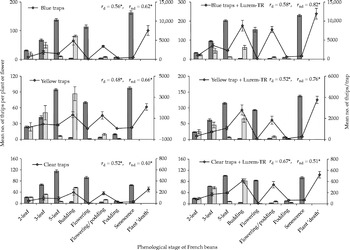
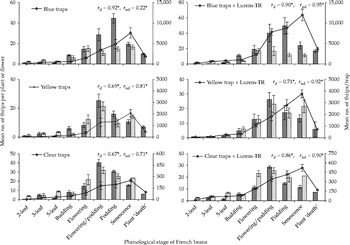
The correlation between mean total thrips captures in the coloured sticky traps, using both the destructive (leaves and flowers) and non-destructive (tapping) plant sampling methods, was positive and significant (Figs 4 and 5). The correlation between the mean numbers of thrips captured per sticky trap and the mean number recovered from plants was highest in the second trial compared with the first trial (Figs 4 and 5). Blue traps with Lurem-TR correlated the most (r= 0.95; df = 34; P< 0.001) with the absolute estimates of thrips using the destructive sampling method.
Correlation of mean total thrips estimates from the coloured sticky traps with estimates from the destructive (picking leaves and flowers) and non-destructive sampling (tapping whole plant) methods as shown by pale- and dark-shaded bars, respectively, for planting period 1. r d and r nd are Pearson's correlation coefficients with destructive and non-destructive sampling, respectively. The asterisk indicates significant correlation at P< 0.05.

Correlation of mean total thrips estimates from the coloured sticky traps with estimates from the destructive (picking leaves and flowers) and non-destructive sampling (tapping whole plant) methods as shown by pale- and dark-shaded bars, respectively, for planting period 2. r d and r nd are Pearson's correlation coefficients with destructive and non-destructive sampling, respectively. The asterisk indicates significant correlation at P< 0.05.

Discussion
The results of the present study indicate that M. sjostedti, F. schultzei and F. occidentalis are more responsive to blue sticky traps than yellow and clear sticky traps. Yellow traps are more attractive to H. adolfifriderici than blue and clear traps. The attractiveness of different coloured traps to many thrips species has been demonstrated (Hoddle et al., Reference Hoddle, Robinson and Morgan2002; Chen et al., Reference Chen, Chu, Fitzgerald, Natwick and Henneberry2004; Broughton and Harrison, Reference Broughton and Harrison2012). For instance, blue traps have previously been reported as the preferred colour for monitoring F. occidentalis in broccoli, Brassica oleracea L. (‘Marathon’) fields (Chen et al., Reference Chen, Chu, Fitzgerald, Natwick and Henneberry2004) and head lettuce, Lactuca sativa L., cultivar Lighthouse (Natwick et al., Reference Natwick, Byers, Chu, Lopez and Henneberry2007). Similarly, blue colour has been reported to be attractive to both F. occidentalis and F. schultzei on plums (Allsopp, Reference Allsopp2010). Nevertheless, there is evidence that F. schultzei can also be attracted to red colour (Yaku et al., Reference Yaku, Walter and Najar-Rodrigueza2007). However, information on attraction to coloured traps for thrips species indigenous to Africa such as M. sjostedti and H. adolfifriderici presented in this study was not reported earlier.
Trap colour preferences exhibited by M. sjostedti, F. schultzei and F. occidentalis changed gradually over the course of the trial with a sudden increase at the budding stage, which is critical for thrips infestation (Nyasani et al., Reference Nyasani, Meyhöfer, Subramanian and Poehling2012). By contrast, H. adolfifriderici observed at the early vegetative stage declined as the crop matured. The increase could also be associated with migration of thrips to the French beans from neighbouring plants or due to increased thrips reproduction on the plants. Nyasani et al. (Reference Nyasani, Meyhöfer, Subramanian and Poehling2012) made a similar observation that M. sjostedti, F. schultzei and F. occidentalis showed an increase at the budding stage in a French bean crop.
The kairomone attractant (Lurem-TR) increased the captures of all four thrips species, F. occidentalis, F. schultzei, M. sjostedti and H. adolfifriderici, in various sticky trap treatments. The highest increase of thrips catches was recorded for M. sjostedti on blue sticky traps. A similar differential response among thrips species to plant allelochemicals, including the kairomone attractant, has been reported (Teulon et al., Reference Teulon, Penman and Ramakers1993; Koschier, Reference Koschier, Rai and Carpinella2006; Davidson et al., Reference Davidson, Butler and Teulon2009). Broughton and Harrison (Reference Broughton and Harrison2012) also observed a threefold increase in the captures of western flower thrips (WFT) with the use of Lurem-TR in Western Australia. In Tunisia, blue traps with Lurem-TR caught more than twice as many WFT as those without in a pepper crop (Harbi et al., Reference Harbi, Elimem and Chermiti2013). However, the present study reports for the first time the influence of Lurem-TR in increasing captures of thrips species such as F. schultzei, M. sjostedti and H. adolfifriderici. In both experiments, more natural enemies of thrips were caught in yellow compared with blue traps. This result is in agreement with that reported by Rodriguez-Saona et al. (Reference Rodriguez-Saona, Byers and Schiffhauer2012), who found that yellow traps caught more Orius spp. than blue traps placed in cranberries in Burlington Co., New Jersey, USA. The use of Lurem-TR did not influence the attraction of the natural enemies of thrips, such as the anthocorid predator Orius spp. and the parasitoid C. menes. Waite (Reference Waite2012) also observed that methyl isonicotinate, the active ingredient of Lurem-TR, repelled the anthocorid bug Orius insidious in laboratory olfactometer studies. However, Broughton and Harrison (Reference Broughton and Harrison2012) observed that Lurem-TR increased trap captures of brown lacewings by 1.3 times.
Significant positive correlations were found between trap catches and thrips populations on plants, presenting their validity for thrips monitoring. Cloyd and Sadof (Reference Cloyd and Sadof2003) and Macintyre-Allen et al. (Reference Macintyre-Allen, Scott-Dupree, Tolman and Harris2005) reported a positive correlation after comparing the number of thrips caught in sticky traps and the numbers collected on the plants. Broughton and Harrison (Reference Broughton and Harrison2012) found a poor correlation when comparing trap catches and tapping methods for the monitoring of thrips in a deciduous fruit tree. Pizzol et al. (Reference Pizzol, Nammour, Hervouet, Bout, Desneux and Mailleret2010) compared traps, tapping flower heads and whole-plant counts of thrips, and demonstrated that the use of traps provided an accurate estimate in a rose crop. Determining the best sampling method involves finding one that is precise, reliable, inexpensive and easy to adopt (Parajulee et al., Reference Parajulee, Shrestha and Leser2006). It was observed from our studies that blue traps with Lurem-TR had the strongest positive correlations and thus could be more sensitive in detecting the early presence of thrips in French bean fields.
Conclusion
Blue traps were the most attractive to three economically important flower-inhabiting thrips (M. sjostedti, F. occidentalis and F. schultzei), while yellow traps were attractive to the vegetative-inhabiting thrips H. adolfifriderici. The kairomone attractant, Lurem-TR, was able to increase thrips captures for all thrips species without influencing the captures of their natural enemies. Blue sticky traps with Lurem-TR can be used with a great deal of validity as an early detection and thrips-monitoring tool to implement timely management strategies. However, this should be considered carefully in situations where H. adolfifriderici is the dominant thrips species.
Acknowledgements
The authors thank the icipe Thrips IPM Project staff for all their assistance in undertaking this study. The authors also acknowledge the support from Dr Willem Jan de Kogel, Plant Research International, The Netherlands and Dr David Teulon, Plant and Food Research, New Zealand for providing the Lurem-TR attractants and their constant encouragement during the conduct of the study. The authors gratefully acknowledge the funding provided by the BMZ (Federal Ministry for Economic Cooperation and Development, Germany) through GIZ (project no. 07.7860.5-001.00).