Introduction
In the past two decades, there has been growing concern over human online activities,Reference Fineberg, Demetrovics and Stein1 which, when performed in excess or when people get preoccupied by them, can lead to a wide variety of problems, including interpersonal stress, vocational difficulties, academic failure, financial problems, and mental health morbidity.Reference Kuss and Lopez-Fernandez2, Reference Király, Griffiths and Demetrovics3 The term problematic internet use (PIU) has been used to characterize this emerging disorder (also known as Internet Addiction); however, the causes, correlates, and consequences of this relatively new phenomenon are far from well understood.Reference Fineberg, Demetrovics and Stein1 PIU has been associated with a wide variety of psychopathological phenomena,Reference Carli, Durkee and Wasserman4, Reference Ko, Yen and Yen5 including alcohol misuse, mood disorders, ADHD,Reference Chamberlain, Ioannidis and Leppink6 and impulse control disorders.Reference Chamberlain, Ioannidis and Grant7 Problematic internet users have been characterized by increased impulsivity and compulsivity,Reference Ioannidis, Chamberlain and Treder8, Reference Ioannidis, Treder and Chamberlain9 and they suffer from a wide variety of cognitive problems, including motor-response inhibition, decision making, and working memory.Reference Ioannidis, Hook and Goudriaan10
In terms of heritability, a small number of studies in PIU using the classical twin design have demonstrated that both genetic and environmental influences are important to explain the observed PIU phenotypical variation. Those studies report genetic influences of 0–48%,Reference Deryakulu11–Reference Hahn, Reuter and Spinath14 and the results are considered consistent with previous observations of behavioral genetics in addiction disorders.Reference Prescott and Kendler15 Indeed, the molecular genetics considered to influence PIU have also been associated with substance use and addiction;Reference Fineberg, Demetrovics and Stein1 studies looking at molecular genetic influences of PIU have explored the influences of those addiction-related variants in the serotonin transporter gene (5HTTLPR/SLC6A4),Reference Lee, Han and Yang16 nicotine acetylcholine receptor gene (CHRNA4),Reference Jeong, Rhee and Kim17, Reference Montag, Kirsch and Sauer18 and neurotrophic tyrosine kinase type 3 receptor gene (NTRK3).Reference Kim, Jeong and Rhee19 However, dopamine, a major neurotransmitter, is also involved in addiction and impulsive behavior,Reference Volkow, Fowler and Wang20, Reference Robbins, Everitt and Nutt21 and has been implicated in the psychopathological pathway of PIU; reduced dopamine transporters have been observed in the striatum of PIU participants.Reference Hou, Jia and Hu22, Reference Kim, Baik and Park23 Studies looking at genetic loci related to the dopaminergic system to identify correlations with PIU have found that the Taq1A1 allele of the DRD2 gene (χ 2 = 4.06, p = 0.04) and the “met” allele of the catechol-O-methyltransferase (COMT) gene (rs4680 val158met polymorphism) (χ 2 = 5.08, p = 0.02) increased in the excessive online video game-playing subjects relative to age and gender-matched controls.Reference Han, Lee and Yang24 Conversely, gambling behavior, which is thought to be closely related to PIU,Reference Chamberlain, Ioannidis and Grant7 was much more prevalent in the COMT “Val/Val” group (p = 0.001).Reference Grant, Leppink and Redden25 The latter is more in keeping with the concept of relatively reduced dopamine function in such patients, coupled with sub-optimal cognition; compared to the “Met/Met” group, in the “Val/Val” group, there is higher enzymatic activity of COMT, associated with decreased frontal lobe dopaminergic post-synaptic stimulation.Reference Chen, Lipska and Halim26 Furthermore, the COMT rs4818 haplotypes exerted differential effects on pre-frontal cortex functions, including non-emotional problem solving and decision making.Reference Roussos, Giakoumaki and Pavlakis27 Overall, it is unclear whether genetic determinants of reduced or excessive cortical dopamine levels are driving addictive online behavior.
Based on the literature presented in the previous paragraph, we hypothesized that the COMT rs4680 (G/G or “Val/Val”) haplotype would have higher rates of PIU (in line with the concept that lower levels of dopaminergic post-synaptic stimulation would increase vulnerability toward PIU) and would perform worse in decision making and spatial memory tasks. We hypothesized that the COMT rs4818 “C” homozygotes would have enhanced performance in decision-making tasks. We did not make further hypotheses for any of the other genetic variants and cognitive domains, and we performed exploratory comparison of cognitive performance, stratified by genetic haplotypes.
Methods
Participants
About 206 non-treatment seeking young adults aged 18–29 years who had gambled (any game of chance where they wagered money) at least five times in the past year participated in the study (this standard was used to over-sample for impulsive young adults). The study was conducted from 2010 to 2016. They responded to media advertisements in two large metropolitan areas (Chicago and Minneapolis, USA) and were compensated with a $50 gift card to an online retailer. Exclusion criteria included intellectual disability, neurological conditions affecting cognition, and the inability to give voluntary written informed consent.
Measures
Subjects’ internet use was evaluated using Young’s Diagnostic Questionnaire (YDQ).Reference Young28 In addition to the YDQ, participants took part in several baseline clinical and cognitive evaluations. Subjects were also given the opportunity to provide a saliva sample for genetic analysis.
Clinical assessments
PIU was quantified using YDQ.Reference Young28 The YDQ consists of eight items ascertaining the level of PIU. According to Young’s original operational criteria, a cut-off score of 5 or more was regarded as PIU, which has been used in previous studies.Reference Chamberlain, Ioannidis and Grant7, Reference Dong, Zhou and Zhao29–Reference Chamberlain, Redden and Leppink31
Mental health disorders were evaluated with the Mini International Neuropsychiatric Inventory (MINI) and the Minnesota Impulsive Disorders Interview (MIDI). The MINI is a clinician-administered psychiatric interview that evaluates for major depressive disorder, panic disorder, generalized anxiety disorder, eating disorders, and others.Reference Sheehan, Lecrubier and Sheehan32 The MIDI detects the presence of impulse control disorders, including compulsive buying, kleptomania, trichotillomania, skin picking disorder, pyromania, intermittent explosive disorder, gambling disorder, compulsive sexual behavior, and binge eating disorder.Reference Grant, Levine and Kim33 In addition, the Barratt Impulsiveness Scale (BIS-11), a self-report questionnaire, was employed to quantify impulsive personality.Reference Patton, Stanford and Barratt34 The Padua Inventory (PADUA),Reference Burns, Keortge and Formea35 a questionnaire consisting of 39 items, assessed common obsessive and compulsive phenomena. Quality of life was measured using the Quality of Life Inventory (QOLI).Reference Frisch, Cornell and Villanueva36
Cognitive assessments
Cambridge Neuropsychological Test Automated Battery (CANTAB Eclipse, version 3, Cambridge Cognition Ltd, Cambridge, UK) was used to evaluate neurocognition using a variety of tasks.
Intra/Extradimensional Task (IED)
The IED, a computerized analogue of the Wisconsin Card Sorting test, examines rule acquisition and reversal learning. Participants suffering from internet gaming disorder and obsessive-compulsive disorder have demonstrated impaired performance on the IED, suggesting that both disorders are characterized by cognitive inflexibility.Reference Kim, Lim and Lee37 The task features two shapes and white lines in which the subject is told that one of them is “correct” according to a rule generated by the computer. The goal is to find out which one is correct first using trial and error. When they get it wrong again, it means the rule has changed and they need to figure out which of the shapes or lines is the new correct answer. The task includes nine blocks, with block eight signifying the extra-dimensional shift.
Stop Signal Task (SST)
The SST tests response inhibition. Subjects are instructed to press the left button on the button box if they see an arrow pointing to the left and the right button if they see an arrow pointing to the right. They are told to inhibit their response if an arrow appears followed by a beeping sound.Reference Aron, Robbins and Poldrack38 The Stop Signal Reaction Time (SSRT) is the time between the go stimulus (arrow) and the stop stimulus (beep) when subjects successfully inhibit their response on 50% of trials. Previous studies have suggested that problematic internet users are characterized by impaired response inhibition,Reference Li, Nan and Taxer30, Reference Kim, Lim and Lee37, Reference Liu, Choi and Boland39 although non-significant results have been reported as well.Reference Chamberlain, Redden and Leppink31, Reference Choi, Kim and Kim40, Reference Lim, Lee and Jung41
One-Touch Stockings of Cambridge Task (OTS)
The OTS is a test of executive function, based on the Tower of Hanoi test assessing spatial planning and working memory. Previous studies have shown that PIU is characterized by impaired working memory performance,Reference Chamberlain, Redden and Leppink31, Reference Zhou, Zhou and Zhu42, Reference Zhou, Zhu and Li43 although null findings have been reported.Reference Lim, Lee and Jung41 For the OTS, subjects are shown two images on the screen each containing three colored balls in sockets. The goal of the task is to determine how many moves it takes to make one image look like the other (each ball moved equals one move). The variable included in this analysis was “problems solved on first choice.”
Cambridge Gambling Task (CGT)
The CGT tests aspects of decision making.Reference Lawrence, Luty and Bogdan44 Previous studies have shown that PIU is characterized by impaired decision-making performance,Reference Chamberlain, Redden and Leppink31, Reference Pawlikowski and Brand45, Reference Qi, Du and Yang46 although null findings have been reported.Reference Lorenz, Krüger and Neumann47, Reference Nikolaidou, Fraser and Hinvest48 Subjects are shown a row of 10 boxes (either red or blue) on the screen. They choose whether they think a golden token is under a red or a blue box. Subjects are able to bet points on which color they selected by waiting while the points ascend or descend on the screen. The variables for the CGT included in this analysis were “quality of decision making” (the proportion of times when the subject gambles on the more likely outcome), “risk adjustment” (the tendency to bet a higher proportion of points when the large majority of boxes are the color they chose than when a smaller majority of boxes are the color they chose), and “delay aversion” (the tendency for subjects who are unable or unwilling to wait to bet more points when the points are presented in descending order and fewer points when points are presented in ascending order).
Rapid Visual Processing Task (RVP)
The RVP is a test of continuous performance and visual sustained attention; it involves subjects recognizing several sequences within scrolling numbers. The RVP A prime is the signal detection measure of sensitivity to the target, regardless of response tendency. The RVP mean latency measures how long it takes the subject to respond to correct sequences (in milliseconds). The RVP probability of false alarm is when the subject responds inappropriately. Poor performance in RVP has been associated with ADHD among other disorders.Reference Gau and Huang49 Prolonged periods in the online environment require sustained attention and rapid visual processing of online information. While the RVP has not been tested in PIU before, ADHD has been described as a major co-morbidity of PIU; therefore, an examination of this task can provide insights into whether those disorders share this cognitive endophenotype.
Spatial Working Memory Task (SWM)
The SWM tests ability to remember spatial information and to use working memory in that process. Similar to the OTS, PIU may be characterized by impaired working memory performance. Colored boxes are presented on a screen, one containing a blue box in it. Subjects click the boxes in order to find the blue box. Once they find it, they can use the process of elimination to find all of the other blue boxes until a column on the right of the screen is filled. The number of boxes in each trial increases over time. SWM total errors are the number of times the subject clicks a box that is known not to contain a blue box. SWM strategy is a measure of how well the subject follows a specific strategy that has been suggested to be efficient for the task.Reference Owen, Downes and Sahakian50
Genetic analysis
Saliva samples were analyzed for COMT val158met (rs4680 G to A) and (rs4818 C to G) genotyping. TaqMan probes and primers were designed and synthesized by Applied Biosystems Inc. DNA samples were genotyped using TaqMan SNP Genotyping Assays (Applied Biosystems Inc., Foster City, CA) using standard reagents and standard cycling protocols. Data were managed by the Applied Biosystems’ ABI 7900 Real-Time Basic Software. Researchers who conducted the analysis were blind to results on clinical and cognitive measures.
COMT rs4680 (Val158Met) polymorphism
The COMT 158met allele results from a single nucleotide substitution between “G to A” and results in an amino acid change from valine to methionine at codon 158. This leads to a ~38% reduced enzymatic activity of COMT in the “Met/Met” group,Reference Chen, Lipska and Halim26 leading to higher synaptic dopamine levels following neurotransmitter release, ultimately increasing frontal lobe dopaminergic post-synaptic stimulation,Reference Lotta, Vidgren and Tilgmann51 a mechanism through which the COMT val158met polymorphism is considered to exert its differential effects in human cognition. The “Val/Val” group has been associated with increased gambling behaviors and worse cognitive performance in the CGTReference Grant, Leppink and Redden25 and SWM,Reference Grant, Leppink and Redden25, Reference Farrell, Tunbridge and Braeutigam52 although conflicting results do exist.Reference van den Bos, Homberg and Gijsbers53, Reference Soeiro-De-Souza, Stanford and Bio54 Ultimately, the relationship between dopaminergic tone in the prefrontal cortex (PFC) and PFC-dependent cognitive performance may better be described as an inverted U-shape function, in which excessively high or low dopamine is associated with poor performance.Reference Schacht55, Reference Robbins and Arnsten56
COMT rs4818 polymorphism
Other studies have highlighted the importance of a synonymous polymorphism within the COMT gene (rs4818 C/G) and suggested that it accounts for a greater variation of COMT activity compared to the functional Val158Met polymorphism in some aspects of cognition. The rs4818 polymorphism affects COMT enzymatic expression activity up to 18-fold, by altering mRNA stability.Reference Nackley, Shabalina and Tchivileva57 The rs4818 haplotypes have been shown to have differential effects on pre-frontal cortex functions, including non-emotional problem solving (Stockings of Cambridge, “C” homozygotes outperformed G-carriers analysis of variance (ANOVA) p < 0.01) and decision making (Iowa Gambling Task “G” homozygotes outperformed C-carriers ANOVA p < 0.001).Reference Roussos, Giakoumaki and Pavlakis27 Also, tolcapone (a COMT inhibitor) improved performance in working memory for the “G” homozygotes only.Reference Roussos, Giakoumaki and Bitsios58
Statistical analysis
Statistical analyses were done using statistical software R version 3.4.2 and R packages including “HardyWeinberg”Reference Graffelman59 and “MASS”.Reference Venables and Ripley60 Power calculations were performed using G*Power software.Reference Faul, Erdfelder and Lang61 Participants were grouped according to their PIU status (PIU = YDQ ≥ 5 at any point during the four yearly assessments of PIU) and compared using one-way ANOVA or chi square (χ 2) tests. We did not apply a Bonferroni correction for multiple comparisons given that this is an exploratory study. An a priori power calculation with α error probability 0.05 required a sample size of 145 to identify a medium size effect (ω = 0.3) with 95% power (n = 52 for large effect) for chi square tests. It also required a sample size of 208 to identify medium size effects with 95% power and α error probability 0.05 (n = 82 for large effect) in two-groups ANOVA. However, a sample size of 246 was required to identify medium size effects with 95% power and α error probability 0.05 in three-group ANOVA. Therefore, our sample size of 206 was considered adequate to identify a medium effect or larger in the chi square group comparisons and only large effects in the ANOVA analysis between three groups. To deal with a small minority of missing values in the cognitive tests (<0.5%) we used mean substitution imputation. There were also 34 subjects (16%) who lacked ADHD clinical status, and the proportion of missing ADHD clinical status was larger in the PIU group at 45% compared to non-PIU group at 12.1%. However, the reported proportions of 7% in the PIU group and 3% in the non-PIU group are consistent with the large epidemiological studies for ADHD and PIU.Reference Carli, Durkee and Wasserman4, Reference Ko, Yen and Yen5
Ethics
The procedures of this study were carried out in accordance with the Declaration of Helsinki. The institutional review boards of the University of Chicago and the University of Minnesota approved the study. All study procedures were explained, allowing for subjects to have the opportunity to have questions answered, before subjects gave written informed consent.
Results
PIU vs non-PIU comparison
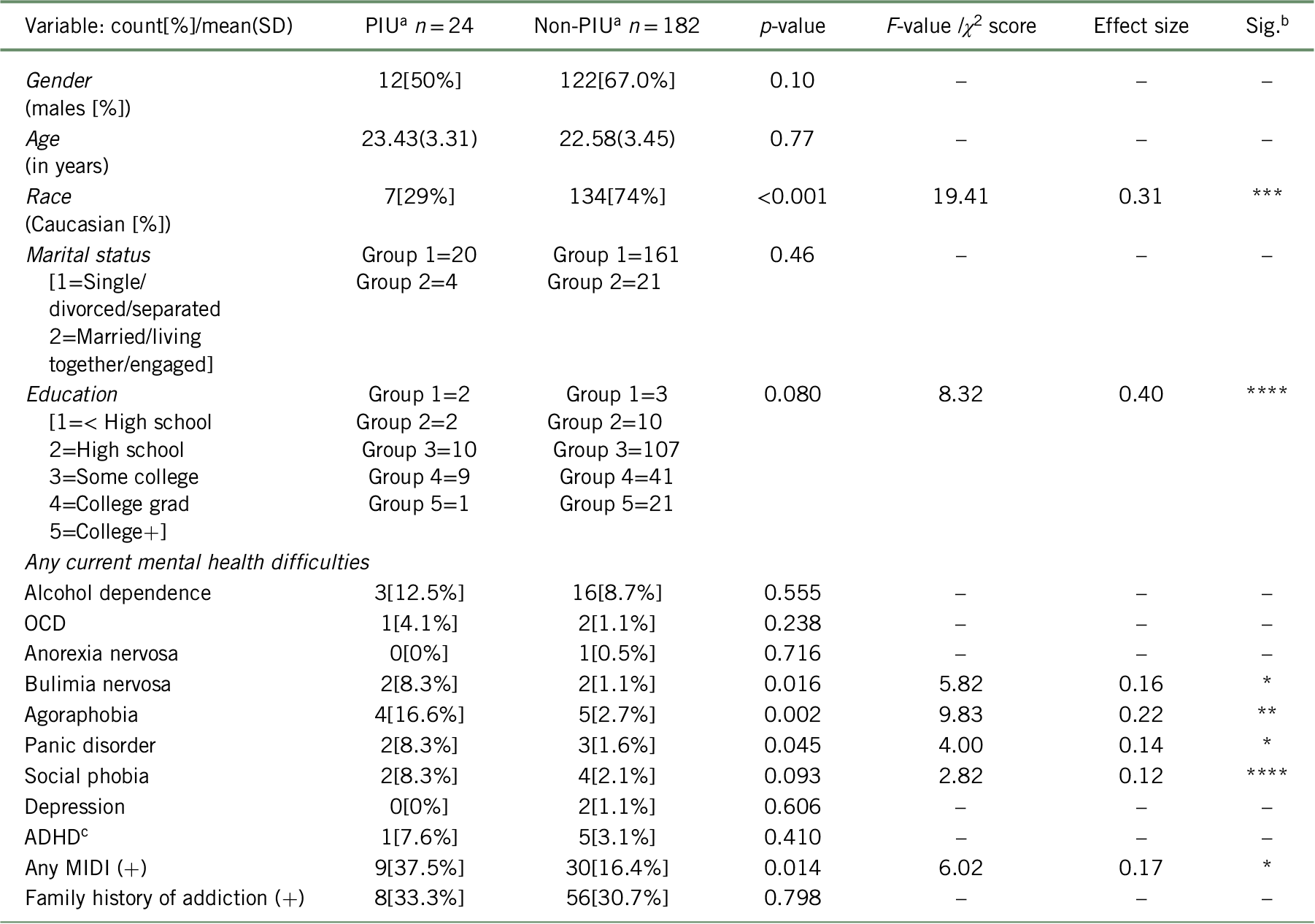
In the whole sample the yearly prevalence rate of PIU was 11.65%. Full results about the demographic and clinical variables as well as a comparison between PIU and non-PIU participants are presented in Table 1.
Baseline demographic and clinical characteristics of problematic internet users

Note: Effect size is phi(ϕ) or Cramer’s V as appropriate for chi square and eta squared (η2) for one-way ANOVA.
ADHD: attention deficit hyperactivity disorder; OCD: obsessive-compulsive disorder; MIDI: Minnesota Impulsive Disorders Interview.
a PIU as >=5 on YDQ (0–8 scale).
b Significance: chi square without continuity correction for categorical variables.
c There were 34 missing ADHD data points.
Significance: * <0.05; ** <0.01; *** <0.001; **** <0.10 (trend level).
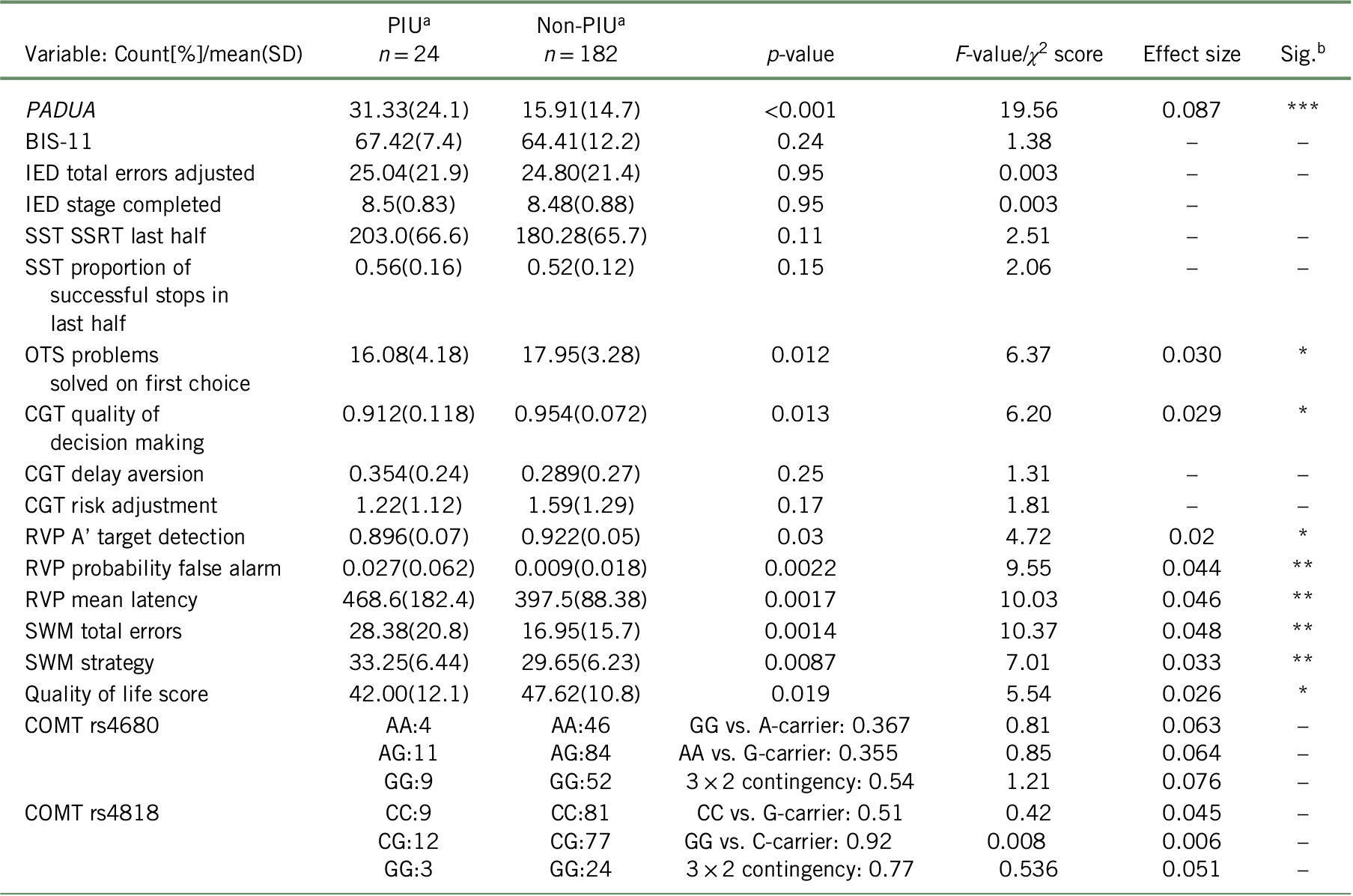
PIU was associated with non-Caucasian race (χ 2, p < 0.001). PIU was also associated with higher rates of psychiatric diagnoses including agoraphobia, panic disorder, bulimia nervosa, and impulse control disorders. Problematic internet users were characterized by increased PADUA scores (p < 0.01), worse quality of life (p = 0.019) and worse performance on the OTS (p = 0.012), CGT quality of decision making (p = 0.013), RVP target detection sensitivity (p = 0.03), RVP probability of false alarm and mean latency (both p = 0.002), and SWM total errors (p = 0.001) and search strategy (p = 0.008). All eta squared (η2) effect sizes of significant results were small (0.01 ≤ η2 ≤ 0.09). No other differences in performance were identified in the other cognitive tasks between PIU and non-PIU subjects (Table 2).
Cognitive and genetic characteristics of problematic internet users

Note: Effect sizes are phi(ϕ) for chi square and eta squared (η2) for one-way ANOVA.
YDQ ≥ 5 in Young’s 8-item Diagnostic Questionnaire; IED = Intra/Extra-dimensional Shift Test; SST = Stop Signal Task; SSRT = Stop-Signal Reaction Time; OTS = One-Touch Stockings of Cambridge; CGT = Cambridge Gambling Task; RVP = Rapid Visual Information processing; SWM = Spatial Working Memory; PADUA = Padua Inventory total score; BIS-11 = Barratt Impulsiveness Inventory Total score.
a PIU as >= 5 on YDQ (0–8 scale).
b Significance: chi square for categorical variables and ANOVA for continuous variables.
* <0.05; ** <0.01; *** <0.001; **** <0.10 (trend level); p-values are uncorrected.
Genetics results
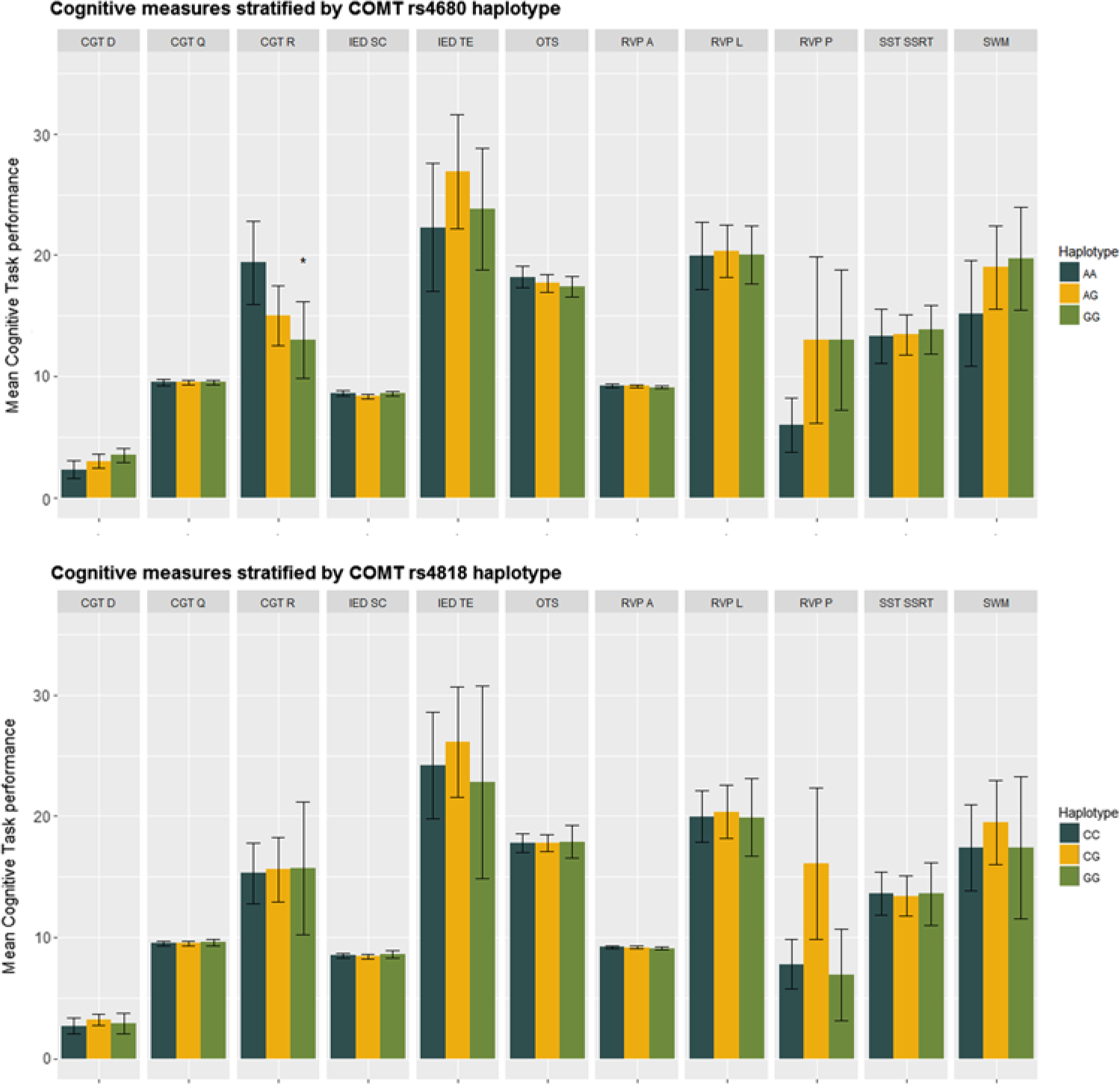
The COMT distribution was under Hardy–Weinberg equilibrium for COMT rs4680 (χ 2 = 1.15, p = 0.28) and COMT rs4818 (χ 2 = 0.48, p = 0.50). Full results for the cognitive performance stratified by COMT rs4680 and rs4818 variants are presented in Figure 1.
Cognitive measures stratified by genetic haplotypes. CGT D = Cambridge Gambling Task Delay aversion *10; CGT Q = Quality of Decision-making *10; CGT R = risk adjustment *10; IED SC = Intra/Extra-Dimensional Task Stages completed; IED TE = IED total errors; OTS = One-Touch Stockings Solved 1st choice; RVP A = Rapid Visual Processing target sensitivity; RVP R = Rapid Visual Processing Probability false alarm; RVP L = RVP Mean Latency (sqrt); SST SSTR: Stop-Signal Task SSTR Last half (sqrt); SWM = Spatial Working Memory Total errors; Sig: * <0.05; ** <0.01; *** <0.001; p-values are uncorrected.

The COMT rs4818 “CG” allele was associated with a trend level worse performance in the RVP Probability of false alarm (ANOVA: F = 2.562, p = 0.0797), but no other group-level differences between alleles in any other cognitive tasks were examined. The COMT rs4680 “Val/Val” allele was associated with higher PADUA score (p = 0.049) and worse performance in the CGT risk adjustment (Tukey HSD test indicates true difference lies within the “Val/Val” vs. “Met/Met” comparison (p = 0.021), overall ANOVA: F = 3.685, p = 0.027), but no other group-level differences between alleles in any other cognitive tasks were examined. We found no statistical evidence to support that any of the COMT variants were associated with increased rates of PIU. Post-hoc power calculations suggested that the chi square values did not reach critical threshold (χ 2 = 1.21 vs. critical χ 2 = 5.99 for α = 0.05 and λ = 2.06) indicating that the null hypothesis should be retained.
Discussion and Conclusions
This is the first study to examine the impact of COMT genetic variants on PIU and its cognitive determinants. While PIU was characterized by worse performance in multiple cognitive domains, we found no evidence that any of the genetic variants tested had any significant impact on those associations. This null finding implies that the genetic heritable components of PIU shown in previous studiesReference Deryakulu11–Reference Hahn, Reuter and Spinath14 may not lie within the genetic loci influencing COMT function and cognitive performance, or that the genetic component in PIU involves many genetic polymorphisms each conferring only a small effect viewed individually.
Our results add to the series of studies that have demonstrated cognitive deficits in PIU and specifically that PIU subjects perform worse on decision making and working memory tasks.Reference Ioannidis, Hook and Goudriaan10 We also found evidence of impaired inhibitory control on the RVP (sustained attention) task as indexed by commission errors in PUI, though this group was not significantly impaired on the SST inhibition measure (stop-signal reaction times). Evidence of impaired inhibitory control in prior literature is mixed and may be impacted by study quality. Our finding of deficits on RVP but not SST inhibitory control may suggest that this cognitive domain is particularly impacted in situations of high attentional demand. We also did not find any statistically significant difference in the performance of PIU vs. non-PIU subjects in the IED task; in IED, when a difference was reported before, findings were inconsistent, depending on which outcome measure was used.Reference Kim, Lim and Lee37
In addition, a unique finding of this study was the identification of impaired sustained attention on the RVP task in PUI, both in terms of the ability to detect targets and also slower responses to target sequences. This novel finding suggests that sustained attention difficulties might be important for our understanding of PIU. An important aspect to consider is the possibility of ADHD being a confounding factor of performance on some of these tasks, due to the fact that impaired performance has been described in ADHD subjects; therefore future studies should account for that.
In terms of our cognitive results stratified by genetic variants, we were able to replicate the result that the “Val/Val” group of COMT rs4680 would perform worse on the CGT. However, we failed to replicate the positive results of previous studies indicating that COMT rs4680 influences spatial working memory.Reference Grant, Leppink and Redden25, Reference Farrell, Tunbridge and Braeutigam52 Furthermore, we failed to replicate the results of previous studies suggesting a potential influence of COMT rs4818 haplotypes in cognition,Reference Roussos, Giakoumaki and Pavlakis27 as we only found a trend-level significance in the RVP Probability of false alarm scores, in which the “CG” carriers performed worst. While those results are unexpected, they suggest that further replication research is required to confidently ascertain the impact of such COMT polymorphisms on cognitive performance.
Finally, while our analysis suggests that none of the examined genetic variants had a significant impact on PIU prevalence rates, the “Val/Val” (rs4680) had a much higher rate of PIU [14.6%] compared to “met/met” participants [8%], suggesting the possibility that the null finding represents a type 2 error. However, given that the chi square value of the three-group comparison did not reach the critical value of the post-hoc power computation, if an effect does exist, it is likely to be small. This would be in line with previous reports that “Val/Val” carriers are more vulnerable to developing disorders characterized by impaired impulse control, but contrary to a previous report that “Met/Met” carriers are more vulnerable to developing video gaming disorder.Reference Han, Lee and Yang24 Another possibility is that the effect of COMT rs4680 is non-linear, in which case both extremes of dopamine cortical availability might be driving vulnerability toward PIU, or that video gaming disorder is qualitatively different from the more general concept of PIU, in terms of neurobiological footprint. Nonetheless, the null findings also suggest differential genetic determinants of PIU vs. other impulse control or addictive disorders, potentially supporting the concept of PIU as a separate disorder.
Limitations
There are limitations to this study related to the use of the YDQ instrument; the YDQ has been criticized for its unstable factor structure, deviation from current classification directions (DSM-V and ICD-11 moving toward internet gaming disorder), and lagging behind the technological advances of internet applications.Reference Laconi, Rodgers and Chabrol62 Furthermore, the YDQ threshold for PIU requires further validation in future research. However, the threshold used in this study was consistent with similar studies using the YDQ instrument and was able to identify impairment in the quality of life in the PIU group vs. controls. There are further limitations related to our study sample size. While this was large enough to provide significant results, it was not enough to allow for the correction of significance for multiple comparisons. Therefore, our results are susceptible to bias generated by multiple statistical testing and should be regarded as exploratory. Moreover, when discussing our null findings in the cognitive tests, we should take into consideration our a priori power analysis indicating that our study was only powered enough to detect large effects in the three-group ANOVA analysis. Therefore, there is the possibility that small or medium effects do exist and the null hypothesis has been falsely retained. This is in line with previous work, indicating that PIU is characterized by small or medium effects in the domains tested, particularly response motor inhibition, decision making, and working memory.Reference Ioannidis, Hook and Goudriaan10 Furthermore, our sample of problematic internet users had relatively high rates of co-occurring psychiatric diagnoses. While this is in line with recent meta-analyses and literature reviews,Reference Carli, Durkee and Wasserman4, Reference Ko, Yen and Yen5 the question remains whether some of our results are confounded by these co-occurring disorders. A further limitation relates to our sampling technique; by including individuals who have gambled five times or more, it is possible that our sample is biased toward heightened impulsivity traits (particularly in the control group) and thus differences between PIU and control groups may become attenuated. This may also explain to some degree the lack of significant differences found between PIU and controls in the motor inhibition task; however, the recent meta-analysis showed that higher quality studies reported null results in this cognitive domain.Reference Ioannidis, Hook and Goudriaan10 It may also explain the lack of significantly elevated rates of ADHD in the PIU group, despite the fact that ADHD is a commonly reported co-morbidity of PIUReference Ho, Zhang and Tsang63; however, lack of power to detect differences in comorbid disorders might be a contributing factor. Finally, given that our power analysis indicated that our study could only identify medium and larger effects, it is possible that genetic influences of the COMT rs4680 and rs4818 genes exist, although their effects would be small. Indeed, our results highlight the need for large-scale international collaborative studies on PIU including genetic data. The COMT rs4680 haplotypes in particular might be worthy of attention when examining resilience and vulnerability against PIU.
Conclusions
PIU was associated with worse performance on decision making, working memory (as in previous studies), and RVPs (novel finding). Although particular genetic variants were associated with altered cognitive performance, we found no evidence to suggest that rates of PIU differed for particular haplotypes of COMT rs4680 and rs4818. This implies that the genetic heritable components of PIU may not lie within the genetic loci influencing COMT function, or that their effects are small and larger studies are required to ascertain them.
Acknowledgement
We are indebted to the volunteers of both sites who participated in the study.
Funding
This research was supported by a COST Action Grant (CA16207; European Network for Problematic Usage of the Internet; European Cooperation in Science and Technology) and COST Action Short-term Scientific Mission (STSM) to Dr Ioannidis.
Disclosures
Dr Ioannidis’ research activities were supported by Health Education East of England Higher Training Special interest sessions. Dr Chamberlain’s involvement in this research was funded by a Wellcome Trust Clinical Fellowship (110049/Z/15/Z). Dr Chamberlain consults for Cambridge Cognition and Shire. Dr Grant reports grants from the National Center for Responsible Gaming, Forest Pharmaceuticals, Takeda, Brainsway, and Roche, and others from Oxford Press, Norton, McGraw-Hill, and American Psychiatric Publishing outside of the submitted work. Authors received no funding for the preparation of this manuscript. The other authors report no financial relationships with commercial interest.