Implications
Wet-fermented soybean meal (WFSM) and dry-fermented soybean meal (DFSM) exert many beneficial effects in the large intestine, leading to improve the growth performance of piglets. Wet-fermented soybean meal and DFSM supplementation altered the compositions of metabolites and microbiota in the large intestine and exerted beneficial effects, with WFSM being more effective than DFSM. The present study provides an understanding on the mechanism of how fermented soybean meal (FSM) promotes piglet growth performance from the perspective of microflora and its metabolism in the large intestine, and thus present a theoretical basis for the application of FSM in the development of biological feed for piglets.
Introduction
The gastrointestinal tract (GIT) of pigs harbors a highly diverse and dynamic microbial ecosystem that plays an important role in the maintenance of intestinal health and contributes to nutrient utilization (Willing and Van, Reference Willing and Van2010). Compared with the stomach and small intestine, the number of microbial species and their populations are higher in the large intestine (Yeoman and White, Reference Yeoman and White2014). Dietary proteins, which are not digested in the foregut, are fermented by micro-organisms in the large intestine. Although small amount of protein metabolites can participate and play important roles in other metabolic functions, majority of the protein metabolites in the large intestine are absorbed and later excreted via urine, and thus have no significant contribution to the nitrogen nutrition of the animal (Davila et al., Reference Davila, Blachier, Gotteland, Andriamihaja, Benetti, Sanz and Tomé2013). In addition, these metabolites may have negative effects on the development of the intestinal mucosa (Jha and Berrocoso, Reference Jha and Berrocoso2016). Because of the inadequate secretion of enzymes to digest feed in the GIT of piglets, exogenous feed enzymes are widely added, and in some cases, probiotics are also added to establish a healthy intestinal microflora (Dhruw et al., Reference Dhruw, Verma, Agarwal, Patel and Singh2016). Supplementation with oligosaccharides, which are non-digestible by the host’s enzymes but fermentable by GIT bacteria, has been shown to be a promising approach to reduce the concentration of protein-derived fermentation end products in the large intestine of pigs (De and Pluske, Reference De, Pluske, Gong and Nyachoti2010). Saccharomyces cerevisiae fermentation products, such as mannan oligosaccharides and β-glucan, can be fermented by micro-organisms in the large intestine and improve the production of volatile fatty acids (VFAs), especially butyric acid, while decreasing the fermentation of undigested proteins to toxic metabolites (Davila et al., Reference Davila, Blachier, Gotteland, Andriamihaja, Benetti, Sanz and Tomé2013).
Enzymes, probiotics and oligosaccharides can be found in FSM, and these materials have been widely reported to improve the feeding value of soybean meal and the growth performance of piglets (Jeong et al., Reference Jeong, Park, Lee and Kim2016). Although WFSM contains ~35% water, which may reduce its shelf life, feeding WFSM without drying helps to retain its high digestibility, enzyme activity and probiotic properties compared with DFSM (González et al., Reference González, Kim, Htoo, Lemme and Stein2011). However, whether FSM can reduce the fermentation of undigested proteins and promote the fermentation of carbohydrates in the large intestine of piglets remains unknown. Therefore, in this study, WFSM and DFSM were used as additives in the diet of piglets to investigate the impact of these two forms of FSM on protein and carbohydrate metabolisms in the large intestine of piglets using the 16S rRNA gene sequencing technique and metabonomic analysis.
Material and methods
Preparation of fermented soybean meal
The FSM used in this study was prepared by fermenting fresh soybean meal using a mixture of three types of micro-organisms: 4 g of Bacillus subtilis KC 101, 2 g of S. cerevisiae JM 102 and 2 g of Bacillus lactis RG 103 (the numbers of live micro-organisms were 1.0×10¹⁰, 1.0×10⁹ and 2.5×10⁹ colony-forming units/g, respectively). In brief, the fermentation broth (50 g of glucose, 516 g of ultrapure water and 8 g of microbial mixture) was added to a 3-l beaker containing 1.426 kg of soybean meal, mixed thoroughly and incubated at 35°C for 4 days, as described by Zhang et al. (Reference Zhang, Yu, Lu, Wang, Liang, Tufarelli, Laudadio and Liao2016). Approximately 6 kg of FSM was prepared daily. Half of the FSM (hereafter referred to as WFSM) was mixed directly with the feed and fed to the piglets on the same day, whereas the remaining half was dried at 60°C to a moisture content of 10% (DFSM) (Yan et al., Reference Yan, Wang and Kim2012). Mannan oligosaccharides and β-glucan were determined using commercial mannan oligosaccharides assay kits and β-glucan assay kits (Megazyme International Ireland Ltd, Dublin, Ireland). The digestibility coefficients of mannan oligosaccharides and β-glucan in the stomach and small intestine were determined by a computer-controlled simulated digestion system (The State Key Laboratory of Animal Nutrition, Beijing, China), as described by Zhao et al. (Reference Zhao, Ren, Mi, Tan, Zhao, Li, Zhang and Zhang2014).
Experimental design and animal management
The experimental protocol was approved by the South China Agricultural University Committee for Animal Experiments (approval ID: SYXK-2014-0136). In total, 75 41-day-old Duroc×Landrace×Yorkshire piglets were used in this 4-week feeding trial with three dietary treatments to examine the effect of supplementing 7.33% WFSM (equivalent to 5% on a dry matter (DM) basis) or 5% DFSM on the protein and carbohydrate metabolism in the GIT of piglets. The ingredient and chemical compositions of the diets are shown in the Supplementary Table S1. The piglets had an average BW of 13.14±0.22 kg at the commencement of the study. The animals were housed in groups of five per pen with five replication pens per treatment according to a randomized complete block design. Clean drinking water was available to the animals at all times. Chromic oxide (Cr2O3, 0.15%) was added to each diet as an indigestible marker to determine the nutrients’ digestibility (Lee et al., Reference Lee, Ingale, Kim, Kim, Lokhande, Kim, Kwon, Kim and Chae2014). Diets were offered individually twice daily (0800 and 1600 h) in equal portions (3 kg/pen) to ensure ad libitum feed intake. The average ambient temperature and relative humidity in the room in which the pigs were housed during the experimental period were 25.9±0.2°C and 88.4±1.0%, respectively.
The BW and feed intake by each pen were determined by calculating the average daily gain (ADG), average daily feed intake (ADFI) and feed conversion ratio (FCR). Dry matter, CP, total organic carbon (TOC) and chromium contents were determined following the methods described by Lee et al. (Reference Lee, Ingale, Kim, Kim, Lokhande, Kim, Kwon, Kim and Chae2014).
Sampling of large intestinal contents and analysis
At the end of the feeding trial, one pig from each pen was randomly selected for sampling of its large intestinal contents, and a total of five pigs (i.e. replicates) were selected per treatment. The animals were anaesthetized with 5% sodium pentobarbital at 100 mg/kg BW and humanely killed. The entire large intestine was immediately removed, and parts of the ileocecal junction, end of the cecum, upper portion of the colon, end of the colon and end of the rectum were ligated. The contents in the above GIT segments were quickly sampled, immediately frozen in liquid nitrogen and stored at −80°C for subsequent analysis, except for the VFA study.
For the VFA analysis, the intestinal content samples were pretreated with normal saline (~2 g of fresh intestinal content dissolved in 2 ml of normal saline and centrifuged at 10 000 rpm for 10 min), then acidified with H3PO3 (0.2 ml of 250-g/l H3PO3 with 0.2 ml of 42-mmol/l crotonic acid as internal standard) and stored at −20°C before analysis using gas chromatography (GC), as described by Deng et al. (Reference Deng, Liao, Wang, Liang and Tufarelli2015).
16S ribosomal RNA-based taxonomic analysis
Whole genomic DNA was extracted using a bacterial DNA kit (Omega Bio-Tek Inc., Norcross, GA, USA) according to the manufacturer’s protocol. Polymerase chain reaction primers were designed to amplify a 459-bp region across the V3 to V4 region of the 16S rRNA gene, and the primers were forward 5′-GTACTCCTACGGGAGGCAGCA-3′ and reverse 5′-GTGGACTACHVGGGTWTCTAAT-3′ (Takahashi et al., Reference Takahashi, Tomita, Nishioka, Hisada and Nishijima2014). The amplification conditions were as follows: 94°C for 5 min; 30 cycles of PCR (94°C for 30 s, 50°C for 30 s and 72°C for 30 s); and a final elongation step of 72°C for 10 min. The samples were kept at 4°C.
Libraries were constructed and quantitated using a KAPA Hyper Prep Kit (Illumina, Los Angeles, CA, USA). Equimolar amounts of each of the 12 libraries were pooled and submitted for sequencing on a Miseq Sequencer using a 250-bp paired-end protocol at the Honor Technology Company of Beijing. The sample containing indexed amplicons was loaded onto the Miseq reagent and then onto the instrument along with the flow cell.
The primary data analysis was performed directly on the Illumina Miseq platform. Low-quality data reads were removed according to the Q20, 90% of the filter standard. The quality scores of most reads were above 20. The sequence was joined together, mothur software was used to filter the data (control condition: min length=200, max homop=10 and max ambig=0), and then, reads with lengths less than 200 bp were removed. The data were then used for further information analysis. Chimeras and error sequences in the optimized data were removed using QIIME software (v1.9.0) by clustering the data into operational taxonomic units (OTUs) for species classification under 0.97 similarity. The classification comparing graphs at various levels of species composition analysis were produced using QIIME software (v1.9.0), and the community distribution graph and box-type figure of a single sample were drawn by R software (v3.1.1) based on the calculation results generated by QIIME software (v1.9.0). The sample community distribution graph can be used to intuitively visualize the community composition of each sample. We obtained the OTU under 0.97 similarity for each sample.
Phylogenetic Investigation of Communities by Reconstruction of Unobserved States (PICRUSt) was used to predict the functional composition of the microbial communities using marker gene data and a database of reference genomes (Langille et al., Reference Langille, Zaneveld, Caporaso, McDonald, Knights, Reyes, Clemente, Burkepile, Thurber, Knight, Beiko and Huttenhower2013). Our implementation of these techniques, the associated documentation and example data sets are freely available in the PICRUSt software package at http://picrust.github.com/
Metabonomic analysis
The metabonomic approach based on GC–MS described by Sun et al. (Reference Sun, Zhu, Liu, Sheng, Ma, Zhang, Nishawy, Zeng, Xu, Ma, Cheng and Deng2013) was used to assay the changes in metabolites among the samples. Exactly 0.3 g of the mixed sample was mixed with 1080 ml of cold methanol and 120 ml of 2-chloro-l-phenylalanine (0.3 mg/ml) added as an internal standard. The mixture was extracted at 70°C for 15 min, and centrifuged at 3000 r.p.m. for 4 min. The upper (methanol) phase was removed and discarded. Then, the lower phase was concentrated and dried under vacuum. The residue was dissolved in 50 ml of 20-mg/ml pyridine hydrochloride and incubated for 30 min at 50°C. The sample was then treated with 50 ml of N,O-bis(trimethylsilyl)acetamide (1% trimethylchlorosilane) for 40 min at 60°C.
Exactly 1 μl of each sample was injected into the GC (Agilent 7890B, Agilent Technologies, Los Angeles, CA, USA) through a fusedsilica capillary column (30 m×0.25 mm×0.25 μm, DB‐5 MS stationary phase). The injector temperature was 250°C, and helium (purity 99.999%) was used as the carrier gas at a constant flow rate of 1.0 ml/min. The column temperature was held at 100°C for 1 min, increased to 184°C at a temperature gradient of 3°C/min, increased to 190°C at 0.5°C/min, held for 1 min, increased to 280°C at 15°C/min and then held for 5 min. The MS operating parameters were as follows: ionization voltage, 70 eV (electron impact ionization); ion source temperature, 200°C; and interface temperature, 250°C. Total ion current spectra were recorded in the mass range of 50 to 450 atomic mass units in full-scan mode.
To analyze the effects of WFSM and DFSM on metabolites from different segments of the large intestine, the variable influence on projection values of orthogonal projections to latent structures-discriminant analysis (OPLS-DA) model (threshold value 1) was employed, and the results were combined with the P values of independent sample t-tests (threshold value 0.05) to search for discriminant metabolites. Qualitative methods used to identify discriminant metabolites involved searching through the Kyoto Encyclopedia of Genes and Genomes (KEGG) database. The data on discriminant metabolites between the two treatments were described in terms of fold changes (i.e. the values of the ratios between the means of the WFSM and DFSM groups, DFSM and control groups, and WFSM and control groups).
Statistical analysis
Analysis of variance was used to determine the existence of significant differences among the groups using a Tukey test at P<0.05 with SPSS software (v20.0.0).
Results
Growth performance
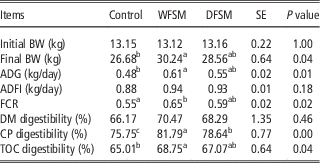
The results of this study revealed no significant differences in DM digestibility among the three treatments (P>0.05). However, WFSM supplementation increased CP and TOC digestibility (P<0.05), whereas DFSM supplementation increased only CP digestibility (P<0.05) relative to the control (Table 1).
Growth performance of piglets

WFSM=wet-fermented soybean meal; DFSM=dry-fermented soybean meal; ADG=average daily gain; ADFI=average daily feed intake; FCR=feed conversion ratio; DM=dry matter; TOC=total organic carbon.
a,bMeans with different superscript letters within a row are significantly different (P<0.05).
Dietary supplementation with WFSM significantly increased ADG and improved the FCR of piglets (P<0.05) but had no effect on ADFI (P>0.05) (Table 1). However, DFSM had no effect on ADG, FCR and ADFI (P>0.05).
Volatile fatty acids concentrations in the intestinal contents
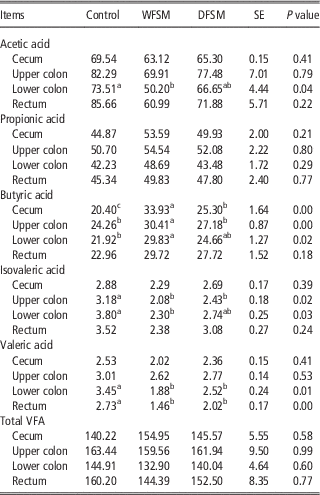
Volatile fatty acids are metabolites of organic matter produced by micro-organisms in the large intestine. No significant differences in acetic, propionic acids and total VFA concentrations were found in the different segments of the large intestine among the three treatments (P>0.05), except for acetic acid in the lower colon, which was the lowest for WFSM supplementation (Table 2).
Volatile fatty acids (VFA) concentrations (mmol/kg) in different segments of the large intestine of piglets

WFSM=wet-fermented soybean meal; DFSM=dry-fermented soybean meal.
a,b,cMeans with different superscript letters within a row are significantly different (P<0.05).
The butyric acid concentration in the WFSM treatment was significantly higher than those in the other two groups (P<0.05). The butyric acid concentration of the WFSM and DFSM groups increased by 38.35% (P<0.05) and 17.10% (P>0.05), respectively, compared with the control group.
The valeric and isovaleric acid concentrations of the WFSM and DFSM were significantly lower than that of the control group (P<0.05). Compared with the control group, the valeric acid concentrations of the WFSM and DFSM groups decreased by 32.00% and 17.58%, whereas the isovaleric acid concentrations decreased by 32.24% and 18.25%, respectively.
16S ribosomal RNA-based taxonomic analysis
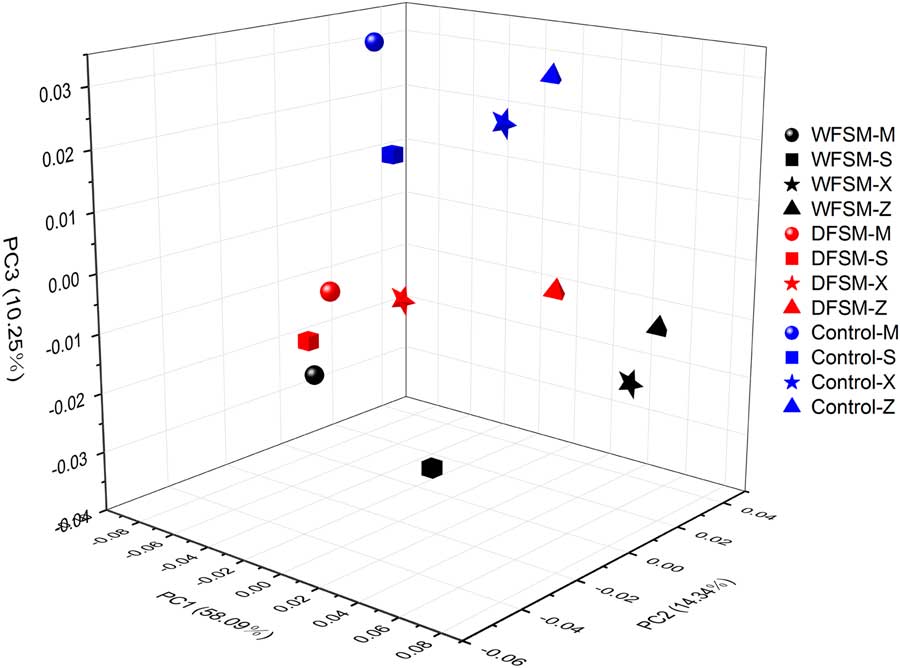
After analyzing the samples with different OTU classification compositions, principal coordinates analysis (PCoA) was performed to compare microbial communities among different groups. Based on the ordination of distance matrix, clear demarcations were observed between both the WFSM and DFSM groups relative to the control (Figure 1), indicating that WFSM and DFSM affected the microbial communities in the large intestines of piglets.
(colour online) Principal coordinates analysis scores plot of all samples. WFSM=wet-fermented soybean meal; DFSM=dry-fermented soybean meal; M=cecum; S=upper colon; X=lower colon; Z=rectum.

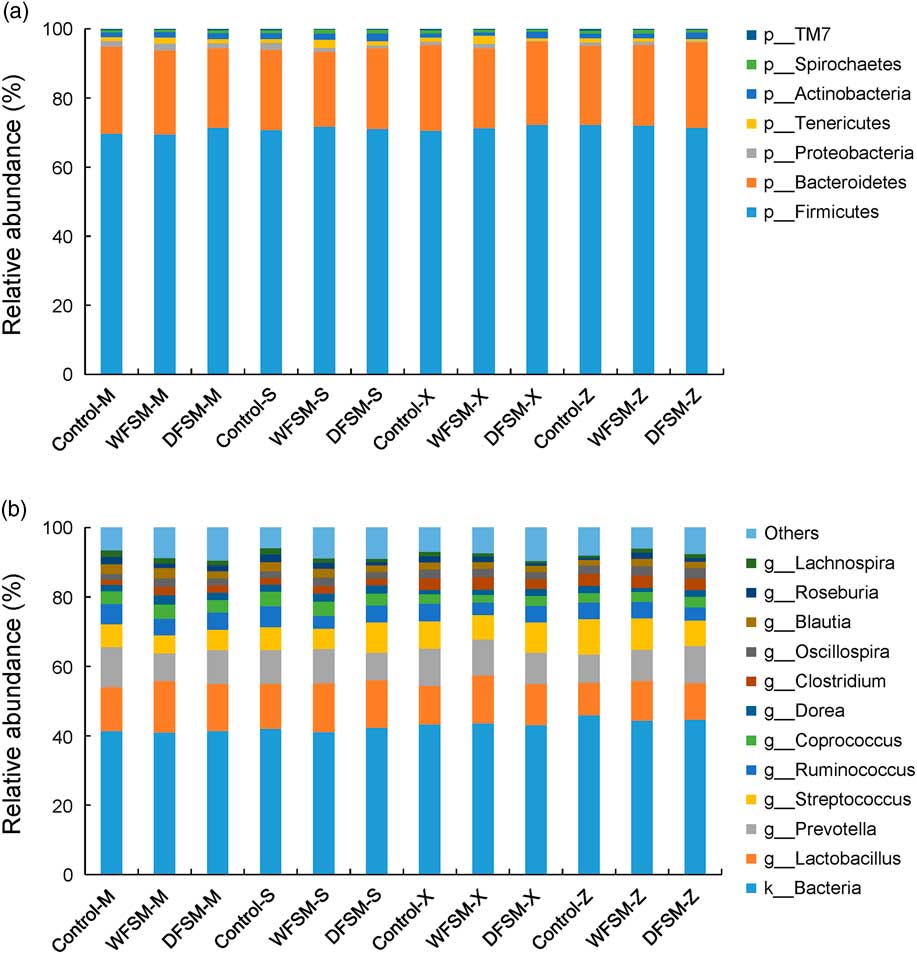
Firmicutes and Bacteroidetes were the most abundant phyla in the large intestine of piglets, regardless of the type of diet received (Figure 2a), and most of these bacteria belong to the genera Lactobacillus, Prevotella and Streptococcus (Figure 2b). The relative abundances of Lactobacillus in each large intestine segment of the WFSM and DFSM groups were higher than those in the control group.
(colour online) Taxonomic profile of bacteria at the phylum (a) and genus (b) levels in the large intestine of piglets. WFSM=wet-fermented soybean meal; DFSM=dry-fermented soybean meal; M=cecum; S=upper colon; X=lower colon; Z=rectum.

Predictive functional profiling of microbial communities
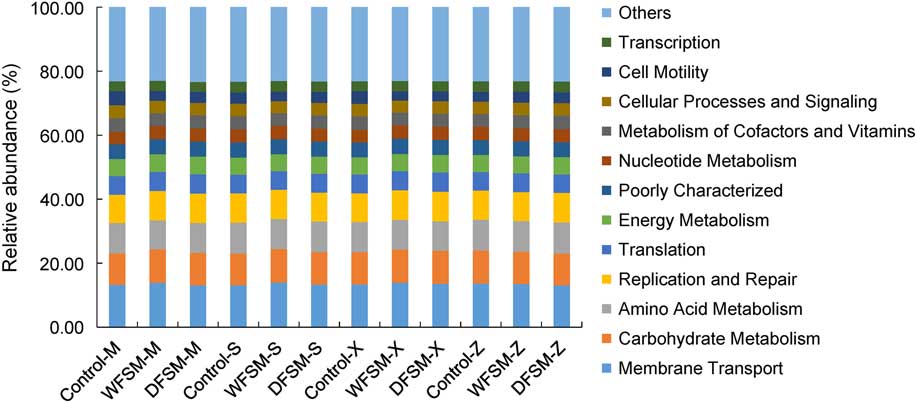
Based on the functionality prediction of the obtained OTU data using the KEGG database, 41 gene function families were observed (Figure 3), most of which are involved in membrane transport.
(colour online) The gene function families in the large intestine of piglets. WFSM=wet-fermented soybean meal; DFSM=dry-fermented soybean meal; M=cecum; S=upper colon; X=lower colon; Z=rectum.

The carbohydrate metabolism function families in the WFSM group (11.95%) did not differ significantly from those identified in the DFSM group (11.86%) (P>0.05). However, the levels of these families, the WFSM and DFSM groups, were significantly higher than that in the control group (11.55%) (P<0.05). Additionally, no significant difference in the amino acid metabolism function families was found among the WFSM (10.74%), DFSM (10.84%) and control groups (10.93%) (P>0.05). Wet-fermented soybean meal and DFSM supplementation increased the carbohydrate metabolism function families by 3.46% and 2.68% and reduced the amino acid metabolism function families by 1.74% and 0.82%, respectively. These findings were consistent with the results obtained for the concentrations of valeric, isovaleric and butyric acids.
Metabonomic analysis
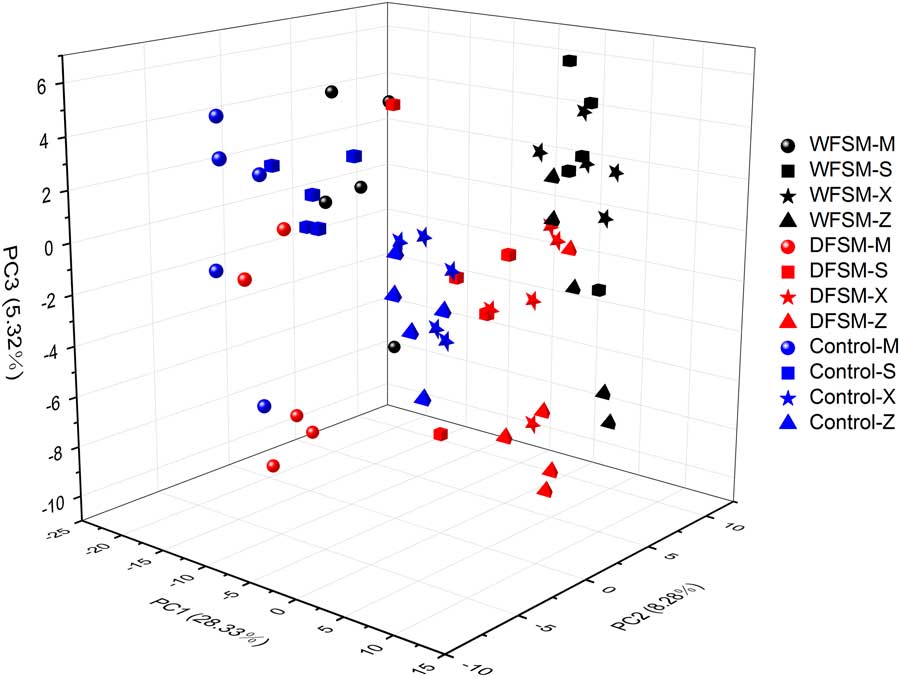
Principal component analysis (PCA) modeling was applied for sample analysis, and six principal components were obtained with acumulative R 2 X=0.53. Based on the overall PCA three-dimensional score plot (Figure 4), the scores of cecum metabolites were grouped away from those in the upper and lower colon and rectum for all treatment groups. A similar pattern was observed in the microbial diversity PCoA plots. In contrast, a degree of separation was found among the three treatments in each part of the intestine, indicating that a metabolite’s production could be affected by both WFSM and DFSM in the upper colon, lower colon and rectum but not in the cecum of piglets. Among these three groups, the effects on metabolite production were mainly attributable to the existence of different microflora in different parts of the large intestine of piglets (Davila et al., Reference Davila, Blachier, Gotteland, Andriamihaja, Benetti, Sanz and Tomé2013).
(colour online) Principal component analysis score plot of all samples. WFSM=wet-fermented soybean meal; DFSM=dry-fermented soybean meal; M=cecum; S=upper colon; X=lower colon; Z=rectum.

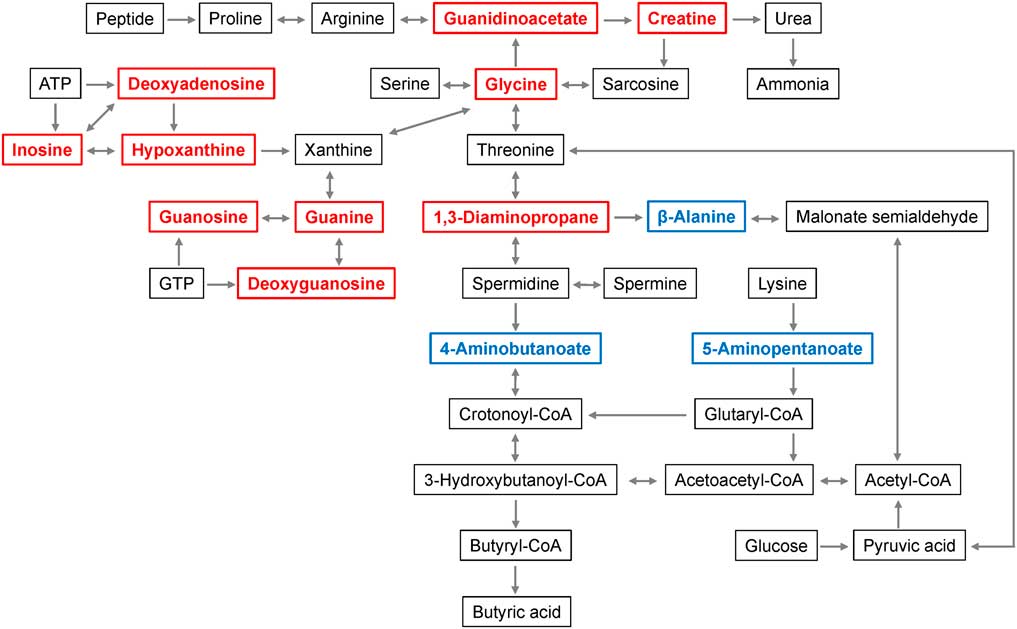
The OPLS-DA model, which was established using multivariate data analysis, was used to excavate and identify a total of 135 significant discriminant metabolites (P<0.05) (Supplementary Table S2). Combined with metabolic pathway tracing, these results obtained using this model revealed that WFSM and DFSM increased the levels of carbohydrate-related metabolites, such as 4-aminobutanoate, 5-aminopentanoate, lactic acid, mannitol, threitol and β-alanine, while decreasing the levels of those related to protein catabolism, such as 1,3-diaminopropane, creatine, glycine and inosine.
Discussion
Growth performance
Fermentation has been reported to reduce anti-nutritional factors, such as protease inhibitors, and enhance the contents of free amino acids and small peptides in soybean meal (Seo and Cho, Reference Seo and Cho2016; Zhang et al., Reference Zhang, Yu, Lu, Wang, Liang, Tufarelli, Laudadio and Liao2016). Therefore, the digestibility of the feed should be improved by supplementation with WFSM or DFSM (Jeong et al., Reference Jeong, Park, Lee and Kim2016). The higher CP and TOC digestibility found with inclusion of WFSM in this study is in agreement with published results (Yan et al., Reference Yan, Wang and Kim2012; Lee et al., Reference Lee, Ingale, Kim, Kim, Lokhande, Kim, Kwon, Kim and Chae2014). Indeed, drying has been shown to significantly reduce the beneficial live bacteria in the fermented product (DFSM) and, thereby, reduce the digestibility of the amino acids (González et al., Reference González, Kim, Htoo, Lemme and Stein2011).
As mentioned previously, the net inclusions of WFSM and DFSM were the same (5% DM basis in the diet), thus, the improvements in ADG and FCR in the piglets fed WFSM are partly attributable to the enhanced nutrient digestibility, which resulted in higher digestible nutrient intake. The improvement in ADG associated with WFSM supplementation in this study was higher than earlier studies in which similar FSM supplementation rates (i.e. from 6.27% to 13.64%) were used in pigs (Wang et al., Reference Wang, Liu, Wang, Li, Piao and Lu2014 and Reference Wang, Fan, Chang and Lu2016). As different micro-organisms play different roles in soybean meal fermentation (Teng et al., Reference Teng, Gao, Yang, Liu, Tian and Wang2012), the higher improvement in ADG found here could be ascribed to the appropriate selection of the types and proportions of the micro-organisms used in this study.
Volatile fatty acids concentrations in the intestinal contents
The fermentation of soybean meal produced mannan oligosaccharides (0.51 mg/g) and β-glucan (5.08 mg/g) by micro-organisms (mainly S. cerevisiae). Most of these two oligosaccharides (88.44% and 79.27%, respectively) are expected to remain intact after passing through the stomach and small intestine and could thus be used by micro-organisms to produce butyric acid in the large intestine (Metzler et al., Reference Metzler, Zijlstra, Mosenthin and Gänzle2011; Zhou et al., Reference Zhou, Kong, Lian, Blachier, Geng and Yin2014). Butyric acid is mainly produced in the cecum and colon and positively affects growth, digestibility and feed efficiency through the modulation of cell proliferation (Guilloteau et al., Reference Guilloteau, Martin, Eeckhaut, Ducatelle, Zabielski and Immerseel2010), optimization of the structure of microbial communities (Abdel, Reference Abdel2012) and reduction of inflammatory responses (Singh et al., Reference Singh, Gurav, Sivaprakasam, Brady, Padia, Shi, Thangaraju, Prasad, Manicassamy, Munn, Lee, Offermanns and Ganapathy2014).
Unlike butyric acid, valeric and isovaleric acids originate exclusively from the breakdown of proteins and not produced from carbohydrates (Le et al., Reference Le, Aarnink, Ogink, Becker and Verstegen2005; Davila et al., Reference Davila, Blachier, Gotteland, Andriamihaja, Benetti, Sanz and Tomé2013). Therefore, our results suggest that the undigested protein in the large intestine may have been converted to a carbohydrate-related bacterial protein rather than undergoing decomposition in the WFSM and DFSM groups.
16S ribosomal RNA-based taxonomic analysis
The guts of animals are inhabited by diverse communities of microbiota, mostly bacteria, which contribute to the diverse processes that occur within the GIT. The bacterial community structure of the large intestine is a plastic factor that responds to diet and environmental changes (Tao et al., Reference Tao, Xu and Wan2015). The rapid development of sequencing technologies has led to the growth of research on the bacterial community structure through the use of the 16S rRNA gene sequencing method (Kraler et al., Reference Kraler, Ghanbari, Domig, Schedle and Kneifel2016).
Fermented soybean meal is a good source of oligosaccharides, such as mannan and β-glucan. These oligosaccharides can be fermented by beneficial bacteria, such as Lactobacillus, thereby improving the colonization of beneficial bacteria and improving intestinal health (Metzler et al., Reference Metzler, Zijlstra, Mosenthin and Gänzle2011). As shown in this study, the relative abundance of Lactobacillus was the highest in WFSM group (13.53%), followed by the DFSM group (12.40%) and the control group (11.44%).
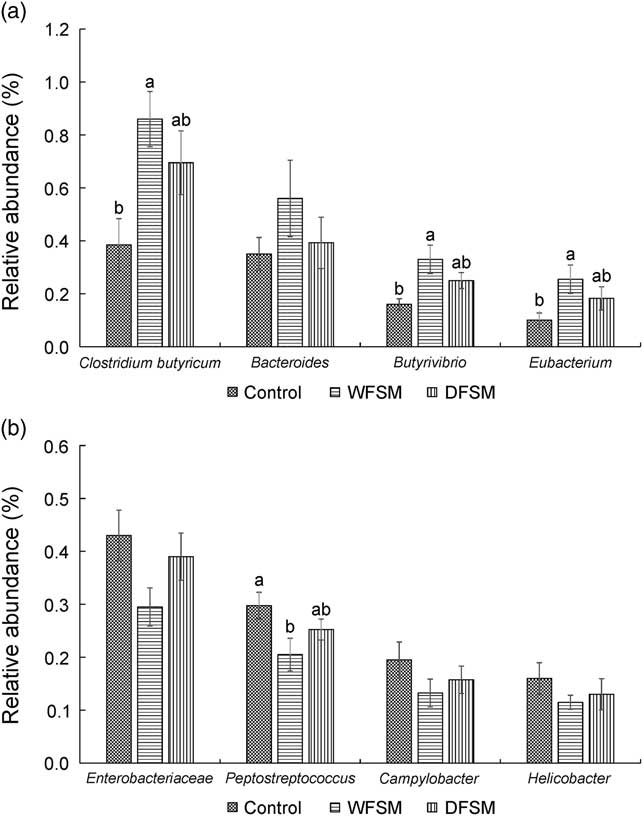
Four types of butyrate-producing bacteria (i.e. Clostridium butyricum, Bacteroides, Butyrivibrio and Eubacterium) previously reported (Duncan et al., Reference Duncan, Louis and Flint2004; Zocco et al., Reference Zocco, Ainora, Gasbarrini and Gasbarrini2007; Foditsch et al., Reference Foditsch, Santos, Teixeira, Pereira, Dias and Gaeta2014) were found in all samples, and their levels were the highest in the WFSM group, followed by the DFSM group and, finally, the control group (Figure 5a). These results are consistent with those obtained for the butyric acid concentration. The fermentation of oligosaccharides by butyrate-producing bacteria yields butyrate, an important short-chain fatty acid that has been documented to maintain intestinal health by reinforcing the epithelial defense barrier or modulating visceral sensitivity and intestinal motility (Metzler et al., Reference Metzler, Zijlstra, Mosenthin and Gänzle2011; Zhou et al., Reference Zhou, Kong, Lian, Blachier, Geng and Yin2014).
Relative abundances of butyrate-producing bacteria (a) and amino acid-fermenting bacteria (b) in the large intestine of piglets.a,bMeans with different letters within columns are significantly different (P<0.05). WFSM=wet-fermented soybean meal; DFSM=dry-fermented soybean meal.

Four types of amino acid-fermenting bacteria, namely Enterobacteriaceae, Peptostreptococcus, Campylobacter and Helicobacter (Velayudhan et al., Reference Velayudhan, Jones, Barrow and Kelly2004; Dai et al., Reference Dai, Wu and Zhu2011; Davila et al., Reference Davila, Blachier, Gotteland, Andriamihaja, Benetti, Sanz and Tomé2013; Ricci et al., Reference Ricci, Giannouli, Romano and Zarrilli2014) were found in all samples. These amino acid-fermenting bacteria were most abundant in the control group, followed by the DFSM group and, finally, the WFSM group (Figure 5b). The above results suggest that lower amino acid contents are present in the large intestine in piglets of the WFSM and DFSM groups, because these two diets had higher CP digestibility than the control diet (Table 1).
Metabonomic analysis
Metabolomics is an important component of systems biology in which the physiological states are identified and the relationship between the various animal metabolisms analyzed by multivariate statistical analysis. This approach has been applied to intestinal microflora metabolism research in recent years (Arias et al., Reference Arias, Chevallier, Graham, Gasull, Fodey, Cooper, Crooks, Danaher and Elliott2016).
According to the KEGG pathway database, the discriminant metabolites include those related to carbohydrates and proteins and could be combined with metabolic pathway tracing to analyze the relationship among variations and, thereby, elucidate the effects of WFSM and DFSM on carbon and nitrogen metabolism (Figure 6). We observed that WFSM and DFSM could reduce metabolites of protein (the upper corner of Figure 6) and increase metabolites of carbohydrate in the large intestine of piglets (the lower corner of Figure 6), and that WFSM was more effective than DFSM because less creatine and more β-alanine accumulated in the WFSM group than in the DFSM group.
(color online) Carbon and nitrogen metabolism in the large intestine of piglets. Red indicates a decrease, and blue indicates an increase in metabolites (KEGG pathway online database: http://www.genome.jp/kegg/pathway.html).

Conclusions
To the best of our knowledge, this is the first study examining the relationship between carbon and nitrogen metabolism in the large intestine of piglets fed diets supplemented with WFSM and DFSM. In accordance with our initial working hypothesis, the present study shows that FSM exert numerous beneficial effects on the ecosystem in the large intestine, leading to improvements in the growth performance of piglets. Fermented soybean meal supplementation altered the compositions of metabolites and microbiota in the large intestine and exerted beneficial effects, with WFSM being more effective than DFSM. Whether these effects on the large intestine contents influence ammonia production of the excreted feces remains to be elucidated.
Acknowledgment
None.
Declaration of interest
None.
Ethics statement
None.
Software and data repository resources
None.
Supplementary material
To view supplementary material for this article, please visit https://doi.org/10.1017/S1751731118000058